QUOTE(cloudstrife07 @ Nov 11 2007, 09:25 PM)
still noob in this so i wanna ask:
for the S-flow piping and straight flow, S is where got bengkok2 abit while straight is like straight from extractor right?
s-flow or original route piping

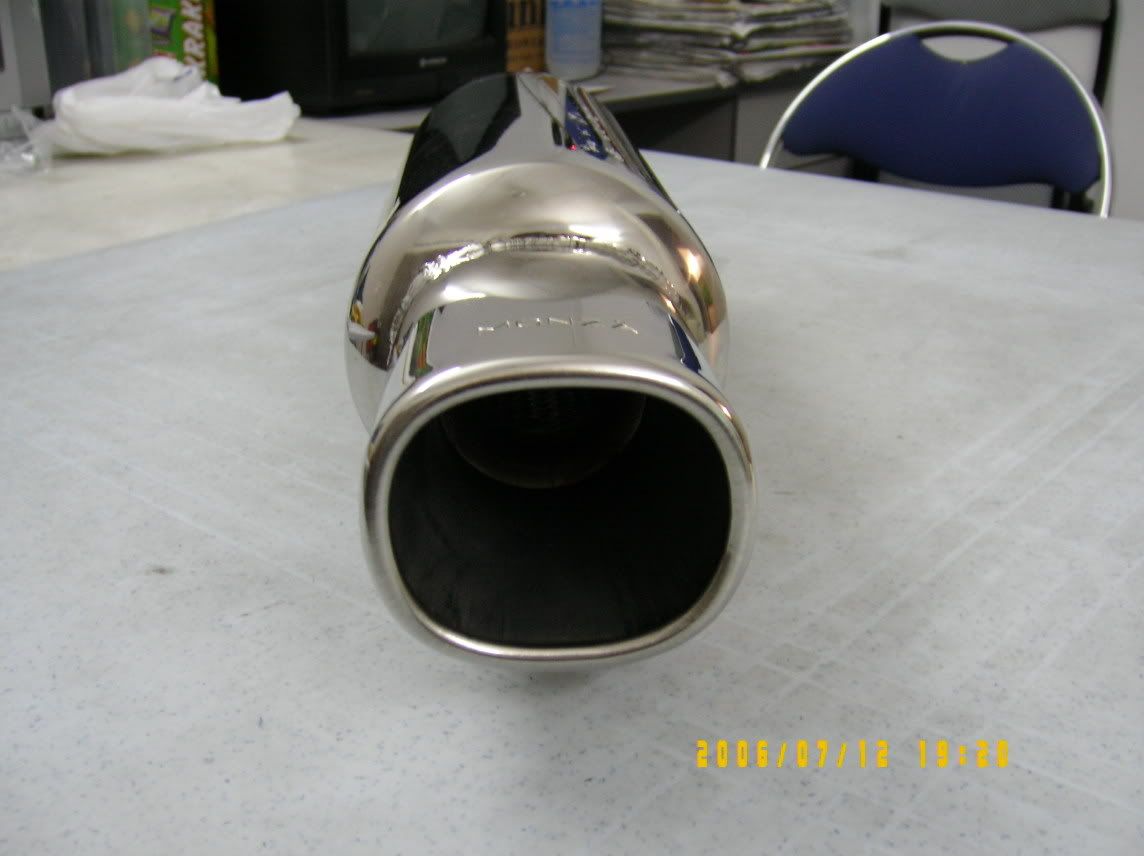
straight flow muffler

s-flow muffler

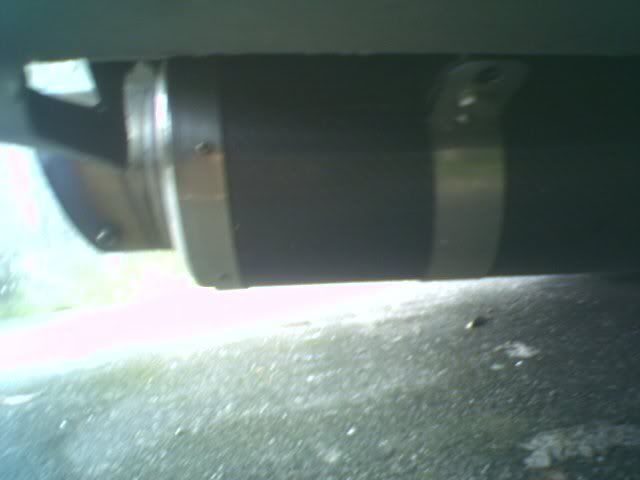
somehow couldnt find any straight flow piping lah... but if u see the car muffler facing this way, usually it is straight flow...

QUOTE(singchaii @ Nov 11 2007, 10:50 PM)
You so hope your engine die?

Use 1st gear tarik till 140km/h and always go redline. Confirm die soon. hehe.
i mean die as in die naturally lah... no kill it on purpose..
QUOTE(cloudstrife07 @ Nov 11 2007, 10:55 PM)
waa thx guys for providing so much info for me.seriously, last year i wasn't interested at all about car parts.all i know is Mitsu evo, subaru impreza, turbo, supercharger that's all.how those thing works i wouldn't want to know as it seems kinda complicated.so just drive only la.
fuhyoo... u used to drive evo, impreza, turbo and supercharged cars arr??...

why downgrade to saga??...
QUOTE(cloudstrife07 @ Nov 12 2007, 12:14 AM)
btw guys, what causes "backpressure" in 4-2-1 setup with S-flow?
copy n paste article from sioc...
» Click to show Spoiler - click again to hide... «
EXHAUST TUNING
Getting your exhaust system right
by Adian Yein Khalid (Team Matrix)
I might sound show-off-ish by saying this, but a lot of what you hear from our local mechanics is crap. Serious. There is no such thing as an engine requiring a bit of backpressure to make the most power, and certainly no such thing as an Automatic car having different needs to a Manual car. Often, you should use your own deductions and logic when they mention techniques that sound dubious and illogical. Generally I can assume that we are fairly educated individuals, and therefore expect that you should be able to assimilate the arguments that I bring forth from time to time on car modifications.
Gaining more power
An engine is an engine is an engine, and to gain more power you need it to breathe better and get rid of exhaust gases faster (these increase volumetric efficiency), or make the engine more efficient (lessen internal friction etc.). One can also try and minimise release of thermal energy (heat) but to do so would require severe engineering skills.
A simple example: Stuff a pillow over your mouth and nose and try breathing, in and out. This is similar to what the engine experiences on both its intake (restrictive air filter) and exhaust (restrictive exhaust system). We use straight-flow mufflers and large diameter pipes in order to make the path of the exhaust gases as easy to navigate to freedom as possible, and we use airfilters with better flow to allow more air into the engine.
The very first belief that must be redefined is the "a bit of backpressure is good for the engine" mythology.
Backpressure
What is backpressure?
Pressure can exist in two forms, positive and negative. In it's negative state, we usually call it a vacuum although a vacuum is technically a state of no atmosphere at all. Anyway, for this concept to be understood, we need to think of air (exhaust gases) as a moving object with mass. You see, just like water, a fixed volume of gas moving through a pipe of smaller diameter will have a higher velocity than the same volume of gas moving through a pipe with a larger diameter. Why this is important to exhaust tuners is because of a thing called inertia. Moving objects tend to stay in motion. Therefore, if exhaust gasses are moving at high speeds out of the exhaust pipe, they will tend to keep moving out. If they are moving fast enough (higher velocity), the inertia can be enough to create a negative pressure in the exhaust pipe. This is back pressure. Contrary to popular belief, back pressure is not a positive pressure in the exhaust system, it's a negative pressure.
Positive backpressure on the other hand is a build-up of gases and pressure that are trying to escape the tight confines of the exhaust pipe. Backpressure means that some of the engine's energy is taken-up just having to "push" these exhaust gases out of the combustion chamber during the exhaust cycle of the 4-stroke internal combustion cycle.
Your next argument will be, if we want the gases to exit the system as fast as possible then why use silencers and pipes at all? Well, simply because an open exhaust would be too bloody noisy, and because there are some beneficial effects that the pipe itself contributes via "shockwave tuning", which is an argument in itself.
Shockwave tuning
Exhaust shockwave tuning, as it is called, only really really makes sense when you run without mufflers and silencers. At the bare minimum, use only a single straight-thru muffler of identical diameter to the existing pipe. The soundwave sees any sudden increase in atmospheric area as a "shock", hence the name, and what happens then is that some of the sound wave then bounces back along the pipe and back into the combustion chamber. An easy assumption to shockwave tuning would be: the shorter the pipe length (or placement of the silencer closer to the engine) relates to a sound wave that take less time to travel down the pipe and back up again. Therefore, generally, you'll get your shockwave tuning HP boost higher up the rev range, as the engine has shorter time intervals between each combustion (ignition), and the fast returning exhaust gases will be able to help "extract" some of the outgoing exhaust and pull-in the incoming air-fuel charge.
This is the real reason why our race cars run what we call "straight-flow" pipes. However, in our road cars we can see these gains slightly by good placement of the centre muffler. Which is why you should pay close attention to where the manufacturer places the first muffler (or "expansion chamber", as it literally that without any glass-fibre sound-deadening). Remember, the manufacturer has spend millions testing this stuff!
Shockwave tuning only works for a particular RPM band and that's it. Why? Basically, for a given pipe length, the time it will take the shockwave to travel back up the pipe is the same everytime. Therefore, the exact moment when it returns to the combustion chamber to help gas extraction and charge inhalation will be only equal to a certain duration and timing of the exhaust valves and intake valve overlap at an exact point in time, and no other.
F1 and SuperBikes are different. Why? They rev much higher than our cars do, and the characteristics of their exhaust shockwave a very different to our road engines. My old ZX6R-F2 pulled to 14500rpm. Crazy! And guess what, it ran 4-1 headers. Why? Numerous tests (I think even Dave Walker once tried) have shown that 4-1 headers work for powerbands above 6000rpm, and their effect isn't just like 2 or 3 HP in a 200 HP engine with race cams and the works, but more like 15-20HP, often with some HP loss at the bottom-end. So, for race cars and engines that rev their bollocks off, 4-1 works. But what I am trying to demonstrate here is the great difference exhaust length, shockwave tuning, and manifold design has based on different specifications and requirements of an engine.
Exhaust pipe lengths and diameters.
The next argument you will ask is "If you dont want back-pressure at all then why do we bother with pipe diameters and lengths and muffler placement? Why don't I simply out a 5 inch truck exhaust pipe from my 1.3 engine that exits at the side of my car? The sooner the bloody exhaust gases exit from my engine the better, right?" Not so simple, but the answer again is.... no prizes for guessing Shockwave Tuning!! In simple terms, too big a pipe and you'll lose the dinky soundwave that your piddly 1.3 engine's combustion eminates. Therefore, pipe diameters and lengths are there to aid extraction.
However, bigger is always better is correct only to a certain extent. Larger pipes means an exhaust system has more capacity for exhaust gases. This capacity acts as a sort of buffer between the cylinder and the muffler. Therefore, a car fitted with a 3" exhaust will be able to scavenge more exhaust than a car with a 2" system simply because it has more volumetric capacity between the cylinder and the muffler. However, a properly tuned exhaust system would be able to create negative pressures in the exhaust system in a defined rpm range and since the exhaust valves are open when exhaust is released, there will also be a slight negative pressure in the cylinder, if this "vacuum" can be maintained until the exhaust valve closes, it will help to suck more mixture into the cylinder when the intake valve opens. As we all know, more mixture means more power. In this case a properly tuned exhaust system will mean more power over a certain range of rpm than just simply installing the biggest diameter pipes you can find.
In headers (manifolds or extractors), steps in a pipe set up several peak torque points for each diameter as the gas velocity reaches its optimum speed for that diameter. A smaller diameter pipe has a lower rpm peak, larger diameter pipe has a higher rpm peak torque. So a series of these steps would broaden the width of a torque curve (not the actual peak torque value), as well as having anti-reversionary properties. Whether this applies to exhaust pipes and in muffler pipes I do not know.
This is the theory, however, from experience, it is close to impossible to find someone who knows how to do the calculations to get the optimum sized pipe for your particular car. So what most people do is try different diameters until they find one that seems to get the most power. After a while, more people know about this optimum diameter from word of mouth etc. This is why for popular cars like the Proton Wira, most exhaust tuners will have a rule of thumb about what size works best. However, since they might not be able to explain the technical reasons for it, they'll put it down to some vague reason like back-pressure.
Some suggestions: 2-1/4" for up to 200HP @ the crank, 2-1/2" for 275HP, 2-3/4" for 320HP, 3 " for > 320HP
Turbo exhausts
Next question you'll ask is "Then why do I need to do all this tuning with my turbo car, when the compressor is right there after the manifold screwing all the soundwave/shockwave tuning up?" True, turbo engines dont need shockwave tuning!
If you notice, before the turbo compressor, the pipe expands a bit and does something funny. Thats as much as you'll get for exhaust technologies of a turbo. The expansion chamber before the turbine if to reduce lag and increase pressure buildup.
A turbine works on the basis of pressure differentials before (high) and after (low) the turbine. And the fact is that atmospheric pressure is the lowest we can hope to achieve. With everything else being equal, it will always be atmospheric pressure at the mouth of the outlet (be it the outlet of the muffler, outlet of the piping, or outlet of the turbine) - depending on how little exhaust piping/muffler you want to run.
Anything after the turbine is simply creating a secondary area of pressure between the turbine and the atmosphere. And by definition, the presure in this secondary area needs to be at least atmospheric pressure or higher. And this pressure becomes higher as the volume of the enclosure becomes smaller, assuming a given output of gas volume from the engine.
So, the theoretical optimal pressure differential for a given volume of exhaust expelled by an engine (thus creating a given pressure before the turbine), would be when the pressure immediately after the turbine is at a minimum i.e. atmospheric pressure.
Thats why, for a turbo car, everyone simply plonks in the largest exhaust that they can get away with. So you boys with all your turbo cars, just make it 5 inch all the way ok! (joking BTW!) Guaranteed to spit flame on the overrun everytime you backoff the accelerator! So as far as turbos are concerned: the bigger the better, and the best being you not have any piping at all!
Conclusion
Another example: If your mechanics claims that automatic gearbox vehicles require a bit of backpressure, let me inform you that the fastest cars in the world use automatic gearboxes with any form of muffling at all, to reduce backpressure to an absolute minimum. And what kind of cars am I talking about?? Why, dragsters of course!!!
My final nail in the coffin: Dragsters you may notice do away with all this piddly shockwave tuning crap and just run 3 ft long pipes directly from the exhaust ports, and these guys literally spit flame when they (as Nas would say) floor the fun peddle. They dont need shockwave tuning, for them the objective is to just get all the exhaust out of the engine as soon as possible. The pipes are there only to redirect the flames so that they dont melt the tyres!
I hope I have been able to show you the light. Don't purchase a S-flow muffler just to "allow a bit of backpressure". They're more expensive, heavier, and they don't work. Always look down the pipe of the silencer that you are going to buy and make sure that the diameter is consistent along the pipe and you can see the light at the end of the tunnel!
conclusion??...
piping size cannot be too big or too small... there is an optimum diameter where each exhaust gas pulse/wave that comes out from the engine must not feel restricted in its airflow, but yet able to create somesort of vacuum effect (in this case is called backpressure) to pull the next exhaust pulse/wave... this pulling effect is what reduces the power needed for the piston to push the exhaust gas out of the combustion chamber... its all about volumetric effienciency...
as for shockwave tuning... i still dont quite get it yet, especially for turbo cars... hmmm... anyone can explain in more layman term??...
This post has been edited by the_catacombs: Nov 12 2007, 02:24 AM 

 Nov 11 2007, 06:58 PM


 Quote
Quote ...
... 



 can someone explain me in layman terms?
 ..every morning have to waste petrol to warm up my engine..
  :
:


 true
true 


 0.0507sec
 0.52
0.52
 7 queries
 GZIP Disabled