Kes NGPV tu dah xle buat apa, kontrak asal dengan PSCND tapi entiti tu dah takde, orang tu enjoy duit rakyat kat UAE sekarang ni
Under 15 to 5 NGPV numbers is back on revival seems Meko legal issue also has bee cleared with the Germany side but since LCS pun tak siap lagi jangan harap la NGPV next batch nak mula
Good example why there shouldbt be offsets^. Otherwise youll get these and Atreyus.
It may not be just 12. Sg typically buys equipment in small batches and it is not known to disclose its military purchases or rather they just dont talk about it and military enthusiasts find out by themselves.
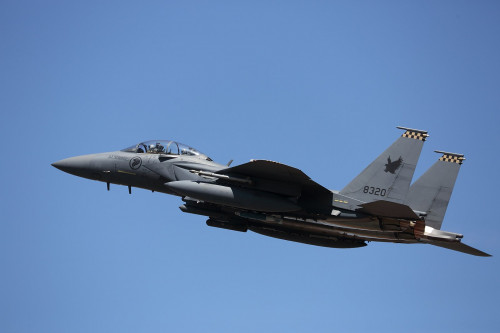
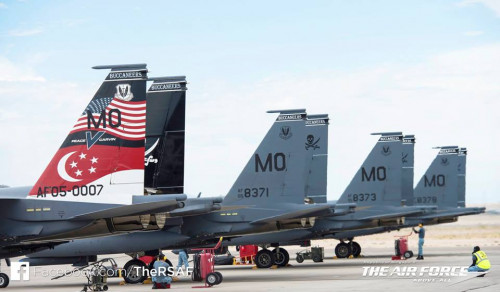
I think they initially bought only 8 f15SGs. Now, it is confirmed that they have at least 40 F15SGs (Boeing gave civilian production numbers to some of them prior to transfer to RSAF - likely because Sg want it that way). But keen observers note that F15Sg serial numbers 8373 and 8378 have been sighted i.e. the ostensible 73rd and 78th F15SGs. My guess is that they have bought 80 F15SGs in total over the years.
RSAF F15SG based in SG^
RSAF F15Sg attached to CONUS@Mountain Home.^
It does add up considering the F15Sgs replaced some (if not all) of the 60+ Super Skyhawks and 49-50 F 5 S/Ts. The remainder will be replaced by F35s which will also replace the F16Vs.
On how many F35s they want, see what they (SG) told the F35 programme office - up to 100 F35s:
Pretty much doubt it. Doesn't seem anyone is replace their F15 with F35.
Thats not what i wrote. The F15Sgs replaced some or all of the Super Skyhawks and F5 S/Ts see my post.
The RSAF also bought 6 MRTTs (so far) to replace 4 KC 135Rs. Connect the dots...more and bigger tankers because of more air frames (now and/or in the future).
This post has been edited by Mai189: Dec 13 2021, 05:30 PM
It seems they maintain more or less around 100 jet. So i doubt they eventually bought 100 f35 Most country are currently reducing it's f35 committed number Probably around 60 only while the F15 would be replaced by another air superiority platforms?
Likely 80 F15Sg + > 80 F35A/Bs by early 2030s.
They were operating 60+ Super Skyhawks (last Skyhawk retired in 2005) + 49-50 F5 S/Ts (retired in 2016) + 70 F16s before they started retiring the older air frames from 2000.
RSAF is in transition.
Sgs style is to upgrade and then replace. So I would expect the F15SGs to be upgraded to maybe EX standard. It is not a major upgrade as the F15SG is already a 4.5 gen jet equipped with AESA and some of the latest EW systems.
But yes, the F15Sg will be replaced eventually.
This post has been edited by Mai189: Dec 13 2021, 06:34 PM
I though they only bought 4 F35? With 8 more as options Most Probably because their original f16 (that they already sold to Thailand) already reach end of service live
They themselves said they only start buying f35 in numbers starting in 2030s as f16 replacement.
So 60 F35 in the early 2030 seem a bit far fetched don't you think?
With plan for 4 JMMS i doubt they even get the F35A though. Most likely an all fleet of F35B?
Many f35 purchasers buy an initial small lot before commiting to a bigger purchase. In Sgs case, they do in fact buy in batches - likely a policy decision to make defence purchases palatable to neighbours. Anyway, it works if the goods arrive in the time frame they want. More F35s will be built in the coming years than typhoons + rafales + suks + migs combined. Not a prob for Sg to get say 80 to 100 F35s by early 2030s. Note: they will retire the F16Vs by that period.
My sense is that they will follow Japan i.e. buy a mix of As and Bs. They do not need to test the As - they can get inputs from Israel and Australia. But their only reference point for Bs is the US marines so thats why they bought the 12 f35bs initially.
This post has been edited by Mai189: Dec 13 2021, 07:02 PM
LoL palating the neighbors konon. Obviously it's got more to do with the oldest F16 SG has in stock is only 20 years old. That's why they say they would bought more begining by 2030s.
Im trying to explain to you that they buy stuffs in batches and offered a plausible explanation.
They renew and replace their equipment as needed. They do have the $$$$ 2 do that.
The F35s will be bought in batches and introduced in batches from 2026 onwards. The F16Vs meanwhile will be drawn down in early 2030s. Thats the plan.
This post has been edited by Mai189: Dec 14 2021, 09:18 AM
Their F16 still young & the F35 still a turt at this point In time thus haven't enter mass production stage yet. Why would they do the silly thing and ordered the turt version, when the good one is around the corner.
And why would they even want 100 f35 when other country even US are reducing their commited purchase while NGAD is around the corner. Not mentioning the proliferation of loyal wingman type things.
Also geopolitical wise SG are scared of her 2 immediate neighbors & thus why they seek US protection. Changing circumstances create a situation where relationship with her 2 neighbors are more of an interest to US. And US want to fight her number 1 customer. The fallout in HK create a situation of trading with PRC shifting to SG, making SG heavily dependent on PRC trade.
So i say what likely happen is SG to excellerate diversification away from US weaponry.
I dont know what youre going on abt. Their F16s, upgraded to F16vs, are at the end of their lifespan. And no; many countries buying more f35s 2 like israel and australia. As far as i know, Sg has no mutual defence treaty with anyone!. FPDA is consultative. Not going to bother abt ur other fantasy on trade.
Said the guy who sendiri shiok fantasizing of 100 f35 by Early 2030s and sinkie throwing away f16 after just 20 years of operation.
Literally thinking money do grows on trees 😂 Anyway with AUKUS the Aussie are literally at the front of the line for the NGAD. So i doubt they would bought the F35 for the growlers & super hornet replacement. Everyone else are busy with their 6th gen program.
And yes, SG has no defense treaty with anyone, they think their neighbors are the enemies & refuse US 'instruction' basically milk the US during good times and abandoned them when they needed a favor. With that kind of behavior off course you won't get any allies.
Oh bummer! Now I remember you! Too many crazies here.
Btw, your math fail. By the time the RSAF F16s are retired, many will be reaching 30 years of operation. They bought F16s in batches and delivered* from 1994 to 2004.
Who are the heck are - everyone else are busy with their 6th gen planes. Apart from the US, the rest are struggling to even fund 5th gen planes.
This post has been edited by Mai189: Dec 14 2021, 06:20 PM
Singapore's defence budget expected to hit $18.57 billion (between USD $13.7 to 14 billion) in 2026
A new report has said that Singapore is expected to spend $18.57 billion on defence by 2026, up from $15.23 billion in 2021.
The spending will be driven by factors as diverse as terrorism threats to sustaining its large overseas military training presence such as those in Australia.
This represents an expected Compound Annual Growth Rate (CAGR) of 4.6 per cent, up from its current figure of 2.58 per cent, according to the report published by London-based data analytics and consulting firm GlobalData.
The report also “offers detailed analysis of Singapore defense market with market size forecasts covering the next five years”, and analyzes factors that influence demand for the industry, key market trends, and challenges faced by industry participants.
Located at the southern tip of the Malay peninsula, Singapore is strategically located at a vital maritime chokepoint that is traversed by a significant amount of the world’s seaborne trade.
The prosperous island nation, with a population just short of 6 million people, is highly dependent on the maritime trade which uses its port as a transhipment point, however it has almost no strategic depth to speak of, measuring just under 300 square kilometres in size with its widest point being less than 50 kilometres from one end to the other.
Key acquisition programs currently being undertaken by the southeast Asian island nation include the Lockheed-Martin F35B Lightning II Joint Strike Fighter, indigenous ST Engineering Land Systems Hunter Next-Generation AFV, and the Invincible-class Submarine (Type 218SG) diesel-electric attack submarines being built by Germany’s ThyssenKrupp Marine Systems (TKMS).
Singapore is also introducing the European MBDA Aster 30 ground-based air defence system into service, integrated into its bespoke integrated Island Air Defence System (IADS). It is also introducing the Boeing CH-47F Chinook and Airbus H225M transport helicopters into service, replacing earlier versions of both types (CH-47D/SD Chinook and AS332M/M-1 Super Pumas) in the Republic of Singapore Air Force.
In addition, Singapore also has other acquisition projects in the pipeline. It will seek new Joint Multi-Mission Ships (JMMS) to complement and/or replace its four Endurance class Landing Platform Docks. This is likely to be a through deck ship, with Singapore having previously said it will require the JMMS to operate more helicopters and possess improved air traffic control capabilities compared to the Endurance-class.
Singapore’s navy is also seeking a new Multi-Role Combat Vessel (MRCV) to replace its six 62m Victory-class missile corvettes. These will be larger vessels than their predecessors, and in addition to being armed with anti-ship and anti-aircraft missiles, are envisaged to act as motherships to a host of unmanned surface, underwater, and aerial vehicles and able to fulfill a variety of mission sets.
The JMMS and MRCVs are almost certainly to be built in Singapore by local defence contractor ST Engineering Marine Systems although substantial input from foreign contractors to assist in the design of vital subsystems is likely to be required. A recent example are eight Littoral Mission Vessels (LMV) currently being commissioned into the Republic of Singapore Navy, with Saab having a hand in the design of the integrated bridge and mast.
Singapore’s army is also seeking a wheeled 155mm self-propelled howitzer to replace the last towed howitzers in its inventory, and will complement the Primus tracked howitzers, rapid firing self-propelled 120mm mortars and HIMARS guided artillery rockets. Like the two former systems, the new wheeled howitzer will also likely be a homegrown design by ST Engineering’s Land Systems division.
Other likely acquisitions will be replacements for the Republic of Singapore Air Force’s fleet of ten Lockheed-Martin C-130B/H Hercules transports and nine Fokker 50 light transports and Enforcer 2 Maritime Patrol Aircraft. The oldest of the C-130 fleet has gone past six decades in service with the older B models limited to local training missions, although Singapore has not publicised an intention to replace these.
An increasingly complex regional defence picture is also driving many of Singapore’s defence acquisitions, with conventional arms and defence Research and Development (R&D) featuring prominently in its defence budget.
It’s Defence Science and Technology Agency is investing in research in bespoke areas that suit Singapore’s unique environment. This includes emphasis on unmanned systems and reduced crewing requirements, with Singapore being the first customer and assisting in the testing and certification for Automatic Air-to-Air Refuelling in the Airbus A330 Multi-Role Tanker Transport (MRTT), which among other things, reduces the aerial refuelling officers’ cognitive workload.
It has also worked with Airbus to develop a unique boom control law for the MRTT unique for the Boeing F-15 Eagle, and has developed a command and control information system that uses Artificial Intelligence to assist in determining priority for time-sensitive targets in cluttered urban environment and can determine how best to engage a target to ensure a better success rate with lower risk of civilian casualties.
Mai's note: Nothing new here. Covid may have slowed the budget growth a bit. But it is clear Sg's defence budget will reach $ USD15 billion by end 2020s. Also, we need to note that Sg doesnt borrow 2 spend. And yet make surpluses or have balanced budgets most of the time so they can sustain the military budget indefinitely.
This post has been edited by Mai189: Dec 14 2021, 07:04 PM
Anyway I doubt you are even a Sinki. Aren't sinki supposed to be smart or something?
.
Actually, I have never wrote that the F16Vs (tail serial numbers indicate that they have bought about 90-100 F16s - see my previous post which corresponds with how many F35s they want i.e. up to 100. Also see tail numbers for F15SGs...now at 70-80 aircrafts) are going to be retired as soon as they are upgraded. I said that they will be withdrawn in the early 2030s (Sg's Menhan actually said 2030). This will be the time when the last of the purchased F35s reach IOC.
It is 2021-22 now. 2030 is some 9 to 10 years down the road. That is why I said that there is something wrong with you.
As for Sg's growth rate, a developed economy should not grow so much - 2% to 3% is fine. But fyi, SG will grow >7% this year and about >5% next year:
But what is more important than basic comparison of GDP or GDP per cap is basically money and surpluses. SG simply has the money to sustain and increase its defence budget because it is making money and has tons of it.
Hmm..not sure this was posted...cant follow much on defence matters everytime i need to focus on my projects but ive got some lul period since it is Dec.
Estonia buys Singapore-Israel Blue Spear 5th gen anti-ship/land attack missile.
Oct 11, 2021,08:00am EDT|27,163 views Estonia Is About To Aim Missiles At A Key Russian Weakness
The Estonian military is buying a 200-mile-range anti-ship cruise missile.
For almost any other country, the Oct. 6 deal between the Estonian Center for Defense Investment and Proteus Advanced Systems—a joint venture of Israel Aerospace Industries and ST Engineering Land Systems—might not be a big deal.
But the Blue Spear missile that Estonia is buying from Proteus is Estonia’s first anti-ship missile. And anti-ship missile in Estonian hands has unique potential to cause very, very big problems from Russia.
“The chosen weapon system will form the cornerstone of Estonian naval defense for decades to come,” said Jüri Saska, commander of the tiny Estonian navy, which has just 300 sailors and six small, very lightly armed vessels. “Estonian navy will be able to contribute significantly both to national, regional and collective defense effort.”
He’s not kidding.
Blue Spear is the latest version of Israel’s Gabriel missile. The roughly 20-foot-long, truck-launched missile has different flight modes. It can fly low. Or it can fly really low. It packs a warhead weighing several hundred pounds and an active radar seeker for maximum accuracy. Navigation is inertial, meaning it’s impossible to jam.
Some of the farther-flying Gabriels can travel more than 300 miles, presumably while cruising at higher altitude. As a sea-skimmer, Blue Spear is less fuel-efficient. So its range is less than 200 miles (321 km).
But in the crowded waters of the Baltic Sea, 200 miles is a long way. That’s especially true for Estonia. A Blue Spear missile launching from Estonia can range across the entire Gulf of Finland, that branch of the Baltic that connects the Russian port of St. Petersburg to Kaliningrad, Russia’s coastal exclave lying between Poland and Lithuania.
Kaliningrad is a weird holdover from World War II. Once German, it became Russian—and today it’s Moscow’s main Baltic outpost. The 86-square-mile territory, population 400,000, bristles with weaponry.
Kaliningrad gives Russia a toehold in the Baltic from where air, sea and land forces can threaten NATO’s weakest members Lativa, Lithuania and ... Estonia.
But Kaliningrad’s position is a strength and a weakness. Yes, the exclave is a Russian base inside NATO’s borders. But that means that, in times of tension, NATO governments easily could stop trucks, trains and planes from resupplying Kaliningrad.
Indeed, that already happened—a decade ago. In response, Moscow opened a new sea trade route between St. Petersburg and Kaliningrad. It’s a safe bet that, in wartime, the exclave would depend on frequent supply convoys.
NATO already has significant naval forces in the Baltic. But none of them belong to Estonia or, for that matter, any of the alliance’s other Baltic states. Estonia’s single minelayer and three minehunters, none displacing more than 500 tons, are defensive vessels. It’s their job to keep Estonia’s own ports open for trade.
Truck-fired anti-ship missiles certainly possess a defensive capability. Especially if the threat is, say, a Russian amphibious force. But the same missiles are offensive, too. Estonia’s new missiles, ranging across one of the most important maritime chokepoints in Europe, could help to sever the flow of food, fuel and reinforcements from mainland Russia to Kaliningrad.
Now consider this: Blue Spear isn’t just an anti-ship missile. It like many ASMs also has a latent land-attack capability. And St. Petersburg lies just 90 miles from the Estonian border.
It’s unclear how many Blue Spears Estonia is buying. Each missile apparently costs around $5 million.
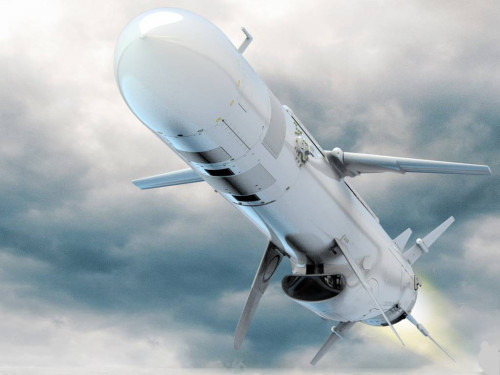
Blue Spear and Sea Serpent missile systems In 2020, Israel's IAI and Singapore's ST Engineering started a 50/50 joint venture company called Proteus Advanced Systems to develop, produce and market a derivative of the Gabriel V called the Blue Spear missile system (Blue Spear). The missile has both sea and deep land attack capabilities with enhanced maneuverability for littoral environments. The warhead employs an active radar-homing seeker, accurate INS-based navigation capabilities, beyond-line-of-sight (BLOS) capability and a robust system which is immune to GPS disruptions and maximal accuracy target acquisition. The system is equipped with a variety of deception means to achieve its mission and cope with the different battle-field challenges. ST Engineering’s role in the Blue Spear’s development includes the design, development and production of major subsystems like the booster motor and warhead whilst IAI focuses on other parts. In 2021, IAI and Thales jointly market a variant of Gabriel V or Blue Spear called Sea Serpent to the Royal Navy to replace its ageing Harpoon missile system. At DSEI 2021, IAI revealed that Sea Serpent is developed in parallel with the Blue Spear and based on the Gabriel V missile system and/or older variants. IAI added that Sea Serpent has a low profile mode or sea skimming range of greater than 290km [11].This range corresponds with the overall Gabriel V's range of 200km to 400km, depending on flight profile. Hence, the Sea Serpent or Blue Spear missile can engage targets at distances of up to 400km.
In October 2021, it was announced that the Estonian Defence Forces purchased the Blue Spear missile system with a maximum range of 290km (flight profile not mentioned).[12] It is also rumored that both Israel and Singapore already use variants of the Gabriel V which replaces their older Harpoon missiles. Blue Spear or Sea Serpent or Gabriel V allows both countries to conduct deep land, littoral and open sea surgical strikes effectively.
Mai's note: This is likely the biggest/heaviest ant-ship missile employed by Western oriented navies right now and it screams...carrier killer. God help smaller sized ships that becomes its prey.
I note that Blue Spear will also fit into RSN's Invincible class submarine torp tubes. An air launched variant of the missile should be able to reach distances of up to 700-800km (depending on altitude).
This post has been edited by Mai189: Dec 19 2021, 09:17 PM
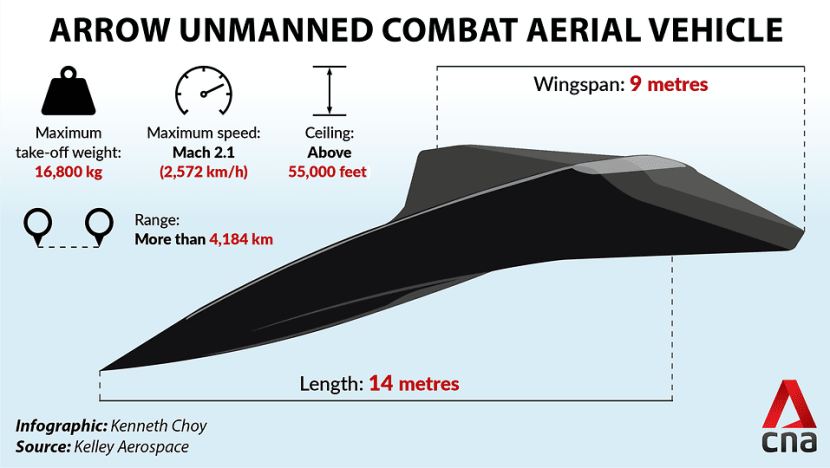
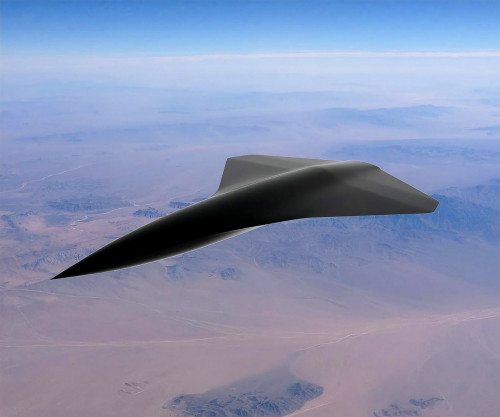
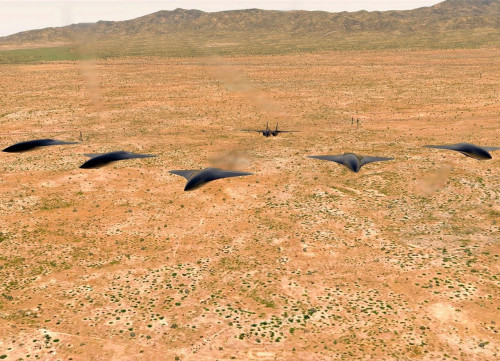
Up-Close Look at Singapore Kelly Aerospace’s Arrow, a Stealthy Supersonic Combat Drone
BY BILL SMITH OCTOBER 18, 2021
Singapore-based Kelley Aerospace is taking the combat drone industry to the next level with their supersonic Arrow. Featuring a carbon fiber monocoque it’s capable of flying over 2,982-miles with a maximum payload of 37,038-pounds. It’s estimated to cost less than $16 million, and as production ramps, as low as $9-million per unit.
The company reports that they have already received 100 pre-orders for the drone and two prototypes are currently being tested in Sweden as well as the United States. These are not autonomous drones, so the company is recruiting at least 500 pilots to eventually control them after completing training at a general aviation pilot academy.
Good company for RSAF's F35. Competition will come from Kratos Defense and Security’s XQ-58 Valkyrie and Beoing's Loyal Wingman UCAV drones.
Google around...the executives are/were from ST Engineering and Israel defence companies. Possibly another 50/50 joint venture firm like Proteus Advanced Systems—a joint venture of Israel Aerospace Industries and ST Engineering Land Systems.
This post has been edited by Mai189: Dec 19 2021, 09:21 PM


 Sep 11 2021, 08:55 PM


 Quote
Quote



 0.1041sec
 0.41
0.41
 7 queries
 GZIP Disabled