Welcome Guest ( Log In | Register )

Outline · [ Standard ] · Linear+

 Multimeter recommend, Learning the Basic now

views
     
okuribito
post Oct 14 2021, 07:13 PM

Regular
******
Senior Member
1,021 posts

Joined: Mar 2010
QUOTE(ceo684 @ May 4 2021, 09:47 AM)
Multimeter will work fine for the above electronics testing application.  thumbup.gif
Clamp meter only if you wanna measure AC amps in your DB box. Multimeter being direct probe will not withstand big AC amps. Itu sahaja.

Can I ask why measure AC amps at DB box? Is it a normal test for troubleshooting? Curious to learn smile.gif

The other thing is, I notice the regular residential DB is really crammed with wires, especially at the E & N bars; I'm curious how the clamps can be used. Perhaps only on the big wires in & out of the ELCB & main breaker?

LOL iinm I understand the clamp is really to measure current by inductance (also non-contact safety iinm). But I see many youtubers (some probably working electricians) use the clamp to hang up and free the hands (good idea biggrin.gif ). On the other hand, I notice Fluke DMMs have a magnetic strap accessory to do the same thing.

QUOTE
Brand wise any Uni-T will work fine if you don't wanna spend too much. However, some features like auto ranging, 10A DC amps, and capacitance may only be found in higher model.

RM40 below UNI-T UT33D+ can only do V/10 A/Ω - manual range NO capacitance

RM125 SANWA DIGITAL MULTIMETER CD800A - 600V/0.4 A/Ω/100 μF capacitance
RM130 FLUKE 101 - 600V/NO A/Ω/100 μF capacitance
RM120 Kyoritsu KEW1018H  - 600V/NO A/Ω/200 μF capacitance
RM150 Kyoritsu 1009 - 600V/10 A/Ω/100 μF capacitance  thumbup.gif
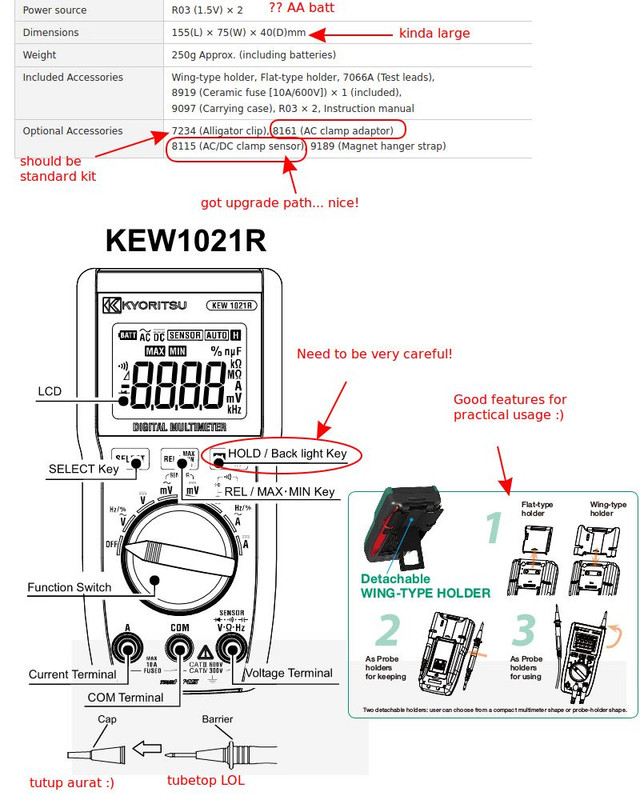
RM170 Kyoritsu KEW1021R  - 600V/10 A/Ω/1000 μF capacitance  thumbup.gif

RM85 UT202A clamp meter  - 600V/600 AC A, NO DC A/Ω/4mF (4000μF) capacitance. If you need bigger capacitance testing you can look at the UT 203/ UT 204, they have even higher Capacitance Range for these as compared to the UT202A.
*
Can I have your opinion on the Fluke 101 for basic troubleshooting residential wiring - light switches, power sockets, aircon/water heater switches? Is it sufficient? Not going to use for troubleshooting appliances that have capacitors ... just wiring (with the mains OFF)

Thanks in advance

PS: I guess key criteria would be reliability & safety which everyone would expect from Fluke. Not so much features. Suggestions for other affordable brands/models most appreciated thumbsup.gif

This post has been edited by okuribito: Oct 14 2021, 07:17 PM
okuribito
post Oct 14 2021, 09:52 PM

Regular
******
Senior Member
1,021 posts

Joined: Mar 2010
QUOTE(alvarez_ @ Oct 14 2021, 09:28 PM)
https://www.uni-trend.com/meters/html/produ...s/UT210_Series/

UT210C Mini Clamp Meter
all rounder from digital multimeter to AC clamp. sufficient for home electrical troubleshooting. got NCV function, can detect live current without touching the copper directly. the small size make it easier to clamp wire inside db box.

UT210D Mini Clamp Meter
like above spec plus DC current clamp ability.  DC current check useful for home electronic projects or in car wiring troubleshooting.

last year the price of UT210D around rm150 (shopee) but i end up with UT204+ (same price range). the reason being 204+ can check DC current up to 600A while 210D only up to 200A. the downside of 204+ is the full size clamp make it a bit hard to clamp wire inside db box.
*
thanks... would you know what test it is that need to check current Amps in the DB? I read that to prove DB is dead, NCV and Voltage is sufficient (haha dangerous to DIY work on live db)

This post has been edited by okuribito: Oct 14 2021, 09:53 PM
okuribito
post Oct 15 2021, 12:26 AM

Regular
******
Senior Member
1,021 posts

Joined: Mar 2010
QUOTE(alvarez_ @ Oct 14 2021, 11:48 PM)
clamp meter can only measure current on single wire either live or neutral wire, cannot both alltogether since it will cancel each other out become 0amp result. this mean if u clamp on regular home appliances 3 core wire, the result is 0amp. thus electrician would clamp on single wire inside db box to measure ongoing current value. however this purpose only to measure how much CURRENT that spesific wiring from a certain fuse. this process need to be done on LIVE DB BOX. so if u need to ask this, i would advice u to dont open the db box. very dangerous u know especially if alone. ask friend who knows or any electrician.

even before NCV invention, electrician use the trusted philips test pen to test any live current from sockets to db box. test pen is a must while NCV for convinience to any electrician.

if u only wish to check how much ur appliances using current/power. u can use this device. i havent bought any but i bet much safer for u than touching live db box.

https://shopee.com.my/%E2%9A%A1-Energy-Mete...00-ab70c1989485

anyway, what is ur intention with DIY WORK ON LIVE DB?  hmm.gif
*
doh.gif

hahaha go to sleep for now & when u wake up refreshed, read my post again... I an inclined towards getting the fluke 101 BUT 2 of the pros are telling me to get a clampmeter which I know I DON'T need

Goodnight bro
okuribito
post Oct 15 2021, 12:29 AM

Regular
******
Senior Member
1,021 posts

Joined: Mar 2010
TQ for your reply. Much appreciated
QUOTE(ceo684 @ Oct 14 2021, 11:01 PM)
Current Measurement
You can carefully position the clamp not to disturb the wires in the DB and be 100% mindful don't simply poke here poke there.

It is used in residential to troubleshoot AC that die off.. WH load amps.. getting a feel of 3 phase balanced or totally imba circuit assignment.
Usually I used them for commercial work/inverter load monitoring upon commissioning

IMHO normal householders would not be concerned with the things you described. I dunno if by AC, you mean aircon or alternating current. And by WH you mean watthours or some appliance. Either way, I'm not interested in measuring amps

I can only think of ppl who are wondering why their TNB bill is high & hence wanna "measure" how many amps is running thru which circuit at the DB. Rest assured, I'm not one of them - I'd rather just read the owner's manual or the sticker on the appliance. That's why I don't see the need for a clamp meter; but that's only me LOL


QUOTE
NCV sufficient, follow with a 2nd test on voltage just to be sure.
You need to understand the concept of LDL (live dead live), prove the equipment works to measure, prove the dead circuit is truly dead reading, prove the measurement is repeatable on live again.

Oh yes! LDL - always prove against a known live. And always zero out the leads & check if the Hold button's been accidentally activated previously

QUOTE
https://www.fluke.com/en-my/learn/blog/elec...voltage-testing
Clamps are for measuring AC amps under load safely. It is NOT a test by itself. It is a measurement.

The question then is why would I wanna measure current? My end objective is safety. Will knowing how much current runs thru that wire on circuit xyz add to my safety? If not, I'll pass smile.gif

QUOTE
Why usually at DB? Because its easy to access all the live wire.
There is no better spot (logically) as:
1. concealed wiring = need to tear down the whole wall
2. device on the other end is fixed in nicely = meaning there won't be enough space to slip in a clamp.
3. flexicord L and N cancel each other out = meaning forever 0A reading
4. Fundamental of Clamps = can only work for AC amps measurement when you can isolate only one leg.

Theoretically, you can use a clamp to check full load amps before the compressor motor jams up or sth along those lines.
TQ for explaining. Helps me decide smile.gif

QUOTE
Other than that, the fluke 101 is kinda like an overpriced A-class.. you get to check voltage and continuity with it. Cannot read current.

If you want to poke around AC.. I'd recommend the Kyoritsu clamp (KEW 2117) over it. Autoranging so lesser chance to blow up.

There you can see.. ahh WH take up 16A..
got voltage checks
got continuity test to see whether fuse blow

Coz voltage will be 230V all over the house unless something is wrong.

I thought the 101 is auto-ranging & cannot fool around selecting specific ranges. And on the contrary, someone said that without an amp socket in the 101, there was less chance for a noob to stick the probe in the wrong socket & blow a fuse tongue.gif

hehe what's this WH? sounds more like an appliance in this context smile.gif

Edit: LOL water heater hahaha now I can go to sleep

QUOTE
Magnetic straps are accessories but not needed.
It was just a comparison with using the clamp of a clampmeter for hanging the meter up LOL ummm like using a fridge as a cabinet for stuff??
QUOTE
The CAT III or better rating is the one to be concerned about. Just in case butterfingers.
*
thumbsup.gif

QUOTE
Do NOT work on the live DB if you don't have any idea what you are doing in there.

Couldn't agree more!!!

This post has been edited by okuribito: Oct 15 2021, 12:36 AM
okuribito
post Oct 15 2021, 03:26 PM

Regular
******
Senior Member
1,021 posts

Joined: Mar 2010
» Click to show Spoiler - click again to hide... «

rclxms.gif rclxms.gif rclxms.gif rclxms.gif you're a champ, maam!!!

No, not that I "like" the Fluke ... just that it's simple & got reputation for quality. Yeah I know it's made in PRC but even Sanwa has mfg in Shenzen

Shopee price ~150 ... Looks like it's the 1021R for me ... it's got backlight which the F101 does not haha. Kyoritsu also a serious brand, right?

Both the K & the F can diy a strap to hang up but the K wins with the probe holder (though dunno if easy to hold the meter with the probe attached & ***stick into power/switch sockets)

As for the test lead design, I only wish the distance between the finger guard & the testing end is longer & the insulation narrower - so that it's easy to find&contact the fixing screws in tight quarters (switches and power sockets). Unfortunately, I think none of the brands have this

Thanks again... you been super helpful & generous with your knowledge thumbup.gif

some links:
https://www.kew-ltd.co.jp/files/en/manual/1..._92-2238B_E.pdf
https://www.kew-ltd.co.jp/en/products/detail/00015/
ps: i noticed the upgrade path LOL ...
PPS: *** I mean after opening the faceplate & probing at the terminals at the back

user posted image

This post has been edited by okuribito: Oct 15 2021, 03:34 PM
okuribito
post Oct 16 2021, 09:05 PM

Regular
******
Senior Member
1,021 posts

Joined: Mar 2010
» Click to show Spoiler - click again to hide... «

Thanks ceo684

Yeah I appreciate the need for some extra length of wire in there as well as not too much; else cannot close the box LOL Still, i think a longer section with narrow insulation between the barrier/finger guard & the tip will speed up work

Btw, I was learning about RCDs and I think I found a use case for current measurement. Since they work on residual current, one might want to find out how much that residual current is.

My friend had a RCCB that just wouldn't reset after a thunderstorm. The electrician said RCCB damaged by surge & recommended to instal a new one. So my friend did that himself; turned off the Main circuit breaker after the meter & took out the old RCCB & put in a new one, ensuring the Line & Neutral were inserted correctly and tightly

Before he turned the main circuit breaker back on, he pushed the RCCB's switch back on; but it wouldn't engage ohmy.gif He also had a good look at the old one (not connected at all) and tried to push the switch back on AND he could! So he took out the new one and connected the old one back in the DB. LOL the switch wouldn't engage in the ON position hahaha

He then reconfirmed that the main CB was OFF & removed one of the Neutral wire from the RCCB; tried to push the switch up again - it engaged & stayed up!

We think there's current in the Neutral but none in the Line - that's why the RCCB wouldn't allow the switch to stay up. I'm waiting for my new Kyoritsu to arrive & I plan to go over to measure the amps across the In & Out Neutral poles on the RCCB (mains off) to test our suspicion. What do you think?

This post has been edited by okuribito: Oct 16 2021, 09:06 PM
okuribito
post Oct 17 2021, 01:11 PM

Regular
******
Senior Member
1,021 posts

Joined: Mar 2010
» Click to show Spoiler - click again to hide... «


QUOTE
The touch at in and out N will not work for current because you're measuring in parallelshakehead.gif
Running current through the meter directly produce a lot of heat.  sweat.gif


ummmmmm the thing is that the RCCB refuse to engage in ON position... ie there's a break in the circuit because the RCCB refuse to close the circuit ....so if "touch at in and out N" it is in series.... Isn't it?

Only IF the RCCB is in ON position will "touch at in and out N" be in parallel IMHO haha I wasn't sleeping in form five physics class tongue.gif Am I mistaken? hehe double check


thanks for that practical tip about stressing the meter thumbsup.gif

This post has been edited by okuribito: Oct 17 2021, 01:11 PM


Change to:
| Lo-Fi Version
0.0178sec    0.33    7 queries    GZIP Disabled
Time is now: 16th December 2025 - 05:38 PM