Welcome Guest ( Log In | Register )

Outline · [ Standard ] · Linear+

 Basic Bond & Bond buying 101, Let's share our knowledge

views
     
TShksgmy
post Sep 3 2020, 12:36 PM, updated 6y ago

Doraemon!
*******
Senior Member
7,847 posts

Joined: Sep 2019
Hello everyone.

After a cursory search through the F/B/I threads, I realise there isn't much information around for the investor who might be interested in buying whole retail bonds (not via a bond fund), and since bonds have been my preferred asset class for the past few years, I thought I'd share the little that I know, and I'd be very grateful for any input or comments or corrections by the real experts here.

What are bonds?

Bonds are debts or a fancy IOU note issued by companies or corporations or even governments. Bonds usually come in 2 flavours:

1. Those with a fixed maturity date, by which time the bond “matures”, the debt is paid in addition to whatever coupon (“interest”) that is promised every quarterly/half-yearly or annually and is considered “redeemed”
2. Those with no fixed maturity date (termed “perpetual” bonds), but usually have a “callable date”, in which the issuer has the option of redeeming the debt as per no.1 above. Otherwise, the bond continues to be valid and the coupon continues to be paid

Perpetual bonds also usually come with a “re-fix”, by which the coupon is re-pegged and re-adjusted at the “callable date” if the option of redeeming it has not been exercised by the issuer. The re-fix is usually the prevailing interest rate or base lending rate or some other point of reference, plus a premium (which will usually be clearly indicated on the bond prospectus) to account for the risks the bond holder takes on in buying & holding the issuer’s bonds.

What are secured vs unsecured bonds?

Bonds can also be secured, or unsecured junior or senior subordinated, or unsecured & unsubordinated. Essentially, these are sub-divisions within the bond offering to determine the priority in which debt will be repaid in the event of a catastrophic meltdown (i.e. the company going bankrupt or becoming insolvent and is placed under judicial management). Secured bonds will always be paid first – although a haircut is expected, and the investor cannot be expected to get his or her full capital back, followed by the others. Unsecured and unsubordinated bonds will be paid last – and the investors may get nothing back!

Realistically, most retail investors like myself can never hope to get secured bonds – those would likely be snapped by institutional investors. The best we can ever hope for realistically are the unsecured subordinated offerings – but, to be honest, this sub-category isn’t really as important as the next which I’ll be discussing, because if the company folds, the money is as good as lost.

What are investment grade vs unrated bonds?

By definition, investment grade bonds are bonds which have been given a rating of no less than Baa3 (Moody’s), or BBB- (S&P & Fitch). And, various different book-runners (i.e. the banks that are in charge of the bond’s IPO) may then assign in-house rating guides as to the “safety” of these IG bonds. Maybank, for example, assigns an in-house system of IG1 (highest rating, as close to sovereign AAA bonds as you can get) to IG10 (lowest rating, but still investment grade). Different banks/brokerage houses will assign different internal rating guides, but they usually work along the same principles.

“Unrated” bonds can these can be further subdivided into 2 broad categories.

Bonds may be unrated if the company is very well known locally, and the bond IPO is mainly for the domestic market. An example I will quote is a well-known local entity in Singapore, Mapletree. Mapletree came up with a bond a few years ago, which was unrated, but it was quickly snapped up by retail and institutional investors. The reason for it was simple – Mapletree is wholly owned by Temasek Holdings Pte, and that was all the backing that investors needed.

Bonds may also be unrated “junk” bonds. These bonds usually carry a high yield (my personal cut off is anything more than a coupon yield of 6%), and correspondingly, these bonds will come with a higher risk. A classic case of such a bond that folded spectacularly is Singapore’s Hyflux. Bond defaults in Oil & Gas companies and Off Shore marine companies have also been on the rise, as the result of the recent economy downturn and the plunge in oil & gas prices.

Common wisdom would therefore dictate that the safer bonds are those which have are rated as investment grade offerings.

What type of investors are suited for bonds?

As my learned colleagues have opined correctly, bonds are not for everyone. Firstly, the capital outlay required for bonds can be prohibitive, especially for someone starting out in their investment journey. In Singapore for example, the minimum “entry” purchase is $250,000 per “whole” bond. In Australia, the entry criteria ranges from AUD200,000 to AUD250,000 per bond. Different countries will obviously have different purchase requirements.

Alternately, bonds may be purchased in parts, through a bond fund – but that’s outside the scope of this discussion.

So, who then is the typical bond buyer? It’s usually an older investor, who can ill-afford the inherent volatility of stocks or other assets/instruments with higher yields but come with higher risks. Bonds (especially investment grade ones) are often considered “boring” and rank amongst the safer asset classes.

Case in point, when I purchased a bunch of Equity-Linked Notes about a year ago, every one of those purchases had to be done in person, with my personal banker coming to see my wife and I at our house and we would sign the documents after a lengthy waiver and disclaimer lecture. With bonds, my bankers can do voice verification over the phone, as long as what we are buying are investment grade bonds.

Bonds, being “safer” (but not without its risks – e.g. when the company goes bankrupt!), also pays a lower yield, when compared to shares or stocks or ELNs. A decent yield from an investment grade bond is around 3 – 4%, some older IG bonds may offer up to 5%, but that’s quite rare in today’s environment. In contrast, the ELN plays my wife and I committed to last year offered 10% in returns, but came with much sleepless nights, especially when COVID-19 happened. My bonds kept chugging along in their quiet, unobtrusive way, paying me the coupons when they were due, with nary a complaint or a peep.

So, a younger investor, with a smaller “war chest” and a longer run of economic productivity in terms of working life might not find bonds all that attractive. More mature investors who are now in the phase of wealth preservation as opposed to outright wealth accumulation/generation are more the target demographic of purchasers. Bonds are usually also less volatile, and less likely to need close monitoring, so they are more suited for the busy investor who might want to “fire and forget”, and may not have time to squint over price movements on a screen.

Final miscellaneous notes

I would recommend only ever buying bonds in your “home” currency, to minimize the effects of currency exchange rates and fluctuations. That’s why I only ever purchase bonds in SGD and AUD, as I don’t mind holding currencies in these 2 denominations.

Sometimes, bonds can show sharp capital appreciation, and these can be realised for profit, as was the case when I picked up blue chip bonds of Singapore’s local banks for below their IPO price during the earliest weeks of COVID-19 and there was mass selling in the market. Now, they’ve not only recovered but broadly appreciated in price.

Bonds are traded on the open market, and the final payment is the sum of the offer price plus the interest accrued, so you’ll have to factor that into the cost involved, as well as the final yield to maturity or yield to call, as a result of the offer price being higher than the IPO price.

I am sure I would have missed out on a great many other details – so if anyone else has comments and opinions to offer, please do so and we can all benefit together!


Ramjade
post Sep 3 2020, 12:49 PM

20k VIP Club
*********
All Stars
24,427 posts

Joined: Feb 2011


QUOTE(hksgmy @ Sep 3 2020, 12:36 PM)
Hello everyone.

After a cursory search through the F/B/I threads, I realise there isn't much information around for the investor who might be interested in buying whole retail bonds (not via a bond fund), and since bonds have been my preferred asset class for the past few years, I thought I'd share the little that I know, and I'd be very grateful for any input or comments or corrections by the real experts here.

What are bonds?

Bonds are debts or a fancy IOU note issued by companies or corporations or even governments. Bonds usually come in 2 flavours:

1. Those with a fixed maturity date, by which time the bond “matures”, the debt is paid in addition to whatever coupon (“interest”) that is promised every quarterly/half-yearly or annually and is considered “redeemed”
2. Those with no fixed maturity date (termed “perpetual” bonds), but usually have a “callable date”, in which the issuer has the option of redeeming the debt as per no.1 above. Otherwise, the bond continues to be valid and the coupon continues to be paid

Perpetual bonds also usually come with a “re-fix”, by which the coupon is re-pegged and re-adjusted at the “callable date” if the option of redeeming it has not been exercised by the issuer. The re-fix is usually the prevailing interest rate or base lending rate or some other point of reference, plus a premium (which will usually be clearly indicated on the bond prospectus) to account for the risks the bond holder takes on in buying & holding the issuer’s bonds.

What are secured vs unsecured bonds?

Bonds can also be secured, or unsecured junior or senior subordinated, or unsecured & unsubordinated. Essentially, these are sub-divisions within the bond offering to determine the priority in which debt will be repaid in the event of a catastrophic meltdown (i.e. the company going bankrupt or becoming insolvent and is placed under judicial management). Secured bonds will always be paid first – although a haircut is expected, and the investor cannot be expected to get his or her full capital back, followed by the others. Unsecured and unsubordinated bonds will be paid last – and the investors may get nothing back!

Realistically, most retail investors like myself can never hope to get secured bonds – those would likely be snapped by institutional investors. The best we can ever hope for realistically are the unsecured subordinated offerings – but, to be honest, this sub-category isn’t really as important as the next which I’ll be discussing, because if the company folds, the money is as good as lost.

What are investment grade vs unrated bonds?

By definition, investment grade bonds are bonds which have been given a rating of no less than Baa3 (Moody’s), or BBB- (S&P & Fitch). And, various different book-runners (i.e. the banks that are in charge of the bond’s IPO) may then assign in-house rating guides as to the “safety” of these IG bonds. Maybank, for example, assigns an in-house system of IG1 (highest rating, as close to sovereign AAA bonds as you can get) to IG10 (lowest rating, but still investment grade). Different banks/brokerage houses will assign different internal rating guides, but they usually work along the same principles.

“Unrated” bonds can these can be further subdivided into 2 broad categories.

Bonds may be unrated if the company is very well known locally, and the bond IPO is mainly for the domestic market. An example I will quote is a well-known local entity in Singapore, Mapletree. Mapletree came up with a bond a few years ago, which was unrated, but it was quickly snapped up by retail and institutional investors. The reason for it was simple – Mapletree is wholly owned by Temasek Holdings Pte, and that was all the backing that investors needed.

Bonds may also be unrated “junk” bonds. These bonds usually carry a high yield (my personal cut off is anything more than a coupon yield of 6%), and correspondingly, these bonds will come with a higher risk. A classic case of such a bond that folded spectacularly is Singapore’s Hyflux. Bond defaults in Oil & Gas companies and Off Shore marine companies have also been on the rise, as the result of the recent economy downturn and the plunge in oil & gas prices.

Common wisdom would therefore dictate that the safer bonds are those which have are rated as investment grade offerings.

What type of investors are suited for bonds?

As my learned colleagues have opined correctly, bonds are not for everyone. Firstly, the capital outlay required for bonds can be prohibitive, especially for someone starting out in their investment journey. In Singapore for example, the minimum “entry” purchase is $250,000 per “whole” bond. In Australia, the entry criteria ranges from AUD200,000 to AUD250,000 per bond. Different countries will obviously have different purchase requirements.

Alternately, bonds may be purchased in parts, through a bond fund – but that’s outside the scope of this discussion.

So, who then is the typical bond buyer? It’s usually an older investor, who can ill-afford the inherent volatility of stocks or other assets/instruments with higher yields but come with higher risks. Bonds (especially investment grade ones) are often considered “boring” and rank amongst the safer asset classes.

Case in point, when I purchased a bunch of Equity-Linked Notes about a year ago, every one of those purchases had to be done in person, with my personal banker coming to see my wife and I at our house and we would sign the documents after a lengthy waiver and disclaimer lecture. With bonds, my bankers can do voice verification over the phone, as long as what we are buying are investment grade bonds.

Bonds, being “safer” (but not without its risks – e.g. when the company goes bankrupt!), also pays a lower yield, when compared to shares or stocks or ELNs. A decent yield from an investment grade bond is around 3 – 4%, some older IG bonds may offer up to 5%, but that’s quite rare in today’s environment. In contrast, the ELN plays my wife and I committed to last year offered 10% in returns, but came with much sleepless nights, especially when COVID-19 happened. My bonds kept chugging along in their quiet, unobtrusive way, paying me the coupons when they were due, with nary a complaint or a peep.

So, a younger investor, with a smaller “war chest” and a longer run of economic productivity in terms of working life might not find bonds all that attractive. More mature investors who are now in the phase of wealth preservation as opposed to outright wealth accumulation/generation are more the target demographic of purchasers. Bonds are usually also less volatile, and less likely to need close monitoring, so they are more suited for the busy investor who might want to “fire and forget”, and may not have time to squint over price movements on a screen.

Final miscellaneous notes

I would recommend only ever buying bonds in your “home” currency, to minimize the effects of currency exchange rates and fluctuations. That’s why I only ever purchase bonds in SGD and AUD, as I don’t mind holding currencies in these 2 denominations.

Sometimes, bonds can show sharp capital appreciation, and these can be realised for profit, as was the case when I picked up blue chip bonds of Singapore’s local banks for below their IPO price during the earliest weeks of COVID-19 and there was mass selling in the market. Now, they’ve not only recovered but broadly appreciated in price.

Bonds are traded on the open market, and the final payment is the sum of the offer price plus the interest accrued, so you’ll have to factor that into the cost involved, as well as the final yield to maturity or yield to call, as a result of the offer price being higher than the IPO price.

I am sure I would have missed out on a great many other details – so if anyone else has comments and opinions to offer, please do so and we can all benefit together!
*
That's a reason why you don't see people talking much about bonds in Malaysia.

One bond cost RM250k/batch. How many can fork out RM250k? Same issue in sinagpore. One batch cost SGD250k That's why bond is off limit to Malaysian unless one is extremely rich.

I will never buy bonds even if I have the money cause bond coupon is stagnant so you will lose money to inflation.
I am dividend investing guy.
Better for me to buy Dividend growth stock as every year my dividends are increasing automatically which means for the same bond duration, I am actually earning more than bond coupons.

This post has been edited by Ramjade: Sep 3 2020, 12:50 PM
TShksgmy
post Sep 3 2020, 01:50 PM

Doraemon!
*******
Senior Member
7,847 posts

Joined: Sep 2019
QUOTE(Ramjade @ Sep 3 2020, 12:49 PM)
That's a reason why you don't see people talking much about bonds in Malaysia.

One bond cost RM250k/batch. How many can fork out RM250k? Same issue in sinagpore. One batch cost SGD250k That's why bond is off limit to Malaysian unless one is extremely rich.

I will never buy bonds even if I have the money cause bond coupon is stagnant so you will lose money to inflation.
I am dividend investing guy.
Better for me to buy Dividend growth stock as every year my dividends are increasing automatically which means for the same bond duration, I am actually earning more than bond coupons.
*
I think that’s a fair point you’ve made. Nevertheless, different asset classes for different people at different stages smile.gif
Cookie101
post Sep 3 2020, 01:52 PM

Regular
******
Senior Member
1,616 posts

Joined: Jul 2016
Great write up!

But nowadays not many as high returns as the previous ones.

Nowadays hovering around 3~3.5%

Last great one was emirates.
Emily Ratajkowski
post Sep 3 2020, 08:36 PM

Casual
***
Junior Member
444 posts

Joined: Nov 2014
QUOTE(Ramjade @ Sep 3 2020, 12:49 PM)
That's a reason why you don't see people talking much about bonds in Malaysia.

One bond cost RM250k/batch. How many can fork out RM250k? Same issue in sinagpore. One batch cost SGD250k That's why bond is off limit to Malaysian unless one is extremely rich.

I will never buy bonds even if I have the money cause bond coupon is stagnant so you will lose money to inflation.
I am dividend investing guy.
Better for me to buy Dividend growth stock as every year my dividends are increasing automatically which means for the same bond duration, I am actually earning more than bond coupons.
*
But what happens if you have 1 bil? Where else are you going to put your money? Bonds is still the answer. You won't put all your money in bonds for sure. But you still want about 40% of your money to be in a safe and liquid instrument that has the potential to beat inflation.

When the amount of money you have gets more and more, the places you can park it and still generate safe and decent returns become less and less.

Bonds will still be a premium choice for safe investments. We just will never have the pleasure of having that problem.
Ramjade
post Sep 3 2020, 08:51 PM

20k VIP Club
*********
All Stars
24,427 posts

Joined: Feb 2011


QUOTE(Emily Ratajkowski @ Sep 3 2020, 08:36 PM)
But what happens if  you have 1 bil? Where else are you going to put your money? Bonds is still the answer. You won't put all your money in bonds for sure. But you still want about 40% of your money to be in a safe and liquid instrument that has the potential to beat inflation.

When the amount of money you have gets more and more, the places you can park it and still generate safe and decent returns become less and less.

Bonds will still be a premium choice for safe investments. We just will never have the pleasure of having that problem.
*
Bonds do not beat inflation. I will put into PE funds.
TShksgmy
post Sep 3 2020, 08:58 PM

Doraemon!
*******
Senior Member
7,847 posts

Joined: Sep 2019
QUOTE(Ramjade @ Sep 3 2020, 08:51 PM)
Bonds do not beat inflation. I will put into PE funds.
*
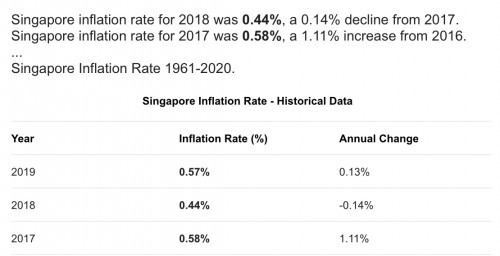
Actually, that depends a lot on the inflation rate in the home country (currency) and the refixing formula (for perpetual bonds). For example, a bond which I’m hoping to get (the seller wants a certain price, I’m offering to buy at a different price - and now the seller wants me to buy 2 lots instead of one in return) has a refixing formula of 4% higher than the prevailing bank rate. So, if interest rates go up, my returns go up in tandem. And inflation is low at the moment. In fact, Singapore is dealing with close to negative inflation thanks to COVID.

user posted image

It may not return as much as your investments, but to say it doesn’t beat inflation may be an over generalisation.

This post has been edited by hksgmy: Sep 3 2020, 09:17 PM
Ramjade
post Sep 3 2020, 09:22 PM

20k VIP Club
*********
All Stars
24,427 posts

Joined: Feb 2011


QUOTE(hksgmy @ Sep 3 2020, 08:58 PM)
Actually, that depends a lot on the inflation rate in the home country (currency) and the refixing formula (for perpetual bonds). For example, a bond which I’m hoping to get (the seller wants a certain price, I’m offering to buy at a different price - and now the seller wants me to buy 2 lots instead of one in return) has a refixing formula of 4% higher than the prevailing bank rate. So, if interest rates go up, my returns go up in tandem. And inflation is low at the moment. In fact, Singapore is dealing with close to negative inflation thanks to COVID.

user posted image

It may not return as much as your investments, but to say it doesn’t beat inflation may be an over generalisation.
*
Don't look at current inflation. Use 2% inflation for calculations. Then see if your price of food/stuff you want to buy does it increase in money by next year? Good place is when you do groceries and when you go out for say eating hawker food/ buying a piece of curry puff. That's real life inflation.
TShksgmy
post Sep 3 2020, 09:34 PM

Doraemon!
*******
Senior Member
7,847 posts

Joined: Sep 2019
Take away the cost of houses and cars (all paid up), inflation in Singapore is quite well controlled - for political reasons: thankfully the cost of chicken rice can still be only $2.50 at some stalls.
Emily Ratajkowski
post Sep 3 2020, 09:40 PM

Casual
***
Junior Member
444 posts

Joined: Nov 2014
QUOTE(Ramjade @ Sep 3 2020, 08:51 PM)
Bonds do not beat inflation. I will put into PE funds.
*
Again... when you have too much money, bonds are the safest thing with potential to beat inflation.
There is simply nothing else you can sink your money in. Everything else carries a higher risk.
PE funds may generate more return. But are they safe? Definitely not as safe as government backed bonds.

We will never utilize bonds to it's full and intended purpose. But bonds will be here to stay.
TShksgmy
post Sep 3 2020, 10:05 PM

Doraemon!
*******
Senior Member
7,847 posts

Joined: Sep 2019
QUOTE(Emily Ratajkowski @ Sep 3 2020, 09:40 PM)
Again... when you have too much money, bonds are the safest thing with potential to beat inflation.
There is simply nothing else you can sink your money in. Everything else carries a higher risk.
PE funds may generate more return. But are they safe? Definitely not as safe as government backed bonds.

We will never utilize bonds to it's full and intended purpose. But bonds will be here to stay.
*
Good comment. All I can say is that each of us will have our preferences and risk tolerance, as well as the financial wherewithal to choose the asset classes that best fit our profiles.

If it were a single gold standard, a “one ring to rule them all” asset class - then, we’d all be making a beeline for that to the exclusion of all other legitimate instruments.

I’m old enough to know that different strokes for different folks - and your mileage may vary smile.gif
viruz
post Sep 3 2020, 10:37 PM

Enthusiast
*****
Senior Member
820 posts

Joined: Jan 2003


I bought several bonds from OCBC bank Malaysia, such as HSBC GBP bond which yield 5% coupon annually, and NAB CNY bond which gives 4 or 4.5% (can't remember) annually, and several other CNY bond sold by UOB Malaysia.

Ya bond is boring, and it's yield can dropped as well, for example during the early stage of COVID-19 where market entered sell everything sentiment, my bond price all went below my purchased price, but now all recovered almost fully.
Rinth
post Sep 4 2020, 09:45 AM

Regular
******
Senior Member
1,263 posts

Joined: Oct 2016
QUOTE(hksgmy @ Sep 3 2020, 12:36 PM)
Hello everyone.

After a cursory search through the F/B/I threads, I realise there isn't much information around for the investor who might be interested in buying whole retail bonds (not via a bond fund), and since bonds have been my preferred asset class for the past few years, I thought I'd share the little that I know, and I'd be very grateful for any input or comments or corrections by the real experts here.

What are bonds?

Bonds are debts or a fancy IOU note issued by companies or corporations or even governments. Bonds usually come in 2 flavours:

1. Those with a fixed maturity date, by which time the bond “matures”, the debt is paid in addition to whatever coupon (“interest”) that is promised every quarterly/half-yearly or annually and is considered “redeemed”
2. Those with no fixed maturity date (termed “perpetual” bonds), but usually have a “callable date”, in which the issuer has the option of redeeming the debt as per no.1 above. Otherwise, the bond continues to be valid and the coupon continues to be paid

Perpetual bonds also usually come with a “re-fix”, by which the coupon is re-pegged and re-adjusted at the “callable date” if the option of redeeming it has not been exercised by the issuer. The re-fix is usually the prevailing interest rate or base lending rate or some other point of reference, plus a premium (which will usually be clearly indicated on the bond prospectus) to account for the risks the bond holder takes on in buying & holding the issuer’s bonds.

What are secured vs unsecured bonds?

Bonds can also be secured, or unsecured junior or senior subordinated, or unsecured & unsubordinated. Essentially, these are sub-divisions within the bond offering to determine the priority in which debt will be repaid in the event of a catastrophic meltdown (i.e. the company going bankrupt or becoming insolvent and is placed under judicial management). Secured bonds will always be paid first – although a haircut is expected, and the investor cannot be expected to get his or her full capital back, followed by the others. Unsecured and unsubordinated bonds will be paid last – and the investors may get nothing back!

Realistically, most retail investors like myself can never hope to get secured bonds – those would likely be snapped by institutional investors. The best we can ever hope for realistically are the unsecured subordinated offerings – but, to be honest, this sub-category isn’t really as important as the next which I’ll be discussing, because if the company folds, the money is as good as lost.

What are investment grade vs unrated bonds?

By definition, investment grade bonds are bonds which have been given a rating of no less than Baa3 (Moody’s), or BBB- (S&P & Fitch). And, various different book-runners (i.e. the banks that are in charge of the bond’s IPO) may then assign in-house rating guides as to the “safety” of these IG bonds. Maybank, for example, assigns an in-house system of IG1 (highest rating, as close to sovereign AAA bonds as you can get) to IG10 (lowest rating, but still investment grade). Different banks/brokerage houses will assign different internal rating guides, but they usually work along the same principles.

“Unrated” bonds can these can be further subdivided into 2 broad categories.

Bonds may be unrated if the company is very well known locally, and the bond IPO is mainly for the domestic market. An example I will quote is a well-known local entity in Singapore, Mapletree. Mapletree came up with a bond a few years ago, which was unrated, but it was quickly snapped up by retail and institutional investors. The reason for it was simple – Mapletree is wholly owned by Temasek Holdings Pte, and that was all the backing that investors needed.

Bonds may also be unrated “junk” bonds. These bonds usually carry a high yield (my personal cut off is anything more than a coupon yield of 6%), and correspondingly, these bonds will come with a higher risk. A classic case of such a bond that folded spectacularly is Singapore’s Hyflux. Bond defaults in Oil & Gas companies and Off Shore marine companies have also been on the rise, as the result of the recent economy downturn and the plunge in oil & gas prices.

Common wisdom would therefore dictate that the safer bonds are those which have are rated as investment grade offerings.

What type of investors are suited for bonds?

As my learned colleagues have opined correctly, bonds are not for everyone. Firstly, the capital outlay required for bonds can be prohibitive, especially for someone starting out in their investment journey. In Singapore for example, the minimum “entry” purchase is $250,000 per “whole” bond. In Australia, the entry criteria ranges from AUD200,000 to AUD250,000 per bond. Different countries will obviously have different purchase requirements.

Alternately, bonds may be purchased in parts, through a bond fund – but that’s outside the scope of this discussion.

So, who then is the typical bond buyer? It’s usually an older investor, who can ill-afford the inherent volatility of stocks or other assets/instruments with higher yields but come with higher risks. Bonds (especially investment grade ones) are often considered “boring” and rank amongst the safer asset classes.

Case in point, when I purchased a bunch of Equity-Linked Notes about a year ago, every one of those purchases had to be done in person, with my personal banker coming to see my wife and I at our house and we would sign the documents after a lengthy waiver and disclaimer lecture. With bonds, my bankers can do voice verification over the phone, as long as what we are buying are investment grade bonds.

Bonds, being “safer” (but not without its risks – e.g. when the company goes bankrupt!), also pays a lower yield, when compared to shares or stocks or ELNs. A decent yield from an investment grade bond is around 3 – 4%, some older IG bonds may offer up to 5%, but that’s quite rare in today’s environment. In contrast, the ELN plays my wife and I committed to last year offered 10% in returns, but came with much sleepless nights, especially when COVID-19 happened. My bonds kept chugging along in their quiet, unobtrusive way, paying me the coupons when they were due, with nary a complaint or a peep.

So, a younger investor, with a smaller “war chest” and a longer run of economic productivity in terms of working life might not find bonds all that attractive. More mature investors who are now in the phase of wealth preservation as opposed to outright wealth accumulation/generation are more the target demographic of purchasers. Bonds are usually also less volatile, and less likely to need close monitoring, so they are more suited for the busy investor who might want to “fire and forget”, and may not have time to squint over price movements on a screen.

Final miscellaneous notes

I would recommend only ever buying bonds in your “home” currency, to minimize the effects of currency exchange rates and fluctuations. That’s why I only ever purchase bonds in SGD and AUD, as I don’t mind holding currencies in these 2 denominations.

Sometimes, bonds can show sharp capital appreciation, and these can be realised for profit, as was the case when I picked up blue chip bonds of Singapore’s local banks for below their IPO price during the earliest weeks of COVID-19 and there was mass selling in the market. Now, they’ve not only recovered but broadly appreciated in price.

Bonds are traded on the open market, and the final payment is the sum of the offer price plus the interest accrued, so you’ll have to factor that into the cost involved, as well as the final yield to maturity or yield to call, as a result of the offer price being higher than the IPO price.

I am sure I would have missed out on a great many other details – so if anyone else has comments and opinions to offer, please do so and we can all benefit together!
*
Thanks for the info. Great info sharing there. I always know that bond is normally out for normal people that taking salaries as the entry is high, but didnt expect it to be so high @ RM 250k per bond.

I'm just turned 30 this year and most probably wont touch bond at the near future, as i'm still planning to invest in real estate 1st to build up rental income as my passive income in future.

I always have this question and maybe you can give some opinion on this :-

1) whats the main different between bond & fixed deposit? (other than fixed deposit has lower interest rates compared to bond, because to me seems like both serving same purposes, except that bond can be traded)

2) for us Malaysian, upon retiring at age 60, is it wiser to remain our EPF fund in our EPF and withdraw it upon usage to earn the higher interest rate or venture to bond? (assuming lets say you have RM 2.5 mil today at age 60, its better to put the whole money in EPF to earn interest at maybe average 5% at today's market OR buy 10 bond of RM 250k?)

Thanks in advance for your comment. thumbup.gif

mmweric
post Sep 4 2020, 10:59 AM

Getting Started
**
Junior Member
156 posts

Joined: Jan 2020
Would like to add a bit. I am currently 46 and retired early at 42. I have owned direct bonds before but currently have moved to bond funds.

In my personal opinion what asset classes you have in your investment portfolio depends on your cashflow requirements, risk capacity and risk tolerance.

Bonds are bought for fixed income, high liquidity and low risk to capital (that is if you buy portfolio of investment grade bonds ).

If you're young and have a steady job it might make more sense to have a higher percentage of your investments in more high risk assets like equity as you have steady income and lots of time to accumulate more wealth and higher capacity to recover from a huge lost.

If you are older and retired bonds it make more sense to allocate a bit to bonds as you are no longer in the accumulation phase you can't take a big loss and have no more income.

For me I keep my spare cash basically 1.5 years spending in a bond fund. And 6 months in FD giving me a 2 year buffer.

In Malaysia bond ratings are down by either MARC or RAM. I wouldn't buy any bonds which are unrated or perpetual as the risk is too high for me. Having a ladder of diredt bonds is a great way to have a secured income but not really practical in Malaysia.

It is almost impossible to buy 5 to 6 direct investment grade bonds with different maturities as the supply is quite limited hence I would feel buying a bond fund would be easier and more practical. After bank charges for their markup etc it is not that cheap also.

One thing for us malaysians who were employed and are retiring we don't really have to keep that much in bonds as we have a huge chunk of money in our epf which has a guaranteed return of 2.5% and a rolling target of 3.5% above inflation which is better then any bond so it would be better to just leave your money in epf acting as some sort of bond allocation in your portfolio.

This post has been edited by mmweric: Sep 4 2020, 11:00 AM
MUM
post Sep 4 2020, 11:15 AM

10k Club
********
All Stars
14,959 posts

Joined: Mar 2015

QUOTE(Rinth @ Sep 4 2020, 09:45 AM)
Thanks for the info. Great info sharing there. I always know that bond is normally out for normal people that taking salaries as the entry is high, but didnt expect it to be so high @ RM 250k per bond.
according to this site....
BOND EXPRESS - RETAIL BONDS
24 Hours. Non-stop. Real-time Trading.

Now everyone can trade bonds from as low as MYR1,000 (nominal value).

https://www.fundsupermart.com.my/fsm/bonds/Bond%20Express

I'm just turned 30 this year and most probably wont touch bond at the near future, as i'm still planning to invest in real estate 1st to build up rental income as my passive income in future.

while you are in the process of doing that, why not use your available money to invest into other things to help maximizing returns and for diversification?

I always have this question and maybe you can give some opinion on this :-

1) whats the main different between bond & fixed deposit? (other than fixed deposit has lower interest rates compared to bond, because to me seems like both serving same purposes, except that bond can be traded)
other than as highlighted by you ..."fixed deposit has lower interest rates compared to bond", the other one main reason is i think is FD has to wait till maturity to redeem else will lose the interest, while Bond has is more flexible as it can be traded otc.

2) for us Malaysian, upon retiring at age 60, is it wiser to remain our EPF fund in our EPF and withdraw it upon usage to earn the higher interest rate or venture to bond? (assuming lets say you have RM 2.5 mil today at age 60, its better to put the whole money in EPF to earn interest at maybe average 5% at today's market OR buy 10 bond of RM 250k?)
the better when comes to lesser risk would be EPF as bond can have default
the better when it comes to returns would be which of this 2 instruments would gives you higher returns.


Thanks in advance for your comment. thumbup.gif
*
well, that is my kay poh thought while waiting for his responses to your post...

This post has been edited by MUM: Sep 4 2020, 11:17 AM
Ramjade
post Sep 4 2020, 11:19 AM

20k VIP Club
*********
All Stars
24,427 posts

Joined: Feb 2011


QUOTE(hksgmy @ Sep 3 2020, 12:36 PM)
Hello everyone.

After a cursory search through the F/B/I threads, I realise there isn't much information around for the investor who might be interested in buying whole retail bonds (not via a bond fund), and since bonds have been my preferred asset class for the past few years, I thought I'd share the little that I know, and I'd be very grateful for any input or comments or corrections by the real experts here.

What are bonds?

Bonds are debts or a fancy IOU note issued by companies or corporations or even governments. Bonds usually come in 2 flavours:

1. Those with a fixed maturity date, by which time the bond “matures”, the debt is paid in addition to whatever coupon (“interest”) that is promised every quarterly/half-yearly or annually and is considered “redeemed”
2. Those with no fixed maturity date (termed “perpetual” bonds), but usually have a “callable date”, in which the issuer has the option of redeeming the debt as per no.1 above. Otherwise, the bond continues to be valid and the coupon continues to be paid

Perpetual bonds also usually come with a “re-fix”, by which the coupon is re-pegged and re-adjusted at the “callable date” if the option of redeeming it has not been exercised by the issuer. The re-fix is usually the prevailing interest rate or base lending rate or some other point of reference, plus a premium (which will usually be clearly indicated on the bond prospectus) to account for the risks the bond holder takes on in buying & holding the issuer’s bonds.

What are secured vs unsecured bonds?

Bonds can also be secured, or unsecured junior or senior subordinated, or unsecured & unsubordinated. Essentially, these are sub-divisions within the bond offering to determine the priority in which debt will be repaid in the event of a catastrophic meltdown (i.e. the company going bankrupt or becoming insolvent and is placed under judicial management). Secured bonds will always be paid first – although a haircut is expected, and the investor cannot be expected to get his or her full capital back, followed by the others. Unsecured and unsubordinated bonds will be paid last – and the investors may get nothing back!

Realistically, most retail investors like myself can never hope to get secured bonds – those would likely be snapped by institutional investors. The best we can ever hope for realistically are the unsecured subordinated offerings – but, to be honest, this sub-category isn’t really as important as the next which I’ll be discussing, because if the company folds, the money is as good as lost.

What are investment grade vs unrated bonds?

By definition, investment grade bonds are bonds which have been given a rating of no less than Baa3 (Moody’s), or BBB- (S&P & Fitch). And, various different book-runners (i.e. the banks that are in charge of the bond’s IPO) may then assign in-house rating guides as to the “safety” of these IG bonds. Maybank, for example, assigns an in-house system of IG1 (highest rating, as close to sovereign AAA bonds as you can get) to IG10 (lowest rating, but still investment grade). Different banks/brokerage houses will assign different internal rating guides, but they usually work along the same principles.

“Unrated” bonds can these can be further subdivided into 2 broad categories.

Bonds may be unrated if the company is very well known locally, and the bond IPO is mainly for the domestic market. An example I will quote is a well-known local entity in Singapore, Mapletree. Mapletree came up with a bond a few years ago, which was unrated, but it was quickly snapped up by retail and institutional investors. The reason for it was simple – Mapletree is wholly owned by Temasek Holdings Pte, and that was all the backing that investors needed.

Bonds may also be unrated “junk” bonds. These bonds usually carry a high yield (my personal cut off is anything more than a coupon yield of 6%), and correspondingly, these bonds will come with a higher risk. A classic case of such a bond that folded spectacularly is Singapore’s Hyflux. Bond defaults in Oil & Gas companies and Off Shore marine companies have also been on the rise, as the result of the recent economy downturn and the plunge in oil & gas prices.

Common wisdom would therefore dictate that the safer bonds are those which have are rated as investment grade offerings.

What type of investors are suited for bonds?

As my learned colleagues have opined correctly, bonds are not for everyone. Firstly, the capital outlay required for bonds can be prohibitive, especially for someone starting out in their investment journey. In Singapore for example, the minimum “entry” purchase is $250,000 per “whole” bond. In Australia, the entry criteria ranges from AUD200,000 to AUD250,000 per bond. Different countries will obviously have different purchase requirements.

Alternately, bonds may be purchased in parts, through a bond fund – but that’s outside the scope of this discussion.

So, who then is the typical bond buyer? It’s usually an older investor, who can ill-afford the inherent volatility of stocks or other assets/instruments with higher yields but come with higher risks. Bonds (especially investment grade ones) are often considered “boring” and rank amongst the safer asset classes.

Case in point, when I purchased a bunch of Equity-Linked Notes about a year ago, every one of those purchases had to be done in person, with my personal banker coming to see my wife and I at our house and we would sign the documents after a lengthy waiver and disclaimer lecture. With bonds, my bankers can do voice verification over the phone, as long as what we are buying are investment grade bonds.

Bonds, being “safer” (but not without its risks – e.g. when the company goes bankrupt!), also pays a lower yield, when compared to shares or stocks or ELNs. A decent yield from an investment grade bond is around 3 – 4%, some older IG bonds may offer up to 5%, but that’s quite rare in today’s environment. In contrast, the ELN plays my wife and I committed to last year offered 10% in returns, but came with much sleepless nights, especially when COVID-19 happened. My bonds kept chugging along in their quiet, unobtrusive way, paying me the coupons when they were due, with nary a complaint or a peep.

So, a younger investor, with a smaller “war chest” and a longer run of economic productivity in terms of working life might not find bonds all that attractive. More mature investors who are now in the phase of wealth preservation as opposed to outright wealth accumulation/generation are more the target demographic of purchasers. Bonds are usually also less volatile, and less likely to need close monitoring, so they are more suited for the busy investor who might want to “fire and forget”, and may not have time to squint over price movements on a screen.

Final miscellaneous notes

I would recommend only ever buying bonds in your “home” currency, to minimize the effects of currency exchange rates and fluctuations. That’s why I only ever purchase bonds in SGD and AUD, as I don’t mind holding currencies in these 2 denominations.

Sometimes, bonds can show sharp capital appreciation, and these can be realised for profit, as was the case when I picked up blue chip bonds of Singapore’s local banks for below their IPO price during the earliest weeks of COVID-19 and there was mass selling in the market. Now, they’ve not only recovered but broadly appreciated in price.

Bonds are traded on the open market, and the final payment is the sum of the offer price plus the interest accrued, so you’ll have to factor that into the cost involved, as well as the final yield to maturity or yield to call, as a result of the offer price being higher than the IPO price.

I am sure I would have missed out on a great many other details – so if anyone else has comments and opinions to offer, please do so and we can all benefit together!
*
Your expertise is needed
prophetjul, guy3288
TShksgmy
post Sep 4 2020, 02:08 PM

Doraemon!
*******
Senior Member
7,847 posts

Joined: Sep 2019
QUOTE(Rinth @ Sep 4 2020, 09:45 AM)
I'm just turned 30 this year and most probably wont touch bond at the near future, as i'm still planning to invest in real estate 1st to build up rental income as my passive income in future.


Hi Rinth,

My wife and I started investing in properties in Singapore and Australia in our early baby steps towards financial freedom. This was about 20 years ago, in our early 30’s. Looking back, we might have opted to do things differently (but bear in mind, your mileage may vary), for the following reasons:

1. We decided to not have children so there’s really no one for us to pass this portfolio over to anyone. In the chance that we wish to sell, then there’ll be the risk (as with anything) with capital losses.
2. Properties come with their hassles of tenants and need for repairs and need for refurbishment and upkeep. There are also other ancillary costs associated such as property taxes, land taxes, council taxes, taxes on rental (bond and stocks are tax free in Singapore), agent fees and repair costs as mentioned above
3. Property is really illiquid. If you need cash all of a sudden, it’s hard to get rid of
4. Servicing the mortgages meant money lost to interest charged

QUOTE
I always have this question and maybe you can give some opinion on this :-

1) whats the main different between bond & fixed deposit? (other than fixed deposit has lower interest rates compared to bond, because to me seems like both serving same purposes, except that bond can be traded)


Apart from that which you mentioned and what MUM added, FDs are also guaranteed by the government up to a certain amount. Beyond that sum, you’re on your own and if the bank folds, you’ll lose that portion that is unprotected.

QUOTE
2) for us Malaysian, upon retiring at age 60, is it wiser to remain our EPF fund in our EPF and withdraw it upon usage to earn the higher interest rate or venture to bond? (assuming lets say you have RM 2.5 mil today at age 60, its better to put the whole money in EPF to earn interest at maybe average 5% at today's market OR buy 10 bond of RM 250k?)


I’m still Malaysian - it’s just that I work in Singapore and my money is stuck in the CPF, but the same concerns are raised. And my answer is the same: Unless you have need for your money, I’d keep that portion which is in the CPF untouched, as the interest and sum is 100% guaranteed and protected. Right now, it’s making me 2.5% and 4% respectively and one should never ever discount the power of compounding.

However, if you feel you can purchase a good selection of IG bonds that offer a higher yield that what the EPF/CPF can do, then by all means, go for it - but is probably wiser to NOT put all your eggs into one instrument alone and instead, diversify amongst different asset classes for safety.

Hope that helps. I’m not an expert by any means. To honest truth and I’ll put it on record again, is that my wife and I have relatively outsized salaries and that’s helped us build up our war chest to invest the way we do.

In fact, just today, I finally pulled the trigger on 2 lots of an NAB bond in AUD that I had been eyeing for a while - managed to negotiate the price to a level I was happy to buy in smile.gif

This post has been edited by hksgmy: Sep 4 2020, 02:48 PM
Ramjade
post Sep 4 2020, 02:20 PM

20k VIP Club
*********
All Stars
24,427 posts

Joined: Feb 2011


For me EPF is my bond part. That's why dump my parents money into EPF since FD is so low.
TShksgmy
post Sep 4 2020, 02:24 PM

Doraemon!
*******
Senior Member
7,847 posts

Joined: Sep 2019
QUOTE(Ramjade @ Sep 4 2020, 02:20 PM)
For me EPF is my bond part. That's why dump my parents money into EPF since FD is so low.
*
Yes. That’s actually a very appropriate way to look at it smile.gif a lot of my fellow workers here in Singapore keep complaining about how their CPF is all tied up etc - but it’s guaranteed money!!
Ramjade
post Sep 4 2020, 02:36 PM

20k VIP Club
*********
All Stars
24,427 posts

Joined: Feb 2011


QUOTE(hksgmy @ Sep 4 2020, 02:24 PM)
Yes. That’s actually a very appropriate way to look at it smile.gif a lot of my fellow workers here in Singapore keep complaining about how their CPF is all tied up etc - but it’s guaranteed money!!
*
I learned from ASSI. CPF is actually the best type of bond you can get. 4%p.a fixed rate. AAA rated. Where to find a AAA rated bond giving 4%?
For me I didn't add more into EPF when PM announce that going to have more salary (11%->8%) cause I know I can get more than EPF returns.

This post has been edited by Ramjade: Sep 4 2020, 02:36 PM
SUSTOS
post Sep 4 2020, 03:16 PM

Look at all my stars!!
*******
Senior Member
8,667 posts

Joined: Aug 2019
From: Penang <-> Singapore


QUOTE(hksgmy @ Sep 3 2020, 09:34 PM)
Take away the cost of houses and cars (all paid up), inflation in Singapore is quite well controlled - for political reasons: thankfully the cost of chicken rice can still be only $2.50 at some stalls.
*
I know, but the 2.50 SGD chicken rice has very little chicken only. You won't be full, really. I tried once, close to Tampines Interchange. Rice and chicken so little. 3-4 dollars a plate will be a better one. tongue.gif

The actual inflation in SG is around 3-4%, based on my own "real life" calculation, Ramjade got a lower number at around 2%.

But good write-up on the bond article. Hope they will promote retail bonds soon so that the layman can have access to such vehicles.
Ramjade
post Sep 4 2020, 03:23 PM

20k VIP Club
*********
All Stars
24,427 posts

Joined: Feb 2011


QUOTE(TOS @ Sep 4 2020, 03:16 PM)
I know, but the 2.50 SGD chicken rice has very little chicken only. You won't be full, really. I tried once, close to Tampines Interchange. Rice and chicken so little. 3-4 dollars a plate will be a better one. tongue.gif

The actual inflation in SG is around 3-4%, based on my own "real life" calculation, Ramjade got a lower number at around 2%.

But good write-up on the bond article. Hope they will promote retail bonds soon so that the layman can have access to such vehicles.
*
Go woodlands or toa payoh and eat at their hawker place. Anyway Singapore is a freaking expensive place to live. The cheapest in Malaysia I think is taiping. Anyway OT.

This post has been edited by Ramjade: Sep 4 2020, 03:24 PM
prophetjul
post Sep 4 2020, 04:37 PM

10k Club
********
All Stars
12,279 posts

Joined: Oct 2010

QUOTE(Ramjade @ Sep 4 2020, 11:19 AM)
Your expertise is needed
prophetjul, guy3288
*
No expert in bonds. biggrin.gif
TShksgmy
post Sep 5 2020, 02:06 AM

Doraemon!
*******
Senior Member
7,847 posts

Joined: Sep 2019
QUOTE(mmweric @ Sep 4 2020, 10:59 AM)
Would like to add a bit.  I am currently 46 and retired early at 42.  I have owned direct bonds before but currently have moved to bond funds. 

In my personal opinion what asset classes you have in your investment portfolio depends on your cashflow requirements, risk capacity and risk tolerance. 

Bonds are bought for fixed income, high liquidity and low risk to capital (that is if you buy portfolio of investment grade bonds ).

If you're young and have a steady job it might make more sense to have a higher percentage of your investments in more high risk assets like equity as you have steady income and lots of time to accumulate more wealth and higher capacity to recover from a huge lost.

If you are older and retired bonds it make more sense to allocate a bit to bonds as you are no longer in the accumulation phase you can't take a big loss and have no more income.

For me I keep my spare cash basically 1.5 years spending in a bond fund.  And 6 months in FD giving me a 2 year buffer.

In Malaysia bond ratings are down by either MARC or RAM.  I wouldn't buy any bonds which are unrated or perpetual as the risk is too high for me.  Having a ladder of diredt bonds is a great way to have a secured income but not really practical in Malaysia.

It is almost impossible to buy 5 to 6 direct investment grade bonds with different maturities as the supply is quite limited hence I would feel buying a bond fund would be easier and more practical.  After bank charges for their markup etc it is not that cheap also.

One thing for us malaysians who were employed and are retiring we don't really have to keep that much in bonds as we have a huge chunk of money in our epf which has a guaranteed return of 2.5% and a rolling target of 3.5% above inflation which is better then any bond so it would be better to just leave your money in epf acting as some sort of bond allocation in your portfolio.
*
To a certain extent, based on what you’ve just shared, the bond market in Singapore is a lot more developed than that of Malaysia’s. I can still get (and I do possess) a few investment grade perpetual bonds - mainly issued by our local banks - and I bought them in multiples. This is as close to sovereign rating bonds as I can imagine possessing, and these bonds will generate positive income on a regular basis. OCBC, UOB and DBS have perpetuals that proved extremely popular and bloody resistant to price drops, even during the mess that was the early days of COVID-19.

My only concern is that the banks will exercise their call dates instead of refixing the coupon extending the validity of the bond (which is the opposite of what most buyers usually want, but all I’m interested is in a steady passive income stream).

But, generally, I agree with you - I wouldn’t touch junk bonds with a ten foot pole. I did try one, offered by Midas Engineering, which paid 6.5% some years ago, and I remembered 2 things from that experiment: I ended up flipping through the pages of the Straits Times Business for updates on their China railways tender more often than I would like (they were successful in obtaining the tender award) and I never felt more relief than I did when they redeemed their bond in full at the end of the maturity date.

Never picked up a junk bond since!

This post has been edited by hksgmy: Sep 5 2020, 02:07 AM
pisces88
post Sep 5 2020, 02:51 AM

Look at all my stars!!
*******
Senior Member
3,970 posts

Joined: Nov 2007


Just curious, did u ever compare returns for bond vs bond fund, and what was the outcome? Wil a bond fund fair better in medium term, say 3-5 years?
TShksgmy
post Sep 5 2020, 04:29 AM

Doraemon!
*******
Senior Member
7,847 posts

Joined: Sep 2019
Actually, to be honest, that has not occurred to me. Generally, I stay away from funds because I don’t have as much control over the type of bonds they pick. Usually a fund may try to balance out a raft of say AAA rated bonds with a bunch of lesser rated but still IG bonds and finish off with a (hopefully) pinch of junk bonds solely to chase a theoretical higher return - so, I can’t quite pick and day I only want the AAA rated ones.

In my age, because of the sheer volume of bonds I’ve purchased from the 3 outlets (UOB, Maybank and Kay Hean - the last one is a brokerage house), I’m happy to say the bankers/brokers there are happy to negotiate on the offer prices.

Let’s be fair, these guys need to make a living too - but, because they know I’ll be back and back and back, they’re willing to make less off me, sometimes by as much as 2 or 3¢ off the asking price, and multiply that by 250,000, it actually makes quite a difference.

This post has been edited by hksgmy: Sep 5 2020, 07:41 AM
mmweric
post Sep 5 2020, 06:17 AM

Getting Started
**
Junior Member
156 posts

Joined: Jan 2020
QUOTE(hksgmy @ Sep 5 2020, 02:06 AM)
To a certain extent, based on what you’ve just shared, the bond market in Singapore is a lot more developed than that of Malaysia’s. I can still get (and I do possess) a few investment grade perpetual bonds - mainly issued by our local banks - and I bought them in multiples. This is as close to sovereign rating bonds as I can imagine possessing, and these bonds will generate positive income on a regular basis. OCBC, UOB and DBS have perpetuals that proved extremely popular and bloody resistant to price drops, even during the mess that was the early days of COVID-19.

My only concern is that the banks will exercise their call dates instead of refixing the coupon extending the validity of the bond (which is the opposite of what most buyers usually want, but all I’m interested is in a steady passive income stream).

But, generally, I agree with you - I wouldn’t touch junk bonds with a ten foot pole. I did try one, offered by Midas Engineering, which paid 6.5% some years ago, and I remembered 2 things from that experiment: I ended up flipping through the pages of the Straits Times Business for updates on their China railways tender more often than I would like (they were successful in obtaining the tender award) and I never felt more relief than I did when they redeemed their bond in full at the end of the maturity date.

Never picked up a junk bond since!
*
There are a lot more investment options and better banking services in Singapore that's why most rich people in Malaysia have their money in Singapore. smile.gif

Government Bonds and Investment Bonds denominated in local currency are a bit different compared to sovereign bonds. Singapore (same as Malaysia) has a fiat currency meaning it's currency is not tagged to gold so it is impossible to default as the government can just print more money. Companies can't so there is still a possibility of default (but unlikely for the banks in Singapore as I am sure the government would come to their rescue (like in 2008 in the US) as so many retirees money is tied to OCBC, UOB and DBS in Singapore).

Bond prices depend on the current interest rate, credit risk, it's term and its options like whether it is callable or convertible. It looks like the banking bonds you bought are perpetual and callable. Perpetual bonds give you a higher coupon rate compared to non perpetual as it is more sensitive to interest rate changes (the longer the term the more sensitive it is).

In my opinion you have to be careful with perpetual bonds as if interest rates rise you would have a capital loss and unlike a non-perpetual bond you can't hold it to maturity to get back the original amount. If you want a constant income in a more secure way using direct bonds it would be better to buy a ladder of bonds with different maturity dates for example 5 bonds with maturities of 1-5 years (you would have to most probably start with 3-8 years) and continue to buy a new bond eveytime one matures.

That would ensure even if there was an interest rate increase you wouldn't really be affected as you would still be able to hold the bond to maturity . It's not possible to have a ladder of bonds in Malaysia as a retail investor here we don't have access to many direct
bonds.
TShksgmy
post Sep 5 2020, 07:40 AM

Doraemon!
*******
Senior Member
7,847 posts

Joined: Sep 2019
QUOTE(mmweric @ Sep 5 2020, 06:17 AM)
There are a lot more investment options and better banking services in Singapore that's why most rich people in Malaysia have their money in Singapore. smile.gif

Government Bonds and Investment Bonds denominated in local currency are a bit different compared to sovereign bonds.  Singapore (same as Malaysia) has a fiat currency meaning it's currency is not tagged to gold so it is impossible to default as the government can just print more money.  Companies can't so there is still a possibility of default (but unlikely for the banks in Singapore as I am sure the government would come to their rescue (like in 2008 in the US) as so many retirees money is tied to OCBC, UOB and DBS in Singapore). 

Bond prices depend on the current interest rate, credit risk, it's term and its options like whether it is callable or convertible.  It looks like the banking bonds you bought are perpetual and callable.  Perpetual bonds give you a higher coupon rate compared to non perpetual as it is more sensitive to interest rate changes (the longer the term the more sensitive it is).

In my opinion you have to be careful with perpetual bonds as if interest rates rise you would have a capital loss and unlike a non-perpetual bond you can't hold it to maturity to get back the original amount.  If you want a constant income in a more secure way using direct bonds it would be better to buy a ladder of bonds with different maturity dates for example 5 bonds with maturities of 1-5 years (you would have to most probably start with 3-8 years) and continue to buy a new bond eveytime one matures.

That would ensure even if there was an interest rate increase you wouldn't really be affected as you would still be able to hold the bond to maturity .  It's not possible to have a ladder of bonds in Malaysia as a retail investor here we don't have access to many direct
bonds.
*
Yes, good point - but, these callable perpetuals have set dates not too far off in the future where either the refix is done, or where they can be redeemed. I would never buy perpetuals without the option of a refix or the possibly or the bonds being called, in fact, I’m pretty sure there are no such bonds in the market, at least not in Singapore.

My mention of sovereign ratings in the same sentence as OCBC, UOB and DBS is very much in line with what you said - these guys are simply too essential, too central to Singapore’s existence to be allowed to fail. And let’s face it, they are also quite prudently managed and if there’s one thing I can bet on, it is for the Singaporeans to be ultra conservative when it comes to risk taking.

Works well for me, because I’m ultra scared of risks too - especially at my age! Haha.
xuzen
post Sep 5 2020, 11:00 AM

Look at all my stars!!
*******
Senior Member
4,436 posts

Joined: Oct 2008


Friends,

Bonds return are usually in the region of 4 - 5% p.a., may go up to 8% if you trade it or go for speculative bonds.

Now, ask yourself, you as a bond holder will need to study the bond. You need to calculate its Macaulay Duration, its convexity, the Yield to Maturity etc. All these need effort and for what? For a 4-5% return?

It is just me, but I rather let the professional bond trader or bond fund manager manage my bond portfolio knowing that bond management charges are usually low anyway hence you don't overpay much.

With the time and effort saved, I rather use it to trade in stocks which has a larger quantum of gain potential. Minimum effort, maximum gain should be the way.

p/s my two cents worth.

Xuzen

This post has been edited by xuzen: Sep 5 2020, 11:01 AM
TShksgmy
post Sep 5 2020, 12:03 PM

Doraemon!
*******
Senior Member
7,847 posts

Joined: Sep 2019
QUOTE(xuzen @ Sep 5 2020, 11:00 AM)
Friends,

Bonds return are usually in the region of 4 - 5% p.a., may go up to 8% if you trade it or go for speculative bonds.

Now, ask yourself, you as a bond holder will need to study the bond. You need to calculate its Macaulay Duration, its convexity, the Yield to Maturity etc. All these need effort and for what? For a 4-5% return?

It is just me, but I rather let the professional bond trader or bond fund manager manage my bond portfolio knowing that bond management charges are usually low anyway hence you don't overpay much.

With the time and effort saved, I rather use it to trade in stocks which has a larger quantum of gain potential. Minimum effort, maximum gain should be the way.

p/s my two cents worth.

Xuzen
*
I think that's a fair comment! My purpose for posting this was also to learn and read about other people's perspective - and I'm glad to see that it's been a good mix of opinions so far. Thank you for chipping in!
vanitas
post Sep 5 2020, 12:18 PM

Enthusiast
*****
Senior Member
785 posts

Joined: Mar 2012
Other than bond and bond fund that being discussed here, actually there is also a Malaysia government bond ETF.

Link: https://www.ambankgroup.com/sites/abfmy1/en...es/default.aspx
mmweric
post Sep 5 2020, 03:07 PM

Getting Started
**
Junior Member
156 posts

Joined: Jan 2020
QUOTE(hksgmy @ Sep 5 2020, 07:40 AM)
Yes, good point - but, these callable perpetuals have set dates not too far off in the future where either the refix is done, or where they can be redeemed. I would never buy perpetuals without the option of a refix or the possibly or the bonds being called, in fact, I’m pretty sure there are no such bonds in the market, at least not in Singapore.

My mention of sovereign ratings in the same sentence as OCBC, UOB and DBS is very much in line with what you said - these guys are simply too essential, too central to Singapore’s existence to be allowed to fail. And let’s face it, they are also quite prudently managed and if there’s one thing I can bet on, it is for the Singaporeans to be ultra conservative when it comes to risk taking.

Works well for me, because I’m ultra scared of risks too - especially at my age! Haha.
*
Perpetual bonds are bonds which are which can't be redeemed hence called perpetual bonds. Perpetual bonds are quite common they even sell Singapore perpetual bonds here in Malaysia. My banker has been trying to sell me some too.

https://www.moneysense.gov.sg/articles/2018...%20call%20dates.

Personally I would rather go through a bond fund as a good bond fund manager sometimes can make a few more points return through trading of bonds and besides that they also reduce risk through the diversification by owning a larger pool of bonds. Bonds are quite technical with a deterministic return not like equity which can be exploited by a good bond fund manager.

In Malaysia the investment grade bond funds I own has quite consistently performed better then investment grade bond returns for the last 10 years. I am sure there are similar bond funds in Singapore.

When you buy a bond fund you can check it's prospectus on what type of bonds they buy and whether they buy only local or overseas bonds. So you do have a bit of control over the types of bonds they have. Bond funds do of cause have an advantage of getting to purchase bonds at a significantly lower price then retail investors. The bond fund I own charges a 0.52% management fee with 0% sales charge. If a bond fund charges something like 1% management fees and you buy it from a bank which charges you another 1% sales charge then it might not be worth purchasing it.

But with the current drop in interest rates in the near to mid term direct bonds might start to make more sense as if bond yields drop to 1-2% the management fees of 0.52% might not be justifiable.
TShksgmy
post Sep 5 2020, 03:27 PM

Doraemon!
*******
Senior Member
7,847 posts

Joined: Sep 2019
QUOTE(mmweric @ Sep 5 2020, 03:07 PM)
Perpetual bonds are bonds which are which can't be redeemed hence called perpetual bonds.  Perpetual bonds are quite common they even sell Singapore perpetual bonds here in Malaysia.  My banker has been trying to sell me some too.

https://www.moneysense.gov.sg/articles/2018...%20call%20dates.

Personally I would rather go through a bond fund as a good bond fund manager sometimes can make a few more points return through trading of bonds and besides that they also reduce risk through the diversification by owning a larger pool of bonds.  Bonds are quite technical with a deterministic return not like equity which can be exploited by a good bond fund manager. 

In Malaysia the investment grade bond funds I own has quite consistently performed better then investment grade bond returns for the last 10 years.  I am sure there are similar bond funds in Singapore. 

When you buy a bond fund you can check it's prospectus on what type of bonds they buy and whether they buy only local or overseas bonds.  So you do have a bit of control over the types of bonds they have.  Bond funds do of cause have an advantage of getting to purchase bonds at a significantly lower price then retail investors.  The bond fund I own charges a 0.52% management fee with 0% sales charge.  If a bond fund charges something like 1% management fees and you buy it from a bank which charges you another 1% sales charge then it might not be worth purchasing it.

But with the current drop in interest rates in the near to mid term direct bonds might start to make more sense as if bond yields drop to 1-2% the management fees of 0.52% might not be justifiable.
*
Thank you for raising some valid points. I do have to make a small clarification on the nature of perpetual bonds though - on the surface, these are bonds that don’t have a maturity date (hence their designation) but in practice, they always have a callable date in which the issuer can exercise to pay off the debt (what is termed yield to call, YTC as opposed to yield to maturity, YTM). None of my previous perpetual bonds have suffered a lapse in their callable dates.

This is important to the issuer’s reputation and also to its ability to raise future bond sales. Of course, in extenuating circumstances, the callable date may be delayed, but to let it lapse and enter a refixing is actually very rare in the context of IG bonds in Singapore.
guy3288
post Sep 5 2020, 03:45 PM

Look at all my stars!!
*******
Senior Member
5,922 posts

Joined: Sep 2009


QUOTE(Ramjade @ Sep 4 2020, 11:19 AM)
Your expertise is needed
prophetjul, guy3288
*
Hello Ramjade,
how is your investment doing, sounds like you are making more than most of us here

i am no expert in financial as you know me in FSM i just hantam buy and see.

Anyway, bonds are just diversification from FD ASX, esp if you have too much there.

Not true to say gd bonds pay only 4-5%,
PBB (2009-2059) AA coupon 7.5%
OSK Medium Note 2010-2020 A2 7.25%
CIMB Tier 1 perpetual (2008-2039) AA 6.7%
say only Perpetual, tipu lah! all of them called back,
dont call back i am more happy.

Now lower CIMB perpertual 2016 5.5%
buy corporate then, unrated also take
Tropicana 7.0% Ecoworld 6.4 Mahsing 6+, Affin Single 5+%
No default so far, best part is buy below PAR and at maturity call back make another tidy sum
who say bonds not gd......maybe properties better, buy rent then sell.
Got a unit bought 48k 6 yrs ago now agent ask me wanna sell 205k nett

Ramjade
post Sep 5 2020, 03:56 PM

20k VIP Club
*********
All Stars
24,427 posts

Joined: Feb 2011


QUOTE(guy3288 @ Sep 5 2020, 03:45 PM)
Hello Ramjade,
how is your investment doing, sounds like you are making more than most of us here

i am no expert in financial as you know me in FSM i just hantam buy and see.

Anyway, bonds are just diversification from FD ASX, esp if you have too much there.

Not true to say gd bonds pay only 4-5%, 
PBB (2009-2059)  AA coupon  7.5%
OSK Medium Note 2010-2020 A2 7.25%
CIMB Tier 1 perpetual (2008-2039) AA 6.7%
say only Perpetual, tipu lah! all of them called back,
dont call back i am more happy.

Now lower CIMB perpertual  2016  5.5%
buy corporate then, unrated also take
Tropicana 7.0% Ecoworld 6.4 Mahsing 6+, Affin Single 5+%
No default so far, best part is buy below PAR and at maturity call back make another tidy sum
who say bonds not gd......maybe properties better, buy rent then sell.
Got a unit bought 48k 6 yrs ago now agent ask me wanna sell 205k nett
*
I am doing great. My dividends are giving me 1/3 of my annual salary and it can but one free stock worth SGD4k every year.
No la. Making small money only.

This post has been edited by Ramjade: Sep 5 2020, 03:57 PM
TShksgmy
post Sep 5 2020, 04:09 PM

Doraemon!
*******
Senior Member
7,847 posts

Joined: Sep 2019
QUOTE(Ramjade @ Sep 5 2020, 03:56 PM)
I am doing great. My dividends are giving me 1/3 of my annual salary and it can but one free stock worth SGD4k every year.
No la. Making small money only.
*
Wow! You guys are real gurus... I am humbled in your presence, and I thank you for contributing your invaluable opinions to this thread.
Boomwick
post Sep 5 2020, 05:16 PM

Regular
******
Senior Member
1,005 posts

Joined: Mar 2019
QUOTE(Ramjade @ Sep 3 2020, 12:49 PM)
That's a reason why you don't see people talking much about bonds in Malaysia.

One bond cost RM250k/batch. How many can fork out RM250k? Same issue in sinagpore. One batch cost SGD250k That's why bond is off limit to Malaysian unless one is extremely rich.

I will never buy bonds even if I have the money cause bond coupon is stagnant so you will lose money to inflation.
I am dividend investing guy.
Better for me to buy Dividend growth stock as every year my dividends are increasing automatically which means for the same bond duration, I am actually earning more than bond coupons.
*
U dun buy and prefer dividend stock doesnt mean other people dun buy..
Bond market capitalization is almost as big as the equity market, or even bigger.. i dun have data..

U prefer dividend stock, and dun want bond.. tats alright.. maybe u r not that level yet..

And dividend stock is still a stock tat goes up and down very quickly

Giv u an example.. dominan.. every quarter pay dividend.. 1 lock down.. price from rm 1.30 go to rm 0.7..

But if the same happen.. good rated bond will not drop from par value 100 to 50 over 1 week.. junk bond aside...
mmweric
post Sep 5 2020, 05:40 PM

Getting Started
**
Junior Member
156 posts

Joined: Jan 2020
QUOTE(hksgmy @ Sep 5 2020, 03:27 PM)
Thank you for raising some valid points. I do have to make a small clarification on the nature of perpetual bonds though - on the surface, these are bonds that don’t have a maturity date (hence their designation) but in practice, they always have a callable date in which the issuer can exercise to pay off the debt (what is termed yield to call, YTC as opposed to yield to maturity, YTM). None of my previous perpetual bonds have suffered a lapse in their callable dates.

This is important to the issuer’s reputation and also to its ability to raise future bond sales. Of course, in extenuating circumstances, the callable date may be delayed, but to let it lapse and enter a refixing is actually very rare in the context of IG bonds in Singapore.
*
The reason why they are called perpetual is due to them not having a maturity date for the buyer. A bond can be perpetual or of fixed maturity with an option to be callable (convert to cash) or convertible (convertible to shares).

If interest rates fall the issuer would call it back as it would be cheaper to refinance the debt. The perpetuity part is more on perpetuity for the buyer if the issuer does not call it. If interest rates had gone up your bonds might not have been called and the bond price would go down so if you sell it at that time you would make a capital lost.

Interest rates fluctuate depending on a government's monetary policy if inflation suddenly went up and the singapore economy was overheating interest rates would go up. Same as if the economy was depressed and inflation was too low interest rates would drop.

Singapore interest rates can be viewed here.
https://tradingeconomics.com/singapore/interest-rate

An interesting fact is some of the oldest perpetual bonds are consols which was issued by the UK govt in 1751 originally at 3.5%. The government continued to pay interest on it till 2015 when they decided to redeem all of it (make a call). That is 264 years.

There are pro's and con's of buying perpetual bonds so whether perpetual bonds are right for you is of cause a personal decision and depends on your own personal financial situation

Pros
-----
1. Steady, predictable source of income with payments on a set schedule

2. Some perpetual bonds increase interest at predetermined points in the future

Cons
-----

1. Investors are subject to perpetual credit risk exposure

2. Issuers may be able to recall some perpetual bonds

3. Rising general interest rates could diminish the value of the perpetual bond

source: https://www.investopedia.com/articles/inves...ds-overview.asp

This post has been edited by mmweric: Sep 5 2020, 05:46 PM
Ramjade
post Sep 5 2020, 06:03 PM

20k VIP Club
*********
All Stars
24,427 posts

Joined: Feb 2011


QUOTE(Boomwick @ Sep 5 2020, 05:16 PM)
U dun buy and prefer dividend stock doesnt mean other people dun buy..
Bond market capitalization is almost as big as the equity market, or even bigger.. i dun have data..

U prefer dividend stock, and dun want bond.. tats alright.. maybe u r not that level yet..

And dividend stock is still a stock tat goes up and down very quickly

Giv u an example.. dominan.. every quarter pay dividend.. 1 lock down.. price from rm 1.30 go to rm 0.7..

But if the same happen.. good rated bond will not drop from par value 100 to 50 over 1 week.. junk bond aside...
*
I don't buy Malaysian stocks. And as dividend investor I don't care about price. Who cares if it drop? The company is fine (you need to check before buying). I am not selling. I only care if I am selling at that time. What price drop? If a company that I am holding drop in price, just buy more.
Very good if drop. As a dividend investor I love it if the price drop.
So far my dividneds have held up very good. Even in this covid era.

Best part about dividend Investing, no one is going to come and ask you to sell your company an did you invest long term, a 4% yield stock can become 10%. Bonds are unable to do that.

This post has been edited by Ramjade: Sep 5 2020, 06:47 PM
hlyh1230
post Sep 5 2020, 10:46 PM

Casual
***
Junior Member
348 posts

Joined: May 2011
From: Kangar,Perlis


anyone here purchases retail/wholesale bonds in FSM MY?
how's your result so far?
TShksgmy
post Sep 28 2020, 09:44 PM

Doraemon!
*******
Senior Member
7,847 posts

Joined: Sep 2019
frostfrench - just a friendly heads up. I got a call from my banker today, and she’s able to get me another one of the OCBC Perp bonds I was telling you about. It’s from a secondary market reseller, and he’s asking for 1.5¢ above IPO. I’m trying to negotiate down to 0.75¢ above IPO, so just to let you know that there are a few of these bonds being put out in the market again, in case you are still keen.

Speak to your good for nothing RM and see if he or she can help you get your hands on one of these. This is as close to AAA rated Perpetuals as you’ll ever find, and the yield is about 2.85% at 101.5.

Good luck!
frostfrench
post Sep 29 2020, 11:06 AM

Casual
***
Junior Member
465 posts

Joined: Oct 2011
From: KL


QUOTE(hksgmy @ Sep 28 2020, 09:44 PM)
frostfrench - just a friendly heads up. I got a call from my banker today, and she’s able to get me another one of the OCBC Perp bonds I was telling you about. It’s from a  secondary market reseller, and he’s asking for 1.5¢ above IPO. I’m trying to negotiate down to 0.75¢ above IPO, so just to let you know that there are a few of these bonds being put out in the market again, in case you are still keen.

Speak to your good for nothing RM and see if he or she can help you get your hands on one of these. This is as close to AAA rated Perpetuals as you’ll ever find, and the yield is about 2.85% at 101.5.

Good luck!
*
Thank you for the heads up. Will talk to my RM about it. Some of my funds already put into UT, hope for the rest of it will be able to put into this bond.

Thank you again. Appreciate it wub.gif
TShksgmy
post Sep 29 2020, 11:17 AM

Doraemon!
*******
Senior Member
7,847 posts

Joined: Sep 2019
QUOTE(frostfrench @ Sep 29 2020, 11:06 AM)
Thank you for the heads up. Will talk to my RM about it. Some of my funds already put into UT, hope for the rest of it will be able to put into this bond.

Thank you again. Appreciate it wub.gif
*
You are most welcome! Always happy to help ... otherwise, why would we be on forums as this one eh? Good luck!
SUSTOS
post Oct 3 2020, 04:31 PM

Look at all my stars!!
*******
Senior Member
8,667 posts

Joined: Aug 2019
From: Penang <-> Singapore


Cross-posted from S-REITs thread on REIT perpetuals.

Reits may have higher yields but Reit perps' payout more certain

user posted image
The bond-like stable yields of perps still appeal to a class of middle-aged investors in this low rate and volatile environment, said CFA Society Singapore's Chan Fook Leong. ST FILE PHOTO


QUOTE
Companies & Markets
HOCK LOCK SIEW; Reits may have higher yields but Reit perps' payout more certain
Lee Meixian

30 September 2020
Business Times Singapore
STBT
English
© 2020 Singapore Press Holdings Limited
WHY would investors buy perpetual bonds (perps) issued by real estate investment trusts (Reits), when the Reits themselves would deliver higher yields?

Case in point: Earlier this month Ascendas Reit, which is currently yielding 4-plus to 5 per cent, priced and sold its S$300 million green subordinated perpetual securities at an initial annual distribution rate of 3 per cent.

The eventual take-up by investors was split between institutionals at 80 per cent and high net worth individuals at 20 per cent. Yeow Kit Peng, head of capital markets & investor relations for Ascendas Reit, said this attests to the strong demand for the issuance.

Similarly, in August, Aims Apac Reit priced and sold S$125 million of perpetual securities at 5.65 per cent. The Reit itself is currently yielding 7-plus per cent, with a 12-month forward yield of 8.1 per cent.

Edmund Leong, head of group investment banking at United Overseas Bank, the sole dealer of the issue, said the perps pay a lower coupon when compared to the Reit's dividend yield for unitholders because perp holders rank ahead of Reit unitholders as creditors in a liquidation scenario.

In addition, the fixed coupons of perps are paid with more certainty every six months and can only be deferred in a non-cumulative manner if the Reit stops paying dividends altogether on its units.

Reit managers, on the other hand, have full discretion over how much dividends should be paid to unitholders. Although Reits need to pay out 90 per cent of their income to qualify for tax transparency, some new measures have recently been introduced offering Reit managers flexibility to deal with the pandemic.

Non-Reit issuers

The more attractive perps by comparison, however, could be those issued by non-Reit players.

"For example, Hotel Properties has been paying a higher distribution rate for its perp than (the dividend yield of its stock)," noted Wong Hong Wei, a credit research analyst at OCBC Global Treasury Research and Strategy.

"With the outbreak of Covid-19 impacting businesses, it is likely that dividends, and hence dividend yields, may not stay the same."

Generally speaking the price of perps tends to more stable than for equities, he added.

But there are risks to perps as well given that the underlying exposure from investing in perpetuals versus investing in stocks is completely different. Equity holders enjoy upside when a company does better, while the upside for perpetual holders is capped.

"I am inclined to think that perpetuals behave more like equity when times are bad," said Mr Wong, referring to how perpetuals can lose their bond-like features - such as having a maturity date and providing a fixed-income stream - in bad times.

This is because issuers may exercise prudence by not calling their perpetuals.

That has already happened this year. Both Ascott Residence Trust and Wing Tai Properties, in June and August this year, respectively, chose to miss the call of their perpetuals, because spreads had increased significantly due to Covid-19.

As a result, perpetuals can become a cheap form of equity to issuers, and it may make sense for issuers to keep them in their capital structures permanently, Mr Wong said.

Trevor Chuan, partner of debt capital markets practice at WongPartnership, added that legal characterisation aside, it helps to remember that a perp remains in essence a fixed income instrument.

"Its performance is much more aligned with that of a bond, and while there is an inverse relationship between bond prices and the movement of interest rates, one does not typically expect to enjoy capital appreciation from such instruments, unlike in the case of a stock."

Apples and oranges

Other examples of non-Reit perp issuers whose perpetual coupons were higher than their dividend yields at the point of pricing include Frasers Property, Wing Tai Holdings and CapitaLand, said Clifford Lee, DBS Bank's head of fixed income.

"In some cases, there are unlisted corporates who may not have the history of paying ordinary dividends, like ST Telemedia and ARA Asset Management," he added. The latter company delisted from the Singapore Exchange in 2017.

In the case of unlisted companies, perps could be investors' only options of gaining exposure to such companies' growth.

Proxy bonds

Mr Lee added that Reits differ from other corporate issuers in that Reits themselves already behave like "proxy bonds" with more dependable dividend payouts because of their regulatory obligations.

Theoretically, they are expected to be less volatile instruments because of their rental business models. But this also means that their chances for capital appreciation are lower, compared to other issuers which might be growth stocks with greater upside potential through price inclines.

Chan Fook Leong, executive director of advocacy at CFA Society Singapore, said that while the drama surrounding Hyflux's perpetual securities may have dampened appetite for this asset class, the bond-like stable yields of perps still appeal to a class of middle-aged investors in this low interest rate and volatile environment.

In essence, perp investors are looking for something completely different from equity investors.

Some perp investors also boost the return on their instruments using leverage.

Ms Yeow of Ascendas Reit said private banks do offer leverage to their clients, which can help to boost returns on the perps compared to what an all-cash investment would yield.

Of course, loans are offered to different levels for different clients based on the banks' risk assessments, and investing using leverage has inherent risks. But yield-hungry investors certainly have plenty of options. In the current environment, perps are one of them.

Singapore Press Holdings Limited


This post has been edited by TOS: Oct 3 2020, 04:33 PM
TShksgmy
post Oct 3 2020, 04:57 PM

Doraemon!
*******
Senior Member
7,847 posts

Joined: Sep 2019
QUOTE(TOS @ Oct 3 2020, 04:31 PM)
Cross-posted from S-REITs thread on REIT perpetuals.

Reits may have higher yields but Reit perps' payout more certain

user posted image
The bond-like stable yields of perps still appeal to a class of middle-aged investors in this low rate and volatile environment, said CFA Society Singapore's Chan Fook Leong. ST FILE PHOTO

*
Thank you for sharing!

SUSTOS
post Oct 9 2020, 11:19 PM

Look at all my stars!!
*******
Senior Member
8,667 posts

Joined: Aug 2019
From: Penang <-> Singapore


Sharing an interesting event held during the Sustainable and Inclusive Finance Forum 2020 today (Oct. 9, 2020).

Malaysia's Domestic Bond Market: A Success Story

Webcast and Presentation Slides: https://www.worldbank.org/en/events/2020/10...success-story#1

Report: https://openknowledge.worldbank.org/handle/10986/34538

Report (PDF link): https://openknowledge.worldbank.org/bitstre...e=1&isAllowed=y

Related news: The Edge Malaysia, The Star

This post has been edited by TOS: Oct 9 2020, 11:22 PM
SUSTOS
post Dec 14 2020, 11:36 AM

Look at all my stars!!
*******
Senior Member
8,667 posts

Joined: Aug 2019
From: Penang <-> Singapore


hksgmy

Do you invest in Astrea bonds?

https://www.astrea.com.sg/

Came across this recently. They convert PE into liquid bonds. Looks interesting. Minimum investment is 2k SGD for retail, wholesale definitely higher, so off limits to me.
drbone
post Dec 14 2020, 08:52 PM

Regular
******
Senior Member
1,757 posts

Joined: May 2011
QUOTE(hksgmy @ Sep 28 2020, 09:44 PM)
frostfrench - just a friendly heads up. I got a call from my banker today, and she’s able to get me another one of the OCBC Perp bonds I was telling you about. It’s from a  secondary market reseller, and he’s asking for 1.5¢ above IPO. I’m trying to negotiate down to 0.75¢ above IPO, so just to let you know that there are a few of these bonds being put out in the market again, in case you are still keen.

Speak to your good for nothing RM and see if he or she can help you get your hands on one of these. This is as close to AAA rated Perpetuals as you’ll ever find, and the yield is about 2.85% at 101.5.

Good luck!
*
Hi, firstly , kudos to starting this thread. Am also looking into purchasing bonds via OCBC. Please share more info about this Perp Bond.
SUSTOS
post Jan 10 2021, 04:26 PM

Look at all my stars!!
*******
Senior Member
8,667 posts

Joined: Aug 2019
From: Penang <-> Singapore


2021 Singapore Credit Outlook by OCBC

https://www.ocbc.com/iwov-resources/sg/ocbc...look%202021.pdf


no6
post Apr 14 2021, 12:00 AM

Casual
***
Junior Member
427 posts

Joined: Oct 2010
QUOTE(guy3288 @ Sep 5 2020, 03:45 PM)
Hello Ramjade,
how is your investment doing, sounds like you are making more than most of us here

i am no expert in financial as you know me in FSM i just hantam buy and see.

Anyway, bonds are just diversification from FD ASX, esp if you have too much there.

Not true to say gd bonds pay only 4-5%, 
PBB (2009-2059)  AA coupon  7.5%
OSK Medium Note 2010-2020 A2 7.25%
CIMB Tier 1 perpetual (2008-2039) AA 6.7%
say only Perpetual, tipu lah! all of them called back,
dont call back i am more happy.

Now lower CIMB perpertual  2016  5.5%
buy corporate then, unrated also take
Tropicana 7.0% Ecoworld 6.4 Mahsing 6+, Affin Single 5+%
No default so far, best part is buy below PAR and at maturity call back make another tidy sum
who say bonds not gd......maybe properties better, buy rent then sell.
Got a unit bought 48k 6 yrs ago now agent ask me wanna sell 205k nett
*
how can one access to the offering of these bonds ? only for UHNW ?
PBB (2009-2059) AA coupon 7.5%
OSK Medium Note 2010-2020 A2 7.25%
CIMB Tier 1 perpetual (2008-2039) AA 6.7%
CIMB perpertual 2016 5.5%

guy3288
post Apr 15 2021, 12:13 AM

Look at all my stars!!
*******
Senior Member
5,922 posts

Joined: Sep 2009


QUOTE(no6 @ Apr 14 2021, 12:00 AM)
how can one access to the offering of these bonds ? only for UHNW ?
PBB (2009-2059)  AA coupon  7.5%
OSK Medium Note 2010-2020 A2 7.25%
CIMB Tier 1 perpetual (2008-2039) AA 6.7%
CIMB perpertual  2016  5.5%
*
buy from bank/investment bank RM eg CIMB

All already called back except the last one still running
no6
post Apr 16 2021, 02:20 PM

Casual
***
Junior Member
427 posts

Joined: Oct 2010
QUOTE(guy3288 @ Apr 15 2021, 12:13 AM)
buy from bank/investment bank RM eg CIMB

All already called back except the last one still running
*
should be very hard to subscribe these days
Cookie101
post Apr 16 2021, 06:33 PM

Regular
******
Senior Member
1,616 posts

Joined: Jul 2016
Plenty Australia bonds (not the best rating but pretty good) available currently and China ones.
guy3288
post Apr 21 2021, 05:34 PM

Look at all my stars!!
*******
Senior Member
5,922 posts

Joined: Sep 2009


QUOTE(no6 @ Apr 16 2021, 02:20 PM)
should be very hard to subscribe these days
*
these days no more such high coupon rate 6-7%

and yes good bonds are usually oversubscribed,
and each RM has only limited quota,
must book early to be on top the waiting list
KingArthurVI
post Apr 22 2021, 12:38 PM

BWOAHHHH
******
Senior Member
1,127 posts

Joined: Feb 2011
From: Penang


Anyone tried buying bonds from FSMOne before?
cklimm
post Apr 22 2021, 03:02 PM

Look at all my stars!!
*******
Senior Member
2,338 posts

Joined: Oct 2014


QUOTE(KingArthurVI @ Apr 22 2021, 12:38 PM)
Anyone tried buying bonds from FSMOne before?
*
Retail bond yes, wholesale no
no6
post Apr 22 2021, 03:39 PM

Casual
***
Junior Member
427 posts

Joined: Oct 2010
QUOTE(Cookie101 @ Apr 16 2021, 06:33 PM)
Plenty Australia bonds (not the best rating but pretty good) available currently and China ones.
*
retail or wholesale ? these bonds can be purchased from ?

Cookie101
post Apr 22 2021, 03:41 PM

Regular
******
Senior Member
1,616 posts

Joined: Jul 2016
QUOTE(no6 @ Apr 22 2021, 03:39 PM)
retail or wholesale ? these bonds can be purchased from ?
*
Both from banks
no6
post Apr 22 2021, 03:45 PM

Casual
***
Junior Member
427 posts

Joined: Oct 2010
QUOTE(guy3288 @ Apr 21 2021, 05:34 PM)
these days no more such high coupon rate 6-7%

and yes good bonds are usually oversubscribed,
and each RM has only limited quota,
must book early to be on top the waiting list
*
so just tell RM to reserve whatever wholesale bond that's up in the market ? or is there any specific criteria for value buy bond ?
no6
post Apr 22 2021, 03:47 PM

Casual
***
Junior Member
427 posts

Joined: Oct 2010
QUOTE(Cookie101 @ Apr 22 2021, 03:41 PM)
Both from banks
*
from local banks ? any recommendation for reference ?
KingArthurVI
post Apr 22 2021, 04:08 PM

BWOAHHHH
******
Senior Member
1,127 posts

Joined: Feb 2011
From: Penang


QUOTE(cklimm @ Apr 22 2021, 03:02 PM)
Retail bond yes, wholesale no
*
Sorry, what's the difference? As I understand it retail bond is minimum RM250k, what about wholesale?
cklimm
post Apr 22 2021, 05:46 PM

Look at all my stars!!
*******
Senior Member
2,338 posts

Joined: Oct 2014


QUOTE(KingArthurVI @ Apr 22 2021, 04:08 PM)
Sorry, what's the difference? As I understand it retail bond is minimum RM250k, what about wholesale?
*
Correction: 250k is for wholesale, retail is 1k.
KingArthurVI
post Apr 22 2021, 05:47 PM

BWOAHHHH
******
Senior Member
1,127 posts

Joined: Feb 2011
From: Penang


QUOTE(cklimm @ Apr 22 2021, 05:46 PM)
Correction: 250k is for wholesale, retail is 1k.
*
Ah got it, thanks biggrin.gif
guy3288
post Apr 27 2021, 06:20 PM

Look at all my stars!!
*******
Senior Member
5,922 posts

Joined: Sep 2009


QUOTE(no6 @ Apr 22 2021, 03:45 PM)
so just tell RM to reserve whatever wholesale bond that's up in the market ? or is there any specific criteria for value buy bond ?
*
better call your RM and ask her

SUSTOS
post May 27 2021, 02:33 PM

Look at all my stars!!
*******
Senior Member
8,667 posts

Joined: Aug 2019
From: Penang <-> Singapore


https://www.businesstimes.com.sg/companies-...-interest-rates

QUOTE
Companies & Markets
Singapore's corporate bond issuance stays robust amid low interest rates
Claudia Tan
27 May 2021
Business Times Singapore

© 2021 Singapore Press Holdings Limited

In addition, demand for corporate debt is expected to remain strong even with the prospect of rising inflation and bond yields: fixed-income experts

Singapore

BOND issuance by Singapore-listed companies has gathered pace this year as firms continued to take advantage of ultra-loose monetary policy and historically low interest rates amid the ongoing pandemic to raise funds.

In addition, demand for corporate debt is expected to remain robust even with the prospect of rising inflation and bond yields, say fixed-income experts.

Corporate bond issuance among Singapore listcos jumped 63.7 per cent to S$19.35 billion from S$11.82 billion the previous year, according to Bloomberg data. The momentum has continued so far this year; as at May 25, bond issuance in the same space surpassed S$10 billion year-to-date.

While the onset of the pandemic last year caused severe turbulence in global bond markets, things calmed down when global central banks stepped in to provide liquidity and maintain the flow of credit to households and businesses.

The year-on-year change in corporate debt issuance tends to be inversely correlated with benchmark rates (see graph), according to Tan Chu Ren, fixed income analyst, Bondsupermart Team at iFast Financial. When the five-year Singapore-dollar swap offer rate declines, corporate debt issuance tends to increase shortly after, and vice versa.

Corporate debt issuance has also consistently been in the positive region during periods of low interest rates, Mr Tan added.

Phillip Securities bond analyst Timothy Ang said that the increase in corporate bond issuance is part of the efforts by listcos here to tap lower funding rates, as well as to refinance maturing debt.

"SGX listcos are issuing bonds at cheaper rates relative to their existing bond rates, and at relatively longer tenures to lock in the rates for a longer period," he noted.

For instance, Singtel's wholly-owned subsidiary Singtel Group Treasury, had in April priced S$1 billion of subordinated perpetual securities. Singtel said that its order book closed after receiving interest of about S$2.1 billion, resulting in an oversubscription. This 10-year non-call 3.3 per cent perpetual has the longest tenure among existing Singtel bonds.

"Demand was healthy and its yield is trading very tightly or expensively to its comparable senior bonds," said Mr Ang.

Companies could also be locking in rates given that economic recovery is underway.

"Many believe that recovery is in sight, aided by the rapid rollout of vaccines," said John Kuong, assistant professor of finance at Insead.

Recent remarks by the US Federal Reserve also signalled that there could be tightening of monetary policy. Fed chairman Jerome Powell said in April that the US economy is at an "inflection point".

Companies might therefore view the current interest rate environment as an opportune time to "build up financial capacity" in order to "expand in full speed during the foreseeable recovery", according to Prof Kuong.

"Some companies that are in secular growth sectors such as industrial, manufacturing and technology need to raise funds to finance their growth expansion plans," said Edmund Leong, managing director and head of group investment banking, UOB.

Tapping the bond market also serves to diversify the investor base for issuers. "With debt financing, they could then use banking facilities to support event-driven situations such as acquisition bids or working capital needs in other jurisdictions," explained Mr Leong.

The sectors that are likely to note the most debt issuance involve two different spectrums, according to iFast's Mr Tan. They either include sectors most adversely impacted by the Covid-19 outbreak such as consumer discretionary, energy and industrials or those sectors that have fared well such as tech and consumer staples.

This year's blockbuster issuance will include Singapore Airlines' recently-proposed additional fund raising exercise to raise S$6.2 billion via mandatory convertible bonds. This is despite the national carrier posting a smaller year-on-year quarterly loss of S$661.7 million for the three months to March.

SIA chairman Peter Seah had said that the liquidity will strengthen the group's financial position during uncertain times while providing resources to "position the SIA Group for growth and leadership".

Real estate investment trusts are also a major issuer of corporate bonds, especially perpetual bonds.

"This helps to improve their gearing ratios as perpetual bonds are accounted as equity on the balance sheet rather than debt," said Mr Ang.

Even as fears of interest rate hikes have pushed US Treasury yields higher, market watchers are expecting the demand for corporate bonds to sustain.

As at May 25 5.30pm SGT, the yield on the benchmark 10-year US Treasury stood at 1.59 per cent, up from under one per cent at the start of the year.

Mr Ang said that there is still a healthy demand despite high inflation expectations and lower bond yields. But this will be centred around investment-grade or issuances from stronger names, for instance Temasek-linked listcos. "Their valuations are historically elevated, but we don't see demand waning. One key reason is their ability to get better rates from investors," he added.

On the other hand, lesser-known firms may resort to bank loans given the low borrowing cost.

Meanwhile, UOB's Mr Leong expects more infrastructure businesses to tap the debt market to issue longer-term bonds to match the sector's asset life cycle. In this regard, he expects robust investor demand for green and sustainability-linked bonds, particularly to fund projects in the renewables space.

Even so, some observers do not rule out the possibility of corporate debt issues slowing down on expectations that central banks may taper economic support and turn off the tap on easy money as a result of inflationary pressures.

"For Singapore, we may see a similar trend but we may have to rely on domestic economic conditions, movements in the benchmark rates and the cost of borrowing Sing dollar deposits for a directional read on future borrowing rates, rather than examining US labour data," said iFast's Mr Tan.

It will then boil down to whether corporates choose to raise capital through the issuance of loans, debt or equity.

"When inflation rises, corporates that can pass on higher costs to consumers are also in a better position to borrow at higher interest rates. Such businesses may be in the consumer discretionary sector such as automobile companies," said Mr Tan.

Singapore Press Holdings Limited

SUSTOS
post Jun 1 2021, 08:22 AM

Look at all my stars!!
*******
Senior Member
8,667 posts

Joined: Aug 2019
From: Penang <-> Singapore


https://www.bloomberg.com/news/articles/202...ve-haven-demand
SUSTOS
post Nov 7 2022, 08:57 PM

Look at all my stars!!
*******
Senior Member
8,667 posts

Joined: Aug 2019
From: Penang <-> Singapore


QUOTE(Hansel @ Nov 7 2022, 11:09 AM)
Tq for all your replies, bro,... Yes, I'm already into USD FDs with DBS. But,... how do you buy the US Corporate Bonds ?
*
Let's continue our discussions here. smile.gif

So, first things first. I am talking about using High Investment Grade USD corporate bonds with short maturity periods as a short-term USD parking facility. These products/vehicles are comparable to short-term commercial papers and corporate certificate of deposits (CDs). They carry credit risk on top of similar-tenure US Treasury Bills. But alas, we are talking about super high investment grade, AAA/AA+ and only 3 companies make it to AAA: AAPL, MSFT and JNJ, all in net cash positions. It's important that as a corporate bond investor, you check the issuer's cash flow statements all the time and ensure the cash flows from the issuers are in a healthy state. Net profit is not important, after all that figure can be manipulated easily. It's CASH that ultimately matters to a bondholder. (Teachings from a bond fund manager friend).

For illustrations:

AAPL FCF is approximately 111.4 billion USD TTM, 20-30 billion USD per quarter
MSFT FCF is approximately 63.3 billion USD TTM, 15-20 billion USD per quarter
JNJ FCF is approximately 17.7 billion USD TTM, 4-5 billion USD per quarter

Also, read the accompanying documents such as the prospectus and indenture to know more about the bond's legal covenants and other matters of interests.

Refer to the SEC EGDAR filing website, search using issuer's stock code like AAPL, MSFT, JNJ and search for Form S-1, 424A, 424B1 to B5). The indenture is usually filled as an exhibit to the prospectus. Different companies may use different ways of fillings. Some like AAPL filed 424B2 regardless of initial or finalized prospectus, whereas others like JNJ filled 424B2, B3 and B5 for initial, updated and finalized prospectuses, respectively. Here are some examples:

AAPL's past bond-related EGDAR fillings (Form S-1, 424A, 424B1 to B5): https://www.sec.gov/edgar/search/#/dateRang...2C424B5%252CS-1

Finalized prospectus of the 2.4% AAPL bond due in Jan 2023: https://www.sec.gov/Archives/edgar/data/320...75365d424b2.htm

JNJ's past bond-related EGDAR fillings (Form S-1, 424A, 424B1 to B5): https://www.sec.gov/edgar/search/#/dateRang...2C424B5%252CS-1

Finalized prospectus of the 2.05% JNJ bond due in March 2023: https://www.sec.gov/Archives/edgar/data/200...55611d424b5.htm

-----------------------------------------

Ok enough legal stuffs, mainly to tease Hansel tongue.gif

So, after finding your favourite bond on BondSupermart. Mark down the issuer's name, coupon rate and the maturity date.

Go to IBKR and type in the issuer's stock code first (You need not buy the stock, just a way of accesing the bonds of the issuer).

» Click to show Spoiler - click again to hide... «


You will then be shown a huge window.

» Click to show Spoiler - click again to hide... «


Now your task is to find the bond you found earlier on Bondsupermart (of course you can select other bonds too). Narrow down your search by choosing bonds that are tradable, with the specific maturity date and coupon rate you found earlier.

Here I show an example of the 2.4% AAPL bond due on 20230113. (Note the maturity date format on IB is shown as YYYYMMDD format). I am not sure whether to select SMART(TradeWeb) or just TradeWeb, haven't tried either one yet. Maybe dwRK knows which exchange to route to for bonds?

» Click to show Spoiler - click again to hide... «


Choose either exchange and you will be directed to the trading page where you can input your orders to buy/sell etc. Just make sure to accept the ATS warning signal. It warns you corporate bonds are usually traded OTC so the pricing (yield) indicator may not be accurate. You can always refer to FINRA's trade reporting engine (TRACE) data for a 15-min delay quote, e.g. for the 2.4% AAPL bond: https://finra-markets.morningstar.com/BondC...=11%2F07%2F2022

» Click to show Spoiler - click again to hide... «


You may now proceed to buy/sell as usual. Take note the minimum denomination is 2k USD with 1k USD interval for subsequent amounts. The price quoted is known as clean price which does not include accrued interests. Use the Bondsupermart calculator to find out the dirty price for your bond purchase: https://www.bondsupermart.com/bsm/bond-fact...et/US037833DE71 IBKR should also tell you the actual (dirty price) amount when you purchase the bond, though I have no screenshot to show as I don't have the money to purchase yet.

» Click to show Spoiler - click again to hide... «


At maturity, the bond will not be tradable and the principal plus the last semi-annual coupon payment will be paid to your IBKR USD cash balance.

This post has been edited by TOS: Nov 7 2022, 08:59 PM
dwRK
post Nov 8 2022, 11:07 AM

the consummate chartist
*******
Senior Member
6,248 posts

Joined: Jun 2006


QUOTE(TOS @ Nov 7 2022, 08:57 PM)
Here I show an example of the 2.4% AAPL bond due on 20230113. (Note the maturity date format on IB is shown as YYYYMMDD format). I am not sure whether to select SMART(TradeWeb) or just TradeWeb, haven't tried either one yet. Maybe dwRK knows which exchange to route to for bonds?

*
probably doesn't matter... goes to same tradeweb marketplace...

Hansel
post Nov 8 2022, 01:54 PM

Look at all my stars!!
*******
Senior Member
9,361 posts

Joined: Aug 2010
" Here I show an example of the 2.4% AAPL bond due on 20230113. "

Bro,... if the coupon rate is 2.5%, I might as well put into DBS USD FD's today which yield me close to 3.6% for 1-mth tenure, interest deposited every mth-end,..

Why go for a 2.4% p.a. return and have capital loss risk too ?
SUSTOS
post Nov 8 2022, 02:10 PM

Look at all my stars!!
*******
Senior Member
8,667 posts

Joined: Aug 2019
From: Penang <-> Singapore


QUOTE(Hansel @ Nov 8 2022, 01:54 PM)
" Here I show an example of the 2.4% AAPL bond due on 20230113. "

Bro,... if the coupon rate is 2.5%, I might as well put into DBS USD FD's today which yield me close to 3.6% for 1-mth tenure, interest deposited every mth-end,..

Why go for a 2.4% p.a. return and have capital loss risk too ?
*
Uhm... You should read more about bond pricing...

The yield and actual returns has nothing to do with the coupon. It's the current yield to maturity that matters if you hold it for about 2 months till maturity. The coupon rate is the YTM at the instance of issuance and is a meaningless figure once the bonds are floated. It's only used for identification purposes.

The YTM for the AAPL bond is 4.47% p.a. https://bondfacts.finra.org/AAPL4562449?

If in doubt, use Excel' XIRR to compute the returns.

This post has been edited by TOS: Nov 8 2022, 02:17 PM
Hansel
post Nov 8 2022, 04:46 PM

Look at all my stars!!
*******
Senior Member
9,361 posts

Joined: Aug 2010
QUOTE(TOS @ Nov 8 2022, 02:10 PM)
Uhm... You should read more about bond pricing...

The yield and actual returns has nothing to do with the coupon. It's the current yield to maturity that matters if you hold it for about 2 months till maturity. The coupon rate is the YTM at the instance of issuance and is a meaningless figure once the bonds are floated. It's only used for identification purposes.

The YTM for the AAPL bond is 4.47% p.a. https://bondfacts.finra.org/AAPL4562449?

If in doubt, use Excel' XIRR to compute the returns.
*
I know abt YTMs, and all.

Since you did not put down the price of the AAPL bond in your above input, I presumed it is fixed-price. Hence, I just computed by using the 2.4% indication.

We don't normally call it 'instance of issuance'. We call it PAR VALUE.

Look at my input for the Frasers Green Bond,... it talks abt the current coupon rate at a price which is currently below par value.

I don't like to use the Term : Yield-to-Maturity (YTM). Maturity can be extended dependant on the terms of the bond.

Edit : You shld buy more bonds to take advantage of bond returns in a rising interest rate environment. Use the practical terms outside,... not the book terms from the financial analysts.

This post has been edited by Hansel: Nov 8 2022, 04:48 PM
SUSTOS
post Nov 8 2022, 04:51 PM

Look at all my stars!!
*******
Senior Member
8,667 posts

Joined: Aug 2019
From: Penang <-> Singapore


QUOTE(Hansel @ Nov 8 2022, 04:46 PM)
I know abt YTMs, and all.

Since you did not put down the price of the AAPL bond in your above input, I presumed it is fixed-price. Hence, I just computed by using the 2.4% indication.

We don't normally call it 'instance of issuance'. We call it PAR VALUE.

Look at my input for the Frasers Green Bond,... it talks abt the current coupon rate at a price which is currently below par value.

I don't like to use the Term : Yield-to-Maturity (YTM). Maturity can be extended dependant on the terms of the bond.

Edit : You shld buy more bonds to take advantage of bond returns in a rising interest rate environment. Use the practical terms outside,... not the book terms from the financial analysts.
*
thumbsup.gif

I showed several links earlier in the SSB/T-bills thread. https://forum.lowyat.net/index.php?showtopi...ost&p=105771228
Hansel
post Nov 8 2022, 05:14 PM

Look at all my stars!!
*******
Senior Member
9,361 posts

Joined: Aug 2010
QUOTE(TOS @ Nov 8 2022, 04:51 PM)
thumbsup.gif

I showed several links earlier in the SSB/T-bills thread. https://forum.lowyat.net/index.php?showtopi...ost&p=105771228
*
I saw some solid news today abt China being really keen on opening-up,... I think,... I'll skip T-Bills-lar,...

Standby my money for China-related instruments.

But I'll chase the SSB.
SUSTOS
post Nov 8 2022, 05:17 PM

Look at all my stars!!
*******
Senior Member
8,667 posts

Joined: Aug 2019
From: Penang <-> Singapore


QUOTE(Hansel @ Nov 8 2022, 05:14 PM)
I saw some solid news today abt China being really keen on opening-up,... I think,... I'll skip T-Bills-lar,...

Standby my money for China-related instruments.

But I'll chase the SSB.
*
Ya, fair enough. 2% spread really kills the liquidity. MAS should consider developing a liquid, retail-friendly secondary market for their T-bills, like the US.
SUSTOS
post Nov 9 2022, 09:08 AM

Look at all my stars!!
*******
Senior Member
8,667 posts

Joined: Aug 2019
From: Penang <-> Singapore


QUOTE(dwRK @ Nov 8 2022, 11:07 AM)
probably doesn't matter... goes to same tradeweb marketplace...
*
HKD money is converted to USD today. I tried with SMART. Fees range from 2-9 USD.

» Click to show Spoiler - click again to hide... «


But if you try TradeWeb or IBKRATS, the fees are guaranteed to be 2 USD only.

» Click to show Spoiler - click again to hide... «


I guess TradeWeb/IBKRATS is a better option. Otherwise I end up getting charged 9 USD.
dwRK
post Nov 9 2022, 09:31 AM

the consummate chartist
*******
Senior Member
6,248 posts

Joined: Jun 2006


QUOTE(TOS @ Nov 9 2022, 09:08 AM)
HKD money is converted to USD today. I tried with SMART. Fees range from 2-9 USD.

» Click to show Spoiler - click again to hide... «


But if you try TradeWeb or IBKRATS, the fees are guaranteed to be 2 USD only.

» Click to show Spoiler - click again to hide... «


I guess TradeWeb/IBKRATS is a better option. Otherwise I end up getting charged 9 USD.
*
under smart... you can further configure your routing options... these affects the fees you pay...

ibkr won't know how your order(s) will be split/taken up until its execution... so will give you a range of fees in the preview page

you can manually select all the individual market to try see which give you the 9... wink.gif

I did this when I sold my shell... because it can be routed to so many exchanges throughout Europe... so wanna make sure I paid the lowest fees... for US products, usually the marketplaces are quite limited...

SUSTOS
post Nov 9 2022, 06:02 PM

Look at all my stars!!
*******
Senior Member
8,667 posts

Joined: Aug 2019
From: Penang <-> Singapore


QUOTE(dwRK @ Nov 9 2022, 09:31 AM)
under smart... you can further configure your routing options... these affects the fees you pay...

ibkr won't know how your order(s) will be split/taken up until its execution... so will give you a range of fees in the preview page

you can manually select all the individual market to try see which give you the 9... wink.gif

I did this when I sold my shell... because it can be routed to so many exchanges throughout Europe... so wanna make sure I paid the lowest fees... for US products, usually the marketplaces are quite limited...
*
Can you check if this setting is correct? No bond settings available... only stocks and options.

» Click to show Spoiler - click again to hide... «


TWS only allow to choose from IBKRATS and TradeWeb.

When I try IBKRATS, it says specified destination exchange is not allowed. No commissions are mentioned.

» Click to show Spoiler - click again to hide... «


When I try TradeWeb, it says only marketable orders are accepted. I will wait US market to open at 8am Eastern to resumbit my order. This one charges 2 USD min.

» Click to show Spoiler - click again to hide... «


I studied a bit on TradeWeb. It's popular for high yield junk bond trading.

This post has been edited by TOS: Nov 9 2022, 06:06 PM
dwRK
post Nov 9 2022, 08:23 PM

the consummate chartist
*******
Senior Member
6,248 posts

Joined: Jun 2006


QUOTE(TOS @ Nov 9 2022, 06:02 PM)
Can you check if this setting is correct? No bond settings available... only stocks and options.

» Click to show Spoiler - click again to hide... «


TWS only allow to choose from IBKRATS and TradeWeb.

When I try IBKRATS, it says specified destination exchange is not allowed. No commissions are mentioned.

» Click to show Spoiler - click again to hide... «


When I try TradeWeb, it says only marketable orders are accepted. I will wait US market to open at 8am Eastern to resumbit my order. This one charges 2 USD min.

» Click to show Spoiler - click again to hide... «


I studied a bit on TradeWeb. It's popular for high yield junk bond trading.
*
looks OK... no right or wrong... just what you want...

sorry dunno anything about bond settings... not interested in them so never checked or purged from memory... sweat.gif


Change to:
| Lo-Fi Version
0.0560sec    1.30    5 queries    GZIP Disabled
Time is now: 19th December 2025 - 08:42 AM