Welcome Guest ( Log In | Register )

4 Pages  1 2 3 > » Bottom

Outline · [ Standard ] · Linear+

 Basic Bond & Bond buying 101, Let's share our knowledge

views
     
TShksgmy
post Sep 3 2020, 12:36 PM, updated 6y ago

Doraemon!
*******
Senior Member
7,847 posts

Joined: Sep 2019
Hello everyone.

After a cursory search through the F/B/I threads, I realise there isn't much information around for the investor who might be interested in buying whole retail bonds (not via a bond fund), and since bonds have been my preferred asset class for the past few years, I thought I'd share the little that I know, and I'd be very grateful for any input or comments or corrections by the real experts here.

What are bonds?

Bonds are debts or a fancy IOU note issued by companies or corporations or even governments. Bonds usually come in 2 flavours:

1. Those with a fixed maturity date, by which time the bond “matures”, the debt is paid in addition to whatever coupon (“interest”) that is promised every quarterly/half-yearly or annually and is considered “redeemed”
2. Those with no fixed maturity date (termed “perpetual” bonds), but usually have a “callable date”, in which the issuer has the option of redeeming the debt as per no.1 above. Otherwise, the bond continues to be valid and the coupon continues to be paid

Perpetual bonds also usually come with a “re-fix”, by which the coupon is re-pegged and re-adjusted at the “callable date” if the option of redeeming it has not been exercised by the issuer. The re-fix is usually the prevailing interest rate or base lending rate or some other point of reference, plus a premium (which will usually be clearly indicated on the bond prospectus) to account for the risks the bond holder takes on in buying & holding the issuer’s bonds.

What are secured vs unsecured bonds?

Bonds can also be secured, or unsecured junior or senior subordinated, or unsecured & unsubordinated. Essentially, these are sub-divisions within the bond offering to determine the priority in which debt will be repaid in the event of a catastrophic meltdown (i.e. the company going bankrupt or becoming insolvent and is placed under judicial management). Secured bonds will always be paid first – although a haircut is expected, and the investor cannot be expected to get his or her full capital back, followed by the others. Unsecured and unsubordinated bonds will be paid last – and the investors may get nothing back!

Realistically, most retail investors like myself can never hope to get secured bonds – those would likely be snapped by institutional investors. The best we can ever hope for realistically are the unsecured subordinated offerings – but, to be honest, this sub-category isn’t really as important as the next which I’ll be discussing, because if the company folds, the money is as good as lost.

What are investment grade vs unrated bonds?

By definition, investment grade bonds are bonds which have been given a rating of no less than Baa3 (Moody’s), or BBB- (S&P & Fitch). And, various different book-runners (i.e. the banks that are in charge of the bond’s IPO) may then assign in-house rating guides as to the “safety” of these IG bonds. Maybank, for example, assigns an in-house system of IG1 (highest rating, as close to sovereign AAA bonds as you can get) to IG10 (lowest rating, but still investment grade). Different banks/brokerage houses will assign different internal rating guides, but they usually work along the same principles.

“Unrated” bonds can these can be further subdivided into 2 broad categories.

Bonds may be unrated if the company is very well known locally, and the bond IPO is mainly for the domestic market. An example I will quote is a well-known local entity in Singapore, Mapletree. Mapletree came up with a bond a few years ago, which was unrated, but it was quickly snapped up by retail and institutional investors. The reason for it was simple – Mapletree is wholly owned by Temasek Holdings Pte, and that was all the backing that investors needed.

Bonds may also be unrated “junk” bonds. These bonds usually carry a high yield (my personal cut off is anything more than a coupon yield of 6%), and correspondingly, these bonds will come with a higher risk. A classic case of such a bond that folded spectacularly is Singapore’s Hyflux. Bond defaults in Oil & Gas companies and Off Shore marine companies have also been on the rise, as the result of the recent economy downturn and the plunge in oil & gas prices.

Common wisdom would therefore dictate that the safer bonds are those which have are rated as investment grade offerings.

What type of investors are suited for bonds?

As my learned colleagues have opined correctly, bonds are not for everyone. Firstly, the capital outlay required for bonds can be prohibitive, especially for someone starting out in their investment journey. In Singapore for example, the minimum “entry” purchase is $250,000 per “whole” bond. In Australia, the entry criteria ranges from AUD200,000 to AUD250,000 per bond. Different countries will obviously have different purchase requirements.

Alternately, bonds may be purchased in parts, through a bond fund – but that’s outside the scope of this discussion.

So, who then is the typical bond buyer? It’s usually an older investor, who can ill-afford the inherent volatility of stocks or other assets/instruments with higher yields but come with higher risks. Bonds (especially investment grade ones) are often considered “boring” and rank amongst the safer asset classes.

Case in point, when I purchased a bunch of Equity-Linked Notes about a year ago, every one of those purchases had to be done in person, with my personal banker coming to see my wife and I at our house and we would sign the documents after a lengthy waiver and disclaimer lecture. With bonds, my bankers can do voice verification over the phone, as long as what we are buying are investment grade bonds.

Bonds, being “safer” (but not without its risks – e.g. when the company goes bankrupt!), also pays a lower yield, when compared to shares or stocks or ELNs. A decent yield from an investment grade bond is around 3 – 4%, some older IG bonds may offer up to 5%, but that’s quite rare in today’s environment. In contrast, the ELN plays my wife and I committed to last year offered 10% in returns, but came with much sleepless nights, especially when COVID-19 happened. My bonds kept chugging along in their quiet, unobtrusive way, paying me the coupons when they were due, with nary a complaint or a peep.

So, a younger investor, with a smaller “war chest” and a longer run of economic productivity in terms of working life might not find bonds all that attractive. More mature investors who are now in the phase of wealth preservation as opposed to outright wealth accumulation/generation are more the target demographic of purchasers. Bonds are usually also less volatile, and less likely to need close monitoring, so they are more suited for the busy investor who might want to “fire and forget”, and may not have time to squint over price movements on a screen.

Final miscellaneous notes

I would recommend only ever buying bonds in your “home” currency, to minimize the effects of currency exchange rates and fluctuations. That’s why I only ever purchase bonds in SGD and AUD, as I don’t mind holding currencies in these 2 denominations.

Sometimes, bonds can show sharp capital appreciation, and these can be realised for profit, as was the case when I picked up blue chip bonds of Singapore’s local banks for below their IPO price during the earliest weeks of COVID-19 and there was mass selling in the market. Now, they’ve not only recovered but broadly appreciated in price.

Bonds are traded on the open market, and the final payment is the sum of the offer price plus the interest accrued, so you’ll have to factor that into the cost involved, as well as the final yield to maturity or yield to call, as a result of the offer price being higher than the IPO price.

I am sure I would have missed out on a great many other details – so if anyone else has comments and opinions to offer, please do so and we can all benefit together!


Ramjade
post Sep 3 2020, 12:49 PM

20k VIP Club
*********
All Stars
24,427 posts

Joined: Feb 2011


QUOTE(hksgmy @ Sep 3 2020, 12:36 PM)
Hello everyone.

After a cursory search through the F/B/I threads, I realise there isn't much information around for the investor who might be interested in buying whole retail bonds (not via a bond fund), and since bonds have been my preferred asset class for the past few years, I thought I'd share the little that I know, and I'd be very grateful for any input or comments or corrections by the real experts here.

What are bonds?

Bonds are debts or a fancy IOU note issued by companies or corporations or even governments. Bonds usually come in 2 flavours:

1. Those with a fixed maturity date, by which time the bond “matures”, the debt is paid in addition to whatever coupon (“interest”) that is promised every quarterly/half-yearly or annually and is considered “redeemed”
2. Those with no fixed maturity date (termed “perpetual” bonds), but usually have a “callable date”, in which the issuer has the option of redeeming the debt as per no.1 above. Otherwise, the bond continues to be valid and the coupon continues to be paid

Perpetual bonds also usually come with a “re-fix”, by which the coupon is re-pegged and re-adjusted at the “callable date” if the option of redeeming it has not been exercised by the issuer. The re-fix is usually the prevailing interest rate or base lending rate or some other point of reference, plus a premium (which will usually be clearly indicated on the bond prospectus) to account for the risks the bond holder takes on in buying & holding the issuer’s bonds.

What are secured vs unsecured bonds?

Bonds can also be secured, or unsecured junior or senior subordinated, or unsecured & unsubordinated. Essentially, these are sub-divisions within the bond offering to determine the priority in which debt will be repaid in the event of a catastrophic meltdown (i.e. the company going bankrupt or becoming insolvent and is placed under judicial management). Secured bonds will always be paid first – although a haircut is expected, and the investor cannot be expected to get his or her full capital back, followed by the others. Unsecured and unsubordinated bonds will be paid last – and the investors may get nothing back!

Realistically, most retail investors like myself can never hope to get secured bonds – those would likely be snapped by institutional investors. The best we can ever hope for realistically are the unsecured subordinated offerings – but, to be honest, this sub-category isn’t really as important as the next which I’ll be discussing, because if the company folds, the money is as good as lost.

What are investment grade vs unrated bonds?

By definition, investment grade bonds are bonds which have been given a rating of no less than Baa3 (Moody’s), or BBB- (S&P & Fitch). And, various different book-runners (i.e. the banks that are in charge of the bond’s IPO) may then assign in-house rating guides as to the “safety” of these IG bonds. Maybank, for example, assigns an in-house system of IG1 (highest rating, as close to sovereign AAA bonds as you can get) to IG10 (lowest rating, but still investment grade). Different banks/brokerage houses will assign different internal rating guides, but they usually work along the same principles.

“Unrated” bonds can these can be further subdivided into 2 broad categories.

Bonds may be unrated if the company is very well known locally, and the bond IPO is mainly for the domestic market. An example I will quote is a well-known local entity in Singapore, Mapletree. Mapletree came up with a bond a few years ago, which was unrated, but it was quickly snapped up by retail and institutional investors. The reason for it was simple – Mapletree is wholly owned by Temasek Holdings Pte, and that was all the backing that investors needed.

Bonds may also be unrated “junk” bonds. These bonds usually carry a high yield (my personal cut off is anything more than a coupon yield of 6%), and correspondingly, these bonds will come with a higher risk. A classic case of such a bond that folded spectacularly is Singapore’s Hyflux. Bond defaults in Oil & Gas companies and Off Shore marine companies have also been on the rise, as the result of the recent economy downturn and the plunge in oil & gas prices.

Common wisdom would therefore dictate that the safer bonds are those which have are rated as investment grade offerings.

What type of investors are suited for bonds?

As my learned colleagues have opined correctly, bonds are not for everyone. Firstly, the capital outlay required for bonds can be prohibitive, especially for someone starting out in their investment journey. In Singapore for example, the minimum “entry” purchase is $250,000 per “whole” bond. In Australia, the entry criteria ranges from AUD200,000 to AUD250,000 per bond. Different countries will obviously have different purchase requirements.

Alternately, bonds may be purchased in parts, through a bond fund – but that’s outside the scope of this discussion.

So, who then is the typical bond buyer? It’s usually an older investor, who can ill-afford the inherent volatility of stocks or other assets/instruments with higher yields but come with higher risks. Bonds (especially investment grade ones) are often considered “boring” and rank amongst the safer asset classes.

Case in point, when I purchased a bunch of Equity-Linked Notes about a year ago, every one of those purchases had to be done in person, with my personal banker coming to see my wife and I at our house and we would sign the documents after a lengthy waiver and disclaimer lecture. With bonds, my bankers can do voice verification over the phone, as long as what we are buying are investment grade bonds.

Bonds, being “safer” (but not without its risks – e.g. when the company goes bankrupt!), also pays a lower yield, when compared to shares or stocks or ELNs. A decent yield from an investment grade bond is around 3 – 4%, some older IG bonds may offer up to 5%, but that’s quite rare in today’s environment. In contrast, the ELN plays my wife and I committed to last year offered 10% in returns, but came with much sleepless nights, especially when COVID-19 happened. My bonds kept chugging along in their quiet, unobtrusive way, paying me the coupons when they were due, with nary a complaint or a peep.

So, a younger investor, with a smaller “war chest” and a longer run of economic productivity in terms of working life might not find bonds all that attractive. More mature investors who are now in the phase of wealth preservation as opposed to outright wealth accumulation/generation are more the target demographic of purchasers. Bonds are usually also less volatile, and less likely to need close monitoring, so they are more suited for the busy investor who might want to “fire and forget”, and may not have time to squint over price movements on a screen.

Final miscellaneous notes

I would recommend only ever buying bonds in your “home” currency, to minimize the effects of currency exchange rates and fluctuations. That’s why I only ever purchase bonds in SGD and AUD, as I don’t mind holding currencies in these 2 denominations.

Sometimes, bonds can show sharp capital appreciation, and these can be realised for profit, as was the case when I picked up blue chip bonds of Singapore’s local banks for below their IPO price during the earliest weeks of COVID-19 and there was mass selling in the market. Now, they’ve not only recovered but broadly appreciated in price.

Bonds are traded on the open market, and the final payment is the sum of the offer price plus the interest accrued, so you’ll have to factor that into the cost involved, as well as the final yield to maturity or yield to call, as a result of the offer price being higher than the IPO price.

I am sure I would have missed out on a great many other details – so if anyone else has comments and opinions to offer, please do so and we can all benefit together!
*
That's a reason why you don't see people talking much about bonds in Malaysia.

One bond cost RM250k/batch. How many can fork out RM250k? Same issue in sinagpore. One batch cost SGD250k That's why bond is off limit to Malaysian unless one is extremely rich.

I will never buy bonds even if I have the money cause bond coupon is stagnant so you will lose money to inflation.
I am dividend investing guy.
Better for me to buy Dividend growth stock as every year my dividends are increasing automatically which means for the same bond duration, I am actually earning more than bond coupons.

This post has been edited by Ramjade: Sep 3 2020, 12:50 PM
TShksgmy
post Sep 3 2020, 01:50 PM

Doraemon!
*******
Senior Member
7,847 posts

Joined: Sep 2019
QUOTE(Ramjade @ Sep 3 2020, 12:49 PM)
That's a reason why you don't see people talking much about bonds in Malaysia.

One bond cost RM250k/batch. How many can fork out RM250k? Same issue in sinagpore. One batch cost SGD250k That's why bond is off limit to Malaysian unless one is extremely rich.

I will never buy bonds even if I have the money cause bond coupon is stagnant so you will lose money to inflation.
I am dividend investing guy.
Better for me to buy Dividend growth stock as every year my dividends are increasing automatically which means for the same bond duration, I am actually earning more than bond coupons.
*
I think that’s a fair point you’ve made. Nevertheless, different asset classes for different people at different stages smile.gif
Cookie101
post Sep 3 2020, 01:52 PM

Regular
******
Senior Member
1,616 posts

Joined: Jul 2016
Great write up!

But nowadays not many as high returns as the previous ones.

Nowadays hovering around 3~3.5%

Last great one was emirates.
Emily Ratajkowski
post Sep 3 2020, 08:36 PM

Casual
***
Junior Member
444 posts

Joined: Nov 2014
QUOTE(Ramjade @ Sep 3 2020, 12:49 PM)
That's a reason why you don't see people talking much about bonds in Malaysia.

One bond cost RM250k/batch. How many can fork out RM250k? Same issue in sinagpore. One batch cost SGD250k That's why bond is off limit to Malaysian unless one is extremely rich.

I will never buy bonds even if I have the money cause bond coupon is stagnant so you will lose money to inflation.
I am dividend investing guy.
Better for me to buy Dividend growth stock as every year my dividends are increasing automatically which means for the same bond duration, I am actually earning more than bond coupons.
*
But what happens if you have 1 bil? Where else are you going to put your money? Bonds is still the answer. You won't put all your money in bonds for sure. But you still want about 40% of your money to be in a safe and liquid instrument that has the potential to beat inflation.

When the amount of money you have gets more and more, the places you can park it and still generate safe and decent returns become less and less.

Bonds will still be a premium choice for safe investments. We just will never have the pleasure of having that problem.
Ramjade
post Sep 3 2020, 08:51 PM

20k VIP Club
*********
All Stars
24,427 posts

Joined: Feb 2011


QUOTE(Emily Ratajkowski @ Sep 3 2020, 08:36 PM)
But what happens if  you have 1 bil? Where else are you going to put your money? Bonds is still the answer. You won't put all your money in bonds for sure. But you still want about 40% of your money to be in a safe and liquid instrument that has the potential to beat inflation.

When the amount of money you have gets more and more, the places you can park it and still generate safe and decent returns become less and less.

Bonds will still be a premium choice for safe investments. We just will never have the pleasure of having that problem.
*
Bonds do not beat inflation. I will put into PE funds.
TShksgmy
post Sep 3 2020, 08:58 PM

Doraemon!
*******
Senior Member
7,847 posts

Joined: Sep 2019
QUOTE(Ramjade @ Sep 3 2020, 08:51 PM)
Bonds do not beat inflation. I will put into PE funds.
*
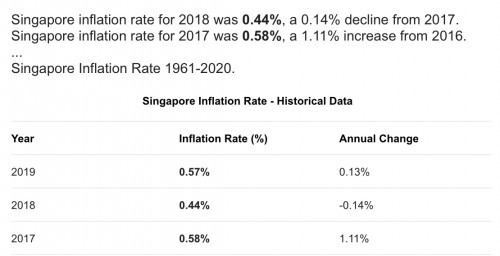
Actually, that depends a lot on the inflation rate in the home country (currency) and the refixing formula (for perpetual bonds). For example, a bond which I’m hoping to get (the seller wants a certain price, I’m offering to buy at a different price - and now the seller wants me to buy 2 lots instead of one in return) has a refixing formula of 4% higher than the prevailing bank rate. So, if interest rates go up, my returns go up in tandem. And inflation is low at the moment. In fact, Singapore is dealing with close to negative inflation thanks to COVID.

user posted image

It may not return as much as your investments, but to say it doesn’t beat inflation may be an over generalisation.

This post has been edited by hksgmy: Sep 3 2020, 09:17 PM
Ramjade
post Sep 3 2020, 09:22 PM

20k VIP Club
*********
All Stars
24,427 posts

Joined: Feb 2011


QUOTE(hksgmy @ Sep 3 2020, 08:58 PM)
Actually, that depends a lot on the inflation rate in the home country (currency) and the refixing formula (for perpetual bonds). For example, a bond which I’m hoping to get (the seller wants a certain price, I’m offering to buy at a different price - and now the seller wants me to buy 2 lots instead of one in return) has a refixing formula of 4% higher than the prevailing bank rate. So, if interest rates go up, my returns go up in tandem. And inflation is low at the moment. In fact, Singapore is dealing with close to negative inflation thanks to COVID.

user posted image

It may not return as much as your investments, but to say it doesn’t beat inflation may be an over generalisation.
*
Don't look at current inflation. Use 2% inflation for calculations. Then see if your price of food/stuff you want to buy does it increase in money by next year? Good place is when you do groceries and when you go out for say eating hawker food/ buying a piece of curry puff. That's real life inflation.
TShksgmy
post Sep 3 2020, 09:34 PM

Doraemon!
*******
Senior Member
7,847 posts

Joined: Sep 2019
Take away the cost of houses and cars (all paid up), inflation in Singapore is quite well controlled - for political reasons: thankfully the cost of chicken rice can still be only $2.50 at some stalls.
Emily Ratajkowski
post Sep 3 2020, 09:40 PM

Casual
***
Junior Member
444 posts

Joined: Nov 2014
QUOTE(Ramjade @ Sep 3 2020, 08:51 PM)
Bonds do not beat inflation. I will put into PE funds.
*
Again... when you have too much money, bonds are the safest thing with potential to beat inflation.
There is simply nothing else you can sink your money in. Everything else carries a higher risk.
PE funds may generate more return. But are they safe? Definitely not as safe as government backed bonds.

We will never utilize bonds to it's full and intended purpose. But bonds will be here to stay.
TShksgmy
post Sep 3 2020, 10:05 PM

Doraemon!
*******
Senior Member
7,847 posts

Joined: Sep 2019
QUOTE(Emily Ratajkowski @ Sep 3 2020, 09:40 PM)
Again... when you have too much money, bonds are the safest thing with potential to beat inflation.
There is simply nothing else you can sink your money in. Everything else carries a higher risk.
PE funds may generate more return. But are they safe? Definitely not as safe as government backed bonds.

We will never utilize bonds to it's full and intended purpose. But bonds will be here to stay.
*
Good comment. All I can say is that each of us will have our preferences and risk tolerance, as well as the financial wherewithal to choose the asset classes that best fit our profiles.

If it were a single gold standard, a “one ring to rule them all” asset class - then, we’d all be making a beeline for that to the exclusion of all other legitimate instruments.

I’m old enough to know that different strokes for different folks - and your mileage may vary smile.gif
viruz
post Sep 3 2020, 10:37 PM

Enthusiast
*****
Senior Member
820 posts

Joined: Jan 2003


I bought several bonds from OCBC bank Malaysia, such as HSBC GBP bond which yield 5% coupon annually, and NAB CNY bond which gives 4 or 4.5% (can't remember) annually, and several other CNY bond sold by UOB Malaysia.

Ya bond is boring, and it's yield can dropped as well, for example during the early stage of COVID-19 where market entered sell everything sentiment, my bond price all went below my purchased price, but now all recovered almost fully.
Rinth
post Sep 4 2020, 09:45 AM

Regular
******
Senior Member
1,263 posts

Joined: Oct 2016
QUOTE(hksgmy @ Sep 3 2020, 12:36 PM)
Hello everyone.

After a cursory search through the F/B/I threads, I realise there isn't much information around for the investor who might be interested in buying whole retail bonds (not via a bond fund), and since bonds have been my preferred asset class for the past few years, I thought I'd share the little that I know, and I'd be very grateful for any input or comments or corrections by the real experts here.

What are bonds?

Bonds are debts or a fancy IOU note issued by companies or corporations or even governments. Bonds usually come in 2 flavours:

1. Those with a fixed maturity date, by which time the bond “matures”, the debt is paid in addition to whatever coupon (“interest”) that is promised every quarterly/half-yearly or annually and is considered “redeemed”
2. Those with no fixed maturity date (termed “perpetual” bonds), but usually have a “callable date”, in which the issuer has the option of redeeming the debt as per no.1 above. Otherwise, the bond continues to be valid and the coupon continues to be paid

Perpetual bonds also usually come with a “re-fix”, by which the coupon is re-pegged and re-adjusted at the “callable date” if the option of redeeming it has not been exercised by the issuer. The re-fix is usually the prevailing interest rate or base lending rate or some other point of reference, plus a premium (which will usually be clearly indicated on the bond prospectus) to account for the risks the bond holder takes on in buying & holding the issuer’s bonds.

What are secured vs unsecured bonds?

Bonds can also be secured, or unsecured junior or senior subordinated, or unsecured & unsubordinated. Essentially, these are sub-divisions within the bond offering to determine the priority in which debt will be repaid in the event of a catastrophic meltdown (i.e. the company going bankrupt or becoming insolvent and is placed under judicial management). Secured bonds will always be paid first – although a haircut is expected, and the investor cannot be expected to get his or her full capital back, followed by the others. Unsecured and unsubordinated bonds will be paid last – and the investors may get nothing back!

Realistically, most retail investors like myself can never hope to get secured bonds – those would likely be snapped by institutional investors. The best we can ever hope for realistically are the unsecured subordinated offerings – but, to be honest, this sub-category isn’t really as important as the next which I’ll be discussing, because if the company folds, the money is as good as lost.

What are investment grade vs unrated bonds?

By definition, investment grade bonds are bonds which have been given a rating of no less than Baa3 (Moody’s), or BBB- (S&P & Fitch). And, various different book-runners (i.e. the banks that are in charge of the bond’s IPO) may then assign in-house rating guides as to the “safety” of these IG bonds. Maybank, for example, assigns an in-house system of IG1 (highest rating, as close to sovereign AAA bonds as you can get) to IG10 (lowest rating, but still investment grade). Different banks/brokerage houses will assign different internal rating guides, but they usually work along the same principles.

“Unrated” bonds can these can be further subdivided into 2 broad categories.

Bonds may be unrated if the company is very well known locally, and the bond IPO is mainly for the domestic market. An example I will quote is a well-known local entity in Singapore, Mapletree. Mapletree came up with a bond a few years ago, which was unrated, but it was quickly snapped up by retail and institutional investors. The reason for it was simple – Mapletree is wholly owned by Temasek Holdings Pte, and that was all the backing that investors needed.

Bonds may also be unrated “junk” bonds. These bonds usually carry a high yield (my personal cut off is anything more than a coupon yield of 6%), and correspondingly, these bonds will come with a higher risk. A classic case of such a bond that folded spectacularly is Singapore’s Hyflux. Bond defaults in Oil & Gas companies and Off Shore marine companies have also been on the rise, as the result of the recent economy downturn and the plunge in oil & gas prices.

Common wisdom would therefore dictate that the safer bonds are those which have are rated as investment grade offerings.

What type of investors are suited for bonds?

As my learned colleagues have opined correctly, bonds are not for everyone. Firstly, the capital outlay required for bonds can be prohibitive, especially for someone starting out in their investment journey. In Singapore for example, the minimum “entry” purchase is $250,000 per “whole” bond. In Australia, the entry criteria ranges from AUD200,000 to AUD250,000 per bond. Different countries will obviously have different purchase requirements.

Alternately, bonds may be purchased in parts, through a bond fund – but that’s outside the scope of this discussion.

So, who then is the typical bond buyer? It’s usually an older investor, who can ill-afford the inherent volatility of stocks or other assets/instruments with higher yields but come with higher risks. Bonds (especially investment grade ones) are often considered “boring” and rank amongst the safer asset classes.

Case in point, when I purchased a bunch of Equity-Linked Notes about a year ago, every one of those purchases had to be done in person, with my personal banker coming to see my wife and I at our house and we would sign the documents after a lengthy waiver and disclaimer lecture. With bonds, my bankers can do voice verification over the phone, as long as what we are buying are investment grade bonds.

Bonds, being “safer” (but not without its risks – e.g. when the company goes bankrupt!), also pays a lower yield, when compared to shares or stocks or ELNs. A decent yield from an investment grade bond is around 3 – 4%, some older IG bonds may offer up to 5%, but that’s quite rare in today’s environment. In contrast, the ELN plays my wife and I committed to last year offered 10% in returns, but came with much sleepless nights, especially when COVID-19 happened. My bonds kept chugging along in their quiet, unobtrusive way, paying me the coupons when they were due, with nary a complaint or a peep.

So, a younger investor, with a smaller “war chest” and a longer run of economic productivity in terms of working life might not find bonds all that attractive. More mature investors who are now in the phase of wealth preservation as opposed to outright wealth accumulation/generation are more the target demographic of purchasers. Bonds are usually also less volatile, and less likely to need close monitoring, so they are more suited for the busy investor who might want to “fire and forget”, and may not have time to squint over price movements on a screen.

Final miscellaneous notes

I would recommend only ever buying bonds in your “home” currency, to minimize the effects of currency exchange rates and fluctuations. That’s why I only ever purchase bonds in SGD and AUD, as I don’t mind holding currencies in these 2 denominations.

Sometimes, bonds can show sharp capital appreciation, and these can be realised for profit, as was the case when I picked up blue chip bonds of Singapore’s local banks for below their IPO price during the earliest weeks of COVID-19 and there was mass selling in the market. Now, they’ve not only recovered but broadly appreciated in price.

Bonds are traded on the open market, and the final payment is the sum of the offer price plus the interest accrued, so you’ll have to factor that into the cost involved, as well as the final yield to maturity or yield to call, as a result of the offer price being higher than the IPO price.

I am sure I would have missed out on a great many other details – so if anyone else has comments and opinions to offer, please do so and we can all benefit together!
*
Thanks for the info. Great info sharing there. I always know that bond is normally out for normal people that taking salaries as the entry is high, but didnt expect it to be so high @ RM 250k per bond.

I'm just turned 30 this year and most probably wont touch bond at the near future, as i'm still planning to invest in real estate 1st to build up rental income as my passive income in future.

I always have this question and maybe you can give some opinion on this :-

1) whats the main different between bond & fixed deposit? (other than fixed deposit has lower interest rates compared to bond, because to me seems like both serving same purposes, except that bond can be traded)

2) for us Malaysian, upon retiring at age 60, is it wiser to remain our EPF fund in our EPF and withdraw it upon usage to earn the higher interest rate or venture to bond? (assuming lets say you have RM 2.5 mil today at age 60, its better to put the whole money in EPF to earn interest at maybe average 5% at today's market OR buy 10 bond of RM 250k?)

Thanks in advance for your comment. thumbup.gif

mmweric
post Sep 4 2020, 10:59 AM

Getting Started
**
Junior Member
156 posts

Joined: Jan 2020
Would like to add a bit. I am currently 46 and retired early at 42. I have owned direct bonds before but currently have moved to bond funds.

In my personal opinion what asset classes you have in your investment portfolio depends on your cashflow requirements, risk capacity and risk tolerance.

Bonds are bought for fixed income, high liquidity and low risk to capital (that is if you buy portfolio of investment grade bonds ).

If you're young and have a steady job it might make more sense to have a higher percentage of your investments in more high risk assets like equity as you have steady income and lots of time to accumulate more wealth and higher capacity to recover from a huge lost.

If you are older and retired bonds it make more sense to allocate a bit to bonds as you are no longer in the accumulation phase you can't take a big loss and have no more income.

For me I keep my spare cash basically 1.5 years spending in a bond fund. And 6 months in FD giving me a 2 year buffer.

In Malaysia bond ratings are down by either MARC or RAM. I wouldn't buy any bonds which are unrated or perpetual as the risk is too high for me. Having a ladder of diredt bonds is a great way to have a secured income but not really practical in Malaysia.

It is almost impossible to buy 5 to 6 direct investment grade bonds with different maturities as the supply is quite limited hence I would feel buying a bond fund would be easier and more practical. After bank charges for their markup etc it is not that cheap also.

One thing for us malaysians who were employed and are retiring we don't really have to keep that much in bonds as we have a huge chunk of money in our epf which has a guaranteed return of 2.5% and a rolling target of 3.5% above inflation which is better then any bond so it would be better to just leave your money in epf acting as some sort of bond allocation in your portfolio.

This post has been edited by mmweric: Sep 4 2020, 11:00 AM
MUM
post Sep 4 2020, 11:15 AM

10k Club
********
All Stars
14,959 posts

Joined: Mar 2015

QUOTE(Rinth @ Sep 4 2020, 09:45 AM)
Thanks for the info. Great info sharing there. I always know that bond is normally out for normal people that taking salaries as the entry is high, but didnt expect it to be so high @ RM 250k per bond.
according to this site....
BOND EXPRESS - RETAIL BONDS
24 Hours. Non-stop. Real-time Trading.

Now everyone can trade bonds from as low as MYR1,000 (nominal value).

https://www.fundsupermart.com.my/fsm/bonds/Bond%20Express

I'm just turned 30 this year and most probably wont touch bond at the near future, as i'm still planning to invest in real estate 1st to build up rental income as my passive income in future.

while you are in the process of doing that, why not use your available money to invest into other things to help maximizing returns and for diversification?

I always have this question and maybe you can give some opinion on this :-

1) whats the main different between bond & fixed deposit? (other than fixed deposit has lower interest rates compared to bond, because to me seems like both serving same purposes, except that bond can be traded)
other than as highlighted by you ..."fixed deposit has lower interest rates compared to bond", the other one main reason is i think is FD has to wait till maturity to redeem else will lose the interest, while Bond has is more flexible as it can be traded otc.

2) for us Malaysian, upon retiring at age 60, is it wiser to remain our EPF fund in our EPF and withdraw it upon usage to earn the higher interest rate or venture to bond? (assuming lets say you have RM 2.5 mil today at age 60, its better to put the whole money in EPF to earn interest at maybe average 5% at today's market OR buy 10 bond of RM 250k?)
the better when comes to lesser risk would be EPF as bond can have default
the better when it comes to returns would be which of this 2 instruments would gives you higher returns.


Thanks in advance for your comment. thumbup.gif
*
well, that is my kay poh thought while waiting for his responses to your post...

This post has been edited by MUM: Sep 4 2020, 11:17 AM
Ramjade
post Sep 4 2020, 11:19 AM

20k VIP Club
*********
All Stars
24,427 posts

Joined: Feb 2011


QUOTE(hksgmy @ Sep 3 2020, 12:36 PM)
Hello everyone.

After a cursory search through the F/B/I threads, I realise there isn't much information around for the investor who might be interested in buying whole retail bonds (not via a bond fund), and since bonds have been my preferred asset class for the past few years, I thought I'd share the little that I know, and I'd be very grateful for any input or comments or corrections by the real experts here.

What are bonds?

Bonds are debts or a fancy IOU note issued by companies or corporations or even governments. Bonds usually come in 2 flavours:

1. Those with a fixed maturity date, by which time the bond “matures”, the debt is paid in addition to whatever coupon (“interest”) that is promised every quarterly/half-yearly or annually and is considered “redeemed”
2. Those with no fixed maturity date (termed “perpetual” bonds), but usually have a “callable date”, in which the issuer has the option of redeeming the debt as per no.1 above. Otherwise, the bond continues to be valid and the coupon continues to be paid

Perpetual bonds also usually come with a “re-fix”, by which the coupon is re-pegged and re-adjusted at the “callable date” if the option of redeeming it has not been exercised by the issuer. The re-fix is usually the prevailing interest rate or base lending rate or some other point of reference, plus a premium (which will usually be clearly indicated on the bond prospectus) to account for the risks the bond holder takes on in buying & holding the issuer’s bonds.

What are secured vs unsecured bonds?

Bonds can also be secured, or unsecured junior or senior subordinated, or unsecured & unsubordinated. Essentially, these are sub-divisions within the bond offering to determine the priority in which debt will be repaid in the event of a catastrophic meltdown (i.e. the company going bankrupt or becoming insolvent and is placed under judicial management). Secured bonds will always be paid first – although a haircut is expected, and the investor cannot be expected to get his or her full capital back, followed by the others. Unsecured and unsubordinated bonds will be paid last – and the investors may get nothing back!

Realistically, most retail investors like myself can never hope to get secured bonds – those would likely be snapped by institutional investors. The best we can ever hope for realistically are the unsecured subordinated offerings – but, to be honest, this sub-category isn’t really as important as the next which I’ll be discussing, because if the company folds, the money is as good as lost.

What are investment grade vs unrated bonds?

By definition, investment grade bonds are bonds which have been given a rating of no less than Baa3 (Moody’s), or BBB- (S&P & Fitch). And, various different book-runners (i.e. the banks that are in charge of the bond’s IPO) may then assign in-house rating guides as to the “safety” of these IG bonds. Maybank, for example, assigns an in-house system of IG1 (highest rating, as close to sovereign AAA bonds as you can get) to IG10 (lowest rating, but still investment grade). Different banks/brokerage houses will assign different internal rating guides, but they usually work along the same principles.

“Unrated” bonds can these can be further subdivided into 2 broad categories.

Bonds may be unrated if the company is very well known locally, and the bond IPO is mainly for the domestic market. An example I will quote is a well-known local entity in Singapore, Mapletree. Mapletree came up with a bond a few years ago, which was unrated, but it was quickly snapped up by retail and institutional investors. The reason for it was simple – Mapletree is wholly owned by Temasek Holdings Pte, and that was all the backing that investors needed.

Bonds may also be unrated “junk” bonds. These bonds usually carry a high yield (my personal cut off is anything more than a coupon yield of 6%), and correspondingly, these bonds will come with a higher risk. A classic case of such a bond that folded spectacularly is Singapore’s Hyflux. Bond defaults in Oil & Gas companies and Off Shore marine companies have also been on the rise, as the result of the recent economy downturn and the plunge in oil & gas prices.

Common wisdom would therefore dictate that the safer bonds are those which have are rated as investment grade offerings.

What type of investors are suited for bonds?

As my learned colleagues have opined correctly, bonds are not for everyone. Firstly, the capital outlay required for bonds can be prohibitive, especially for someone starting out in their investment journey. In Singapore for example, the minimum “entry” purchase is $250,000 per “whole” bond. In Australia, the entry criteria ranges from AUD200,000 to AUD250,000 per bond. Different countries will obviously have different purchase requirements.

Alternately, bonds may be purchased in parts, through a bond fund – but that’s outside the scope of this discussion.

So, who then is the typical bond buyer? It’s usually an older investor, who can ill-afford the inherent volatility of stocks or other assets/instruments with higher yields but come with higher risks. Bonds (especially investment grade ones) are often considered “boring” and rank amongst the safer asset classes.

Case in point, when I purchased a bunch of Equity-Linked Notes about a year ago, every one of those purchases had to be done in person, with my personal banker coming to see my wife and I at our house and we would sign the documents after a lengthy waiver and disclaimer lecture. With bonds, my bankers can do voice verification over the phone, as long as what we are buying are investment grade bonds.

Bonds, being “safer” (but not without its risks – e.g. when the company goes bankrupt!), also pays a lower yield, when compared to shares or stocks or ELNs. A decent yield from an investment grade bond is around 3 – 4%, some older IG bonds may offer up to 5%, but that’s quite rare in today’s environment. In contrast, the ELN plays my wife and I committed to last year offered 10% in returns, but came with much sleepless nights, especially when COVID-19 happened. My bonds kept chugging along in their quiet, unobtrusive way, paying me the coupons when they were due, with nary a complaint or a peep.

So, a younger investor, with a smaller “war chest” and a longer run of economic productivity in terms of working life might not find bonds all that attractive. More mature investors who are now in the phase of wealth preservation as opposed to outright wealth accumulation/generation are more the target demographic of purchasers. Bonds are usually also less volatile, and less likely to need close monitoring, so they are more suited for the busy investor who might want to “fire and forget”, and may not have time to squint over price movements on a screen.

Final miscellaneous notes

I would recommend only ever buying bonds in your “home” currency, to minimize the effects of currency exchange rates and fluctuations. That’s why I only ever purchase bonds in SGD and AUD, as I don’t mind holding currencies in these 2 denominations.

Sometimes, bonds can show sharp capital appreciation, and these can be realised for profit, as was the case when I picked up blue chip bonds of Singapore’s local banks for below their IPO price during the earliest weeks of COVID-19 and there was mass selling in the market. Now, they’ve not only recovered but broadly appreciated in price.

Bonds are traded on the open market, and the final payment is the sum of the offer price plus the interest accrued, so you’ll have to factor that into the cost involved, as well as the final yield to maturity or yield to call, as a result of the offer price being higher than the IPO price.

I am sure I would have missed out on a great many other details – so if anyone else has comments and opinions to offer, please do so and we can all benefit together!
*
Your expertise is needed
prophetjul, guy3288
TShksgmy
post Sep 4 2020, 02:08 PM

Doraemon!
*******
Senior Member
7,847 posts

Joined: Sep 2019
QUOTE(Rinth @ Sep 4 2020, 09:45 AM)
I'm just turned 30 this year and most probably wont touch bond at the near future, as i'm still planning to invest in real estate 1st to build up rental income as my passive income in future.


Hi Rinth,

My wife and I started investing in properties in Singapore and Australia in our early baby steps towards financial freedom. This was about 20 years ago, in our early 30’s. Looking back, we might have opted to do things differently (but bear in mind, your mileage may vary), for the following reasons:

1. We decided to not have children so there’s really no one for us to pass this portfolio over to anyone. In the chance that we wish to sell, then there’ll be the risk (as with anything) with capital losses.
2. Properties come with their hassles of tenants and need for repairs and need for refurbishment and upkeep. There are also other ancillary costs associated such as property taxes, land taxes, council taxes, taxes on rental (bond and stocks are tax free in Singapore), agent fees and repair costs as mentioned above
3. Property is really illiquid. If you need cash all of a sudden, it’s hard to get rid of
4. Servicing the mortgages meant money lost to interest charged

QUOTE
I always have this question and maybe you can give some opinion on this :-

1) whats the main different between bond & fixed deposit? (other than fixed deposit has lower interest rates compared to bond, because to me seems like both serving same purposes, except that bond can be traded)


Apart from that which you mentioned and what MUM added, FDs are also guaranteed by the government up to a certain amount. Beyond that sum, you’re on your own and if the bank folds, you’ll lose that portion that is unprotected.

QUOTE
2) for us Malaysian, upon retiring at age 60, is it wiser to remain our EPF fund in our EPF and withdraw it upon usage to earn the higher interest rate or venture to bond? (assuming lets say you have RM 2.5 mil today at age 60, its better to put the whole money in EPF to earn interest at maybe average 5% at today's market OR buy 10 bond of RM 250k?)


I’m still Malaysian - it’s just that I work in Singapore and my money is stuck in the CPF, but the same concerns are raised. And my answer is the same: Unless you have need for your money, I’d keep that portion which is in the CPF untouched, as the interest and sum is 100% guaranteed and protected. Right now, it’s making me 2.5% and 4% respectively and one should never ever discount the power of compounding.

However, if you feel you can purchase a good selection of IG bonds that offer a higher yield that what the EPF/CPF can do, then by all means, go for it - but is probably wiser to NOT put all your eggs into one instrument alone and instead, diversify amongst different asset classes for safety.

Hope that helps. I’m not an expert by any means. To honest truth and I’ll put it on record again, is that my wife and I have relatively outsized salaries and that’s helped us build up our war chest to invest the way we do.

In fact, just today, I finally pulled the trigger on 2 lots of an NAB bond in AUD that I had been eyeing for a while - managed to negotiate the price to a level I was happy to buy in smile.gif

This post has been edited by hksgmy: Sep 4 2020, 02:48 PM
Ramjade
post Sep 4 2020, 02:20 PM

20k VIP Club
*********
All Stars
24,427 posts

Joined: Feb 2011


For me EPF is my bond part. That's why dump my parents money into EPF since FD is so low.
TShksgmy
post Sep 4 2020, 02:24 PM

Doraemon!
*******
Senior Member
7,847 posts

Joined: Sep 2019
QUOTE(Ramjade @ Sep 4 2020, 02:20 PM)
For me EPF is my bond part. That's why dump my parents money into EPF since FD is so low.
*
Yes. That’s actually a very appropriate way to look at it smile.gif a lot of my fellow workers here in Singapore keep complaining about how their CPF is all tied up etc - but it’s guaranteed money!!
Ramjade
post Sep 4 2020, 02:36 PM

20k VIP Club
*********
All Stars
24,427 posts

Joined: Feb 2011


QUOTE(hksgmy @ Sep 4 2020, 02:24 PM)
Yes. That’s actually a very appropriate way to look at it smile.gif a lot of my fellow workers here in Singapore keep complaining about how their CPF is all tied up etc - but it’s guaranteed money!!
*
I learned from ASSI. CPF is actually the best type of bond you can get. 4%p.a fixed rate. AAA rated. Where to find a AAA rated bond giving 4%?
For me I didn't add more into EPF when PM announce that going to have more salary (11%->8%) cause I know I can get more than EPF returns.

This post has been edited by Ramjade: Sep 4 2020, 02:36 PM

4 Pages  1 2 3 > » Top
 

Change to:
| Lo-Fi Version
0.0285sec    1.21    5 queries    GZIP Disabled
Time is now: 19th December 2025 - 01:53 AM