Welcome Guest ( Log In | Register )

Outline · [ Standard ] · Linear+

 is it recommended to get high loan margin, for investment property

views
     
TStimidandslow
post Dec 4 2019, 05:35 PM, updated 7y ago

Getting Started
**
Junior Member
80 posts

Joined: Nov 2019
currently i have rm200k sitting in FD. i am planning to buy property which costs rm400k for investment.
my question is , should i take a 50% loan and use my FD to pay 50% downpayment?
or , take a 90% flexi loan then move my FD into the mortgage to reduce the interest payable ?

This post has been edited by timidandslow: Dec 4 2019, 05:40 PM
dwRK
post Dec 4 2019, 06:26 PM

the consummate chartist
*******
Senior Member
6,248 posts

Joined: Jun 2006


QUOTE(timidandslow @ Dec 4 2019, 05:35 PM)
currently i have rm200k sitting in FD. i am planning to buy property which costs rm400k for investment.
my question is , should i take a 50% loan and use my FD to pay 50% downpayment?
or , take a 90% flexi loan then move my FD into the mortgage to reduce the interest payable ?
*
90% loan, $ into epf or anything giving more than 5-6% returns
TStimidandslow
post Dec 4 2019, 09:52 PM

Getting Started
**
Junior Member
80 posts

Joined: Nov 2019
QUOTE(dwRK @ Dec 4 2019, 06:26 PM)
90% loan, $ into epf or anything giving more than 5-6% returns
*
1. mortgage currently is around BR - 2.2 which is around 4% right ? but its reducing balance . and there are additional costs involved with mortgage such as legal fees and MRTA which depends on how much I borrow. while FD best rates are currently around 4% .

2. epf has a annual contribution cap of 50k. plus epf is stuck until age 55.


MUM
post Dec 4 2019, 10:04 PM

10k Club
********
All Stars
14,965 posts

Joined: Mar 2015

QUOTE(timidandslow @ Dec 4 2019, 05:35 PM)
currently i have rm200k sitting in FD. i am planning to buy property which costs rm400k for investment.
my question is , should i take a 50% loan and use my FD to pay 50% downpayment?
or , take a 90% flexi loan then move my FD into the mortgage to reduce the interest payable ?
*
do you need to spend on renovation and legal fees?
your 200k in FD if used to pay those,...how much will balance?

btw, regarding the EPF thing.....read before, "use proxy" such as parents for self contribution thus no need to wait till 55 yrs old
dwRK
post Dec 4 2019, 10:06 PM

the consummate chartist
*******
Senior Member
6,248 posts

Joined: Jun 2006


QUOTE(timidandslow @ Dec 4 2019, 09:52 PM)
1. mortgage currently is around BR - 2.2 which is around 4% right ? but its reducing balance . and there are additional costs involved with mortgage such as legal fees and MRTA which depends on how much  I borrow. while FD best rates are currently around 4% .

2. epf has a annual contribution cap of 50k. plus epf is stuck until age 55.
*
correct...

the real question is do you foresee needing 200k in the near future? do you have emergency funds...this decide 90% loan or not

dumping into the house and smaller loan, about the same as dumping into epf wrt the 200k...gone from your pocket for a long time. you work your maths and see which is better lor

dwRK
post Dec 4 2019, 10:09 PM

the consummate chartist
*******
Senior Member
6,248 posts

Joined: Jun 2006


QUOTE(MUM @ Dec 4 2019, 10:04 PM)
do you need to spend on renovation and legal fees?
your 200k in FD if used to pay those,...how much will balance?

btw, regarding the EPF thing.....read before, "use proxy" such as parents for self contribution thus no need to wait till 55 yrs old
*
plus if epf more than a mil or something can take out anytime

also can take out for renovations, upgrades...
hksgmy
post Dec 4 2019, 10:48 PM

Doraemon!
*******
Senior Member
7,847 posts

Joined: Sep 2019
I can't speak for everyone, as each person's financial standing will obviously be different, but here's how we did it for our biggest property purchase (a $6,500,000 freehold landed house nestled within District 10, in Singapore). This is our background:

1. Cash/FD holdings (at that point - this was about nearly 8 or 9 years ago): $3,000,000 - this was money that we had set aside for the purchase of this particular property. We did have other sources of funds, but those were in less liquid instruments (mainly bonds and blue chips)
2. The developer was willing to absorb the buyer's stamp duty (3%) & also to offer us a "renovation rebate" of nearly $150,000
3. FD rates were a measly 1.5% (that was back in the days of Quantitative Easing & furious greenback printing by the US Fed Reserve)
4. Mortgage loans rates were even more laughable, at 0.8% (floating) - lock in period 2 or 3 years

The "smart" thing to do, so all our relatives told us (and if I had known about lowyat.net back then, I reckon quite a few of the gurus here would have said the same thing) was to keep the cash in the FD, generating 1.5% interest, while maximizing the loan tenure & amount (back then, there was no TDSR (total debt service ratio) and we could borrow up to 90%). As a Malaysian PR, I cannot legally buy a landed freehold property in Singapore, but since my wife had taken up Singapore citizenship, she could - and I could act as a co-guarantor for the loan. This way, we were already making money, by earning the 1.5%, while the bank was charging us at 0.8%.

On closer scrutiny, a few issues cropped up:

1. 1.5% per annum is on $3,000,000
2. 0.8% per annum translates to a higher "effective interest rate" because of amortization, which front loads quite a bit of interest repayments in the INITIAL repayment periods, before the capital gets repaid
3. And the 0.8% is on a $5,850,000 total loan
4. Edited to add this important point: I didn’t think I was financially savvy to risk the $3,000,000 on instruments with higher returns, seeing how the money was initially earmarked for the house purchase

Immediately, that should tell you that I'd end up paying far more interest than I'd be making interest.

So, thanks but no thanks, we bit the bullet and used our $3,000,000 to offset the purchase price, thus taking out a loan on the $3,150,000 over 20 years. We then continued to pare down the principal with capital pre-payments (this was a floating rate), and paid off the entire mortgage the minute we were able to do so without penalty (If I'm not mistaken, we managed to clear the whole lot within 5 or 6 years).

For those who are not acquainted with our backgrounds, I'll take this opportunity to rehash: I'm a medical specialist in private practice (have been for the past 15 years) and my wife is a chartered accountant who used to work in a senior role for one of the big firms, so financially, we were upper middle class. Again, I reiterate, what we did may not be applicable to everyone - but in my humble opinion, the principles of calculation can be universally applied.

I can see parallels in TS' question, compared to our own situation, and it is in the interest of sharing that I post the above. Good luck with your decision, however and whichever you decide.

This post has been edited by hksgmy: Dec 4 2019, 11:29 PM
TStimidandslow
post Dec 4 2019, 11:55 PM

Getting Started
**
Junior Member
80 posts

Joined: Nov 2019
QUOTE(hksgmy @ Dec 4 2019, 10:48 PM)
I can't speak for everyone, as each person's financial standing will obviously be different, but here's how we did it for our biggest property purchase (a $6,500,000 freehold landed house nestled within District 10, in Singapore). This is our background:

1. Cash/FD holdings (at that point - this was about nearly 8 or 9 years ago): $3,000,000 - this was money that we had set aside for the purchase of this particular property. We did have other sources of funds, but those were in less liquid instruments (mainly bonds and blue chips)
2. The developer was willing to absorb the buyer's stamp duty (3%) & also to offer us a "renovation rebate" of nearly $150,000
3. FD rates were a measly 1.5% (that was back in the days of Quantitative Easing & furious greenback printing by the US Fed Reserve)
4. Mortgage loans rates were even more laughable, at 0.8% (floating) - lock in period 2 or 3 years

The "smart" thing to do, so all our relatives told us (and if I had known about lowyat.net back then, I reckon quite a few of the gurus here would have said the same thing) was to keep the cash in the FD, generating 1.5% interest, while maximizing the loan tenure & amount (back then, there was no TDSR (total debt service ratio) and we could borrow up to 90%). As a Malaysian PR, I cannot legally buy a landed freehold property in Singapore, but since my wife had taken up Singapore citizenship, she could - and I could act as a co-guarantor for the loan. This way, we were already making money, by earning the 1.5%, while the bank was charging us at 0.8%.

On closer scrutiny, a few issues cropped up:

1. 1.5% per annum is on $3,000,000
2. 0.8% per annum translates to a higher "effective interest rate" because of amortization, which front loads quite a bit of interest repayments in the INITIAL repayment periods, before the capital gets repaid
3. And the 0.8% is on a $5,850,000 total loan
4. Edited to add this important point: I didn’t think I was financially savvy to risk the $3,000,000 on instruments with higher returns, seeing how the money was initially earmarked for the house purchase

Immediately, that should tell you that I'd end up paying far more interest than I'd be making interest.

So, thanks but no thanks, we bit the bullet and used our $3,000,000 to offset the purchase price, thus taking out a loan on the $3,150,000 over 20 years. We then continued to pare down the principal with capital pre-payments (this was a floating rate), and paid off the entire mortgage the minute we were able to do so without penalty (If I'm not mistaken, we managed to clear the whole lot within 5 or 6 years).

For those who are not acquainted with our backgrounds, I'll take this opportunity to rehash: I'm a medical specialist in private practice (have been for the past 15 years) and my wife is a chartered accountant who used to work in a senior role for one of the big firms, so financially, we were upper middle class. Again, I reiterate, what we did may not be applicable to everyone - but in my humble opinion, the principles of calculation can be universally applied.

I can see parallels in TS' question, compared to our own situation, and it is in the interest of sharing that I post the above. Good luck with your decision, however and whichever you decide.
*
in general, it stands to reason that banks will certainly lend out money (mortgage) at a higher rate than they pay on deposits (FD). else how would the bank profit?

and this is in addition to miscellaneous costs like legal fees and mrta which depend on the loan amount.

mini orchard
post Dec 5 2019, 05:13 AM

10k Club
********
All Stars
14,511 posts

Joined: Sep 2017
QUOTE(MUM @ Dec 4 2019, 10:04 PM)
do you need to spend on renovation and legal fees?
your 200k in FD if used to pay those,...how much will balance?

btw, regarding the EPF thing.....read before, "use proxy" such as parents for self contribution thus no need to wait till 55 yrs old
*
Use parents epf account can be troublesome unless ts is the only child.

Some HL do have redraw facility for payment made.

This post has been edited by mini orchard: Dec 5 2019, 05:55 AM
SUSyklooi
post Dec 5 2019, 10:37 AM

Look at all my stars!!
*******
Senior Member
8,188 posts

Joined: Apr 2013


If hv many siblings Parents can use % on setting nomination to cater for the extra from that particular child...
Troublesome of course....
TStimidandslow
post Dec 5 2019, 12:18 PM

Getting Started
**
Junior Member
80 posts

Joined: Nov 2019
QUOTE(mini orchard @ Dec 5 2019, 05:13 AM)
Use parents epf account can be troublesome unless ts is the only child.

Some HL do have redraw facility for payment made.
*
QUOTE(yklooi @ Dec 5 2019, 10:37 AM)
If hv many siblings  Parents can use % on setting nomination to cater for the extra from that particular child...
Troublesome of course....
*
thanks for advice. i believe the epf contribution limit for senior citizens, is 50k per annum per parent
SUSyklooi
post Dec 5 2019, 12:20 PM

Look at all my stars!!
*******
Senior Member
8,188 posts

Joined: Apr 2013


QUOTE(timidandslow @ Dec 5 2019, 12:18 PM)
thanks for advice.  i believe the epf contribution limit for senior citizens,  is 50k per annum per parent
*
hmm.gif I think it is 60k
fun_feng
post Dec 5 2019, 01:03 PM

One Cat to Rule Them ALL
*******
Senior Member
2,289 posts

Joined: Jan 2003
From: Stairway to Heaven
QUOTE(hksgmy @ Dec 4 2019, 10:48 PM)
I can't speak for everyone, as each person's financial standing will obviously be different, but here's how we did it for our biggest property purchase (a $6,500,000 freehold landed house nestled within District 10, in Singapore). This is our background:

1. Cash/FD holdings (at that point - this was about nearly 8 or 9 years ago): $3,000,000 - this was money that we had set aside for the purchase of this particular property. We did have other sources of funds, but those were in less liquid instruments (mainly bonds and blue chips)
2. The developer was willing to absorb the buyer's stamp duty (3%) & also to offer us a "renovation rebate" of nearly $150,000
3. FD rates were a measly 1.5% (that was back in the days of Quantitative Easing & furious greenback printing by the US Fed Reserve)
4. Mortgage loans rates were even more laughable, at 0.8% (floating) - lock in period 2 or 3 years

The "smart" thing to do, so all our relatives told us (and if I had known about lowyat.net back then, I reckon quite a few of the gurus here would have said the same thing) was to keep the cash in the FD, generating 1.5% interest, while maximizing the loan tenure & amount (back then, there was no TDSR (total debt service ratio) and we could borrow up to 90%). As a Malaysian PR, I cannot legally buy a landed freehold property in Singapore, but since my wife had taken up Singapore citizenship, she could - and I could act as a co-guarantor for the loan. This way, we were already making money, by earning the 1.5%, while the bank was charging us at 0.8%.

On closer scrutiny, a few issues cropped up:

1. 1.5% per annum is on $3,000,000
2. 0.8% per annum translates to a higher "effective interest rate" because of amortization, which front loads quite a bit of interest repayments in the INITIAL repayment periods, before the capital gets repaid
3. And the 0.8% is on a $5,850,000 total loan
4. Edited to add this important point: I didn’t think I was financially savvy to risk the $3,000,000 on instruments with higher returns, seeing how the money was initially earmarked for the house purchase

Immediately, that should tell you that I'd end up paying far more interest than I'd be making interest.

So, thanks but no thanks, we bit the bullet and used our $3,000,000 to offset the purchase price, thus taking out a loan on the $3,150,000 over 20 years. We then continued to pare down the principal with capital pre-payments (this was a floating rate), and paid off the entire mortgage the minute we were able to do so without penalty (If I'm not mistaken, we managed to clear the whole lot within 5 or 6 years).

For those who are not acquainted with our backgrounds, I'll take this opportunity to rehash: I'm a medical specialist in private practice (have been for the past 15 years) and my wife is a chartered accountant who used to work in a senior role for one of the big firms, so financially, we were upper middle class. Again, I reiterate, what we did may not be applicable to everyone - but in my humble opinion, the principles of calculation can be universally applied.

I can see parallels in TS' question, compared to our own situation, and it is in the interest of sharing that I post the above. Good luck with your decision, however and whichever you decide.
*
This doesnt make sense.. your 0.8% pa home loan is fixed interest rate??

I don't know about SG, but in MY, both FD and home loan are effective interest rate... generally you just put money into whichever has higher interest..
hksgmy
post Dec 5 2019, 02:25 PM

Doraemon!
*******
Senior Member
7,847 posts

Joined: Sep 2019
QUOTE(fun_feng @ Dec 5 2019, 01:03 PM)
This doesnt make sense.. your 0.8% pa home loan is fixed interest rate??

I don't know about SG, but in MY, both FD and home loan are effective interest rate... generally you just put money into whichever has higher interest..
*
The home loan is a floating loan and a special rate because of the quantum involved. The FD is a fixed rate for 12 or 18 months.

Essentially the logic of my calculation is as follows:

1.25% pa FD on $3m comes up to $37,500 interest per year or $3,125 per month

0.8% (floating, adjuster every 3 months according to the prevailing SIBOR rates + margin) pa mortgage on $5,850,000 following the amortisation schedule of 20y comes up to $45,809 even if I took into consideration that there was no adjustment for the entire first year, or $3,817 per month

The figure is even more eye-watering when you take into consideration the amount I would have paid over 20 years - total additional interest of nearly $485,000.

Based on that closed system calculation, it was better over all for me to reduce the overall loan quantum than for me to do an offset.

inquiries
post Dec 5 2019, 03:40 PM

Getting Started
**
Junior Member
273 posts

Joined: Jan 2017
QUOTE(hksgmy @ Dec 5 2019, 02:25 PM)
The home loan is a floating loan and a special rate because of the quantum involved. The FD is a fixed rate for 12 or 18 months.

Essentially the logic of my calculation is as follows:

1.25% pa FD on $3m comes up to $37,500 interest per year or $3,125 per month

0.8% (floating, adjuster every 3 months according to the prevailing SIBOR rates + margin) pa mortgage on $5,850,000 following the amortisation schedule of 20y comes up to $45,809 even if I took into consideration that there was no adjustment for the entire first year, or $3,817 per month

The figure is even more eye-watering when you take into consideration the amount I would have paid over 20 years - total additional interest of nearly $485,000.

Based on that closed system calculation, it was better over all for me to reduce the overall loan quantum than for me to do an offset.
*
I suspect... that's because you did not factor in the compounding interest of $3m FD for the next 20 years (while the effective rate for house loan has already factored that in).
Anyway I'm just voicing out my 1cent... compared to you and your wife I have measly financial/accounting background. Thanks a lot for sharing your experience here though.
hksgmy
post Dec 5 2019, 03:55 PM

Doraemon!
*******
Senior Member
7,847 posts

Joined: Sep 2019
QUOTE(inquiries @ Dec 5 2019, 03:40 PM)
I suspect... that's because you did not factor in the compounding interest of $3m FD for the next 20 years (while the effective rate for house loan has already factored that in).
Anyway I'm just voicing out my 1cent... compared to you and your wife I have measly financial/accounting background. Thanks a lot for sharing your experience here though.
*
Your assumption was correct, but here’s something else you didn’t take into account:

1. There’s no guarantee that I would enjoy the 1.25% FD rate next year
2. The floating home loan rate could (and did) go up - now, with the Fed Reserve current rates, SGD home loans start at about 2.5%. This is a HUGE increase from the < 1% rate about 8 or 9 years ago.
3. FD rates have not caught up as exponentially - it’s around 1.75% to max 2%, which means the difference is now bigger
4. Monthly repayments for a $5,850,000 mortgage is way more than a $3,000,000 one. Less pressure on me to balance the books

Add all that up, our ultra conservative, closed-system approach (where I only count realised assets as assets for this particular purchase) will start to make a little more sense.

Hope that clarifies,
fun_feng
post Dec 5 2019, 04:32 PM

One Cat to Rule Them ALL
*******
Senior Member
2,289 posts

Joined: Jan 2003
From: Stairway to Heaven
QUOTE(hksgmy @ Dec 5 2019, 02:25 PM)
The home loan is a floating loan and a special rate because of the quantum involved. The FD is a fixed rate for 12 or 18 months.

Essentially the logic of my calculation is as follows:

1.25% pa FD on $3m comes up to $37,500 interest per year or $3,125 per month

0.8% (floating, adjuster every 3 months according to the prevailing SIBOR rates + margin) pa mortgage on $5,850,000 following the amortisation schedule of 20y comes up to $45,809 even if I took into consideration that there was no adjustment for the entire first year, or $3,817 per month

The figure is even more eye-watering when you take into consideration the amount I would have paid over 20 years - total additional interest of nearly $485,000.

Based on that closed system calculation, it was better over all for me to reduce the overall loan quantum than for me to do an offset.
*
You do know you are comparing the interest rate of 3M vs home loan 6M?? Definitely the interest rate of 6M will be higher than 3M.. but as you can see even though the principal amount is 2x, the interest is not 2x more..

You know the interest rate of 3M at 1.25% for 20 yrs is a whooping $851,575.06


QUOTE(hksgmy @ Dec 5 2019, 03:55 PM)
Your assumption was correct, but here’s something else you didn’t take into account:

1. There’s no guarantee that I would enjoy the 1.25% FD rate next year
2. The floating home loan rate could (and did) go up - now, with the Fed Reserve current rates, SGD home loans start at about 2.5%. This is a HUGE increase from the < 1% rate about 8 or 9 years ago.
3. FD rates have not caught up as exponentially - it’s around 1.75% to max 2%, which means the difference is now bigger
4. Monthly repayments for a $5,850,000 mortgage is way more than a $3,000,000 one. Less pressure on me to balance the books

Add all that up, our ultra conservative, closed-system approach (where I only count realised assets as assets for this particular purchase) will start to make a little more sense.

Hope that clarifies,
*
So.... FD rate used to be higher than home loan rate 9 years ago
Now home loan rate is higher than FD rate..
Do they have flexi loan? You can dump money inside and still take it out... You have the flexibility to put FD or home loan whenever one of them is higher... then it will be a win-win situation thumbup.gif

In the end, if you take out the human factor out of it, it's all just mathematics

hksgmy
post Dec 5 2019, 04:43 PM

Doraemon!
*******
Senior Member
7,847 posts

Joined: Sep 2019
QUOTE(fun_feng @ Dec 5 2019, 04:32 PM)
You do know you are comparing the interest rate of 3M vs home loan 6M?? Definitely the interest rate of 6M will be higher than 3M.. but as you can see even though the principal amount is 2x, the interest is not 2x more..

You know the interest rate of 3M at 1.25% for 20 yrs is a whooping $851,575.06
So.... FD rate used to be higher than home loan rate 9 years ago
Now home loan rate is higher than FD rate..
Do they have flexi loan? You can dump money inside and still take it out... You have the flexibility to put FD or home loan whenever one of them is higher... then it will be a win-win situation  thumbup.gif

In the end, if you take out the human factor out of it, it's all just mathematics
*
Yes, my friend, I’m aware it’s 3m vs 6m but that’s the essence of the discussion here - the TS had a substantial amount of money but not in its entirety to cover for the house purchase. Same as my situation,

And, the FD rate of 1.25% was a fixed rate for 1 year, no compounding as it wouldn’t be renewed at the same rate. No bank would pay more % than it charged, unless it was for its own benefit. The 1.25% was so I’d take the loan with them AND keep my money with them at the same time.
dwRK
post Dec 5 2019, 04:48 PM

the consummate chartist
*******
Senior Member
6,248 posts

Joined: Jun 2006


QUOTE(hksgmy @ Dec 4 2019, 10:48 PM)
I can't speak for everyone, as each person's financial standing will obviously be different, but here's how we did it for our biggest property purchase (a $6,500,000 freehold landed house nestled within District 10, in Singapore). This is our background:

1. Cash/FD holdings (at that point - this was about nearly 8 or 9 years ago): $3,000,000 - this was money that we had set aside for the purchase of this particular property. We did have other sources of funds, but those were in less liquid instruments (mainly bonds and blue chips)
2. The developer was willing to absorb the buyer's stamp duty (3%) & also to offer us a "renovation rebate" of nearly $150,000
3. FD rates were a measly 1.5% (that was back in the days of Quantitative Easing & furious greenback printing by the US Fed Reserve)
4. Mortgage loans rates were even more laughable, at 0.8% (floating) - lock in period 2 or 3 years

The "smart" thing to do, so all our relatives told us (and if I had known about lowyat.net back then, I reckon quite a few of the gurus here would have said the same thing) was to keep the cash in the FD, generating 1.5% interest, while maximizing the loan tenure & amount (back then, there was no TDSR (total debt service ratio) and we could borrow up to 90%). As a Malaysian PR, I cannot legally buy a landed freehold property in Singapore, but since my wife had taken up Singapore citizenship, she could - and I could act as a co-guarantor for the loan. This way, we were already making money, by earning the 1.5%, while the bank was charging us at 0.8%.

On closer scrutiny, a few issues cropped up:

1. 1.5% per annum is on $3,000,000
2. 0.8% per annum translates to a higher "effective interest rate" because of amortization, which front loads quite a bit of interest repayments in the INITIAL repayment periods, before the capital gets repaid
3. And the 0.8% is on a $5,850,000 total loan
4. Edited to add this important point: I didn’t think I was financially savvy to risk the $3,000,000 on instruments with higher returns, seeing how the money was initially earmarked for the house purchase

Immediately, that should tell you that I'd end up paying far more interest than I'd be making interest.

So, thanks but no thanks, we bit the bullet and used our $3,000,000 to offset the purchase price, thus taking out a loan on the $3,150,000 over 20 years. We then continued to pare down the principal with capital pre-payments (this was a floating rate), and paid off the entire mortgage the minute we were able to do so without penalty (If I'm not mistaken, we managed to clear the whole lot within 5 or 6 years).

For those who are not acquainted with our backgrounds, I'll take this opportunity to rehash: I'm a medical specialist in private practice (have been for the past 15 years) and my wife is a chartered accountant who used to work in a senior role for one of the big firms, so financially, we were upper middle class. Again, I reiterate, what we did may not be applicable to everyone - but in my humble opinion, the principles of calculation can be universally applied.

I can see parallels in TS' question, compared to our own situation, and it is in the interest of sharing that I post the above. Good luck with your decision, however and whichever you decide.
*
mortgage calculator, 6 mil loan, 0.8% rate, 20 years... interest paid = 495k
interest calculator, 3 mil principal, 1.5% rate, compounded yearly, 20 years... interest earned = 1.04m

vs

3 mil loan, 0.8% rate, 20 yrs...interest paid = 247k

fun_feng
post Dec 5 2019, 05:01 PM

One Cat to Rule Them ALL
*******
Senior Member
2,289 posts

Joined: Jan 2003
From: Stairway to Heaven
QUOTE(hksgmy @ Dec 5 2019, 04:43 PM)
Yes, my friend, I’m aware it’s 3m vs 6m but that’s the essence of the discussion here - the TS had a substantial amount of money but not in its entirety to cover for the house purchase. Same as my situation,

And, the FD rate of 1.25% was a fixed rate for 1 year, no compounding as it wouldn’t be renewed at the same rate. No bank would pay more % than it charged, unless it was for its own benefit. The 1.25% was so I’d take the loan with them AND keep my money with them at the same time.
*
wait what??? the 1.25%FD is tied to the 0.8%loan??

Fren, your situation is very unique and confuse the heck out of me... and as you can see... it confuse other ppl too..

I'm not sure it is helpful to TS here
hksgmy
post Dec 5 2019, 05:05 PM

Doraemon!
*******
Senior Member
7,847 posts

Joined: Sep 2019
QUOTE(fun_feng @ Dec 5 2019, 05:01 PM)
wait what??? the 1.25%FD is tied to the 0.8%loan??

Fren, your situation is very unique and confuse the heck out of me... and as you can see... it confuse other ppl too..

I'm not sure it is helpful to TS here
*
Oh dear. I thought I was being helpful. But it’s hard to explain the finer details on a forum. In any case, the 1.25% was given as an incentive for me to take up the max loan, and to keep the $3,000,000 with them for a year. It is NOT a rolling FD and the interest rate would not be repeated on due date (it’ll revert to the usual existing FD rate in Singapore about 8 or 9 years ago, which was 0.25%).

I apologize if I confused people - I thought it was instantly obvious that the banks would NEVER pay more in FD rates than they could make from lending rates.
TStimidandslow
post Dec 5 2019, 05:07 PM

Getting Started
**
Junior Member
80 posts

Joined: Nov 2019
QUOTE(fun_feng @ Dec 5 2019, 05:01 PM)
wait what??? the 1.25%FD is tied to the 0.8%loan??

Fren, your situation is very unique and confuse the heck out of me... and as you can see... it confuse other ppl too..

I'm not sure it is helpful to TS here
*
i heard of this practice before. in order for the bank to lend you money at preferential rates, the borrower need to pledge certain amount of FD first.
dwRK
post Dec 5 2019, 05:08 PM

the consummate chartist
*******
Senior Member
6,248 posts

Joined: Jun 2006


just realize ts wanna buy for investment/flipping... then is no brainer, maximum loan

roi is profit over capital used...

200k you can down payment a few more liao...hahahaha
dwRK
post Dec 5 2019, 05:10 PM

the consummate chartist
*******
Senior Member
6,248 posts

Joined: Jun 2006


QUOTE(fun_feng @ Dec 5 2019, 05:01 PM)
wait what??? the 1.25%FD is tied to the 0.8%loan??

Fren, your situation is very unique and confuse the heck out of me... and as you can see... it confuse other ppl too..

I'm not sure it is helpful to TS here
*
package deal lah...
TStimidandslow
post Dec 5 2019, 05:13 PM

Getting Started
**
Junior Member
80 posts

Joined: Nov 2019
QUOTE(dwRK @ Dec 5 2019, 05:08 PM)
just realize ts wanna buy for investment/flipping... then is no brainer, maximum loan

roi is profit over capital used...

200k you can down payment a few more liao...hahahaha
*
true, i can leverage my liquid funds to invest in 3 properties.
dwRK
post Dec 5 2019, 05:17 PM

the consummate chartist
*******
Senior Member
6,248 posts

Joined: Jun 2006


QUOTE(hksgmy @ Dec 5 2019, 05:05 PM)
Oh dear. I thought I was being helpful. But it’s hard to explain the finer details on a forum. In any case, the 1.25% was given as an incentive for me to take up the max loan, and to keep the $3,000,000 with them for a year. It is NOT a rolling FD and the interest rate would not be repeated on due date (it’ll revert to the usual existing FD rate in Singapore about 8 or 9 years ago, which was 0.25%).

I apologize if I confused people - I thought it was instantly obvious that the banks would NEVER pay more in FD rates than they could make from lending rates.
*
yeah was a bit confusing also...hahaha...

but epf dividend >> loan rate >> fd rate...

and if savvy enough on investing, you can get 10-15% returns


dwRK
post Dec 5 2019, 05:21 PM

the consummate chartist
*******
Senior Member
6,248 posts

Joined: Jun 2006


QUOTE(timidandslow @ Dec 5 2019, 05:13 PM)
true, i can leverage my liquid funds to invest in 3 properties.
*
then managing cash flow is your priority....overstretched == bank lelong
icemanfx
post Dec 6 2019, 04:14 AM

20k VIP Club
*********
All Stars
21,458 posts

Joined: Jul 2012


QUOTE(timidandslow @ Dec 5 2019, 05:13 PM)
true, i can leverage my liquid funds to invest in 3 properties.
*
Leverage amplify profit as well as losses.

tanas88 P
post Dec 15 2019, 02:21 AM

New Member
*
Probation
2 posts

Joined: Dec 2019
Looking for help to see if I have missed a trick with the maths of a conundrum with the current FD/Home Loan interest rates.

Trying to figure out if better to take home loan of RM 500K at 4.15% for 10Y and keep my savings of RM 500K in FD at 4% for 10Y (recognise this is not a given, and FD rates can change going forward ) or dumping the RM500K into the house and not take the loan.

Somehow, the math shows I am better off taking the loan and keeping my savings in FD.

1. Loan of RM 500K @ 4.15% for 10Y

- Monthly repayment = RM 5098
- Total payment for whole loan = RM 611757

2. Savings of RM 500K @ 4% into FD for 10Y (with the "brave" assumption that this is available and rates remain over the 10Y).

- Value of savings at the end of the 10Y = RM 740122

3. Gain - i.e. (2) minus (1) = RM 128K.

- Hence, above points towards taking the loan, and keeping my savings in FD.
- Above ignored inflation and time value of money for simplification (can't figure out the maths).

Hope to get help on the following

1. Are the numbers correct (with the brave assumption about FD can be available at 4% for 10Y) ?
2. Will impact of inflation (say at 3-4%) change the maths above (can't figure out how to work the maths).....?


Thanks in advance - welcome any wise counsel.

MUM
post Dec 15 2019, 02:54 AM

10k Club
********
All Stars
14,965 posts

Joined: Mar 2015

QUOTE(tanas88 @ Dec 15 2019, 02:21 AM)
................
3. Gain - i.e. (2) minus (1) = RM 128K.

- Hence, above points towards taking the loan, and keeping my savings in FD.
- Above ignored inflation and time value of money for simplification (can't figure out the maths).

Hope to get help on the following

1. Are the numbers correct (with the brave assumption about FD can be available at 4% for 10Y) ?
2. Will impact of inflation (say at 3-4%) change the maths above (can't figure out how to work the maths).....?
Thanks in advance - welcome any wise counsel.
*
the above is good if you can keep on paying the housing loan repayment till the end.
Housing loan works on reducing balance,....every time you do a repayment, the principal is reduced and until a certain period, the amount of repayment you pay is higher than the interest charged amount, thus you pay less interest and pay more principal.
FD works on compounding balance,....every time the interest is added into your principal, the amount of your principal goes bigger, thus you will earn more interest on it and it rolls over and over again.

you cannot see the inflation effect from the maths above, you can only see the effect of it by the lost of purchasing power over time.....

This post has been edited by MUM: Dec 15 2019, 03:02 AM
TStimidandslow
post Dec 15 2019, 11:17 AM

Getting Started
**
Junior Member
80 posts

Joined: Nov 2019
QUOTE(tanas88 @ Dec 15 2019, 02:21 AM)
Looking for help to see if I have missed a trick with the maths of a conundrum with the current FD/Home Loan interest rates.

Trying to figure out if better to take home loan of RM 500K at 4.15% for 10Y and keep my savings of RM 500K in FD at 4% for 10Y (recognise this is not a given, and FD rates can change going forward ) or dumping the RM500K into the house and not take the loan. 

Somehow, the math shows I am better off taking the loan and keeping my savings in FD.

1. Loan of RM 500K @ 4.15% for 10Y

- Monthly repayment = RM 5098
- Total payment for whole loan = RM 611757

2. Savings of RM 500K @ 4% into FD for 10Y (with the "brave" assumption that this is available and rates remain over the 10Y).

- Value of savings at the end of the 10Y = RM 740122

3. Gain - i.e. (2) minus (1) = RM 128K.

- Hence, above points towards taking the loan, and keeping my savings in FD.
- Above ignored inflation and time value of money for simplification (can't figure out the maths).

Hope to get help on the following

1. Are the numbers correct (with the brave assumption about FD can be available at 4% for 10Y) ?
2. Will impact of inflation (say at 3-4%) change the maths above (can't figure out how to work the maths).....?
Thanks in advance - welcome any wise counsel.
*
taking loan has ancillary costs - mrta, legal fee, valuer fee

This post has been edited by timidandslow: Dec 15 2019, 11:18 AM
hksgmy
post Dec 15 2019, 10:19 PM

Doraemon!
*******
Senior Member
7,847 posts

Joined: Sep 2019
QUOTE(tanas88 @ Dec 15 2019, 02:21 AM)
Looking for help to see if I have missed a trick with the maths of a conundrum with the current FD/Home Loan interest rates.

Trying to figure out if better to take home loan of RM 500K at 4.15% for 10Y and keep my savings of RM 500K in FD at 4% for 10Y (recognise this is not a given, and FD rates can change going forward ) or dumping the RM500K into the house and not take the loan. 

Somehow, the math shows I am better off taking the loan and keeping my savings in FD.

1. Loan of RM 500K @ 4.15% for 10Y

- Monthly repayment = RM 5098
- Total payment for whole loan = RM 611757

2. Savings of RM 500K @ 4% into FD for 10Y (with the "brave" assumption that this is available and rates remain over the 10Y).

- Value of savings at the end of the 10Y = RM 740122

3. Gain - i.e. (2) minus (1) = RM 128K.

- Hence, above points towards taking the loan, and keeping my savings in FD.
- Above ignored inflation and time value of money for simplification (can't figure out the maths).

Hope to get help on the following

1. Are the numbers correct (with the brave assumption about FD can be available at 4% for 10Y) ?
2. Will impact of inflation (say at 3-4%) change the maths above (can't figure out how to work the maths).....?
Thanks in advance - welcome any wise counsel.
*
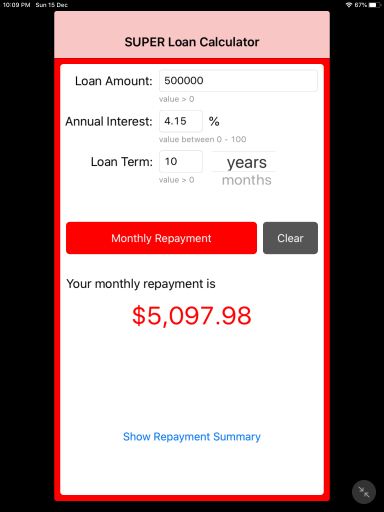
I’ll show you the amortization calculator and you decide whether you’ve calculated correctly or otherwise:

user posted image

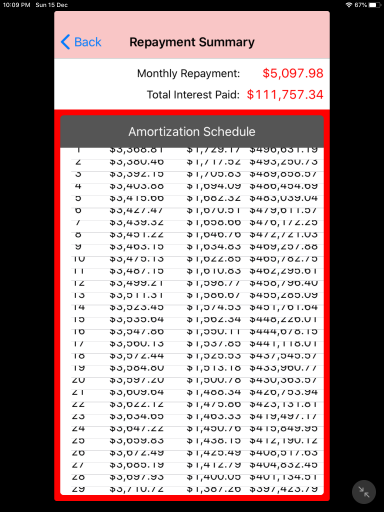
And the total interest paid at the end of 10 years:

user posted image

You can check that with any online amortization calculator.

Good luck.


tanas88 P
post Dec 18 2019, 02:08 AM

New Member
*
Probation
2 posts

Joined: Dec 2019
Thanks for the comments


Change to:
| Lo-Fi Version
0.0227sec    0.36    5 queries    GZIP Disabled
Time is now: 22nd December 2025 - 03:59 PM