Outline ·
[ Standard ] ·
Linear+
LYN Christian Fellowship Thread Ver 15
|
Yggdrasil
|
 Oct 13 2019, 12:03 AM Oct 13 2019, 12:03 AM
|

|
My goodness. Is this thread about Christians arguing with each other about who is right and wrong?
With the time spent, the Christians in this thread should be helping others or doing God's work.
Btw, no one should exegete without any experience especially historical context.
|
|
|
|
|
|
Yggdrasil
|
Oct 13 2019, 12:26 AM
|
|
|
QUOTE(Alan K. @ Oct 9 2019, 06:28 PM) ahhh, yes, book of Leviticus. £You shall not make any cuttings in your flesh for the dead, nor tattoo any marks on you: I am the Lord.£ - Leviticus 19:28 So that means no tattoos. Tattoos are socially acceptable if you are not a Christian. EVERYTHING MUST BE READ WITH HISTORICAL CONTEXT! Most of Leviticus is about being free from Pagan influence. Cutting oneself is part of a Pagan ritual when people mourn for the dead. So, when was written, it was for that period of time only. It’s certainly clear that the biblical writers condemned the practice of tattooing. Leviticus 19:28 prohibits cutting or marking the body; however, no reason is given in this verse, which probably means it was obvious to the ancient reader (but not to us).
The larger context of the passage is concerned with pagan mourning practices and idolatry; thus tattooing has been traditionally deemed “guilty by association” with other pagan rites. This is how it has been interpreted by both Jews and Christians over the centuries. Interestingly, a parallel passage in Leviticus 21:5 mentions mourning prohibitions but without any reference to tattooing.
It must be remembered that the Bible is the product of an alien and dead civilization, the ancient Near East. Two years ago, John Huehnergard and Harold Liebowitz challenged the traditional reasons for the biblical prohibition of tattooing in the Dutch journal, Vetus Testamentum. They recognized that mourning practices in mythological texts from Ugarit (a Late Bronze Age Canaanite town on the coast of Syria contemporary to Israel) involved the cutting of the body. However, tattooing is never mentioned in these texts. That same holds true of mourning practices in Mesopotamia and Egypt.
Oddly, there is a possible positive reference to tattooing in the Bible. In a poetic line from Isaiah 44:5, an Israelite commits himself to God by inscribing God’s name on his arm. Thus, the Israelite in Isaiah was willingly proposing to become a servant of God.
This is reminiscent of the common Mesopotamian and Israelite practice of marking or branding slaves with the name of the owner, often involving the forehead or hand, perhaps so the slave could be returned to the owner if they had fled. If this is correct, then tattooing was considered by the ancients as a mark of ownership; the person inscribed was in servitude, and thus belonged to a master.
Many of the laws in Leviticus were made to disassociate the Israelites from their neighbors, the Canaanites, and from the Egyptians, their former masters. Tattooing, an insignia of ownership, was perhaps condemned in Leviticus because it reminded them of their past. After all, they had just spent the past four centuries as slaves in Egypt, where tattooing was also used as a sign of slavery.
No longer considered slaves, the Israelites were now prohibited to mark their bodies with permanent signs of servitude to former masters. This did not have to be explicitly articulated to them; no one needs to ask a prison inmate why they shed their orange jump suits when they are no longer incarcerated. Later, Jewish tradition viewed humans as bearing the image of God; thus they concluded that tattooing was a permanent marring of the divine image. -Mark W. Chavalas: Why does the Bible prohibit tattooing?
For reference: Isaiah 44:5 New Revised Standard Version (NRSV) 5 This one will say, “I am the Lord’s,” another will be called by the name of Jacob, yet another will write on the hand, “The Lord’s,”
and adopt the name of Israel. |
|
|
|
|
|
Yggdrasil
|
Oct 13 2019, 12:32 AM
|
|
|
QUOTE(NicoRobinz @ Oct 9 2019, 05:17 PM) guys, is there any book that interprets or explain bible in more details? Get this: The New Oxford Annotated Bible with Apocrypha: New Revised Standard Version 5th EditionIt is a study bible highly recommended by seminarians/academic students in the US. The authors are from various religious backgrounds, Jews, Catholic and Protestants. Hence, the chance of the book being bias is low. It also contains the Apocrypha if you are interested to read. Note: This is not a devotional bible but rather interprets the Bible in a historical/neutral way. This is likely the Bible that your pastor used in seminary (or at least something similar). Sample from Romans:  This post has been edited by Yggdrasil: Oct 13 2019, 12:40 AM This post has been edited by Yggdrasil: Oct 13 2019, 12:40 AM |
|
|
|
|
|
Yggdrasil
|
Oct 22 2020, 02:57 AM
|
|
|
QUOTE(cicakopi @ Oct 22 2020, 12:17 AM) Hello, Protestant here. Recently i've been reading a lot of NIV and RSV because it's easier for me. I browse around in 4chan's version of christian general. Some discussed pic below saying how the new simplified versions removed alot of significant verses for the bible readers. I checked it up and alot of them are true. What are your opinions on this? 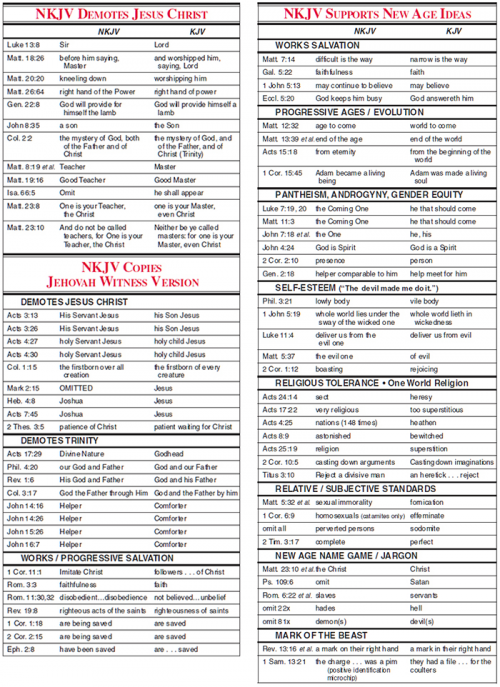 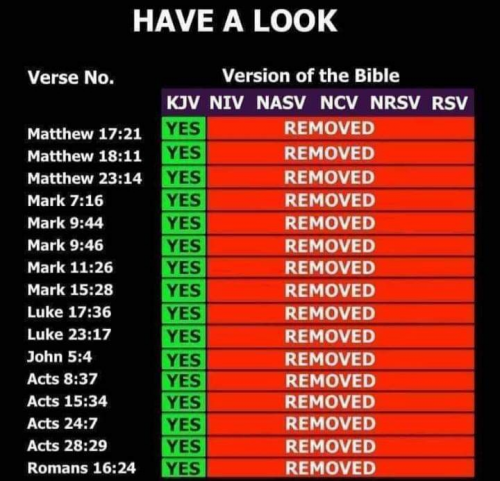 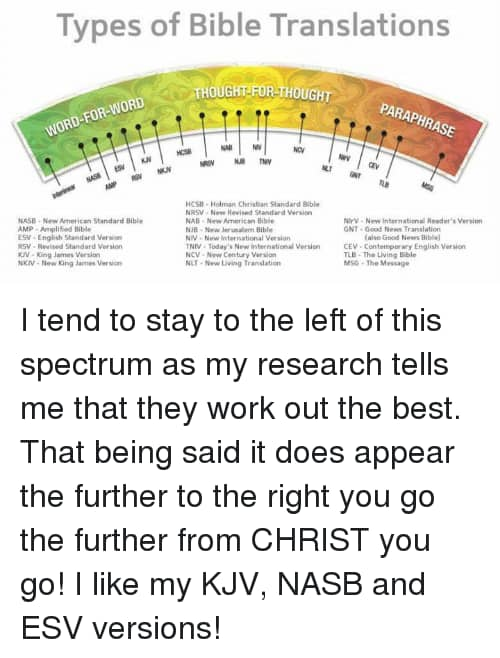 I personally don't think translation difference is that important to be Christian. I think ESV is good enough. NASB/NRSV is not common but usually used in seminary. If really want to argue which is superior, might as well go read the original koine greek texts. |
|
|
|
|




 Quote
Quote

 0.0178sec
 0.59
0.59
 7 queries
 GZIP Disabled