

QUOTE(skyhyk88 @ Jun 2 2021, 05:43 PM)
where did bought the nu-calgon foam?

mr diy got. go to the car section. got aircond cleaner. using that and my room aircond much cooler now1hp aircon inverter better or normal better?
|
|
 Jun 2 2021, 06:24 PM Jun 2 2021, 06:24 PM
Show posts by this member only | IPv6 | Post
#181
|
 
Newbie
34 posts Joined: May 2015 
|
QUOTE(skyhyk88 @ Jun 2 2021, 05:43 PM) where did bought the nu-calgon foam? mr diy got. go to the car section. got aircond cleaner. using that and my room aircond much cooler now |
|
|
|
|
|
Jun 2 2021, 09:18 PM
|

Junior Member
732 posts Joined: Jul 2010
|
QUOTE(Syie9^_^ @ Jun 2 2021, 05:47 PM) thank you for letting us know your location. Good luck fool Dont run, inspection team will come |
|
|
Jun 2 2021, 09:18 PM
|
|
Junior Member
732 posts Joined: Jul 2010
|
QUOTE(Syie9^_^ @ Jun 2 2021, 05:47 PM) thank you for letting us know your location. Good luck foolDont run, inspection team will come |
|
|
Jun 2 2021, 10:13 PM
|

Senior Member
1,072 posts Joined: Jun 2018 
|
QUOTE(StevenL @ Jun 2 2021, 10:48 PM) Good luck fool sure smarty squirrel , hope you fall hard and got eaten alive  This post has been edited by Syie9^_^: Jun 2 2021, 10:13 PM |
|
|
Jun 2 2021, 10:14 PM
|

Newbie
33 posts Joined: Jan 2019
|
QUOTE(tictac88 @ Jan 30 2019, 11:23 PM) for a 1hp aircon, is it better to get an inverter aircon or non-inverter aircon? in terms of cost of operation, cooling etc. Inverter obviously. If you set the temp at around 25°C, it will only consume 200-500w |
|
|
Oct 25 2021, 02:04 PM
Show posts by this member only | IPv6 | Post
#186
|

Junior Member
437 posts Joined: Jun 2012
|
hi. i would like to ask sifu here. For inverter units, from my understanding, there will be additional wire right? Non-inverter only has 3 wiring but inverter there will be 4 wirings where the additional one will be connected to the outdoor unit? The reason I am asking is that my contractor just install the cooper pipe and wiring. I noticed there is 4 wiring but am unsure whether compatible with the inverter?
Here are the pictures I managed to capture. Any idea if is these are for inverter? 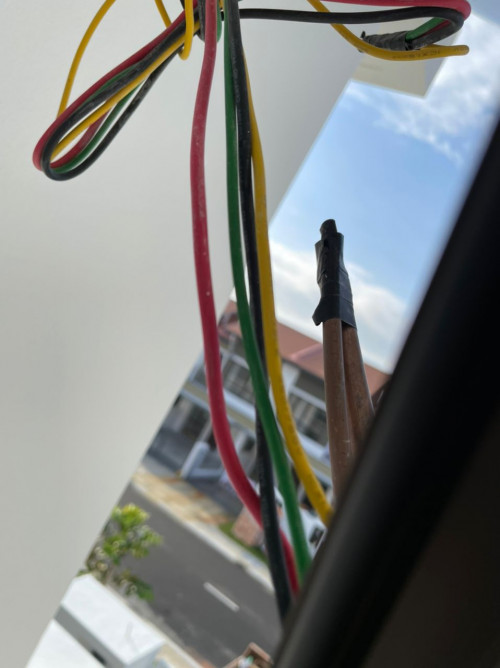  |
|
|
|
|
|
Oct 25 2021, 02:10 PM
Show posts by this member only | IPv6 | Post
#187
|

Senior Member
3,836 posts Joined: Aug 2016
|
QUOTE(incredibless @ Oct 25 2021, 02:04 PM) hi. i would like to ask sifu here. For inverter units, from my understanding, there will be additional wire right? Non-inverter only has 3 wiring but inverter there will be 4 wirings where the additional one will be connected to the outdoor unit? The reason I am asking is that my contractor just install the cooper pipe and wiring. I noticed there is 4 wiring but am unsure whether compatible with the inverter? ceo684 can help you.Here are the pictures I managed to capture. Any idea if is these are for inverter? |
|
|
Oct 25 2021, 02:27 PM
|

Senior Member
1,132 posts Joined: Apr 2014 From: Shah Alam, Selangor
|
QUOTE(incredibless @ Oct 25 2021, 02:04 PM) hi. i would like to ask Yes, your pictures look like the wiring is for an inverter air cond, ie 4 wire from internal to outdoor unit.Here are the pictures I managed to capture. Any idea if is these are for inverter? ceo684 liked this post
|
|
|
Oct 25 2021, 02:55 PM
|

All Stars
11,667 posts Joined: Jan 2003 From: Klang/Subang 
|
QUOTE(incredibless @ Oct 25 2021, 02:04 PM) hi. i would like to ask sifu here. For inverter units, from my understanding, there will be additional wire right? Non-inverter only has 3 wiring but inverter there will be 4 wirings where the additional one will be connected to the outdoor unit? The reason I am asking is that my contractor just install the cooper pipe and wiring. I noticed there is 4 wiring but am unsure whether compatible with the inverter? Correct, 3 wire Power (LNE) to indoor IDUHere are the pictures I managed to capture. Any idea if is these are for inverter? 4 wire Power + Signal between IDU and ODU.  |
|
|
Oct 25 2021, 02:57 PM
|

Senior Member
5,614 posts Joined: Jun 2006 From: Cyberjaya, Shah Alam, Ipoh  
|
get midea inverter aircond...my bro in law install in his room...very fast cooling...
prcie + instaallation pun he said same je with non inverter...dunno which lubang he gali got such deal |
|
|
Oct 25 2021, 03:01 PM
Show posts by this member only | IPv6 | Post
#191
|

Junior Member
170 posts Joined: Jan 2014
|
inverter FTW!
jimat bill la wei |
|
|
Oct 25 2021, 04:11 PM
Show posts by this member only | IPv6 | Post
#192
|
|
Junior Member
437 posts Joined: Jun 2012
|
QUOTE(ceo684 @ Oct 25 2021, 02:55 PM) Correct, 3 wire Power (LNE) to indoor IDU Thank you. Fuh what a relief at least my contractor install it correctly. Thank you alot. Need to learn more from you in electrical 4 wire Power + Signal between IDU and ODU.  ceo684 liked this post
|
|
|
Oct 25 2021, 06:44 PM
|
|
Senior Member
2,549 posts Joined: Apr 2008
|
If you use air con for only 2-3 hours a day, no need to buy inverter. the difference in electric bill is so little. Buy inverter only if you use 8 hours air con everyday....then only can you justify the high price to buy inverter Bijisss liked this post
|
|
|
|
|
|
Mar 17 2022, 02:38 PM
|

Senior Member
1,712 posts Joined: Aug 2009
|
QUOTE(empire @ Oct 25 2021, 06:44 PM) If you use air con for only 2-3 hours a day, no need to buy inverter. the difference in electric bill is so little. Buy inverter only if you use 8 hours air con everyday....then only can you justify the high price to buy inverter betul ka? |
|
|
Mar 17 2022, 03:25 PM
|
|
Junior Member
65 posts Joined: Feb 2022
|
Inverter will only be beneficial if you use it for long periods of time (e.g. your room when you sleep). Other than that, not much difference in operating cost. Bijisss liked this post
|
|
|
Mar 17 2022, 05:20 PM
|
|
Senior Member
5,831 posts Joined: Jun 2017
|
QUOTE(tictac88 @ Jan 30 2019, 04:23 PM) for a 1hp aircon, is it better to get an inverter aircon or non-inverter aircon? in terms of cost of operation, cooling etc. like many has said, it depends how/where you will be using it.used PROPERLY, Inverter can save at least 40% electricity. Use wrongly, no saving. |
|
|
Mar 17 2022, 05:22 PM
|
|
Senior Member
5,831 posts Joined: Jun 2017
|
QUOTE(shirohamada @ Jan 30 2019, 05:21 PM) No you are. Inverter only saving electricity if there are no stop-start happening.What do you think an inverter is? 1hp = 745. 7 watts. 1) How much power a 1hp non inverter ac use in an hour if it runs at 1hp? 2) How much power a 1hp inverter ac use in an hour if it runs at 1hp?  here is a analogue. You drive in town with stop-start uses petrol aka non-inverter. You drive highway no stop-start saving petrol aka inverter. This post has been edited by touristking: Mar 17 2022, 05:24 PM |
|
|
Mar 17 2022, 05:26 PM
|
|
Senior Member
5,831 posts Joined: Jun 2017
|
QUOTE(bootmod3 @ Mar 17 2022, 08:25 AM) Inverter will only be beneficial if you use it for long periods of time (e.g. your room when you sleep). Other than that, not much difference in operating cost. Not entirely true.No matter how long or short you use the air cond, as long are many stop-start happening or constant at full power (like in an oversized room), you will not save electricity, even an inverter. |
|
|
Jun 17 2022, 11:16 PM
Show posts by this member only | IPv6 | Post
#199
|
|
Newbie
27 posts Joined: Mar 2018
|
This is my take on this whole inverter vs non-inverter problem:
Simply speaking, Like modern BMWs, inverter airconds are like the following Inverter AC Advantages: -Energy efficient: Adjustable speed aside, the BLDC/PMSM compressors used in inverter units are simply more efficient than the induction motor type used in non-inverter units. Just like how luxury cars have lower fuel consumption. But in Malaysia the savings in ringgit may not be significant. -Intelligent: Features like EcoNavi automatically optimizes itself to your needs, resulting in superb performance. Comparable to the myriad of sensors used on luxury cars. -Superb experience: Inverter units does not have thermal fluctuation problem like non-inverter units. You can feel this when using non-inverter AC at night, where somehow the air blowing out from the aircond does not feel as comfortable anymore, but once the compressor kicks in you get chills from the cold breeze. Part load capability of inverter units minimizes this problem, so you a stable, smooth experience all the time. Comparable to the superb feel and ride in luxury cars. Inverter AC Disadvantages: -Expensive to buy: Inverter units can sometimes cost double the price of non-inverter units. Used to be anyway. -More parts: Meaning more place that can fail. Especially the outdoor inverter board. Our hot and humid climate does not play nice with outdoor electronics. -Expensive spare parts: Replacing the fragile outdoor board can cost nearly RM1k. -Hard to find people who really know their stuff: Inverter units are complex machines that requires special training from the manufacturer to install and repair properly. Hiring an Ah Beng cowboy air cond man to install your inverter unit can potentially shorten it's lifespan & cost you avoidable repairs. While non-inverter airconds are a lot like Proton Wira Non-Inverter AC Advantages: -Tough AF: Some people still use the same unit for nearly 10 years. Like the Magma engine it has no complicated parts & has minimal electronics, meaning less place to fail. -Spare parts and maintenance easily available: Monkey level air cond man also can repair it without fucking up the unit too much. -Instant cooling: No ramping-up required as in inverter units. Suitable for people who wants "hawa dingin" instead of "udara nyaman" and runs on full blast all the time. Like Magma engine has no Eco Mode, just gas, gas gas! -Cost: This doesn't really seem to be to significant anymore, but non-inverter is still cheaper. I remember years ago inverter units are nearly double the price of non-inverters, now this has come down, and ironically non-inverter seems to become a little more expensive. Non-Inverter AC Advantages: -Not so efficient: Some people say this is due to the current spike when the compressor is turned on, but I don't really think this is the main cause. For me it is mostly due to limitations of it's low tech control mechanism. Like how Magma engine vs MIVEC. -Rough: Like mentioned before, it will have large temperature fluctuation due to it's ON/OFF operating method. Can feel weird if you are not used to it. Does not apply if you run it on full blast all the time. The sudden on/off sound can also be very annoying. To decide between these two really depends on one's appetite Inverter: "I want the best the industry has to offer. I am willing to pay more now, and willing to spend more in the future as well. I am also willing to put up with the hassle and frustration of getting it properly maintained. A comfortable living environment means a lot to me." Non-inverter: "I just want an aircond. No fuss, no hanky panky. Just on and go." Technical stuff below 1) Aircond horsepower is not the electrical wattage QUOTE(shirohamada @ Jan 31 2019, 12:21 AM) No you are. The HP unit usually used to size aircond in Malaysia does not refer to the electrical power used, but rather rate of heat energy transfer. Overseas, the imperial unit is BTU (British Thermal Unit), while metric countries uses kW. Even the conversion rate is odd, where 1HP = ~2.5kW. See this page for a table of conversion. BTU to HP | BTU to Ton | BTU to kW | Conversion TablesWhat do you think an inverter is? 1hp = 745. 7 watts. 1) How much power a 1hp non inverter ac use in an hour if it runs at 1hp? 2) How much power a 1hp inverter ac use in an hour if it runs at 1hp? This can be confusing, but kW is still the correct unit to be used, because like all types of energy, heat energy is measured in Joule, and Joules/sec is still Watt. What determines the actual electrical usage depends on the situation. For example if the thermal transfer mechanism does not work well due to poor airflow or very high outdoor temperature, the system will have to work harder to transfer a single unit of heat energy. 2) Piping has nothing to do with inverter/non-inverter The thickness of piping needed depends on the refrigerant gas used. The older R22 Freon gas (the one that punched a hole in the ozone layer) uses lower pressure, and thus thinner piping. It's replacement, R410a however needs to be charged at almost twice the pressure, thus the need for thicker piping. R32 operating pressure is close to R410a, so piping replacement is likely not needed. 3) Why non-inverter aircond consumes so much energy? There are 3 reasons behind this. i) Current spike during startup of compressor induction motor: This does happen, but the amount of energy wasted may not be significant due to the short time period it occurs. There are 2 parts to this process. a. Inrush surge: In some situation your lights may dim a while when the compressor starts. But as you can observe with your eyes this is very short, usually only a flash. b. Acceleration current: Efficiency of an induction motor is correlated with it's slip frequency. This depends a lot on the motor design, but a typical induction motor will behave like this chart below. (Typical-induction-motor-torque-speed-current-curve) 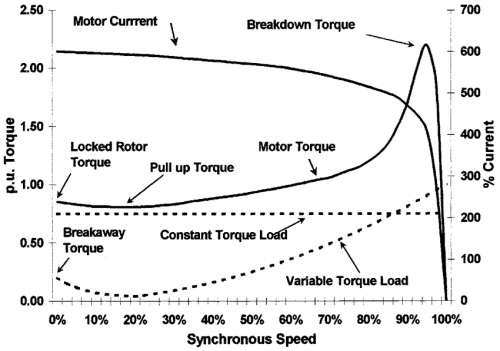 [https://www.researchgate.net/profile/John-Kay-2/publication/3171041/figure/fig2/AS:668922684645391@1536495004855/Typical-induction-motor-torque-speed-current-curve.pbm] Here you can see that before the motor reaches it's rated speed (X axis move from left to right), the current curve starts at an significantly high 550% rated value, which then rapidly collapses when the motor reaches 95% synchronous speed. In this region the motor is operating at very bad efficiency, giving out less than 100% rated torque at 5 times the current. In large industrial motors, this can be a serious problem, but residential aircond compressor motors are significantly smaller. You can observe this even by ear. Aircond compressors don't have that ramping up sound that industrial machines have (like jet engine starting up). Besides, modern non-inverter units are digitally timed to start the compressor only after the head pressure had lowered significantly (due to refrigerant discharging through the expansion device), thus minimizing the power needed to accelerate the motor. This is why modern non-inverters does not need a separate starter like it's older electromechanical, bimetallic thermostat controlled ancestor. (Remember these bad boys?)  (Starters must be used these ancient airconds) 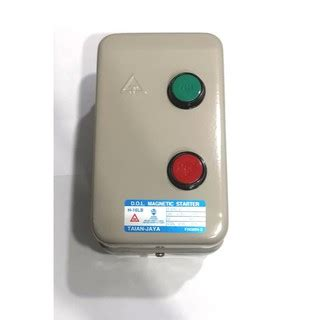 I can't say for sure how much power is wasted during this stage in non-inverter airconds, but it is save to say that it is nothing too significant. ii) Induction motor are just not as efficient as BLDC/PMSM motors. Induction motors are around 70~80% efficiency, but BLDC/PMSM motors can go around 80~90% efficient. But consider that a typical 1HP (as in thermal energy unit) aircond is rated at 850W (electrically) [I am using Acson A3WM 10N as a reference], a 10% savings means only around 85W, which is close to the power consumption of 2 old style florescent light. With long usage, 85W can mean a lot. (Remember, TNB charges by kWh. That is Watt/1000 x hour. It piles up with time.) But for the occasional user this might mean nothing significant. iii) Limitations of hysteresis control algorithm This is an interesting problem, which so far remains as my own opinion, so feel free to disagree. Non-interter air cond works on hysteresis control. I drawn this chart below to explain how this is usually described to consumers. 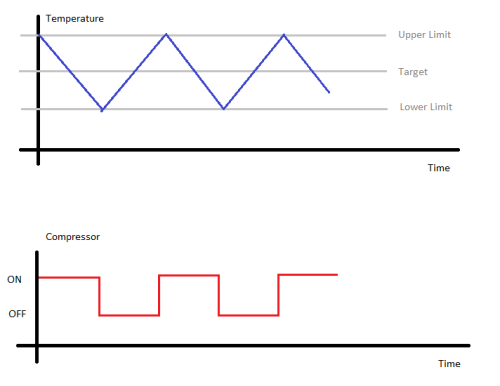 Nothing too complicated here. Once the room temperature reaches let's say 1 degree Celcius higher than target, the compressor kicks in. The compressor keeps on running until the room is colder than 1 degree Celcius below target. But what this chart ignored is that thermal transfer rate is relative to temperature difference. In reality, the temperature curve will not be a straight line. This is because as the room gets colder, the faster outdoor heat will move into the room. The chart should look more like this. 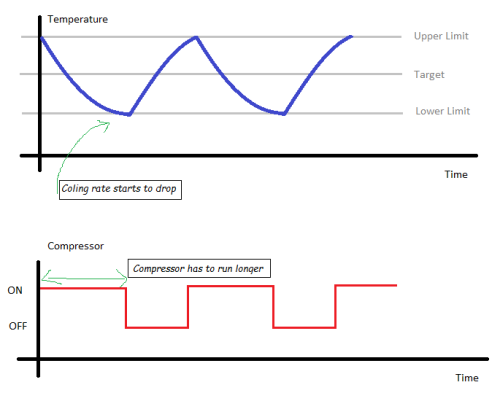 Notice how the rate of temperature drop slows down as the room gets colder. This causes the compressor to run much longer than what is expected, and that means extra energy consumption. This problem can be even worse if the temperature setting is very low, beause this means outdoor heat will move in at even faster rate. Getting the room to 16 deg Celcius is already a struggle; but to get it to the Lower Limit of let's say 15 deg Celcius is even worse. Unfortunately, this is the nature of hysterisys control. And when all the control mechanism we have on the cooling system is on/off, this is the only way it can be controlled. 4) Why energy savings from inverter aircond may not mean much to the average Malaysian household i) Our domestic tariff is subsidized: This means that even though the amount of kWh used is significant, it will not feel as much in ringgit sense. But with heavy use, once the kWh used is high enough and you reach the higher tariff bracket, then your wallet starts to hurt. For the occasional user who manage to keep themselves to the lower tariff bracket, it means nothing much. A lot of posts here are comparing the consumption in ringgit sense, which is technically not very reliable. Comparison in kWh is better, but not very intuitive to most people. ii) Consistently hot climate Inverter air cond saves energy by handling partial load more effectively. In countries with distinct seasons this is a very relevant feature because their air conditioning needs changes throughout the year. For example, the highest demand will come during mid summer and winter, but as the seasons transitions into spring and autumn the demands begin to decrease significantly, so much so that in mid spring & autumn it is possible to to use air conditioning at all. This presents a lot of opportunities for energy savings. In Malaysia? It is mid summer all year long! If there is any situations where partial load situations will occur it will be in commercial premises, where occupancy changes throughout the day and in hotels, seasonal. 5) The real problem with hot buildings. We have a lot of brain-dead architectural designs in this country. Take a look at this picture of Merdeka PNB 118. This is a giant greenhouse! And why are we having a greenhouse in this tropical country? (Giant glass greenhouse in the sky) 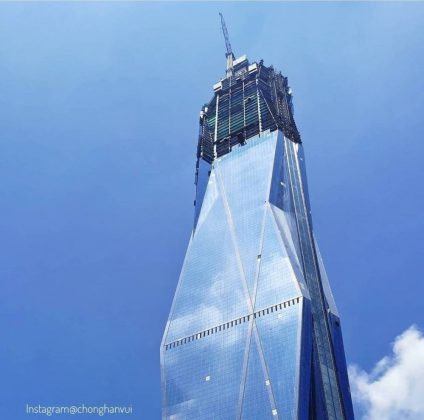 For residential homes, the problem is usually solar gain. Heavy brick walls get baked by direct sunlight during daytime and being bricks and stones, they accumulate a lot of heat energy. By sundown the heat is slowly released, and the occupants had to spend the night being baked by the released heat for long periods of time. The house is effectively a stone oven, or a claypot if you prefer.  Any air conditioning put in will have to work extra hard at night to remove all this massive ammount of heat, only then the room can be cooled down. Traditional constructions work around this problem by using wood, which does not retain heat as much, and has long eaves which shields out direct sunlight. Ventilation is maximized using oversized windows, a lack of ceiling, and breathable roof. (Modern house vs Kampung house) 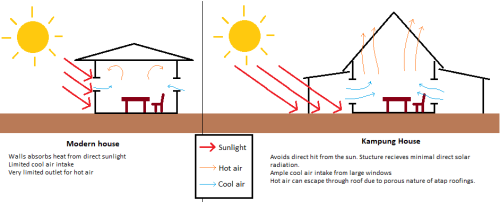 These features should have been mordernized and put into use in our local buildings, but sadly as always, we always copy other people's homework blindly. And we rather throw money at the problem rather than doing some critical thinking. This post has been edited by marche_ck: Jun 18 2022, 12:32 AM |
|
|
Jun 17 2022, 11:21 PM
Show posts by this member only | IPv6 | Post
#200
|

Senior Member
4,050 posts Joined: Mar 2005
|
Big or open space, no need inverter
In small to medium office or room, use inverter better |
| Change to: |  0.0210sec 0.0210sec
 0.69 0.69
 5 queries 5 queries
 GZIP Disabled GZIP Disabled
Time is now: 16th December 2025 - 09:47 PM |
 Quote
Quote