Welcome Guest ( Log In | Register )

Outline · [ Standard ] · Linear+

 Understanding Unit Trusts (Update 25/6/07 Post#5), Risk taker? Orthodox? All invited.

views
     
TSdeadalus
post Apr 5 2007, 09:36 PM, updated 19y ago

Live Life Cool
*****
Senior Member
796 posts

Joined: Dec 2006


What are Unit Trusts?

i) A form of collective investment that allows investor with similar investment objectives to pool their savings, which then invested in a portfolio of securities or other assets managed by investment professionals.

ii) Investors in Unit Trusts do not purchase the securities in the portfolio directly and the ownership of the portfolio is divided into units of entitlement and each investor is known as a "unit holder"

iii) As evidence of their stake in the Unit Trusts, each investor receives a confirmation of entitlement either in the form of a statement or unit certificate.

iv) The return on investment for unitholder in Unit Trusts is usually a combination of a regular income payment (distribution) and capital appreciation, derived from the pool of investment held within that Unit Trusts.

_____________________________________________________________________

Who should invest in Unit Trusts?

I) For investor who is unable or unwilling to research and analyse investment markets on his own, Unit Trusts are an ideal tool of investing.

II) Investor who have relatively small amounts to invest and neither have the time nor the inclination to hold portfolios of direct investments in shares or bond.

III) Investors who want good returns on their savings, Unit Trusts provide an ideal way for them to gain exposure to investment that, in the long run, can produce returns superior to those from traditional saving accounts and fixed deposits. ( Bare in mind that 3.7% from FD can barely cover the actual inflation rate)

_____________________________________________________________________

How to invest in Unit Trust

1) Lump Sum Purchase
- An investor can invest his savings in the Unit Trusts after he or she has completed an application form from a prospectus. With a lump sum purchase, there is no further commitment to add to the initial investment.

2) Reinvestment of Income/Distribution
-By reinvesting distributions from Unit Trust, an investor can acquire, on a regular basis, small numbers of additional units that, over time, can add significantly to total returns from investing in Unit Trusts.

3) Regular Saving
- Investor may invest in Unit Trusts by making regular contribution (such as a monthly Standing Instruction to purchase additional unit which will be deducted from your saving account) to purchase more unit. The contributions are not contractual and can be stopped at any time without penalty.

-This is a disciplined, useful and flexible way for investor to accumulate capital for a future need.

4) Borrowing to invest in Unit Trusts
- An investor can obtain loan from a financial institution for the purpose of investing in Unit Trusts.

- As long as the rate of return from investing in Unit Trusts exceed the borrowing costs, the investor will benefit from the additional profit arise from the investment. This is known as LEVERAGING (or GEARING) an investment in Unit Trusts.

- Most banks and finance companies in Malaysia offer borrowing facilities to investor who wish to leverage their investment in Unit Trusts. Loans are generally for periods of up to 10 years at interest rates generally higher than personal finance and housing loans.

- The maximum loan-to-valuation ratio is 67%. Meaning that an investor who wishes to invest RM 100,000 in Unit Trusts could be able to borrow up to RM 67,000.

- However, this method may involve certain risk such as volatile interest rate and a possibly margin call from the bank if the value of investment falls below a certain level.


_____________________________________________________________________

Which type of Unit Trusts is suitable for you?

A) Age 21 ~ 30 Years
- At this early stage of life, an investor may be single or newly married. His or her income level may be sufficient to meet living expenses. There may be no significant financial respondsibilities.

- Young investor in this group can perhaps begin to build a small nest egg by investing into growth-oriented Unit Trusts with Aggresive and Specialised investment objective. (such as Public Small-Cap Fund, Public Equity Fund)

B) Age 31 ~ 44 Years
- Commonly, investor at their 30's & 40's may be at the peak of their carreer life and accompany with greater financial responsibilities such as children's education needs and house mortgage.

- Depending on the level of financial commitments, there may now be a greater opportunity to save and invest. Investor at this age can consider investing for long-term capital growth using Growth or Balanced Unit Trusts.

- Also, their EPF balances may now be sufficient to be transferred to Unit Trusts that meet these objective.

C) Age 45 ~ 60 Years
- An investor in this age group may now be more financially secure and have a high savings capacity to invest for retirement.

- Perhaps more conservative Unit Trusts should be considered, such as Bond Fund as well as Balanced Fund.

This post has been edited by deadalus: Jun 25 2007, 12:44 PM
TSdeadalus
post Apr 5 2007, 09:36 PM

Live Life Cool
*****
Senior Member
796 posts

Joined: Dec 2006


Type of Unit Trusts:


i) Equity Unit Trusts
- Mainly invest into the share of listed companies

- Most equity Unit Trusts are closely linked to the performance of KLCI. A rising share market will normally result in an increase in the value of the units, and vice-versa.

- Equity Unit Trusts can be further categorize into I) Aggresive growth Equity Unit Trust, II) Growth & Income Equity Unit Trust, III) Index Equity Unit Trust, IV) Income Equity Unit Trust, V) International Equity Unit Trust.


ii) Fixed Income Unit Trusts
- Invest in Government Securities, corporate bond and money market instruments such as bankers acceptance and fixed deposits.


iii) Real Estate Unit Trusts
- Invest in real property, usually prominent commercial properties, and provide the investor with an opportunity to participate in the property market in a way which is normally impossible for the smaller investor.


iv) Balanced Unit Trusts
- A balanced Unit Trust has a portfolio comprising equities, fixed income securities, cash and government bonds. The fund manager will emphasize on certain type of instrument depending on the market outlook.

-For instance, when the share market experience violent turbulence, the fund manager will shift the resources to a more secure bond market, and vice-versa.


v) Syariah Unit Trusts
- Syariah Unit Trust can only invest in a portfolio of halal companies, Islamic Debt Securities and bonds.

- The returns of Syariah Unit Trust will also avoid the incidence of riba or usury interest through a unique systematic process of cleansing or purification in removing the amounts representing all non-syariah permissible elements.


________________________________________________________________________________


Pros & Cons of Unit Trusts:


Advantages of Unit Trust:


1) Diversification
- For investors who unable to acquire a wide range of investments because of limited savings, investment in UTS which equip with a larger pool of funds allow the fund manager to maintain a portfolio consisting 30~100 shares with diversified and lower risk.


2) Liquidity
- Under regulation, Unit Trusts managers release the proceeds from the repurchase of units to unitholders within 7 days.


3) Professional Management
- Fund managers are trained and have professional background that ensure the process adopted by the Unit Trust is structured and follows basic investment principles.


4) Investment Exposure
- For small investor, it's difficult to gain exposure to a particular asset class or securities.

- For instance, if an investor with RM 1,000 wished to invest in real estate or government bond, it would be impossible for him or her to hold a direct investment in any of these investment instruments

- With Unit Trusts, it is possible to invest in one of these investment.


5) Investment cost
- As fund manager invest large amount of money, economies of scale apply and hence benefit from lower transaction cost such as stockbroker commissions.


Disadvantage of Unit Trust:


1) Risk
- Any investment involves risk. investment in Unit Trust also has its risks.

- For equity Unit Trust, the movement of share prices in stock market is reflected in the NAV if the Unit Trust. As share price vary, prices of units in Unit Trust can go down as well as up.

- Ownership of investments through Unit Trust does not, and cannot, reduce the underlying volatility in values of those investment.

- However, the benefits of diversification across a greater number of individual investments reduces the effect of that volatility for investor with limited capital to invest.


2) Fees & Charges
- Services provided by Unit Trust Manager are not without cost. Hence there are fees and charges payable by investors. (Such as Initial Charge, Management Fee, Trusty Fee)

- Such fees should be measured against the professional expertise available to investors through Unit Trust. And the initial charge will be diluted over a medium and long term period.


3) Opportunity cost
- An investor who invests in Unit Trust may have produced better returns by investing directly in the markets. This represents the "OPPORTUNITY COST" of investing in Unit Trust.

- A single direct investment may produce a return in excess of that from investment through Unit Trust, but clearly the risk level accepted by a direct investor is significantly greater than that through investing in Unit Trust.

________________________________________________________________________________

Fees and Charges involve in Unit Trust:


A) Direct Fees and Charges

i) Initial Service Charge
- The 1st cost that an investor incurs in relation to Unit Trust is the initial service charge. It is levied primarily to cover the cost of marketing and distributing units, and the costs of opening an account in the unit register for an unitholder.

- Most Unit Trust in Malaysia levy a charge of 5% to 7%

- This means that for every Rm 1,000 an investor invests, an amount of between RM50 and RM70 will be taken by Unit Trust Manager.

- Therefore, investment in most Unit Trust should not be for the short term, as the cost will become less significant when spread over a longer time frame.


ii) Exit Fee
- Exit fees may be charged as an alternative to an initial service charge, but they are rare in Malaysia.


iii) Fees for specific services
- A fixed amount of switching fee may charge by certain Unit Trust Manager.

- A fee may also be charged to transfer units to another unitholder.


B) Non-Discretionary Fees and Charges (Those that deduct from a fund's P&L)

I) Annual Management fee
- Annual management fees that range from 0.75 ~ 1.5% per annum are levied by Unit Trust Manager to cover the costs of managing Unit Trust (such as salaries, office rent, computer systems, depreciation, compliance, training, funds management and general overheads of Unit Trust Manager).

- The expenses is monitored by the Trustee (Such as CIMB Merchant Bank, Amana Raya Bhd) and regulated by Security Commission (SC).


II) Trustee Fee
- The SC requires that trustees charge a minimum rate of 0.08% per annum of the NAV to the Unit Trust Manager.


III) Unit Trust Expenses
- Transaction cost, income tax & duties, auditor fee, investment valuation fee, legal cost, cost of issuing prospectus.

This post has been edited by deadalus: Apr 9 2007, 11:23 PM
TSdeadalus
post Apr 5 2007, 09:37 PM

Live Life Cool
*****
Senior Member
796 posts

Joined: Dec 2006


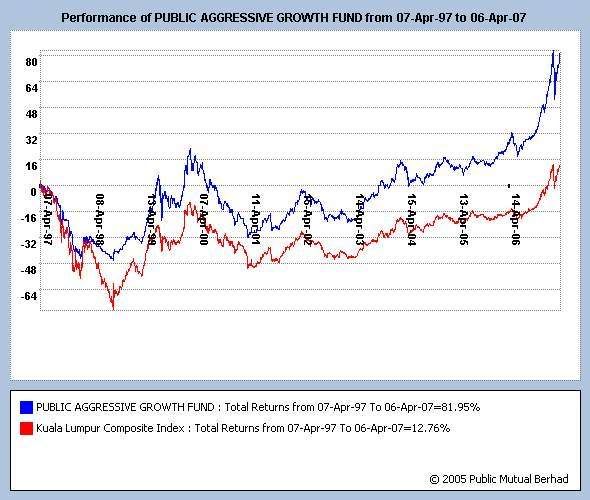
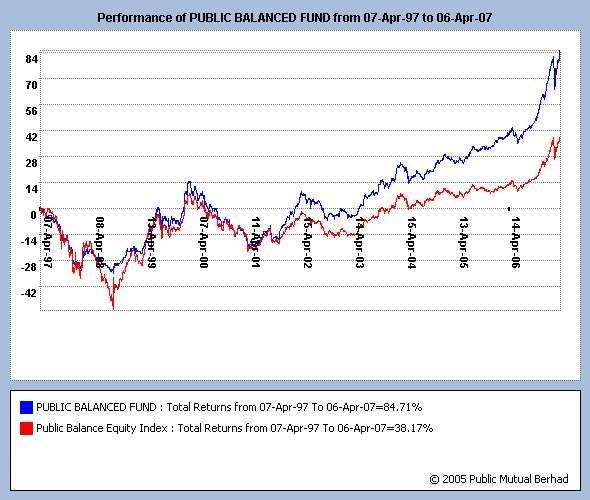
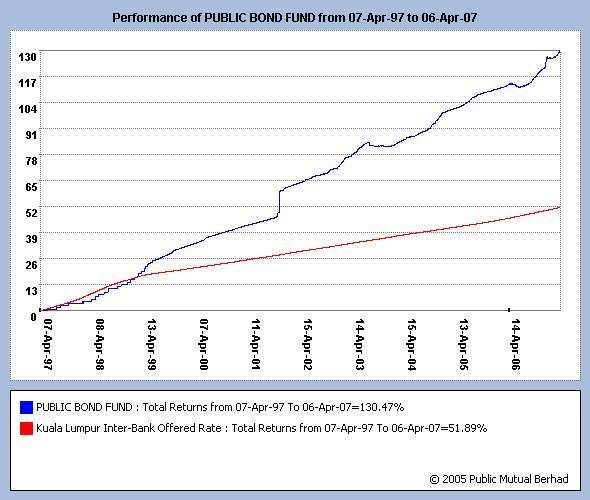
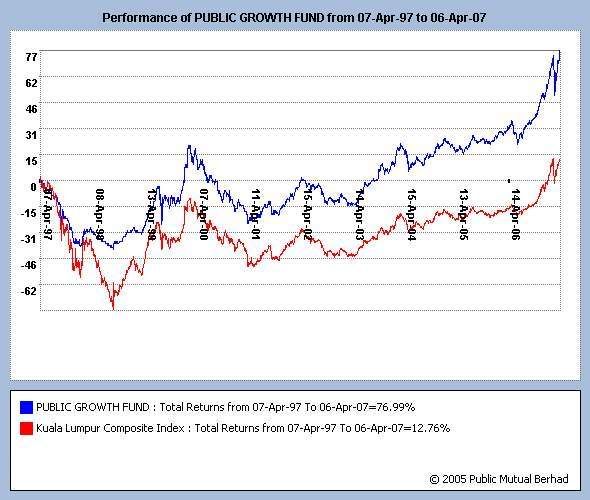
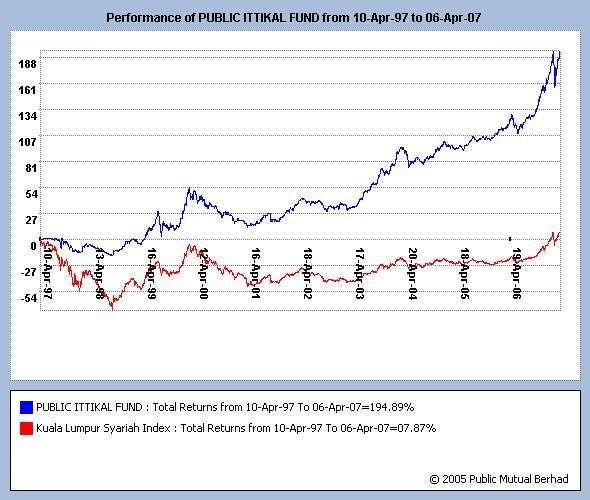
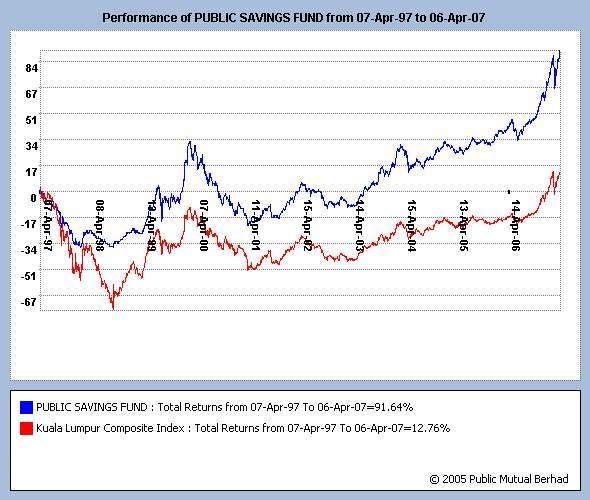
Fund Performance for Public Mutual.

Fund with more than 10 yrs history

user posted image
Average Return per year: 8.2%

user posted image
Average Return per year: 8.5%

user posted image
Average Return per year: 13%

user posted image
Average Return per year: 7.7%

user posted image
Average Return per year: 19.5%

user posted image
Average Return per year: 9.2%


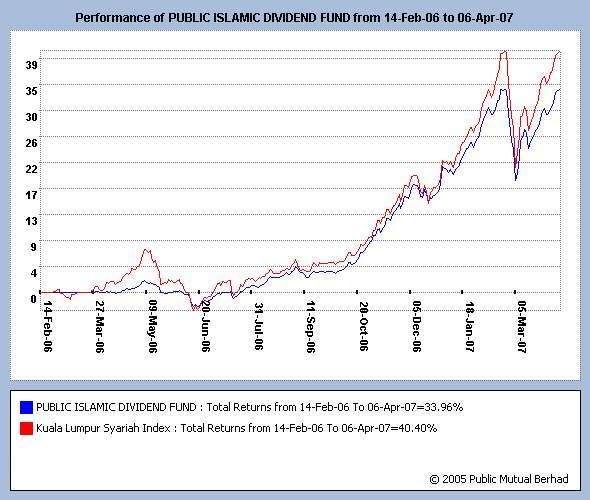
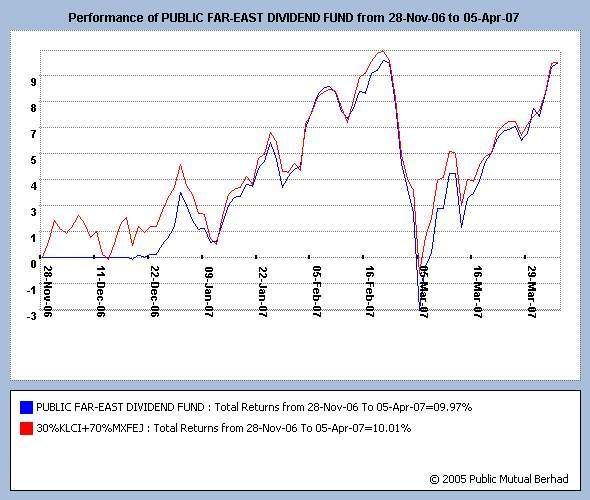
New Fund with less than 1 yr history

user posted image
Total return within 14 months: 34%

user posted image
Total return within 5 months: 9.97%

user posted image
Total return within 26 months: 22.4%

user posted image
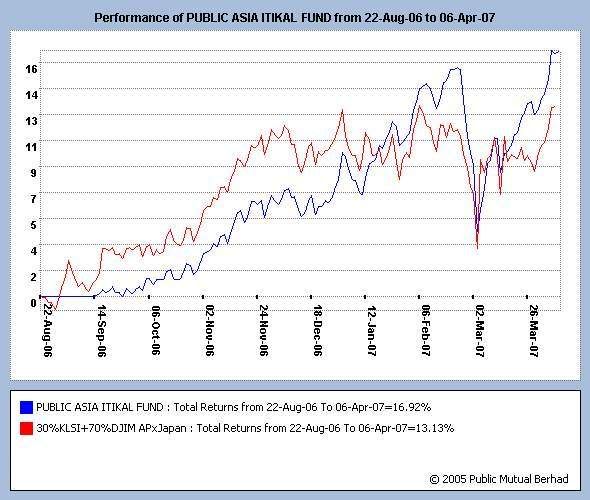
Total return within 8 months: 16.9%

This post has been edited by deadalus: Apr 7 2007, 09:39 PM
TSdeadalus
post Apr 5 2007, 09:38 PM

Live Life Cool
*****
Senior Member
796 posts

Joined: Dec 2006


Comparison between various investment tools

user posted image

______________________________________________________________________________

Risk minimization with Unit Trust:


1) Diversification in portfolio

user posted image

user posted image


2) Dollar cost leveraging

user posted image

This post has been edited by deadalus: Apr 15 2007, 09:35 PM
TSdeadalus
post Apr 5 2007, 09:38 PM

Live Life Cool
*****
Senior Member
796 posts

Joined: Dec 2006


Extra Information on the Unit Trust industry (Worldwide)

user posted image

Luxemberg is one of the largest financial hub in Europe.

This post has been edited by deadalus: Jun 25 2007, 12:41 PM
TSdeadalus
post Apr 6 2007, 06:30 PM

Live Life Cool
*****
Senior Member
796 posts

Joined: Dec 2006


Thanks for your comment.

Good news to fellow investor.

PM will launch a new equity funds with a focus on high dividend yield company (i.e YTL-PWR, Digi, Public bank,Shell) which comply to Syariah law within Asia region.

It is like a combination of existing PM's Far East Dividend fund + Islamic Dividend fund.

The good things about high dividend yield company is that their share price are relatively more stable and accompany with high dividend payout. Bare in mind that only those company with low gearing/liability can affort to chunk out a large portion of their profit into dividend. And also most of these company have a very strong fundamental and good track record.

As usual, if you buy a newly launch unit trust you will get additional 1% free unit which give you a good start on your investment.

Promotion valid until 23/4/2007.
______________________________________________________________________

Official details from Public Mutual

The new Public Islamic Asia Dividend Fund is a moderate-risk Islamic equity income fund that seeks to provide income by investing in a portfolio of stocks in domestic and regional markets that complies with Syariah requirements, which offer or have the potential to offer attractive dividend yields.

Up to 70% of the fund's net asset value (NAV) can be invested in selected foreign markets which include South Korea, China, Taiwan, Hong Kong, Philippines, Indonesia, Singapore, Thailand, Australia, New Zealand and other approved markets.


Equity exposure: Generally range from 75% to 90% of its NAV.


RM0.25 per unit during the initial offer period (3 April 2007 - 23 April 2007).


PM me if interested

This post has been edited by deadalus: Apr 6 2007, 10:11 PM
TSdeadalus
post Apr 7 2007, 12:39 PM

Live Life Cool
*****
Senior Member
796 posts

Joined: Dec 2006


QUOTE(Grengo01 @ Apr 7 2007, 12:04 PM)
However, I find a lot of agents propogating long term into a particular fund depending on risk profile. Personally there may be some truth in it but to me, I will take that as the agent being totally lazy to support the client in their best interest. They take this as the easiest way to make the commission and without the client bothering them after investing that sum.

Maybe its just me, but I advocate switching in the hope that we get the most from our limited resources to ensure our quality of lifestyle do not diminish even in our sunset years.
*
In Public Mutual, at least for the Damansara Branch, we do not advice or practice frequent switching from fund to fund. We are humble enough to realise that very few people in the industry is competitive enough to predict the trend in the equity market.

To us, it is not about the zero commission derive from performing switching, it is the opportunity cost that may involve which affect a client wealth that concern us the most.
TSdeadalus
post Apr 7 2007, 09:28 PM

Live Life Cool
*****
Senior Member
796 posts

Joined: Dec 2006


QUOTE(clsiluf @ Apr 7 2007, 09:10 PM)
1. if i invest 2k, how long i need to keep it in PM before i withdraw it?

2. i think is like FD right?

3. if the Average Return per year is 10% and i invest 1k, means total i can get back 1.1k?

tx
*
1) Most unit trust (except for bond fund) will have an one time initial charge of 5~6% on each investment made.

- Technically you may withdrew anytime; but you may suffer lost from the initial charge (5%) if you did not allow sufficient time for the investment to growth.

- Normally, you need at least allow minimum 2~3 years for the funds to fully realise its value (cause unit trust will declare distribution/dividend at the end of its financial year) and selling off the funds within a year is not recommended under most circumstances.

2) Money save through FD, will be loaned to personal/corporate end user and the bank earns through the difference in interest rate. (i.e FD rate at 3.75%, business/personal loan rate at 7~9%, bank earn 3%+ out of your FD)

Whereas unit trust manager will use the money of unit holder to invest in the share in a listed company or the bond issued by government.

3) In Malaysia, unit trust manager does not impose an exit fee when you sell your unit. Thus, if the Average Return per year is 10% and you invest 1k, means total you can get back 1.1k

Hope these answer your question.

Peace.
TSdeadalus
post Apr 7 2007, 11:42 PM

Live Life Cool
*****
Senior Member
796 posts

Joined: Dec 2006


If you are comparing the Equity Trusts against a fixed income instrument (such as FD) of cause it will not reflect the true picture since you are comparing apple to orange. (2 investment tools with different risk profile)

FD should be compare to a Bond Fund (0% Initial charge) to be fair. Thats why most performance for pure bond fund is benchmark against FD interest rate.

The true strength of Unit Trust lies within the terminology of "Dollar Cost Averaging" which will be further illustrate later.

Peace.
TSdeadalus
post Apr 8 2007, 11:28 PM

Live Life Cool
*****
Senior Member
796 posts

Joined: Dec 2006


QUOTE(athlon 11 @ Apr 8 2007, 10:09 PM)
i hope goverment can do something to regulating unit trust industry on the purchasing and exit charge issue......there is a company even charge 4% for its bond fund.
*
highest initial charge for a bond fund is 1.5% from ING Bon Islam. 4% will most likely be a balanced fund or income fund.

most bond fund will have 0 ~ 0.25% initial charge as part of processing fee.

TSdeadalus
post Apr 9 2007, 04:55 PM

Live Life Cool
*****
Senior Member
796 posts

Joined: Dec 2006


The thread is still under progress and more update on the way. (Thats why i put a date on every update.)

But yet people generally is impatient and straight away jump to conclusion without looking at the whole content.
TSdeadalus
post Apr 9 2007, 10:41 PM

Live Life Cool
*****
Senior Member
796 posts

Joined: Dec 2006


Just take note that all the write-up here is abstracted from the reading material released by Federation of Malaysian Unit Trust Managers (FMUTM). I just summarise it for easier reading, but it seems to me that it is getting wordy.
TSdeadalus
post Apr 12 2007, 09:44 PM

Live Life Cool
*****
Senior Member
796 posts

Joined: Dec 2006


Hwang-DBS has launched a new Fund with a focus in IndoChina (Vietnam, Laos,Cambodia).

I think it is the first fund in Malaysia to really look into the emerging opportunity in those omitted market in IndoChina. Interesting indeed.

But it has a minimum investment requirement of RM 100,000, which not many people can afford.

http://www.theedgedaily.com/cms/content.js...1f39e0-bd07972e
TSdeadalus
post Jun 20 2007, 09:48 PM

Live Life Cool
*****
Senior Member
796 posts

Joined: Dec 2006


QUOTE(Geminist @ Jun 20 2007, 08:23 PM)
http://www.fidelity.co.uk/cgi-bin/direct/i...cgi?sid=0386454

Just an example above but a 5 - 7 % management fee is basically a rip off.
*
i dont get the point of the fidelity fund that you are quoting. The fund charge 1.5% management fee p.a and an initial cost of 7%. More or less similar to those in Malaysia.

As for the ISA discount, i guess it is some sort of tax relief thingy implement by uk government to encourage people to invest.

The charges from Malaysian Unit Trust may seems relatively high at the moment, but when the industry growth, chances are the cost will eventually more affordable.


Attached thumbnail(s)
Attached Image

Attached image(s)
Attached Image
TSdeadalus
post Jun 20 2007, 10:39 PM

Live Life Cool
*****
Senior Member
796 posts

Joined: Dec 2006


As part of Securities Commision requirement, a trustee must be assigned to scrutinize the activity of the fund manager and a trustee fee of 0.07% is chargeable on the fund's NAV. And it is payable to a 3rd party trustee that not related to fund manager. (i.e Amanah Raya Bhd)

In Public Ittika case, the NAV is around RM 1.5B (as at 31/3), the trustee fee= RM 1.5B x 0.07% = ~1mil.

However the actual trustee will be RM 450k. (SC regulated that a min fee of RM 18k and max of RM 450k is chargeable on NAV)

As for the 1.5% management fee, it is a norm for the industry.
TSdeadalus
post Jun 21 2007, 08:58 AM

Live Life Cool
*****
Senior Member
796 posts

Joined: Dec 2006


the chances of the bank collapse is as low as striking a lottery. even if that happens, the government will pay RM 10 Billion to bail them up. Worry not.


Change to:
| Lo-Fi Version
0.0236sec    0.37    7 queries    GZIP Disabled
Time is now: 21st December 2025 - 05:05 PM