He did even better than what you think He forbade. He came in the flesh, allowing people to see and touch Him!
“The Word was made Flesh and dwelt amongst us.”
Your iconoclasm (an ancient heresy that has been dealt with by the Church), is an attack on the Incarnation.
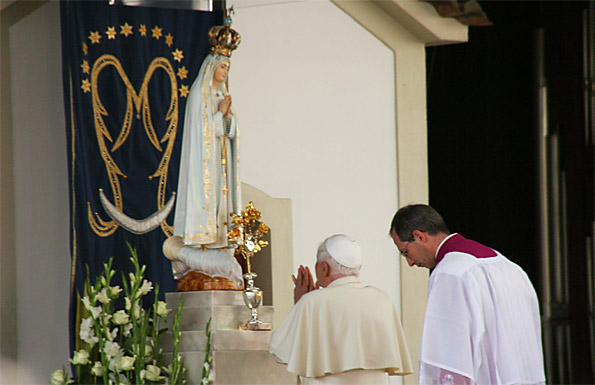
Iconoclasm was a frontal assault on that seeable, touchable, and holdable attribute of the Church. Iconoclasm and the Iconoclasts would have eradicated that visible notion of the Church and made her the invisible entity, the “mere Christianity,” that she has become today in the minds of many. By seeking to suppress the very visible representations of Our Lord Jesus Christ, His Mother, and the Communion of Saints in Heaven, the Iconoclasts attempted to de-Incarnationalize Christianity and replace it with an immaterial and ethereal contemplation of God. To de-Incarnationalize Christianity is to remove the visible essence of the Church and her moral authority from the mind, to eradicate the priestly hierarchy, and to break down the distinction between the sacred and the profane. Once the Church and her visible essence have been removed from the mind, the other Authority — the State — soon fills the vacuum, and its “civil” religion replaces that of the True Faith. There are many examples of this in history, including the Protestant Revolt. Wherever Protestantism took hold (often accompanied by Iconoclasm), the end product was the consolidation of power — both civil and religious — in the hands of the State.
Iconoclasm comes from the Greek Eikonoclasmos , which is literally “image breaking.” Eradication of the visible representations, in any form, be it statues or paintings of Christ, His Mother, or the Saints, was the end to which Iconoclasts strove. The rise of Iconoclasm can be traced to a variety of causes, all coming together at that particular time in history. As is the case with all heresy, we are dealing not only with a doctrinal error, but also with historical circumstances which form its particular character.
The Iconoclast position de-Incarnationalizes religion and turns it into a form of Manichaeism, where flesh is evil and the corporate body of the Church is replaced by the individual’s immaterial contemplation of a God who is no longer “the Word made Flesh.”
Carried to its extreme, Iconoclasm becomes Docetism, where God merely appears to use a body of flesh. Docetism is very much alive in many modern Christian heresies.
“Of old, God the incorporeal and uncircumscribed was never depicted. Now, however, when God is seen clothed in flesh, and conversing with men (Bar. 3:38), I make an image of the God whom I see. I do not worship matter, I worship the God of matter, who became matter for my sake, and deigned to inhabit matter, who worked out my salvation through matter. I will not cease from honoring that matter which works my salvation. I venerate it, though not as God. How could God be born out of lifeless things? And if God’s body is God by union, it is immutable. The nature of God remains the same as before, the flesh created in time is quickened by a logical and reasoning soul. I honor all matter besides, and venerate it. Through it, filled, as it were, with a divine power and grace, my salvation has come to me. Was not the thrice happy and thrice blessed wood of the Cross matter? Was not the sacred and holy mountain of Calvary matter? What of the life-giving rock, the Holy Sepulchre, the source of our resurrection: was it not matter? Is not the most holy book of the Gospels matter? Is not the blessed table matter which gives us the Bread of Life? Are not the gold and silver matter, out of which crosses and altar-plate and chalices are made? And before all these things, is not the Body and Blood of Our Lord matter? Either do away with the veneration and worship due to all these things, or submit to the tradition of the Church in the worship of images, honoring God and His friends, and following in this the grace of the Holy Spirit. Do not despise matter, for it is not despicable.”
-- St John Damascene
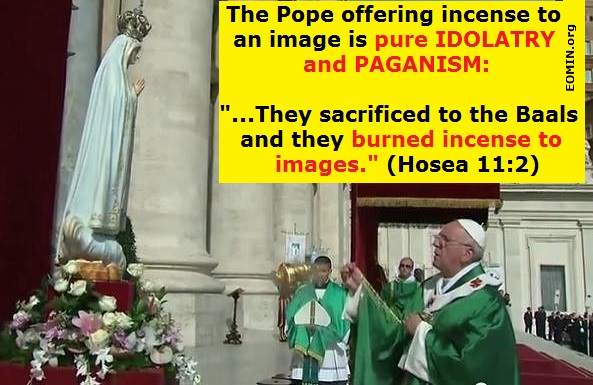
Regarding the use of incense, it is merely to symbolise the prayers of the faithful rising to heaven and also used even in the Old Testament as a purification ritual.
Old RCC pagan declarations. No Jewish apostle would do that. Your old John does not represent the church.
Pagan way of understanding God.
Thou shalt not make unto thee any graven image, or any likeness of any thing that is in heaven above, or that is in the earth beneath, or that is in the water under the earth.
5 Thou shalt not bow down thyself to them, nor serve them: for I the Lord thy God am a jealous God, visiting the iniquity of the fathers upon the children unto the third and fourth generation of them that hate me


 Mar 8 2019, 08:55 AM




 Quote
Quote



 0.0697sec
 0.46
0.46
 7 queries
 GZIP Disabled