Welcome Guest ( Log In | Register )

15 Pages « < 12 13 14 15 >Bottom

Outline · [ Standard ] · Linear+

 LYN Catholic Fellowship V02 (Group), For Catholics (Roman or Eastern)

views
     
TSyeeck
post Oct 30 2020, 05:48 PM

Look at all my stars!!
*******
Senior Member
3,573 posts

Joined: Apr 2006


A Sower Went Out to Sow, But Why?

Why did Our Lord Jesus Christ teach in parables? The answers to this question vary. To many, these earthy stories are like supernatural versions of Aesop’s Fables or Grimm’s Fairy Tales: great stories with a solid moral lesson, only even better because, well, Jesus told them.

Others would say that the parables employ figurative language — as extended similes — to teach obscure and hidden things using easily understood figures. And that answer, too, sounds reasonable.

But neither of these is the reason Jesus Himself gave for teaching in parables. He was asked by the disciples why he taught the multitudes this way (Matt. 13:10), and He answered the question in a way that might mystify us:

Because to you it is given to know the mysteries of the kingdom of heaven: but to them it is not given. For he that hath, to him shall be given, and he shall abound: but he that hath not, from him shall be taken away that also which he hath. Therefore do I speak to them in parables: because seeing they see not, and hearing they hear not, neither do they understand. And the prophecy of Isaias is fulfilled in them, who saith: By hearing you shall hear, and shall not understand: and seeing you shall see, and shall not perceive. For the heart of this people is grown gross, and with their ears they have been dull of hearing, and their eyes they have shut: lest at any time they should see with their eyes, and hear with their ears, and understand with their heart, and be converted, and I should heal them. (Matt. 13:11-15)

These challenging words should be pondered and explained, but before I explain my own ponderings on them, it will be good to consider their context. Our Lord says these things after telling the Parable of the Sower, which prompts the disciples to ask him why he teaches in parables. After His jarring reply, above, Jesus tells the disciples how blessed they are for seeing and hearing His Person and His divine teachings, things which the saints of the Old Testament longed for but were not given the grace to witness (Cf. Matt. 13:16-17).

At that point, Jesus goes on to explain to them in detail what the Parable of the Sower means. In summary, there are three categories of bad soil and then there is the good soil, which, in Matthew’s telling, is also threefold. The bad ground comes in these varieties: the wayside soil, hard from being trampled on by the husbandmen, represents those who hear God’s word and do not understand it, the demons taking the word from their hearts; the rocky soil, where the seeds first take root and then quickly wither because they have not much soil, are those who receive the word joyfully but fall away when persecution comes; lastly, the thorny ground, where the seeds take root and grow only for the plants to be choked by the thorns, represent those who are too taken with the cares of this world and “the deceitfulness of riches,” which render these men spiritually “fruitless.”

It would seem that these categories of men fail respectively in faith, in hope, and in charity.

Finally, there is the good soil, which Jesus distinguishes into a further three categories, showing thereby that there are different degrees of spiritual fruitfulness, i.e., of earthly merit and its consequent heavenly reward: “But he that received the seed upon good ground, is he that heareth the word, and understandeth, and beareth fruit, and yieldeth the one an hundredfold, and another sixty, and another thirty” (Matt. 13:23).

And now, to explain those challenging words of Our Lord I cited above (Matt. 13:11-15). The short review of the Parable of the Sower was first necessary because that parable tells us something about the “method behind the madness” of this manner of preaching, for the Parable of the Sower is reflexive; that is, it is a parable about parables — and, by extension, about hearing the word of God in general. Considering those harsh words of Matt. 13:11-15 in light of the three categories of bad soil Jesus Himself explained, we may conclude that He preached to the multitudes in the (unexplained) enigmas of parables because they were the bad ground. By contrast, the disciples, whom Our Lord here calls “blessed,” are the good ground. There is a parallel, then, between Matt. 13:11-15 and Matt. 13:19-22 and another parallel between Matt. 13:16-17 and Matt. 13:23.

Cornelius a Lapide, in his Great Commentary admits that there were probably among Our Lord’s auditors at Capharnaum some who were of good will and therefore who truly constituted “good ground,” and that these would have humbly asked Our Lord or the disciples for some explanation of the parable. Yet these were not representative of the majority, who were not, due to their own ill will, worthy of the sublime truths they were being taught obscurely and in a manner beyond their reach.

We should keep in mind, too, that to the Apostles, the nascent ecclesiastical hierarchy, it was “given to know the mysteries of the kingdom of heaven” (Matt. 13:11). They could and did teach those mysteries later to the four corners of the world.

This episode unfolded in time as a part of Our Lord’s larger public ministry, and many of His hearers likely had other opportunities to hear His teaching, or subsequently the preaching of the Apostles. Even among those who clamored for the crime of deicide, there were those who later “had compunction in their heart” at the preaching of Saint Peter on Pentecost day (Acts 2:37). Their hard-packed, stony, or thorny ground was, in time, harrowed by their own sins, by the preaching of the Apostle, and by the remorse they felt for their part in the horrors of the Passion. Above all this was God’s grace at work.

Soil can change; just ask a farmer. Souls can change; just ask a priest.

In the Pre-Anaphora of the Maronite Divine Liturgy (corresponding to our Roman Offertory), the following lovely words are sung from the vantage point of Our Lord:

I am the Bread of Life. From the Father I was sent as Word without flesh to give new life. Of the Virgin Mary I was born, taking flesh as man; as good earth receives a seed, her womb received me. Priestly hands now lift me high above the altars… .

The words I underlined show that whoever wrote this sublime liturgical text beautifully juxtaposed the mystery of the Annunciation with the Parable of the Sower — and all just moments before the Eucharistic consecration. How’s that for an Angelus meditation!

Just as there are varying degrees of bad soil, there are varying degrees of good soil, too. Mary’s is the best — the richest, the most perfectly prepared soil, for it is the mystical “garden of delights” heralded by the terrestrial paradise of Eden, as Saint Jerome and Saint John Eudes assure us.

There is so much to the Parable of the Sower, and indeed there is much more to Our Lord’s use of parables in general than what I have written about here. I refer the reader to the masterpiece of Cornelius a Lapide that I have already referenced. I will close these lines with one lovely passage from that work, but before doing so, I would like to turn tropological.

In the medieval quadriga, the four-fold manner of interpreting Holy Scripture, the tropological sense is that reading of the Bible that “turns” the passage upon the reader so that he may examine himself in it as in a mirror. How can we turn this parable upon ourselves? We can and we should, by becoming spiritual “soil scientists” and seeing how it is we respond to the seed of the word in the Gospel. Do we receive it well? Even those passages that are challenging? Even those passages that fulminate against our very favorite vices? A good examination of conscience might reveal to us that we have become hard, stony, or thorn-choked and therefore fruitless; our faith, hope, and charity may need reviving. The fertilizer of prayer and penance may be necessary to break up the clods, while the purging action of toil and good works may be necessary to trim back the thorns that would choke the life of grace in us. We have been commanded to bear fruit (Luke 13:9, John 15:4). Are we doing so?

Soil can change from good to bad and back again. Change is a constant in this vale of tears, but not all change is good.

Here is one of Cornelius a Lapide’s insights into the Parable of the Sower, which beautifully ties in the parable to the Catholic doctrine of grace and free will:

Just as a father and a mother cooperate in generating offspring, so too, for the production of fruit, there must be a meeting of earth and seed, in such a way, however, that the earth draws from the seed all of its power to produce this or that kind of fruit. Similarly, for good works there must be the concurrence of the word of God, which is both an external force and even more so an internal force, and of man’s free will, which must cooperate with the word of God, in such manner, however, that the will derives all its power of producing a spiritual, supernatural and divine work from the word and grace of God, in order that they may be pleasing unto God, and may merit eternal life. This is taught by the Council of Trent, session 6. In like manner, from free will the fruit derives liberty, that is to say, the fact that it is a free work and not compulsory nor done of necessity. For the interior word, which God speaks in the soul, stirring it up and strengthening it for acts of penance, patience, charity, religion, etc., is nothing else but the grace of God itself, illuminating the understanding, and strengthening the affection or the will, and inflaming it to the divine works of virtue. This interior word, or grace, God customarily adds to the external word of preaching, thus enlivening, so to speak, what would otherwise be without grace and inanimate, incapable and powerless to perform such works. Therefore, what the preacher speaks outwardly in the ear, God must speak inwardly in the heart, if it is to bear fruit.

All three Synoptic Gospels relate the Parable of the Sower. In this piece, I have relied exclusively on Saint Matthew’s account in chapter thirteen of his Gospel. I recommend to my readers the parallel passages in Mark four and Luke eight. They all provide ample matter for meditation.

Perhaps it’s because I have recently been thinking more than I am accustomed to about such things as animals, plants, and soil, but Our Lord’s agricultural similes are more meaningful to me lately. I hope that’s a good sign. If the parables of Our Lord grow on us, maybe we are good ground.

Most devotedly yours in the Hearts of Jesus and Mary,
Brother André Marie, M.I.C.M.
TSyeeck
post Nov 13 2020, 02:28 PM

Look at all my stars!!
*******
Senior Member
3,573 posts

Joined: Apr 2006


The Raising of Jairus’ Daughter and the Healing of the Haemorrhissa

The secular pieties being imposed upon us by our ascended masters are a hodgepodge of blasphemies, abominations, and lies meant to keep the common man enslaved while at the same time fooling him into thinking he is actually free. The cult of the lie — or dare I say it, the DAMN LIE — forms the black heart of these pieties. To resist such a malign cult, we must at times back away from the mundane and enervating nonsense that passes for our national discourse and look up, contemplating the eternal verities that do not change amid the very changeable things of this world. I invite my reader to do just that with me now by considering a liturgical pericope from this past Sunday’s traditional Roman Mass.

user posted image

The Gospel for the twenty-third Sunday after Pentecost is Saint Matthew’s brief account of a revealing pair of miracles Our Lord performed to benefit two whose destinies were interwoven in the eternal decrees of Providence: the daughter of Jairus and the Haemorrhissa, i.e., the “woman with an issue of blood.” If, as Saint Thomas tells us, God teaches us things with words and also teaches us things with other things, what might He be teaching us by the things this Gospel presents on its surface? While completely accepting the historical veracity of the literal sense of the account, we can and should dig deeper into the spiritual senses and learn much from them for our benefit, which we now purpose to do with these events that are related by all three synoptic Gospels:

Matthew 9:18-26
Mark 5:22-43
Luke 8:41-56
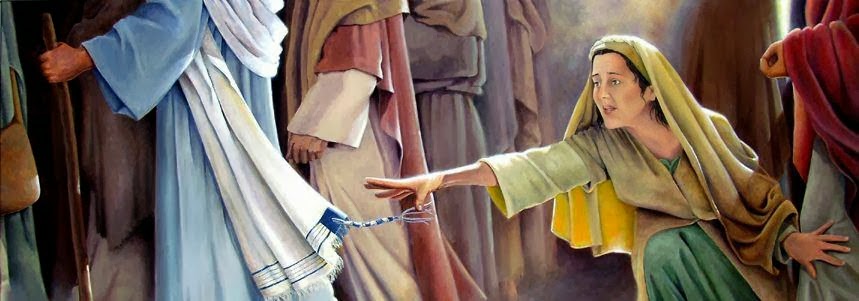
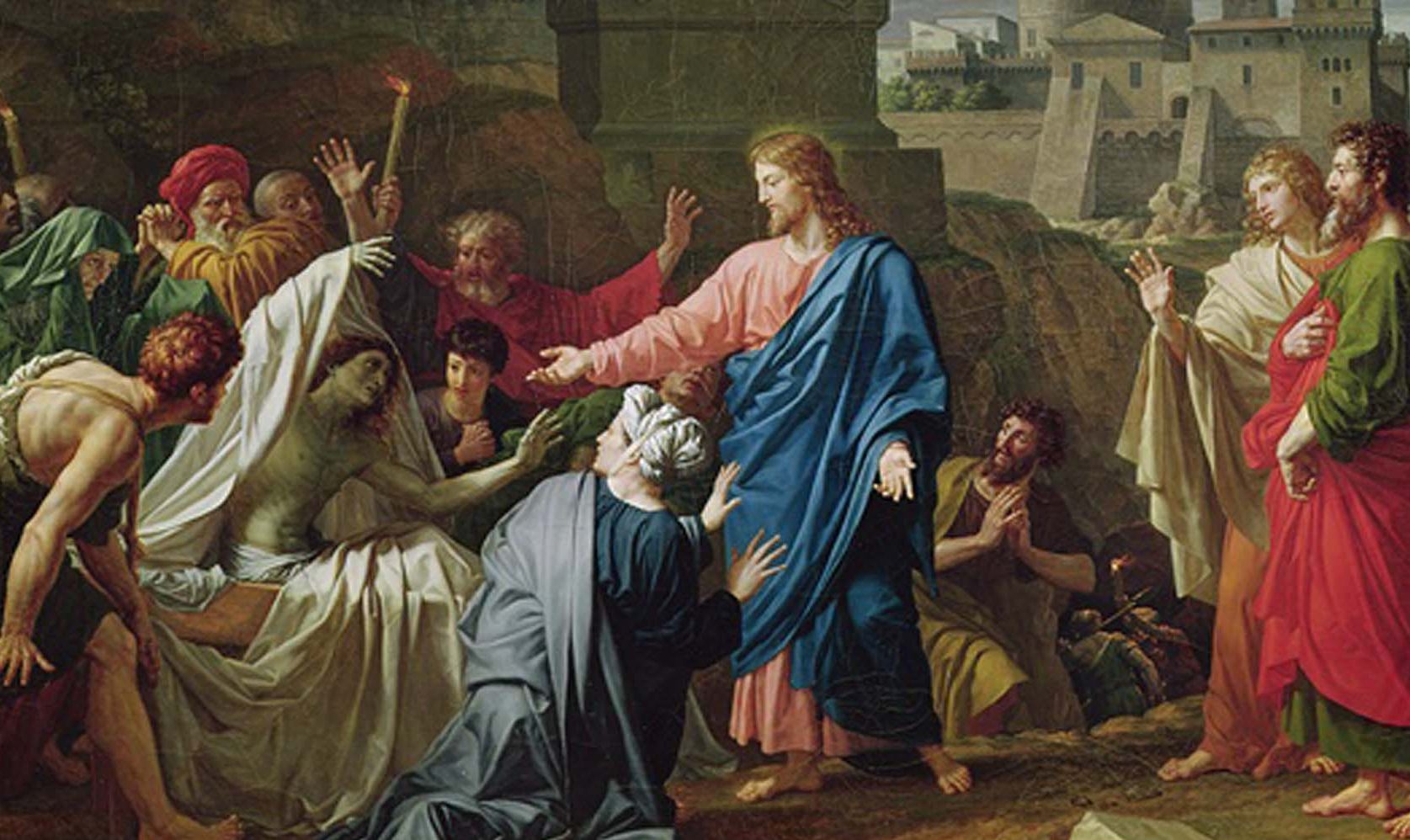
The essentials of the story are that a ruler of the Synagogue of Capharnaum, one Jairus by name, approaches Our Lord asking the Master to heal his twelve-year-old daughter, who is dying. As Jesus makes His way with Jairus and the disciples, He finds Himself in a packed crowd of people. A woman who has suffered with an issue of blood for twelve years approaches to touch the hem of Our Lord’s garment, reasoning (correctly, as it turns out) that if she were just to touch it, she would be healed. She does so and immediately senses that she has been cured of what physicians could not remedy, even though she had spent all her substance on them. Jesus, still thronged about by people, asks “Who touched me?” — a question that confuses the Apostles, who note that this query seems incongruous, as they find themselves in a very congested tangle of people. But Our Lord notes that He has felt power going out of Himself, and He wants the person who touched Him to be identified. As those around her deny one by one that they touched Jesus, the woman realizes that she must step forth, which she does trembling and fearful, to relate all that happened — all, including her embarrassing condition. Jesus commends her faith, and tells her to leave in peace. Then come messengers from Jairus’ house to inform him that his girl is dead. Jesus tells him not to fear but only to believe, and the party proceeds to the house, which is now draped in mourning. In bombastic Mideastern fashion, the wailers and the minstrels playing mournful music are making quite a din in the house, but Jesus tells them not to weep so, because the girl is only sleeping. Showing their emotional agility, the crowd in the house now laugh Jesus to scorn, knowing her to be dead indeed; nonetheless, they obey His command to leave the house, where only six people remain with the dead girl: Jesus, Peter, James, John, Jairus, and the girl’s mother. The Master takes the girl by the hand and utters, “Talitha cumi” (maid arise), and she is immediately restored to life and health, after which He commands food to be brought to her, while everyone marvels at the miracle. Jesus then commands them not to tell what they had seen, but the fame of what happened was nevertheless widely publicized.

At nine verses, Saint Matthew’s account is the shortest of the three, while Saint Mark’s twenty-two-verse treatment is the longest, leaving Saint Luke’s fifteen-verse version in between. This fact alone rather demolishes a favorite Modernist idea about Saint Mark’s Gospel being an earlier version of the Synoptics that the others built upon by adding further details. Among other details Saint Mark alone relates, it is he who gives us those tender words spoken in Aramaic by the Divine Physician, which he immediately translates for his Greek readers: talitha cumi, “young girl, arise.”

In his Spartan account, Saint Matthew begins with Jairus saying to Our Lord, “My daughter is even now dead.” One might object that this is a contradiction because the other evangelists have him telling Our Lord that his daughter is dying, not dead. But there is no contradiction, and commentators have pointed out two ways to reconcile the different accounts: The first is that when Jairus left the house, he knew his daughter to be near death, so that he reasoned within himself that she must be dead by this time. The second possibility is based upon what we know for certain occurred according to Luke and Mark, namely, that messengers arrived while these events were in progress to inform the distressed father that his daughter had indeed died in the meantime. In this second scenario, Saint Matthew could simply have omitted the first part of the conversation. Either way, there is not a hard contradiction among the accounts.

Jewish men wore a garment called the tallit, a rectangular white prayer shawl with dyed blue patterns on it, and fringed about with tassels called tzitzit. This is what the woman touched. While modern authors perhaps draw unwarranted conclusions from this, the fact that this is the “hem of his garment” mentioned by the evangelists is practically beyond dispute. Cornelius a Lapide certainly holds it to be the case. The tallit, a sort of Old-Testament sacramental, was a reminder to Jewish men of their covenant with God (cf. Num. 15:38-40).

user posted image

user posted image
Fresco, Catacomb of Sts. Marcellinus and Peter, Rome, early 4th Century showing the haemorrhissa being healed by touching Christ’s garment (Mk 5:25–34)

A woman with an issue of blood would have been considered ritually impure. Her religious observance, and even her routine social interaction with other Jews would have been drastically curtailed by this impurity. She could not, in fact, touch others without rendering them impure. This may well be why she was trembling and fearful when called upon to identify herself, which supposition leads to a question: Why did Jesus call her out in the first place, thus subjecting her to such embarrassment and fear? Perhaps it was to give her confidence, and to assure her that it was perfectly fine for her to “steal” this cure, or perhaps it was to try her for the purpose of building her up, removing her fears while at the same time calling the attention of the bystanders to the miracle. Maybe it was to assure this good woman that it was He who had healed her and not merely His tzitzit, thus strengthening her faith. Whatever the exact reasons were in the Mind of Our Lord, after the humiliation consequent upon this public acknowledgment, the Haemorrhissa is commended for her faith and told to be “at peace,” whereas before she was “trembling” and “fearful.” Jesus challenged her to reveal her vulnerability — to be open, trusting, docile, and completely abandoned to His goodness. None the worse for all this, she walks away not only physically healed, but also reassured, comforted, confident, and sanctified.

There is a tradition — that identifies this good woman with Saint Veronica of the Veil.

What must it have been like for poor Jairus to witness this episode that “distracted” the Master while on the way to cure his dying daughter? One can imagine mixed emotions based upon a newfound confidence in the Master along with a heightened urgency to present the dying girl to Jesus. The ruler’s emotional state would then have been exacerbated by the news that came after the woman’s cure and subsequent dialogue with Jesus, when messengers arrived to inform him that his little girl was dead. Undaunted by the news, Jesus tells the anguished father to fear not but only to believe.

As with the now-cured Haemorrhissa, Jairus is being tested to believe in and trust Jesus even more. These two cases are practical studies in how Our Lord deals with people. Never satisfied with where they are, He tries them and thus invites them to come higher by practicing greater virtue and relying more and more on Him, rewarding their cooperation with further graces. These lessons are invaluable for us.

When Jesus arrives at the house of Jairus, He is greeted by a very extroverted display of emotion. There were musicians there, and possibly hired mourners (“professional wailers” as they are called), who were paid for the service of priming the pump of people’s tears. Saint Matthew mentions “minstrels and the multitude making a rout,” whereas Mark calls it “a tumult, the people weeping and wailing much, and Luke laconically says “all wept and mourned for her.” There is nothing of Anglo-Saxon reserve in Middle Eastern mourning, where bombast is the order of the day; add to that, though, the fact that this was a twelve-year-old girl. Even in our comparatively frigid North-American culture, the funeral of a child is different than that of an adult. The note of tragedy is there, making the mourning deeper.

Then Jesus says something at least materially untrue: “The girl is not dead, but sleepeth.” Is this a lie? No, of course not; He is simply notifying the mourners of the temporary nature of the girl’s condition. He said something similar about Lazarus (John 11:11), whom He was also about to “awake... out of sleep” at the time. Death and sleep often stand as metaphors for each other in Scripture and in the Church’s liturgy, but here as with Lazarus, Jesus miraculously renders death just as susceptible to interruption as routine sleep.

Having dispelled the noisy mourners and brought in His three favorites and the girl’s parents, Jesus approaches the damsel with only six people in the room — six, the imperfect number which therefore represents evil, a whole trinity of sixes being the very number of the beast. Man was made on the sixth day, but he was made for the seventh day, the eternal sabbath of Heaven, according to Saint Augustine. At the resurrection of the dead girl, the scene is now representative of perfection, because six living souls become seven. Jesus perfects our imperfections if we “fear not, but believe only.”

Those three favorites Jesus brought with him — Peter, James, and John — would witness two other things that the rest of the Twelve did not see: the Transfiguration and the Agony in the Garden. The first two were, or should have been, an adequate preparation for the third. Peter represents faith because his profession of faith at Caesarea-Phillipi was rewarded with the office of being Christ’s Vicar. Saint John, being “the beloved disciple,” evidently represents charity. Less clear is how Saint James the Great represents hope — less clear, that is, until we realize that he was the first of the Twelve to have his hope give way to vision when he died in A.D. 42, a victim of Herod Agrippa, who had him beheaded.

When the girl is raised from the dead, Jesus commands that she be brought something to eat. Why? Well, no doubt as a courtesy because He cared, but there was another good reason: to assure the onlookers that she was indeed alive and perfectly healthy, so that she could eat and retain food. After His Resurrection, on the night of the first Easter Sunday, Jesus asked for food and they gave Him fish and a honeycomb so that they could see that He had a real body and was in perfect health.

Even in a quick reading we might notice the curious fact that the woman suffered from the issue of blood for twelve years, and Jairus’ daughter was twelve years old when she died (though Luke says she was “almost twelve years old”). In his Catena Aurea, Saint Thomas quotes the medieval monastic writer, Rabanus Maurus, on the significance of this. In summary, Jairus represents Moses, and his daughter the Synagogue, while the woman with the issue of blood represents the Gentiles. Jesus is sent to the lost sheep of the house of Israel, but on the way, He also heals the Gentiles. Twelve and a half years was considered marriageable age for a girl, though they often waited till they were thirteen or fourteen to marry. The lesson here, according to Rabanus, is that just when the Synagogue should have been fruitful in bringing about offspring, she dies from her own infidelity; but the Gentiles — who had apostatized from God and consequently became spiritually fruitless around the time the Hebrews were chosen out of the mass of humanity — even these will enter the Church of the Messias. In the Matins reading for this Sunday, Saint Jerome applies two Biblical passages to this Jew-Gentile reading of the two females in our Gospel: First, “Ethiopia [the Gentiles, represented by the Haemorrhissa] shall soon stretch forth her hands unto God” (Ps. 67:32; note the gesture of “stretching forth her hands” as if to touch Jesus’ tzitzit), and second, “Blindness in part is happened to Israel, until the fullness of the Gentiles is come in and so all Israel shall be saved” (Rom. 11:25). Near the end of time, after the complete conversion of all the Gentile nations, the Jews, who spiritually “died” prematurely, will come to life and enter the Church.

In these days of increasing ugliness and hate in the world, let us meditate upon and avail ourselves of the supreme moral beauty and efficacious love of our Divine Physician, “looking on Jesus” (Heb. 12:2), “Who his own self bore our sins in his body upon the tree: that we, being dead to sins, should live to justice: by whose stripes you were healed” (1 Pet. 2:24).

Most devotedly yours in the Hearts of Jesus and Mary,
Brother André Marie, M.I.C.M.

This post has been edited by yeeck: Nov 13 2020, 02:34 PM
TSyeeck
post Dec 18 2020, 10:24 AM

Look at all my stars!!
*******
Senior Member
3,573 posts

Joined: Apr 2006


EVERY night, in the traditional office of Compline, we encounter the following words of Saint Peter (I Pet. 5:8):
Fratres: Sóbrii estóte, et vigiláte: quia adversárius vester diábolus tamquam leo rúgiens círcuit, quærens quem dévoret: cui resístite fortes in fide.
V. Tu autem, Dómine, miserére nobis.
R. Deo grátias.

In English:

Brothers: Be sober and watch: because your adversary the devil, as a roaring lion, goeth about seeking whom he may devour. Whom resist ye, strong in faith:
V. But thou, O Lord, have mercy upon us.
R. Thanks be to God.

Faith is the initium salutis, “the beginning of human salvation” — not the middle, not the end. This doctrine comes to us from the Council of Trent, which cites Saint Fulgentius of Ruspe (468-533) as its source. Among the three theological virtues — and, indeed, within the supernatural life as a whole — faith is “first,” not chronologically or in any other respect “mathematically,” but first in that ontological sense in which all else that comes after is dependent upon it; without it, there simply is no supernatural life.

Fortitude is a moral virtue, and one of the four cardinal moral virtues. Its other names are “courage” and “bravery.” It exists in us as a power to restrain fear, which itself exists in us as a perfectly useful human passion, though we can allow fear to traumatize us as people are clearly being traumatized by all manner of false fears lately. On the other hand, without fear, we would endanger ourselves unnecessarily by doing foolhardy things. Like all the passions, fear is a potentially very good servant, but a poor master, and therefore needs to be directed according to reason. Subjecting fear to reason is precisely the function of fortitude — about which I wrote more elsewhere.

Fortitude, to be a genuinely Christian virtue, must rest firmly on the Rock of Christ. Otherwise, what we have will be a counterfeit of fortitude, a bravado or machismo founded upon the shifting sands of pride and disordered self-love. How then, can we guarantee that our fortitude rests firmly on the Rock of Christ? There are three powerful adhesives that firmly attach fortitude to that Rock and assure its strength: humility, abandonment, and confidence in God.

Concerning these, Saint Paul gives us a wonderful image in a much celebrated passage (II Cor. 12:7-10):

And lest the greatness of the revelations should exalt me, there was given me a sting of my flesh, an angel of Satan, to buffet me. For which thing thrice I besought the Lord, that it might depart from me. And he said to me: My grace is sufficient for thee; for power is made perfect in infirmity. Gladly therefore will I glory in my infirmities, that the power of Christ may dwell in me. For which cause I please myself in my infirmities, in reproaches, in necessities, in persecutions, in distresses, for Christ. For when I am weak, then am I powerful.

Father Challoner comments as follows on that passage:

The strength and power of God more perfectly shines forth in our weakness and infirmity; as the more weak we are of ourselves, the more illustrious is his grace in supporting us, and giving us the victory under all trials and conflicts.

See how the great Apostle recognizes his own smallness and dependence, and even glories in his infirmities as he abandons himself to God’s good pleasure with the full confidence that Christ’s power will dwell in him in the midst of those manifold threats, torments, betrayals, and life-threatening dangers he only partially narrated to the Corinthians in the preceding chapter. He will continue manifest this his humble, abandoned, and confident fortitude even unto martyrdom, thus maximally availing himself of the grace of Christ.

Christian fortitude is not remotely possible without the theological virtue of faith, and there are times when faith itself needs the moral virtue of fortitude to shield it from harm — as when that roaring lion seeks to devour us. These two great virtues support one another.

Concerning the virtue of faith, its truths admit of no negotiation, no compromise, and no attenuation. For this reason, faith has a paradoxical double aspect: In itself, it is a house of stone built upon a rock, but it can also be a house of cards, or, to use Christ’s own figure at the end of the Sermon on the Mount, a house built upon the sand.

How explain this paradox?

Objectively speaking, as it comes from God through the Church, the divine and catholic faith is an impregnable, enduring, unbreakable fortress of stone built upon solid rock. Subjectively speaking — that is, as that faith exists in each one of us as in its subject — it is assailable. It can be compromised, even destroyed. If we remove one stone from that sturdy edifice, it crumbles like a house of cards. By our own assent to superstition or heresy, or even our own deliberate doubt of just one revealed truth, we can mutilate what is divine into a merely human faith.

Here is Saint Thomas explaining how a heretic does not have “living faith” (that is, faith accompanied by hope, charity, and sanctifying grace), or even “lifeless faith” (faith without the last two of those things, i.e., the faith of an orthodox Catholic in mortal sin):

Neither living nor lifeless faith remains in a heretic who disbelieves one article of faith.

The reason of this is that the species of every habit depends on the formal aspect of the object, without which the species of the habit cannot remain. Now the formal object of faith is the First Truth, as manifested in Holy Writ and the teaching of the Church, which proceeds from the First Truth. Consequently whoever does not adhere, as to an infallible and Divine rule, to the teaching of the Church, which proceeds from the First Truth manifested in Holy Writ, has not the habit of faith, but holds that which is of faith otherwise than by faith. Even so, it is evident that a man whose mind holds a conclusion without knowing how it is proved, has not scientific knowledge, but merely an opinion about it. Now it is manifest that he who adheres to the teaching of the Church, as to an infallible rule, assents to whatever the Church teaches; otherwise, if, of the things taught by the Church, he holds what he chooses to hold, and rejects what he chooses to reject, he no longer adheres to the teaching of the Church as to an infallible rule, but to his own will. Hence it is evident that a heretic who obstinately disbelieves one article of faith, is not prepared to follow the teaching of the Church in all things; but if he is not obstinate, he is no longer in heresy but only in error. Therefore it is clear that such a heretic with regard to one article has no faith in the other articles, but only a kind of opinion in accordance with his own will.

We are all subject to doubts and to trials of our faith. Saint Peter, whose words began the present lines, writes elsewhere of “the trial of your faith (much more precious than gold which is tried by the fire)” (I Pet. 1:7). In fact, the great saints have their faith and other theological virtues tried a great deal as they become perfected in the interior life.

We must frequently renew this fundamental virtue by making interior acts of faith, by daily reciting the Credo, and by not permitting any doubt to undermine this necessary foundation to our spiritual edifice. But when our faith is assailed, let us be at peace. Only in peace can we have the proper internal atmosphere whereby the power of Christ can freely operate in us. If we are humble, abandoned, and confident, we will also be peaceful. Our faith will not evaporate for all that, but, rather, be strengthened. On the other hand, when we suffer from anxiety, depression, or disordered fear, we can lose our trust in the divine promises and subject ourselves to the undermining forces of the devil. (Which reminds me that the woodpecker, for its ability to undermine the structural integrity of a tree is a symbol of both heresy and the Devil)

Faith is the initium salutus, the beginning of human salvation, but not its end. Faith cleaves in this life to God as Truth. From there, we cleave by hope to God as our last Good, but that is not the highest virtue. The highest virtue is the one that cleaves to God as the Good to be loved in Himself, and that is charity, "the greatest of these" (I Cor. 13:13), which abides forever. Without faith, we cannot have charity; therefore, we cannot have God. Because of this, charity perfects what was begun by faith. Moreover, because “perfect charity casteth out fear” (1 John 4:18), charity also completes the work of fortitude.
TSyeeck
post Dec 21 2020, 04:36 PM

Look at all my stars!!
*******
Senior Member
3,573 posts

Joined: Apr 2006


Fourth Sunday of Advent

In the Epistle, St. Paul tells us: " Let a man so account us, as servants of Christ and stewards of the mysteries of God. Now here it is required in stewards that a man be found trustworthy" (I Cor 4;1). Let us say a few words about this fidelity that the Good Lord expects from us.

God the Creator of the universe and our lives is the Source of all wisdom and goodness. He knows and organises everything down to the smallest details, from the first moment of the world to the last. Does this mean that we have nothing else to do but to "undergo" God's plan, passively and with fatalism? Not at all, because God introduces us, to a certain extent, to the knowledge and understanding of His plan so that we can take an active, free and voluntary part in its execution. What the Good Lord therefore expects from us is the acceptance and faithful execution of His plan, each one at his own level. It is like an architect who has drawn up the detailed plan of a house and explains it to the foreman who is going to build the house: what does he expect from the foreman? To be faithful to carry out the plan as indicated and to put all his know-how and energy into it. The Good Lord has revealed to us through the Bible and the perennial teaching of the Church's Magisterium what we should know about His plan, established for the glory of the Holy Trinity and the eternal salvation of mankind by Our Lord Jesus Christ: He expects us now to work on it actively and faithfully, applying all our energy and qualities to it with perseverance.

During Advent, the Church makes us meditate particularly on St. John the Baptist. He is the type of the faithful servant, a great model for all of us. The Good Lord laid out in details the plan of the Incarnation, the life of the Saviour in Palestine. He established St. John the Baptist to be the precursor of the Saviour and introduced him into the knowledge of the Mystery of the Incarnation so that he could prepare souls to welcome Our Lord Jesus Christ and send them to Him. In his hymn, St. Zechariah prophetically expressed his son's programme: "Thou shalt go before the face of the Lord to prepare his ways: to give knowledge of salvation to his people, unto the remission of their sins."(Lk 1:77). St. John the Baptist understood his place in God's plan and faithfully fulfilled his mission, preaching the salutary truth to each and every one. To all he said, "Bring forth therefore fruits worthy of penance" (Lk 3; 8) and "he that has two coats, let him give to him that hast none; and he that hast meat, let him do in like manner" (Lk 3; 11).To thieving officials he preached the virtue of justice: "Do nothing more than that which is appointed you” (Lk 3; 13); to the police and army, brutal and oppressive, he preached the virtue of Fortitude: "Do violence to no man, neither calumniate any man; and be content with your pay" (Lk 3; 14); to the proud and heretical religious leaders, he denounced their malice: "Ye, brood of vipers, who hath shewed you to flee from the wrath to come?" (Mt 3 7) and he preached to them the humility of the true servant of Jesus Christ: "the latchet of whose shoe I am not worthy to loose" (Jn 1; 27); to the scandalous political leaders, he denounced their corruption: "It is not lawful for thee to have thy brother’s wife" (Mk 6:18); to all, St. John the Baptist showed the way to eternal salvation: "Behold the Lamb of God, behold Him who taketh away the sin of the world... and I saw and gave testimony that this is the Son of God" (Jn 1:29,34). And because of his faithful testimony, he was murdered. Should we be shocked by this? Should we be afraid of it? No, because " Now here it is required in stewards that a man be found trustworthy " and this up to martyrdom. St John the Baptist was faithful to the end. Glory to him: "Amen I say to you, there hath not risen among them that are born of women a greater than John the Baptist" (Mt 11:11).

This phrase of St. Paul " Now here it is required in stewards that a man be found trustworthy " applies to each one of us. We are the stewards, each at our own level, of the treasure of Faith: the Good Lord has made known to us how all honour is given to Him only through Our Lord Jesus Christ, how the salvation of mankind is possible only through Our Lord Jesus Christ. There is no need to look for a mission: what we are asked to do is to be the faithful witnesses to Christ in our personal life, our family life, our social and political life. And too bad, if this does not please the publicans, soldiers, Pharisees, Sadducees and Herods of the civil and religious societies of our times.

During the time of Advent we are preparing two events: the first one is about the past and it is the birthday of the Saviour on Christmas Day. In honour of Jesus, you are going to offer various gifts to your children, relatives and friends: that's good. The second event concerns the future and it is the coming of the same Saviour at the end of the world to judge the living and the dead. In view of this moment, there is a very precious gift to give to your children, parents and friends: the Catholic Faith. Our Lord gave a terrible warning in the Gospel: "When the Son of Man cometh, shall he find, think you, faith on earth? "(Lk 18:8), which suggests our falling into tepidity and unfaithfulness. So, while you are wrapping your Christmas presents, remember that above anything else, towards and against all odds and even at the cost of your life, it is the living Catholic Faith that you must pass on to your children, relatives and friends.

TSyeeck
post Dec 28 2020, 03:26 PM

Look at all my stars!!
*******
Senior Member
3,573 posts

Joined: Apr 2006


QUOTE(and85rew @ Dec 27 2020, 11:42 PM)
For some reasons some other church followers like SIB (sorry) dont really like RC
*
“There are not one hundred people in the United States who hate the Catholic Church, but there are millions who hate what they wrongly perceive the Catholic Church to be.”

― Fulton J. Sheen
TSyeeck
post Jan 17 2021, 06:44 PM

Look at all my stars!!
*******
Senior Member
3,573 posts

Joined: Apr 2006


The Light, the Law, and the Weapon

I would like to speak about three things today: (1) the Light, (2) the Law, and (3) the Weapon.

The Light. I know a lot of people are discouraged now. There are reasons to be discouraged. Darkness seems to be ascendant, victorious, triumphant. But it’s always darkest just before the dawn. Which brings me to my first subject, “the Light.” What light am I talking about? The Light of Christ, of course! We Catholics are in the middle of the octave of the Epiphany, a liturgical celebration of eight days. It goes from Epiphany day — January 6 — to the eighth day of the Epiphany, January 13. This feast gives us the second part of the Christmas season, which is called “Epiphanytide.” On the Epiphany and for its octave and its season, the Church celebrates three great mysteries: (1) The Visit of the Magi, (2) the Baptism of Jesus in the Jordan, and (3) the Wedding Feast at Cana. All three mysteries are mysteries of Light. They are all mysteries of “showing-forth” — which is what epipháneia means in Greek: a showing forth or manifestation.

We in the West emphasize the Visit of the Magi on the Epiphany. They were led to Jesus by that star that was revealed all the way back in the book of Numbers, when Balaam prophesied that “a star shall rise out of Jacob.” The traditions of that star were kept alive in the East. When these Wise Men saw it from their home in modern-day Iraq, they were enlightened by grace more than by their astrology to know that this was the sign foretold of the Promised One. They were astrologers, yes, but they also believed in one true God. They followed that light, and it led them to “THE LIGHT.”

This is the Light spoken of by Saint John in the prologue to his Gospel:

In the beginning was the Word, and the Word was with God, and the Word was God. ... In him was life, and the life was the light of men. And the light shineth in darkness, and the darkness did not comprehend it.

That’s the saddest verse of Scripture: “The darkness did not comprehend it.”

Saint John goes on:

That was the true light, which enlighteneth every man that cometh into this world. He was in the world, and the world was made by him, and the world knew him not.

How does the life that is the light of men enlighten every man that comes into this world? By two lights. All men have the light of human reason. This comes to us by that divine Logos by whom we were all created. It is a reflection of Him in whose image we were made. The light of natural reason is very important, but there is a higher light, the light of faith. This is a supernatural light that comes to us through the gift of divine grace. Because receiving the gift of faith is considered an “enlightenment,” “Illumination” is the ancient Christian name for the sacrament of Baptism. Some of our Eastern brethren still use this expression for holy Baptism.

What does all this have to do with the Pro-Life cause and ridding our society of that abomination we call abortion?

A lot. Both lights — the light of natural reason itself as well as the light of faith — reveal this horrible deed to be darkness, to be wicked; these two lights reveal two laws that we need. And, that brings me to my second point.

The Law. The light of natural reason reveals to us the Natural Law. The light of supernatural revelation imparts to us the Law of Grace, which comes to us through Holy Scripture and Tradition. The Natural Law is what the Apostle Saint Paul describes as written on the hearts of the Gentiles who did not have the benefit of the supernaturally revealed Law of Moses:

For when the Gentiles, who have not the law, do by nature those things that are of the law; these having not the law are a law to themselves: Who shew the work of the law written in their hearts, their conscience bearing witness to them, and their thoughts between themselves accusing, or also defending one another (Rom. 2:14-15).

All men have been enlightened by the Logos, “the light of men” (John 1:4), to know the Natural Law; and that is why all men have consciences. It’s why we all know when we do wrong and why we consequently feel guilty. Even the pro-aborts know that murder is a sin; they know — many of them — that what they are doing is wrong. The Supreme Court Justices who gave us that horrible decision known as “Roe v. Wade” egregiously violated the Natural Law. They closed their eyes to the Logos, to light of natural reason, and they consequently violated that Divine Law that was written on their hearts.

To be saved, we need the two lights emanating from the Logos as well as the laws that they reveal to us. To be a just civil society, we need at least the Natural Law. To be a Christian civil society — which is what we all here want — we need also the supernatural Law of Grace as well as the Natural Law to enlighten those who govern society.

There is something I want to say about the Natural Law before I move on to my third part, “the Weapon.” I’m going to say something that perhaps some here will disagree with. But, I ask you all to examine your hearts and see if you are on the right side here. There is an “evil twin” that always accompanies the sin of abortion. You might say that it is abortion’s dark mirror of John the Baptist; this evil is the forerunner of abortion. What am I talking about? Contraception. Historically, ethically, medically, and legally, contraception and abortion are always together. The same herbs used in antiquity to commit the one sin also caused the other to happen, just as modern-day chemical contraceptives are often abortifacient. Legally, Roe v. Wade was heralded by Griswold v. Connecticut.

Contraception is a violation of the Natural Law written by God on the heart of man. God had a very powerful way of telling the faithful of the Old Testament what He thought of this abomination. In Genesis chapter 38, a man named Onan commits this sin and was struck dead by God for it: “And therefore the Lord slew him, because he did a detestable thing” (Genesis 38:10).

We will never win the abortion battle until we get the issue of birth control right. You may say, “That’s hard. It’s one thing to convince people of the evil of abortion; that’s murder — but how can you convince people that contraception is wrong? Nobody believes that!” Ladies and Gentlemen, look at a Crucifix. That was hard, too. Convincing the pagan world that this Jew who died on a Roman instrument of capital punishment is the One True God was “difficult.” This, too, was a hard pill to swallow. But eleven million martyrs later, and the Roman Empire was Christianized. We need to witness to this truth concerning the “evil twins” of contraception and abortion. We simply will not win this war against baby killing if we don’t.

The Weapon. Speaking of war brings me to “the Weapon.” I’m going to show you my weapon. Don’t worry, it won’t go “bang,” but it will make a much bigger bang in eternity than weapons that make sensible noise. Do you see this? This is my weapon. It’s the Rosary. Do you know why friars in the Middle Ages wore these on their left-hand side, where I just had mine hanging on my belt? Because that’s where knights wore their swords! This is a spiritual sword.

In the high Middle Ages, there was a Pro-Death heresy called Albigensianism or Catharism. It was primarily in southern France and Northern Italy. The sectarians of this dualistic heresy believed that there were two gods who had equal power. The good god made spirits, but the evil god made matter. Therefore, all matter is evil. Therefore, marriage is evil because it is all about procreation, which traps good souls in evil matter. Sex was evil to them for this reason, but so were Christian sacraments because the sacraments require matter. The Alibgensians were pro-death because they raised suicide and even murder to the status of what we would call sacraments.

God raised up a great saint to battle this particular heresy. His name was Saint Dominic de Guzman, and he was the founder of the Order of Preachers. Besides his preaching and the preaching of his brethren, what was his weapon to defeat this heresy? It was this — THE ROSARY, with its fifteen mysteries and its 150 Hail Marys, symbolizing the 150 Psalms in the Old Testament. There is something both life-affirming and lightsome about each one of these mysteries. They were, in so many ways, diametrically opposed to the anti-Incarnational, anti-material heresy of the Albigensians: The Joyful mysteries — the Annunciation of Saint Gabriel to Mary, the Visitation of Mary to Elizabeth, the Nativity of Our Lord, the Presentation of Jesus in the Temple, and His Finding in the Temple — these are all mysteries of light. They are the mysteries we contemplate the most in this part of the Church’s liturgical calendar. They are full of the beautiful light of Christ, born as He was on the winter solstice, the darkest day of the year, and on the Jewish feast of Hanukkah, the Festival of Lights.

The Sorrowful Mysteries speak to us of the Light, too. But they show us the contrast of Light and Darkness. These are the mysteries of Our Lord’s Passion — the Agony in the Garden, the Scourging at the Pillar, the Crowning with Thorns, the Carrying of the Cross, and finally the Crucifixion. Remember: “the darkness did not comprehend it”! Saint John also wrote that, “Men loved darkness rather than the light: for their works were evil” (John 3:19). What happens when the Darkness does not want to be enlightened? It reaches out to extinguish the light — to kill the Light of the World! But the divine irony is that when the Darkness finally killed the Light, the Darkness lost and man’s salvation was won.

Then we have the Glorious Mysteries: the Resurrection of Our Lord, His glorious Ascension into Heaven, the Descent of the Holy Ghost, the Assumption of Our Lady, and Her Coronation. These mysteries point us toward the full light of glory in Heaven. Our Lady here in Her Assumption is an example of what the Church is to be: holy, perfect, saved, assumed into Heaven. She is the great achievement of the Church, the holiest of all human persons. Saint Augustine said that Mary conceived the Word in Her mind before She conceived Him in Her womb. As for Her Coronation, Saint Augustine also tells us that when God crowns our good works, He is only crowning His gifts. We must cooperate with these gifts of grace — we must cooperate as Mary did.

All of these mysteries are full of life and light. You might say they are all “luminous” mysteries. This isn’t just a sword — it’s a “light saber”!

user posted image

Let us all open ourselves to the two-fold Light of Christ; let us embrace His two-fold Law, and let each one of us wield this lightsome sword of the Rosary to fight the enemies of our salvation and to extend the Kingdom of God on earth.

Thank you very much for listening.

Most devotedly yours in the Hearts of Jesus and Mary,
Brother André Marie, M.I.C.M.
TSyeeck
post Jan 29 2021, 12:41 PM

Look at all my stars!!
*******
Senior Member
3,573 posts

Joined: Apr 2006


To Heaven With You!

Catholics should always have some good spiritual book that they are reading. “Spiritual reading,” and its more ancient cousin, Lectio Divina, are staples of the Catholic spiritual diet. The need for devout reading has always been a reality for the faithful; but, the more surrounded we are by lies, filth, and ugliness, so much the more do we need to arrange scheduled encounters with the true, the good, and the beautiful so that we can “touch base,” so to speak, with our heavenly homeland.

Happily, I am reading a book now that I can highly recommend to my readers, be they lay, religious, or clerical. The book is To Heaven with Diana, by Father Gerald Vann, O.P. It was published in 1960, but has been reprinted by the Dominican Nuns of the Perpetual Rosary in Summit, New Jersey. The book’s subtitle adequately summarizes its subject matter, even if it cannot possibly do justice to the treasures one will find between its covers: “A Study of [Blessed] Jordan of Saxony and [Blessed] Diana d’Andalò with a Translation of the Letters of Jordan.”

There is a tendency in many modern spiritual writers to be highly introspective and “psychological.” Saint Augustine was both of those, to be sure, and he wrote insightfully and movingly in this vein; it is an undeniable part of the charm of his writing. But he also balanced these aspects with something absolutely essential if our introspection is not to become cramped, narcissistic, childish, or self-serving: He combined it with what we might call looking at Our Lord.

Some of the more modern writers who venture into the interior landscape of the soul, even the good ones, are deficient in this area. Self-knowledge is important, indispensable even, but this pursuit can become harmful if it is not joined to something else that is absolutely indispensable to the spiritual life, the knowledge of God.

The second Master General of the Order of Preachers and consequently Saint Dominic’s immediate successor, Blessed Jordan of Saxony (c. 1190-1237) oversaw an immense expansion of the Dominican Order. While he was attentive to the recruiting and formation of numerous men as friars, he did not neglect the cloistered nuns who were — in Saint Dominic’s vision of this great spiritual family — the contemplative “prayer engine” of the Order of Preachers. If the friars could not give themselves as much to prayer as they would like, owing to their pressing duties of preaching and lecturing, the good nuns could participate in the Dominican “Holy Preaching” by their beautiful life of contemplation and penance in the cloister. Because Master Jordan was as convinced as his Holy Father Dominic of the sagacity of this arrangement, he fought for the nuns and saw to their spiritual formation.

user posted image

Modern readers who have been infected to one degree or another of a spirit of Jansenism or of modern sensualism may be scandalized to discover how tenderly and lovingly this holy friar addresses his “beloved” Sister Diana (1200-1236), a noble woman of keen intelligence and strong will, ten years his junior, and described by her contemporaries as beautiful in appearance. If it is true that modern man, in his weakness, has so sensualized the very notion of love that even the masculine love of friendship cannot be imagined by many of our contemporaries in terms other than the homoerotic, so, too, have we made it that all love between men and women must be sexual.

user posted image

That is a pity, a grotesque falsehood, and a standing condemnation of our age. Granted that Saints Benedict and Scholastica were biological brother and sister (twins, in fact), and therefore less likely to raise pharisaical or prurient eyebrows, there remain a large number of saintly pairings of men and women who enjoyed a friendship that was not only close and mutually beneficial to the two friends, but also “charismatic” in the proper theological sense of that word, i.e., their friendship was not only for the good of the two individuals in question but also for the common good. A partial list would include Saints Francis and Clare, Saint Francis de Sales and Jane Frances de Chantal, Saints Margaret Mary Alacoque and Claude Colombiere, Saints Teresa of Avila and John of the Cross, Saints Patrick and Brigid of Kildare, Saint Catherine of Siena and Blessed Raymond of Capua. These friendships sanctified the friends named here, but they also sanctified others, in some cases, many others. The evangelism of Ireland and its highly developed male and female monasticism, the Carmelite reform, the founding of the Poor Clares and the Daughters of the Visitation, and other such works were more or less directly the products of these chaste and holy friendships. The many thousands of canonized saints produced by some of their common undertakings bear witness to the spiritual fecundity of these friendships.

What is impressive about the way Blessed Jordan writes is the fact that Holy Scripture drips off his pen because his mind has been so completely soaked in it. He does not merely quote from the Bible; he has so interiorized it that Biblical language and images become his own. It was the task of Father Vann — for which we are grateful — to annotate these letters so that modern readers can know the passages being cited. Specially deserving of mention here is the frequency with which Old-Testament allusions are made, mostly in their allegorical or tropological senses. Speaking of which, Blessed Jordan’s letters are wonderfully suffused with the fourfold way of reading Holy Scripture so common in the Middle Ages, the quadriga. Along with Scripture, the fonts of Jordan’s thoughts and expressions are the Church’s liturgy and the Rule of Saint Augustine (common to both the friars and nuns of the Order of Preachers).

Blessed Jordan of Saxony would have Blessed Diana d’Andalò look at Our Lord frequently. Speaking of Jesus Christ in the spousal terms that have long been standard in the lexicon of consecrated women, he constantly reminds her of the presence of her divine Bridegroom. When he thought that she was too given to bodily austerities, Brother Jordan urged Sister Diana to moderation and reminded her that what matters is loving God, desiring Him, contemplating Him, and loving her sisters in the monastery with “one mind and one heart in God” (Augustinian Rule).

For the edification of my readers, I will include one complete but short letter of Blessed Jordan’s here. It was sent to Blessed Diana in her monastery at Bologna from Magdeburg, Germany, where he found himself in September of 1225 (pg. 70-71):

Brother Jordan, useless servant of the Order of Preachers, to his beloved daughter Diana: may she be brought by Jesus Christ her Bridegroom into his cellar of wine [Cant. 2:4].

Since I know that your love makes you anxious about me, I wanted to let you know that after leaving Verona, the God of our salvation making my journey prosperous for me [Ps. 67:20], and giving new strength to my weak body, on the third day after the feast of St. Matthew I arrived here at Magdeburg safe and in good health and was given a very joyful welcome by our brethren, who had long been anxious about me, and by a great number of other people. I was much consoled to find everything in our convent here [a house of friars] in good order, and the recent reception of several novices rejoiced me greatly. Give thanks then to God, whose mercy looks so kindly upon us in all things [Ps. 68:17], and gives us so much more than we deserve.

For the rest, beloved, preserve a due measure in your labours and apply the curb of discretion to all that you do; so that as you run after your Bridegroom, drawn by the fragrance of his ointments [Cant. 1:3], and longing to offer him myrrh, which is the chastening of the flesh, you may yet leave place for an offering of gold, following the example of the three holy Wise Men who, opening their treasure-chests, offered to Jesus gold, frankincense and myrrh [Mt. 2:11]. Thus your treasure chest must not be so filled with myrrh as to leave no room for the gold of wisdom and discretion. You must be able to say with the bride in the Song of Songs, A bundle of myrrh is my beloved to me [Cant. 1:12]; she does not liken her beloved to a great weight or load of myrrh, but to a little bundle, as showing that a due measure is to be observed in all things. Often I have told you this when I was with you, and now that I am far away I say it again: you must go forward on your way with such prudence as to be able to climb up, without stumbling, to your goal which is the land of heaven, led thither by the Son of God, Christ Jesus, who is blessed for ever and ever [2 Cor. 11:31], Amen.

Commend me to the prayers of your sisters and greet them for me; and may the Spirit of truth be with you in all things [Jn. 15:26].

The next letter he sends her is a tour de force of both mourning and consolation. Brother Henry, a priest of the Order and the Prior of Cologne, has just died and Blessed Jordan is weeping for his beloved brother, son, and friend, whose death he has felt very tenderly. At the same time, Blessed Diana is mourning the death of a biological brother and sister of her own. Jordan gives full vent to his sorrow while rejoicing for the joy of the elect in heaven — without falling into presumption on behalf of their beloved deceased: “Yet, let us pray for them, so that if in death they were still burdened with some small failings, they may be the more swiftly loosed therefrom and receive their crowns” (pg. 73).

The image we get here is of two very holy people who were a man and a woman of flesh and blood, of profound intellect and subtle feeling. Their religion did not make them insouciant to human suffering, but all the more sympathetic to it. It did not make them love each other or their friends and family less, but more. In short, their religion did not dehumanize them; it made them all the more human because it made them what humanity was meant to be: supernaturally united to God in grace, in faith, in hope, and in charity. Together, Blessed Jordan and Blessed Diana formed a powerful nexus of charity in the Mystical Body of Christ.

Reading the letters of holy people has a certain advantage over reading their systematic treatises. In the systematic treatise, one encounters the author’s spiritual doctrine more or less well illuminated and fully developed, but in reading their letters, the doctrine is presented alongside its practical application amid the joys, sorrows, and glories of daily life. We encounter tears and smiles, longing and aching, triumph and tragedy — and all that turned to the glory of God and the sanctifying of their souls. In the letters of Blessed Jordan to Blessed Diana, we see a union of holy hearts both panting for God “as the hart panteth after the fountains of water” (Ps. 41:2).

While the inmates running the asylum keep gaslighting us, we need to purify and nourish our minds with wholesome draughts of supernatural truth such as we can imbibe here. I cannot recommend this book more highly.


Most devotedly yours in the Hearts of Jesus and Mary,
Brother André Marie, M.I.C.M.
TSyeeck
post Feb 17 2021, 11:41 AM

Look at all my stars!!
*******
Senior Member
3,573 posts

Joined: Apr 2006


Blessed Ash Wednesday folks!

A summary of current practice:

On Ash Wednesday, Good Friday, and all Fridays of Lent: Everyone of age 14 and up must abstain from consuming meat.
On Ash Wednesday and Good Friday: Everyone of age 18 to 59 must fast, unless exempt due to usually a medical reason.

user posted image

GUIDE TO MAKING A SPIRITUALLY PROFITABLE LENT IN
PREPARATION FOR THE PROPER CELEBRATION OF EASTER

The Lenten discipline consists of three separate parts:

1. Corporal or External Fast, including the abstinence from certain foods, drinks, and amusements, i.e. music, and parties during Lent.

These points of fast should be stressed today especially with the mania for entertainment besetting our society;

2. Spiritual or Internal Fast which consists of abstinence from all evil----sin.

Saint John Chrysostom taught that the "value of fasting consists not so much in abstinence from food but rather in withdrawal from sinful practices."

And Saint Basil the Great explains: "Turning away from all wickedness means keeping our tongue in check, restraining our anger, suppressing evil desires, and avoiding all gossiping and swearing. To abstain from these things----herein lies the true value of fast!"

3. Spiritual Change achieved by the practice of virtues and good works must be the main objective of our fasting.

The Fathers of the Church insisted that during Lent the faithful attend the Lenten church services and daily Mass.

In the course of the centuries, our fasting discipline has undergone numerous and radical changes. Today, unfortunately, the observance of Lent is but mere formalism, reduced to abstinence on certain days and without any stress on one's spiritual growth or the amending of one's life style.

It is urgent that we return to the pristine spirit of the Great Fast which is so badly needed in our materialistic world.

Listed below are suggested practices that may be used along with your usual Lenten family traditions of sacrifices and penances.

Corporal or External Practices:

Take less of what you like and more of what you dislike at meals today.
Take nothing to drink between meals.
Do not use seasoning on your food today.
Do not use any sweeteners with your food or drinks today.
Avoid listening to the radio at all today.
Take nothing to eat between meals today.
Avoid any TV or videos; instead read the Passion of Christ in your Bible or Missal.
Take on!y one helping of each item at meals today.
Say an extra Rosary.

Spiritual or Internal Fast Practices:

Don't do any unnecessary talking; instead, say little aspirations (e.g. "Jesus, Mary, Joseph, we love thee, save souls!") throughout the day.
Exercise your patience today in all things.
Don't make any complaints today.
Restrain any anger, and go out of your way to be kind to the person who caused your anger.
Don't be distracted with someone else's business.
Avoid any gossip today. Instead say an extra Rosary to overcome this great fault.
When asked to do something extra do so with a joyful and pleasant attitude today.
Speak in a pleasant tone to everyone today.
Avoid using the phone today.
Tell the truth in all your dealings today.
Avoid any vanity or self-seeking today.

Spiritual Practices: [virtues and good works]

Practice humility today in all your actions.
Be generous today; help someone in need.
Look for ways to be helpful throughout the day.
Do a job that needs to be done without being asked.
Be courageous; walk away from any impure situations today.
Don't be at all idle today. Always be doing something for others or for your spiritual growth.
Go out of your way today to help or talk to someone who is usually difficult.
Volunteer for an extra job today.
Say an extra Rosary today for the conversion of a sinner.
Visit someone who is sick or lonesome today. Offer to say the Rosary with them.

This post has been edited by yeeck: Feb 17 2021, 11:46 AM
TSyeeck
post Mar 21 2021, 12:40 AM

Look at all my stars!!
*******
Senior Member
3,573 posts

Joined: Apr 2006


‘Same Sex Attraction,’ a Different Perspective

DR. G.C. DILSAVER once said something very provocative about “same sex attraction” in an interview with Mike Church.

For those not familiar, this is the term of recent coinage used to label the intrinsically disordered attractions otherwise called “homosexual” and other adjectives no longer considered polite. (People like Saint Thomas and me, who use the words derived from that Biblical city now at the bottom of the Dead Sea, are now considered old fashioned.) The neologism does have a debatable utility in that it limits itself to the attraction alone, abstracting from both particular acts and the lifestyle founded upon that attraction. This has its advantages at times, but it is rather like considering the attraction to domestic violence while prescinding entirely from the stark reality of its traumatized victims.

But what was that provocative thing that Dr. Dilsaver said?

He said that he was all for “same sex attraction” — that it is indeed a good thing.

After a brief moment of discomfort sufficient to let the shock value kick in, he explained himself, making a great deal of good sense: When a man sees excellent qualities and masculine virtues in another man, he is attracted to those goods, and so he should be. Such an attraction leads the beholder to admire and want to emulate the manly virtue he sees in his excellent exemplar. This is quite natural and beneficial to all concerned.

We Christian men have been given the model of perfect masculinity in Our Lord Jesus Christ, the Man-God. After Him, we have the most perfect of all male human persons, Saint Joseph, in whose month of March we presently find ourselves. We should be strongly attracted to these great men, one of whom is a Divine Person, while the other is the divinely appointed guardian and protector of Jesus and Mary — who, as head of the Holy Family, stands as a human icon of God the Father.

Dr. Dilsaver’s insightful provocation came to mind the other day while I was reading a book by the Marist spiritual writer, Father Thomas Dubay, “And You Are Christ’s”: The Charism of Virginity and the Celibate Life. In his preface, Father Dubay contrasts the different ways that men and women view the virginal and celibate consecrated life. The extended passage is worth citing, with my underlined emphasis drawing attention to what is most germane to my point:

Just as on the natural plane women and men differ widely in their outlook on reality, so too do they vary in their attraction to the life of consecrated celibacy. Normal women are readily drawn to the Pauline imagery of the Church as the beautiful bride married to Christ. A woman’s whole bent is toward persons and love. Drawn naturally to the male and his characteristics, a woman with the virginal charism and responding fully to its implications of a total, burning love for God, easily sees herself as given in a heavenly marriage to the eternal Word of God become man. She has no problem in seeing her life, not as an impersonal career — a job to be done — but as Saint Paul describes it, giving her undivided and chaste attention to one Beloved.

A man sees consecrated celibacy somewhat differently. His attraction centers on the towering and virile figure of Christ as one normal man is drawn, with not the least erotic overtones, to another extraordinary man — but immeasurably more so, for this extraordinary man is also the very Son of God. When the male responds fully to his celibate gift and thus begins to grow in a total, burning love for Christ, he sees himself not, obviously, as a bride, but as an intimate friend and brother. Such actually is another way Jesus addresses himself to his chosen intimates: “I shall not call you servants any more... I call you friends [beloved ones]” (Jn. 15:15).

Yet men with the celibate charism need to be reminded that they, along with all men and women, are members of the virgin Church wedded to one husband. Before God each person is receptive, feminine.

Father Dubay goes on to explain that last assertion in a clear and satisfying way, using both Old Testament and New Testament passages. In relation to God, all creation is feminine. This is a cosmological reality in the order of nature, but in the higher order of supernatural grace, it takes on a more “personal” specificity: In relation to the masculine Incarnate Logos, Jesus Christ, the Church is feminine, for the Church is the bride of Christ. For this reason, I argue that a consecrated woman is a more perfect image than a consecrated man of what the Church is.

Focusing on the underlined passage, I was gratified to read that Father Dubay said that the celibate man aflame with “a total, burning love for Christ” sees Our Lord “as an intimate friend and brother.” Yes, Jesus Christ is our Friend; yes, He is our Brother. This is true for all the baptized, but just as the virgin woman looks at Christ in a special way as her Bridegroom, the consecrated male celibate sees Jesus especially as his Friend and Brother.

Naturally speaking, a good and noble man’s virtue and character make him the object of our attraction. If we are blessed to have such a good man as our friend, we can discuss matters pertaining to virtue and character with him, and, in a completely natural and non-contrived way, our conversation with him would approach any topic of mutual interest from the point of view of virtue and the true good to be considered in that topic. We can learn from that friend both by his word and his example.

It should be evident to anyone with a sensus Catholicus that friendships like this can and ought to be supernaturalized if our friend belongs to the household of Faith.

But it gets even better than that. By reading the Gospels in a meditative and prayerful way, we can engage Our Lord in a similar friendship. In so doing, we spend time with our Friend and Brother, learning from Him both in word and deed, and speaking to Him about our struggles with sin, our failures in practicing virtue, our difficult relationships, our desires, our aspirations — or any topic we would discuss with our closest Friend. This does not exclude the acts that are due to God alone in our worship of the Blessed Trinity: adoration, thanksgiving, reparation, and petition. Not at all. But it adds to them a certain intimacy that flows from the beautiful divine condescension of the Incarnation. When our best Friend is also a Divine Person, He gives us more than advice, example, and a sympathetic ear: He gives us grace.

It has already been mentioned that this is the month of Saint Joseph, the most perfect model for us men after Our Lord. Before drawing to a close, I would like to take a glance at the Patriarch of Nazareth. It is said that chivalry is dead, and that men no longer know how to treat ladies. To institute a Catholic renaissance in chivalry, I think devotion to Saint Joseph is necessary. We can even elevate chivalry above what it generally was in the past by making it truly supernatural.

Here is a challenge to Catholic men: In your interactions with the fairer sex, whether with your wives, sisters, daughters, consecrated women, or whomever, strive to be chivalric like Saint Joseph. Can you imagine the awe, the respect, and the perfect adoration of God that Saint Joseph practiced in the face of the august mystery of Mary’s sanctity? Not only did he honor Her virginity, but he adored the mystery of the Incarnation in Her, fully aware that the Blessed Virgin had conceived of the Holy Ghost. It is no wonder that he considered himself unworthy of this arrangement and “was minded to put her away privately” (Matt. 1:19). I realize that we are here considering the Chosen One Herself, the supernal and immaculate Mother of God, who merits a higher regard than all others (specifically, the cultus hyperduliae). Yes, she is “blessed among women” (Luke 1:28), but all women, either as mothers or as virgins can be images, however imperfect, of the Virgin Mother of God, which is why chivalry originally grew out of devotion to the Blessed Virgin Mary in the first place.

To those who object that some women simply are not ladies and therefore do not merit chivalrous treatment, all I can say is perhaps if they were treated like ladies, they would seek to become ladies. If not, at least the men striving to practice chivalry will elevate their own lot in the attempt. They would thereby be acting more like Saint Joseph and the One he so sedulously defended.

Etymologically, the word “attract” comes from the Latin words ad and trahere, meaning “draw toward.” It is notable that, in the Latin Vulgate, Saint Jerome puts that same Latin verb on the Master’s lips when He says, “No man can come to me, except the Father, who hath sent me, draw him [traxerit eum]; and I will raise him up in the last day” (John 6:44).

So I end with another challenge to Catholic men: Stir up in your souls that “burning love for Christ” Father Dubay wrote of, saying to yourself with Saint Paul that this heavenly exemplar of all virtue and virility, “loved me, and delivered himself for me” — and let the Father attract you deeply and ardently to “the Son of his love” (Col. 1:13).

Most devotedly yours in the Hearts of Jesus and Mary,
Brother André Marie, M.I.C.M.
TSyeeck
post Apr 2 2021, 01:17 PM

Look at all my stars!!
*******
Senior Member
3,573 posts

Joined: Apr 2006


Days of Grace

WE ARE in the Sacred Triduum and therefore have entered into the very “holy of holies” of the Church’s liturgical cycle. Please know that all our generous supporters, tertiaries, readers, and friends are remembered in our prayers in this holiest time of the year. I speak for all my Brothers and Sisters when I say that.

If the following little morsel of Catholic erudition is known to my readers — as it will be to at least some of you — I ask your forbearance as I relate a cornerstone of the spiritual doctrine of Blessed Columba Marmion, the famed Benedictine abbot and spiritual writer. According to Blessed Columba, the Mysteries of Our Lord Jesus Christ are also “our mysteries,” and that by a triple title: first, because Jesus carried them out for us (“for us men and for our salvation” as the Creed says); second, because He effected each of them as our Exemplar (our Model); and third — this is the deepest, most “mystical” of the three — because He forms but one with us in doing them.

Because Holy Week and Easter represent the dramatic high point of Our Lord’s saving mission, there is a sense in which this triple claim the baptized have to Our Lord’s Mysteries is also at its zenith this time of year.

That Jesus Christ did all He did for us is obvious; as I mentioned, this is a truth enshrined in the sacrosanct Creed of Nicea. First, of course, all the Mysteries of Jesus, from His Incarnation to His glorious Ascension and sending of the Holy Ghost with the Father, were done because it was the will of the Eternal Father. Our Lord affirms this truth at least twice in the Gospel of Saint John:

“Because I came down from heaven, not to do my own will, but the will of him that sent me.” (John 6:38)
“And he that sent me, is with me, and he hath not left me alone: for I do always the things that please him.” (John 8:29)

But the fact that the joys, sorrows, and glories of the Incarnate Logos were done to please the Father who willed that they be accomplished does not contradict the fact that they are also ours because Jesus carried them out for us. It should make our love to grow all the more when we consider that Jesus Christ came to save us in complete agreement with the eternal will of the Three Persons, who do, after all, share one Will in common.

That Jesus Christ is our Exemplar is the truth brought out by that rather corny and awkward rhetorical question, “What would Jesus do?” — which serves as one of the manifold proofs of something I once heard Gary Potter say, namely, that the religion suffers when we attempt to reduce it to a bumper sticker. Something cheap and plastic-sounding inevitably results when Jerusalem meets Madison Avenue. However, for all its defects, the question does convey the truth that the Master came on earth not only to save us by His atoning Death, but also to show those whom the Father adopts in Him by Baptism just how to be good children of the Eternal Father. This touches upon that profound question of why it was the Second of the Three Divine Persons who became Man: It is because He is the only One of the Three who, in eternity, is and remains a Child, for He is, in truth, the only begotten of the Father. Yet by grace we become what He is, so He is also the “firstborn amongst many brethren” (Rom. 8:29).

Our Elder Brother is our Exemplar, so let us look at Him in His afflictions during these days and “learn from [Him] because [He] is meek and humble of heart” (Matt 11:29). The promised reward for so doing is too good to miss: “and you shall find rest to your souls.” We can all use a bit of that.

To look at Jesus as our Exemplar is to make practical use of that third of the four senses of Holy Scripture, the tropological sense.

It is the third of Abbot Marmion’s three reasons that is the deepest and most mystical. Being members of His Mystical Body, we are joined to Jesus Christ as to our Head, and therefore have some participation in these Mysteries — which are no ordinary historical events, but acts of a Divine Person that have an eternal weight to them. Our Mass, our Christmas, our Holy Week, and the rest are no mere historical reenactments. In the case of the Holy Mass, it is none other than the dread and unbloody re-presentation of the selfsame sacrifice of Jesus Christ on the Cross on that first Good Friday. For all the other Mysteries of Our Lord’s life, the various feasts that bring them to our attention are as many occasions for us to benefit, here and now, from the action performed by Our Lord over two millennia ago. When these Mysteries reach their climax in Holy Week, we see the summit of what Saint Paul wrote concerning our divine adoption, for we are children of God and joint heirs with Christ “if we suffer with him, that we may be also glorified with him” (Rom. 8:17).

As we assist at the Rites of Holy Mother Church over these coming days, we would do well to recall that we do so as no mere passive audience; recipients of divine grace and gifts, yes, but we are also active participants in the drama of our own salvation, who are challenged to be those for whose salvation these things were done, for whom they stand as examples, and who actually participate in them (mystically but really) by being joined to Jesus Christ in faith and Baptism. Let us attend to the sacred Mysteries in this spirit and thereby render glory to God and avail ourselves of the overflowing fonts of divine grace.

I would like to take leave of my readers with the very uplifting words of Saint Augustine of Hippo, from today’s Matins lessons. He is commenting on Psalm fifty-four as it applies to Jesus our Head and to us, His members. Certainly there are not wanting hateful and wicked men both in the temporal society of the State and, sadly, in the spiritual society of the Church. Let us learn from the Psalmist and Saint Augustine how to bear with such people as the children of God should.

A blessed Triduum and a glorious Pasch to all! (And don’t forget your Easter Duty!)

From the Treatise of St. Augustine, Bishop
upon the Psalms (on Psalm liv, 1)


Give ear to my prayer, O God, and despise not my supplication: attend unto me and hear me. These are the words of a man travailing, anxious, and troubled. He prayeth in the midst of much suffering, longing to be rid of his affliction. Our part is to see what that his affliction was, and when he hath told us, to acknowledge that we also suffer therefrom; that so, partaking in his trouble, we may take part also in his exercise, and am troubled. Wherein mourned he? Wherein was he troubled? He saith: In my exercise. In the next words he giveth us to know that his affliction was the oppression of the wicked, because of the voice of the enemy, and because of the oppression of the wicked, and this suffering which came upon him at the hands of wicked men, he hath called his exercise. Think not that wicked men are in this world for nothing, or that God doth no good with them. Every wicked man liveth, either to repent, or to exercise the righteous.

Would to God that they which now exercise us were converted and exercised with us! Yet, while they are as they are, and exercise us, we will not hate them: for we know not of any one of them whether he will endure to the end in his sin. Yea, oftentimes, when thou deemest that thou hatest thine enemy, he whom thou hatest is thy brother, and thou knowest it not. The Holy Scriptures show us that the devil and his angels are already damned unto everlasting fire, and therefore of their repentance it behoveth us to despair; but of theirs only. These are they against whom we wrestle within; to the which wrestling the Apostle stirreth us up where he saith: We wrestle not against flesh and blood, (that is, not against men whom we see,) but against principalities, against powers, against the rulers of the darkness of this world. Eph. vi. 12. He saith not the rulers of this world, lest perchance thou shouldest deem that devils are the lords of heaven and earth; what he doth say is, rulers of the darkness of this world, of that world which they love who love the world, of that world wherein the ungodly and unrighteous do prosper, of that world, in fine, of which the Gospel saith: And the world knew Him not.

We have seen iniquity and strife in the city. v. 10. Behold, the glory of the Cross. That Cross which was the object of the insults of God's enemies, is established now above the brows of kings. The end hath shown the measure of its power: it hath conquered the world, not by the sword, but by its wood. The enemies of God thought the Cross a meet object of insult and ridicule, yea, they stood before it, wagging their heads and saying: If He be the Son of God, let Him come down from the Cross! Matth. xxvii. 39, 40. And He stretched forth His Hands unto a disobedient and gainsaying people. Rom. x. 21. If he is just which liveth by faith, Rom. i. 17; Hab. ii. 4, he is unjust that hath not faith. Therefore where is written iniquity we may understand unbelief. The Lord therefore saith that He saw iniquity and strife in the city, and that He stretched forth His Hands unto that disobedient and gainsaying people, and, disobedient and gainsaying as they were, He was hungry for their salvation, and said: Father, forgive them, for they know not what they do. Luke xxiii. 34.

user posted image

Most devotedly yours in the Hearts of Jesus and Mary,
Brother André Marie, M.I.C.M.
TSyeeck
post Apr 5 2021, 01:04 PM

Look at all my stars!!
*******
Senior Member
3,573 posts

Joined: Apr 2006


EPISTLE (I Cor. 5:7-8)
Brethren: Purge out the old leaven, that you may be a new paste, as you are unleavened. For Christ our pasch is sacrificed. Therefore, let us feast, not with the old leaven, nor with the leaven of malice and wickedness: but with the unleavened bread of sincerity and truth.


INTROIT (Ps. 138:18, 5-6)
I arose, and am still with you, alleluia! You have laid your hand upon me, alleluia! your knowledge has proven wonderful, alleluia, alleluia!
Ps. 138:1-2. O Lord, You have proved me and You know me; You know when I sit and when I stand.
V. Glory be . . .

GRADUAL (Ps. 117:24, 1)
This is the day the Lord has made; let us be glad and rejoice in it.
V. Praise the Lord, for He is good, for His mercy endures forever.

Alleluia, alleluia! V. (I Cor. 5:7)
For Christ, our passover, has been sacrificed.

SEQUENCE
May you praise the Paschal Victim,
immolated for Christians.
The Lamb redeemed the sheep:
Christ, the innocent one,
has reconciled sinners to the Father.

A wonderful duel to behold,
as death and life struggle:
The Prince of life dead,
now reigns alive.
Tell us, Mary,
what did you see in the way?

"I saw the sepulchre of the living Christ,
and I saw the glory of the Resurrected one:
The Angelic witnesses,
the winding cloth, and His garments.
The risen Christ is my hope:
He will go before His own into Galilee."
We know Christ to have risen
truly from the dead:
And thou, victorious King,
have mercy on us.
Amen. Alleluia.

OFFERTORY ANTIPHON (Ps. 75:9-10)
The earth was fearful and silent when God arose in judgment, alleluia!

COMMUNION ANTIPHON (I Cor. 5:7-8)
Christ, our passover, has been sacrificed, alleluia! Therefore let us keep festival with the unleavened bread of sincerity and truth, alleluia, alleluia, alleluia!

This post has been edited by yeeck: Apr 5 2021, 02:13 PM
TSyeeck
post May 7 2021, 12:43 PM

Look at all my stars!!
*******
Senior Member
3,573 posts

Joined: Apr 2006


The Progress of Salvation

“ARE YOU saved, brother?” That question, often asked by a certain kind of “reformed” Protestant, can be answered in different ways, depending on the precise meaning given to the word “saved.”

We might answer, “No, I’m not dead yet,” or, “Yes, inasmuch as Christ has already merited my salvation, which awaits the grace of final perseverance and my cooperation with it,” or the more subtle, “Yes, but my salvation is not yet complete, so it is better to say that I am being saved.”

While the kind of street apologetics that often accompany such discussions leaves little room for grammatical argumentation, we should say that the use of the past participle “saved” implies a finished or perfected work. Now, Christ’s part as the meritorious cause of all salvation is most certainly finished. Yet, even on Christ’s part, and on the part of the Father and the Holy Ghost, the completion of salvation for any one of us who is not yet in beatitude remains unfinished because we remain dependent on God’s grace for our perseverance: “But he that shall persevere to the end, he shall be saved” (Matt. 24:13). As for my part, or the part of any one of us who remains on this side of the grave, the necessary cooperation has not been finished. Given all that, I repeat that it is more proper for those of us living the life of grace in the Church Militant — who are still working out our salvation with fear and trembling (cf. Phil. 2:12) — to use the present participle in the passive voice by saying, “I am being saved.”

The work of salvation is the work of God in us, one He begins in us and perfects over time: “[H]e, who hath begun a good work in you, will perfect it unto the day of Christ Jesus” (Phil. 1:6). Moreover, the perfection of that salvation is something explicitly spoken of by the Apostle in terms of becoming nearer: “And that, knowing the season, that it is now the hour for us to rise from sleep. For now our salvation is nearer than when we believed” (Rom. 13:11).

We can look at salvation in at least three distinct senses: First, as merely potential, such that it can be said that even the unbeliever is saved in potency because the price of his salvation has been paid, though it has not yet been applied to that particular unbeliever subjectively. If he dies in that sad state, he will not have that potency made actual. Second, we can understand salvation as incipient and progressing in this life, as in the case of the Catholic in the state of sanctifying grace, who is building up treasures in Heaven (cf. Matt. 6:20); using the language of Philippians 1, already cited, this is that good work begun in us by God. Third, we can consider salvation as complete, which only happens when the person in question enters celestial beatitude, when God Himself has perfected that good work “unto the day of Christ Jesus.”

It would be a problem for a Catholic to say that in no sense can someone claim to be “saved” in this life. Our Lady was still in the wayfaring state in Nazareth when she called God “my Savior” in her Magnificat (Luke 1:47), and the New Testament is teeming with references to God and Christ as “our Savior.” How can we call the Trinity or Jesus Christ “our Savior” if we are in no sense saved? In Saint Francis Xavier’s “Prayer for Unbelievers,” featured in the once very popular Novena of Grace, reference is made to “Jesus Christ, Thy Son, Our Lord, Who is our health, life, and resurrection … through Whom we have been redeemed and saved….” The word “saved” is found in every translation of that prayer I could find. Saint Francis Xavier was perfectly orthodox, and it may be safely assumed that he was not under the influence of John Calvin when he composed the prayer. He evidently meant “saved” in the first or second sense I gave it above.

Jesus Christ’s work on the Cross is most certainly complete, as has already been stated: “Knowing that Christ rising again from the dead, dieth now no more, death shall no more have dominion over him” (Rom. 6:9). But Our Lord’s work in me is not finished in this vale of tears — for I am not yet finished, in the sense of complete, or perfected. We Catholics regularly speak in terms of progress in the spiritual life, which, like the lives of our bodies and our minds, is something dynamic, admitting of progress and setback, growth, and even termination. If, God willing (and my will seconding His Will), I go to Heaven, I am finished at that point; my salvation is complete. Then and only then can I say that “I am saved” in the third, full, and final sense of those words.

This economy of salvation is intimately bound up with the notion of Purgatory, for if we exit this life not yet “perfected” and ready for Heaven, where nothing “defiled” or “impure” can enter (cf. Apoc. 21:27), how then, can we be saved? Similarly, this economy is also bound up with the Catholic doctrine of merit and the clear Biblical teaching that we are saved by both faith and good works, which Saint Paul and Saint James respectively state with reference to our father Abraham as the model of the just man.

There is a very trite and popular saying to the effect that “God’s not done with me yet.” Search the phrase on the Internet and you will find a great variety of books, songs, sermons, and the rest. For all its triteness, the phrase is something that any member of the Church Militant (or Suffering) can say. The “once saved always saved” Calvinist, who believes himself incapable of falling away or losing his salvation, would be compelled to say that God is indeed done with him, for he needs nothing more to enter immediately into heavenly beatitude — nothing, that is, except bodily death.


* * * * * * * * * * * *


Beyond the realm of the merely apologetic, we faithful Catholics ought to cherish and cling to the words, “salvation,” “saved,” and all other forms of the word (e.g., my personal favorite, the adjective “salvific”). Why? Because these are our concepts, for there is no salvation outside the Church. And though we readily grant that our salvation is not yet fully accomplished, if we are living the life of grace, complete with the observance of God’s moral law, the reception of the sacraments, prayer, and good works, we are indeed being saved. At its height, such a life is one of the Beatitudes, which Saint Thomas Aquinas tells us are an anticipation of the happiness of Heaven.

All during Eastertide, the Apostle admonishes us that “Therefore, if you be risen with Christ, seek the things that are above; where Christ is sitting at the right hand of God: Mind the things that are above, not the things that are upon the earth. For you are dead; and your life is hid with Christ in God” (Col. 3:1-3). As long as we are in this vale of tears, we must fight, for the world, the flesh, and the devil are ever at us, but we must with some frequency draw our attention away from our immediate surroundings and initiate an “up periscope” from our terrestrial submarine, like the monk of old who frequently stopped amid his toils to look up and “take aim” at Heaven. Something is missing if we do not make those upward glances and pine away for our Homeland, painfully nostalgic for the Undying Lands that are our inheritance as the baptized.

However much we ought to build up the Kingdom of God on earth — as per Jesus’ last command immediately before He ascended — so much the more ought we to strive for our own personal participation in that Ascension, which will take us, through “the progress of salvation,” to the very perfection of the Kingdom of God in Heaven.

And I, John, saw the holy city, the new Jerusalem, coming down out of heaven from God, prepared as a bride adorned for her husband. And I heard a great voice from the throne, saying: Behold the tabernacle of God with men: and he will dwell with them. And they shall be his people: and God himself with them shall be their God. And God shall wipe away all tears from their eyes: and death shall be no more. Nor mourning, nor crying, nor sorrow shall be any more, for the former things are passed away. And he that sat on the throne, said: Behold, I make all things new. —Apoc. 21:2-5

Most devotedly yours in the Hearts of Jesus and Mary,
Brother André Marie, M.I.C.M.
TSyeeck
post Sep 22 2021, 02:19 PM

Look at all my stars!!
*******
Senior Member
3,573 posts

Joined: Apr 2006


The Gospel against Heretics
Dickson Leong September 20, 2021

You are the Christ, the son of the living God (Mt. 16:16).

Scripture also has many references to the importance of confessing the name of Christ. For example, in Romans 10:9, if thou confess with thy mouth the Lord Jesus, and believe in thy heart that God hath raised him up from the dead, thou shalt be saved. Heretics have misinterpreted verses such as these to spread the pernicious error that merely accepting Christ as your “personal Lord and Saviour,” and superficially confessing that He is Lord, would by that fact, number you among the “saved”.

The truth however, is far deeper than that heresy. The very fact that the Scriptures teach us the need of confessing Jesus as Lord points to the necessity of good works in order to be saved. This does not in any way reflect the neo-Pelagian heresy that we are somehow saved by our own initiative by reaching out to God, who in turn gives us grace, for Scripture also teaches us no man can say ‘Jesus is Lord’, but by the Holy Ghost (1 Cor 12:3). However, this is contrasted with the other extreme of thinking that the human will is so damaged due to sin that it loses its autonomy and God has to move it like how we move an inanimate object. This latter extreme of the loss of free will due to original sin, a doctrine of the Calvinists, is unbiblical (cf. Mt. 23:37, Acts 7:51) as well as solemnly condemned by the Council of Trent.


The truth is that it is God through the Holy Spirit Who draws sinners to Himself by first giving them actual grace. Then they, assisted by that actual grace, are called to cooperate with it freely and conceive faith when Christ is preached to them. By believing what God has revealed to be true, especially in the truth of the Redemption, they are thereby moved to hope in His promises and then to love of Him. Lastly, out of love for Him and out of hatred for sin, the sinner is drawn to Baptism, where sanctifying grace is conferred by the indwelling of the Holy Ghost in their souls.

Therefore, it is faith working through charity that saves (Gal. 5:6). However, since we are called to be doers of the word, and not hearers only (Js. 1:22), we are also called to actualize our faith and confess that Jesus is Lord. This professing of faith in Christ in turn, draws others to Him, as God uses us as His instruments in drawing others to Him. However, faith working through charity is not only actualized in preaching Christ by word, but also in deed, for Scripture teaches let us not love in word, nor in tongue, but in deed (1 Jn. 3:18). And God has taught us how to love Him in deed, which is by keeping His commandments, as Scripture teaches: by this we know that we have known him, if we keep his commandments. He who saith that he knoweth him, and keepeth not his commandments, is a liar, and the truth is not in him (1 Jn. 2:3-4).

Lastly, one of the greatest signs of a true follower of Christ is by the love we show for others. A Christian who shows no love for others in a concrete way undermines his own faith that he claims to profess in, for Scripture teaches: If any man say, I love God, and hateth his brother; he is a liar (1 Jn. 4:20), and

If any man think himself to be religious, not bridling his tongue, but deceiving his own heart, this man’s religion is vain. Religion clean and undefiled before God and the Father, is this: to visit the fatherless and widows in their tribulation: and to keep one’s self unspotted from this world (Js. 1:26-27).

So great is this importance of loving our neighbour that Our Lord Himself taught it with the greatest solemnity on the night of the Last Supper: A new commandment I give unto you: That you love one another, as I have loved you, that you also love one another (Jn. 13:34). The Church, drawing from the Gospel, gives us a list of concrete examples on how we may practice charity, and this list is called the corporal and spiritual works of mercy.

Sadly, there are some who still take this in a merely superficial way, practicing the minimalism of the Pharisees. Obeying the letter of the law by abstaining from committing murder, yet they murder their neighbour in their hearts by the hatred they bear towards them. It is for this reason that Our Lord taught us:

For I tell you, unless your righteousness exceeds that of the scribes and Pharisees, you will never enter the kingdom of heaven. You have heard that it was said to the men of old, ‘You shall not kill; and whoever kills shall be liable to judgment.’ But I say to you that everyone who is angry with his brother shall be liable to judgment; whoever insults his brother shall be liable to the council, and whoever says, ‘You fool!’ shall be liable to the hell of fire (Mt. 5:20-22).

Therefore, may we practice an authentic Christianity by remaining united to the mystical rock on which Christ founded His Church and by faith working through charity, keeping ourselves undefiled by sin and repenting whenever we fall through the Sacrament of Penance. By this, we will like Peter, truly be able to confess authentically to Our Lord that You are the Christ, the son of the living God.

Saints Peter and Paul, pray for us!
TSyeeck
post Feb 28 2022, 02:45 PM

Look at all my stars!!
*******
Senior Member
3,573 posts

Joined: Apr 2006


Do not lose heart, O soul, do not grieve; pronounce not over yourself a final judgment for the multitude of your sins; do not commit yourself to fire; do not say: The Lord has cast me from his face.

Such words are not pleasing to God. Can it be that he who has fallen cannot get up? Can it be that he who has turned away cannot turn back again? Do you not hear how kind the Father is to a prodigal?

Do not be ashamed to turn back and say boldly: I will arise and go to my Father. Arise and go!

He will accept you and will not reproach you, but rather rejoice at your return. He awaits you; just do not be ashamed and do not hide from the face of God as did Adam.

It was for your sake that Christ was crucified; so will he cast you aside? He knows who oppresses us. He knows that we have no other help but him alone.

Christ knows that man is miserable. Do not give yourself up to despair and apathy, assuming that you have been prepared for the fire. Christ derives no consolation from thrusting us into the fire; he gains nothing if he sends us into the abyss to be tormented.

Imitate the prodigal son: leave the city that starves you. Come and beseech him and you shall behold the glory of God. Your face shall be enlightened and you will rejoice in the sweetness of paradise. Glory to the Lord and Lover of mankind who saves us.


-- St. Ephrem the Syrian
TSyeeck
post Mar 14 2022, 11:01 AM

Look at all my stars!!
*******
Senior Member
3,573 posts

Joined: Apr 2006


QUOTE(Jedi @ Mar 13 2022, 06:42 PM)
Been a year since last celebrate Mass physically in Church. Are we open to public already or ticketing system again?
*
I thought already open again, with most places using ticketing system or first come first served basis.
TSyeeck
post Feb 25 2023, 11:17 PM

Look at all my stars!!
*******
Senior Member
3,573 posts

Joined: Apr 2006


Then shalt thou call, and the Lord shall hear; thou shalt cry, and He shall say: “Here I am. For I, the Lord thy God, am merciful.”

—Isaiah 58:9


Our Lord will let Himself be touched if we carry out during Lent the three indispensable works which the Holy Scriptures recall to us in these days: prayer, fasting and almsgiving. To simplify them, let us speak rather of prayer, penance, and other people who stand in need of our help; we can refer to them as “the three P’s,” “the three priorities of Lent.” It all amounts to the three battles we have to wage against our weaknesses.

The first work to carry out is prayer, because it is not by our own power that we will manage to flee sin, nor to make reparation for the evil which we have done: without Our Lord, those are impossible! Lent is the opportune time to ask Him to change our heart and to teach us how to see; how to love people and things as He sees them and loves them.

The second work prescribed by the Church is penance. We have to discipline our body to submit it to our soul. Isaiah explains that the privation of food will not please Our Lord, if we are not trying at the same time to struggle against our faults. Our body and our soul have often sinned together, and they must make reparation together.

Finally, the third work to carry out concerns other people, our neighbor. Prayer has to do with our duties toward God, penance concerns our duties toward ourselves, and fraternal charity regards our duties toward other people. We may not have money, but we understand very well that money is not the only thing that we can share with others: we can give our time (by rendering service), share our joys, our good mood, our smiles, our talents, lend our games, and also make efforts at patience at home or outside the home. Yes, Lord, teach us to be always more generous and patient!

Lord Jesus, I see very well the need to make practical resolutions for better fulfilling my duties toward Thee, toward my neighbor and toward myself. I wish, during this Lent, to combine these three complementary aspects in order to make reparation for my past sins and to lead from now on a true Christian life.
TSyeeck
post Mar 13 2023, 11:50 PM

Look at all my stars!!
*******
Senior Member
3,573 posts

Joined: Apr 2006


Naaman went down and washed in the Jordan seven times, according to the word of Eliseus, and he was cleansed of his leprosy.

—Epistle: 4th Book of Kings 5:14


Naaman, who is mentioned in today’s Epistle, was a general of the army of the king of Syria. He was a pagan. It turns out he has caught leprosy. Leprosy is a terrible disease which eats away at the whole body. He learns that there is in Israel an all-powerful God who could heal him.

And so he goes there. He is an important man and he expected to be received with all the honors due to his rank. Yet a simple servant of the prophet Eliseus comes to tell him to wash seven times in the Jordan in order to recover his health. Naaman is furious! There are rivers in Syria whose waters are better than those of the Jordan! However, his own servants point out to him that if Eliseus had asked him to do difficult things in order to be healed, he would have done them. Why not, then, carry out what he prescribed? It is so simple... Naaman therefore went and washed himself seven times in the Jordan, and he came out healed.

This bath prepared by the God of all mercy represents the seven sacraments and especially the sacrament of penance. It is principally that sacrament which brings healing to our souls. Let us not neglect it by lack of a spirit of faith. Let us prepare ourselves for it in seeking out our failures toward the commandments of God and of the Church, as well as toward our duty of state. Let us aim first at finding the most frequent and the most voluntary faults, for it is those which reveal the shape of our soul and tell us the points we should give priority to correcting.

Lord Jesus, in order to make good confessions, I resolve never to omit my evening examination of conscience. To make that examination, I will begin by thanking Thee for the graces received during the day that is ending, and then I will try to meet Thy gaze or the gaze of Thy holy Mother, to see what in my day has displeased Thee. I will make concrete resolutions for the next day in fighting constantly against my predominant fault and in practicing the contrary virtue. I will then make my act of contrition.
TSyeeck
post Mar 24 2023, 10:42 AM

Look at all my stars!!
*******
Senior Member
3,573 posts

Joined: Apr 2006


user posted image

Jesus said, “Young man, I say to thee, arise!” And he that was dead sat up, and began to speak. And He gave him to his mother.

—Gospel: St. Luke 7:14-16


Jesus encounters a funeral procession in Naim. A young man is being buried, the only son of a widow. A numerous crowd is accompanying this weeping woman to the place of burial of her child.

As St. Ambrose explains, this woman is the image of the Church who weeps for all the souls that live far from God. But the Church does not content herself with weeping. She constantly addresses ardent supplications to Heaven for the unfaithful Christians who, by indifference, by pride or by the draw of the passions, are walking the path to perdition and are going from the spiritual death of their soul toward eternal death.

The crowd which accompanies this woman represents the whole of the faithful who share in the prayers of the Church. These ardent prayers touch the heart of Jesus. He says to the woman of Naim, “Weep not.” Then He says to the young man, “I say to thee, arise!” And he that was dead sat up, and began to speak. And He gave him to his mother.

Today, Jesus very often renews this miracle of the resurrection of the child of the Gospel. As St. Augustine emphasizes, just as “this mother is full of joy at the resurrection of her child, likewise the Church, our mother, rejoices at the men who rise again spiritually every day in her bosom.”

O Jesus, I want to unite my prayer and my sacrifices to Thine own, so that all those who need to rise again to true life might hear Thy voice. May they arise to obtain resurrection through the sacrament of penance! Then I will be able to cry out, in turn, with the inhabitants of Naim, “God hath visited His people!” (Lk. 7:16).
TSyeeck
post May 18 2023, 10:37 AM

Look at all my stars!!
*******
Senior Member
3,573 posts

Joined: Apr 2006


user posted image

All power is given to me in heaven and in earth. Going therefore, teach ye all nations; baptizing them in the name of the Father, and of the Son, and of the Holy Ghost. Teaching them to observe all things whatsoever I have commanded you: and behold I am with you all days, even to the consummation of the world.

TSyeeck
post Dec 25 2023, 04:55 PM

Look at all my stars!!
*******
Senior Member
3,573 posts

Joined: Apr 2006


But let your speech be yea, yea: no, no: and that which is over and above these, is of evil. Matthew 5:37

15 Pages « < 12 13 14 15 >Top
 

Change to:
| Lo-Fi Version
0.1123sec    1.03    7 queries    GZIP Disabled
Time is now: 3rd December 2025 - 12:49 PM