Welcome Guest ( Log In | Register )

65 Pages « < 53 54 55 56 57 > » Bottom

Outline · [ Standard ] · Linear+

 LYN Catholic Fellowship V02 (Group), For Catholics (Roman or Eastern)

views
     
TSyeeck
post Nov 7 2019, 10:43 AM

Look at all my stars!!
*******
Senior Member
3,576 posts

Joined: Apr 2006


This is my reponse to the new Protestant thread of the Baptist flavour.

To compare the Catholic priesthood to the role of a doctor is like saying priesthood is just a career like any other. That's a big NO. No Catholic has a RIGHT to the priesthood just because they themselves think they have the qualities to become a Catholic priest. First of all it is a calling from God, and then the rector of the seminary and the seminary professors need to determine after the years of studies and seminary life whether or not a person has the mental and physical fitness to be a priest. And then there is something similar to the banns of wedding (a notification to the community saying so and so is going to be ordained and if there are any objections to that candidate's fitness, the objections need to be made known to the bishop). Being a Catholic priest is no joke. He is giving up his life for the salvation of souls, giving up marriage just like Our Lord and St Paul, giving up having their own family to serve the people of God and woe to those who causes scandals, as Our Lord say it is better for them to have a millstone tied around their neck and thrown into the sea.

If you intend to be a doctor and work hard to achieve that goal, fine you can say you have a right to be a doctor, but don't forget even doctors are governed by rules and regulations set by the local medical council on what they can or cannot do. No one has the absolute right to everything. In the case of the Catholic priesthood, I repeat again the vows are taken by them voluntarily. No one is forcing them.

This post has been edited by yeeck: Nov 7 2019, 10:46 AM
TSyeeck
post Nov 14 2019, 05:21 PM

Look at all my stars!!
*******
Senior Member
3,576 posts

Joined: Apr 2006


Saint of the Day

Saint Laurence O’Toole (1180)
NOV 14


Saint Laurence O’Toole was born in Leinster in Ireland. He became an Augustinian when he was a little boy of twelve. He was made Abbot of Glendalough when he was twenty-five. Eight years later he was made Archbishop of Dublin. At the tomb of Saint Laurence O’Toole seven dead persons were raised to life. He was canonized in 1226, the year Saint Francis of Assisi died.

user posted image


Saint Josaphat (1623)
NOV 14


He was a Basilian monk of the Ukrainian Rite who became Archbishop of Polotsk, after the Orthodox Ukrainian Church was officially united to Rome. He fought vigorously in support of the primacy of the Pope. In a sermon he cried out, “Please God I will give my life for the holy union, for the supremacy of Peter and of the Holy Father, his successor.” Soon after a mob of Orthodox invaded Saint Josaphat’s episcopal residence and killed him.

user posted image

This post has been edited by yeeck: Nov 14 2019, 05:21 PM
TSyeeck
post Nov 15 2019, 03:09 PM

Look at all my stars!!
*******
Senior Member
3,576 posts

Joined: Apr 2006


Saint of the Day
Saint Albertus Magnus (1280)
NOV 15


Saint Albertus Magnus (Albert the Great) was a Dominican. He was a teacher of Saint Thomas Aquinas. He is one of the greatest theologians of the Catholic Church. He studied all the sciences, and knew and saw and declared how shallow they were for all purposes of eternal wisdom. His great devotion was to the Blessed Sacrament and to Our Blessed Lady. He was seventy-four years old when he died. Saint Albert the Great is one of the Doctors of the Catholic Church.

user posted image
Roman Catholic
post Nov 15 2019, 04:06 PM

Look at all my stars!!
*******
Senior Member
3,520 posts

Joined: Feb 2017

QUOTE(yeeck @ Nov 7 2019, 10:43 AM)
This is my reponse to the new Protestant thread of the Baptist flavour.

To compare the Catholic priesthood to the role of a doctor is like saying priesthood is just a career like any other. That's a big NO. No Catholic has a RIGHT to the priesthood just because they themselves think they have the qualities to become a Catholic priest. First of all it is a calling from God, and then the rector of the seminary and the seminary professors need to determine after the years of studies and seminary life whether or not a person has the mental and physical fitness to be a priest. And then there is something similar to the banns of wedding (a notification to the community saying so and so is going to be ordained and if there are any objections to that candidate's fitness, the objections need to be made known to the bishop). Being a Catholic priest is no joke. He is giving up his life for the salvation of souls, giving up marriage just like Our Lord and St Paul, giving up having their own family to serve the people of God and woe to those who causes scandals, as Our Lord say it is better for them to have a millstone tied around their neck and thrown into the sea.

If you intend to be a doctor and work hard to achieve that goal, fine you can say you have a right to be a doctor, but don't forget even doctors are governed by rules and regulations set by the local medical council on what they can or cannot do. No one has the absolute right to everything. In the case of the Catholic priesthood, I repeat again the vows are taken by them voluntarily. No one is forcing them.
*
How blessed are those who comes truly in the name of our Lord Jesus Christ.

TSyeeck
post Nov 20 2019, 12:39 PM

Look at all my stars!!
*******
Senior Member
3,576 posts

Joined: Apr 2006


Saint of the Day
Saint Elizabeth of Hungary (1231)
NOV 19

Saint Elizabeth was a princess of Hungary. She married Louis of Thuringia, and had three children. After his death, she became a Franciscan. She is the patron saint of the Third Order of Saint Francis. She died when only twenty-four years old, the same age as the Little Flower of Jesus, Saint Casimir of Poland and Gabriel of the Most Sorrowful Virgin. Four years after her death, Saint Elizabeth of Hungary was canonized. The dead have been raised to life when brought to her tomb.
user posted image

Saint Mechtilde (1310)
NOV 19

She was a Benedictine nun at Helfta in Germany and was a teacher of Saint Gertrude the Great. She received revelations from God, which Saint Gertrude recorded.
user posted image

Saint Pontian (235)
NOV 19

Saint Pontian was Pope from 230 to 235. He was exiled to Sardinia where he died.
user posted image

This post has been edited by yeeck: Nov 20 2019, 12:39 PM
khool
post Nov 20 2019, 01:17 PM

Getting Started
**
Junior Member
225 posts

Joined: Mar 2008


user posted image
khool
post Nov 24 2019, 07:44 AM

Getting Started
**
Junior Member
225 posts

Joined: Mar 2008


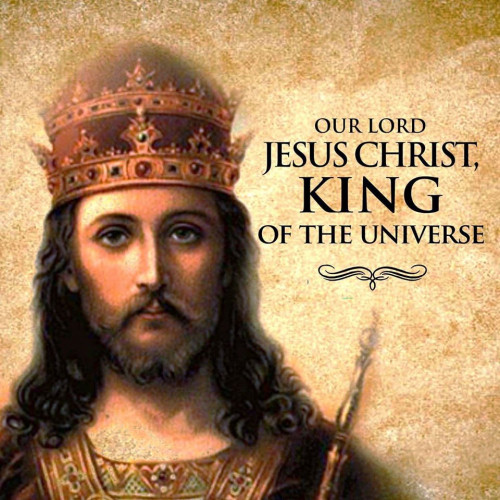
† The Solemnity of Our Lord Jesus Christ, King of the Universe †
Sunday, 24 November, 2019

Happy Solemnity of Jesus Christ, King of the Universe! This is the last Sunday of the Church year which means we focus on the final and glorious things to come! It also means that next Sunday is already the First Sunday of Advent.
Holy God, Holy Mighty One, Holy Immortal One, have mercy on us and on the whole world.

Amen †††, Amen ††† & Amen †††

user posted image


This post has been edited by khool: Nov 24 2019, 07:47 AM
TSyeeck
post Nov 25 2019, 02:48 PM

Look at all my stars!!
*******
Senior Member
3,576 posts

Joined: Apr 2006


Saint of the Day

Saint John of the Cross (1591)
NOV 24

Saint John of the Cross, Doctor of the Church, was a Spanish Carmelite priest. He died when he was only forty-nine years old. He was the great friend and supporter of Saint Teresa of Avila. He has been called the “mystic of mystics.” His brilliant works, The Ascent of Mount Carmel, The Dark Night of the Soul, The Spiritual Canticle, and The Living Flame of Love, are beautiful inspirations for those who wish to be detached from all worldly things and dedicate themselves wholly to God. Saint John suffered great persecutions, even from his own Order. He was once kept in prison for nine months and slandered by everyone. But his motto and his prayer was “to suffer and to be despised.” He gloriously lived up to his title, “of the Cross.”

user posted image

Saint Chrysogonus (304)
NOV 24

He was martyred for the Faith at Aquilea in northern Italy during the persecution of Diocletian. His name is mentioned in the Roman Canon of the Mass. He consoled and encouraged the martyr, Saint Anastasia, during her imprisonment.

user posted image

Saint Flora (856)
NOV 24

Saint Flora was the companion of a beautiful Spanish girl named Mary, and their feasts are celebrated together. They were beheaded by the Mohammedans for refusing to deny their Catholic Faith.

user posted image
SUStalentrecruiter
post Nov 25 2019, 07:18 PM

Getting Started
**
Junior Member
105 posts

Joined: Jul 2019
QUOTE(yeeck @ Nov 20 2019, 12:39 PM)
Saint of the Day
Saint Elizabeth of Hungary (1231)
NOV 19

Saint Elizabeth was a princess of Hungary.  She married Louis of Thuringia, and had three children.  After his death, she became a Franciscan.  She is the patron saint of the Third Order of Saint Francis.  She died when only twenty-four years old, the same age as the Little Flower of Jesus, Saint Casimir of Poland and Gabriel of the Most Sorrowful Virgin.  Four years after her death, Saint Elizabeth of Hungary was canonized.  The dead have been raised to life when brought to her tomb.
user posted image

Saint Mechtilde (1310)
NOV 19

She was a Benedictine nun at Helfta in Germany and was a teacher of Saint Gertrude the Great. She received revelations from God, which Saint Gertrude recorded.
user posted image

Saint Pontian (235)
NOV 19

Saint Pontian was Pope from 230 to 235.  He was exiled to Sardinia where he died.
user posted image
*
You're already a Saint.
TSyeeck
post Nov 26 2019, 01:56 PM

Look at all my stars!!
*******
Senior Member
3,576 posts

Joined: Apr 2006


QUOTE(talentrecruiter @ Nov 25 2019, 07:18 PM)
You're already a Saint.
*
Those are canonised saints. We are saints here on earth if we keep ourselves in the state of grace.
TSyeeck
post Nov 27 2019, 01:45 PM

Look at all my stars!!
*******
Senior Member
3,576 posts

Joined: Apr 2006


The Trinity in the Old Testament

When the first Sunday of Advent comes and the new liturgical year begins, the Church once again relives the Mysteries of Christ for a whole year. She also summarizes all of history, from Creation to the end of time. The four Sundays of Advent symbolizing the four thousand years of the Old Testament (if we rely on the Vulgate, not the Septuagint), we are, as it were, mystically transported back to the time before the Incarnation of the Man-God. It is opportune, then, to dwell during this time on the Law of types and figures to see New-Testament realities hidden in it.

Saint Augustine has it that novum testamentum in vetere latet. Vetus testamentum in novo patet — “the New Testament is hidden in the Old. The Old Testament is revealed in the New”. This canon of interpretation is a standard part of the Catholic approach to the Bible. Let us look, then, for the Blessed Trinity “hidden” in the Old Testament.

We begin at the beginning, Genesis 1:1: “In the beginning God created heaven, and earth.” The Hebrew for “God created” is bara Elohim, which has the linguistic peculiarity of a plural noun followed by a singular verb, something which actually does not violate the grammatical rules of Hebrew. The particular kind of plural here used means three or more, (there is, in Hebrew, a plural that indicates only two). A conventional way of dismissing the trinitarian interpretation of this name for God is to say that it is a plurality “of majesty,” much as the queen or the pope might say “we” instead of the first person singular. This, of course, is not how Christian exegetes classically understood such passages. See, for instance, Saint Lawrence of Brindisi, a man learned enough in Hebrew to preach in it:

Therefore, since Moses, inspired by the Holy Ghost, wrote bara Elohim, literally, ‘the gods, he-created’ (a plural subject with a singular verb), without doubt we understand the sense of these words: he means plurality of divine Persons in the word Elohim and the unity of essence in the singular verb, ‘he-created.’ That is to say, three divine Persons are not three gods, but one God. (Explicatio in Genesim, Ch. 1, cited in Clough, Daniel M., Genesis According to the Saints, p. 5)

Nobody, of course, says that this passages proves that there is one God in three divine Persons. That would be a reach. But it does foreshadow what the New Testament later reveals clearly when it indicates a plurality of Persons in the Godhead.

We can say the same about two other passages in Genesis where the so-called “plural of majesty” is found: “And he said: Let us make man to our image and likeness…” (Gen. 1:26), and “Come ye, therefore, let us go down, and there confound their tongue, that they may not understand one another’s speech” (Gen. 11:7). The first is the divine utterance preceding the creation of Adam, while the second concerns the builders of the Tower of Babel.

God created man in His own image, in the image of God. He was not speaking to the angels, in whose image man was not created, but to Himself in Gen. 1:26. In both Latin and English, we have a plural hortatory subjunctive verb, “Let us make…” in verse 26, followed in the next verse by the singular indicative verb, “God created.” This is substantially the same in the language of inspiration: see an interlinear translation of the Hebrew — v. 26 and v. 27 — for proof.

In confounding the tongues at Babel, there is a similar structure: in Genesis 11:7, the two verbs for “let us go down and confound…” are plural, while the subsequent verse eight has a singular verb for “the Lord [Yahweh] scattered….”

In both cases, Moses was privileged to know — and we to read — the internal counsels of God, speaking in a plurality of Persons.

Remaining in Genesis for one more account, we turn to Chapters eighteen and nineteen, where Moses relates the interaction of the three angels with Abraham and then with Lot. This is the account that terminates in the destruction of Sodom and Gomorrah. The whole thing is quite mystical, for Genesis alternately calls these three persons “men” and “angels” — as do the Gospels, by the way, concerning the angels who appeared to the women after the Resurrection. More mysterious is that these three angels show up just after Genesis eighteen mentions that “Yahweh” appeared to Abraham, of whose appearance nothing else is said, unless we assume that the appearance of the three angels is the appearance of Yahweh. Moreover, Abraham “adored down to the ground. And he said: Lord [Adonai], if I have found favour in thy sight, pass not away from thy servant” (Gen. 18:2-3).

If these angels did not stand in the place of God, such an act would be a shocking violation of the Old Testament’s strict monotheism. By comparison, when Saint John bowed down to the feet of an angel (Apoc. 22:8-9), the angel stayed him, and forbidding that he should receive such honors: “See thou do it not: for I am thy fellow servant… Adore God.” But the angels who received similar honors from Abraham made no such remonstration, probably because they were standing in the Person(s) of God.

Saint Augustine interpreted this passage in a Trinitarian sense in book two of his On the Trinity (see here for a brief but interesting discussion of this passage). According to Monsignor Pohle, Saint Augustine was of the opinion that the three angels of Genesis eighteen were just that, angels, not actually God Himself, but their mission was such that the words they spoke were understood to be the words of God; they were, in other words, standing in God’s place. This opinion was shared by Saints Athanasius, Basil, Cyril of Alexandria, Chrysostom, Jerome, Gregory the Great, and others. This “standing in the place of” would help us to make sense out of the Angel’s willingness to allow Abraham to “adore down to the ground”: the adoration was going to the three divine Persons whom they were visibly manifesting.

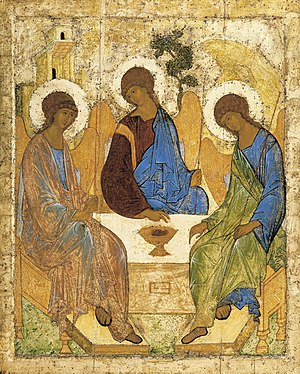
As can be seen from the list in the last paragraph, it is not only Western but also Eastern Fathers who read this episode as a Trinitarian theophany. One of Christian Russia’s most celebrated icons, the Trinity, by Andrei Rublev, is a depiction of Abraham’s hospitality to these three angels, but with a clear Trinitarian interpretation.

user posted image

Still remaining in the Pentateuch, we come to the Book of Numbers 6:24-27. This is the blessing that God instructed Moses to teach to Aaron and his priestly sons: “The Lord bless thee, and keep thee. The Lord shew his face to thee, and have mercy on thee. The Lord turn his countenance to thee, and give thee peace.” The blessing is threefold, leading many Christian commentators to see in it the Holy Trinity. Notice that the “face” the Levitical priest wishes God to show us is the second of the three: it is the Holy Face of Jesus!

Many Franciscan priests will use this formula of Numbers six to bless people. The story of how this blessing came to be known as “the blessing of Saint Francis” is edifying.

We pass now to the Prophesy of Isaias, chapter six, which gives us the Sanctus in our Holy Mass. Here is what Monsignor Joseph Pohle says on it in his text on the Trinity (pg. 12):

The clearest allusion to the mystery of the Blessed Trinity in the Old Testament is probably the so-called Trisagion [“thrice holy”] of Isaias (VI, 3): “Holy, holy, holy, the Lord God of Hosts, all the earth is full of his glory,” which is rightly made much of by many Fathers and not a few theologians. This triple “Holy” [uttered by the seraphim, the highest angelic choir] refers to an ecstatic vision of the Godhead, by which Isaias was solemnly called and consecrated as the Prophet of the Incarnate Word, an office which won for him the title of the “Evangelist” among the four major prophets.

The Hebrew word for “holy” is Kadosh (or qā-ḏō-wōš). Regarding the tripling of the word, some authors claim that there is no regular way of forming the comparative and superlative degrees of the adjective in Hebrew, and that this triple utterance of the adjective is an effort at the superlative. I’ve seen this contested by others, who say that the tripling of the adjective is merely an “intensifier.” I will let the Hebrew specialists fight it out; either way — whether constrained by the conventions of Hebrew usage or the desire to be “intense” — the Holy Isaias taught us that God is not simply “holy,” but “Holy, holy, holy”; and the Church has seen in this sublime utterance of the seraphim a foreshadowing of the full revelation of the Trinity.

In another indication of plurality in the Godhead, the same Isaias also presents the future Messias as God. Here are some of his descriptions of Christ to come: “the Wonderful, the Counsellor, the Prince of Peace… God the Mighty, the Father of the world to come” (Is. 9:6, cf. Luke 1:32); “Emmanuel,” literally, “God with us” (Is. 7:14, cf. Matt. 1:23); “God himself will come and will save you” (Is. 35:4; cf. Matt. 9:5); “Prepare ye the way of the Lord… . Behold, the Lord God shall come with strength” (Is. 40:3, 10; cf. Mark 1:3).

Of the Messianic Psalms, I will select only two passages: “The Lord hath said to me: Thou art my son, this day I have begotten thee” (Ps. 2:7) and “The Lord said to my Lord: Sit thou at my right hand . . . from the womb before the day star I begot thee” (Ps. 109 [110]:1-3). Here, the Messias is shown to be the Son of God. Moreover, He is “my [David’s] Lord,” who is at the same time the Son of “the Lord”; He is, in other words, both Son of God and God. During His public life, Our Lord confounded the Pharisees with the mystery hidden in Psalm 109 (cf. Matt. 22:41-46). If they had had good will, His enemies would have asked Him to explain the passage, which was perfectly fulfilled in Himself, but they held their tongues. Concerning Our Lord’s enemies, Saint Augustine pointed out that the unbelieving Jews of His day understood more of Christ’s claims than the Arians did, for the unbelievers understood Him to call Himself God simply because he called God His Father (cf. Jn. 5:18, and Jn. 10:33; note that Jesus did not deny the accusation), whereas the heretics missed that point, and denied Him divine honors. All of this shows a plurality of persons in the Godhead, at least as concerns the Father and the Son.

One last strain of Old-Testament prophesies that show the plurality of persons in God comes to us from the Wisdom Books. To keep this from getting too long, I will refer the reader to Monsignor Pohle’s page sixteen and following: “The Teaching of the Sapiential Books”.

The Mystery of the Holy Trinity is a “pure Mystery” or an “absolute Mystery,” meaning both that we have no way of knowing it without the benefit of supernatural revelation, and that we cannot comprehend it fully. Because It is such a Mystery — indeed, it is the greatest of our Mysteries — we cannot know everything about It, but we can know what God has taught us through the Church. And that is both true and sufficient for us to adore the Three:

“Glory be to the Father, and to the Son, and to the Holy Ghost; as it was in the beginning, is now, and ever shall be, world without end. Amen!”

Most devotedly yours in the Hearts of Jesus and Mary,
Brother André Marie, M.I.C.M.
khool
post Nov 28 2019, 06:16 AM

Getting Started
**
Junior Member
225 posts

Joined: Mar 2008


Luke 21:12-19 New Revised Standard Version Catholic Edition (NRSVCE)

“But before all this occurs, they will arrest you and persecute you; they will hand you over to synagogues and prisons, and you will be brought before kings and governors because of my name. This will give you an opportunity to testify. So make up your minds not to prepare your defense in advance; for I will give you words[a] and a wisdom that none of your opponents will be able to withstand or contradict. You will be betrayed even by parents and brothers, by relatives and friends; and they will put some of you to death. You will be hated by all because of my name. But not a hair of your head will perish. By your endurance you will gain your souls.
khool
post Nov 29 2019, 11:05 AM

Getting Started
**
Junior Member
225 posts

Joined: Mar 2008


user posted image

TSyeeck
post Dec 6 2019, 01:34 PM

Look at all my stars!!
*******
Senior Member
3,576 posts

Joined: Apr 2006


Editorial

Touchstone, Sept./Oct. 2012

The Man Alive

Irenaeus Did Not Teach Self-Fulfillment


by Patrick Henry Reardon

user posted image

Reviewing conversations with Christians over the past half-century or so, I am impressed by how often I have heard quoted a line from Irenaeus of Lyons: "the glory of God is man fully alive."

Normally it would be encouraging to hear a wide variety of Christians quoting a second-century church father and martyr, especially so prolific and effective an opponent of every heresy that plagued the churches of his day. But in the case of this quotation, its popularity arises from a radical misreading, and this misreading explains a lot about what is wrong with American Christianity at present.

How did this come about? The greater part of Irenaeus's largest work, A Treatise Against the Heresies, is devoted to the refutation of second-century Gnostic writers, whose philosophical and religious speculations may strike the modern reader as bizarre beyond consideration.

Yet, Irenaeus took those fellows seriously; he studied their writings in depth and refuted them in meticulous and painstaking detail.

Regarding Gnosticism as spiritually dangerous to the Christian souls for whom he was responsible, he fulfilled that task of refutation with self-sacrificing pastoral love.

A Skewed Translation

Irenaeus is not easy to read straight through; at least, I have found this to be the case.

When I finished my first complete reading of the Adversus Haereses several decades ago, my chief sentiment was admiration for the author's patience in studying, and then refuting, so much theological nonsense.

Because the lunacy of his opponents makes many pages of Irenaeus a bit tedious—especially in the first half of the work—it has occurred to me to wonder, from time to time, whether all those who quote Irenaeus have actually read him.

This impression comes with special force when I consider that the alleged quotation—"the glory of God is man fully alive"—doesn't appear until fairly late in the Adversus Haereses; it is found in the middle of book 4, chapter 20.

Unfortunately, the original Greek text of that passage was not preserved, so we know it only in ancient translations, the most important being Latin. This is where we have to start.

The traditional Latin of the quotation cited above reads, "Gloria Dei est vivens homo." The literal translation is, "the glory of God is a living man."

And here arises a problem. The popular translation, "man fully alive," seems to indicate that God is glorified in what today would be called "human fulfillment" or "self-fulfillment."

Indeed, whenever I have heard these words cited, this has always been, I believe, the intended sense of the person citing them.

And such an understanding of Irenaeus—I am about to insist—is disingenuous and misleading at best.

Irenaeus is not talking about "human fulfillment."

Nonetheless, this mistranslation is so prevalent that we find it in places where its use can only be regarded as deceptive, even mendacious.

I cite one example, the English translations of the Catechismus Catholicae Ecclesiae.

The original Latin of this Vatican document (#294) accurately quotes the traditional text of Irenaeus and then goes on to explain that it refers to the life of the Word Incarnate.

That is to say, the "living man" intended by Irenaeus is Christ himself, in whose life we believers contemplate the Father's glory revealed in the Son.

"Vita hominis visio Dei," Irenaeus goes on to say; "the life of a man is the vision of God."

In the life of the man Jesus, believers behold the glory of God shining on the face of his Son.

The Vatican document has it right, but both English versions (1992 and 1997) reflect an unfortunate and skewed reading of Irenaeus.

The Cult of Self-Fulfillment

Is this an important matter?

Surely it is.

The English expression "man fully alive" conveys an idea radically alien to the teaching of Irenaeus, who declared that "the revelation of the Father, which comes through the Word, conveys life to those who contemplate God."

The vague "man fully alive," which can mean almost anything, usually means a quest for human fulfillment or self-expression.

As commonly quoted, the words "man fully alive" have nothing to do with the life of Jesus Christ.

And that is the basis for my suspicion that the popularity of this quote is evidence of a capitulation of Christians to a cult of self-fulfillment and self-expression.

For many, indeed, our churches have become merely self-improvement societies, where the ancient creedal affirmations about Christ—those derived from the New Testament—have been decisively excised from worship and hymnography.

A subjective quest for emotional fulfillment subverts Christian worship by focusing on how worship makes a person feel, and by encouraging worship schemes that arise from individual self-expression rather than the lived history of the people of God down through the ages.

"Man fully alive" is at the heart of that most baneful of cultural deviations, the circus act known as "the contemporary worship service."

This cult of self-fulfillment also preaches false notions of happiness.

It gives unsound counsel on marital love, and thus undermines marriage.

It encourages an unwarranted autonomy among children, and thus lessens their dependence on the inherited cultural and moral standards available in traditional family life.

Among the clergy, whose sniveling acquiescence has been essential to this religious and cultural decline, the religion of Jesus Christ can be used for the exercise of power, the building of one's ego and reputation, and the search for personal stroking that indicates narcissism.

The modern quest for self-fulfillment also means the loss of the founding dogma that places Jesus Christ at the heart of every believer's adherence, worship, devotion, longing, and emulation.

It means the rise of self-improvement sermons and the declension of Christo-centric preaching that initiates believers ever more deeply into the Mystery of Christ.

Genuine Fulfillment in Christ

The suggestion that God is glorified by a widespread human quest for self-fulfillment—the notion that God is actually pleased by cultural and societal expressions of radical selfishness—flies in the face of everything Irenaeus held dear.

He was ever attentive to the voice from heaven that proclaimed, "This is my beloved Son, in whom I am well pleased."

It will be obvious to everyone who has read it, I think, that this is the substance of the Adversus Haereses.

The only "alive" Irenaeus would recognize is in the life of divine grace, incorporation in the living Christ, the sole Mediator of salvation.

According to Irenaeus and the other authentic fathers, the only true self-fulfillment—if we must use such a term—is to be sought in obedience to the lordship of, and communion with, the living Christ.

Genuine fulfillment of self is expressed in forgetfulness of self and in the love of others exemplified by the Savior of the world.

Finally, if Irenaeus were writing today, I have no doubt he would include the modern quest for self-fulfillment among the heresies he chose to refute.
TSyeeck
post Dec 9 2019, 12:15 PM

Look at all my stars!!
*******
Senior Member
3,576 posts

Joined: Apr 2006


Saint of the Day

The Immaculate Conception of the Blessed Virgin Mary (17 B.C.)
DEC 8


The meaning of this mystery is that from the instant of her conception in the womb of Anna, her mother, Mary was without original sin. Nothing of the guilt which Adam bestowed on the whole human race, because of his sin in the Garden of Paradise, was allowed to touch the perfect soul of the Blessed Virgin Mary. God created the soul of Mary in sheer holiness, full of every grace He could bestow on her. In our own day, which is rightly called “the age of Mary,” in the year 1854, on December 8, the courageous and holy Pope, Pius IX, defined the Immaculate Conception of the Blessed Virgin Mary as a Dogma of the Catholic Faith. Anyone who does not believe in this dogma can never enter Heaven. Four years after the definition of this dogma, Our Lady, in 1858, in one of her eighteen apparitions to Saint Marie Bernadette of Lourdes, a little fourteen-year old girl who lived in southern France, said, by way of innocently emphasizing the papal definition of Pius IX and its meaning, not “I was immaculately conceived,” but, “I AM the Immaculate Conception.” This she said on the feast of the Annunciation, March 25. Mary let us know thereby that she was the very notion of this grace in the mind of God from all eternity. Mary is God’s love, His dove, His beautiful one.

user posted image
Immaculate Conception, by Peter Paul Rubens (credits/details)
“She shall crush thy head, and thou shalt lie in wait for her heel” (Gen 3:15b).
TSyeeck
post Dec 13 2019, 01:12 PM

Look at all my stars!!
*******
Senior Member
3,576 posts

Joined: Apr 2006


Racist Ideology and the Blood that Really Matters

Begging the reader’s pardon for being so personal, I begin with an odd confession, one that I hope will be fully justified sociologically and theologically in the lines that follow: I don’t identify as a white man.

No, I don’t mean that I identify as a black, brown, red, or yellow man, either; I mean I don’t think of myself as white. I think of myself first as a Catholic, a member of the Mystical Body of Jesus Christ, and only secondarily — by way of ancestry, of blood and DNA — as a European (a genuine Euro-mutt: French, Spanish, and German, with a dash of Polish). In light of my first identity, this latter is comparatively trivial. I emphasize comparatively because it is not utterly inconsequential. I love my parents, and my grandparents, and I rather like having their genetic matter as part of the material side of my hylomorphic composite. But what makes that ancestry trivial in comparison is that it comes from nature, whereas being Christ’s is a matter of super-nature. It is by supernatural adoption, not flesh and blood, that we are “born of God” (Cf. Jn. 1:13, 1 Jn. 3:9, 1 Jn. 4:7).

The idea I am getting at is best expressed by the fourth-century Bishop of Barcelona and Father of the Church, Saint Pacian, who famously wrote these words in his first Epistle to Sympronian: Christianus mihi nomen est, catholicus vero cognomen — “Christian is my name; Catholic is my surname.” In the context, Saint Pacian was defending the use of the word, “Catholic,” to distinguish orthodox Christians from the adherents of the many heresies of the day, much as Saint Ignatius of Antioch had done before him.

This is my supernatural DNA, if you will.

To those perplexed by a man of my relatively pale skin pigmentation not identifying as “white,” let me explain myself. As a Catholic who is an American of European descent, I have much in common with Germans, French, Polish, Spanish, etc., who are as pale-faced as I or more, but also with Maltese, Sicilians, Southern Italians, and others on the darker side of the color palette. Had I chosen to marry one of these latter, nobody in my family would have considered a union to a lady with any such ancestry to be a “mixed-race marriage.” In fact, neither my one brother marrying a beautiful Sicilian lady, nor my other brother marrying a beautiful Armenian lady raised any eyebrows in my family from the Deep South. There was no rush to the Pantone color fan to see if they were in the right range to marry my brothers.

Yet, is a Sicilian white? I’d say that most of them are what I sometimes call myself: off-white, most of them much more than I. Yes, I’m treating the matter somewhat lightly, but it actually is a serious issue, because now there is, on the right and the left, a racial mythology surrounding the “white man.” Historically, Mediterraneans, Englishmen, Germans, Celts, and Slavs did not consider themselves to belong to the same “race.” Nor did they consider themselves “white.” Providentially, on the same day I was writing this piece, I happened upon a very good interview about current affairs in Ireland, where a very articulate Irishman named John Waters speaks to this very point. You can find what he says about the issue right here (the whole interview is well worth a listen).

When all these various tribes, nations, and peoples were made one in the Church, they gave us something infinitely superior to “whiteness”; they gave us Western Christendom with its religious and political unity known as the Christian Republic (res publica Christiana).

And what of Eastern Christendom? Greeks, Syrians, Copts, Phoenicians, Persians, and Arabs are not the same “race.” They are not the same people, or nation; yet, they were Eastern Christendom, and, to some extent, they shared a common culture — a culture that later added lighter-skinned Eastern Slavs. (Yes, of course, there was much local variation in this common culture, perhaps even more so than there was in Western Christendom, which was itself quite diverse.) In the East, the sundering of Syria, Arabia Felix, Armenia, and Egypt from the rest of Eastern Christendom was a result of tragic religious divisions caused by schism and heresy (e.g., Monophysitism, and the consequent rejection of the council of Chalcedon). Schisms and heresies weakened the social cohesion of Eastern Christendom and, in part anyway, prepared the way for the Muslim conquest.

More tragic still was the sundering of Eastern from Western Christendom because of the Great Schism, a separation that helped Islam to take over much of the East.

Coming back to the West, here in America, we witness “white” people of disparate European ancestry reveling in their whiteness, when what they should be reveling in is first, their supernatural adoption in Christ as members of His Mystical Body, and, second, the fruitful Christian culture that their ancestors built in Europe and that we would like to rebuild here in the Americas, for the glory of God and for the good of Christian families.

Much of this nonsense is literally pagan, as it involves the resurrection of Nordic and Teutonic paganism, Celtic Druidism, and the like. The modern pagans of the Alt Right (yes, I mean literal pagans, e.g., Stephen McNallen, Richard Spencer, Alain de Benoist) engage in a sort of idolatry of race. In so doing, they resemble racists of every stripe, whether those racists be White Nationalists, Black Nationalists, Nazis, Zionists, or the members of La Raza. Racism is racism, and infatuation with race is itself a false ideology even when it does not involve actual idolatry. Some of these ideologues will point out that they don’t hate people of other races, and it is only just to recognize that many of these folks are not advocating violence towards other people. But they err in making biology of paramount importance when what matters is the true Faith and all that accompanies it (its liturgical and sacramental life, moral code, modus vivendi, etc.) and, secondarily, the culture it has produced and is still capable of producing among any people who assimilate it and live accordingly.

Cultural Marxists need racism, just as the SPLC and the ADL need the various “hatreds” they major in exposing; the first because it feeds into their ideology of dialectical materialism, the latter two for fiduciary reasons. As Jackie Mason said of the ADL’s Abe Foxman, “Anybody who makes a life out of fighting racism in effect has to blow-up racism in order to justify himself and the job he has…. Otherwise he’d have to get up in the morning and get a real job.”

In becoming the bogeymen that their enemies need for marketing purposes, those who embrace the genuinely racist ideologies of the heathen right lend assistance to groups like the SPLC and the ADL.

What I would like to do for the rest of these lines is to show how Holy Scripture condemns racism in principle, and speaks to us of the only Blood that really matters.

Two evangelists record a particularly blistering part of the preaching of the great Forerunner, Saint John the Baptist: “Ye offspring of vipers, who hath shewed you to flee from the wrath to come? Bring forth therefore fruits worthy of penance; and do not begin to say, we have Abraham for our father. For I say unto you, that God is able of these stones to raise up children to Abraham” (Luke 3:7-8; cf. Matt. 3:7-9). In the part I emphasized, Saint John implies that mere biological descent from the great Patriarch Abraham is not sufficient, and goes on to speak mysteriously of “stones” becoming children to Abraham, an utterance fulfilled in the very sacrament he heralded in the Jordan river, Baptism, which makes of gentile “stones,” children of Abraham. Our Lord and Saint Paul will later develop both of these themes.

In chapter eight of his Gospel, Saint John records a particularly hostile confrontation between Our Lord and his enemies. Here is the part of that exchange that most interests us now:

[31] Then Jesus said to those Jews, who believed him: If you continue in my word, you shall be my disciples indeed. [32] And you shall know the truth, and the truth shall make you free. [33] They answered him: We are the seed of Abraham, and we have never been slaves to any man: how sayest thou: you shall be free? [34] Jesus answered them: Amen, amen I say unto you: that whosoever committeth sin, is the servant of sin. [35] Now the servant abideth not in the house for ever; but the son abideth for ever. [36] If therefore the son shall make you free, you shall be free indeed. [37] I know that you are the children of Abraham: but you seek to kill me, because my word hath no place in you. [38] I speak that which I have seen with my Father: and you do the things that you have seen with your father. [39] They answered, and said to him: Abraham is our father. Jesus saith to them: If you be the children of Abraham, do the works of Abraham. [40] But now you seek to kill me, a man who have spoken the truth to you, which I have heard of God. This Abraham did not. [41] You do the works of your father. They said therefore to him: We are not born of fornication: we have one Father, even God. [42] Jesus therefore said to them: If God were your Father, you would indeed love me. For from God I proceeded, and came; for I came not of myself, but he sent me: [43] Why do you not know my speech? Because you cannot hear my word. [44] You are of your father the devil, and the desires of your father you will do. He was a murderer from the beginning, and he stood not in the truth; because truth is not in him. When he speaketh a lie, he speaketh of his own: for he is a liar, and the father thereof. [45] But if I say the truth, you believe me not. (Jn. 8:31-45)

Notice that Our Lord acknowledges that his interlocutors are of the seed of Abraham, but then he goes on to assert that if they be children of Abraham, they should do the works of Abraham, which would entail listening to Him, for, as He will say towards the end of the chapter, “Abraham your father rejoiced that he might see my day: he saw it, and was glad” (v. 56). But, in rejecting Jesus whom Abraham had seen in vision, they showed themselves not to be that great man’s true children, and therefore not the children of God, but, rather of their father the devil! Rejection or acceptance by God has nothing to do with Abrahamic genes but everything to do with true Abrahamic Faith, which includes belief in Jesus Christ.

Sadly, these words of Our Lord about His enemies’ satanic parentage have been taken literally (as in biologically) by a few heretics who lack the benefit of Catholic tradition and the magisterium. I speak of the genuine racists and anti-semites (note: a racial category), who call themselves the “Christian Identity movement” (e.g., “Kingdom Identity Ministries”). They ignorantly assert, based upon this passage, that Jews are the biological offspring of Satan. In their racist mania, they mistake the spiritual for the carnal, and the election of grace for the genetics of race, thus supplying the shakedown artists of the SPLC and the ADL with useful ad copy.

Saint Paul speaks at times of the biological descent from Abraham (cf. Rom. 11:1, 2 Cor. 11:22; [see my comments on Rom. 11:1 in A Slow Reading of Romans XI]), but at other times of a spiritual descent from Abraham. The latter is the only that is of any lasting, supernatural consequence; for instance, in Romans 9:6-9, the Doctor of the Gentiles writes:

For all are not Israelites that are of Israel: Neither are all they that are the seed of Abraham, children; but in Isaac shall thy seed be called: That is to say, not they that are the children of the flesh, are the children of God; but they, that are the children of the promise, are accounted for the seed.

Father Challoner, in his commentary on the Rheims New Testament, thus explains the passage:

Not all, who are the carnal seed of Israel, are true Israelites in God’s account: who, as by his free grace, he heretofore preferred Isaac before Ismael, and Jacob before Esau, so he could, and did by the like free grace, election and mercy, raise up spiritual children by faith to Abraham and Israel, from among the Gentiles, and prefer them before the carnal Jews.

To the gentile Galatians, Saint Paul is clear and quite definitive about the Christian’s spiritual descent from Abraham: “And if you be Christ’s, then are you the seed of Abraham, heirs according to the promise” (Gal. 3:29). This comes, let us recall, from a chapter refuting the errors of the Judaizers, wherein is also found the Apostle’s famous exegesis of the promises recorded in Genesis to Abraham and “his seed”: “To Abraham were the promises made and to his seed. He saith not, And to his seeds, as of many: but as of one, And to thy seed, which is Christ” (Gal. 3:16). Because Christ is that promised “seed” of Abraham, all those who are incorporated into Christ’s Mystical Body are of that one, singular “seed.” Thus, on a daily basis, priests who offer the traditional Roman Mass ask God the Father to accept this sacrifice “as You accepted the sacrifice of our patriarch Abraham.” Similarly, when we daily pray Mary’s Magnificat, and Zachary’s Benedictus, we make our own those references to Abraham as “our father.”

Abraham is our father because we are of his seed, who is Christ.

The biological particulars of the blood that courses through our veins has nothing to do with either the life of grace here on earth or the life of beatitude in Heaven. In all important affairs, there is one Blood that matters, and that is the Precious Blood of Christ:

* “He that eateth my flesh, and drinketh my blood, hath everlasting life: and I will raise him up in the last day” (Jn. 6:55).
* “He that eateth my flesh, and drinketh my blood, abideth in me, and I in him” (Jn. 6:57).
* “The chalice of benediction, which we bless, is it not the communion of the blood of Christ? (1 Cor. 10:16).

May Blood of the Lamb unite us! For as the four living creatures and the four and twenty ancients sing to Him in the Apocalypse: “Thou art worthy, O Lord … because thou wast slain, and hast redeemed us to God, in thy blood, out of every tribe, and tongue, and people, and nation.”

Most devotedly yours in the Hearts of Jesus and Mary,
Brother André Marie, M.I.C.M.
TSyeeck
post Dec 21 2019, 12:14 PM

Look at all my stars!!
*******
Senior Member
3,576 posts

Joined: Apr 2006


Saint of the Day

Saint Dominic of Silos (1073)
DEC 20


He was first a shepherd. He later became a priest and lived as a hermit under the Rule of Saint Benedict. He was appointed Abbot of Saint Sebastian’s at Silos in Spain. He miraculously delivered more than three hundred prisoners taken by the Mohammedans shortly after his death. It was because of the intercession of Saint Dominic of Silos that Blessed Jane of Aza brought into the world, in 1170, the great Saint Dominic who founded the Order of Friars Preachers. All the queens of Spain used to keep his staff in their room when they were giving birth to a child.

user posted image
TSyeeck
post Dec 21 2019, 12:18 PM

Look at all my stars!!
*******
Senior Member
3,576 posts

Joined: Apr 2006


Saint Thomas (74)
DEC 21

Saint Thomas the Apostle, who is also called Didymus, which means twin, was the great and outstanding apostle to the East after the death and resurrection of Our Lord. Persia and India both learned the true message of the Catholic Faith from this heroic and courageous soldier of the truth. It was Saint Thomas who baptized the Magi, in the year 40. In the year 58, he was miraculously transported back to Jerusalem, on the third day after Our Lady’s death. It was his love for Mary and his eagerness to open her grave and see her body that revealed to all the Apostles and those gathered with him that she had been assumed into Heaven. Saint Thomas was martyred by being stabbed to death. His body is now reverently and lovingly kept in the town of Ortona in Italy.

Saint Thomas was the same age as Our Lord. He was seventy-four years old when he died in the year 74 A.D. Saint John, the youngest of the Apostles, was eighteen when he was called, twelve years younger than Our Lord, and died in the year 100 at the age of eighty-eight. Saint James the Less was the oldest of the Apostles. He was sixty-five when he was called and ninety-six when he died in the year 62.

user posted image
TSyeeck
post Dec 24 2019, 12:33 PM

Look at all my stars!!
*******
Senior Member
3,576 posts

Joined: Apr 2006


Saints of the Day

Saint Adam and Saint Eve (First Age of the world)
DEC 24

As we have said elsewhere, Adam and Eve are not called saints in ordinary reference, historical or scriptural. But they may be called saints on their feast day, which is the vigil of Christmas, because we know from sound Catholic tradition that they repented of their great sin, lived lives of holiness and are now in Heaven. Adam is the father of the human race. Eve, his wife, was formed from Adam’s body. All of us have descended from these two. Adam was created in a state of paradisal innocence, with no human frailties or weaknesses. Adam sinned by disobeying the command of God not to eat a forbidden fruit. The whole human race inherited original sin because of Adam. Adam personally repented. Adam lived for 930 years. By his sorrow, his contrition, his pleading and his love, Adam finally won God’s full forgiveness for himself. Adam died and went to the Limbo of the Just, which is called “hell” in the Apostles’ Creed. This was not the hell of the damned. It was the place where the Just had to wait for the coming of Christ. Adam ascended into Heaven in body and in soul with Our Lord on Ascension Thursday, forty days after Easter. Adam’s feast is the vigil of Christmas, which is also the feast of Eve, his wife, who is with him in Heaven.

user posted image
William Bouguereau (1825-1905) Premier Deuil (The First Mourning, i.e., of Adam and Eve over Abel), Oil on canvas, 1888, Museo Nacional de Bellas Artes, Buenos Aires
TSyeeck
post Jan 6 2020, 02:52 PM

Look at all my stars!!
*******
Senior Member
3,576 posts

Joined: Apr 2006


The Baptism of Jesus (30)
JAN 6


user posted image

Jesus was baptized when He was thirty years old and about to begin His public life. A special feast of the Baptism of Jesus is kept on the octave of the Epiphany, January 13.

The Marriage Feast at Cana (30)
JAN 6


user posted image

This marriage feast occurred at the end of January, in the year 30, but it is celebrated today because it is, in its way, an epiphany–a showing of the power of Jesus–because it was His first miracle. This marriage feast is spoken about in the second chapter of Saint John. It was held in the little town of Cana, north of Nazareth, in Galilee, in the first year of Our Lord’s public life. At the Blessed Virgin’s request, Jesus changed six jars (120 gallons) of water into wine. This miracle, in addition to showing God’s generosity and His eagerness to grant Our Lady any favor, is by way of giving us the type and symbol of the fact that the water poured upon every Catholic at Baptism is to give him the right to another sacrament, the Blood of Jesus in the Holy Sacrifice of the Mass, which he receives at Holy Communion.


Saint Gaspar, Saint Melchior and Saint Balthasar (First Century)
JAN 6


user posted image

January 6 is the feast of these three Magi, who brought Jesus gifts of gold, frankincense and myrrh. The Magi brought Jesus gold to show that He was a king; frankincense to honor Him as God; and myrrh to greet Him as man. These Magi first saw the star which led them to Bethlehem on the previous March 25, the day, and at the moment, that Jesus was conceived in Mary’s womb. It took the Magi nine months and twelve days to reach Bethlehem, guided by the star. The star left them when they were in Jerusalem. But it shone again after the Magi left Jerusalem, and led them to the cave of Bethlehem. Our Lady let each of the Magi hold Jesus in his arms. They were given some of His baby clothes to bring back to the East by way of relics. The Magi returned to the East, to Persia and later were baptized there by Saint Thomas the Apostle, in the year 40. All three of the Magi were martyred for the Catholic Faith. Their names are now, and should always be called, Saint Gaspar, Saint Melchior and Saint Balthasar. The bodies of Saint Gaspar, Saint Melchior and Saint Balthasar were first brought to Constantinople, and then to Milan, and in the twelfth century they were placed in the Cathedral of Cologne, in Germany, where they are venerated with much love by the Christians who worship there.

The Epiphany (1 A.D.)
JAN 6


user posted image

This was the showing of Our Lord as a Child to the Gentile Kings. The Epiphany occurred twelve days after the birth of Jesus. The English call it Twelfth Night. It is one of the most important feasts in the Catholic Church. The Epiphany is God letting us know simply and dramatically that though He was born of the Jews, He was destined for the Gentiles. The Jews rejected Jesus. Their Temple was crashed to the ground in the year 70, and has never been built up since. Gentile Kings came over a thousand miles from the East to greet Jesus at His birth. This feast is often celebrated on the first Sunday after January 1.

The Sunday within the octave of the Epiphany is the feast of the Holy Family. This Holy Family is now in Heaven, all three, in body and in soul. Saint Joseph’s grave was opened on Good Friday, the day that Jesus died. Saint Joseph ascended into Heaven, in body and in soul, with Jesus, forty days after the first Easter. Twenty-five years later, in the year 58, Mary, when she was seventy-two years old, died, and three days later she was assumed into Heaven, anxious to help us when we pray, waiting to receive us when we die.

The octave of the Epiphany, January 13, is the day on which a special Mass is said in the Catholic Church to commemorate the Baptism of Jesus by John the Baptist in the River Jordan. Under recent liturgical changes, if the octave of the Epiphany falls on a Sunday, then the feast of the Holy Family is celebrated on that day and there is no commemoration made of the Baptism of Jesus that year.

Saint Andre Bessette (1937)
JAN 6


user posted image

Brother Andre was a simple lay brother of the Congregation of the Holy Cross at Montreal in Quebec. He had a consuming love for Saint Joseph and spent his life in spreading devotion to him. He is responsible for the famed Oratory of Saint Joseph at Montreal. Through Brother Andre’s prayers to Saint Joseph countless cures took place even during his lifetime. Nearly a million people came to pay him their last respects when he died on January 6, 1937, at the age of ninety-one.

65 Pages « < 53 54 55 56 57 > » Top
 

Change to:
| Lo-Fi Version
0.0379sec    0.61    6 queries    GZIP Disabled
Time is now: 4th December 2025 - 05:05 PM