Welcome Guest ( Log In | Register )

Outline · [ Standard ] · Linear+

 FundSuperMart v18 (FSM) MY : Online UT Platform, UT DIY : Babystep to Investing :D

views
     
george_dave91
post Feb 11 2021, 04:08 PM

Getting Started
**
Junior Member
63 posts

Joined: Feb 2021


Hi guys. I see that fsm Singapore has a fee structure that uses an overall platform fee minus the sales charge. Similar to their current fee structure for the bond funds on the fsm Malaysia platform currently. My fear is that eventually the Malaysian platform may adopt a similar fee structure too, considering the bond fund changed from upfront sales charge to platform fee couple years back. This is concerning especially in my case since I plan to invest for the long term (at least 30 years ++). Based on the math an overall platform fee will have major impact on performance compared to one that has an upfront sales charge only (even if it is 5.5%). This is so for investments that exceed 20 years. In my case I would be accumulating for 25 years before having to withdraw funds. Does anyone else feel the same? Would it be better to just DCA into normal upfront sales charge funds. Of course at present there are no platform fees for equity/balanced funds (phew). Just a concern. I guess I’m being quite paranoid about something that has not even happened yet.
george_dave91
post Feb 11 2021, 05:28 PM

Getting Started
**
Junior Member
63 posts

Joined: Feb 2021


@ky33li, That’s true. That would be ideal. Still waiting for an affordable broker that’s regulated here.

@yklooi, eunittrust huh 🤔, I shall look into that, thanks. Yeah I’m currently DCA-ing my way into some core funds in fsm. Inaction certainly is much worse, agreed.
george_dave91
post Feb 11 2021, 08:13 PM

Getting Started
**
Junior Member
63 posts

Joined: Feb 2021


QUOTE(lee82gx @ Feb 11 2021, 06:06 PM)
as you say it hasn't happened yet. and the main reason singapore is charging platform fee in my guess is because of the plethora of really really low fee funds (ETF's etc) which in return unlikely to allow FSM singapore to get any income from them, so they charge the end investor instead. If the actual fund house almost dont charge you and the platform charge you 1% pa it is still manageable in my opinion. Plus the fact that they are soo open to be able to purchase from such a wide range of funds.

If it happens here, be sure that your thinking and mindset is going to occupy all of us. At which time I will change the brokerage to directly under my own name for the units owned and perhaps to Philip mutual or eunittrust or someone else. In other words, if you come in, the market heats up, the fees get competitive. Not the other way around.
*
Right I see. That is a pretty enlightening perspective on the matter. Glad to hear that there are more players like eunittrust joining the market. Indeed as you say, hopefully this leads to more competitive fees for us investors.
george_dave91
post Jul 15 2021, 02:00 AM

Getting Started
**
Junior Member
63 posts

Joined: Feb 2021


Hi all. Hoping to get your thoughts and opinions.

How many funds should one have ideally?

In my case I already have about 9k in 3 funds weighted more or less at my target allocation. That is; 45% Affin Select APAC ex Jap Dividend Fund, 45% Affin Select Asia ex Jap Quantum Fund, 10% Affin Select Bond Fund.

The prob however is that I only have RM100 a month to use for DCA-ing. So I have to choose one fund to contribute to each month. Typically I choose the one that is most underweight from the target allocation however my more volatile funds don’t seem to benefit much from the DCA-ing this way.

Are 3 funds too many in my case? I used to only have 2, just the dividend fund and the bond fund. However I’m trying to increase my average annual rate so I added the quantum fund early this year.

Any thoughts? Sorry if it’s a noob question though. I am a noob after all.
george_dave91
post Jul 15 2021, 02:01 AM

Getting Started
**
Junior Member
63 posts

Joined: Feb 2021


Hi all. Hoping to get your thoughts and opinions.

How many funds should one have ideally?

In my case I already have about 9k in 3 funds weighted more or less at my target allocation. That is; 45% Affin Select APAC ex Jap Dividend Fund, 45% Affin Select Asia ex Jap Quantum Fund, 10% Affin Select Bond Fund.

The prob however is that I only have RM100 a month to use for DCA-ing. So I have to choose one fund to contribute to each month. Typically I choose the one that is most underweight from the target allocation however my more volatile funds don’t seem to benefit much from the DCA-ing this way.

Are 3 funds too many in my case? I used to only have 2, just the dividend fund and the bond fund. However I’m trying to increase my average annual rate so I added the quantum fund early this year.

Any thoughts? Sorry if it’s a noob question though. I am a noob after all.
george_dave91
post Jul 15 2021, 08:19 PM

Getting Started
**
Junior Member
63 posts

Joined: Feb 2021


QUOTE(tadashi987 @ Jul 15 2021, 02:28 AM)
sometimes it is not just how many funds, it is about risk allocation by sector/region as well.
your risk allocation by region is 90% at Asia Pacific, the 10% Bond is mostly on Asia Pacific as well.
I won't judge that it is not approciate, as long you are fine with it.

For me, i hold Max 5 funds.
and i make sure it is not overweight in certain sector/region, focusing on equity as i am young to take the risk.

down to road i might switch the strategy to put more onto REITS etc, when my risk appettide reduced.
*
Yes that’s true my allocation lacks geographical diversification in that sense. There is quite little exposure to developed markets (us/euro/aus), 20% more or less.

QUOTE(xander83 @ Jul 15 2021, 04:35 AM)
Too concentrated while I suggest you better consolidated Dividend into Qusntum fund while taking another 10% buying either commodity or fixed income or balanced fund
*
I have been considering the replacement of one of the funds with something like principal global titans while maintaining quantum or the dividend fund. I do think it was easier to dca when I only had 2 funds. I recently added the quantum earlier this year. Thinking it through and seeking out advice from others too, don’t want to be too hasty.

QUOTE(MUM @ Jul 15 2021, 09:34 AM)
on that,...
i think it depends on each individual preferences on how "diversified" he wanted his port to be
sometimes not just diversified geographically or sector diversification BUT he may just don't trust having too much under the same fund house too or he may just want to place ALL his bet in just 1 fund
just for info, one of the portfolio of FSM managed fund has 17 funds

my guess is no right or wrong,....just individual preferences....but while doing that,....some may also highlight the need to take note of correlation of funds to avoid being having concentration risks or biased risk.
but in the end it is also up to individual preference too... just like to be super heavy in Malaysia or all in a bond fund or FD.....

just like you for example are now 43.5% in Greater China region

no right or wrong,....just individual preference and just hope you can achieve your objective of "trying to increase my average annual rate" with that

btw,...why do you want to have 10% in Select bond fund?? hmm.gif

on that "The prob however is that I only have RM100 a month to use for DCA-ing............. however my more volatile funds don’t seem to benefit much from the DCA-ing this way. "
because of your 4k (45% of 9k) is in there,...while you only put in 100,...which is ONLY 0.025% of 4k.....this 0.025% will not benefits much from DCA in the short term BUT in the longer terms it will grow your total sum in your investment...
just like putting some pocket change money into piggy bank/saving a/c every month,...over the longer years,...one will still have "saved" substantial money for some luxury items too.
*
Thanks for the analysis. Yes I noted that I’m heavy on the China & greater China markets. Like I mentioned above I do consider changing the fund mix, just wondering how often should someone change their funds, also, should it be done gradually or lump sum.

Yes regarding the 10% bonds, the idea was to have some less correlated asset in the mix to act as an indicator for me to know when markets are high/low. Also I would use that fund to lock-in profits and redeploy them when there are good opportunities. Well that’s the strategy at least.

Essentially for the 100/month DCA it’s still not too bad among 3 funds right? I did consider just dumping in all into the aggressive managed portfolio and DCA. However based on my investment goal and time frame I would need at least 12% pa to achieve a mediocre retirement at least since my monthly investments are too small for now. Hoping to increase my income and invest more over time but as of now I’m planning more pessimistically incase my income doesn’t increase the way I hope it does.

Hoping to get at least 1.25 mil (epf+ own investments) when I’m 55, just in case I’m not able to work by that age due to health complications. My mum was like that too, she had a stroke by 59, I think my grandfather had it younger. I have about 20k in investments currently; 9k in UT, 4k in SA, and 7k in KLSE bluechip dividend stocks. So monthly I add 100 UT, 50 SA and 50 stocks.

Well that’s the gist of it at least. Hahaha sorry for the essay guys.

george_dave91
post Jul 16 2021, 07:05 PM

Getting Started
**
Junior Member
63 posts

Joined: Feb 2021


QUOTE(MUM @ Jul 15 2021, 09:40 PM)
on that, "Hoping to get at least 1.25 mil (epf+ own investments) when I’m 55, just in case I’m not able to work by that age due to health complications. My mum was like that too, she had a stroke by 59, I think my grandfather had it younger. I have about 20k in investments currently; 9k in UT, 4k in SA, and 7k in KLSE bluechip dividend stocks. So monthly I add 100 UT, 50 SA and 50 stocks. "

assuming you are now 25 yrs old
assuming you make 4k pm and contributed to EPF your share + your employer share would be 22%
assuming your salary did not increase for the NEXT 30 yrs,....your monthly contribution to EPF would be 880 pm or 10.5k pa.
assuming your EPF have 10k now
assuming EPF pays you 5% pa for the next 30 years
from the calculator, at end of the 30 yrs, you will get 740k

you have 20k invested now
you will put in 100 pm or 1200 pa
assuming the investment just gives you 7.0%
from that calculator, at end of 30 yrs, you will get 265k

it just short of 200k to reach your 1.2 mil target,
BUT,
if you combined your current monthly investment of 100UT + 50SA + 50 Stock = total RM200 pm,.....@ 7%pa ROI x 30 yrs it will grow to 386K.
if add to the projected EPF of 740k it will be 1.126 million, thus just short 74K to your target of 1.2 mil

and with current low/modest or not realistic assumptions simulated, thus i think i am confident that you can get your 1.2mil goal....

i hope you can compute again using the calculator,....most probably you will NOT need to have 12% pa investment ROI to meet your target......lowering your ROI target will helps makes investment selection easier & alot less riskier
calculator link
https://www.calculator.net/future-value-cal...ntit=0&x=23&y=6
you are welcome to try other online calculators too

btw, i don't think you can have annualised 10% returns with this Affin Select APAC ex Jap Dividend Fund....so are with Affinhwang Select bond fund......
by holding that 2, you are dragging (45% + 10% = 55%) of your money from meeting your 12% pa ROI goal, thus will subject your other investment to be placed in a more higher risk bets
*
Thanks for the input. Yes hopefully with the overly modest projection, it would mean that my base target would be more realistic and attainable.

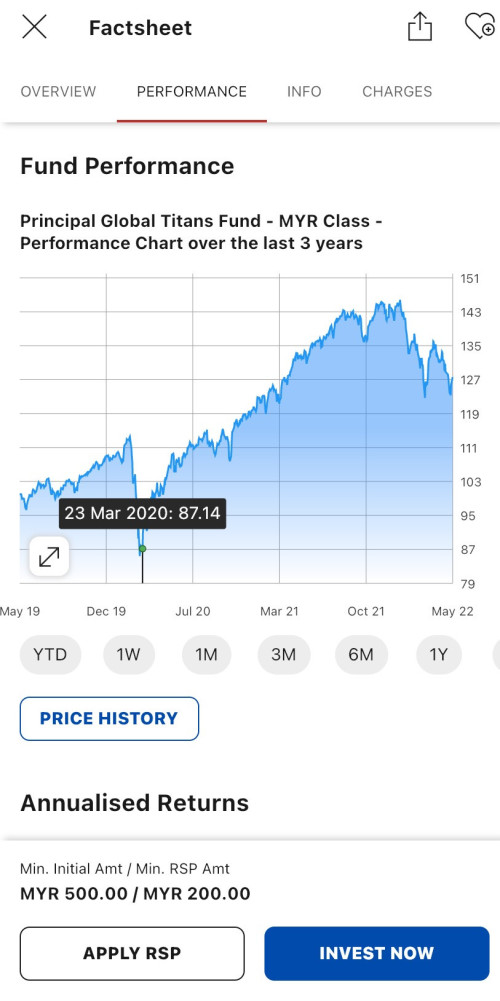
True I have been reconsidering my portfolio’s components. I may add the Principal Global Titans fund or the TA Global Tech fund into the mix. Then I will slowly move over the funds away from the dividend and bond fund accordingly. 👍
george_dave91
post Dec 27 2021, 09:25 AM

Getting Started
**
Junior Member
63 posts

Joined: Feb 2021


Hi guys. Just curious as to how most others are going about with their FSM UT investments. Will be glad if anyone is willing to share their strategy/allocation/etc.

In my case I’m going with a 90/10 stock to bond allocation for now. My bonds are local, as for my equities it’s mainly split between developed markets and APAC, although it is more heavy on APAC for now.

My funds are as follows:
Amanahraya Unit Trust Fund 10%
Affin Hwang Select APAC Div Fund 30%
Principal APAC Dynamic Growth Fund 25%
Principal Global Titans 35%

I mainly rebalance monthly using new funds (just by adding to whichever has fallen most from the ideal allocation). If there’s some significant change to the allocation due to market volatility (5-10%), then I would consider rebalancing.

What do you guys think? What’s does your portfolio of UTs look like?

Cheers.
george_dave91
post Dec 27 2021, 10:43 PM

Getting Started
**
Junior Member
63 posts

Joined: Feb 2021


QUOTE(MUM @ Dec 27 2021, 09:32 AM)
hmm.gif no right or wrong,...
just wondering,...what is the 10% FI in your port for?
in time of market volatility, i think that 10% does not help much to act as a stabilizer of your port

your port is now 55% in Asia Pac + 10% Japan = 65% in Asia Pac include Jpn
*
Well there are a few reasons why it’s there actually. Initially it started due to having the misguided idea that maintaining a bond fund and rebalancing it helps me buy stocks when it’s cheap and lock in profits when it’s overvalued.

However having read up more studies on the matter, due to the long term returns on bonds not being anywhere close to stocks means that it this whole exercise does not actually help you increase returns. Then again there are other articles that say otherwise.

So yea I decided I will just maintain it for now cz while it doesn’t guarantee more optimised returns for the portfolio, it certainly does increase my risk adjusted returns quite significantly, while sacrificing some returns surely but not as much.

I also keep it around get to know how the bond market behaves given that I would someday need to have a larger sum in these assets when I retire, and what better way to experience the market then by getting some skin in the game right?

But yea lastly I think it just serves as a bantam busuk to provide some consolation when the markets are either down or sideways. At least one fund will be in the green, albeit an insignificant amount, but it certainly has a significant psychological impact.

Also yeah I’m quite heavily weighted in Asia now mainly cz of the affin apac dividend fund. I was trying to offset the significant amount of US stocks in it by adding more of the principal apac dynamic growth fund. But yea I want to keep developed markets at 45-35% ideally.

Btw what’s your UT strategy like so far? If you don’t mind sharing that is, no obligations. ✌️


QUOTE(adele123 @ Dec 27 2021, 01:23 PM)
Answering your question on what my UT portfolio looks like.

7% bond
93% equity

the 93% is actually
45% asia pacific via Principal Asia pacific dynamic income fund
22% eastspring small cap fund
19% kenanga growth
7% manulife india

as to what i think of your portfolio, i would suggest you simulate abit what happened in march 2020, and understand how you feel if a similar event happen. aside from that. i myself do not have a good strategy myself.
*
Hey thanks for sharing. That’s quite a bit of exposure in Malaysia I see. Any reason for that? Anticipating some significant growth in the near future?

In my case, the equity funds are predominantly foreign Cz if I consider the money I have growing in epf and my bursa stock portfolio, I would say I’m overly exposed to the Malaysian market (and it hasn’t exactly been the best place for steady long term growth, in recent times at least). So yeah, I’m overly weighted in one country currently, one with a volatile political climate too. Didn’t want to put all my eggs in one basket so to speak. Well I guess it’s not too bad if you go for the local small cap and growth funds in the long term, just that in comparison to some foreign market, I personally feel there’s more certainty for decent growth. Just my speculative opinion tho.

All in how has your portfolio mix been returns wise and all? That being said this was a bad year anyways. My portfolio is down. But they’re UTs so I’m not too concerned. In fact if I had more cash I would dump in more. My stock holdings tho, those are rather concerning.
george_dave91
post Dec 31 2021, 09:13 AM

Getting Started
**
Junior Member
63 posts

Joined: Feb 2021


QUOTE(MUM @ Dec 27 2021, 11:07 PM)
hmm.gif could be biased,... after having gone thru the downs since Mar....and having seen FI dropped too and with the interest rate expected to go up in the near future

preferably,....
35% Asia Pac
20% US
10% China A shares
10% India
10% Tech
15% Global Reits
*
Oou that’s an interesting mix. You should be getting decent risk adjusted returns on that one right? How as it been so far? So do the REIT funds kinda act as the bonds in your portfolio?


QUOTE(adele123 @ Dec 27 2021, 11:35 PM)
i started off in 2014 when i think ppl are into global titan funds and also greater china fund... i invest in neither because i think it was too volatile for my taste. i have made mistakes here and there. my UT portfolio gives about 5 to 6% IRR on average but recently dropped to 4%. i believe, if i reduce my malaysia exposure, overall return should be better.

i think for me now is, the focus should be around 5 to 6 funds max. di-worse-sification is a thing. i actually stop buying into local funds. my plan is to not increase my malaysian equity... increase my exposure with some bond funds also. continue to increase put money into asia pacific regularly.

and i'm slowly increasing my stake into china heavy fund given recent drop in hk/china but doing via ETF instead.

what i'm lacking is exposure to the USA in my opinion.

I dont have a strategy. i just trial and error, see what i can do.
*
Right, decent enough, similar to asb/epf returns. Is that sufficient for your investment goals/objectives?

Btw are you using the fsm brokerage for the ETFs (is it an international etf or bursa based)?

Hahaha. Yes I totally get the whole trial and error thing. There doesn’t seem to be much content/ books on more in-depth mutual fund strategies etc (in comparison to stocks investing content at least).
george_dave91
post Jan 2 2022, 02:11 AM

Getting Started
**
Junior Member
63 posts

Joined: Feb 2021


QUOTE(MUM @ Dec 31 2021, 09:44 AM)
Sorry I hv no idea how to calculate the risk adjusted return.
Reits fund is more volatile than FI. My thought of having it is for diversification purposes on that posted idea port of mine
*
Well essentially its any calculation/ratio that considers return in relation to risk taken. The sharpe ratio is one such example (and probably the most commonly used).

Yeah I think REIT funds are good in that sense too, being a whole different asset and all. Having a mix of uncorrelated assets essentially lowers the volatility of a portfolio while either maintaining or maybe even improving returns, so goes the theory at least. But yea, seems like a good mix 👍
george_dave91
post May 6 2022, 03:10 PM

Getting Started
**
Junior Member
63 posts

Joined: Feb 2021


Hi guys. What do yal think?:

Scenario:

Target allocation
Equity fund A (25%)
Equity fund B (25%)
Equity fund C (25%)
Equity fund D (25%)

Top up 100 monthly

Current allocation
A 20% (loss -5%)
B 20% (loss -5%)
C 30% (loss -10%)
D 30% (loss -15%)

Would it be better to top up the 100 in the fund that has fallen from your target allocation (A/B) or top up on the fund with the biggest loss to average down (D)?

*Assume all are good funds just going through a bad period.

Just a hypothetical question.


george_dave91
post May 6 2022, 06:20 PM

Getting Started
**
Junior Member
63 posts

Joined: Feb 2021


QUOTE(adele123 @ May 6 2022, 04:59 PM)
It depends on how much you want to stick to this 25% for A B C D. If you strongly believe in this asset allocation then you should try to restore it back. Your hypothetical example abit flawed. If C D, drop more, then the allocation should be < 25%.
*
Yes that’s quite true. This doesn’t typically happen. The rare occasion that one my find themselves in such a situation is when you’ve added new funds to the portfolio with little capital to balance it out.
george_dave91
post May 19 2022, 02:46 AM

Getting Started
**
Junior Member
63 posts

Joined: Feb 2021


QUOTE(james.6831 @ May 16 2022, 05:17 PM)
yea paper loss is still paper loss...but seeing your loss down 32% hurts like a #$!#@ haha
*
What hurts more is not having any additional funds to capitalise on it. Feels like a colossal waste of opportunity. I have already deployed all my fixed income at the start of the year. Who knew the market would go lower. Hahaha. Well that’s just the nature of investing isn’t it, no one has a crystal ball. We just try to “buy the dip” to the best of our ability/resources and stick to the overall plan.

It’d totally suck if one was retired already and living off their investment portfolio tho. For all everyone else (excluding those nearing retirement) it’s 11.11 in the markets.
george_dave91
post May 19 2022, 03:29 AM

Getting Started
**
Junior Member
63 posts

Joined: Feb 2021


Btw what do you guys think of the fact that many personal finance influencers often demonise investing in unit trusts. How have your experiences been with UTs, robos(most are practically mutual funds in a way), other collective investment schemes vs your own direct investments in stocks?

I feel this is really bad as the younger investors would then be led to think that if they just do “the work” they would be the next warren buffet. Meanwhile they’d be missing out on the comppunding effect that is absolutely crucial in the early years. I would generally encourage investors, especially newbies to start out with UTs. Set up the min and dca the minimum in that collective investment scheme. But then eventually if one has extra I feel they should use it to invest in stocks directly. That way they can see if they can do better than a ut. If they can then great! You’re part of that 1%. However, if we are honest about our returns, I’m sure the majority 60-80% of retail investors actually have terrible returns in the stock market, but keep it a secret. There’s nothing wrong with that tho. Learning how to choose a decent ut and dca-ing into them would easily put you miles ahead of your poor performance from pretending to be a fund manager. Nothing wrong with 5-8% annual returns vs hoping to make double digit returns but effectively making -ve returns or 3–6% returns at best.

Back in the days they’d say those who say UTs are great and downplay direct stock investing are probably agents whore trying to make money out of you. However these days it seems to be the reverse. Most of those who trash UTs are probably selling you a course, making lien y from YouTube videos about stocks etc.

Guess the moral of the story is, be honest with yourself, what’s your actual capability. Not everyone is made for stock investing and there’s nothing wrong with that. Just look for the alternative that has the highest chance of success instead of looking for the highest potential outcome.

The statics have been well studied. The majority of investors are plain bad at investing. Most of us here (personal finance nerds hahaha) are what those statistics refer to. Yes it’s us the personal finance nerds, who think we may be the next warren buffet. Reality check tho, these stats are not referring to the general public, cz the general public don’t invest to begin with. Be honest with your capabilities guys. Serious stock investing is a full time job (the job here being studying mostly). To quote William J. Bernstein “ No one in his right mind would walk into the cockpit of an airplane and try to fly it, or into an operating theater and open a belly. And yet they think nothing of managing their retirement assets. I've done all three, and I'm here to tell you that managing money is, in its most critical elements even more demanding than the first two”

That being said, don’t get me wrong, I’m not discouraging people from investing in stocks. I’m all for it actually. I think we should all try. It certainly keeps our ears to the ground. Depdjimg on your performance you’d know which portfolio should be your core investment. What I’m outlining here is bashing UTs and other collective investment schemes.


Hahaha sorry for the unnecessarily long rant that no one asked for guys. Just thinking about how I would’ve done things differently.
george_dave91
post May 20 2022, 12:50 AM

Getting Started
**
Junior Member
63 posts

Joined: Feb 2021


QUOTE(encikbuta @ May 19 2022, 11:22 AM)
my humble two cents:

1. Actively Managed Funds (Unit Trust / Mutual Fund / Active ETF): Good for inefficient & unstable markets where price discovery (i.e. discounts) can be found by skilled & well connected fund managers. Malaysia is a prime example. The local reputable mutual funds perform WAAAYYY better than the KLSE index.

2. Self-Investing (stock picking): Can only speak from own experience. It sucked balls. In 3 years dabbling in Bursa, while I managed to earn like 50 - 100% returns in about 5x stocks, I lost 20 - 30% in the other 20x stocks. Overall, I made only 1% p.a. in 3 years, lol. I personally believe that commoners like us have very little chance against the whales of the stock market. With enough time & effort, good returns can be made but you'd have upgraded yourself to a professional fund manager, not really a part-time investor.

3. Passive Funds (Index Mutual Funds, Passive ETFs): Good for efficient & developed markets (i.e. USA & Eur) where price discovery opportunities are very low.
*
Hey thanks for sharing your experience man. 👍 Yeah i totally agree with all 3 points. As for point 3 I currently don’t invest in the US via index ETFs as I’ve not found a cost efficient way to invest monthly via sc regulated platforms. As my monthly investment sum is pretty small. However when my US ut holdings get large enough I may consider looking for ETFs tho. Or perhaps there may be better methods offered by these platforms in the near future. 🤷‍♂️


QUOTE(bcombat @ May 19 2022, 12:39 PM)
UT need to pay around 4-5 % to the management company. Anyway, risk should be lower since it consist of the group of different stocks as long as the fund manager know what they are doing.

From so many fund I noted most have hit the bottom around March 2020 then start to recover….in fact a sharp V sharp recovery. The time when our govt announcing first MCO and 1 or 2 months after covid arrived in Malaysia. No one expect the stock mkt started to recover…

Although some saying don’t time the mkt because no one know when the mkt will hit the bottom., I do believe timing of entry is important. But the agent/ banker who sell the UT to us won’t care whether the customer make $$ or not, they will say enter anytime is not problem because it is good asset with fundamentals etc.
user posted image
*
I think you might be referring to the upfront sales charge that ranges from 4-5% as you rightly pointed out. Personally I don’t think that’s too big an issue as it’s a one off charge. Eg: if you’re buying in for the several years (which I believe we all ought to if it’s an equity fund) an investment of RM100 would immediately be at a loss RM95. Assuming through the ups and downs, on average the fund manages to return +6% p.a. Over a period of 10 years the RM100 would grow past that initial 5% loss to RM170(roughly) - that’s a decent 70% return on your initial.

Also these fees can be further reduced by investing through platforms like fsm and the like. Typically 1.5% in sales charge. In which case you would recover that sales charge even quicker still. Using the same eg as above the investment would be about RM175 - an additional 5% in returns.

But the annual management fees tho. That’s something else. Most charge annually from 1.5-2%. Those really dig in to your potential returns in the very long term. I guess that’s something to consider when investing in UTs.
george_dave91
post Jun 1 2022, 12:00 AM

Getting Started
**
Junior Member
63 posts

Joined: Feb 2021


What would be considered decent portfolio geographic allocation?

I There seem to be plenty of resources online on this, however it’s almost always from a US investor point of view. For them it would make sense to have a big chunk of their investments in the solely in the US or maybe even no international holdings.

What would be the case for us Malaysian investors. Surely we too should have substantial allocation to the US but what else? Also what percentages, any thoughts?
george_dave91
post Jun 1 2022, 01:34 AM

Getting Started
**
Junior Member
63 posts

Joined: Feb 2021


QUOTE(MUM @ Jun 1 2022, 12:32 AM)
Maybe perhaps these can provides you with some info while you waits for responses.

Forming A Portfolio
In this section, we list the steps an investor should follow when forming a portfolio!

Maybe can try check out the fsm managed portfolio allocations?
Goto browse portfolio n select the portfolio type, can see the allocation...
Try to see what allocations that can suits you best.

*
Useful article indeed. Also that’s a nice hack; the managed portfolio allocations would be a good place to start.
george_dave91
post Jun 1 2022, 02:02 PM

Getting Started
**
Junior Member
63 posts

Joined: Feb 2021


QUOTE(frankzane @ Jun 1 2022, 01:36 PM)
But we(I) couldn't purchase Franklin; only for millionaires! biggrin.gif
*
Lol. True, can find alternative funds tho. Like the Manulife US fund perhaps.
george_dave91
post Sep 6 2022, 03:06 AM

Getting Started
**
Junior Member
63 posts

Joined: Feb 2021


Hi guys. Was hoping to get your opinions on this. Have been contemplating on how to simplify my small portfolio for awhile now. I feel there’s overlap between funds and my portfolio is less than 10k so doesn’t make much sense to have so many funds at this point too.

It’s currently:
-Affin Hwang select apac ex jp dividend fund
-Principal apac dynamic growth fund
-Principal global titans
-Manulife US equity fund

Proposed change:
-Principal apac dynamic growth fund
-Manulife US equity fund

What do yal think?


2 Pages  1 2 >Top
 

Change to:
| Lo-Fi Version
0.0590sec    0.34    7 queries    GZIP Disabled
Time is now: 15th December 2025 - 02:21 AM