No problem bro, i am not worrying about raising mushroom, they are selling those mushroom kit for RM1.20 each, u just need to water it and wait. Besides, most suppliers will teach you how you grow your seeds(make sense to do long term business).
Soon Hock Raising Techniques(Summarised from AgriWorld Feb 2006)
Soon Hock scientific name is Oxyeleotris Marmoratus, it can grow up to 60cm and 5-6kg, it is a kind of predatoric fish, shade loving, prefer to hide among the rocks and seldom swim around. Compare to other predatoric fish(eg, arowana, piranha) it is quite tame, and usually just stay idle and motionless in water, only when their food(small prawn, fish) get near them, they will be fierce and able to hunt their prey with great agility and speed. It is suitable in water temperature 25-30 degree celcius, PH 7-8.5, salt density 10-15ppt.
There are a lot of prawn farmers raising soon hock in Teluk Jaya, Johor, but due to being a commercial secret, they kept low profile on what they are doing. A prawn farmer from there informed the writer that he actually have farmed soon hock for few years. according to him, for fish seeds of 20-30 fish per kg will take one year to grow up to 800-1000g with >80% survival. Recently the low price of tiger prawn has caused many prawn farmers switched to soon hock.
Soon hock feed on different kind of food in different stage of their life. For 1.5 - 2.5cm size, they feed on
Moina or Daphia copepod live culture, when they reach 5cm size, they can feed on small prawns and red worms. When the young soon hocks reach 12-14cm and weight 30-50g each, under farming condition we can start to tame and feed them with man made food, and feed them with fresh chopped fish or sinking fish feed.
Under good water condition,
- 2-2.5cm size will take 1 month to grow to 4-5cm size
- 4-5cm size will take 4-5 months to grow to 12cm/30-50g
- 30-50g size will take 6 months to reach above 600g, which is the marketable size.
- it will take 12-14 months to complete each cycle.
There are two way to farm Soon Hock:
1) net cage, using PE fish net, 30-50g fish seed can be kept in 1.5cm(hole size) of net cage, which 100g fish seed can stay in 2.5cm net cage. Each net cage can use either 3mx4m or 4mx6m with deep 1.2m size, the edge should be 20cm above water surface, which there should be at least more then 20cm from the bottom(of pond). You can place net cage at river, mine lake, or pond. Farming density should be:
- 30-40 fish per meter cube for 30-50g size
- 15-20 fish per meter cube for 80g size
Each net cage should have two feeding baskets(perhaps means you put the feed on top and lower them into water with a rope etc), feed once daily, and check and clean the feeding baskets every morning.
2) pond farming, usually each pond hv 2000-4000 square meters, with depth of 1.2m, fish density 4.5 fish per square meter, place some PVC tube in the pond for the fish to hide. Each pond of similar size can put in 500 river prawn or river fish which can form a food chain. Prawns not only a very good soon hock food, but can help to clean up food residue as well, therefore maintain the water quality.
(the author is from Sepang Today Aquaculture)
(actually the article also mentioned about breeding your own fish seed, bt why not just get them directly from supplier first)
 Case Study
Paraopticfarm (our thread starter farm)
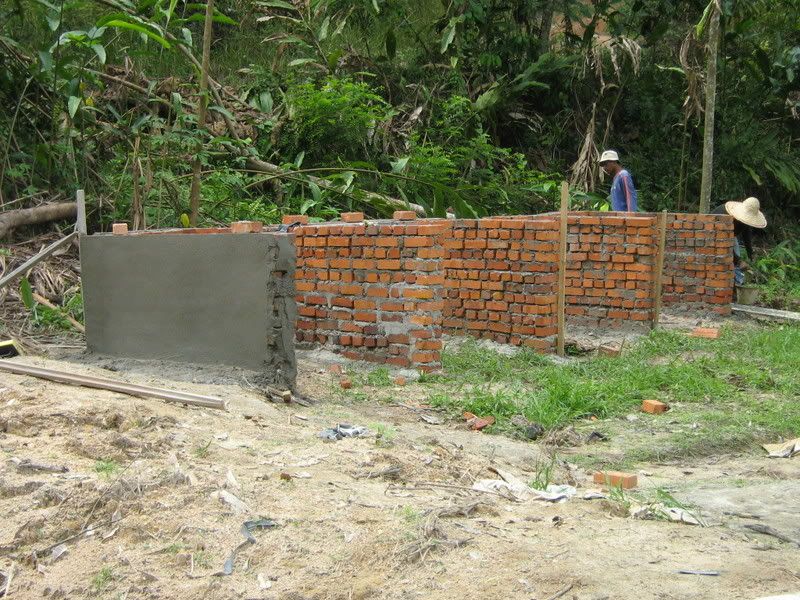
Para rented a land with a river passing by, he has laid concrete floor and placed large water tank and prepared to raise fish. He recently got a batch of soon hock fish seed and wondering how to take care of them.
According to the info above, we can get an idea about what is the fish density we should use:
- 30-40 fish per meter cube for 30-50g size
- 15-20 fish per meter cube for 80g size
This is for a pond, so for fish container with all the water processing system/filter, we should try to look at higher density, just try to add 20% more fish then the recommended density and try out, do regular observation and so on, you can try to double the population but you might get lower survival rate.
And we need to make some place for the fish to hide, as recommended above, PVC tube can be a good choice, the article didnt say a thing about do we need to use different PVC size for different fish size so i am assuming one size fits all, use those big PVC tube which usually we use for water drainage, cut them into like 2.5 feet long and tie them in one big bunch like how we tie up a bunch of dynamite then sink them into water. (It really feel like building fish condo now!) Also try not to make the opening facing each other, the purpose of hiding is not to see others, but this is just imho.
You have to make sure the PVC tube do not block the water circulation thou.
Feed the fish as recommended above, about where to get those fish feed:
- try if you can net any tiny fish tadpodes from the river that running thru your land
- get fish discards(fish heads, etc) from fish cake factory daily
- use ready made fish feed, train your soon hock to adapt to them
- once a while, feed your fish with nutricious meal, like redworm, mealworm, etc. Normally not recommended to get them from a petshop thou you can find them there, try get a distributor for bulk ordering. If you have the time, you can even consider
breeding your own mealworm colony!
If you considering mixing in fresh water prawns/fish into the tank, i think not, because it is already pretty packed and thurs i dont think the small fish/prawns will stand a change. Perhaps keep them at another tank, keep them healthy so they start multiplying and thurs provide you part of the fish food. Theres another article that a soon hock farmer actually putting adult talapia in his fish pond so the talapia will produce small talapia, and thus soon hock will hv extra fresh food, he is decorating his pond as natural as possible.
(disclaimer: the case study is purely a direct analysis of the information available, I am not a professional fish farmer therefore the above are just IMHO.)
This post has been edited by rexis: Aug 29 2007, 01:32 PM 

 Feb 18 2007, 02:15 AM


 Quote
Quote ) if I attend the agenda. Just to have something to look at.
 you have me.


 0.0537sec
 0.42
0.42
 7 queries
 GZIP Disabled