Welcome Guest ( Log In | Register )

Bump Topic Topic Closed RSS Feed
5 Pages < 1 2 3 4 5 >Bottom

Outline · [ Standard ] · Linear+

 Oil & Gas Careers V11, Upstream & Downstream, Market still slump ahead...

views
     
sukhoi35mk
post Aug 15 2016, 05:42 PM

Casual
***
Junior Member
420 posts

Joined: Feb 2007
everything will end well soon

QUOTE
Sarawak DCM calls first meet with Petronas fruitful

KUCHING, Aug 15 — Sarawak Deputy Chief Minister Datuk Amar Douglas Uggah Embas said he had a fruitful meeting with officials from state oil firm Petronas on complaints against alleged discrimination of locals.

“The meeting is productive, and we will meet again this Saturday to iron out on all the issues to the finest details,” Uggah said in a brief statement handed over to the waiting reporters at Wisma Bapa Malaysia.

Uggah was accompanied by Sarawak State Secretary Tan Sri Morshidi Ghani in the private meeting while Petronas was represented by its executive vice president and chief executive officer (upstream) Datuk Mohd Anuar Taib.

Also in the Petronas delegation were senior vice president of group human resource management, Datuk Raiha Azni Abdul Rahman, and senior vice president of corporate strategy Adif Zulkifli.

The meeting was held following the Sarawak government’s decision to place on moratorium on all new applications for work permits for Petronas’ employees from outside Sarawak to work in the state.

The move was in response to complaints by state-sponsored think-tank Suarah Petroleum Group (SPG) that Petronas was treating Sarawak natives in its workforce unfairly.

SPG president Hamin Yusuf claimed that the removal of 29 permanent posts had resulted in the retrenchment of 13 experienced staff from Sarawak in Petronas’ upstream restructuring exercise.

In its reply, Petronas said that the decision by the state government to freeze all new applications for work permits might be based on a misinterpretation that its recent group-wide business restructuring had unfairly impacted its employees from Sarawak.

On August 5, Chief Minister Tan Sri Adenan Satem threatened to cancel the work permits of non-local employees in Petronas if Sarawakians were not given priority to fill senior positions.

- See more at: http://www.themalaymailonline.com/malaysia...h.P4ezVYPe.dpuf

sukhoi35mk
post Aug 16 2016, 08:56 AM

Casual
***
Junior Member
420 posts

Joined: Feb 2007
not sure if this working permit freeze really for O&G players or only target our NOC but my colleague just flew to Kuching from Semanjung for a DS brown field project owned by Assar Chemical... gonna to stuck there for 3 months...
sukhoi35mk
post Aug 16 2016, 09:19 AM

Casual
***
Junior Member
420 posts

Joined: Feb 2007
QUOTE(mark_vyz @ Aug 16 2016, 05:09 AM)
PETALING JAYA: Minister in the Prime Minister’s Department Nancy Shukri is hoping for a quick solution to the issue of non-Sarawakian workers in Petronas in the state, reported Borneo Post Online.
Nancy, who is from Sarawak, said the state government’s decision to freeze new work permit applications by Petronas personnel who wanted to work in the state, had its merits.
In recent weeks, Sarawakian politicians on both sides of the divide have been hitting out at Petronas, after a Sarawakian non-profit organisation, Suarah Petroleum Group (SPG), cried foul over Petronas’s lack of prioritisation of Sarawakians in its operations in the state.
Last Monday, the state government froze all work permits for non-Sarawakian Petronas employees until further notice.
Nancy said she was perturbed by many comments surrounding the issue, and feared that if it was not resolved fast, it would lead to an “unhealthy” relationship between Petronas and the state government.
The PBB leader said Sarawakians were becoming more aware of their constitutional rights and the state government had to act accordingly in their interests.

Nancy, who is Batang Sadong MP, voiced hope that Petronas and the state government would resolve the issue promptly.
“There may be opportunists out there wishing us to prolong the issue which doesn’t bring us anywhere. Just think of the employees who have families to feed and continue with their family responsibilities.”
Meanwhile, in another Borneo Post online report, DAP Serian chairman Edward Andrew Luak called on Petronas to emulate Shell Malaysia, which practised ‘Borneonisation’ of its management team in the state.
Edward, a former Shell employee, said in Shell, Sarawakians headed most of the various sections of the operations in its Miri headquarters, while Sarawakians were also put in charge of the operations, technical division, personnel management, corporate affairs and others.
“We witnessed Shell Malaysia, Sarawak Operations and Shell MDS being led by Sarawakians. This scenario is hardly seen in Petronas.
“The board of directors of Petronas and its subsidiary companies, particularly Petronas Carigali, are Malayan (Peninsular Malaysian)-monopolised. Promotions in Petronas are Malayan-driven. Recruitment of professionals, as well as technical staff, is Malayan-driven.
Edward said many people in the state believed that there were Sarawakians who were on par or even better than their Peninsular Malaysian peers, since many of them were among the cream of the crop from local and overseas institutions of higher learning.

*
that's why i believe Shell will not affected by the working permit issue.... the chairman of shell malaysia is a sarawakian.... Idris Jala also ex-Shell MD... tongue.gif
sukhoi35mk
post Aug 16 2016, 01:07 PM

Casual
***
Junior Member
420 posts

Joined: Feb 2007
i think there is a thread for Seafarers back in 2011 this is the salary scales of MISC... salary + allowance asian rate....

» Click to show Spoiler - click again to hide... «

sukhoi35mk
post Aug 16 2016, 03:26 PM

Casual
***
Junior Member
420 posts

Joined: Feb 2007
QUOTE(mohdyakup @ Aug 16 2016, 02:02 PM)
Very informative! But it havent cover sign-on & sign-off bonus and other allowance hehehehe
*
this one from ALAM.... but currently unemployment rate for local seafarers are high...not sure if the info below still correct...

user posted image
sukhoi35mk
post Aug 17 2016, 09:52 AM

Casual
***
Junior Member
420 posts

Joined: Feb 2007
nah... this has nothing to do with S4S or any "kenegerian" sentiment but current crisis in sarawak which affecting the O&G... no politic elements... readers discretion advised..

QUOTE
90 work permits put on hold

in the news, it's clear indicate that it's for Petronas and its subsidiaries only....  others O&G companies are business as usual

» Click to show Spoiler - click again to hide... «


This post has been edited by sukhoi35mk: Aug 17 2016, 09:57 AM
sukhoi35mk
post Aug 17 2016, 10:03 AM

Casual
***
Junior Member
420 posts

Joined: Feb 2007
Two dead in ammonia leak at Petronas plant

KOTA KINABALU, Aug 16 ― An ammonia leak at a Petronas plant in Sipitang, near here this morning killed two workers and injured three others.

Petronas Chemicals Group Berhad (PCG) confirmed the incident at 9.30am this morning at the Petronas Chemicals Fertiliser Sabah Sdn Bhd (PCFSSB) plant in the Sabah Ammonia Urea project in the Sipitang Oil and Gas Industrial Park some 140km from here.

“Five PCFSSB contractors were affected. The company, however, regrets to inform that two fatalities have been reported. The other three affected personnel have received appropriate medical treatment,” it said in a statement here.

“Our Emergency Response Team was immediately mobilised and the situation has been contained,” it also said, adding that there was no immediate threat to the surrounding communities or environment.

“PCFSSB is extending all necessary assistance to the affected personnel and their family members.

Authorities are still investigating cause of the leak.

Sipitang police chief deputy superintendent Ag Md Arsad Ag Bakar also confirmed the incident and said police were similarly investigating the case.

- See more at: http://www.themalaymailonline.com/malaysia...h.oLjKGSnC.dpuf
sukhoi35mk
post Aug 18 2016, 05:15 PM

Casual
***
Junior Member
420 posts

Joined: Feb 2007
QUOTE(noiseemunkee @ Aug 18 2016, 03:12 PM)
many of those that just got transfered unwillingly to sarawak are actually hoping to be transferred back for this permit issue. haha. 😬
*
i hope this is not a bad news for them

QUOTE
Petronas saves RM3.4bil from cost-cutting efforts

PUTRAJAYA: Malaysia’s oil giant Petronas has saved RM3.4bil since embarking on cost-cutting measures in 2015 and this effort will continue even if oil prices recover.

“Through the Cost Reduction Alliance programme, we have managed to cut RM3.4bil in terms of our costs since we started till the middle of this year,” its president and group chief executive officer Datuk Wan Zulkifli Wan Ariffin said.

He said this at the International Conference of Blue Ocean Strategy’s plenary session themed “Delivering High Value at Low Cost,” here yesterday.

The Cost Reduction Alliance or CORAL 2.0 is a five-year industry-wide programme from 2015 to 2019, driven by Petronas with the aim to inculcate cost-conscious mindset across Upstream Malaysia.

Wan Zulkifli said the transformation kicked in when oil and gas companies, including Petronas, were hit by tumbling prices since 2014.

“In 2014, oil prices were more than US$100 per barrel, at lunch time today it was US$48.

“Oil companies had to do strategic responses, worried about cash flows, cut budgets and optimise the manpower and Petronas was no different,” he said.

He said Petronas had cut its capital expenditure and operating expenses by RM15bil this year and had earmarked about RM50bil over four years.

Malaysia’s only Fortune 500 company, Petronas, is also focusing on cash generation, simplification of process, project delivery, as well as talent management.

However, he said as such measures and mere cost cutting alone was not sustainable, Petronas needed a total overhaul even in terms of its culture.

“I think over time as the organisation grew bigger, we became more bureaucratic and many units become more silo as time went by.

“So, we wanted to eliminate the believe of our staff that Petronas was bureaucratic and silo,” he said.

Hence, to attain the results, it is important for Petronas to fix the day-to-day experience of its 50,000 employees. – Bernama

sukhoi35mk
post Aug 26 2016, 06:33 PM

Casual
***
Junior Member
420 posts

Joined: Feb 2007
how you look at this situation?

QUOTE


SINGAPORE — Tankers full of liquefied petroleum gas (LPG) are gathering off Singapore waiting for buyers as a flood of supply from the US and Saudi Arabia has outpaced demand for the fuel, trade and industry sources said on Thursday (Aug 25).

The number of ships congregating near Singapore, a key ship-fuelling and oil product trading area for Asia, has surged to over 10 from under seven just five weeks ago, said trading and industry sources that are familiar with the market. Shipping data carried on Thomson Reuters Eikon shows that there are at least eight Very Large Gas Carriers (VLGCs) anchored near Singapore including the Chaparral, Ming Long, Promise, Cratis, British Commerce and Berge Nantong.

LPG was once a tightly supplied market with petrochemical manufacturers competing for the fuel with its main residential and commercial consumers that use it for heating and cooking. Now, the market for the fuel is in a dire state following new supply pouring in from the United States.

“There could be as many as 11 floaters being anchored off Singapore waters at the moment. The growth in supplies was too fast,” said consultant Ong Han Wee of energy consulting firm FGE.

US exports for arrival in Asia this month could be about 750,000 tonnes, data from FGE showed. In June, they hit a record of about 1 million tonnes, FGE said.

At the same time, Saudi Arabian exports for August arrival to Asia will rise to 840,000 tonnes, the highest monthly volume this year, said Mr Ong.

The surge in supply coincides with tapering demand in China, whose petrochemical plants have driven much of the demand growth for LPG in the region. LPG imports to China slumped to 408,350 tonnes in July, down 17.8 per cent from June, customs data showed.

LPG for prompt month delivery was estimated to be around US$300 (S$405) a tonne on Aug 24, data from brokerage Ginga showed, down from about US$383 a tonne in early January this year.

The glut of tankers has pushed down chartering rates for these VLGC to about US$10,000 a day from about US$13,000 to US$14,000 a day in the second-half of July, traders said.

The gloomy sight of the wayward tankers is expected to even last into the peak winter season when demand for LPG as a heating fuel surges.

“I do not see the floaters disappearing totally even in the winter months. There would still be floaters but just fewer in numbers,” said Mr Ong. REUTERS

sukhoi35mk
post Aug 28 2016, 12:46 PM

Casual
***
Junior Member
420 posts

Joined: Feb 2007
i think the biggest risk to local O&G industry is everyone is too depending on Petronas... everyone is borrowing money just to pay operation bills.

QUOTE
Credit crunch persists in oil and gas

Lack of funding poses threat to O&G companies’ operations

THE latest round of second quarter earnings for oil and gas service providers shows that companies are experiencing cash flow pressures which could still pose a threat to their operations, say analysts.

After the collapse of Singaporean-listed Swiber Holdings Ltd, which found itself unable to satisfy its debt obligations following the crude oil price collapse, all eyes are now on its peers that operate in Malaysian waters.

“This is because banks have turned cautious on providing financial services to the leveraged players.

“While refinancing existing debt is no issue, obtaining fresh capital through borrowings is almost certainly out of the question, meaning that these firms have no choice but to turn to captial markets,” says an investment banker.

Malaysian banks also felt the brunt of Swiber’s demise.

According to a CIMB Research note, Maybank’s exposure amounted to SG$150mil while RHB Bank is on the hook for an estimated SG$50-85mil, both of which coming from financial notes.

Back in February, Maybank IB Research estimated that the total cumulative gross debt exposure of 46 public listed Malaysian oil and gas firms amounted to some RM50bil, representing 3.6% of total banking system loans.

At present, oil and gas firms are in a tight spot when it comes to recapitalisation. Assets that are purchased using short term debt are either idle or operate far below their utlisation rates, which results in little to no cash generated to service the debt obligations.

Furthermore, a deteriorating cash flow makes it far more difficult for a company to raise money through the bond markets as their ability to generate earnings come under question.

user posted image

Issuing higher-yielding debts with junk status is also out of the question as most institutional investors have specific mandates that prohibit the purchase of such instruments.

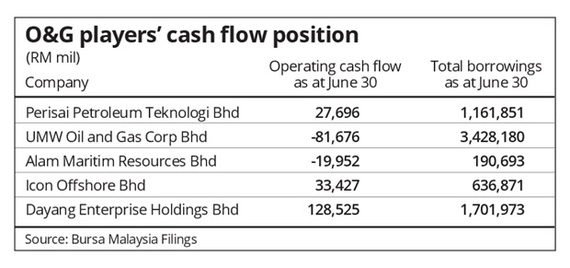
According to an Aug 23 note by UOBKayHian Research, among the stocks that scored poorly on cash flow coverage, high gearing and short term loan repayments are UMW Oil and Gas Corp Bhd (UMWOG), Perisai Petroleum Teknologi Bhd, Dayang Enterprise Holdings Bhd, and Icon Offshore Bhd, among others.

Due to a lack of new contracts and underutilisation of vessels, these companies have experienced worsening cash flows over the past year. However, there were no longer any large impairments made compared to last year. (see table)

The dim near term outlook is reflected in Petroliam Nasional Bhd’s latest quarterly earnings release which saw the firm’s net profit falling 65% on a quarter-on-quarter (q-o-q) basis to RM1.6bil due to impairments as well as weak upstream profits, UOB noted.

“We believe Petronas will resume its austerity measures to avoid overleveraging its balance sheet.

“This means a continued trend of being selective in contracts, renegotiations of margins and poor earnings visibility for local services players,” it said.

For the Malaysian jack-up drilling rig operators, namely UMWOG and Perisai, the companies have taken proactive steps to cut costs and consolidate their respective debt loads.

However, their latest quarterly results show that the companies are not out of the woods just yet.

For the six months period ended June 30, 2016 (H1FY16), UMWOG’s operating cash flow turned negative to the tune of RM81.68mil, according to its latest quarterly filings.

In fact, the bulk of this came from RM50.64mil in interests paid as opposed to just RM29.31mil cash spent towards operating activities.

It is worth noting that the group has successfully refinanced a large chunk of its current borrowings,

with its short term debt at RM1.3bil as at June 30 compared to RM2.26bil a year ago.

UMWOG is also sitting comfortably on a cash pile of RM909.19mil in proceeds from its initial public offering (IPO) in 2013, which cushions its against further cash flow pressure.

On the other hand, the group reported a net loss of RM67.25mil and revenue of RM130.01mil for the second quarter ended June 30, 2016 (Q2FY16).

However, the same cannot be said for Perisai which fell into a net loss of RM2.68mil in Q2FY16.

In an Aug 25 note by TA Securities Research, the firm cautioned that the company faces some significant risk arising from its short term debts.

“Perisai currently has short term borrowings of RM475.4mil but its cash is only RM21.9mil. Note that the group is attempting to renegotiate with bondholders of its SG$125mil in medium term notes to reschedule the payback period,” it said.

As for Alam Maritim Resources Bhd, which provides support vessels to the oil and gas industry, the group saw its RM75mil Islamic sukuk rating downgraded by Malaysian Rating Corp on Aug 26 following its Q2FY16 results.

Despite reporting a net profit of RM7.06mil for the quarter on the back of RM92.81mil in revenue, the ratings firm expressed concern over its outlook.

“Alam Maritim’s cash flow generation ability has been diminished, leading to low liquidity buffers to meet its remaining obligations under the programme, of which RM30mil sukuk is due in July 2017 and the final RM45mil in January 2018. As at end July 2016, its cash balances stood at RM55.3mil,” it cautions.

sukhoi35mk
post Sep 5 2016, 11:34 AM

Casual
***
Junior Member
420 posts

Joined: Feb 2007
more DS projects coming soon in indonesia...

QUOTE
Pertamina seeks overseas refiner for Malaysian, Algerian crude

Indonesia’s Pertamina is looking to process up to 1.2 million barrels per month of crude from Algeria and Malaysia at an overseas refinery, an official at the state-owned energy company said, in an effort to cut costs.

“We’re approaching partner candidates, and it doesn’t necessarily have to be with Shell again. It could be with another company,” said Daniel Purba, senior vice president of Pertamina’s Integrated Supply Chain unit.

Pertamina inked a deal with Shell earlier this year to process around 1 million barrels per month of Iraqi crude at a Singapore refinery.

The company is now seeking a partner to process 300,000 barrels of Algerian crude and up to 900,000 barrels of Malaysian crude each month, which is currently being shipped to Indonesia for refining, Purba said.

“Whatever brings maximum benefits to Pertamina in relation to domestic fuel supply, we will do it. The point is we want to seek value creation in the international market,” he said.

Pertamina currently purchases around 6 million barrels of RON88 gasoline and 3 million barrels of RON92 gasoline per month from the international market to meet domestic demand.

The company expects to begin importing RON92 gasoline through the refining agreement with Shell in the fourth quarter of this year, Purba said, noting that the total volume of crude being processed through the Shell deal would not change. (Writing by Fergus Jensen; Editing by Alexandra Hudson)
Source: Reuters

sukhoi35mk
post Sep 22 2016, 10:18 AM

Casual
***
Junior Member
420 posts

Joined: Feb 2007
QUOTE
Transocean’s cold-stacking gamble

Offshore giant Transocean has found major savings cold-stacking vessels in the Caribbean — but what happens when they try to turn them back on?

(Bloomberg) — In a far corner of the Caribbean Sea, one of those idyllic spots touched most days by little more than a fisherman chasing blue marlin, billions of dollars worth of the world’s finest oil equipment bobs quietly in the water.

They are high-tech, deepwater drillships — big, hulking things with giant rigs that tower high above the deck. They’re packed tight in a cluster, nine of them in all. The engines are off. The 20-ton anchors are down. The crews are gone. For months now, they’ve been parked here, 12 miles off the coast of Trinidad & Tobago, waiting for the global oil market to recover.

The ships are owned by a company called Transocean Ltd., the biggest offshore-rig operator in the world. And while the decision to idle a chunk of its fleet would seem logical enough given the collapse in oil drilling activity, Transocean is in truth taking an enormous, and unprecedented, risk. No one, it turns out, had ever shut off these ships before. In the two decades since the newest models hit the market, there never had really been a need to. And no one can tell you, with any certainty or precision, what will happen when they flip the switch back on.

It’s a gamble that Transocean, and a couple smaller rig operators, felt compelled to take after having shelled out millions of dollars to keep the motors running on ships not in use. That technique is called warm-stacking. Parked in a safe harbor and manned by a skeleton crew, it typically costs about $40,000 a day. Cold-stacking — when the engines are cut — costs as little as $15,000 a day. Huge savings, yes, but the angst runs high.

“These drillships were not designed to sit idle,” said Willard Duffey Jr., an electrician who spent two decades with Transocean. The Deepwater Pathfinder, a ship he had served on for four years, was among the first to be parked off the Trinidad coast. The ship made the voyage there from the Gulf of Mexico about a year ago. Duffey was one of the last men aboard before the engines were turned off. He fretted constantly — “did I do everything I could?” — as he flew back home to Ore City, Texas. “To get the Pathfinder back up would be very difficult to guess actually,” he said.

Once famously labeled the “new Ferraris” of the oil world, these are no ordinary ships. Carrying a price tag of about $500 million a piece, they are loaded bow to stern with sophisticated, and very heavy, gadgetry.

Below the water line sit a half-dozen Rolls-Royce thrusters, coordinated by satellite to push against each other and keep the rig hovering on top of wells lying as much as two miles underwater. Up on deck, there’s a robot that can be launched to work a screwdriver or a wrench under water pressures on the seabed that no human could survive. And the 220-foot-tall, dual-activity oil-drilling derrick is capable of simultaneously lifting and lowering gear down to the seafloor, including a diamond-studded drill bit, a five-story-tall blowout preventer and a heavy-drill pipe. The derrick can handle as much as 5 million pounds of gear — equal to the weight of some 20 adult blue whales — going up and down at one time.

All of these fancy elements, though, are what make turning the ships back on so daunting. Chip Keener, whose rig-storage consulting firm advises Transocean, compares it to what would happen if you left a high-tech new car parked in the garage for months. The battery would be dead, sure, but then there’d also be a slew of pre-sets to reprogram. On a drillship, there are thousands and thousands of pre-sets. And unlike your car, those on a ship are essential to its proper functioning. “It’s a big deal,” said Keener.

For now, cold-stacking has been a huge success for Transocean, a long-time Texas powerhouse that’s based today in Switzerland. (It owned the Deepwater Horizon, the offshore rig that BP Plc was operating in the 2010 Gulf of Mexico disaster.) The company reported a profit of $77 million in the second quarter, surprising investors who had been bracing for a loss. Within minutes the next morning, its stock price had jumped 8.5% in New York trading.

“I don’t think a simple congrats on this quarter’s cost beat is really sufficient,” one stunned analyst, Scott Gruber at Citigroup Inc., told Transocean executives on a conference call. “A big kudos to all of you.”

Still, there are any number of deepwater rig operators unwilling to turn the engines off: Noble Corp., Rowan Cos. and Pacific Drilling, to name a few. They’re paying anywhere from $30,000 to $50,000 a day to store their out-of-work ships. Chris Beckett, the CEO of Pacific Drilling, said the unknowns of cold-stacking are just too great and the cost to keep the ships running too manageable — about $10 million a year — to turn them off. He likes the peace of mind that comes with his approach. “We don’t worry about how you start them again,” Beckett said in an interview at the company’s Houston headquarters.

The cold-stack versus warm-stack dilemma doesn’t figure to go away anytime soon.

Nearly half of the world’s available floating rigs are out of work today, and most observers expect that number will climb further. Not only are the drillship operators’ customers — the likes of ConocoPhillips and Total SA — slashing spending in high-cost offshore areas and canceling work contracts early, but new rigs that were ordered in recent years keep rolling out of shipyards. Bloomberg Intelligence estimates as much as $56 billion worth of offshore rigs, capable of drilling in everything from shallow water to oceans more than two miles deep, are still under construction.

It’s a far different mood from a couple years ago, when crude was hovering around $100 a barrel and just about every single deepwater rig on the planet was in use. Transocean’s Pathfinder was in many ways the symbol of those go-go days. In mid-2014, just as oil prices were peaking, Eni SpA agreed to pay Transocean $681,000 a day to lease the ship. It was one of the richest drilling contracts ever, an amount that’s about triple the rate a deal signed today would fetch. By the end of that year, with oil in freefall, Eni canceled the contract four months before it was due to expire.

Things are quiet on the Pathfinder these days. The water is calm off Trinidad, one of the top global destinations for drillship storage. A handful of seamen recruited locally make the rounds, in part to ward off criminal elements. They’re joined every once in a while by Transocean mechanics sent in to monitor the ships. The company’s chief operating officer, John Stobart, recently dropped in to check them out himself. CEO Jeremy Thigpen said Stobart came away encouraged.

“He was really impressed with the preservation of all the critical components,” Thigpen said at an energy conference in New York this month. “His belief is, ‘Listen, we’re going to be able to reactivate these rigs in a timely and low-cost manner.’”

Stobart’s going to have to wait for his chance. Oil, after having briefly rebounded above $50 in June, is slumping again. And Transocean seems prepared to be in Trinidad for a while. The contract to lease out seabed space that the company’s negotiating, island officials say, could extend through October of 2020.

sukhoi35mk
post Oct 1 2016, 10:59 PM

Casual
***
Junior Member
420 posts

Joined: Feb 2007
QUOTE(nash9701 @ Oct 1 2016, 11:50 AM)
Heard there is another VSS from Shell  which last date of working is yesterday, not sure true or not

(^__^)
*
i tot Shell already announce will move IT from cyberjaya to bangalore and 1XXX ppl inclusive of contractors will losing job?... it's ongoing since last year and will complete by 2017.... this is nothing news.... SMEP already annoucing that they will reduce 1XXX workforce started this year and next year... also old news.
sukhoi35mk
post Oct 1 2016, 11:03 PM

Casual
***
Junior Member
420 posts

Joined: Feb 2007
i tot Petronas is very keen with this project.... always chasing canadian government for approval and they got the approval last week and now wanna sell already?

QUOTE
Petronas weighs sale to exit $27 bln Canada LNG project

KUALA LUMPUR/MILAN: Malaysian state oil firm Petroliam Nasional Bhd is considering selling its majority stake in a $27 billion Canadian liquefied natural gas (LNG) plant, three people familiar with the matter said this week.

Petronas, as the company is known, said in a statement on Saturday that it "categorically denied" the Reuters report on Friday that the company is considering the stake sale.

"Petronas reiterates that, together with the project partners, it will study the conditions that come with the approval and conduct a total review of the project prior to making a decision on the next steps forward," the company said in a statement on Saturday.

Petronas is weighing options for the project as a more than 50 percent slide in crude oil prices since the middle of 2014 has hit the group's profits and prompted cuts to capital expenditure and jobs.

Amid the cost-cutting, the economics of the Canadian project - which took three years to get approval due to environment concerns - have been called into question as LNG prices have fallen more than 70 percent in two years.

Petronas was given the go-ahead for the C$36 billion ($27.34 billion) project by the Canadian government earlier this week. It said then that executives would study the 190 conditions imposed by the authorities and conduct a review before deciding on the next steps.

The sources said Petronas has been considering a sale for months, after it became apparent that a Canadian approval was possible, but had yet to take a final decision. Other options are also being considered, including putting it on ice.

"They are going to be looking at gas prices, costs and returns before they make the final decision," said one of the sources. "It is a very tough call."

The Canadian project is Petronas' biggest foreign investment and seen as a sign of Malaysia's global energy ambitions. An exit would underscore the financial constraints at the state-run firm and also the soft outlook for LNG prices.

Last month, Petronas reported an 85 percent slide in second-quarter profit and labelled the industry outlook "gloomy" well into 2017. It has committed to paying 16 billion ringgit to the government coffers this year, down nearly 40 percent from its year-ago contribution.

TOUGH SELL

Petronas signed on for the project in 2012 through the acquisition of Canada's Progress Energy.

It has faced several hurdles. Aboriginal and environmental groups have said the project would threaten a salmon habitat. The LNG price decline added to concerns, and there is also a growing supply glut as other projects went live.

If Petronas goes ahead with a sale, finding a buyer in current market conditions would be difficult, the sources said.

Petronas was considering its options as far back as a year ago, a separate industry source said, but he added it would be difficult to sell in the current environment given that Canadian projects are more expensive.

If Petronas opts to suspend the Canada project, it would be put on ice until gas prices begin to turn around and Petronas is confident of securing long-term contracts at reasonable prices, said the sources, who declined to be identified as the negotiations are not public.

Other LNG projects in British Columbia have also faced delays, underlining the market outlook. In July, Royal Dutch Shell and its partners pushed back a decision on building an LNG export terminal, and Chevron has delayed the scheduled 2017 start of its Kitimat LNG project.
Petronas has minority partners for the project in China, India, Japan and Brunei. - Reuters

sukhoi35mk
post Oct 3 2016, 11:17 AM

Casual
***
Junior Member
420 posts

Joined: Feb 2007
QUOTE
MISC unit begins arbitration against Sabah Shell


PETALING JAYA: MISC Bhd’s wholly owned subsidiary Gumusut-Kakap Semi-Floating Production System (L) Ltd (GKL) has commenced arbitration proceedings against Sabah Shell Petroleum Co Ltd (SSPC), with claims of US$245 million (RM1.01 billion).

In a filing with Bursa Malaysia last Friday, MISC said GKL filed a notice of adjudication dated Sept 23, 2016 under CIPAA 2012 and a notice of arbitration dated Sept 2, 2016 with the Kuala Lumpur Regional Centre for Arbitration to begin arbitration proceedings against SSPC.

“The legal proceedings were commenced to seek resolution on contractual disputes covering claims for outstanding additional lease rates, payment for completed variation works and other associated costs under the lease agreement dated Nov 9, 2012 entered into between GKL and SSPC for the construction and lease of the Gumusut-Kakap Semi-Floating Production System (Semi-FPS) for the purposes of the production of crude oil,” it said.

The legal proceedings are not expected to have any material impact on the earnings per share, gearing and net assets per share of MISC for the financial year ending Dec 31, 2016.

As advised by GKL’s solicitors, the company is of the view that GKL has a good legal position to succeed in its claims against SSPC.

sukhoi35mk
post Oct 3 2016, 11:26 AM

Casual
***
Junior Member
420 posts

Joined: Feb 2007
QUOTE(Dern @ Oct 3 2016, 01:01 AM)
wit the OPEC cutting production, will the oil price be revive and make oil & gas industry create more jobs ?
*
very unlikely.... world no longer circle around OPEC anymore.... used to be the biggest net importer the Uncle Sam is now biggest shale hydrocarbon producer and exporter.... any space left behind by OPEC can easily fill by Uncle Sam and they do not gip a damn to OPEC... inland drilling is much much cheaper than offshore...


QUOTE
Oil prices fall despite planned OPEC output cut

il prices fell away from $50 per barrel on Monday despite last week's agreement by exporters to cut output, with traders doubting the step was big enough to rein in production that has exceeded consumption for the better part of three years.

Brent crude futures were trading down 35 cents, or 0.7 percent, at $49.84 per barrel at 0053 GMT.


Oil prices fell away from $50 per barrel on Monday despite last week's agreement by exporters to cut output, with traders doubting the step was big enough to rein in production that has exceeded consumption for the better part of three years.

Brent crude futures were trading down 35 cents, or 0.7 percent, at $49.84 per barrel at 0053 GMT.

U.S. West Texas Intermediate (WTI) futures were down 40 cents, or 0.83 percent, at $47.84 a barrel.

Oil trading activity will be limited on Monday as public holidays in China and Germany mean Asia's and Europe's biggest markets are shut.

The price falls came despite last week's agreement by members of the Organization of the Petroleum Exporting Countries (OPEC) to cut output to between 32.5 million barrels per day (bpd) and 33.0 million bpd from about 33.5 million bpd, with details to be finalized at OPEC's policy meeting in November.

Traders said prices went lower despite the announced cuts as overproduction remained in place for the time being, and because the planned intervention might not be sufficient to bring production back to, or below, consumption.

"OPEC has created its own Q4 risk to oil prices ... In raising expectations of a November deal to cut production, it also risks a steep price decline should it fail to achieve its goal of cutting output back to less than 33 million bpd," Barclays said in a note to clients.

The market skepticism stems from the fact that OPEC production has so far chased new records for much of this year as rivaling members like Saudi Arabia, Iran and Iraq are reluctant to give away market share.

As a result, OPEC's oil output is likely to reach 33.60 million bpd in September from a revised 33.53 million bpd in August, its highest in recent history, a Reuters survey found on Friday.

Despite that, the British bank said that it did not expect a repeat of the price crash seen late last year after a rally earlier in 2015.

"We think oil prices, and commodities more generally, will avoid the Q4 price crash that has become a feature of the market in recent years," it said, pointing to an improving Asian economic growth outlook, falling oil supplies and rising investor interest in oil markets as main support factors for this year.


sukhoi35mk
post Oct 3 2016, 11:28 AM

Casual
***
Junior Member
420 posts

Joined: Feb 2007
QUOTE
Opec deal no quick boost for Malaysian oil & gas sector

PETALING JAYA: The Organisation of Petroleum Exporting Countries’ (Opec) plan to cut oil production, which has boosted global oil prices, is not expected to have an immediate positive impact on the Malaysian oil and gas industry, according to analysts.

This is because most of the oil and gas players are involved in the services segment within the industry. Hence, analysts said, they don’t expect the local oil and gas stocks to see significant improvement in their financial performance.

Downstream firms are generally dependent on upstream players for their jobs, and the promised production cut will need time to trickle down to propping up oil prices amid uncertain global outlook, before it warrants a pick-up in upstream activities.

Upstream players are Petroliam Nasional Bhd (Petronas), Shell, SapuraKencana Petroleum Bhd and Hibiscus Petroleum Bhd, to name a few.

Kenanga Research analyst Sean Lim opined that while the revival rate of upstream activities will not be so encouraging, it will definitely instill more confidence to oil majors to fork out more capital expenditure (capex).

“I think the process (of pumping in money) will be slow because cash conservation is the priority at this point of time,” he told SunBiz.

MIDF Research analyst Aaron Tan Wei Min concurred, saying that any budgeting has to be associated with oil companies’ long-term view and outlook on the industry.

“Oil price is just one of many factors to be considered. So I don’t think that capex will be revised upwards. Nonetheless, if oil prices are sustainable at above US$50 (RM207), or maybe US$60 (RM248) per barrel, then there is a possibility that capex will be revised,” he opined.

To turn pessimism into optimism, Tan said the global oil market has to see a more meaningful and sustainable price level, which could take years.

“Even though it is sustained for six months to one year, it’s still not meaningful enough,” he said.

Tan highlighted that the cost structure for upstream players has become lower in the current low oil price environment, which could see reduction in services jobs even though oil prices bounce back to a certain high level.

“They’ve re-regulated their activities, what they want is efficiency. Although you’re extracting more oil, you do not necessarily need more FPSO (floating production, storage and offloading) or extra workers, that’s not the case anymore,” he explained.

Last week, Opec, which produces about 41% of the world’s crude oil, said it will cut production to between 32.5 and 33 million barrels per day from 33.47 million in August, a move that surprised the market. A finalised plan however, will only be announced at their next meeting scheduled for Nov 30.

Analysts are still maintaining their forecasts for oil prices for 2016 and 2017 at the moment, with Tan projecting US$45 and US$50 per barrel and Lim US$47 and US$51.

Lim said if there are more aggressive cuts in oil production, crude prices could rise above US$50 or reach close to US$60 a barrel.

sukhoi35mk
post Oct 4 2016, 09:49 AM

Casual
***
Junior Member
420 posts

Joined: Feb 2007
Perisai Petroleum is next Swiber Holdings Ltd??

QUOTE
Bondholders say no to Perisai

PETALING JAYA: Perisai Petroleum Teknologi Bhd has become the second casualty in the oil and gas debt markets as it faces the redemption of its S$125mil (RM377mil) bond which matured yesterday after noteholders voted to reject its restructuring plan.

The firm had failed to secure a waiver on the payments and other obligations during a meeting with bondholders in Singapore yesterday, Bloomberg reported.

In a Sept 9 consent solicitation note, Perisai had also sought for an extension to the bond’s maturity date to Feb 3, 2017 from Oct 3, 2016.

According to Bloomberg, more than 70% of the holders who voted during the meeting yesterday voted against Perisai’s restructuring plan.

Last week, more than 50 dissenting holders had served an “acceleration notice” to Perisai to demand immediate repayment of the principal and interest, according to multiple reports.

The company would have required the approval of 75% of the noteholders to pass the resolutions and defer the bond payments.

Representatives of the company could not be reached.

The rejection comes after Singapore’s Swiber Holdings Ltd defaulted on a coupon payment for the second time on Sept 19 since applying for judicial management in July.

As at July 31, Swiber has some S$354mil outstanding on three notes under a US$1bil multi-currency medium term notes programme.

In previous statements by Perisai, the cash-strapped offshore services provider said it required the four extra months to manage existing liabilities and formulate a new long-term plan to address its debt issues.

At present, meeting the obligations relating to the bond’s redemption is a tall order. As at June 30, 2016, the firm had RM21.85mil in cash and bank balances left compared to short-term borrowings of RM475.38mil.

It is not immediately known what options are available to the noteholders subsequent to the rejection of Perisai’s proposal.

The S$125mil series 001 notes in question, which were due yesterday, carried a coupon rate of 6.875% as part of Perisai’s S$700mil multi-currency medium-term notes programme.

The two-year slump in crude oil prices has resulted in a severe deterioration of the firm’s cash flows due to a lack of new jobs for its fleet of state-of-the-art jack-up drilling rigs.

Its first jack-up, Perisai Pacific 101, cost RM650mil to build and had commenced operations in August 2014.

However, Perisai has deferred the delivery of its second jack-up, the RM500mil Perisai Pacific 102, since last year due to the unfavourable market environment in the oil and gas sector. The rig’s current expected delivery date is on Oct 31.

Another rig, Perisai Pacific 103, is currently under construction.

Perisai’s shares closed at 12.5 sen last Friday, or close to its all-time low of 11 sen, which was hit two weeks ago. Its market capitalisation stands at RM156.03mil.

Notably, a potential non-payment of the bond could have major ramifications for several Singaporean firms. Singapore Exchange-listed Ezra Holdings Ltd may be impacted as it is the single largest shareholder in Perisai with a 22.5% stake.

Meanwhile, Sembcorp Marine Ltd’s subsidiary, PPL Shipyard, is the builder of the Perisai Pacific 102. A non-delivery of the jack-up rig could see a write-down of the assets for Sembcorp Marine, which had already made similar impairments last year.

Other major shareholders in Perisai include Lembaga Tabung Haji with a 5.86% stake and the Employees Provident Fund with a 3.07% stake, according to its latest annual report.

sukhoi35mk
post Oct 4 2016, 09:51 AM

Casual
***
Junior Member
420 posts

Joined: Feb 2007
QUOTE(azraeil @ Oct 4 2016, 09:34 AM)
Petronas has categorically denied this report. I think the news article has also been pulled from reuters.

Yes got approval but with 190 conditions. Mengalahkan Putri Gunung Ledang.
*
that agreement is available on Internet.... baca baca also making me rclxub.gif ... confirm not easy to become a lawyer.. biggrin.gif
sukhoi35mk
post Oct 12 2016, 08:49 AM

Casual
***
Junior Member
420 posts

Joined: Feb 2007
more bad news for local O&G industry...

QUOTE
TH Heavy seeks to extend maturity date of debt papers

PETALING JAYA: In yet another sign of troubling times faced by oil and gas companies, TH Heavy Engineering Bhd (THHE) has sought to extend the maturity date of its debt papers by one year.

In a filings with Bursa Malaysia, THHE said it had written to the Securities Commission to update the maturity date of its sukuk murabahah from Sept 30, 2016 to Sept 29, 2017.

The said sukuk murabahah, which came with a nominal value of RM170mil and a coupon rate of 7%, was issued in September 2013. The papers came with a maturity period of three years.

THHE’s shares rose one sen to close at 18.5 sen yesterday.

THHE is 30%-owned by Lembaga Tabung Haji.

The pilgrim fund injected RM275mil into the company last September when it was the sole subscriber of its rights issue of preference shares that was grossly undersubscribed. Based on the company’s 2015 annual report, it was stated that RM171mil of the proceeds went towards capital expenditure, RM51.9mil for repaying debts and another RM51.5mil for working capital.

Borrowings stood at RM408.22mil while cash has dwindled to RM48mil as at March 31, down from RM77.6mil in the previous quarter. Its accumulated losses at end-March stood at RM95.6mil.

Early this month, Perisai Petroleum Teknologi Bhd defaulted on bonds worth S$125mil (RM379.3mil) after bondholders rejected the company’s restructuring plans. The Malaysian offshore O&G services provider had other debts – worth around RM791mil at end-June 2016 – with major Singaporean and Malaysian banks likely to be among the main creditors.

A number of other regional O&G service companies had also run into trouble this year.

Swiber Holdings, for instance, filed for creditor protection in July, leading DBS to classify S$651mil of its S$721mil exposure to the troubled group as non-performing, with the remainder expected to be classified in the third quarter.

Swissco Holdings on Oct 4 appointed Ernst & Young to assist in the refinancing and restructuring of S$100mil worth of bonds due in 2018. The others in various stages of debt reorganisation included AusGroup and Marco Polo Marine.


5 Pages < 1 2 3 4 5 >Top
Topic ClosedOptions
 

Change to:
| Lo-Fi Version
0.0737sec    0.58    7 queries    GZIP Disabled
Time is now: 21st December 2025 - 02:12 PM