Welcome Guest ( Log In | Register )

Bump Topic Topic Closed RSS Feed
5 Pages < 1 2 3 4 > » Bottom

Outline · [ Standard ] · Linear+

 Oil & Gas Careers V11, Upstream & Downstream, Market still slump ahead...

views
     
sukhoi35mk
post Jul 28 2016, 03:40 PM

Casual
***
Junior Member
420 posts

Joined: Feb 2007
QUOTE
Royal Dutch Shell says 2nd Q earnings fell 72 percent

LONDON (AP) — Royal Dutch Shell says second-quarter earnings fell 72 percent as low oil prices challenge the profitability of the business.

The Anglo-Dutch company said Thursday that profit adjusted for changes in the value of inventories and excluding one-time items dropped to $1.05 billion from $3.76 billion in the same period of 2015. Net income fell 71 percent to $1.18 billion.

CEO Ben van Beurden said Thursday that "lower oil prices continue to be a significant challenge across the business."

Shell has been cutting costs and selling assets to adjust to lower oil prices. It says it is "firmly on track" to deliver $40 billion in savings by the end of the year.

Brent crude dropped to a 12-year low of $27.10 a barrel in January.

sukhoi35mk
post Jul 29 2016, 03:31 PM

Casual
***
Junior Member
420 posts

Joined: Feb 2007
QUOTE(ljy1 @ Jul 29 2016, 02:07 PM)
just need some career advice, wise to join shell as a business analyst (downstream, cyberjaya) nowadays?
*
Downstream Cyberjaya as BA... DS IT? Otd or OtC? C&P?
sukhoi35mk
post Jul 29 2016, 05:07 PM

Casual
***
Junior Member
420 posts

Joined: Feb 2007
QUOTE(ljy1 @ Jul 29 2016, 04:04 PM)
DS IT? Otd or OtC? C&P?

simple english? new to o&g industry. thx
*
which Class Of Business (CoB) hiring you? there are few depts there such as Finance, HR, Order To Deliver (OtD), Order To Customer (OtC), Contract & Procurement (C&P), Upstream IT, Downstream (DS) IT etc..

This post has been edited by sukhoi35mk: Jul 29 2016, 05:08 PM
sukhoi35mk
post Aug 1 2016, 09:16 AM

Casual
***
Junior Member
420 posts

Joined: Feb 2007
QUOTE(ljy1 @ Jul 29 2016, 05:42 PM)
finance
*
so long it's not IT as Cyberjaya no longer an IT hub to shell...downgraded from Global to Regional... pay wise it's better if not on par with some shared service centrals in Malaysia... i do have friends from audit/accounting firms joined SBO-KL finance then resigned awhile due to not challenging enough...i guess it's depending on depts or what u really want from the job.... Shell has another SBO in Manila... good thing is Shell is not stingy when come to training... since u will be BA, so please enroll courses like CBAP, ScrumMaster, etc once u accumulate enough BA hours...
sukhoi35mk
post Aug 1 2016, 09:27 AM

Casual
***
Junior Member
420 posts

Joined: Feb 2007
QUOTE
Alam Maritim on Swiber impact

PETALING JAYA: Alam Maritim Resources Bhd will not feel the heat from financial troubles of its partner, the Singapore-listed Swiber Holdings Ltd.

In fact, Alam Maritim is considering taking over the stake of the troubled-oil and gas (O&G) firm in a project that the companies are working on.

“There is only one project directly contracted with Swiber which is almost fully-completed namely engineering, procurement, construction, installation, commissioning of SK316 development job worth US$76mil,” Alam Maritim group managing director and group chief executive officer Datuk Azmi Ahmad told StarBiz.

The SK316 project is the development of a huge gas field located offshore Sarawak.

The other option for Alam Maritim is to find a new partner to take over Swiber’s role.

He said Alam Maritim had two JV companies with Swiber,

The first is Alam Swiber Offshore (M) Sdn Bhd which is equally owned by Alam Maritim (M) Sdn Bhd and Swiber Offshore Construction.

The second is Alam Swiber DLB 1 (L) Inc, which is 51% owned by Alam Maritim (L) Inc and 49% by Swiber Engineering Ltd.

“The impact is minimal to us as the contribution from the Alam-Swiber JV is not substantial to the Alam Maritim group,” he said.

Swiber, the Singapore-based oilfield services firm was reported to be in talks with its creditors for a possible debt restructuring exercise.

The stock had slumped by nearly 90% since mid-2014, taking its market value to just S$50mil, while the company had flagged delays in orders, raising concerns and sparking demands for cash.

From just 10 vessels in 2006 when it was listed, Swiber had expanded to own and operate a fleet of 51 vessels with more than 2,700 employees across South-East Asia and other countries, according to its website.

Its shares surged after listing, pushing its valuation to S$1.5bil in late-2007, but the stock fell sharply in recent years.

Smaller firm Technics Oil & Gas Ltd was placed under judicial management this month, and analysts said other firms could face difficulties.

Energy and offshore marine companies in Singapore have bonds totalling nearly S$1.2bil due to mature over the next year-and-a-half, with S$615mil due over the next five months, according to IFR, a Thomson Reuters publication.

Alam Maritim, too is facing a challenging period.

On the O&G support services industry, Azmi said the impact of Brexit on the fragile global economy might slow down the recovery of the crude oil prices affecting overall demand and pushing out the rebalancing of the oil market.

“During this challenging period, we are aggressively and continuously embarking on various cost and asset optimisation initiatives to weather the storm,” he said.

Azmi added that Alam Maritim’s vessel utilisation rate was 56%.

“As at June, our order book stood at RM470mil, tender book at RM2.6bil,” he said.

Alam Maritim fell into the red with a net loss of RM19.2mil in the first quarter ended March 31 compared with a net profit of RM8.6mil a year ago.

Its revenue for the quarter shrank to RM48.6mil from RM73.7mil in the corresponding quarter last year.

According to Maybank Kim Eng, the low oil price has resulted in a swift response to cost reduction or renegotiating of contracts, cash conservation due to delayed projects and debts refinancing as well as strategic collaboration exercises.

“It also opened a window of opportunities to exploring mergers and acquisition options.

“About 69 North American exploration and production companies were declared bankrupt between January 2015 and April this year. “Uncertainties and differences in valuation expectations between buyers and sellers are the greatest hurdles. There is currently a buyer-seller mismatch in terms of expectations,” said Maybank Kim Eng in a June report on the sector.
sukhoi35mk
post Aug 1 2016, 10:20 AM

Casual
***
Junior Member
420 posts

Joined: Feb 2007
QUOTE
Exxon Reports Smallest Profit Since 1999

Lower oil prices continue to punish Exxon Mobil Corp., which reported its weakest quarterly profit in nearly 17 years.

Exxon still earned $1.7 billion in the second quarter. It was, however, down 59 percent from a year ago, and per share income missed Wall Street expectations.

The energy giant cited lower prices for oil and gas and weaker margins from its refining operations.

Chairman and CEO Rex Tillerson said Friday that the results "reflect a volatile industry environment."

The company is cutting exploration spending to manage through the lower prices.

Exxon shares had climbed nearly 30 percent since late January as crude prices rallied from a deep slump. But more recently oil prices have fallen back due to high inventories and the continued sluggish global economy — this week, U.S. oil hit a three-month low, and Exxon shares lost 4 percent through Thursday's close.

Exxon's report followed weak second-quarter results from BP and Shell.

While oil companies are seeing profits shrink, consumers are enjoying the benefit of cheaper energy. The average U.S. price for a gallon of regular gasoline stood at $2.14 on Friday, the lowest price since April, according to auto club AAA.

Gasoline prices are skidding because of high inventories. The decline in pump prices defies the usual pattern of higher prices during summer, when people drive more. Motorists are filling up on the cheapest July gasoline in 12 years, the auto club says.

Exxon's net income was lower than the $1.8 billion it earned in the first quarter and the Texas-based company's smallest profit since the third quarter of 1999, when it earned $1.5 billion.

The profit equaled 41 cents per share, well below the 64 cents per share forecast from 21 analysts surveyed by FactSet. Exxon did not exclude any one-time costs from the per share calculation.

Revenue fell 22 percent, to $57.69 billion.

Exxons production of oil and gas was nearly unchanged, but the comnpany's capital and exploration spending tumbled 38 percent from a year earlier, to $5.2 billion.

Eventually, analysts say, that kind of lower spending by Exxon and its rivals will translate into lower production, smaller supplies and higher prices for oil.

In recent weeks, Exxon announced a major oil discovery off the coast of South America and announced it would pay $2.5 billion for InterOil Corp., a deal designed to grab more of Asias growing demand for natural gas.

Exxon shares fell $2.42, or 2.7 percent, to $87.78 in premarket trading about 30 minutes before Friday's opening bell.
sukhoi35mk
post Aug 1 2016, 10:21 AM

Casual
***
Junior Member
420 posts

Joined: Feb 2007
wondering how Petronas is doing...


QUOTE
Chevron earnings surprise with loss on $2.8 billion in charges


Chevron posted a loss for the second quarter as it reported $2.8 billion in impairments, surprising the Street.


The stock was 1.8 percent lower in premarket trading (See what shares are doing now.)


The San Ramon, California-based company recorded impairments and other charges on assets in its upstream exploration and production business that were expected to produce revenues insufficient to cover costs, Chairman and CEO John Watson said in a statement.

Chevron posted a loss of $1.5 billion, or 78 cents per share, in the second quarter, compared with a profit of $571 million, or 30 cents per share, in the year-earlier period.

Excluding the charges, adjusted earnings per share came in at 35 cents. Analysts polled by Thomson Reuters had expected earnings per share of 32 cents.

Revenues were $29.3 billion, down about 27 percent from $40.4 billion in the second quarter of 2015.


Losses in the company's U.S. and international upstream operations widened from the year-earlier period.

"The second quarter results reflected lower oil prices and our ongoing adjustment to a lower oil price world," said Watson.


Downstream refining earnings also fell on weak refining margins.

Refiners have seen their profit margins squeezed this year as prices rise for crude oil, the feedstock for gasoline. U.S. crude prices rebounded about 85 percent from the lows of January through the end of the second quarter.

Earlier in the oil price downturn, integrated oil companies' refining operations offset battered production segments.

The amount of gasoline sitting in storage in the United States is about 15 percent above the five-year average, RBC Capital Markets said in a note ahead of earnings. As such, the firm expects weak profit margins from refining crude oil into gasoline to persist at least through the spring of 2017.

Chevron left its quarterly dividend unchanged at $1.07 ahead of earnings on Wednesday. The company hasn't raised its dividend since the second quarter of 2014.


The company's cash flow from operations in the first half of 2016 sank more than 60 percent year over year to $3.7 billion.


Earlier this month, a group of integrated oil companies led by Chevron announced it would invest $36.8 billion in a project that will boost production at Kazakhstan's Tengiz field. The investment decision is one of the largest since the beginning of the oil price downturn.
This post has been edited by sukhoi35mk: Aug 1 2016, 10:22 AM
sukhoi35mk
post Aug 2 2016, 04:33 PM

Casual
***
Junior Member
420 posts

Joined: Feb 2007
QUOTE
Crude oil slides below $40 for first time since April

Oil prices dropped below $40 for the first time since April as the growing global supply of crude and refined products rekindled worries about a global glut in the oil market.

On the New York Mercantile Exchange, light, sweet crude futures for delivery in September CLU6, -0.27% lost 11 cents, or 0.3%, to $39.95, a barrel, sliding deeper into bear territory. The contract on Monday closed down 21.8% from a 52-week high of $51.23 hit in early June. A bear market is defined as a fall of 20% from a recent peal.

The October contract for Brent crude LCOV6, -0.19%  on London’s ICE Futures exchange slipped 2 cents to $42.12 a barrel.


Oil prices rallied earlier in the summer, thanks to a group of temporary factors, such as wildfires in Canada and oil-worker strikes in Kuwait. But as those interruptions faded, investors have shifted their focus back to the oversupply issues that have beleaguered the oil markets for two years.

“The world is so oversupplied and the pace of rebalance is so slow that even geopolitical factors such as the ongoing civil strife in Nigeria are not enough to offset the fall in prices,” said Gao Jian, an energy analyst at SCI International.

The recent uptrend seen in U.S. oil drilling activities, Libya’s expected return to the oil exporting markets, and the likely output increase by prominent Organization of the Petroleum Exporting Countries members such as Iraq and Iran last month, are also sparking stronger risk-off sentiment across the commodities complex.

OPEC’s July monthly oil report, which also offers the cartel’s own demand and supply outlook, is expected to be released Aug. 10.

Adding to the concerns is the fact that many refineries, both in the U.S. and in Asia, are undergoing their seasonal maintenance period. The reduced refining rate “will add to the supply backlogs as crude flows will have nowhere to go,” said Stuart Ive, a client manager at OM Financial.

“This seasonal drop in prices does still have room to target $35 before maybe reversing toward the end of the year,” he added.

Moreover, while refiners are taking a breather amid lower margins, oil drillers in the U.S. are becoming more encouraged. According to industry group Baker Hughes data, U.S. active oil rigs have risen in the eight of the nine weeks since oil hit $50, lifting the count by 18% over that span.

All eyes will be watching the weekly U.S. oil stockpiles and production report slated for release Wednesday. Based on an estimate by analysts surveyed by S&P Global Platts, U.S. crude stockpiles likely fell 1.9 million barrels last week, while gasoline stocks decreased 400,000 barrels.

Elsewhere in the energy spectrum, gasoline for September RBU6, +0.29%  gained 0.4% to $1.31 a gallon, while natural gas for the same month NGU16, +0.51%  rose 0.5% to $2.78 per million British thermal units.
sukhoi35mk
post Aug 5 2016, 11:17 PM

Casual
***
Junior Member
420 posts

Joined: Feb 2007
Petronas ada retrenchment going on? next time Sarawak maybe going to ban worker from Peninsular malaysia from working there tongue.gif

QUOTE
Worry over hiring trend in Petronas

KUCHING: The abolishment of 29 permanent positions resulting in the retrenchment of 13 experienced staff from Sarawak by Petronas in its upstream restructuring exercise in Sarawak has raised the concern of Suarah Petroleum Group (SPG).

Speaking through a press statement yesterday SPG president Hamin Yusuf said the exercise reflected a ‘quick fix’ mentality behind the management of Petronas which would hamper the development of local skilled workforce and the local job market.

Hamin was responding to the revelation of the restructuring exercise in the last State Legislative Assembly sitting by Industrial, Entrepreneur, Trade and Investment Minister Datuk Amar Awang Tengah Ali Hasan.

Awang Tengah also told the assembly that the expansion of Petronas Sarawak Gas operations had created 251 new positions in Bintulu, in addition to 134 new positions for Train 9 operations and another 234 new positions for Floating LNG Satu.

Awang Tengah was quoted to have said that he hoped Petronas would seriously consider Sarawakians in filling positions for these new operations.

The SPG president noted that the speed in handing the Separation Packages to the 13 Sarawakian staff without first considering re-skilling to fit them into new positions showed that Petronas was insincere in responding to the state government’s demand for more benefits for Sarawakians from the extraction of oil in the state.

“Petronas’ policy towards the state seems to reflect a lack of sensitivity and sense of reality to the local job market and employment of locals.

“As recently as two months ago, 85 positions in MLNG Bintulu were filled mostly by Peninsular Malaysians under the pretext of ‘redeployment’.

These positions are mostly entry level positions or junior managerial positions which can easily be filled by jobless local Sarawakian graduates who are experiencing difficulties in getting jobs under the current economic slowdown.” he said.

Hamin also pointed out that at present only 39 per cent of management positions and 46 per cent of middle management positions are filled by Sarawakians in Petronas Sarawak operations.

“The majority of senior jobs are also filled by non-Sarawakians and the influx of Peninsular Malaysians filling the lower jobs exacerbates the situation for the state,” SPG called on Petronas to take these concerns positively and seriously by strictly complying with the state’s work permit policy which gives priority to qualified Sarawakians.

“This cannot be done by outsourcing non-Sarawakian work permit applications to a third party as what it has now started to do.

SPG raises these concerns as part of its efforts to assist the state government to obtain economic parity with Peninsular Malaysia,” he said.
sukhoi35mk
post Aug 5 2016, 11:19 PM

Casual
***
Junior Member
420 posts

Joined: Feb 2007
QUOTE
Chong wants permits of non-S’wakians in Petronas revoked

PETALING JAYA: The Sarawak Government must revoke the work and immigration permits of non-Sarawakians holding management and middle-management jobs in the state’s branch of Petronas, says Sarawak DAP chief Chong Chieng Jen.

The state Opposition leader made the call, saying that priority must instead be given to Sarawakians when it came to employment by Petronas’s Sarawak operations.

Chong said in November 2014, Sarawak Chief Minister Adenan Satem informed the state assembly that Petronas had agreed to greater Sarawakian participation in terms of human resource, education and technical training.

“Yet, when it comes to employment by Petronas for its operations in Sarawak, Sarawakians are still not given the priority,” he said.
Chong lamented that almost two years after Adenan’s announcement, a majority of senior posts in Petronas in Sarawak were still held by non-Sarawakians.

“Only 39% of management positions and 46% of middle management positions are filled by Sarawakians.

“On the other hand, when it comes to Petronas’s restructuring exercise, the national oil and gas firm is quick to retrench experienced Sarawakian workers without giving consideration for the re-deployment of these workers to other jobs within the Petronas Group,” he said.

Chong said the state government must also take into account that Peninsular Malaysians working for Petronas in Sarawak were required to hold immigration and work permits to enter Sarawak, and the power to issue these permits was the prerogative of the state government.

Thus, he said the state government must aim for a target of at least 70% Sarawakian representation in Petronas’s management and middle management level positions there.

Until that was achieved, Chong suggested the Adenan administration revoke the work and entry permits of Petronas’s present management and middle management staff who are from Peninsular Malaysia.

“It is only by imposing such strong actions that we can get Petronas to accede to our request for more opportunities to be given to Sarawakians.

“When the state government can be quick to ban the entry of Opposition politicians from entering Sarawak during the state election to protect Barisan Nasional’s interest, there is no reason why such powers cannot be exercised to protect the interests of Sarawakians in general when it comes to job opportunities for locals,” Chong said.

Earlier today, it was reported that the Suarah Petroleum Group (SPG), a Sarawakian non-profit organisation had called on Petronas to give priority to Sarawakians when filling vacancies in the oil company’s operations in the state.
sukhoi35mk
post Aug 9 2016, 10:31 PM

Casual
***
Junior Member
420 posts

Joined: Feb 2007
let's talk diff topic now...

QUOTE
Winding-up of Sona Petroleum kicks off

KUALA LUMPUR: The winding-up of Sona Petroleum has officially started after the board of directors presented a petition to the court to dissolve the special purpose acquisition company (SPAC).

Sona Petroleum said on Tuesday the company had presented the petition to the High Court of Malaya at Kuala Lumpur (Commercial Division) under Section 218(1)(h) of the Companies Act 1965 to among others, wind up the company and to appoint liquidators.

Under the Act, the court may order a winding up upon the occurrence of events which the memorandum or articles provide that the company is to be dissolved.

It said this was in line with the company’s Memorandum and Articles of Association which provides that it shall be dissolved, wound up and liquidated under if it does not complete a qualifying acquisition within the permitted timeframe.

Sona Petroleum nominated Lim San Peen and Datuk Mohd Anwar Yahya of PricewaterhouseCoopers Advisory Services Sdn. Bhd. as joint and/or several liquidators of the company, subject to the approval of the High Court.

It will then take steps to comply with the Companies (Winding-Up) Rules 1972, including to advertise and gazette the Petition.

Under the due process, the High Court will fix a hearing date for the petition.

sukhoi35mk
post Aug 9 2016, 10:35 PM

Casual
***
Junior Member
420 posts

Joined: Feb 2007
QUOTE
Petronas Gas posts lower Q2 pre-tax profit
KUALA LUMPUR: Petronas Gas Bhd recorded a lower pre-tax profit of RM497.76mil in the second quarter ended June 30, 2016, compared with RM527.10mil in the same period last year.

In a filing to Bursa Malaysia on Tuesday, the group said its revenue, however, rose to RM1.12bil from RM1.08bil previously.

“The higher revenue was driven by higher utilities revenue, in line with higher offtake by customers and upward fuel gas price revision effective Jan 1, 2016, as well as, higher performance based structure income and regasification revenue,” it said.

Given the strong and stable income streams from existing gas processing agreement, gas transportation agreements and regasification service agreement signed with Petronas, the gas infrastructure and utilities company expects its performance to remain steady in 2016 amid the challenging economic environment. - Bernama
QUOTE
Petronas Chemicals Q2 earnings down 17% to RM462m
KUALA LUMPUR: Petronas Chemicals Group Bhd reported lower earnings in the second quarter ended June 30, 2016 mainly due to assets write-off amounting to RM241mil due to the cancellation of an elastomers project.

It said on Tuesday earnings fell 17% to RM462mil from RM557mil a year ago. It declared an interim dividend of seven sen a share.

“Profit after tax for the quarter, however, was lower by RM105mil or 16% at RM533mil mainly due to assets write-off amounting to RM241mil (US$59mil) in relation to the cancellation of elastomers project. Excluding the write-off, profit after tax would have been higher by RM136mil or 21% at RM774mil,” it said.

Its revenue declined 3.1% to RM3.20bil from RM3.30bil a year ago as lower average product prices offset the impact of higher sales volume and stronger US dollar.

Petronas Chemicals said the group recorded strong operational performance during the quarter, with higher plant utilisation of 95% compared with 78% a year ago. This was driven by improved feedstock supplies and plant reliability as well as lower level of statutory turnaround activities.

“Correspondingly, both production and sales volumes were higher. Overall average product prices were lower in tandem with the sharp decline in crude oil price,” it said.

As for the olefins and derivatives segment, it achieved higher plant utilisation of 93% compared to 84% a year ago due to higher ethane supply which offset the impact of statutory turnaround at its aromatics plant during the quarter.

Average product prices were lower following sharp decline in crude oil price and subdued market demand. Revenue decreased by RM219milor 9% to RM2.1bil due to lower sales volumes and average product prices.

Petronas Chemicals said earnings before interest, tax, depreciation and amoritsation (EBITDA) for this segment grew by RM99mil or 13% to RM867mil due to higher volumes of ethane-based products, which was further supported by stronger US dollar.

Profit after tax fell RM93mil or 23% to RM312mil following assets write-off amounting to RM241mil (US$59mil) due to the  cancellation of the elastomers project. Excluding the write-off, profit after tax would have been higher by 37% at RM553mil.

As for its fertilisers and methanol segment, Petronas Chemicals recorded plant utilisation of 96% compared to 73% a year ago, underpinned by higher methane supply at the group’s methanol facilities. During the quarter, it undertook a statutory turnaround at its Gurun urea facility.

Revenue rose by 11% to RM1.1bil due to higher sales volumes and stronger US dollar, negated by lower average product prices. EBITDA increased by 12% to RM373mil. Profit after tax dipped 1% to RM219mil.
sukhoi35mk
post Aug 9 2016, 10:38 PM

Casual
***
Junior Member
420 posts

Joined: Feb 2007
some good news for O&G service companies...

QUOTE
Tax breaks, incentives for shipbuilding, repair companie

KUALA LUMPUR: The government has unveiled tax breaks and incentives for shipbuilding and ship repairing industry as it targets the sector to generate RM6.35bil in gross national income and provide 55,000 jobs by 2020.

New companies will either receive pioneer status with 70% of income tax exemption on statutory income for five years or Investment Tax Allowance of 60% on the qualifying capital expenditure incurred within 5 years from the date the first qualifying capital expenditure is incurred.

For existing shipbuilding and ship repairing companies, they can enjoy Investment Tax Allowance of 60% on additional qualifying capital expenditure incurred within five years.

Minister of International Trade and Industry, Datuk Seri Mustapa Mohamed said on Tuesday these new incentives would be for all areas in Malaysia to boost the industry in line with the Malaysian Shipbuilding and  Ship Repair Industry Strategic Plan 2020 and the 11th Malaysia Plan.

Currently there are 100 registered shipyards in Malaysia, in which 39 are located in West Malaysia and 61 in East Malaysia.

Previously, the incentives for shipbuilding and ship repairing were for projects in the Eastern Corridor, Sabah, Sarawak, Perlis, Kelantan, Terengganu, Pahang and the district of Mersing in Johor.

The companies then were eligible for Pioneer Status with income tax exemption of 100% of statutory income for five years or Investment Tax Allowance of 100% on qualifying capital expenditure incurred within five years. The incentives ended in 2010.

Mustapa urged both local and foreign investors to capitalise on these new incentives.

“Despite the sluggish momentum in the offshore oil and gas industry which have suppressed demand for ships and offshore structures, Malaysia has the pull factor to become the leading nation in the shipbuilding and ship repairing industry.

“The country is the right choice to invest in as it has a promising future based on its strategic location, competitive cost, skilled and talented workforce, advanced infrastructure and extensive trade agreement regionally and globally,” he said.

In West Malaysia, the main shipyards are in Lumut (Perak), Port Klang (Selangor), Kemaman (Terengganu) and Pasir Gudang (Johor). In East Malaysia, Sibu (Sarawak) is the main shipbuilding hub with a total of 40 small to medium-sized companies.

There are six large shipyards in the country with repairing capabilities of more than 600 tons displacement. They are Malaysia Marine and Heavy Engineering (MMHE), Boustead Naval Shipyard, Sabah Shipyard, Sapura Kencana, Nam Cheong and Muhibbah Marine Engineering.
sukhoi35mk
post Aug 10 2016, 09:03 AM

Casual
***
Junior Member
420 posts

Joined: Feb 2007
forget abd USD85 or USD100 per barrel... those days are over....

QUOTE
The new normal for oil

Crude seen at US$50, prices may remain for next five years

KUALA LUMPUR: The new normal for oil is US$50 per barrel, says a leading consultancy firm.

Bain & Co feels that this scenario of prolonged low oil prices will remain for the next five years and predicts that the industry will continue to grapple with deleveraging and cash flow issues.

“We believe that this scenario is likely to exist for a while due to the tremendous amount of supply coming from low-cost sources such as Russia and members of the Organisation of the Petroleum Exporting Countries.

“There is also the likelihood of a slowdown in demand towards the end of this decade,” Jorge Leis, a partner in Bain & Co, told reporters at a briefing.

Brent crude prices have fallen from their highest point this year recently. After peaking at US$52.51 per barrel back in June, it was last traded at US$45.29 per barrel on Tuesday.

Despite major restructuring and refinancing efforts since oil prices began to plummet in late 2014, the leveraged positions of some South-East Asian upstream players are still causing financial distress.

Prominent Singaporean offshore services firm Swiber Holdings Ltd was the latest casualty from the low oil price situation.

Last week, the company narrowly averted bankruptcy after putting itself under judicial management to facilitate a restructuring exercise.

According to Leis, the “new normal” scenario calls for a major transformational effort in order for companies to survive over the next five years, as the worst is not over yet for the industry players.

“The adjustments made over the past two years may have gone slower than we expected. However, companies have better access to capital markets today, which will avert the possibility of extreme situations such as bankruptcy,” he remarked.

During its oil and gas (O&G) roadshow in Kuala Lumpur, among the questions asked by prominent Malaysian O&G firms was on what it would take to cope with the long-term ramifications of the low oil prices, said Dale Hardcastle, who is a Bain partner for its Singapore office.

“As for Malaysia, attracting new investments into the upstream segment will be very challenging due to the current volatility in crude prices. If this prolonged low oil price scenario occurs, the industry will need to see a lot more consolidation of assets going forward,” he explained.

On the other hand, Hardcastle lauded the efforts made by Petroliam Nasional Bhd in its bid to lower operating expenses. The oil giant plans to reduce tens of billions in capital expenditure over the next several years to account for lower commodity prices.

Over the long term, Leis ruled out the likelihood of prices returning to US$100 per barrel as seen during the industry’s boom phase several years ago.

“Even in the best-case scenario, we do not foresee oil breaching above US$85 per barrel over the next five years. Oil prices returning to US$100 per barrel will only likely be triggered by some large-scale geopolitical strife, which is not something that the industry wants,” he said.

sukhoi35mk
post Aug 10 2016, 09:55 AM

Casual
***
Junior Member
420 posts

Joined: Feb 2007
QUOTE(azraeil @ Aug 10 2016, 09:14 AM)
LFL. Lower For Longer. We now operate everything at 35. Anything above that tak jalan.
*
USD35 meaning like back to 90s or early 2000s .... hopefully gaji is not back to those day ... either everything is really LEAN or less ppl for more jobs...
sukhoi35mk
post Aug 10 2016, 04:33 PM

Casual
***
Junior Member
420 posts

Joined: Feb 2007
meahwhile in Sabah.........

QUOTE
Sabah has own ways to claim its rights, says Musa

Kota Kinabalu: The Sabah Government has its own ways which have proven to work in claiming its rights from the Federal Government as provided for in the Federal Constitution, said Chief Minister Datuk Seri Musa Aman.
He said what was important now was the way the State Government had approached the matter all this while which bore fruit, compared to the 'making noise' approach or publicity stunts that might not work.

"When we act on something, we don't have to tell the whole world how we do it. We find that it is better to discuss when proposing something," said Musa, who was responding to a question by Datuk Seri Wilfred M. Bumburing (Independent-Tamparuli) during the Sabah Legislative Assembly here, Tuesday.

Citing an example, Musa said the State managed to obtain 30 per cent equity in on-shore oil exploration in Sabah through its negotiations with the Federal Government and oil companies.

"From zero (stake), we now own 30 per cent equity regarding on-shore exploration. This has never happened before.

This is what I mean by no need to make noise," he said.

Meanwhile, Musa assured that Sabahan employees will be given priority by oil and gas companies.

He said he had personally brought up the matter with the top leadership of Petronas and Shell who promised they would give priority to local employees.

"I spoke with the Chairman of Shell (Malaysia) Datuk Iain Lo during the Shell Press Award and I told him you must give priority to Sabahans since most of your explorations are in Sabah waters. He agreed," said Musa.

But, he said, people must also accept the fact that as commercial entities, oil and gas companies are subject to market forces and would naturally have to make necessary adjustments, including to trim their staff to remain competitive in business.

"They told me that they must also adjust to situations. But they promised to be fair," he added.

He said this in reply to Api-Api State Assemblywoman Christina Liew who had asked if Petronas and Shell Malaysia were retrenching more staff in Sabah.

She also expressed concern about reports that Sarawak Barisan Nasional (BN) leaders had supported a move to freeze all new applications for work permits for non-Sarawakian Petronas staff to work in the State.

"I hope what happens in Sarawak won't happen in Sabah," she said.

On this, Musa said there is no need for Sabah to copy the neighbouring State.
sukhoi35mk
post Aug 10 2016, 10:36 PM

Casual
***
Junior Member
420 posts

Joined: Feb 2007
like Shell Alaska exploration.... Yes, they managed to find oil from exploration wells but not economical for full commercial production....So, there goes USD5billion and 5 years of hard-works... all bungkus..
sukhoi35mk
post Aug 10 2016, 10:49 PM

Casual
***
Junior Member
420 posts

Joined: Feb 2007
Meanwhile in Miri..... no wonder SPG guys ranting non stops...

QUOTE
HOW THE GLOBAL OIL CRISIS HAS HIT THE CITY OF MIRI, SARAWAK

“PEOPLE laugh at me these days,” said Charles Zico. “They say I used to be a field operator for a big oil and gas company. Now look what I’m doing.”

Like many young people in Miri, Sarawak, Zico found himself without a job after global oil prices came crashing down last year. And as the sole breadwinner of his young family, he had no choice but to take up a job working with dangerous pesticides, for just a fraction of what he was earning before.

He said he used to earn RM6,000 a month. Now he gets around a quarter of that.

"I had to explain to my children why we can’t afford the things we used to have,” said Zico with a sad smile. “And that if they really want it, they’d have to wait for their grandparents to visit.”

user posted image
Zico earned around RM6,000 when he was working in the oil and gas industry. Now, he does pest control, for about a quarter of his old salary.

Miri is a city built on oil. Not so long ago, those arriving at Miri Airport would find it full of oil workers in brightly coloured overalls, travelling to or from offshore oil rigs. When the R.AGE documentary crew went there a few months ago, it was almost deserted.

Ardiles anak Roland, 25, was one of those oil workers.

He used to bring in a hefty paycheck working as a cook on an offshore tanker. Today, he waits tables at a hotel.

“When I was with the oil and gas industry, I felt great,” he said. “I had enough money to socialise and go drinking with friends, and I spent most of the money I earned.”

Ardiles had been at his job for about a year when he received news of his retrenchment. It was a huge reality check for him.

He had only just graduated from college and had a student loan to pay off. He had a car loan, and almost zero savings.

“Young people are getting retrenched more, especially in the oil and gas sector where big companies are facing major profit losses and need to restructure and resize,” said Shamsuddin Bardan, executive director of the Malaysian Employers Federation.

And when most companies retrench, they usually do it on a “last in, first out” basis, meaning young people are often the first out the door as they’re last ones to enter the company, explained Shamsuddin.

That’s a huge problem for young people in Miri, where many grow up taking a job in the industry for granted.

Harry Leong, 24, was an oil and gas technician before he got retrenched by oil exploration company Schlumberger. He worked hard, having gone an entire year without taking a day off.

At the end of that marathon year, he was retrenched.

There was a silver lining of sorts for Leong, who said he felt relieved to finally have some time off. “It’s weird but I was secretly happy,” he said. “It had been a long time since I felt the joy of holiday.”

But the holiday mood faded quickly when he realised he couldn’t afford his car and housing loans anymore.

When rumours began floating around of possible layoffs, Leong said he and his colleagues weren’t too bothered.

“This was three months before the retrenchments started,” he said. “We thought we were safe, that there was a small chance it would happen to us, so we ignored everything.”

By the time they began to take the matter seriously, it was too late. Leong and many young colleagues were on the chopping board.

Here’s what happened in a nutshell: in 2014, the United States found itself with more oil than it could possibly need as smaller companies began pulling oil out of shale, a type of oil-rich sedimentary rock, instead of drilling for it the traditional way.

And while shale oil isn’t anything new (it’s been a known source of oil since 1985), the technology used to extract it – known as fracking – still is. Today’s fracking technology means that it takes a lot less time, effort, and money to pull oil and gas out of shale.

To keep its market share, Saudi Arabia led the Organization of the Petroleum Exporting Countries (OPEC) to flood the market with more oil from the Middle East.

They were hoping the lower prices would drive the US out of the game. But then Iranian oil became available after economic sanctions were lifted, and the oversupply drove oil prices to the lowest in recent history. That was a year ago.

Consumers rejoiced, but oil and gas workers like Ardiles and Leong had to take the hit.

Oil and gas workers, although standing on the frontlines of this economic drop, weren’t the only ones affected. Last year saw a jump in Sarawak’s unemployment rates, from 3.1% to 3.5%. To put things in context, that’s 43,500 unemployed people in the state alone.

So what do you do when the one skillset you’ve spent years acquiring suddenly becomes redundant? Ardiles said most of his ex-colleagues had no choice but to switch industries altogether.

But because not all of them could afford to learn and master another hard skill, they were forced to do manual labour. It created a lot of disillusionment, but it was the only way to put food on the table.

“One guy I know is now working in a farm,” said Ardiles. “I have another friend who has been unemployed for a while. I keep asking him to join me where I work because he has a wife and child to provide for.”

Ardiles went through the same dilemma himself – to work for what seemed a pittance, or not work at all.

He now works at the Pullman Hotel as a banquet server. It doesn’t carry the same prestige as his old job, but it puts food on the table, and that’s what matters to him at the moment.

The big picture

How this affects all of Malaysia is a case of simple economics. According to the Malaysian Investment Development Authority (MIDA), the oil and gas industry currently contributes 20% to Malaysia’s gross domestic product (GDP).

And until 2014, about a third of government revenue came from local oil and gas giant Petronas. Those are huge contributions, considering they come from a single sector.

Shockwaves from the oil price plummet spilled over into other industries. 2015 saw the highest number of retrenchments in the past six years with 28,499 Malaysians from various sectors being let go.

“This is the danger of making a particular place very dependent on one industry. If that industry is not prospering, then the whole place will be in ruins,” said Wan Saiful Wan Jan, chief executive of the Institute for Democracy and Economic Affairs.

“Of course, the dependency on the oil and gas industry as a whole needs to be reduced and the government realises this. It has been reducing those figures over the years,” he said, adding that the government should diversify their sources of revenue.

“They just stopped calling back,” he said. “One second I had work, the next second I didn’t.”

For undergraduates in Miri who will be entering the job market soon, this brings up an important question: what now?

Kamarul Ariffin’s father worked in oil and gas, but he’s having second thoughts about joining the industry now.

“My dad used to work offshore, but now he’s just an office boy,” said the 19-year-old. “That’s why I’m thinking about going into IT instead.”

Hamizan Muhammad, 20, isn’t sure what to do. He recently applied to study safety management in university so he could work offshore, but now hopes his application is rejected so he can choose another course.

“If I don’t get a placement in that course, I will consider something else, like business management,” he said.

Things have improved slightly in the past few months. The Wall Street Journal reported a 0.3% increase in the FTSE Bursa Malaysia stock market index last week, thanks to an overnight rebound in oil prices. Still, it’s hard to tell if Miri is on the road to recovery.

One thing’s for sure though – Miri-ans know how to tough it out.

With no job prospects on the horizon, Leong decided to further his studies in Mechanical Engineering so he’d be prepared when the market becomes stable.

“I already have the work experience,” he told us, “But because of the current economy, I’ll need more if I want to find a good job.”
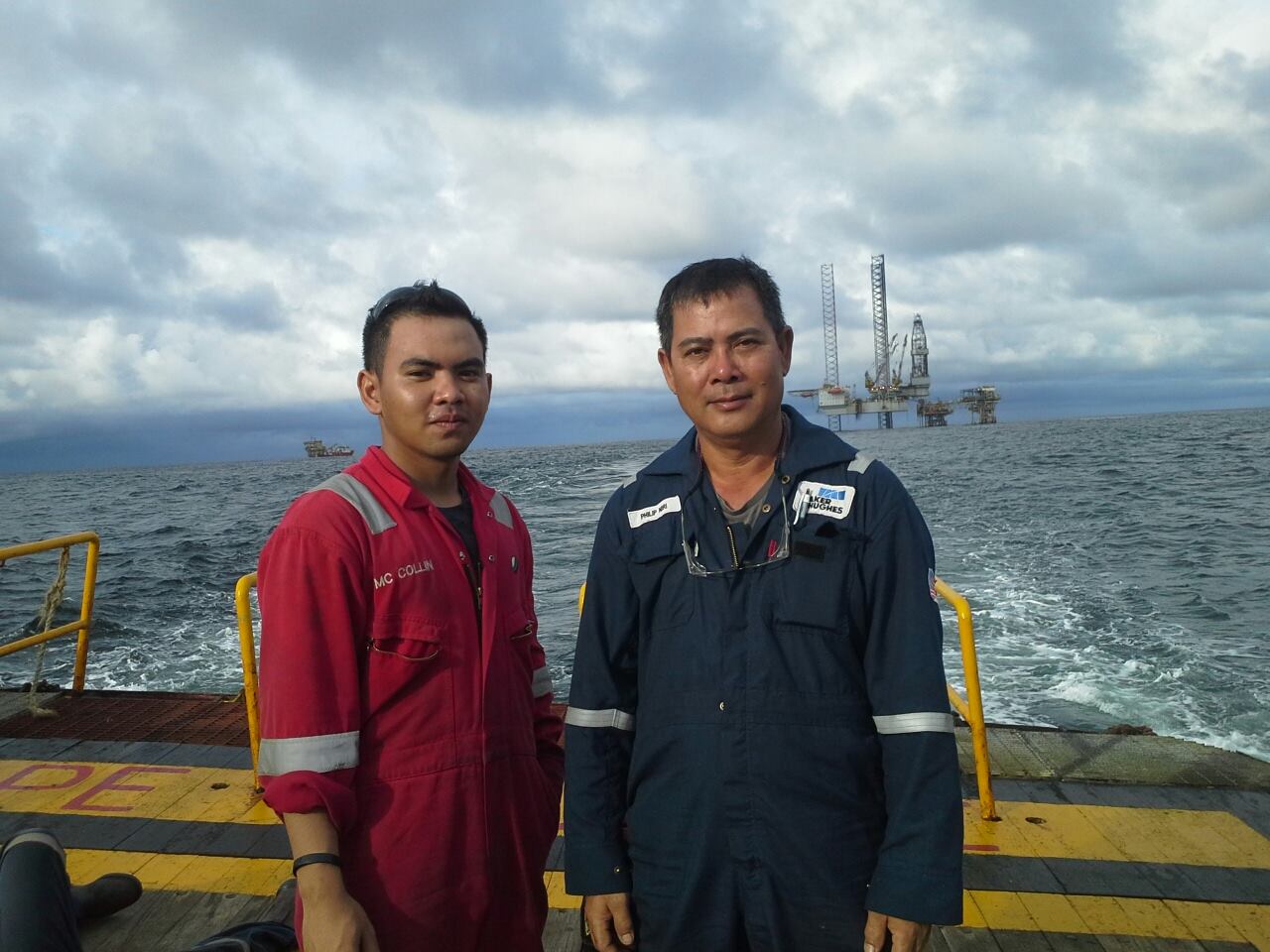
user posted image
McColin and his father, back when they were both in the oil and gas industry. As a young person, McColin was retrenched, but his father was able to keep his job.

For McCollin Ferguson Philip, 22, getting burnt once was enough.

He used to get paid on a project basis, and one day, the projects just dried up. Shortly after that, he lost his job altogether.

“They just stopped calling back,” he said. “One second I had work, the next second I didn’t.”

Unfazed, Philip took the opportunity to explore his interests and started working as a tattoo artist to make ends meet. Tattooing is now his passion, and he has left the oil and gas world behind for good.

“After being treated like that, I couldn’t stay on in that industry. Tattooing is my career now. I have a keen interest in it and I’m confident it can support me.”

Despite not being able to afford a second degree, Ardiles isn’t giving in to his fate either. Although he doesn’t know what his next step will be, he doesn’t see himself waiting tables forever.

“It doesn’t matter if the job is in oil and gas or not, as long as it’s a permanent job with a decent salary. I just want to be able to take care of myself, my family, and my future wife and kids.”
SHARE ON

sukhoi35mk
post Aug 10 2016, 10:55 PM

Casual
***
Junior Member
420 posts

Joined: Feb 2007
Nembiak Negri Minyak

very nice video abt Miri and the oil crisis

https://youtu.be/8BZrgzTzFhU

This post has been edited by sukhoi35mk: Aug 10 2016, 11:00 PM
sukhoi35mk
post Aug 15 2016, 05:33 PM

Casual
***
Junior Member
420 posts

Joined: Feb 2007
can OPEC really stabilize the market with production cut while US shale players continue to increase their drilling activity

QUOTE
Oil prices edge up Monday on potential producer action to prop up market

SINGAPORE: Oil prices edged up early on Monday and have risen more than 10 percent since the start of the month as speculation intensifies about potential producer action to support prices in an oversupplied market.

International Brent crude oil futures were trading at $47.10 per barrel at 0018 GMT (08:18 p.m. EDT), up 13 cents from their last settlement, and over 10 percent above the last close in July.

U.S. West Texas Intermediate crude futures were at $44.65 a barrel, up 16 cents from their last close.

"Oil posted another ... gain as speculation of potential production freezes by OPEC picked up pace. Saudi Arabia signaled that it is prepared to discuss stabilizing the markets at informal OPEC discussions next month," ANZ bank said on Monday.

"This was despite another strong rise in drilling activity in the U.S. ... Baker Hughes data showed the number of rigs operating in the U.S. rose by 15 last week to 396," it added.

After falling sharply from over 1,600 in 2014, before the price rout started, to a low of just 316 in late May, the U.S. oil rig count has steadily risen since then as U.S. producers have adjusted to lower prices.- Reuters


5 Pages < 1 2 3 4 > » Top
Topic ClosedOptions
 

Change to:
| Lo-Fi Version
0.0698sec    0.69    7 queries    GZIP Disabled
Time is now: 21st December 2025 - 02:12 AM