Welcome Guest ( Log In | Register )

Bump Topic Topic Closed RSS Feed
46 Pages < 1 2 3 4 > » Bottom

Outline · [ Standard ] · Linear+

> Military Thread V18

views
     
BorneoAlliance
post Sep 19 2015, 11:53 PM

New Member
*
Newbie
0 posts

Joined: Dec 2014

Air Force fighters will carry laser cannons, cyber weapons by 2020
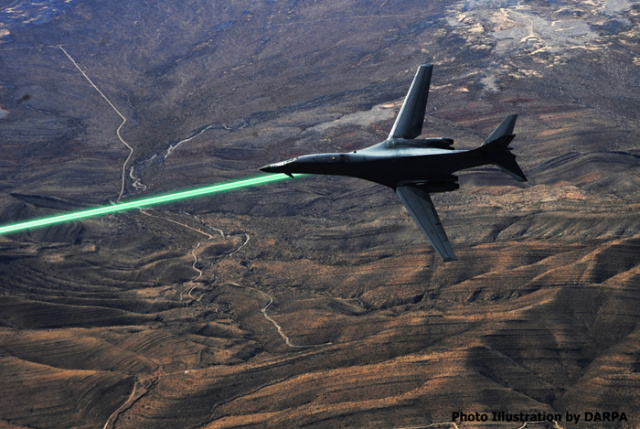
user posted image

QUOTE
Sometime very soon, combat aircraft may be zapping threats out of the sky with laser weapons. “I believe we'll have a directed energy pod we can put on a fighter plane very soon,” Air Force General Hawk Carlisle said at this week’s Air Force Association Air & Space conference in a presentation on what he called Fifth-Generation Warfare. “That day is a lot closer than I think a lot of people think it is.”

Some low-power laser weapons were on display in mock-up on the exposition floor of the conference, including a system from General Atomics that could be mounted on unmanned aircraft such as the Predator and Reaper drones flown by the Air Force. But the Air Force is looking for something akin to a laser cannon for fighter aircraft, more powerful systems that could be mounted on fighters and other manned Air Force planes within the next five years, Air Force leaders said. Directed-energy weapons pods could be affixed to aircraft to destroy or disable incoming missiles, drones, and even enemy aircraft at a much lower “cost per shot” than missiles or even guns, Carlisle suggested.

The Air Force isn’t alone in seeking directed energy weapons. The US Navy has already deployed a laser weapon at sea aboard the USS Ponce, capable of a range of attacks against small boats, drones, and light aircraft posing a threat—either by blinding their sensors or operators or heating elements to make them fail or explode. Other laser weapons are also being tested by the Office of Naval Research for use on helicopters to protect against man-portable antiaircraft missiles. (And there’s a railgun, but that’s not really a directed-energy weapon, and it's too massive to be mounted on an aircraft).

The Air Force has been focused on a 150-plus kilowatt system under development by General Atomics in conjunction with the Defense Advanced Research Projects Agency, called HELLADS. That system is now moving into ground-based testing. But based on the results so far, the Air Force leadership clearly believes that HELLADS has come far enough that it could result in a field-ready weapons system by 2020. Even a stepped-down 100 kilowatt system could be capable of damaging or destroying aircraft and ground targets as well as missiles and drones.


http://arstechnica.com/information-technol...eapons-by-2020/
BorneoAlliance
post Sep 20 2015, 03:32 AM

New Member
*
Newbie
0 posts

Joined: Dec 2014

Flexible electronics one of Air Force’s newest technologies

user posted image

QUOTE
Michael Durstock, an AFRL research team leader for flexible materials and devices, said additive manufacturing, or 3-D printing, of flexible electronics could get parts to troops in the field faster.

“We’re transforming the way the military operates in the sense that we’re responding in real time (to) threats and needs that the military has and rapidly providing the users, the warfighters with … new capabilities and new technologies,” he said.

Researchers envision flexible hybrid electronics in wearable devices that track an airman’s or athlete’s fatigue and hydration, or could replace a maze of wires and medical equipment to monitor patients in hospital rooms.

Pilots could be monitored too, Leever said.

“There are not sensors that monitor the state of the pilot, so we don’t know if that pilot is performing optimally,” he said.

The technology could be used to create flexible batteries or lower the weight of devices airmen and soldiers carry onto the battlefield, researchers said.

“One of the biggest needs is about size, power and weight,” Leever said.

“What that’s really going to mean is an airman, a soldier, a Marine is always going to carry something like 100 pounds because they’re always going to take as many capabilities into the fight as they can. But by lightening their radios, lightening their batteries, we can let them take additional resources into the fight to give them the extra advantage over their adversaries.”

Flexible electronics sensors inside jet engines or embedded in bridges, just two examples, could track when maintenance is needed rather than waiting until it’s normally scheduled, researchers said.

AFRL researchers have tested flexible solar cells on a military drone, doubling its endurance using solar power.

They have also tested an antenna that conforms to the outside of an unmanned aerial vehicle, and flexible-material heaters that de-ice the wings of a drone.

“For these unmanned aerial vehicles, icing can be a big problem and typically can’t be used in conditions where you expect icing might occur,” Leever said.


http://www.mydaytondailynews.com/news/news...est-tech/nnh5H/
BorneoAlliance
post Sep 20 2015, 06:00 PM

New Member
*
Newbie
0 posts

Joined: Dec 2014

Pakistan, China in pact to keep JF-17 tech away from US, India: report

user posted image

China and Pakistan have a pact to keep the technology of their jointly developed JF-17 Thunder multirole combat aircraft away from the United States and India because of its superiority to America's F-16 fighter jet, claims the Beijing-based Sina Military Network.

The Block II variation of the JF-17, known as the FC-1 Xiaolong by China, recently entered into service for the "Minhas" No. 2 squadron of the Pakistan Air Force (PAF). The new and improved configuration of the lightweight fighter jet is said to include improved avionics and better software, as well as a fixed air-to-air refueling probe.

Minhas is the third PAF squadron to be upgraded to the JF-17, which is expected to replace the F-7P, a Chinese-made fighter that can be equipped with C-802A anti-ship missiles.

The JF-17 features an aerodynamic shape similar to the US Navy's F/A-18 and is powered by a high fuel efficiency Russian RD-93 afterburning turbofan. The aircraft's flight performance is said to be far superior to that of second-generation fighters, with its climb rate, maneuvering speed and acceleration making up for a relatively low top speed of Mach 1.6.

While the RD-93 is not regarded as advanced given it was originally developed for the Soviet MiG-29 fighter, the engine is considered stable and reliable, with PAF air commodore Khalid Mahmood, head of the JF-17 sales and marketing team, adding that they have never experienced any problems with it after more than 7,000 hours of use.

Chinese engineers are reportedly continuing to look for ways to lighten the weight and streamline the aircraft. One new advancement is pairing an RD-93 with a so-called divergent supersonic air intake, which is said to be lighter, easier to maintain, and minimizes the JF-17's already low radar signals.

Recent photos of the JF-17 show the jet carrying two CM-400AKG high-speed air-to-surface missiles. Mahmood notes that the aircraft features flexible weapons stations that enables the JF-17 to be equipped with any weapon purchased on the open market.

Though the JF-17 can carry up to four SD-10 radar-guided air-to-air missiles, Mahmood states that the preference of the PAF is to use the space and weight for additional fuel tanks. The standard configuration of the JF-17 is therefore currently two SD-10s and two to three 1,000-liter external fuel tanks in addition to the 800-liter tank in the abdomen of the aircraft, he added.

According to the Sina Military report, expert comparisons between the JF-17 and the US F-16 have the Chinese-Pakistani aircraft dominating, adding that it is akin to a featherweight knocking out a heavyweight. The US has tried to get its hands on the JF-17 to analyze why that is the case but has been turned down by Pakistan because of a deal with China to never share the jet's technology with the US or India, the report added.

http://www.wantchinatimes.com/news-subclas...01&MainCatID=11
BorneoAlliance
post Sep 20 2015, 06:21 PM

New Member
*
Newbie
0 posts

Joined: Dec 2014
user posted image
BorneoAlliance
post Sep 20 2015, 06:28 PM

New Member
*
Newbie
0 posts

Joined: Dec 2014
user posted image
BorneoAlliance
post Sep 20 2015, 06:31 PM

New Member
*
Newbie
0 posts

Joined: Dec 2014
user posted image
BorneoAlliance
post Sep 20 2015, 06:57 PM

New Member
*
Newbie
0 posts

Joined: Dec 2014
user posted image
BorneoAlliance
post Sep 20 2015, 07:00 PM

New Member
*
Newbie
0 posts

Joined: Dec 2014
user posted image
BorneoAlliance
post Sep 20 2015, 07:05 PM

New Member
*
Newbie
0 posts

Joined: Dec 2014
user posted image

user posted image

user posted image

This post has been edited by BorneoAlliance: Sep 20 2015, 07:06 PM
BorneoAlliance
post Sep 21 2015, 02:45 PM

New Member
*
Newbie
0 posts

Joined: Dec 2014

Pentagon intrigued by breakthrough in cloaking technology

user posted image

QUOTE
In 2006 researchers demonstrated it was possible to absorb or direct electromagnetic waves around an object through a coating and make it “invisible”; it only worked on microwaves and in two dimensions. Advances since then helped lead Kante and his team (Li Yi Hsu and Thomas Lepetit) to a new material consisting of a layer of Teflon substrate with tiny ceramic cylinders embedded into it.

Kante cited two main breakthroughs: the ultra-thin material, and the use of the ceramics rather than metallic particles in the Teflon.

Previous cloaking efforts required materials as much as 10 times thicker than the wavelength being dodged. Missile guidance and marine radar wavelengths measure roughly 3 centimeters; that would require about a foot of coating. Kante said his material can work at 1/10 of the wavelength. Hiding from that same 3 cm wavelength would thus only require about a 3 mm coat. Different thicknesses (thinner) could be used for electromagnetic waves as small as those of visible light (which ranges from about 400 to 700 nanometers.)

What are the military benefits?

In case it's not obvious: to hide. There are far-reaching and fairly obvious military implications to getting an object close to an objective. Unmanned Areal Vehicles and other planes, ships and anything else interested in dodging radar could have a use for it. And it could also be used as high-end camouflage for any background colors.

The Homeland Defense & Security Information Analysis Center is a Defense Department contractor tasked essentially to be a matchmaker for the Pentagon and academia/industry. Kayla Matola, research analyst for HDIAC, told Army Times the UCSD design is lighter and cheaper than anything else out there, and “basically what the military’s looking for” regarding cloaking capabilities.

“If anything this could provide the military with air superiority,” Matola said.

Are there limits?

Yes. First, even in theory, true invisibility remains a pipe dream; the objects cloaked still are in front of what's behind them. But there are also limitations to visual camouflage and radar-masking capabilities.

Angle limitations lead the list. The experiment tested the cloak with light hitting at a 45 degree angle, and works effectively only within a 6-degree range of angles. Kante said his team is working on ways to expand that. His study states that the math behind the effectiveness of this experiment indicates a "large range" of angles should be possible.

Also, Kante said the technology does not allow for a cloak that can hide an object from both visual and radar detection; a given cloak will only work for a fairly narrow range of wavelengths.


http://www.armytimes.com/story/military/te...ntion/71960974/
BorneoAlliance
post Sep 21 2015, 06:39 PM

New Member
*
Newbie
0 posts

Joined: Dec 2014

Russia's Unique Fighter Jet Flies in the Face of Physics

user posted image

The multirole Russian fourth-generation supersonic fighter jet Su-30SM, designed for all-weather, air-to-air and air-to-surface deep interdiction missions, is rightly seen by many as one of the best warplanes in the world.
According to experts, the plane's combat and flight characteristics are even superior to those of the US-made F-22 Raptor, touted as a fifth generation fighter.

The Su-30SM is a modernized version of the Su-30 fighter that was created by the Sukhoi Design Bureau in the early 1990s. The aircraft performed its maiden flight in September 2012.

The plane's high degree of maneuverability and unique takeoff and landing characteristics can be explained by its integrated aerodynamic configuration, combined with its thrust vectoring control ability. In terms of the aerodynamic efficiency, the Su-30SM has no rivals.

The Su-30SM is equipped with a digital fly-by-wire system, which enables the aircraft to perform some of the most advanced aerobatic maneuvers attempted by fighter jets, including the Pugachev's Cobra and the tailslide.

During the Pugachev Cobra maneuver, an airplane flying at a moderate speed suddenly raises the nose momentarily to the vertical position and slightly beyond, before dropping it back to normal flight. As for the tailslide, it is an aerobatic maneuver in which an aircraft that has been pulled into a steep climb stalls and then loses altitude by dropping backward.

These manoeuvers quickly decelerate the aircraft, causing a pursuing fighter to overshoot, as well as breaking a Doppler radar-lock, as the relative speed of the aircraft drops below the threshold where the signal registers to the radar.

With a normal fuel reserve of 5,270 kilograms, the Su-30SM is capable of performing a 4.5-hour combat mission with a range of 3,000 kilometers. An aerial refueling system increases the range to 5,200 kilometers or flight duration up to ten hours at cruise altitudes. The plane's maximum speed stands at 2,120 kilometers per hour.

The Su-30SM features friend-or-foe identification equipment, ejection seats as well as global positioning and inertial navigation systems. The aircraft's sophisticated design allows the integration of modern avionics, including a new radar system, radio and recognition system, as well as other support systems.

The plane is capable of carrying an advanced weapons payload weighing up to eight tons. It can be armed with a machine gun, bombs, air-to-air missiles, and Oniks (Yakhont) supersonic anti-ship and land attack missiles.
The Russian Armed Forces received the first eighteen Su-30SMs between 2012 and 2014, amid plans by the country's Defense Ministry to gradually replace the Su-24 fleet with Su-30SM fighters.

The Su-24 is a supersonic, all-weather attack aircraft with variable-sweep wings. The plane was developed in the Soviet Union and is currently in service with the Russian Black Sea Fleet.

http://sputniknews.com/russia/20150921/102...cteristics.html
BorneoAlliance
post Sep 21 2015, 06:51 PM

New Member
*
Newbie
0 posts

Joined: Dec 2014

Ahead of Netanyahu's Trip to Moscow: Russian Fighter Jets Spotted in Syria

user posted image

QUOTE
Some sources have said the planes were the Sukhoi Su-30 model, which are better suited to long-range missions and air-to-ground attacks than the Su-27. Even if that’s the case, they are not the best choice if the goal is to attack mobile targets such as those of the Islamic State organization in Syria.

The Su-27 will presumably not operate against Islamic State, which has no air force of its own, and would instead be used to create a defensive aerial umbrella over western Syria that would prevent, or at least significantly obstruct, the operation of other air forces in the area.

If the United States or another country should in the future want to strike Syrian regime forces from the air, that would lead to a direct conflict with Russia. It would also limit the freedom of action of U.S. and other air forces in attacking ISIS targets in Syria.

According to foreign media reports, Israel has attacked convoys inside Syria carrying weapons from Syria to Hezbollah bases in Lebanon on multiple occasions in the past few years. The presence of Russian interceptors could discourage future operations of this kind.

Prime Minister Benjamin Netanyahu will travel this week to Moscow to discuss with Russian President Vladimir Putin the deployment of Russian forces in Syria.


http://www.haaretz.com/news/middle-east/1.676841
BorneoAlliance
post Sep 21 2015, 06:57 PM

New Member
*
Newbie
0 posts

Joined: Dec 2014

Pakistan eying Sukhoi-35 fighter planes as part of defence deal from Russia, says report

user posted image
An IAF Sukhoi SU-30 takes off at Aero India 2011 in Bangalore on 11 February 2011. Image courtesy PIB

Islamabad: Pakistan is negotiating with Russia on acquiring an unspecified number of Su-35 'Flanker-E' multi-role fighter aircraft in potentially the largest military deal between the two Cold War-era adversaries, according to a leading defence weekly.

Pakistan Air Force has discussed buying Sukhoi-35 'Flanker-E' fighter aircraft from Russia in potentially the largest defence deal between the two countries, but a final decision is yet to be made, IHS Jane's quoted a senior Pakistani government official as saying.

The official was responding to Russian media reports that Russian Deputy Foreign Minister Sergei Ryabkov had said talks were underway for an unspecified number of Su-35s, which follow a recent agreement to provide Mi-35M 'Hind E' attack helicopters to Pakistan.

While the official said "it's too early to say if a deal will conclude and the terms", the fact that discussions have taken place shows Russia's willingness to sell advanced hardware with Pakistan despite Moscow's longstanding ties with India.

The official said Pakistan's interest in the Su-35 was driven by the PAF's need for a twin-engine fighter "that can fly for a longer range than the JF-17 and penetrate more deeply into the enemy's territory".

The PAF currently flies a mixed fleet of Lockheed Martin F-16s, Dassault Mirage-5s, Chinese-manufactured F-7s, and the JF-17 Thunder, which is jointly produced by China and Pakistan.

Islamabad is eager to improve its ties with Moscow to diversify its military options in the event of any stalemate in ties with Washington, Pakistani media reported.

The Mi-35M chopper deal was signed during the visit of army chief General Raheel Sharif to Russia in June when he met top defence officials.

The two countries last year signed a military cooperation agreement to deepen their defence ties and vowed to translate their relationship in "tangible" terms during Russian Defence Minister Sergei Shoigu's visit to Islamabad. Shoigu was the first Russian defence minister to visit Pakistan in 45 years.

http://www.firstpost.com/world/pakistan-ey...rt-2440120.html
BorneoAlliance
post Sep 21 2015, 07:13 PM

New Member
*
Newbie
0 posts

Joined: Dec 2014

Less expensive weapons could serve foreign buyer

user posted image

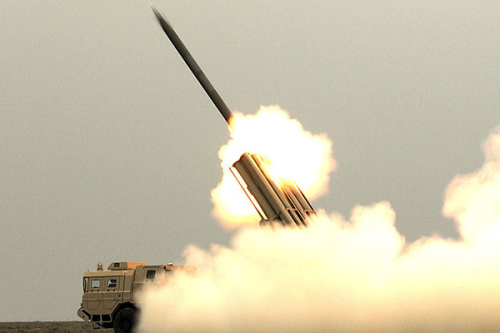
An AR-3 long-range rocket launcher fires during a promotional event at China North Industries Group's test base in northwest China on Aug 8. (Photo provided to China Daily)
Ballistic, cruise missile sales banned; rocket launchers meet market needs

Foreign arms purchasers can forget about getting their hands on Chinese-made ballistic and cruise missiles, such as those displayed in the Sept 3 Victory parade, because although they are extremely powerful and of great military use, a host of statutory obstacles prevent overseas sales, according to a military expert.

Potential buyers need not feel frustrated, though, because business-savvy Chinese arms manufacturers have prepared a number of alternatives-multiple rocket launchers that are equally formidable and more affordable.

"Chinese State-owned businesses in the defense technology sector are offering potential purchasers a wide range of multiple rocket launchers. Their products can provide all the surface-to-surface strike requirements of foreign purchasers," said Gao Zhuo, a defense columnist in Shanghai.

"Multiple rocket launchers are especially suitable for nations that don't have a large defense budget, but aspire to affordable deterrence weapons because they are cheaper than ballistic missiles, yet still have immense destructive capabilities, long ranges and constantly improved levels of accuracy," Gao said.

On Sept 3, China displayed seven types of ballistic and cruise missiles in the parade at Tian'anmen Square in Beijing, including the CJ-10A cruise missile, the DF-15B short-range ballistic missile and DF-31A intercontinental ballistic missile.

However, virtually none of them can be sold to foreign countries because of the restrictions stated in the Regulations on Export Control of Missiles and Missile-related Items and Technologies, which was enacted in 2002.

The regulations specify that the export of "ballistic missiles, space launch vehicles, sounding rockets, cruise missiles and unmanned air vehicles that can be used to deliver at least a 500-kg payload at a range of at least 300 km" must be strictly controlled by the government to prevent proliferation of missile technology.

Like many foreign militaries, the People's Liberation Army has also been seeking low-cost, powerful surface-to-surface strike weapons since the early 2000s, when China began overhauling its arsenal.

'The world's best'

Motivated by the lucrative opportunities on offer, major weapon suppliers such as China North Industries Group and China Aerospace Science and Technology Corp have continued to develop and upgrade multiple rocket launchers and demonstrate them at almost every defense show featuring Chinese defense contractors.

Many observers consider the AR series of long-range rocket launchers, developed by China North Industries Group, to be the most attractive to foreign buyers. A number of African nations have already bought dozens of AR-2 units, according to reports.

Military-today, a weapons database in the United States, said the latest variant, the AR-3, is probably the most powerful artillery rocket system in the world.

The launcher is capable of firing 300-mm-caliber conventional rockets, which have a maximum range of 130 km, and guided rockets, as well as 370-mm-caliber guided rockets, which can hit targets 220 km from the launch site.

By comparison, Russia's BM-30 Smerch has a maximum range of 90 km, while the US M270 Multiple Launch Rocket System has a top range of about 70 km. Conventional artillery cannons have a top range of about 40 km.

Some of the newer rockets developed for the AR-3 can reach 280 km and have an accuracy rate comparable with short-range ballistic missiles, industry observers said.

China Aerospace Science and Technology Corp is currently promoting the WS-64, its newest multiple rocket launcher system, which the company promotes as the world's first precision-guided, anti-ship artillery rocket.

"The WS-64 will be particularly attractive to those who want a powerful and cost-effective anti-ship weapon. Several units of these weapons can form a coastal defense good enough to deter enemy ships from approaching offshore," Gao said.

The manufacturers have deliberately rebuffed inquiries about the weapon's destructive power, but the commander of an artillery rocket battalion from the PLA ground force said each volley fired by his unit's 300-mm multiple rocket launcher can destroy an area the size of more than 80 soccer fields.

"The power of each of my rocket launchers is equal to that of a whole battalion equipped with traditional artillery weapons. To be specific, each rocket can cover and destroy an area equivalent to seven soccer fields, while each volley can fire 12 rockets in just a few minutes," Major Wang Peicheng, political supervisor at one of the long-range rocket artillery battalions under the PLA Jinan Military Command, said during a battalion "open house" event for domestic journalists in August.

"It's fair to say that our artillery rockets are the best in the world in terms of power, range and precision levels," he said.

http://www.ecns.cn/military/2015/09-21/181840_2.shtml
BorneoAlliance
post Sep 21 2015, 07:26 PM

New Member
*
Newbie
0 posts

Joined: Dec 2014

News of hypersonic drone could be Xi's 'gift' to Obama: Duowei

user posted image

China's new hypersonic drone could be similar to the US SR-71 "Blackbird." (Internet photo)

Reports that China could be developing a new hypersonic aircraft could be Xi Jinping's "big present" to Barack Obama during the Chinese president's first full state visit to the United States this week, says Duowei News, a US-based Chinese political news outlet.

On Friday, a report surfaced claiming that the state-owned Aviation Industry Corporation of China (AVIC) had completed a successful test flight of an unspecified new aircraft, adding that it was a breakthrough in hypersonic aircraft technology.

The report was deleted shortly after, fueling speculation that China could be developing its own version of America's SR-71 Blackbird, a long-range, Mach 3+ strategic reconnaissance aircraft

A Chinese military expert who uses the online handle KKTT believes that AVIC is developing a new high-altitude, hypersonic unmanned aerial vehicle requiring a carrier aircraft such as an H-6 twin-engine bomber. The drone will be launched once it is carried to a high enough altitude and will climb by itself to cruising altitude before traveling at hypersonic speed, KKTT said, adding that the drone will be able to return to base itself.

As the SR-71 should have been retired by the US Air Force already, a better point of comparison is the D-21 Mach 3+ reconnaissance drone, KKTT said. Also launched from an a carrier aircraft, the D-21 has a top speed of Mach 3.3-3.5, a service ceiling of 29,000 meters and a range of 5,550 kilometers. The UAV also has a length of 12.8 meters, a wingspan of 5.8m and a launch weight of five tons.

China is currently developing a Turbo Rocket Combined Cycle (TRCC) propulsion system that would enable top speeds between Mach 4.5-5. However, as the TRCC engine is still under development, it is more likely that the new drone is using a less advanced Rocket-Based Combined-Cycle (RBCC) engine, KKTT said.

For the moment, Chinese drones can probably reach cruise altitudes of 30,000m and speeds of Mach 3, which is sufficient for the purposes of regional strategic surveillance, KKTT added.

News of the secret drone comes amid suggestions that the Chengdu Aircraft Design Institute is also developing two high-altitude, high-speed UAVs. Leaked satellite photos revealed that one of them is about 10m long with a winspan of around 6m. Though the size is similar to that of the D-21, the external appearance is said to be closer to the America's retired X-15 hypersonic rocket-powered aircraft.

In addition, China's J-20 fifth-generation stealth fighter aircraft is also said to be close to being ready to enter into service. The highly touted jet is said to be capable of rivaling America's F-22 and F-35 fighters. China's new J-10B multirole fighter has also conducting test flights, while the J-11B jet fighter, whose airframe is based on the Soviet-designed Sukhoi Su-27, has already been performing at air shows and military parades.

Duowei believes that news of the secret UAV may have been intentionally leaked by the Chinese government as Xi's "present" to Obama. Such a move is not unprecedented as the maiden flight of the J-20 stealth jet when then secretary of defense Robert Gates visited Beijing in 2011. Since Xi has already exhibited the PLA's weapons at the Beijing parade earlier this month to celebrate the 70th anniversary of Victory over Japan Day, the news leak could be his way of showing off Chinese arms technology for the future, Duowei said.

http://www.wantchinatimes.com/news-subclas...=20150921000065


BorneoAlliance
post Sep 22 2015, 12:45 AM

New Member
*
Newbie
0 posts

Joined: Dec 2014

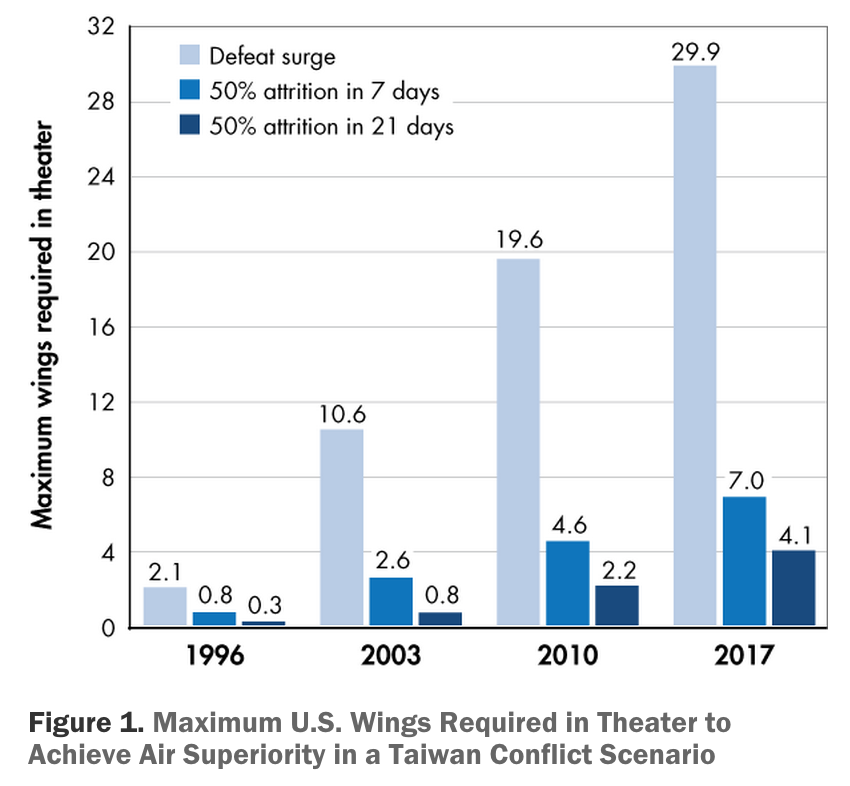
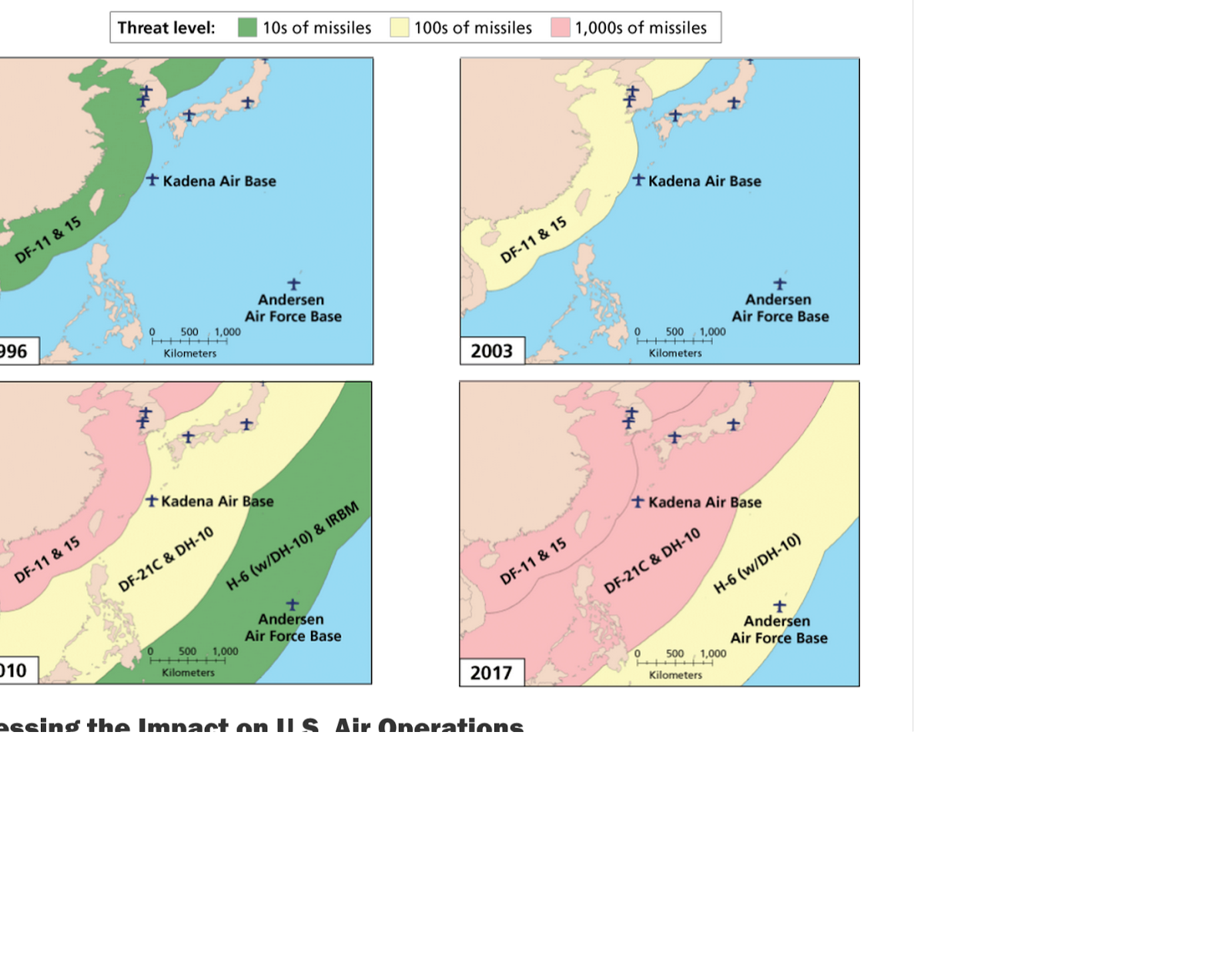
US Military still dominant but China can project to Taiwan and South China Sea

user posted image

user posted image

user posted image

QUOTE
Recommendations

* U.S. military leaders should ensure that U.S. planning for Pacific military operations is as dynamic as possible. The U.S. military should adopt operational concepts and strategies that capitalize on potential advantages and utilize the geographic size and depth of the theater, as well as areas of particular U.S. military strength.

* Specifically, the U.S. military should consider employing an active denial strategy that would improve the resiliency of the force and diminish its vulnerability to preemptive attack. Forces would be more dispersed at the outset of conflict, with many deployed at greater distances from China, but with the ability to move forward as Chinese missile inventories are exhausted or reduced through attrition.

* Military procurement priorities should be adjusted, emphasizing base redundancy and survivability; standoff systems optimized for high-intensity conflict; stealthy, survivable fighters and bombers; submarine and anti-submarine warfare; and robust space and counterspace capabilities. To save money, U.S. decisionmakers should consider more rapid cuts to legacy fighter forces and a decreased emphasis on large aircraft carriers.

* Political and military leaders should intensify diplomatic efforts in the Pacific and Southeast Asia with the goal of expanding potential U.S. access in wartime. This will provide greater strategic depth and more options for U.S. forces.
Western governments and commentators should make it clear to China that aggression would carry immense risks and that China should be cautious not to exaggerate its ability to prevail in armed conflict. They should also engage China on issues of strategic stability and escalation.


http://nextbigfuture.com/2015/09/us-milita...-but-china.html
BorneoAlliance
post Sep 22 2015, 02:36 PM

New Member
*
Newbie
0 posts

Joined: Dec 2014

Venezuela to Buy at Least 12 Russian Fighter Jets - President Maduro

user posted image

MEXICO CITY (Sputnik) — Venezuela will purchase at least 12 fighter jets from Russia, President Nicolas Maduro said Sunday.

"I will talk to [Russian] President Vladimir Putin to deliver at least 12 new [Sukhoi] Su [fighter jets] to Venezuela and replace the one lost [on Friday]," Maduro said as quoted by the Noticias24 news website.

On Friday, a Venezuelan Air Force Sukhoi Su-30 fighter jet crashed on the country's border with Columbia.

The Venezuelan government also plans to sign a contract with China on military equipment delivery, the president added. The equipment will be used to fight drug trafficking, particularly from Colombia, according to him.

The Sukhoi Su-30 is a multi-role fighter aircraft (NATO reporting name Flanker-C) of 4+ generation developed by Russia's Sukhoi Aviation Corporation.

http://sputniknews.com/military/20150921/1027280758.html
BorneoAlliance
post Sep 22 2015, 02:40 PM

New Member
*
Newbie
0 posts

Joined: Dec 2014
user posted image


BorneoAlliance
post Sep 22 2015, 05:11 PM

New Member
*
Newbie
0 posts

Joined: Dec 2014

Russia, Iran Seen Coordinating on Defense of Assad Regime in Syria

user posted image

QUOTE
The U.S. and other Western governments are closely watching for what actions Russia, Iran and the Syrian regime take now.

One possibility, said analysts, is an operation around the ancient city of Palmyra to target Islamic State militants. Mr. Putin has described the Russian presence in Syria as a counterterrorism operation, and he is scheduled to address the U.N. General Assembly in New York on Sept. 28. He could cite Palmyra to back his claims.

Syrian warplanes have intensified airstrikes against Islamic State in Palmyra in recent days, according to opposition activists monitoring the conflict as well as Syrian state media.

Another target could be al Qaeda-linked Nusra Front in Idlib province. The militia and its allies control almost the entire northwestern province with the exception of two Shiite villages, where Hezbollah and other Iranian-trained militias are deployed.

“The first major operation will tell us what their intentions are,” said Elias Farhat, a retired Lebanese army general and military strategist, referring to Iran and Russia.

He said evidence from the ground indicates the Russians, Iranians and Hezbollah are establishing a joint-operational command center in Latakia, near the airport.

The increasing Russian-Iranian defense of Mr. Assad is placing the Obama administration in a diplomatic and strategic bind.


http://www.wsj.com/articles/russia-iran-se...yria-1442856556
BorneoAlliance
post Sep 22 2015, 05:19 PM

New Member
*
Newbie
0 posts

Joined: Dec 2014

Russia begins military operations in Syria as Putin sends 28 jets - Telegraph

user posted image

user posted image

user posted image

QUOTE
It quoted an unnamed senior military source saying Russia is considering a limited operation “that confirms the seriousness of Russia’s intentions.”

The source, who the paper said was involved in high-level military planning, said the idea would be to carry out a small but effective and highly visible operation, possibly involving air or artillery strikes against Isil militants.


http://www.telegraph.co.uk/news/worldnews/...ds-28-jets.html

46 Pages < 1 2 3 4 > » 
Bump Topic Topic ClosedOptions New Topic
 

Change to:
| Lo-Fi Version
0.0589sec    0.36    7 queries    GZIP Disabled
Time is now: 11th December 2025 - 07:31 PM