Welcome Guest ( Log In | Register )

Bump Topic Topic Closed RSS Feed
21 Pages « < 15 16 17 18 19 > » Bottom

Outline · [ Standard ] · Linear+

> Military Thread V16

views
     
BorneoAlliance
post May 8 2015, 07:39 AM

New Member
*
Newbie
0 posts

Joined: Dec 2014

Russia Offers Turkish Navy Hovercrafts, Missile Defense System Technology

user posted image

State-owned Russian arms company Rosoboronexport has offered to collaborate with Turkey to create amphibious hovercraft for the Turkish Navy’s use, a company spokesman said Thursday. A spokesman for the Russian arms exporter said Russia and Turkey also conducted joint tests of a missile defense system and reached several arms deals with Turkish firms.

“We have been cooperating on the creation of smaller amphibious hovercraft, as well as the integration of combat systems of Russian manufacture with Turkish naval platforms," Rosoboronexport spokesman Anatoly Aksyonov said, according to Russian news agency TASS.

Rosoboronexport operates at Russian President Vladimir Putin’s behest and accounts for the vast majority of Russia’s arms sales. Aside from the amphibious hovercrafts, Turkish officials also expressed interest in the acquisition of Russian short-range missile defense systems, Aksyonov said. Turkey would be responsible for the manufacture of the systems.

News of Turkey’s purported collaboration with the Russian arms exporter came weeks after Russian officials disclosed military contracts with China and Thailand. Chinese officials finalized their purchase of Russia’s S-400 air defense systems in September 2014 and became the first country other than Russia to possess the system, Rosoboronexport CEO Antoly Isaykin confirmed to Russian-owned Sputnik News last month.

“I will not disclose the details of the contract, but yes, China has indeed become the first buyer of this sophisticated Russian air defense system,” Isaykin said.

Top Russian officials, including Prime Minister Dmitry Medvedev and Trade Minister Denis Manturov, held high-level meetings with Thai officials last month, during which the two sides discussed the potential sale of Russian military aircraft. The meeting took place at the same time Thai officials met with Chinese representatives for a defense summit, Reuters reported.

Western nations have expressed growing concern in recent months about a marked uptick in Russia’s military activity, both in Eastern Europe and abroad. Russia’s armed forces have conducted extensive military exercises that reached as far as the Arctic.

http://www.ibtimes.com/russia-offers-turki...hnology-1912272
BorneoAlliance
post May 8 2015, 07:49 AM

New Member
*
Newbie
0 posts

Joined: Dec 2014
Beijing to launch giant floating islands in SOUTH CHINA SEA

user posted image

In response to regional concerns over the large scale and pace of its conversion of coral reefs into military outposts in the South China Sea, China is contemplating an even more audacious move - floating islands in the disputed Spratlys.

A recent report in the award-winning US magazine Popular Science says the floating islands have been designed and constructed by two Chinese companies - Jidong Development Group (JDG) and Hainan Industrial Company, as announced by JDG at an April press conference. According to the magazine, the first floating island will be a deep-sea support project in the South China Sea.

Civilian and military use

The floating islands can support both civilian and military missions, will have a full displacement of 400,000 to 1.5 million tonnes, and can move at a speed of 16 kilometres (9 nautical miles) per hour. These floating islands are capable of carrying many marine battalions and a squadron of fighter aircraft. China, no doubt, will have a new tool to pursue its nine-dash line territorial claim over almost the entire South China Sea. Significantly, at the press conference, guests included a PLA officer, suggesting the Chinese military's interest in the dual use in JDG's technology.

The strategic use of floating islands goes back to World War II. In fact, there are many artificial sea constructions currently being used for civilian purposes and specialised scientific research, with Shell Australia's Prelude - the world's first floating liquefied natural gas platform - one notable example. But this is perhaps the first time that the new Chinese-designed mobile floating islands have amphibious functions and can also be used for large-scale defence purposes.

The implications are far-reaching in the context of the South China Sea, which is grappling with competing maritime claims. What is the legal status of such floating islands? Are mobile man-made islands considered artificial islands? If they are artificial structures, under Article 60 of the United Nations Convention on Law of the Sea (UNCLOS), they shall be given a 500-metre-radius safety zone. If they are ships/vessels, they enjoy the right of innocent passage through coastal states' 12-nautical-mile territorial seas.

If those ships belong to the armed forces, they may be entitled to immunity when operating wherever at sea under another international maritime convention for the prevention of pollution, known as MARPOL. Indeed "floating islands" may fall within the definition of "ship" - "a vessel of any type whatsoever operating in the marine environment and includes hydrofoil boats, air-cushion vehicles, submersibles, floating crafts and fixed or floating platforms". International law does not yet have appropriate provisions to deal with such new technologies.

Advantages of floating islands

In its claim for sovereignty over parts of the South China Sea, China has thus far deployed aircraft carriers and mobile oil rigs as well as artificial islands built up from coral reefs. Beijing should perhaps clarify its intentions behind the construction of the mobile islands, which possess at least five advantages:

l First, they have high mobility. With a speed of 9nm/h, these islands could be considered as ships that are slow-moving, but more flexible than drilling platforms. And in theory, unlike aircraft carriers and drilling platforms, they do not require strong escort forces, which are rather costly. They are superior to artificial islands, which are fixed in one place. The floating islands could change their positions and thereby deploy deterrent systems from many different directions, expanding the ability to control the sea and the sky. They are well-suited to support the establishment of an air defence identification zone (ADIZ).

l Second, they are highly accessible. Aircraft carriers and drilling platforms are symbols of threats to security and natural resources, but floating islands enjoying the rights of civilian vessels. These could easily approach the coast of the countries bordering the South China Sea and enter their 12-nautical-mile territorial seas, posing a direct threat to the security of the coastal states that these countries could not easily prohibit or prevent. This would help enforce China's nine-dash-line claim to the sea right up to the coastlines of Vietnam, the Philippines, Malaysia and Brunei.

l Third, they have an excellent safety profile. The design of floating islands is modular, which would also make them difficult to sink - though they cannot easily avoid being destroyed, for instance, by a ship-to-surface missile. Constructing a mobile island costs less than an aircraft carrier or drilling platform.

l Fourth, they are highly adaptable. The floating islands could self-supply. They have the ability to transport and supply fuel, water and necessities. Unlike artificial islands, they need not depend on other sources for supply. This helps increase their operating time and range in the sea.

l Fifth, they are highly versatile. They can meet both civilian and military purposes, and serve as construction equipment or vessels at sea. They will clearly be able to take advantage of whatever loopholes there are in the international law of the sea. Other countries will find it difficult to oppose or apply appropriate measures to prevent the operation of such islands or vessels.

Time for a meeting on maritime law

The international law of the sea is effective only when there is a strong international consensus. Land reclamation and the construction of floating islands in the South China Sea are contrary to Article 5 of the Declaration on the Conduct of Parties (DOC) in the South China Sea signed between Asaen and China in 2002. They cause serious concern for the countries bordering the South China Sea and also threaten the peace, stability, freedom of navigation and overflight as well as the environment in the sea.

It is high time for the leaders of this region's states to hold a joint meeting and a maritime law conference on the South China Sea issue. UNCLOS is an important document for sea management but there are still many points to be elucidated. Scientific and technical developments have rendered the provisions made 33 years ago outdated.

The problem now is no longer one of sovereignty disputes between countries. The international community is facing a common concern: the marine environment and the freedoms of navigation and aviation in the South China Sea are under threat.

NGUYEN HONG THAO is an assistant professor in law at the National University of Hanoi, and also serves at the Diplomatic Academy of Vietnam.

http://www.nationmultimedia.com/opinion/Be...--30259570.html

This post has been edited by BorneoAlliance: May 8 2015, 07:49 AM

BorneoAlliance
post May 8 2015, 04:56 PM

New Member
*
Newbie
0 posts

Joined: Dec 2014

US Approves $130 Million Upgrade to Singapore’s F-16 Fighter Jet Fleet

user posted image

WASHINGTON (Sputnik) — The US State Department approved a $130 million deal for an upgrade of Singapore’s F-16 fighter jet fleet, the US Defense Security Cooperation Agency (DSCA) said in a statement on Thursday.

"The proposed upgrade improves both the capabilities and reliability of the Republic of Singapore Air Force’s (RSAF) aging fleet of F-16s," DSCA said. "The improved capability, survivability and reliability of the newly upgraded F-16s will enhance the RSAF’s ability to defend its borders and contribute to coalition operations."

The upgrade of Singapore’s 60 F-16 jets will be carried out by ten US defense contractors, and will include providing advanced fighter pilot helmets, armaments, transponders and Global Positioning System technology, according to the statement.

http://sputniknews.com/military/20150507/1021846291.html
BorneoAlliance
post May 8 2015, 04:59 PM

New Member
*
Newbie
0 posts

Joined: Dec 2014

China tests its new WS-18 engine for future stealth bomber

user posted image

The PLA Air Force has completed the test of its WS-18 engine, designed for its future stealth bomber, aboard a Russian-built Il-76 cargo plane equipped with an aerial refueling boom, reports the state-run Global Times.

The Il-76 used to test the WS-18 was the first aircraft sent to Israel for the installation of Phalcon early warning and control active electronically scanned array radar system, according to the Canada-based Kanwa Defense Review. Under pressure from the United States, Israel gave up its plan to assist China in building its first-generation early warning aircraft, the A501. The Il-76 was then returned to China without any modification.

China added the aerial refueling boom to the Il-76 aircraft to extend the aircraft's flight range.

The WS-18's first test flight was successful, according to the Kanwa Defense Review. However, more tests will be needed to see if the engine can operate well in different environments and during long-range flights. Several years will be needed before the engine can be fitted with China's Y-20 cargo plane in the future.

If China plans to develop its own next-generation stealth bomber to replace the current H-6 strategic bomber, the WS-18 is likely to be included into the program, according to the report. This new type of bomber, similar in design to the US B-2 bomber, will not begin its service with the PLA Air Force any time soon. At least 10 years are needed for the Chinese military to commission the aircraft.

http://www.wantchinatimes.com/news-subclas...=20150508000024
BorneoAlliance
post May 8 2015, 05:02 PM

New Member
*
Newbie
0 posts

Joined: Dec 2014
user posted image
BorneoAlliance
post May 8 2015, 06:30 PM

New Member
*
Newbie
0 posts

Joined: Dec 2014

Images show how Vietnam is reclaiming land in disputed South China Sea

user posted image

Newly released satellite images show Vietnam has carried out significant land reclamation at two sites in the disputed South China Sea, though the scale and pace of the work is dwarfed by that of China, a US research institute said.

The photographs, shared by Washington’s Centre for Strategic and International Studies (CSIS), show an expansion of the land area of Vietnamese-controlled Sand Cay and West London Reef in the Spratly archipelago and the addition of buildings.

Mira Rapp-Hooper, director of CSIS’s Asia Maritime Transparency Initiative, said the work included military installations and appeared to have started before China began a flurry of reclamation projects last year.

"On one site, it has constructed a significant new area that was formerly underwater and at another it has used land reclamation to add acreage to an existing island," Rapp-Hooper said.

The speed of recent Chinese reclamation work has alarmed its neighbours and the United States, which sees it as a potential threat to the status quo in a region through which US$5 trillion of sea-borne trade passes each year.

China claims 90 per cent of the South China Sea, which is thought to be rich in oil and gas, with overlapping claims from Brunei, Malaysia, the Philippines, Vietnam and Taiwan.

New Vietnamese military facilities at Sand Cay appeared to include defensive positions and gun emplacements, and new buildings visible on West London Reef could also have military applications, Rapp-Hooper said.

Late last month, after weeks of criticism about its reclamation work, China hit back by accusing Vietnam, the Philippines and others of carrying out illegal building work on "Chinese" islands in the South China Sea.

"Strictly speaking, these photos show that China is right," Rapp-Hooper said, "but we can safely say that the scope and scale of what China has undertaken is totally unprecedented and dwarfs Vietnam’s activities many times over."

She said the images showed that Vietnam had reclaimed about 65,000 square metres of land at West London Reef and 21,000 square metres at Sand Cay. This compared to 900,000 square metres reclaimed by China at a single reef, Fiery Cross.

Rapp-Hooper said satellite images showed that since about March 2014, China had conducted reclamation work at seven sites in the Spratlys and was constructing a military-sized air strip on one artificial island and possibly a second on another.

She said Vietnam already had an airstrip on the Spratlys.

The US State Department and Pentagon had no immediate comment on the latest images.

US President Barack Obama last month accused China of "flexing its muscles" to advance its maritime claims and Washington has been helping countries in the region, including Vietnam, strengthen their defense capabilities.

http://www.scmp.com/news/asia/southeast-as...-disputed-south
BorneoAlliance
post May 8 2015, 10:14 PM

New Member
*
Newbie
0 posts

Joined: Dec 2014

Israeli Air Force Team Up With Greeks to Train Against S-300 Missile System

user posted image

The Israeli Air Force practiced maneuvers against the S-300 surface-to-air missile system, soon to be received by Iran, in a bilateral training exercise carried out against the two Greek S-300 batteries stationed on the island of Crete.

The mission took place from April 20-30, when the Israelis joined the Hellenic Air Force's INIOHOS-2015 exercise, one of its largest annual drills, in which at least 150 combat planes from all HAF squadrons took part.
According to reports, Israel deployed a force of ten F-161 jet fighters from four squadrons, and its aircraft were joined by US Air Force in Europe personnel acting as Joint Terminal Attack Controllers.

Israel has acquired technical data about the S-300 system, which is capable of hitting aerial targets at a distance of 150 kilometers, and an altitude of up to 27,000 meters.

The maneuvers were aimed at testing out different tactics against the S-300, in simulated attacks against ground targets protected by S-300 batteries.

This video shows Israeli Air Force F-161 jet aircraft taking part in the exercises.

Greece acquired the S-300 system from Russia in the late 1990s and is the only member of NATO which has the system in service.

Last month Greek Defense Minister Panos Kammenos, on a visit to Moscow for a conference on global security, said that Greece was in negotiations with the Russian government over the purchase of new missiles for its S-300 system, and maintenance for its S-300, Top M-1 and Kornet missiles.

In 2007 Russia and Iran signed a contract to supply five batteries of the S-300 system, but in 2010 the Russian government imposed the ban on its export, in connection with UN sanctions imposed against Iran regarding its nuclear program.

On April 13 the Russian government lifted the ban on the sale of the S-300 system following the successful conclusion of negotiations in Geneva between Iran and the P5-1 group of countries to lift the sanctions against Iran.

http://sputniknews.com/middleeast/20150508/1021873995.html
BorneoAlliance
post May 8 2015, 10:17 PM

New Member
*
Newbie
0 posts

Joined: Dec 2014

Details of China's new AIP submarine technology revealed

user posted image

n recent years several different air-independent propulsion (AIP) submarines have entered service in China and are said to be leading the world in standards, according to Duowei News, a media outlet run by overseas Chinese.

Due to the highly classified nature of submarine technology, however, the parameters of China's AIP systems have not been fully revealed to the public, the website stated. A May 1 report in Communist Party mouthpiece People's Daily, however, mentioned that China's "new Stirling engine" was 117% more efficient than its international rivals. The first hints of the details of the engine technology have gradually emerged recently. The engine will likely be adopted by the PLA Navy's new AIP submarine.

In the April 26 edition of People's Daily, in the run-up to Labor Day, a piece entitled "The 'Prettiest Worker' Reveals Why Workers are Beautiful" included the sentence: "In the field of special propulsion systems, the Stirling engine department of the 711 research institute of the China Ship Scientific Research Center has been around for 10 years and has independently developed a completely new engine, which is 117% more efficient than similar products overseas, which puts it in the lead worldwide. It is set to be installed in China's next generation of warships."

The 711 research institute is the main research unit that develops propulsion systems for conventional submarines. One of the most advanced systems it created was the AIP system for the Type 039B Song-class diesel-electric submarine, powered with Stirling engines based on engines imported into China from Sweden during the 1980s.

According to the People's Daily report, there are several models of the Swedish 4-275 propulsion system that the country is currently exporting to overseas buyers, including a 75 kilowatt and a 110 kW model. Only the 75 kW version is being sold on the international market, however. China imported the 75 kW version from Sweden then replicated the engine and used it to power the Type 039B submarine.

As the Stirling engine is not very efficient, it is normally used for slow cruising underwater. A new electricity generating technology developed in China allows the submarine to cruise underwater and charge its battery at the same time, the website stated. So although the four Stirling engines are identical in efficiency to those used in Japan's Soryu-class diesel-electric attack submarines, the Chinese submarines are afforded more tactical flexibility. Before the liquid oxygen on board the submarine is exhausted, the submarine does not need to navigate with its snorkel extended to the surface, which puts it at the same level of performance as a small nuclear submarine.

This leaves the problem of the low efficiency of the Stirling engine. The engines of the Type 039B submarine charge quite slowly. After travelling at a speed of 20 knots for several hours underwater, it needs to slow to a speed of 2 knots for several days to recharge its battery, which makes increasing the efficiency of the engine key.

This is what the 711 research institute has been working to address. According to a 2004 report by state news agency Xinhua, the engine developed by the 711 research institute has made a breakthrough in the technology. The new engine is said to have a 20 kW and a 100 kW model, said the website. The advantage of the engine is that it can be used together with other propulsion systems such as natural gas, diesel, solar energy or other solid fuels to generate electricity. This also reduces emissions compared to other engines on the market. This meant that back in 2004, China had almost equaled the power of the Swedish 110 kW 4-275 Stirling engine.

The website then speculated that the power of China's new generation of Stirling engine has likely reached the 160 kW or 217 kW mark. If new submarines were to use four Sterling engines, as the Type 039B submarine does, then this would mean power of 640 kW to 868 kW (868-1,180 horsepower). The engine would also drive the submarine at the same time as charging the battery. The Russian Kilo-class submarine has one 150 horsepower cruise generator and two emergency-use 102 horsepower generators.

This means that China's new Stirling engine can charge its main battery at the speed of a conventionally-powered submarine in snorkel mode, while travelling at a low speed of 2-3 knots. This is a unique breakthrough. Even the lithium battery powered submarine, which is under development, is unable to compete with diesel-electric submarines in terms of energy density and it still needs to charge its battery with its snorkel extended.

http://www.wantchinatimes.com/news-subclas...=20150507000080
BorneoAlliance
post May 10 2015, 11:22 AM

New Member
*
Newbie
0 posts

Joined: Dec 2014

Military experts discuss chances of Terminator style AI rebellion

user posted image

China's CH-4 unmanned aerial vehicle shown at the Zhuhai Air Show in November 2014. (Photo/Xinhua)

In the run up to science fiction action film Terminator Genisys being shown in theaters, various Chinese defense experts have been discussing the idea of artificial intelligence (AI) being used in future military operations against the enemies of the People's Liberation Army, reports the China's nationalistic tabloid Global Times.

Dai Hao, an academic from the Chinese Academy of Engineering in Beijing said that AI can be used tactically and strategically in military operations. Tactically, the AI can be deployed as killing machines just like the terminators in the movies. He said that future iterations of weapon systems like unmanned aerial vehicles and precision-guided munition may fit into this category. Strategically, Dai said AI could be developed to improve the command structure and communication between different military units.

Professor Huang Changqiang of the PLA Air Force Engineering University said that in the next five years, he believes that a really intelligent flying killing machine will be deployed to the battlefield, as opposed to just programmed or remote controlled drones. Qin Jirong, the secretary of the Chinese Institute of Command and Control said that it is too early to discuss the question regarding the possibility of a machine rebellion against humanity shown in many science fiction films.

"After all, smart weapon systems are currently under the command and control of human beings," said Qin. "They can not launch any attack unless the human gives the order." Wang Feiyao, the secretary of Chinese Association of Automation said that only man has the capability to destroy man, not machine. Wang said that weapon systems designed with AI may have the ability to wipe out a city or an entire nation, but such an incident would only be the result of an accident, not a robot rebellion.

http://www.wantchinatimes.com/news-subclas...=20150510000012
BorneoAlliance
post May 10 2015, 11:30 AM

New Member
*
Newbie
0 posts

Joined: Dec 2014

Brazil to Send Inquiry About Russian Pantsir-S1 Missile Systems' Purchase

user posted image

MOSCOW (Sputnik) — Brazil will send an official inquiry about the potential purchase of the Russian Pantsir-S1 missile system, Brazilian Minister of Defense Jaques Wagner told Sputnik.
On Saturday, Russian Deputy Prime Minister Dmitry Rogozin said that the waiting list for the purchase of the Pantsir-S1 system is formed until 2019.

"I have talked to the Russian ambassador in Brazil, and soon we will send an official inquiry [about Pantsir-S1 purchase] and start negotiations on the price," the Brazilian minister said on Saturday.

Wagner stressed that the deal could have happened earlier, but it was postponed due to the military spending cuts in Brazil this year.

According to Russian media reports, the potential arms purchase by Brazil, which includes three Pantsir-S1 batteries of up to 18 units, is estimated at $1 billion.

The Pantsir-S1 (SA-22 Greyhound) is a Russian short- to medium-range surface-to-air missile and anti-aircraft artillery weapon system, which first entered service in 2012 and is set to gradually replace the Tunguska self-propelled anti-aircraft weapon.

The Pantsir-S1 system can be mounted on both wheeled and tracked chassis.

http://sputniknews.com/military/20150510/1021947030.html
BorneoAlliance
post May 10 2015, 07:48 PM

New Member
*
Newbie
0 posts

Joined: Dec 2014

Tensions mount after North Korea fires missiles from sub, ship

user posted image

A ballistic missile is launched from a submarine in a photo provided by KCNA, North Korea's official news agency, May 9. (Photo/Xinhua)

Inter-Korean tensions escalated on Saturday as the Democratic People's Republic of Korea test-fired ballistic and cruise missiles to the eastern coast of the Korean Peninsula.

The DPRK test-fired three ship-to-ship missiles for about an hour from 4:25 pm local time (0725 UTC) off its northeast coast, the South Korean military was quoted by local media as saying.

Those were believed to be "KN-01" cruise missiles. The country's supreme leader Kim Jong-un oversaw firing of the missiles on Feb. 6.

The test-firing came after DPRK issued warnings for two consecutive days of "direct aimed strikes without any prior notice" against any South Korean navy patrol ships, which Pyongyang accused of violating the disputed western sea border.

The DPRK's southwestern front command issued the warning Friday, saying 17 South Korean naval boats intruded into its territorial waters in the past seven days.

The warning was sent via the western military communication line to South Korea's presidential office Cheong Wa-dae, and the DPRK command sent another "threatening" notice to Seoul on Saturday.

The DPRK-claimed incursion was a repeat of long-standing inter-Korean dispute over the western maritime boundary. Seoul sees the Northern Limit Line (NLL), which was drawn by US-led forces after the Korean War ended in 1953, as an official demarcation line, while Pyongyang has demanded the border farther south.

As a response, the South Korean military said on Friday that it will "sternly" retaliate against any DPRK provocations.

More alarming was the DPRK's announcement of its success in firing a submarine-launched ballistic missile (SLBM), which could mean more powerful nuclear threats to the US mainland as well as South Korea.

The DPRK's official KCNA news agency reported on Saturday that it has test-fired a ballistic missile from a submarine, which was overseen by top leader Kim.

It was believed to an initial phase of the SLBM, or an underwater launch of a ballistic missile "soaring into the sky," but it would be a real threat of nuclear strike against the United States and South Korea in the future.

The fully-developed SLBM would mean a DPRK submarine secretly sailing underwater to US waters and firing ballistic missiles to strike major military facilities and the mainland.

Pyongyang has test-fired long-range ballistic missiles, including intercontinental ballistic missiles, five times, and the latest was the launch of the "Unha-3" rocket to put a satellite into orbit in December 2012. It resulted in a widespread belief that Pyongyang's long-range missiles are capable of striking the western part of the US mainland.

While the ICBMs can be detected before launches by surveillance satellites and early warning aircraft, the SLBM is very hard to detect and preemptively strike. It could trigger an overhaul in South Korea's missile defense system.

The DPRK's third nuclear test in February 2013 raised concerns for its miniaturizing nuclear devices. If Pyongyang succeeds in producing a nuclear warhead that can be mounted onto the SLBM, its nuclear operational capability would become a real threat.

http://www.wantchinatimes.com/news-subclas...=20150510000135
BorneoAlliance
post May 10 2015, 07:57 PM

New Member
*
Newbie
0 posts

Joined: Dec 2014

The real navy seals: Siberian aquatic army don military gear and perform 'rifle tricks' for 70th anniversary of the Allied win in the Second World War

user posted image

user posted image

QUOTE
'While elsewhere in Russia dolphins and seals have been trained for real-life military activities, this is more of a show, but it is impressive nonetheless,' reported The Siberian Times.

The performance coincided with a vast military display in Red Square to mark the 70th anniversary of the Allied victory in Europe in the Second World War.

The seals have been trained to dive through obstacles with plastic knives in their mouths, and shoot with water guns.


http://www.dailymail.co.uk/news/article-30...-World-War.html
BorneoAlliance
post May 10 2015, 08:07 PM

New Member
*
Newbie
0 posts

Joined: Dec 2014

Affordable $20 million fighter planes

user posted image

The Textron Scorpion costs $20 million, still not exactly a bargain by most people's standards, but a fifth of the cost of the F-35. It suggests that not every advanced defence project has to necessarily come in years late and billions over budget – and points to a new twist in not only the future of fighter-jet design, but also in more humanitarian roles that a budget jet could carry out.

Textron aren’t the only ones creating the tech to address this issue. The single jet fighter JF-17 is a Chinese design, currently being built in collaboration with its sole export customer, Pakistan, and is said to be available for around the same per-plane price of US$20m. Meanwhile, a Russian design, the Yak-130, has also been touted as a low-cost plane to carry out everything from air combat to reconnaissance, as well as train pilots.


The Scorpion took only two years to go from concept to its first flight (Textron)

Textron describes Scorpion as a modern "surveillance and strike" aircraft boasting:

* twin turbofan engines, producing 8,000 lbs. of combined thrust
* a 45,000-foot top altitude
* a top speed of 520 mph
* six hard points for carrying weapons on its wings (6,200 lbs. capacity)
* room for 3,000 lbs. more payload in an internal weapons bay

a flyaway cost of less than $20 million -- and an hourly operations cost of about $3,000

Relative to the A-10 Warthog, Textron's Scorpion has about half as much engine power -- but also half the weight. The aircraft's range is roughly equal to the A-10's, but the Scorpion is a better "sprinter," featuring both a faster maximum speed and a slower "stall speed" -- important for flying low-and-slow on ground support missions.

The Scorpion doesn't carry an integrated 30 mm cannon (like the A-10), its modular design permits it to carry one or even two cannon "pods" on its wings, to provide a strafing ability when there's a need to get up close and personal.

Citing research from DARPA, Anderson notes that, in decades past, it was possible to design and build a new fighter jet in five to 10 years. These days, it takes closer to 20 years to bring a new concept to market. Thus, technology that was cutting-edge when the Lockheed Martin's F-22 Raptor and F-35 Lightning II were first envisioned, for example, is now already becoming obsolete -- just as the planes are starting to fly.

To address this problem, Textron built Scorpion with off-the-shelf parts -- taking fully vetted "mature high technology" that is already available, and assembling it into a jet that's modern today -- and can be upgraded as technology advances tomorrow. This permitted an exceptionally fast turnaround time in developing the plane. As Anderson describes it, "From the time we got the 'go' signal, from a clean slate, it took 23 months for Scorpion to take its first test flight."

There are three main classes of potential customers for planes like the Scorpion, which has a top speed of around 520mph. The first are air forces who want a small jet aircraft capable of carrying out a range of strike and intelligence-gathering missions, and who have either never flown combat jets before or are looking to replace older aircraft. The second are countries who already have, or are developing, high-end fighter forces, but who might buy fewer of the more expensive jets to obtain a larger number of cheaper aircraft. The third are the major military powers who will need the advanced jets for simpler missions in low-risk environments.

http://nextbigfuture.com/2015/05/affordabl...ter-planes.html
BorneoAlliance
post May 10 2015, 08:39 PM

New Member
*
Newbie
0 posts

Joined: Dec 2014

Headsets to aid military commanders

user posted image

They will be able to order the deployment of troops and drones across a virtual representation of the landscape in real situations.

British engineers from BAE Systems are working in collaboration with academics at the University of Birmingham to develop applications for the concept, which 'mixes' together the real and virtual world to allow operators to take control of their environments in a way they have not done before.

This includes a briefcase-sized portable command centre that can be set up anywhere to tackle emergency scenarios by creating a workspace that is rich in 'virtual' information. The concept of 'mixed reality' allows the operator to see themselves and their surroundings along with virtual images, video feeds, objects and avatars, bringing together the critical battlefield elements in a single place.

The technology is brought to life by an Oculus Rift style headset such as is used in video games and which could be deployed in real situations or in training. It is thought that the current demonstrator headsets could be replaced with something as small and light as a pair of spectacles within a decade and a contact lens within 20 years.

The development is also expected to assist emergency response to disaster situations.

Nick Colosimo, futurist at BAE Systems, said: "We're already seeing virtual and augmented reality becoming more commonplace in consumer products, and the possibilities it offers the armed forces are hugely exciting. Our unique approach will identify the optimal balance between the real world and the virtual - enhancing the user's situational awareness to provide battle-winning and life-saving tools and insights wherever they may be.

"Through collaborating with the University of Birmingham, we are able to bring together some of the best minds available in this subject area to develop these concepts and evolve the technology itself."

Professor Bob Stone, simulation and human factors specialist at the University of Birmingham said: "Being able to physically manipulate virtual objects in the real world has been challenging scientists for 40 years. Since my first virtual reality experience at NASA nearly 30 years ago, the technology has evolved from the primitive head-mounted displays and computers to today's world where we can interact with complex virtual objects, integrated in real-time with real-world scenarios.

"Our work with BAE Systems shows just how close we are to delivering the next generation of advanced mixed reality interfaces for future applications not only in defence, but also in such important domains as engineering and healthcare."

http://www.expressandstar.com/news/uk-news...ary-commanders/
BorneoAlliance
post May 10 2015, 08:59 PM

New Member
*
Newbie
0 posts

Joined: Dec 2014

Taipei signs US $2bn helicopter engine deal with US' General Electric

user posted image

• General Electric will supply engines for the Sikorsky-built Black Hawk

• Number of orders for the aircraft by Taiwan not confirmed

• Taiwan is one of the largest foreign operators of the US helicopter model

TAIPEI, Taiwan - General Electric has won a US $2 billion contract to supply helicopter engines to the government of Taiwan over the next five years, the Defense Department has confirmed.

The contract, which runs through December 31, 2020, will see General Electric supplying T700 701D and T700 401C engines to Taiwan to power the popular Black Hawk helicopters built by Sikorsky Aircraft, which is owned by United Technologies Corp.

The Sikorsky UH-60 Black Hawk is a four-bladed, twin-engine, medium-lift utility helicopter which was first developed in 1972 and produced in 1976.

The UH-60A first entered service with the US Army in 1979, to replace the Bell UH-1 Iroquois, used extensively in Vietnam, as the Army's tactical transport helicopter.

Modified versions have also been developed for the US Navy, Air Force, and Coast Guard and the helicopter is a popular export for the US' military industrial complex.

Black Hawks have served in combat during conflicts in Grenada, Panama, Iraq, Somalia, the Balkans, Afghanistan, and Iraq and are currently operated by several dozen nations around the world.

Taiwan has operated S-70C-1/1A variants since the Republic of China Air Force received ten S-70C-1A and four S-70C-1 Bluehawk helicopters in June 1986, for Search And Rescue.

Four further S-70C-6s were received in April 1998 and the ROC Navy received the first of ten S-70C(M)-1s in July 1990.

A further 11 S-70C(M)-2s were received in the beginning of April 2000 and in January 2010, the US announced a Foreign Military Sale of 60 UH-60Ms to Taiwan for the ROC Army.

It is the engines for these helicopters that GE will be supplying, while also providing aftersales support for the existing aircraft operated by Taiwan.

Other major operators of the helicopter include Japan, Colombia, Turkey, China, Mexico, Israel, Brazil and Sweden. The United Arab Emirates has purchased 60 Black Hawks since 2010.

http://www.indiagazette.com/index.php/sid/232716143
BorneoAlliance
post May 11 2015, 07:44 AM

New Member
*
Newbie
0 posts

Joined: Dec 2014

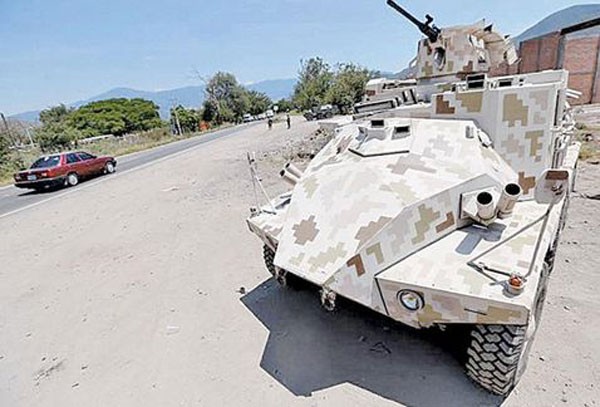
Mexican Army on the move after last week’s attack by drug cartel in Jalisco

user posted image

The troops have been deployed to Jalisco in the strongest show of military might ever seen in Mexico, according to a report today by Milenio.

One week after a criminal gang, believed to be the Jalisco Nueva Generación cartel, shot down a Mexican Air Force Cougar helicopter killing six soldiers, the Armed Forces are on the move.

From San José de Avila to Villa Purificación, the municipality where the attack on the helicopter took place, on the highways and on the approaches to towns in the region, usually under the control of the cartels, is an impressive display of military machinery.

French-made Panhard armoured vehicles carrying 12 soldiers are on patrol. Their 50-caliber guns will fire 1,000 rounds a minute.

But how strong is the vehicle’s armor, a soldier is asked. Strong enough to withstand the shot that took down the helicopter last Friday?

The soldier smiles and says, with typical military frugality, “Yes.”

Residents look at the show of force with astonishment, but they’re not displeased. In fact, they’re glad to see it, although none will appear in front of a camera to say so.

The military is out in full force in Jalisco (Photo: Milenio)

“The truth is, we feel more safe seeing the soldiers everywhere with those huge tanks,” says the woman at an Oxxo store.

“It’s like a movie,” says a woman to her husband while soldiers look over their truck at a checkpoint.

But the scene — armored vehicles, soldiers with bazookas on their shoulders and rocket-powered grenade launches ready to fire — is real enough.

It seems like the winds of war blow in Jalisco.

.Source: http://mexiconewsdaily.com/
BorneoAlliance
post May 11 2015, 07:50 AM

New Member
*
Newbie
0 posts

Joined: Dec 2014

Singapore, Malaysia and Indonesia could extend joint patrols in South China Sea

user posted image

SINGAPORE: To deal with a resurgence of piracy, navies of the littoral states - Singapore, Malaysia and Indonesia - are in discussions to extend joint patrols to the lower reaches of the South China Sea where piracy hotspots are, Chief of Navy Rear-Admiral Lai Chung Han told TODAY.

However, the extension of these patrols - which have been successful in curbing piracy in the Strait of Malacca - is complicated by competing territorial claims in these waters.

“When will (the extension) be realised, we hope (it will be) sooner rather than later,” RADM Lai told the media in an interview last Friday (May 8) at Changi Naval Base, where he also talked about the terrorism threat and congested waterways in the region.

“There is concern with the proximity to the contested claims of South China Sea, and we certainly don’t want those issues to be conflated. We are very focused on dealing with the piracy situation and none of us really benefit from letting this situation fester.”

RADM Lai, 42, was giving his maiden interview as navy chief since his appointment nine months ago.

He also expressed concern about the possibility of terrorists and pirates joining hands, despite their different motives. Terrorist organisation Al Qaeda had recently urged its followers to conduct attacks on Western economic interests at strategic sea lanes, including the Strait of Malacca, he pointed out.

RADM Lai said it would be a challenge to distinguish between a pirate attack and a terror incident in the sea lanes. Nevertheless, the Singapore Maritime Crisis Centre is monitoring the situation, he added.

“Of course when there is any doubt, we never rule out the possibility that the pirates on board, or the ship that has been commandeered could also be used for terrorist purposes, and we have ... means to deal with that,” said RADM Lai.

Terrorists could hijack a fuel tanker, for example, and turn it into a floating bomb. “I think that is something that we watch very carefully, working very closely with police coast guard,” he said, adding that the strategy is to detect the situation early, and deal with it while the threat is still at a distance from the Republic’s shores.

RADM Lai also spoke about the prospect of increased military presence in the region: “In 10 years, there will be more than 100 electric diesel submarines operating in the South China Sea. The South China Sea is a small body of water if you compare it to larger oceans and for the kind of shallow waters that (are) in some parts less than 50m (deep) ... I think it is a matter of time, if it remains unregulated, for there to be an underwater incident.”

Efforts in the past to regulate the underwater space include bilateral agreements signed between Singapore and its neighbours to help submarines in distress.

For example, Singapore and Indonesia signed a submarine rescue support and cooperation agreement in 2012, under which both countries would support each other in the event of a submarine disaster.

RADM Lai said there is a need to extend such existing regulations into a regional framework for submarine safety. This can involve the sharing of best practices for certifying boats, and also sharing information about other underwater craft which are not submarines.

http://www.channelnewsasia.com/news/singap...nd/1838338.html
BorneoAlliance
post May 12 2015, 12:07 AM

New Member
*
Newbie
0 posts

Joined: Dec 2014

China's coast guard has become its second navy: report

user posted image

By introducing larger and more heavily armed vessels into service, China is turning its coast guard into the nation's second navy, according to a US naval intelligence as cited on US military website Strategy Page.

China built, launched or put into commission at least 60 warships in the year 2014. Such a trend is likely to continue between 2015 and 2016, according to the report.

Under China's naval buildup plan, the PLA Navy will have several aircraft carriers, 26 destroyers, 52 frigates, 20 corvettes, 85 missile armed patrol boats, 56 amphibious vessels, 42 mine warfare ships and nearly 500 auxiliary craft, of which 10% are large seagoing ships.

China has successfully combined four of its five maritime police organizations into one unified Coast Guard Bureau, said the report. China once needed more than one coastal patrol organization because of the Communist state tradition to have multiple security organizations keep an eye on each other to ensure loyalty to the party. The old system only brought inefficiency and confusion, spurring the eventual consolidation of most of China's maritime security organizations.

Several months of effort were taken to repaint hundreds of maritime security ships. While ships from the coast guard, which is a paramilitary outfit, are installed with heavier armament, others are sea-going vessels designed for maritime policing. The establishment of China's new Coast Guard Bureau reflects the classic tactic of asserting its claims over the disputed South China Sea by avoiding the use of naval vessels.

Dozens of new seagoing warships are being built for the new Coast Guard, and many of the patrol vessels are carrying weapon systems such as missiles and torpedoes. Moreover, China is creating new bases for its Coast Guard Bureau in the over the disputed South China Sea through its new land reclamation program. From the Chinese perspective, it finally has chance to exercise its "traditional rights" over the seas in its vicinity.

http://www.wantchinatimes.com/news-subclas...=20150511000006
BorneoAlliance
post May 12 2015, 12:14 AM

New Member
*
Newbie
0 posts

Joined: Dec 2014

France Could Sell Mistrals Built for Russia to China

user posted image

In an unlikely coincidence, the task force visiting China consists of two warships, one of which is a Mistral-class protection and command (BPC) ship, the Dixmude. This is the first time a Mistral entered a Chinese port.

Under a $1.3-billion deal Russia and France signed in 2011, Paris was supposed to deliver the Vladivostok in November 2014 and the Sevastopol in early 2015. None of the ships arrived to Russia, since the deliveries were put on hold over Moscow's alleged involvement in the Ukrainian civil war. Kremlin has repeatedly denied these groundless claims and pushed for peace in the war-torn nation.

Meanwhile, the fate of the two Mistrals built and adapted to meet the specifications provided by the Russian Navy remains in limbo. Last month, French President Francois Hollande said Paris would return the payment for the warships if the contract is terminated.

Several other options are reportedly under consideration – to sink the two Mistrals, to hand them over to the French Navy or to sell them to a third party. The Watch China Times named Brazil, Canada, China, Egypt and India as potential buyers.

Price of Stalling: Upkeep of Mistral Warships Costs France €5Mln a Month

China is developing its own as of yet unnamed amphibious assault ship but could buy a Mistral to use as a model, the media outlet noted.

Selling Mistrals commissioned by Russia may prove harder than it seems. Last week, Russian Deputy Prime Minister Dmitry Rogozin warned that France could not sell the helicopter carriers without Russia's permission. He added that Paris was fully aware of that.

The other French ship, accompanying the Dixmude on the visit to China, is the Aconit, a La Fayette-class frigate. The French task force arrived at the Wusong naval port on May 9 and will leave on May 15.

http://sputniknews.com/military/20150511/1021981207.html
BorneoAlliance
post May 12 2015, 12:20 AM

New Member
*
Newbie
0 posts

Joined: Dec 2014
China’s Concept of Military Strategy

user posted image

QUOTE
In conclusion, the most relevant recommendation for US analysts is the imperative to study Chinese military strategy for two reasons: first, through an appreciation of the PLA’s strategic template, to be able to predict and counter their strategies; and second, to learn new ways to understand and apply strategy themselves. Strategy is an ever -evolving concept and should be studied closely for new approaches. Analysts should become familiar with the objective-subjective, stratagem, strate-gic advantage, and shi criteria that can be applied to political, economic, geopolitical, and military fields of study. For example, China’s view of cyber’s objective reality could be understood as knowing there are no rules and regulations to impede intrusive behavior, surrogates hide sources of reconnaissance, and weak systems worldwide encourage pen-etrations. There is no reason to stop reconnaissance activities due to such a lucrative objective reality. Subjectively, packets of electrons can be used as stratagems. Open source Chinese links, for example, note that stratagems such as “looting a burning house” (and stealing property while the house is on fire [that is, weak security]) refers to the illegal use of system files.[xlvi] Many other stratagems work in the same way.

Further, there may well be Chinese institutes in existence now which are studying campaign stratagems to manipulate US financial flows, or to create other disruptive situations, so as to influence the US military’s “intelligence-judgment-decision” paradigm. The United States and its allies must think in terms of the Chinese approach, looking at the stra-tegic environment from the vantage point of disruptive stratagems. It is by understanding differences such as these that analysts will make more reasoned assumptions about Chinese and PLA behavior—and avoid mirror imaging.

There are several additional conclusions US analysts and strategic thinkers can draw from this study of Chinese strategy. First, how to study other nations’ approach’s to and views of strategy remains undervalued. Such analysis allows for an expansion of our comprehension of strategic thought beyond the concepts of prudent ideas or ends, ways, and means. Expanding our limits of strategic thought enables the absorption of a broader method of analysis. Second, clearly China’s ancient strategic thought has applicability even in the digital age. PLA strategy is not outdated and only limited to the thoughts of Sun Tzu and Mao. The use of packets of electrons as stratagems, for example, is a method of thought very seldom considered by US analysts. It combines the old with the new in ways we do not. Active and retired PLA officers continue to adapt and refine their strategic thinking. Third, the close scrutiny of other nations’ strategic theories is vital to unraveling and identifying their long and short term goals. As in cards, chess, Go, or other games, one must know what and how one’s rival thinks to develop effective counters. Finally, Chinese strategy is more analytical and holistic, by definition, than its US counterpart. The analysis includes politics, eco - nomics, military affairs, science and technology, geography, and other issues, resulting in a prism of thought known as comprehensive national power. The US definition of strategy in Joint Publication 1-02, Department of Defense Dictionary of Military and Associated Terms is limited to just the four instruments of national power, diplomacy, information, military, and economics. The implication is China does grand strategy, while the US does something far less. Further, the People’s Republic of China has excelled at “how” to do strategy.

Thus, in summary, there are many sound reasons to study the stra-tegic thought of China and other nations. US strategy has worked well through the ages, but as other nations adjust their strategic thought to conform to new input and a different geopolitical context, our strate-gists need to be aware of these developments and consider adjusting our thinking accordingly.


http://www.isn.ethz.ch/Digital-Library/Art...ng=en&id=190449

This post has been edited by BorneoAlliance: May 12 2015, 12:24 AM

21 Pages « < 15 16 17 18 19 > » 
Bump Topic Topic ClosedOptions New Topic
 

Change to:
| Lo-Fi Version
0.0608sec    0.58    7 queries    GZIP Disabled
Time is now: 13th December 2025 - 04:35 PM