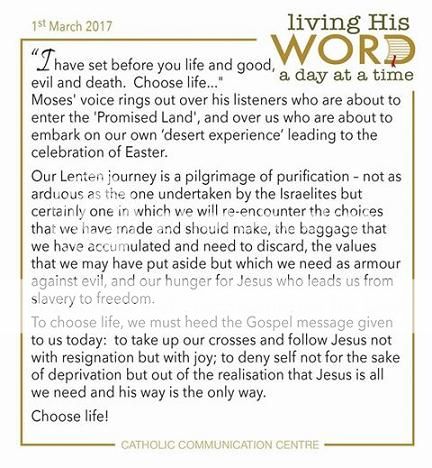
Moses said to the people: "Today I have set before you life and prosperity, death and doom. If you obey the commandments of the LORD, your God, which I enjoin on you today, loving him, and walking in his ways, and keeping his commandments, statutes and decrees, you will live and grow numerous, and the LORD, your God, will bless you in the land you are entering to occupy. If, however, you turn away your hearts and will not listen, but are led astray and adore and serve other gods, I tell you now that you will certainly perish; you will not have a long life on the land that you are crossing the Jordan to enter and occupy. I call heaven and earth today to witness against you: I have set before you life and death, the blessing and the curse. Choose life, then, that you and your descendants may live, by loving the LORD, your God, heeding his voice, and holding fast to him. For that will mean life for you, a long life for you to live on the land that the LORD swore he would give to your fathers Abraham, Isaac and Jacob."
Responsorial Psalm (Ps 1:1-2, 3, 4 and 6)
R. Blessed are they who hope in the Lord.
Blessed the man who follows not the counsel of the wicked Nor walks in the way of sinners, nor sits in the company of the insolent, But delights in the law of the LORD and meditates on his law day and night. R. Blessed are they who hope in the Lord.
He is like a tree planted near running water, That yields its fruit in due season, and whose leaves never fade. Whatever he does, prospers. R. Blessed are they who hope in the Lord.
Not so the wicked, not so; they are like chaff which the wind drives away. For the LORD watches over the way of the just, but the way of the wicked vanishes. R. Blessed are they who hope in the Lord.
Verse Before the Gospel (Mt 4:17)
Repent, says the Lord; the Kingdom of heaven is at hand.
Gospel (Lk 9:22-25)
Jesus said to his disciples: "The Son of Man must suffer greatly and be rejected by the elders, the chief priests, and the scribes, and be killed and on the third day be raised."
Then he said to all, "If anyone wishes to come after me, he must deny himself and take up his cross daily and follow me. For whoever wishes to save his life will lose it, but whoever loses his life for my sake will save it. What profit is there for one to gain the whole world yet lose or forfeit himself?"
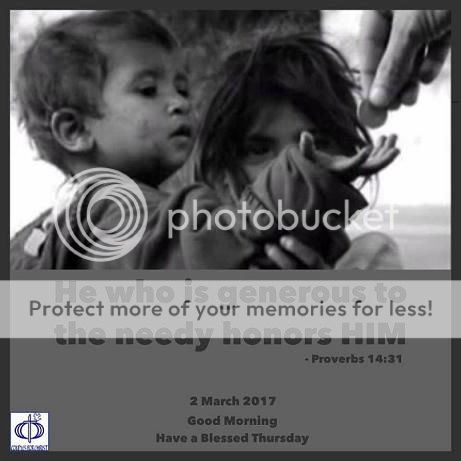
*Errata: Date should be 2nd. March 2017
REFLECTION
The son of man must suffer greatly. “Son of Man” is the title often used in the gospels of Mark, Matthew, and Luke to refer to Jesus. (It is used once in Jn 1:51.) The title encompasses Jesus’ divinity (cf Dn 7:13ff) and humanity (e.g., the prophet in the book of Ezekiel is addressed as son of man).
The humanity of Jesus is described in the first part of v 22: He “must suffer greatly and be rejected by the elders, the chief priests, and the scribes, and be killed,” while the second part of the same verse describes His divinity: He will “on the third day be raised.”
Jesus must undergo great suffering and death, but on the third day, He will be gloriously raised from the dead. “Must” underlines the necessity of suffering to attain his salvific mission.
Jesus’ disciples must follow the same path of suffering, which starts with self-denial. Taking up our cross daily means living responsibly as Christians, reaching out to those in need. We can be of service to others only if we divest ourselves of selfish motives and interests.
“A clean heart create for me, God; renew within me a steadfast spirit” (Ps 51:12)
SOURCE: “365 Days with the Lord 2016,” ST. PAULS Philippines, 7708 St. Paul Rd., SAV, Makati City (Phils.) http://www.ssp.ph/
Thus says the LORD: If you remove from your midst oppression, false accusation and malicious speech; If you bestow your bread on the hungry and satisfy the afflicted; Then light shall rise for you in the darkness, and the gloom shall become for you like midday; Then the LORD will guide you always and give you plenty even on the parched land. He will renew your strength, and you shall be like a watered garden, like a spring whose water never fails. The ancient ruins shall be rebuilt for your sake, and the foundations from ages past you shall raise up; "Repairer of the breach," they shall call you, "Restorer of ruined homesteads."
If you hold back your foot on the sabbath from following your own pursuits on my holy day; If you call the sabbath a delight, and the LORD's holy day honorable; If you honor it by not following your ways, seeking your own interests, or speaking with malice— Then you shall delight in the LORD, and I will make you ride on the heights of the earth; I will nourish you with the heritage of Jacob, your father, for the mouth of the LORD has spoken.
Responsorial Psalm (Ps 86:1-2, 3-4, 5-6)
R. Teach me your way, O Lord, that I may walk in your truth.
Incline your ear, O LORD; answer me, for I am afflicted and poor. Keep my life, for I am devoted to you; save your servant who trusts in you. You are my God. R. Teach me your way, O Lord, that I may walk in your truth.
Have mercy on me, O Lord, for to you I call all the day. Gladden the soul of your servant, for to you, O Lord, I lift up my soul. R. Teach me your way, O Lord, that I may walk in your truth.
For you, O Lord, are good and forgiving, abounding in kindness to all who call upon you. Hearken, O LORD, to my prayer and attend to the sound of my pleading. R. Teach me your way, O Lord, that I may walk in your truth.
Verse Before the Gospel (Ez 33:11)
I take no pleasure in the death of the wicked man, says the Lord, but rather in his conversion, that he may live.
Gospel (Lk 5:27-32)
Jesus saw a tax collector named Levi sitting at the customs post. He said to him, "Follow me." And leaving everything behind, he got up and followed him. Then Levi gave a great banquet for him in his house, and a large crowd of tax collectors and others were at table with them. The Pharisees and their scribes complained to his disciples, saying, "Why do you eat and drink with tax collectors and sinners?" Jesus said to them in reply, "Those who are healthy do not need a physician, but the sick do. I have not come to call the righteous to repentance but sinners."
REFLECTION
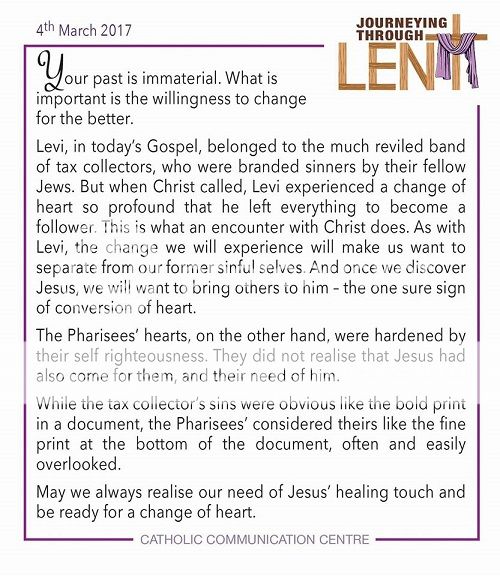
Why do you eat and drink with tax collectors? During the Roman occupation of Palestine, tax collectors are hated by their fellow Jews because they collect taxes for the foreign conquerors and enrich themselves in the process. They belong to the category of “sinners,” who are marginalized in Jewish society.
Jesus compares sinners to sick people who need a physician. And he has come to bring not only physical healing but also, above all, spiritual well-being.
The first stage of spiritual healing is repentance, a word translated from the Greek word metanoia. Paul explains metanoia as a “renewal of… mind” (Rom 12:2). The Hebrew word for metanoia is shub, which means to make a 180-degree turn. Repentance then means to turn away from sin and go to God.
Levi exemplifies true repentance: he leaves everything behind (his means of livelihood), gets up, and follows Jesus. Getting up signifies a new way of life. Levi is transformed from a tax collector to a disciple of Jesus.
The Lenten season invites us to get rid of our prejudice and self-righteous attitude and imbibe Jesus’ spirit of openness to the marginalized in society.
SOURCE: “365 Days with the Lord 2016,” ST. PAULS Philippines, 7708 St. Paul Rd., SAV, Makati City (Phils.) http://www.ssp.ph/
This post has been edited by khool: Mar 4 2017, 11:13 AM
The LORD God formed man out of the clay of the ground and blew into his nostrils the breath of life, and so man became a living being.
Then the LORD God planted a garden in Eden, in the east, and placed there the man whom he had formed. Out of the ground the LORD God made various trees grow that were delightful to look at and good for food, with the tree of life in the middle of the garden and the tree of the knowledge of good and evil.
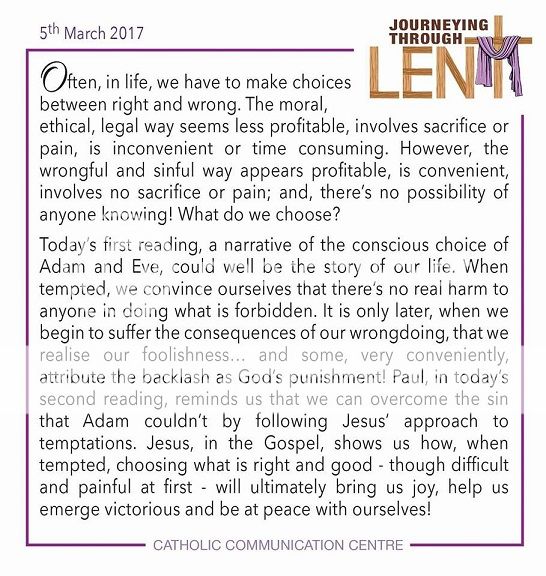
Now the serpent was the most cunning of all the animals that the LORD God had made. The serpent asked the woman, "Did God really tell you not to eat from any of the trees in the garden?" The woman answered the serpent: "We may eat of the fruit of the trees in the garden; it is only about the fruit of the tree in the middle of the garden that God said, 'You shall not eat it or even touch it, lest you die.'" But the serpent said to the woman: "You certainly will not die! No, God knows well that the moment you eat of it your eyes will be opened and you will be like gods who know what is good and what is evil." The woman saw that the tree was good for food, pleasing to the eyes, and desirable for gaining wisdom. So she took some of its fruit and ate it; and she also gave some to her husband, who was with her, and he ate it. Then the eyes of both of them were opened, and they realized that they were naked; so they sewed fig leaves together and made loincloths for themselves.
Responsorial Psalm (Ps 51:3-4, 5-6, 12-13, 17)
R. Be merciful, O Lord, for we have sinned.
Have mercy on me, O God, in your goodness; in the greatness of your compassion wipe out my offense. Thoroughly wash me from my guilt and of my sin cleanse me. R. Be merciful, O Lord, for we have sinned.
For I acknowledge my offense, and my sin is before me always: "Against you only have I sinned, and done what is evil in your sight." R. Be merciful, O Lord, for we have sinned.
A clean heart create for me, O God, and a steadfast spirit renew within me. Cast me not out from your presence, and your Holy Spirit take not from me. R. Be merciful, O Lord, for we have sinned.
Give me back the joy of your salvation, and a willing spirit sustain in me. O Lord, open my lips, and my mouth shall proclaim your praise. R. Be merciful, O Lord, for we have sinned.
Reading 2 (Rom 5:12-19)
Brothers and sisters: Through one man sin entered the world, and through sin, death, and thus death came to all men, inasmuch as all sinned— for up to the time of the law, sin was in the world, though sin is not accounted when there is no law. But death reigned from Adam to Moses, even over those who did not sin after the pattern of the trespass of Adam, who is the type of the one who was to come. But the gift is not like the transgression. For if by the transgression of the one, the many died, how much more did the grace of God and the gracious gift of the one man Jesus Christ overflow for the many. And the gift is not like the result of the one who sinned. For after one sin there was the judgment that brought condemnation; but the gift, after many transgressions, brought acquittal. For if, by the transgression of the one, death came to reign through that one, how much more will those who receive the abundance of grace and of the gift of justification come to reign in life through the one Jesus Christ. In conclusion, just as through one transgression condemnation came upon all, so, through one righteous act, acquittal and life came to all. For just as through the disobedience of the one man the many were made sinners, so, through the obedience of the one, the many will be made righteous.
Verse Before the Gospel (Mt 4:4b)
One does not live on bread alone, but on every word that comes forth from the mouth of God.
Gospel (Mt 4:1-11)
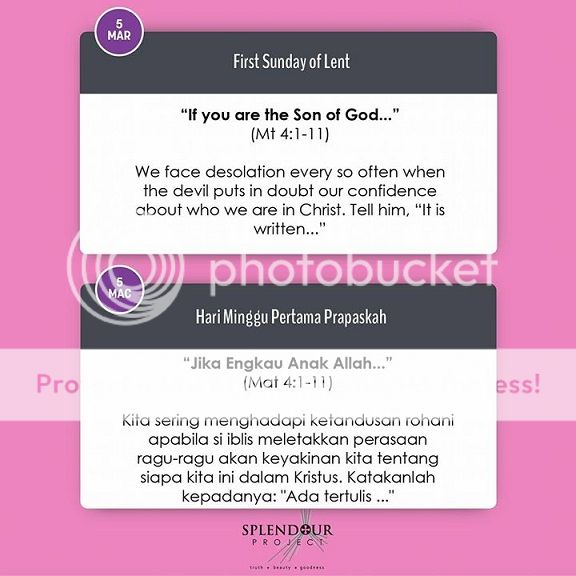
At that time Jesus was led by the Spirit into the desert to be tempted by the devil. He fasted for forty days and forty nights, and afterwards he was hungry. The tempter approached and said to him, "If you are the Son of God, command that these stones become loaves of bread." He said in reply, "It is written: One does not live on bread alone, but on every word that comes forth from the mouth of God."
Then the devil took him to the holy city, and made him stand on the parapet of the temple, and said to him, "If you are the Son of God, throw yourself down. For it is written: He will command his angels concerning you and with their hands they will support you, lest you dash your foot against a stone." Jesus answered him, "Again it is written, You shall not put the Lord, your God, to the test." Then the devil took him up to a very high mountain, and showed him all the kingdoms of the world in their magnificence, and he said to him, "All these I shall give to you, if you will prostrate yourself and worship me." At this, Jesus said to him, "Get away, Satan! It is written: The Lord, your God, shall you worship and him alone shall you serve."
Then the devil left him and, behold, angels came and ministered to him.
REFLECTION
Life is like a cup of coffee. We are often more concerned with what makes us live than with what makes our life worth living. We are so taken up by work that we no longer know what is happening to our spouse and children. We do not have time to enjoy our family. We hold a cup of coffee but focus on the cup rather than savor the drink.
In the Gospel, Jesus shows us that life is not about satisfying our lust for power and material wealth or replacing God with “loaves of bread” or “the kingdoms of the world.” What matters is not what we acquire but whom we worship. Life is always about God.
In Lent, let us spend time with the Lord, speak with him, reflect on our priorities, and confront our craving for the passing pleasures of the world. Let us allow God’s mercy to wash away our sins.
Let us enjoy the coffee, not complain about the cup. The happiest people may not have the best, but they make the best of everything. Let us live simply, love generously, forgive until it hurts, care deeply, speak kindly, and live uprightly.
SOURCE: “365 Days with the Lord 2016,” ST. PAULS Philippines, 7708 St. Paul Rd., SAV, Makati City (Phils.) http://www.ssp.ph/
Meditation:
Are you ready to follow the Lord Jesus wherever he wishes to lead you? After Jesus' was baptized by John the Baptist at the River Jordan, he withdrew into the wilderness of Judea - a vast and mostly uninhabitable wilderness full of danger. Danger from scorching heat by day and extreme cold at night, danger from wild animals and scorpions, plus the deprivation of food and the scarcity of water.
Why did Jesus choose such a barren, lonely place for an intense and long period of sustained prayer and fasting? Matthew, Mark, and Luke tell us in their Gospel accounts that Jesus was led by the Holy Spirit into the wilderness. Mark states it most emphatically: "The Spirit immediately drove him out into the wilderness" (Mark 1:12). What compelled Jesus to seek solitude, away from his family and friends, for such a lengthy period? Was it simply a test to prepare him for his mission? Or did Satan want to lure him into a trap? The word tempt in English usually means to entice someone to do what is wrong or forbidden. The scriptural word used here also means test in the sense of proving and purifying someone to see if there are ready for the task at hand. We test flight pilots to see if they are fit to fly under all conditions, including times of adverse turbulence, storms, and poor visibility. In like manner God tests his people to see if they are ready to follow and serve him without reservation or compromise.
Encountering God face to face
On many occasions God tested Abraham to prove his faith and to strengthen his hope in the promises that God made to him. Abraham obeyed willingly even when God asked him to sacrifice his only son Isaac, the son of promise. When the Israelites were sorely tested in Egypt for more than 400 years, they did not forget God. They kept God's word and remembered his promise to save them. When God called Moses to free the Israelites from captivity in Egypt, God led them into the wilderness to his holy mountain at Sinai. There Moses ascended the mountain and met with God face to face for 40 days in prayer and fasting (Exodus 24:18). The prophet Elijah was also led on a 40 day journey to the holy mountain at Sinai to seek the face of God. God sustained Elijah with bread from heaven (1 Kings 19:8).
Jesus was no exception to this pattern of testing and preparation with prayer and fasting. He was led into the wilderness for 40 days without food or shelter to seek the face of his heavenly Father. When God put Adam and Eve in the Garden of Paradise, he supplied them with everything they needed for abundant life and happiness with him. But when they listened to the voice of evil and followed the counsel of the serpent, who is the devil, they doubted God's word and disobeyed his command They fell because they trusted in themselves rather than in God (Genesis 2:16-17; 3:1-6). They were cast out of Paradise and driven into the wilderness. Jesus now freely enters the wilderness in order to regain Paradise for the lost children of God. Jesus refuses food to show his dependence on the bread of heaven, the word of God, that would sustain him not only in his physical hunger, but in his hour of temptation as well. When Satan tempts Jesus to turn stones into bread, Jesus replies with the words of Scripture, "Man shall not live by bread alone, but by every word that proceeds from the mouth of God" (quote from Deuteronomy 8:3; Matthew 4:4).
Where did Jesus find the strength to survive the desert's harsh conditions and the tempter's seduction? He fed on God's word and found strength in doing his Father's will. Satan will surely tempt us and he will try his best to get us to choose our will over God's will. If he can't make us renounce our faith or sin mortally, he will then try to get us to make choices that will lead us, little by little, away from what God wants for us.
Strength from God in resisting temptation
Jesus was tempted like us and he overcame sin not by his own human effort but by the grace and strength which his Father gave to him. He had to renounce his will for the will of his Father. He succeeded because he wanted to please his Father and he trusted that his Father would give him the strength to overcome the obstacles that stood in the way. Luke says that Jesus was "full of the Holy Spirit" (Luke 4:1). When tempted by the devil Jesus did not try to fight his adversary on his own human strength. He relied on the power which the Spirit gave him. Jesus came to overthrow the evil one who held us captive to sin and fear of death (Hebrews 2:14). His obedience to his Father's will and his willingness to embrace the cross reversed the curse of Adam's disobedience. His victory over sin and death won for us not only pardon for our sins but adoption as sons and daughters of God.
How can we overcome sin and gain freedom over our unruly desires and the lies of Satan and the world? The Lord Jesus gives us his Holy Spirit to help us in our weakness (Romans 8:26) and to be our guide and consoler in temptation and testing (1 Corinthians 10:13). The Lord gives grace to the humble who acknowledge their dependence on him (James 4:6) and he helps us to stand against the lies and attacks of our enemy, Satan, who seeks to destroy us (1 Peter 5:8-10; Ephesians 6:10-18). The Lord Jesus is ever ready to pour out his Spirit upon us that we may have the strength and courage we need to resist sin and to reject the lies and deceits of Satan. God wants us to "fight the good fight of the faith" (1 Timothy 6:12) with the power and strength which comes from the Holy Spirit. Do you rely on the Lord for your strength and help?
"Lord Jesus, your word is life and joy for me. Fill me with your Holy Spirit that I may have the strength and courage to embrace your will in all things and to renounce whatever is contrary to it."
A Daily Quote for Lent: On the Snare of the Devil, by Ambrose, 339-397 A.D.
"The devil said to Jesus: 'If you are the son of God, command that these stones become bread' (Luke 4:3). Here we learn that there are three principal weapons that the devil likes to carry in order to wound our souls. They are gluttony, arrogance and ambition. Here begins the weapon with which he has already been victorious. We likewise should begin to be victorious in Christ in the very same area in which we have been defeated in Adam - we should be wary of gluttony. The devious trap is set for us when the table is laid for a royal banquet - it is bound to weaken our defences.
"See what weapons Christ uses to defeat the power of the devil. He does not use the almighty power he has as God - what help would that be to us? In his humanity he summons the help common to all - overlooking bodily hunger and seeking the word of God for nourishment.
"Whoever follows the Word is no longer attached to earthly bread, because he receives the bread of heaven and knows the divine is better than the human, the spiritual is better than the physical. Therefore, because such a person desires the true life, he looks for that which fortifies the heart by means of its invisible substance." (excerpt from On the Gospel of St. Luke, 4, 17)
I groaned. The message could not have come at a worse time. An urgent anointing. I had a thousand reasons to ignore it, a thousand justifications to refuse. I am in the middle of practice with the altar servers, et al. Tomorrow the Paschal Triduum starts. I want everything to go smoothly, the Liturgical movements, the Washing of the Feet, etc had to be precise, poetry in motion. The patient was out of Petaling District. She was in Kuala lumpur. No need to go. No one would blame you if you didn't. Yet she needed anointing. She was fading fast. "Let another priest do it. Its not my problem." "But what if she dies without being anointed?". "What if another priest cannot be contacted?"
I excused myself from practice. Informed them it was an urgent anointing. Left early. Sped off to Ampang. Reached there to find the whole family had gathered. She had just stopped breathing. Her vital signs dropped. Her head & neck felt warm. The rest of her body had gone cold. I made it in the nick of time. I proceeded to anoint her, telling her that her loved ones are gathered round her. I tell them to whisper in her ear the brightest, most beautiful memory they have of her. I commend her to Christ, who alone is master of life and death. I stepped back, allowing her loved ones to hold her & speak the three most important words to her.
I realise that as priest, our work is often interrupted, disrupted & unfinished. While I have the power to say, "No", I still have to consider the implications of saying, "Yes" or "No" accordingly. Had I not gone, no one would have anointed this lady. But my presence, was important for the family, to soothe them, to calm them down. to help them grieve. There is therefore a tension between working uninterrupted and working with interruptions.I pray I may always be allowed to walk this tight rope, between busyness & compassion, between detailed perfection & derailed imperfection.
Musings of a priest, who is a near and dear friend of mine. His duty and devotion to his calling is a great testament to our faith. A fine example of a combination of love, sacrifice and dedication to our Lord. Despite commitments and obstacles thrown in his way, he still manages to attend to the needs of those placed under his care, those of His flock, even under extraordinary circumstances. May we as lay people show the same when it comes to serving Christ!
This post has been edited by khool: Apr 13 2017, 07:42 PM
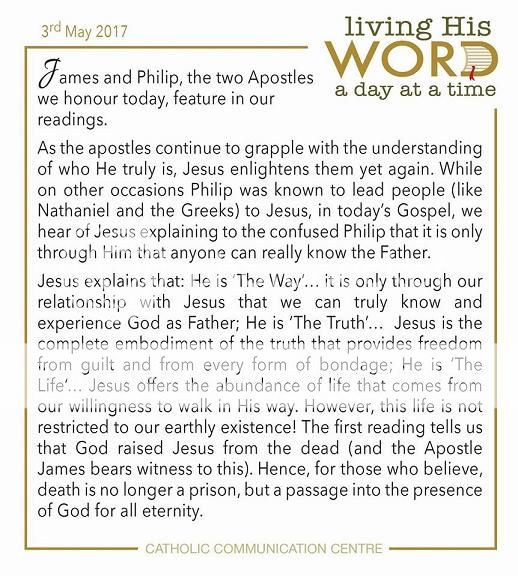
Feast of Saints Philip and James, Apostles Lectionary: 561
Reading 1 (1 Cor 15:1-8)
I am reminding you, brothers and sisters, of the Gospel I preached to you, which you indeed received and in which you also stand. Through it you are also being saved, if you hold fast to the word I preached to you, unless you believed in vain. For I handed on to you as of first importance what I also received: that Christ died for our sins in accordance with the Scriptures; that he was buried; that he was raised on the third day in accordance with the Scriptures; that he appeared to Cephas, then to the Twelve. After that, he appeared to more than five hundred brothers and sisters at once, most of whom are still living, though some have fallen asleep. After that he appeared to James, then to all the Apostles. Last of all, as to one born abnormally, he appeared to me.
Responsorial Psalm (Ps 19:2-3, 4-5)
R. Their message goes out through all the earth. or: R. Alleluia.
The heavens declare the glory of God; and the firmament proclaims his handiwork. Day pours out the word to day; and night to night imparts knowledge. R. Their message goes out through all the earth. or: R. Alleluia.
Not a word nor a discourse whose voice is not heard; Through all the earth their voice resounds, and to the ends of the world, their message. R. Their message goes out through all the earth. or: R. Alleluia.
Alleluia (Jn 14:6b, 9c)
R. Alleluia, alleluia. I am the way, the truth, and the life, says the Lord; Philip, whoever has seen me has seen the Father. R. Alleluia, alleluia.
Gospel (Jn 14:6-14)
Jesus said to Thomas, "I am the way and the truth and the life. No one comes to the Father except through me. If you know me, then you will also know my Father. From now on you do know him and have seen him." Philip said to him, "Master, show us the Father, and that will be enough for us." Jesus said to him, "Have I been with you for so long a time and you still do not know me, Philip? Whoever has seen me has seen the Father. How can you say, 'Show us the Father'? Do you not believe that I am in the Father and the Father is in me? The words that I speak to you I do not speak on my own. The Father who dwells in me is doing his works. Believe me that I am in the Father and the Father is in me, or else, believe because of the works themselves. Amen, amen, I say to you, whoever believes in me will do the works that I do, and will do greater ones than these, because I am going to the Father. And whatever you ask in my name, I will do, so that the Father may be glorified in the Son. If you ask anything of me in my name, I will do it."
REFLECTION
Whoever has seen me has seen the father. God is a mystery tremendum et fascinosum, one we dare not approach because the divine presence sears and elicits fear, and yet it is a presence that attracts and fascinates. One wants to go away but feels drawn. That is why people in the Bible thought that to see God is to die. Still, there is so much joy just to be in the divine presence. The psalmist sings, “One thing I ask of the Lord; this I seek: to dwell in the Lord’s house all the days of my life, to gaze on the Lord’s beauty, to visit his temple” (Ps 27:4).
Philip asks Jesus, “Master, show us the Father, and that will be enough for us.” Here he echoes the ardent wish of Moses who asked the Lord, “Please let me see your glory!” (Ex 33:18). Moses was granted to see only the Lord’s “back” because, as the Lord said, “You cannot see my face, for no one can see me and live” (Ex 33:20).
Jesus tells Philip, “Whoever has seen me has seen the Father.” The one who stands before Philip is a man. But he is the Logos-Incarnate. Believers penetrate the mystery of the Incarnation and declare, “We saw his glory, the glory as of the Father’s only Son” (Jn 1:14).
Do you encounter the divine presence in your day-to-day life, as while beholding nature’s beauty and force and while relating with people you meet?
SOURCE: “365 Days with the Lord 2017,” ST. PAULS Philippines, 7708 St. Paul Rd., SAV, Makati City (Phils.) http://www.ssp.ph/
Friday of the Third Week of Easter Lectionary: 277
Reading 1 (Acts 9:1-20)
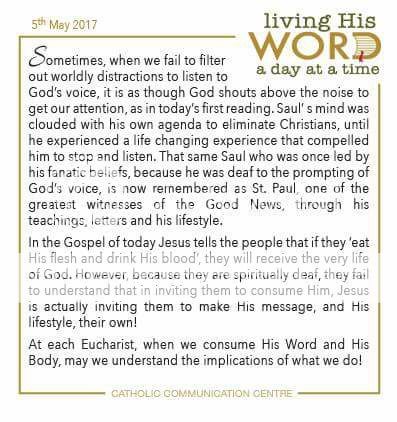
Saul, still breathing murderous threats against the disciples of the Lord, went to the high priest and asked him for letters to the synagogues in Damascus, that, if he should find any men or women who belonged to the Way, he might bring them back to Jerusalem in chains. On his journey, as he was nearing Damascus, a light from the sky suddenly flashed around him. He fell to the ground and heard a voice saying to him, "Saul, Saul, why are you persecuting me?" He said, "Who are you, sir?" The reply came, "I am Jesus, whom you are persecuting. Now get up and go into the city and you will be told what you must do." The men who were traveling with him stood speechless, for they heard the voice but could see no one. Saul got up from the ground, but when he opened his eyes he could see nothing; so they led him by the hand and brought him to Damascus. For three days he was unable to see, and he neither ate nor drank.
There was a disciple in Damascus named Ananias, and the Lord said to him in a vision, "Ananias." He answered, "Here I am, Lord." The Lord said to him, "Get up and go to the street called Straight and ask at the house of Judas for a man from Tarsus named Saul. He is there praying, and in a vision he has seen a man named Ananias come in and lay his hands on him, that he may regain his sight." But Ananias replied, "Lord, I have heard from many sources about this man, what evil things he has done to your holy ones in Jerusalem. And here he has authority from the chief priests to imprison all who call upon your name." But the Lord said to him, "Go, for this man is a chosen instrument of mine to carry my name before Gentiles, kings, and children of Israel, and I will show him what he will have to suffer for my name." So Ananias went and entered the house; laying his hands on him, he said, "Saul, my brother, the Lord has sent me, Jesus who appeared to you on the way by which you came, that you may regain your sight and be filled with the Holy Spirit." Immediately things like scales fell from his eyes and he regained his sight. He got up and was baptized, and when he had eaten, he recovered his strength.
He stayed some days with the disciples in Damascus, and he began at once to proclaim Jesus in the synagogues, that he is the Son of God.
Responsorial Psalm (Ps 117:1bc, 2)
R. Go out to all the world and tell the Good News. or: R. Alleluia.
Praise the LORD, all you nations; glorify him, all you peoples! R. Go out to all the world and tell the Good News. or: R. Alleluia.
For steadfast is his kindness toward us, and the fidelity of the LORD endures forever. R. Go out to all the world and tell the Good News. or: R. Alleluia.
Alleluia (Jn 6:56)
R. Alleluia, alleluia. Whoever eats my Flesh and drinks my Blood, remains in me and I in him, says the Lord. R. Alleluia, alleluia.
Gospel (Jn 6:52-59)
The Jews quarreled among themselves, saying, "How can this man give us his Flesh to eat?" Jesus said to them,
QUOTE
"Amen, amen, I say to you, unless you eat the Flesh of the Son of Man and drink his Blood, you do not have life within you. Whoever eats my Flesh and drinks my Blood has eternal life, and I will raise him on the last day. For my Flesh is true food, and my Blood is true drink. Whoever eats my Flesh and drinks my Blood remains in me and I in him.
Just as the living Father sent me and I have life because of the Father, so also the one who feeds on me will have life because of me. This is the bread that came down from heaven. Unlike your ancestors who ate and still died, whoever eats this bread will live forever." These things he said while teaching in the synagogue in Capernaum.
REFLECTION
Whoever eats my flesh and drinks my blood has eternal life. The second part of the discourse on the Bread of Life (Jn 6:51-59) carries a Eucharistic theme: Jesus speaks of his Body (Flesh) and Blood which he invites the people to eat and drink that they may have life. This is the “living” bread, that is, the bread that gives life, in contrast with the manna that supported the wandering Israelites for 40 years in the desert but did not prevent them from dying. The living bread, too, is the bread that comes down from heaven, that is, Jesus, the Word of God become flesh. The manna, again in contrast, was “earthly”: material food that becomes rotten.
From “believing,” Jesus now requires human beings to “eat” and “drink.” The Bread come down from heaven at the Incarnation now gives his human life in death in order to give life to the world (cf Jn 3:16). Jesus’ gift of life will come at the expense of his own life. As eating human flesh and drinking human blood is abhorrent and strictly forbidden by the Law, Jesus meets it in the sacramental participation in the Eucharist where he gives himself as food and drink.
“Eucharistic communion was given so that we might be ‘sated’ with God here on earth, in expectation of our complete fulfillment in heaven” (St. John Paul II).
SOURCE: “365 Days with the Lord 2017,” ST. PAULS Philippines, 7708 St. Paul Rd., SAV, Makati City (Phils.) http://www.ssp.ph/
This post has been edited by khool: May 5 2017, 10:00 AM
" ... Amen, amen, I say to you, whoever believes has eternal life. I am the bread of life. Your ancestors ate the manna in the desert, but they died; this is the bread that comes down from heaven so that one may eat it and not die. I am the living bread that came down from heaven; whoever eats this bread will live forever; and the bread that I will give is my Flesh for the life of the world ..."
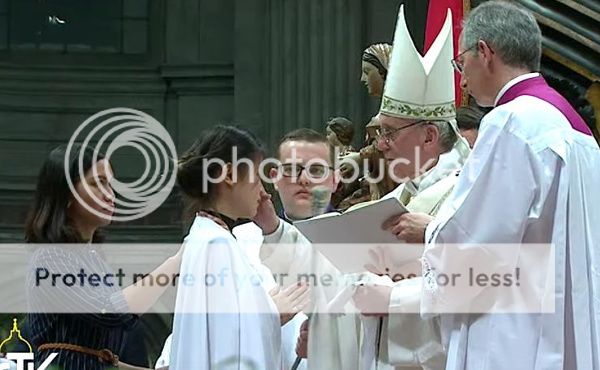
Vivian Wong was baptised by Pope Francis during the Easter Vigil, 2017. “I am so grateful to become a child of God and finally be able to receive our Lord in Holy Communion; I have waited so long for this moment!”
At 8:30 pm on Holy Saturday evening, during the Solemn Easter Vigil presided by Pope Francis in St. Peter's Basilica, he administered the sacraments of Christian initiation to eleven neophytes from Spain, the Czech Republic, Italy, the United States, Albania, Malta, Malaysia and China.
Vivian Wong from Kota Kinabalu, Malaysia, was one of the eleven baptised by the Pope. “I am so grateful to become a child of God and finally be able to receive our Lord in Holy Communion; I have waited so long for this moment! I feel so loved by Him and I always pray that He will give me the heart to love Him as much as I can. I am not so good in expressing my feelings, so every time I receive our Lord, all I can tell Him repeatedly is just ‘Thank you!’ and ‘I love you’. I really hope to be able to bring more people closer to Him through my testimony.”
Growing up in Kota Kinabalu, Sabah, and schooled in the Chinese stream, Vivian never thought she would one day be a Catholic. Her father being Christian and her mother, Buddhist, her contact and exposure to the Catholic faith was nearly non-existent. For a while she followed her father to his church, and later went with her mother to the Buddhist temple, but religion never really played a role in her life.
At eighteen, in January 2015, she signed up for a residential on-the-job training program in hospitality skills at a retreat house in Ulu Tiram, Johor. Part of the program included optional courses for personal development, and one of those was a course about the Catholic Faith. Vivian started attending the classes on the Creed, the Sacraments and the Commandments with some interest but bit by bit, the subject began to really hold her attention, much to her surprise. She was moved when she learnt that the Eucharist comes all the way from Christ through the Apostles and has remained the same for over 2000 years.She reasoned that if it were a human invention, it would have died a natural death shortly after the last Apostle died.
Being a thorough person by nature, she enjoys dwelling into the details of everything she does. Just as she is meticulous and has high standards in setting a dining table or making a tray of pastries, she started reading and studying the Faith to clarify whatever uncertainties she had and to reach a deeper understanding.
Her friendship with the other trainees eased many things for her. Nearly all the Catholic trainees went for Mass daily, prayed the Rosary and participated in outreach projects like visits to the homes for the aged and disabled, helping out in a club for young girls of the neighbourhood or were catechists in the nearby parish. Vivian joined in as well, at the beginning as a passive spectator, then gradually as someone who was discovering God and the beauty of a personal relationship with Him.
In Easter 2016, some trainees wanted to participate in Incontro Romano, a yearly meeting for young people who wish to spend Easter close to the Pope in Rome.Vivian decided to join them, aware that it would be a ‘total immersion’ experience in the Catholic Faith.She had many questions about the Pope: who he was, why he was so important, what he did in the Vatican… During Holy Week in Rome, the group saw the Pope three times: once at the Wednesday general audience in St. Peter’s square; another during the Easter Vigil, where the Pope baptized, among others, a Chinese girl; and finally in the Easter Sunday Urbi et Orbi blessing in St Peter’s Square. At this last event, the group was joyfully waving the Malaysian flag in a corner by the railings when Pope Francis passed very close by. There was a frenzy of enthusiasm, cheering and photos, and Vivian recalled, “All of a sudden I understood who the Pope is: Christ’s representative on earth. And I felt a strong desire to have him as my guide, to be part of the Catholic family and, if possible, be baptized by him.”
Back in Ulu Tiram, Vivian enrolled in the parish program for the Rite of Christian Initiation of Adults. The coordinator for the English group, Therese, even volunteered one-to-one classes for Vivian whenever she could not make it to the group classes. The target was to be ready for the following Easter, regardless of whether the Baptism would be in Rome or in Ulu Tiram. Vivian surmised, “I will be as much a child of God either way!”
In the application to the Vatican for Baptism by the Pope, Vivian approached the parish priest, Fr. Michael, and Bishop Bernard Paul, whom she has met in the weekday Masses in Majodi Centre occasionally.Both were most supportive and they assisted in all the necessary documents that needed to be sent to Rome. She had also decided on the Baptismal name of “Francesca” if the Pope was the one to baptise her.
For quite a while, there was no reply from the Vatican and Fr. Michael suggested contacting someone in Rome who could make inquiries. The Malaysian Embassy to the Holy See had recently started in 2016, and Vivian wrote to the Ambassador, Tan Sri Bernard Giluk Dompok. Through the good office of his Embassy, the Baptism by the Pope was granted.
A frenzy of preparations then started: air tickets for everyone including her god-mother-to-be, Sylvia, a fellow trainee, from Sarawak; winter clothes; informing Vivian’s mother, who could barely comprehend why Vivian wanted to put all her little savings to go to Rome again just to be baptized there...Finally everything was in place for the big day.
The Easter Vigil in Rome was wonderful beyond dreams. Vivian had decided to wear a baju kabaya (traditional blouse and skirt of South East Asia) for the event. The accompanying trainees were given seats of honour the main altar in the grand basilica and they had a clear view of the entire ceremony. Then it started: the lights went off as required by the Easter liturgy on the sacred night and candles lit from the Easter candle spread like a wave through the Basilica as the Pope processed with it up to the main altar, the eleven candidates for Baptism as part of the procession. After the Liturgy of the Word, the Liturgy of Baptism started... Baptism, Confirmation and Holy Communion followed one another. Francesca was finally welcomed into the Catholic Church as a child of God on 16th April.
Sylvia, her god-mother, was feeling nervous just before the Vigil Mass started. “During the long waiting time inside St. Peter’s before the ceremony, many people were busy taking photos or enjoying the moment.But I felt the need to prepare myself to meet the Pope which would take place after the Baptism and I tried to live the Mass well and pray a lot. It was going to be the most special moment ever in my life. I had already seen the Pope at a distance several times amidst the crowd, but this one was going to be different: we will be few, and be very close to him and will be receiving his direct attention... Everything happened in a solemn way, like the rehearsal, yet the moment in front of the Pope was for me truly like a daughter being with her father. I could see that the Holy Father was a bit tired, yet praying for the new children of God and all of us around. I did not get a direct blessing from the Pope, but I consider it given through Msgr. Marini at the final rehearsal, who knew little English thus communication was minimal; he blessed each of the catechumens and god-parent making the sign of the cross on our foreheads. The family spirit of the Catholic Church was clearly palpable.”
After the ceremony, the excited Malaysians went on and on with embraces, kisses and photos in front of Bernini’s bronze baldacchino... till the Vatican’s usher came to announce that St. Peter’s had to be closed for the night! Looking around, Vivian and her group of friends realized that they were the last ones to leave, with the Italian usher encouraging them, “andiamo, signorinas, andiamo” (come along now, ladies, come along).
Francesca now feels the joyful responsibility of sharing the Faith with all who come her way.She asks the Holy Spirit to be able to convey to others the happiness she feels being close to God and living her life according to Our Lord’s inspirations.
“I am so grateful to become a child of God and finally be able to receive our Lord in Holy Communion; I have waited so long for this moment! I feel so loved by Him and I always pray that He will give me the heart to love Him as much as I can. I am not so good in expressing my feelings, so every time I receive our Lord, all I can tell Him repeatedly is just ‘Thank you!’ and ‘I love you’. I really hope to be able to bring more people closer to Him through my testimony.”
Nelly, 20 years old, a fellow trainee in Bukit Tiram House since February 2016 was moved when she witnessed Vivian’s Baptism. “I prayed for her to become a Catholic without much intensity at the beginning. Then, as the day drew nearer, I really prayed for her, and I see the fruit of the prayers in her joy now. I sensed it very specially the second time she received Holy Communion at the Mass on Easter Monday at the Basilica of St. John Lateran. The joy on her face and the awareness that now she is truly one of us was so clear!” It was clearly an unforgettable experience for them all.
Tuesday of the Fourth Week of Easter Lectionary: 280
Reading 1 (Acts 11:19-26)
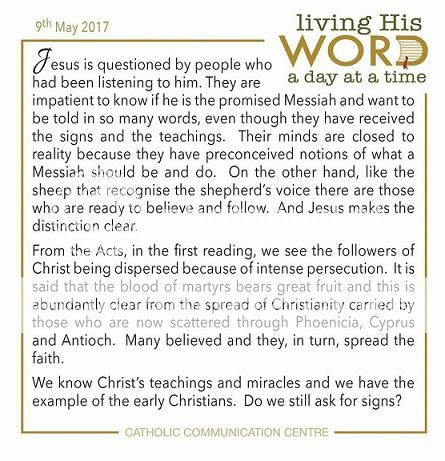
Those who had been scattered by the persecution that arose because of Stephen went as far as Phoenicia, Cyprus, and Antioch, preaching the word to no one but Jews. There were some Cypriots and Cyrenians among them, however, who came to Antioch and began to speak to the Greeks as well, proclaiming the Lord Jesus. The hand of the Lord was with them and a great number who believed turned to the Lord. The news about them reached the ears of the Church in Jerusalem, and they sent Barnabas to go to Antioch. When he arrived and saw the grace of God, he rejoiced and encouraged them all to remain faithful to the Lord in firmness of heart, for he was a good man, filled with the Holy Spirit and faith. And a large number of people was added to the Lord. Then he went to Tarsus to look for Saul, and when he had found him he brought him to Antioch. For a whole year they met with the Church and taught a large number of people, and it was in Antioch that the disciples were first called Christians.
Responsorial Psalm (Ps 87:1b-3, 4-5, 6-7)
R. All you nations, praise the Lord. or: R. Alleluia.
His foundation upon the holy mountains the LORD loves: The gates of Zion, more than any dwelling of Jacob. Glorious things are said of you, O city of God! R. All you nations, praise the Lord. or: R. Alleluia.
I tell of Egypt and Babylon among those who know the LORD; Of Philistia, Tyre, Ethiopia: "This man was born there." And of Zion they shall say: "One and all were born in her; And he who has established her is the Most High LORD." R. All you nations, praise the Lord. or: R. Alleluia.
They shall note, when the peoples are enrolled: "This man was born there." And all shall sing, in their festive dance: "My home is within you." R. All you nations, praise the Lord. or: R. Alleluia.
Alleluia (Jn 10:27)
R. Alleluia, alleluia. My sheep hear my voice, says the Lord; I know them, and they follow me. R. Alleluia, alleluia.
Gospel (Jn 10:22-30)
The feast of the Dedication was taking place in Jerusalem. It was winter. And Jesus walked about in the temple area on the Portico of Solomon. So the Jews gathered around him and said to him, "How long are you going to keep us in suspense? If you are the Christ, tell us plainly." Jesus answered them, "I told you and you do not believe. The works I do in my Father's name testify to me. But you do not believe, because you are not among my sheep. My sheep hear my voice; I know them, and they follow me. I give them eternal life, and they shall never perish. No one can take them out of my hand. My Father, who has given them to me, is greater than all, and no one can take them out of the Father's hand. The Father and I are one."
REFLECTION
My sheep hear my voice; I know them. Because sheep continually live with their shepherd, they are able to distinguish his voice. They do not recognize or heed a stranger.
Speaking of his sheep, Jesus refers to his disciples and the reciprocal relationship between them. The disciples hear Jesus’ voice and follow him as their shepherd. On the other hand, Jesus knows them. The biblical word “to know” (Hebrew yadah) means more than intellectual knowledge. It refers to an intimate relationship, so that it is used to describe the bond between husband and wife, their being “one flesh.” Jesus declares that he knows the disciples through and through, to the very depths of their being. This knowledge is even a reflection of his knowledge of the heavenly Father. With this “divine” knowledge, Jesus knows his disciples better than they can know themselves. He can relate with them as no other person can.
How much do you “know” of persons close to you and of persons committed to your guidance?
SOURCE: “365 Days with the Lord 2017,” ST. PAULS Philippines, 7708 St. Paul Rd., SAV, Makati City (Phils.) http://www.ssp.ph/
Thursday of the Fourth Week of Easter Lectionary: 282
Reading 1 (Acts 13:13-25)
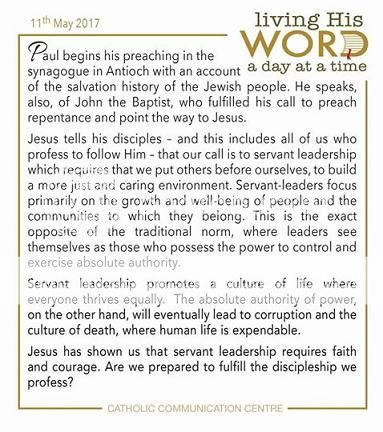
From Paphos, Paul and his companions set sail and arrived at Perga in Pamphylia. But John left them and returned to Jerusalem. They continued on from Perga and reached Antioch in Pisidia. On the sabbath they entered into the synagogue and took their seats. After the reading of the law and the prophets, the synagogue officials sent word to them, "My brothers, if one of you has a word of exhortation for the people, please speak."
So Paul got up, motioned with his hand, and said, "Fellow children of Israel and you others who are God-fearing, listen. The God of this people Israel chose our ancestors and exalted the people during their sojourn in the land of Egypt. With uplifted arm he led them out, and for about forty years he put up with them in the desert. When he had destroyed seven nations in the land of Canaan, he gave them their land as an inheritance at the end of about four hundred and fifty years. After these things he provided judges up to Samuel the prophet. Then they asked for a king. God gave them Saul, son of Kish, a man from the tribe of Benjamin, for forty years. Then he removed him and raised up David as their king; of him he testified, I have found David, son of Jesse, a man after my own heart; he will carry out my every wish. From this man's descendants God, according to his promise, has brought to Israel a savior, Jesus. John heralded his coming by proclaiming a baptism of repentance to all the people of Israel; and as John was completing his course, he would say, 'What do you suppose that I am? I am not he. Behold, one is coming after me; I am not worthy to unfasten the sandals of his feet.'"
Responsorial Psalm (Ps 89:2-3, 21-22, 25 and 27) R. For ever I will sing the goodness of the Lord. or: R. Alleluia.
The favors of the LORD I will sing forever; through all generations my mouth shall proclaim your faithfulness. For you have said, "My kindness is established forever"; in heaven you have confirmed your faithfulness. R. For ever I will sing the goodness of the Lord. or: R. Alleluia.
"I have found David, my servant; with my holy oil I have anointed him, That my hand may be always with him, and that my arm may make him strong." R. For ever I will sing the goodness of the Lord. or: R. Alleluia.
"My faithfulness and my mercy shall be with him, and through my name shall his horn be exalted. He shall say of me, 'You are my father, my God, the Rock, my savior.'" R. For ever I will sing the goodness of the Lord. or: R. Alleluia.
Alleluia (Rv 1:5ab)
R. Alleluia, alleluia. Jesus Christ, you are the faithful witness, the firstborn of the dead, you have loved us and freed us from our sins by your Blood. R. Alleluia, alleluia.
Gospel (Jn 13:16-20)
When Jesus had washed the disciples' feet, he said to them: "Amen, amen, I say to you, no slave is greater than his master nor any messenger greater than the one who sent him. If you understand this, blessed are you if you do it. I am not speaking of all of you. I know those whom I have chosen. But so that the Scripture might be fulfilled, The one who ate my food has raised his heel against me. From now on I am telling you before it happens, so that when it happens you may believe that I AM. Amen, amen, I say to you, whoever receives the one I send receives me, and whoever receives me receives the one who sent me."
REFLECTION
The one who ate my food. At the Last Supper, Jesus washes the feet of the disciples so that they will be “made clean.” The washing anticipates Jesus’ “taking off his outer garments” on the cross: his death is really what cleanses them.
Jesus has full knowledge of his disciples’ weaknesses and strengths. He knows who will betray him. He quotes from the Psalms: “The one who ate my food has raised his heel against me” (Ps 41:10). The betrayal is rendered more acute because it is done not by an enemy but by a member of his intimate band, by one who has shared table fellowship with him.
The psalm is traditionally attributed to David, but is applied to the Messiah, David’s Son. In the light of Jesus’ quotation here, the disciples will later see it as fulfilled in Jesus’ passion, death, and resurrection, when he will be revealed as “I AM”—sharing God’s name and glory. Betrayal is such a tragedy, but it is not the last word. Jesus’ victory is.
Have you ever betrayed a loved one or a friend? What lessons did you draw from such sad event?
SOURCE: “365 Days with the Lord 2017,” ST. PAULS Philippines, 7708 St. Paul Rd., SAV, Makati City (Phils.) http://www.ssp.ph/


 Mar 2 2017, 09:27 AM


 Quote
Quote





 0.1412sec
 0.29
0.29
 7 queries
 GZIP Disabled