What about the Thief on the Cross?
First up, the passage in question:
One of the criminals who were hanged railed at him, saying, “Are you not the Christ? Save yourself and us!” But the other rebuked him, saying, “Do you not fear God, since you are under the same sentence of condemnation? And we indeed justly; for we are receiving the due reward of our deeds; but this man has done nothing wrong.” And he said, “Jesus, remember me when you come into your kingdom.” And he said to him, “Truly, I say to you, today you will be with me in Paradise.” (Luke 23:39-43)
But did the Thief really not have any good works? (Many thanks to the wonderful Monica for finding this quote!)
Look more closely at what the good thief did. First, he rebuked a sinner, someone who was railing against Jesus. Second, he accepted responsibility for his own sin. Third, in the midst of all these people in agony, he turns to Jesus and in front of all these accusers says “Jesus remember me when you come into your kingdom”. He confessed Jesus Christ as a king when everyone else abandoned him. This thief had both faith and good works, by which we are saved through grace.
– Scott Hahn, Seven Last Sayings of Jesus
Most Protestants wouldn’t consider these works really… they’re just faith being expressed, right? So are they works or not?
From a Catholic perspective, the answer is definitely yes. When Catholics speak of faith, they mean it in the specific sense of belief, “an act of the intellect, prompted by the will, by which we believe what has been revealed…” Anything we do, therefore, isn’t faith. It should be an expression of – and motivated by – faith but it isn’t faith itself. And clearly, the Thief does stuff: he acknowledges his sin, rebukes a sinner and proclaims Jesus as the Saviour of sinners.
Now in this case, the Catholic doesn’t have to prove from this text that these works contributed to the Thief’s salvation. The text itself is silent on how the Thief is saved; it only affirms that he is. But to use this text as an argument for faith alone (sola fide), the Protestant needs to prove that there are no works evident whatsoever. Otherwise we’d just have another example of someone who had faith and did works and we’re no clearer about what did (or didn’t) save them.
So are they works? From a Protestant perspective, I think we can safely say… yes, probably. While confessing his sins is part of “having faith” for Protestants, rebuking sinners and proclaiming Christ (i.e. evangelising) aren’t. How can I say that? As a Protestant, I couldn’t imagine faith without repentance but could imagine someone with real faith who didn’t rebuke or evangelise others if only because they didn’t have an opportunity.
It could be argued that the Thief is only indirectly evangelising because really, he’s only addressing Jesus. I don’t entirely buy that but still, that leaves rebuking the sinner, which is definitely a work of love. (In fact, Catholics list it under their Seven Works of Spiritual Mercy.) So we have to admit that there is more than just faith going on here; there are works too.
And those works, however small, are enough to disqualify this text from being an argument against salvation by faith alone. It doesn’t necessarily mean that sola fide is false, only that it cannot be proven from this text.
Now, when I first heard this, I thought that was a bit rich. They didn’t really count as good works did they? I mean, they were so small! But it’s important to understand what Catholics do – and don’t – mean by good works. We don’t mean you have to do a certain number of good things to get into Heaven.
When I first started thinking about this, I thought Catholic works worked a little like proving your identity at the post office to get a passport. Sure, you had to have the application form – that was faith – but then you had to get so many points to prove who you were: 40 points for volunteering at homeless shelter, 20 points for praying the Rosary, 5 points for each evangelistic talk you had with a friend, and maybe a point for each minute you managed to hold your temper (two for each minute if it was with a sibling…), etc. Eventually you got enough points, your application was accepted and voila! A passport to Heaven.
Where exactly I got this outlandish idea, I have no idea. It certainly isn’t Catholic teaching.
No, Catholics understand good works the way Jesus understands them: it’s not about how much you do, how long you do it or how impressive it looks – it’s about what you do with what has been given to you.
For years, I thought the Parable of the Workers in the Vineyard (Mt 20:1-6) was a perfect illustration of salvation by faith alone because all the workers received their day’s pay, regardless of how much they worked. But here’s the thing: they all worked. Invited by the master (grace), they accepted the invitation (faith) and they worked (works) and at the end of the day, were paid what was promised to them (salvation). But all worked.
Or take the Parable of the Talents (Mt 25:14-30). The master gives five talents to one, two talents to another and one talent to a third. The first two invested their talents and managed to double them. They put their gifts to work. But the third hid his in the ground; he didn’t work. When the Master returned, he treated the first two servants exactly the same – even though one had twice as many talents as the other! He said to them both,
Well done, good and faithful servant; you have been faithful over a little, I will set you over much; enter into the joy of your master. (Mt 25:21, 23)
But the third servant, who did nothing with his talent, was cast “into the outer darkness; there men will weep and gnash their teeth.” (Mt 25:30) The important thing in this parable then is not the amount of good works – ten or five or two talents – it’s whether we obeyed.

What matters is whether our faith is joined with, expressed in and completed by works of love. A faith that isn’t put to work in obeying Christ and loving others is a monstrous and unnatural thing. Both Catholics and Protestants instinctively know this. That’s why the Bible is so clear and unequivocal about this:
“You see that faith was active along with [Abraham’s] works, and faith was completed by works, and the scripture was fulfilled which says, “Abraham believed God, and it was reckoned to him as righteousness”; and he was called the friend of God. You see that a man is justified by works and not by faith alone… For as the body apart from the spirit is dead, so faith apart from works is dead.” (James 2:22-26)
(By the by, what does it say about a Christian doctrine that the only time it is mentioned in the Bible, it is explicitly condemned? At the very least it would be wise to change our terminology, wouldn’t it? Or I guess we could do what Luther did and just remove James, that “epsitle of straw” from the Bible…)
But the point is that it’s not about tallying up works and prayers and deeds, it’s about “the obedience of faith” (Rom 1:5, 16:26). We take Jesus at His word that “if you keep my commandments, you will abide in my love” (John 15:10), so “work out [our] salvation with fear and trembling” (Php 2:12) because He has “become the source of eternal salvation to all who obey Him. ” (Heb 5:9)
The Good Thief had faith and immediately, he put his faith to work. In bravely rebuking a fellow sinner, humbly confessing his sins and publicly acknowledging Jesus as Lord, his faith – however new – was working – however little – in love and obedience.
That means the Good Thief cannot be a proof for sola fide; all he proves is the all-surpassing love and mercy of Our Crucified Saviour.
And I think that’s quite enough.
http://www.lauramcalister.com/2012/11/07/w...f-on-the-cross/ This article really shows the desperation that catholics really have. Maybe you and your Catholic friend do not really understand what faith is. Faith is not just a mental assertion that Christ is our only hope. It's not the same as just studying and memorizing facts. For example, it's not just mindlessly knowing about the periodic table. It's something that is really real in that person heart. Faith will of course lead to a paradigm shift and causes the person to act accordingly. Obviously the thief acted based on his beliefs. It was his beliefs that caused him to rebuked the sinner. It was his beliefs that caused him to confess to jesus. In fact based on Catholic doctrines, the thief probably has to go through purgatory which contradicts jesus words to the thief. It's so funny really reading commentaries by catholics. It's like they left their brains in their house before writing the article. Funny how the writer actually compared confessing to jesus as even a form of evangelism. It's speaks of desperation. But catholics tend to invent something along the way when their teachings contradicts. You even mentioned something along the lines that salvation is through faith only and not through works a while ago. But when under pressure, you finally succumb to the fact that in the Catholic system it's faith and works. And now you dun even hide this fact anymore. I guess integrity means very little for you catholics right?


 Apr 25 2016, 10:50 PM


 Quote
Quote
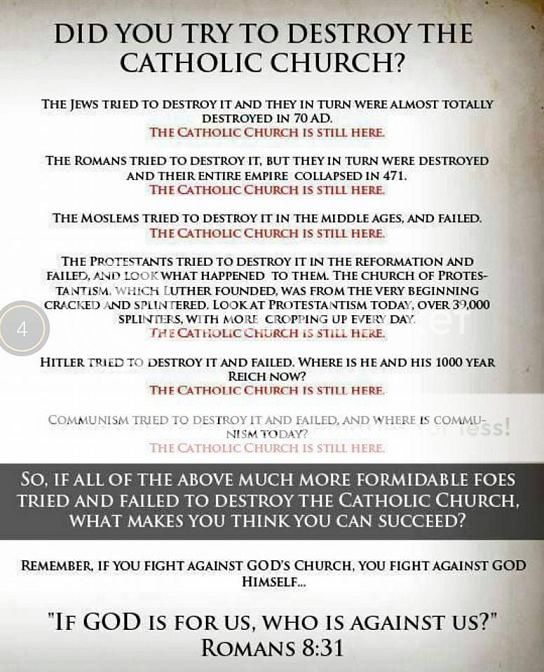
 Many Prots say that Christ is "the rock", not Peter.
  Sound like the case of the disciple handing back something to the Master. LOL.

 0.1387sec
 0.28
0.28
 7 queries
 GZIP Disabled