Welcome Guest ( Log In | Register )

Bump Topic Topic Closed RSS Feed
134 Pages « < 65 66 67 68 69 > » Bottom

Outline · [ Standard ] · Linear+

 LYN Catholic Fellowship V01 (Group), For Catholics (Roman or Eastern)

views
     
khool
post May 13 2016, 02:26 PM

Getting Started
**
Junior Member
225 posts

Joined: Mar 2008


The Tight Purse Strings of Catholics
by Karl Keating
May 9, 2016

user posted image

A slight detour on a cross-country trip took me to Possum Kingdom. The tiny community is in north-central Texas and lies nestled against the shore of a lake that attracts many people during the summer but few on the chilly day that I visited. I dropped in to see Bill and Mary Keeley, long-time friends of the family. When I was a teenager, they lived across the street from us, and I am godfather to two of their now-grown children.

Bill had sent me an e-mail a few weeks earlier, seeking my ideas on the proper way for a diocese to arrange for its cathedraticum. The Catholic Encyclopedia defines cathedraticum (known nowadays in many dioceses as the stewardship fund) as “a certain sum of money to be contributed annually for the support of the bishop, as a mark of honor and in sign of subjection to the cathedral church, hence its name.” The money is paid by the parishes within the diocese and goes to support the bishop personally and to underwrite diocesan-wide expenditures. The practice goes back centuries.

Covering diocesan needs
Traditionally, the cathedraticum was a fixed-amount tax, each parish paying the same, regardless of income or membership. Since the second Plenary Council of Baltimore, held in 1866, in this country the cathedraticum also has come to refer to a tax proportionate to the income of the parish. We thus find both fixed-amount and proportionate-amount systems.

Long ago the cathedraticum was a moderate tax, often hardly more than a token, but in modern times it has come to be relied on, in many places, to cover the basic needs of the diocese, and in the process it has become something other than moderate.

In Bill’s diocese the cathedraticum is a fixed-amount tax. That’s a boon for large and growing parishes in the cities—the equivalent per capita tax is small—but a handicap for parishes such as the one in Possum Kingdom, which has so few members that it warrants only a Saturday-evening Mass and is served by a priest who drives out from Mineral Wells.

I cannot say I was of much help to Bill, but I could sympathize with his concern. Consider the situation in San Diego’s Immaculate Conception parish. Although in the heart of San Diego, it is located in a state historic park called Old Town. Government tabulators say Old Town is the most visited historic park in California. I can believe it. On any given Sunday about three-quarters of the Mass-goers at Immaculate Conception are visitors. It works out that half of the parish income comes from out-of-towners. The parish is taxed on its total income, the diocese using the proportionate-amount system.

In one sense the tax seems fair, in another unfair. Half of the parish income seems “free,” coming from visitors, so it seems there should be no complaint about having that half taxed. On the other hand, if one argues that each Catholic in the diocese should contribute the same to diocesan-wide expenditures (seminary, diocesan-sponsored charitable works, and so on), then this parish’s members are paying at twice the rate of those in other parishes.

Raising necessary funds
I see both sides of the argument and cannot say that either side has an open-and-shut case. Bill’s situation is different. If his little parish puts in the kitty the same amount the richest and most populous parish puts in, something seems askew. Although the parish amount is fixed, the per capita amount is not. The folks in Possum Kingdom are responsible, individually, for much more than are parishioners at St. Big Bucks.

Canon law has something to say about taxes on parishes. Canon 1263 says a bishop “has the right to impose a moderate tax . . . which should be proportionate to [the] income” of the parish and which may be applied to “diocesan needs.” Note that this tax “should be proportionate” but, apparently, need not be. Thus fixed-amount taxes seem to be permissible.

Canon 1266 refers to a different way to raise money. It says the bishop “may prescribe the taking up of a special collection for specific parochial, diocesan, national, or universal projects.” This collection is not a tax as such, and one may presume that the amount collected mirrors the income of the parishes.

One thing all Catholics, I think, can agree on is that dioceses need to raise funds to pay for diocesan-wide activities. The disagreement concerns methodology. I have no solution to the dilemma but do have a suggestion that might ameliorate the situation.

Catholics donate to their parishes at about half the rate Protestants do—one percent of family income versus two percent. I used to be an usher at a parish I no longer attend, and, frankly, I felt embarrassed for well-dressed and apparently well-off people who searched through a thick wad of bills to drop into the basket a single image of George Washington. It wasn’t so much that they were miserly but that they never were instructed on the duty of supporting the Church according to one’s means.

How about a one percent increase?
I’m not advocating that we give a hard sell on tithing ten percent, but I wouldn’t mind homilies urging us to try to match our Protestant brethren’s two percent. I realize that priests cringe at having to ask for money. They shouldn’t have to ask. Their congregants should be sufficiently generous that the parishes should have a bit of a surplus, but most parishes seem to be in perpetual financial straits, in large part because priests don’t ask their flocks to do what they ought to do in terms of parish support.

I know Catholics who earmark ten percent of their income for the Church. They aren’t wealthy people who easily can spare the cash. It’s just that they make the Church a priority. Unfortunately, they represent a small minority among Catholics.

I sometimes wonder what great things parishes could accomplish in terms of apologetics and evangelization if only they had the wherewithal. They often enough have the requisite knowledge and skills among the people in the pews, but they don’t have the financial means to carry out the sorts of projects that, ideally, every parish would undertake as a matter of course.

Beyond that, if Catholic giving just rose to the level of Protestant giving, many parishes could afford to start (or keep) a Catholic school. We sorely need more, not fewer, Catholic schools, but we’re not likely to see new ones pop up unless Catholics learn to take seriously their obligation to support the Church with more than just good wishes.

Source: http://www.catholic.com/blog/karl-keating/...gs-of-catholics

TSyeeck
post May 13 2016, 11:37 PM

Look at all my stars!!
*******
Senior Member
3,577 posts

Joined: Apr 2006


Interesting video on Ethiopian Orthodox Easter (Fasika). Christianity in Ethiopia dates to the 1st century AD, arguably the first nation in the world to accept Christianity (the other nation to debate this being Armenia) and this long tradition makes Ethiopia unique amongst sub-Saharan African countries. You can see the shared tradition of women being veiled in church, use of icons/sacred images, incense, etc. The only noticeable difference are the clapping and usage of drums. triangles, cymbals which is something peculiar to the Alexandrian Rite.

https://vimeo.com/165960002
khool
post May 14 2016, 10:04 AM

Getting Started
**
Junior Member
225 posts

Joined: Mar 2008


QUOTE(yeeck @ May 13 2016, 11:37 PM)
Interesting video on Ethiopian Orthodox Easter (Fasika). Christianity in Ethiopia dates to the 1st century AD, arguably the first nation in the world to accept Christianity (the other nation to debate this being Armenia) and this long tradition makes Ethiopia unique amongst sub-Saharan African countries. You can see the shared tradition of women being veiled in church, use of icons/sacred images, incense, etc. The only noticeable difference are the clapping and usage of drums. triangles, cymbals which is something peculiar to the Alexandrian Rite.

https://vimeo.com/165960002
*
Fantastic video!

They are in full communion with Rome, yes?
khool
post May 14 2016, 10:19 AM

Getting Started
**
Junior Member
225 posts

Joined: Mar 2008


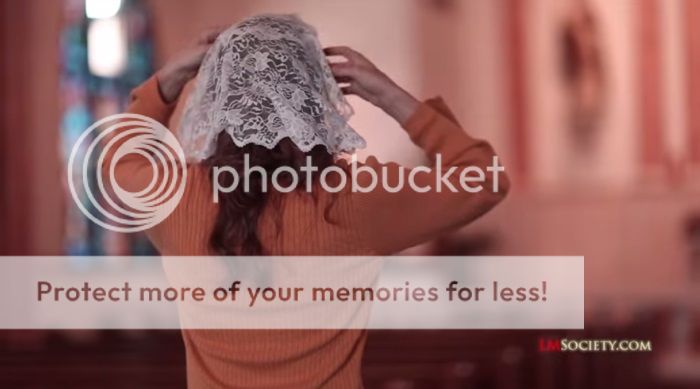
10 Reasons Some Women Are Wearing Veils in Church Again

user posted image

Not that long ago, Christian women always covered their heads at church, and now many are choosing to once again. While lots of women are going the route of the chapel veil, others are choosing things like hats, scarves, or stylish headbands.

What are their reasons for doing this?

1) It’s in the New Testament
Be imitators of me, as I am of Christ. I commend you because you remember me in everything and maintain the traditions even as I have delivered them to you. But I want you to understand that the head of every man is Christ, the head of a woman is her husband, and the head of Christ is God.

Any man who prays or prophesies with his head covered dishonors his head, but any woman who prays or prophesies with her head unveiled dishonors her head–it is the same as if her head were shaven. For if a woman will not veil herself, then she should cut off her hair; but if it is disgraceful for a woman to be shorn or shaven, let her wear a veil. For a man ought not to cover his head, since he is the image and glory of God; but woman is the glory of man. (For man was not made from woman, but woman from man. Neither was man created for woman, but woman for man.)

That is why a woman ought to have a veil on her head, because of the angels. (Nevertheless, in the Lord woman is not independent of man nor man of woman; for as woman was made from man, so man is now born of woman. And all things are from God.)

Judge for yourselves; is it proper for a woman to pray to God with her head uncovered? Does not nature itself teach you that for a man to wear long hair is degrading to him, but if a woman has long hair, it is her pride? For her hair is given to her for a covering. If any one is disposed to be contentious, we recognize no other practice, nor do the churches of God. (1 Corinthians 11:1-16)

Now, I know that this is a hotly debated passage, but let me try to explain.

2) The Church veils things that are sacred
The tabernacle is veiled. The chalice is veiled. Altars are veiled. Moses veiled his face after he had seen God. A veiled woman shows reverence for God, symbolizing the veiled bride of the Church, but also honors herself as a woman before God.

3) Men and women are different
Men represent Christ, the bridegroom, which is why we have the male priesthood. Women represent the Church, the bride. All laymen take part in the feminine nature of the Church, but women symbolize the Church as the bride.

Veiling goes against a society that tells us that men and women are the same, that there are many genders, and that gender is not important when people want to marry. Veiling is an outward statement against modernity and its lies. A woman choosing to be submissive as a wife, as woman, to her husband is against all that our society tells us about man and woman. St. Paul talks about women submitting to their husbands, the Church submitting to Christ, Christ loving the Church to the point of his suffering and death, and husbands loving their wives in this same way.

4) Women and men are equal
St. Paul said this, which went against his culture’s ideas about men and women: “Nevertheless, in the Lord woman is not independent of man nor man of woman; for as woman was made from man, so man is now born of woman. And all things are from God.”

Christianity has made men and women equal in God, and St. Paul says this right in the middle of the passage where he talks about women covering their heads. It is important to remember that when Jesus and St. Paul talk about women in the Scriptures it is in a new way that was not normal to their cultures. Women veiling is not putting them lower than men, but must be seen in conjunction with men not covering their heads. It emphasizes the difference of men and women, and the symbol they are as the image of God.

5) A veil accentuates the natural beauty of a woman
St. Thomas Aquinas explains in his commentary on veiling passage of 1 Corinthians that human beings in general naturally augment their natural beauty with clothing.

Women naturally have beautiful hair, and a veil ornaments and accentuates that beauty. In general, we want to bring the best of ourselves to liturgy, and veiling is a way of doing so.

6) It is part of the tradition from the Apostles
St. Paul writes that he wishes the Corinthians to “maintain the traditions even as I have delivered them to you.” He did not make this up just for their culture. Rather, he is passing on a tradition of women covering their heads and men not doing so. This tradition was from the Apostles and it was maintained until the 1960s when so many liturgical traditions were discarded.

The 1917 Code of Canon law required women to cover their heads and forbade men from covering their heads. The 1983 Code of Canon law omitted the passage about women covering their heads, but maintained that men should not.

It is unclear why the Code was changed, though it is clear that head covering by women is no longer required by Church law. It is also clear this has been a tradition passed down, and as laity there is no reason why we cannot continue that tradition even if it is not in the Code of Canon law.

7) Some women pray better that way
Some are choosing to veil not just in church, but anytime they pray in private or in public. It is a way to help them focus. A prayer to pray when putting on a veil when entering a Church is, “Blessed am I whom am called to the marriage feast of the Lamb.”

8) Having a veil or hat immediately dresses one up for church
Whether at church on a weekday or on a Sunday, when a woman puts something on her head, she is saying to herself and to others that she is dressed for church. A working woman can mentally distinguish between work wear an church wear by using a veil. A woman who wears “mommy clothes” all day, can instantly be dressed up for church when she puts on a veil.

9) Robing oneself in a beautiful veil in the presence of God feels right
It makes the woman feel beautiful, and some husbands think that veils are “hot.” The beauty of the veil is something that honors God in the same way beautiful architecture or beautiful vestments do. They contribute to giving God the worship that is due to Him.

10) Because of the Angels
St. Thomas Aquinas explains this statement from 1 Corinthians 11.10 simply by saying that it is because Angels are present at the Holy Sacrifice of the Mass. Men must show reverence as well as women. Women show reverence by covering their heads, and men show reverence by not covering their heads.

Bonus Fact
Women still cover their heads when they have an audience with the pope.

Source: https://churchpop.com/2014/12/08/10-reasons...g-veils-church/

This post has been edited by khool: May 14 2016, 10:58 AM
tinarhian
post May 14 2016, 03:14 PM

Enthusiast
*****
Senior Member
726 posts

Joined: Sep 2014
Isn't wearing veil a Jewish culture? Its called Tichel.

A common practice among the traditional Roman Catholics right?
TSyeeck
post May 14 2016, 04:51 PM

Look at all my stars!!
*******
Senior Member
3,577 posts

Joined: Apr 2006


QUOTE(tinarhian @ May 14 2016, 03:14 PM)
Isn't wearing veil a Jewish culture? Its called Tichel.

A common practice among the traditional Roman Catholics right?
*
Common also to the Eastern Christians, according to the injunction of St Paul in 1st Corinthians 11.
TSyeeck
post May 14 2016, 04:54 PM

Look at all my stars!!
*******
Senior Member
3,577 posts

Joined: Apr 2006


QUOTE(khool @ May 14 2016, 10:04 AM)
Fantastic video!

They are in full communion with Rome, yes?
*
Ethiopian Catholic Church (Ge'ez Rite), yes. Ethiopian Orthodox Tewahedo no.
khool
post May 14 2016, 05:39 PM

Getting Started
**
Junior Member
225 posts

Joined: Mar 2008


QUOTE(yeeck @ May 14 2016, 04:54 PM)
Ethiopian Catholic Church (Ge'ez Rite), yes. Ethiopian Orthodox Tewahedo no.
*
The video features both Churches correct?

TSyeeck
post May 14 2016, 06:41 PM

Look at all my stars!!
*******
Senior Member
3,577 posts

Joined: Apr 2006


QUOTE(khool @ May 14 2016, 05:39 PM)
The video features both Churches correct?
*
The rite should be common to both.
khool
post May 15 2016, 07:09 PM

Getting Started
**
Junior Member
225 posts

Joined: Mar 2008


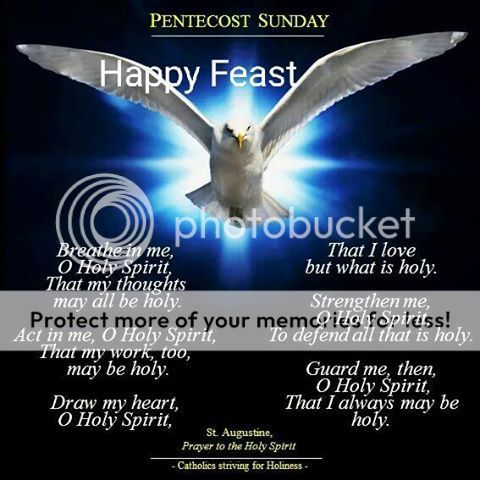
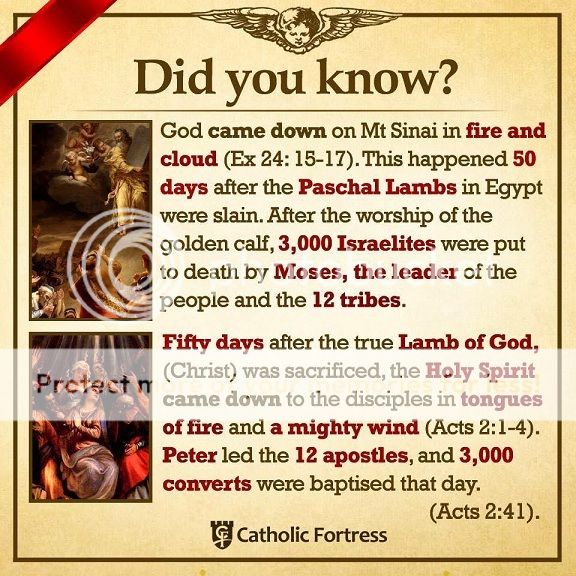
Bible Readings for May 15, 2016
Pentecost Sunday


user posted image

First Reading Acts 2:1-11

When the time for Pentecost was fulfilled,
they were all in one place together.
And suddenly there came from the sky
a noise like a strong driving wind,
and it filled the entire house in which they were.
Then there appeared to them tongues as of fire,
which parted and came to rest on each one of them.
And they were all filled with the Holy Spirit
and began to speak in different tongues,
as the Spirit enabled them to proclaim.
Now there were devout Jews from every nation under heaven
staying in Jerusalem.
At this sound, they gathered in a large crowd,
but they were confused
because each one heard them speaking in his own language.
They were astounded, and in amazement they asked,
“Are not all these people who are speaking Galileans?
Then how does each of us hear them in his native language?
We are Parthians, Medes, and Elamites,
inhabitants of Mesopotamia, Judea and Cappadocia,
Pontus and Asia, Phrygia and Pamphylia,
Egypt and the districts of Libya near Cyrene,
as well as travelers from Rome,
both Jews and converts to Judaism, Cretans and Arabs,
yet we hear them speaking in our own tongues
of the mighty acts of God.”

Responsorial Psalm Ps 104:1, 24, 29-30, 31, 34

R. (cf. 30) Lord, send out your Spirit, and renew the face of the earth.
or:
R. Alleluia.

Bless the LORD, O my soul!
O LORD, my God, you are great indeed!
How manifold are your works, O LORD!
the earth is full of your creatures;
R.

May the glory of the LORD endure forever;
may the LORD be glad in his works!
Pleasing to him be my theme;
I will be glad in the LORD.
R.

If you take away their breath, they perish
and return to their dust.
When you send forth your spirit, they are created,
and you renew the face of the earth.
R.

Second Reading 1 Cor 12:3b-7, 12-13

Brothers and sisters:
No one can say, “Jesus is Lord,” except by the Holy Spirit.
There are different kinds of spiritual gifts but the same Spirit;
there are different forms of service but the same Lord;
there are different workings but the same God
who produces all of them in everyone.
To each individual the manifestation of the Spirit
is given for some benefit.
As a body is one though it has many parts,
and all the parts of the body, though many, are one body,
so also Christ.
For in one Spirit we were all baptized into one body,
whether Jews or Greeks, slaves or free persons,
and we were all given to drink of one Spirit.

Or Rom 8:8-17

Brothers and sisters:
Those who are in the flesh cannot please God.
But you are not in the flesh;
on the contrary, you are in the spirit,
if only the Spirit of God dwells in you.
Whoever does not have the Spirit of Christ does not belong to him.
But if Christ is in you,
although the body is dead because of sin,
the spirit is alive because of righteousness.
If the Spirit of the one who raised Jesus from the dead dwells in you,
the one who raised Christ from the dead
will give life to your mortal bodies also,
through his Spirit that dwells in you.
Consequently, brothers and sisters,
we are not debtors to the flesh,
to live according to the flesh.
For if you live according to the flesh, you will die,
but if by the Spirit you put to death the deeds of the body,
you will live.
For those who are led by the Spirit of God are sons of God.
For you did not receive a spirit of slavery to fall back into fear,
but you received a Spirit of adoption,
through whom we cry, “Abba, Father!”
The Spirit himself bears witness with our spirit
that we are children of God,
and if children, then heirs,
heirs of God and joint heirs with Christ,
if only we suffer with him
so that we may also be glorified with him.

Sequence - Veni, Sancte Spiritus


Come, Holy Spirit, come!
And from your celestial home
Shed a ray of light divine!
Come, Father of the poor!
Come, source of all our store!
Come, within our bosoms shine.
You, of comforters the best;
You, the soul’s most welcome guest;
Sweet refreshment here below;
In our labor, rest most sweet;
Grateful coolness in the heat;
Solace in the midst of woe.
O most blessed Light divine,
Shine within these hearts of yours,
And our inmost being fill!
Where you are not, we have naught,
Nothing good in deed or thought,
Nothing free from taint of ill.
Heal our wounds, our strength renew;
On our dryness pour your dew;
Wash the stains of guilt away:
Bend the stubborn heart and will;
Melt the frozen, warm the chill;
Guide the steps that go astray.
On the faithful, who adore
And confess you, evermore
In your sevenfold gift descend;
Give them virtue’s sure reward;
Give them your salvation, Lord;
Give them joys that never end. Amen.

Alleluia.
Alleluia
R. Alleluia, alleluia.
Come, Holy Spirit, fill the hearts of your faithful
and kindle in them the fire of your love.
R. Alleluia, alleluia.

Gospel Jn 20:19-23

user posted image

On the evening of that first day of the week,
when the doors were locked, where the disciples were,
for fear of the Jews,
Jesus came and stood in their midst
and said to them, “Peace be with you.”
When he had said this, he showed them his hands and his side.
The disciples rejoiced when they saw the Lord.
Jesus said to them again, “Peace be with you.
As the Father has sent me, so I send you.”
And when he had said this, he breathed on them and said to them,
“Receive the Holy Spirit.
Whose sins you forgive are forgiven them,
and whose sins you retain are retained.”

Or

Jn 14:15-16, 23b-26

Jesus said to his disciples:
“If you love me, you will keep my commandments.
And I will ask the Father,
and he will give you another Advocate to be with you always.
“Whoever loves me will keep my word,
and my Father will love him,
and we will come to him and make our dwelling with him.
Those who do not love me do not keep my words;
yet the word you hear is not mine
but that of the Father who sent me.
“I have told you this while I am with you.
The Advocate, the Holy Spirit whom the Father will send in my name,
will teach you everything
and remind you of all that I told you.”

The Gospel of the Lord.

user posted image

TSyeeck
post May 17 2016, 01:15 AM

Look at all my stars!!
*******
Senior Member
3,577 posts

Joined: Apr 2006


TSyeeck
post May 17 2016, 10:56 PM

Look at all my stars!!
*******
Senior Member
3,577 posts

Joined: Apr 2006


user posted image
TSyeeck
post May 18 2016, 01:27 PM

Look at all my stars!!
*******
Senior Member
3,577 posts

Joined: Apr 2006


This post has been edited by yeeck: May 19 2016, 12:06 AM
khool
post May 18 2016, 03:19 PM

Getting Started
**
Junior Member
225 posts

Joined: Mar 2008


QUOTE(yeeck @ May 18 2016, 01:27 PM)

*
error occurred? tongue.gif

TSyeeck
post May 19 2016, 12:06 AM

Look at all my stars!!
*******
Senior Member
3,577 posts

Joined: Apr 2006


QUOTE(khool @ May 18 2016, 03:19 PM)
error occurred?  tongue.gif
*
Corrected.
TSyeeck
post May 19 2016, 12:12 AM

Look at all my stars!!
*******
Senior Member
3,577 posts

Joined: Apr 2006


ON THE IMPORTANCE OF RITUAL

user posted image
Perhaps more than any other religion, Catholicism is belief system based on informed ritual. This is particularly prevalent with younger Catholics, many of whom have a desire to rediscover the rituals that have been lost in the past 100 years. While others deride these rituals as “antiquated” or “relics of a more ignorant age,” the Catholic Gentleman seeks to understand the importance of ritual and helps recapture its former beauty and grace.

Ritual is an action or actions, performed in a prescribed order, which give greater reverence to worship. Some rituals, such as kneeling at communion rails, reverencing a bishop’s ring, or wearing mantillas, have generally fallen into disuse in the United States while others, such as genuflecting, making the sign of the cross, and lighting candles to remember the dead are still strong in today’s Catholic culture.

Not all rituals are created equal. Some rituals, like Lebron James’ chalk throw before every game are designed to excite a crowd, and others, like the rally-cap in baseball, are just plain silly. The Catholic Church’s rituals, evolving over a period of two thousand years, are designed to augment and improve worship. Some simply add to the atmosphere of reverence, while others are a form of worship in and of themselves. The Catholic Gentleman should gravitate to those rituals which aid in creating a certain sense of gravity, reverence, and wonderment befitting the Holy Sacrifice of the Mass.

The Sacrifice of the Mass, it might be said, is the ultimate ritual. In the Mass, the words of Christ are recited as He gave them to the apostles in order to replicate the perfect prayer of the Last Supper. A loving God instructs His people how to worship and please Him, and Christ instructed His Church not on the basis of abstract principles but on the concrete example of the first Mass. We have been saved, in a manner of speaking, through a divine ritual.

Ritual often gives the laity an opportunity to participate in an authentic way in worship. Ritual gives the Catholic Gentleman an opportunity to self-express reverence for the divine while uniting him with the larger Sacrifice. For example, a simple genuflection is an authentic participation because it expresses reverence for the real presence of Christ in the tabernacle while uniting the Catholic to the sacrifice on the altar.

The laity can also seek out ritual as a common cultural thread through time and space. There is something inherently unifying in the fact that a Mass said in South Carolina is conducted through the identical rituals of a Mass said in Tokyo. Similarly, there is something unquestionably comforting in knowing that the rosary we pray today is nearly identical to the rosary prayed by our ancestors in faith nearly one thousand years ago. Ritual forms a common culture which connects Catholics from all parts of the world and gives identity to successive generations of Catholics throughout the history of the Church. In a single instant the ritual allows us to draw a cultural connection to fellow believers separated by time or space.

Ritual is also part of what makes Catholicism unique. Whereas others might decry ritual as nothing more than an attempt to muddle a clear understanding of the divine, the Catholic Gentleman knows that ritual informs Catholics of the divine; it is an acknowledgement that something spectacular and extraordinary is taking place.

Of course, ritual is dead and meaningless if it is not an expression of love for Christ. Love is the essence of what drives and perfects rituals. Love is the very thing that gives them reason for existing in the first place. The root of all Catholic ritual should be the authentic love of Christ. The Catholic Gentleman embraces the opportunity ritual provides to show Christ reverence and in doing so provides an example to others.

http://www.whiskeycatholic.com/2013/03/20/...ance-of-ritual/
TSyeeck
post May 19 2016, 12:45 AM

Look at all my stars!!
*******
Senior Member
3,577 posts

Joined: Apr 2006


1I AM the true vine; and my Father is the husbandman. 2Every branch in me, that beareth not fruit, he will take away: and every one that beareth fruit, he will purge it, that it may bring forth more fruit. 3Now you are clean by reason of the word, which I have spoken to you. 4Abide in me, and I in you. As the branch cannot bear fruit of itself, unless it abide in the vine, so neither can you, unless you abide in me. 5I am the vine; you the branches: he that abideth in me, and I in him, the same beareth much fruit: for without me you can do nothing. 6If any one abide not in me, he shall be cast forth as a branch, and shall wither, and they shall gather him up, and cast him into the fire, and he burneth. 7If you abide in me, and my words abide in you, you shall ask whatever you will, and it shall be done unto you. 8In this is my Father glorified; that you bring forth very much fruit, and become my disciples. 9As the Father hath loved me, I also have loved you. Abide in my love. 10If you keep my commandments, you shall abide in my love; as I also have kept my Father's commandments, and do abide in his love. 11These things I have spoken to you, that my joy may be in you, and your joy may be filled.

12This is my commandment, that you love one another, as I have loved you.

13Greater love than this no man hath, that a man lay down his life for his friends. 14You are my friends, if you do the things that I command you. 15I will not now call you servants: for the servant knoweth not what his lord doth. But I have called you friends: because all things whatsoever I have heard of my Father, I have made known to you. 16You have not chosen me: but I have chosen you; and have appointed you, that you should go, and should bring forth fruit; and your fruit should remain: that whatsoever you shall ask of the Father in my name, he may give it you. 17These things I command you, that you love one another.

18If the world hate you, know ye, that it hath hated me before you. 19If you had been of the world, the world would love its own: but because you are not of the world, but I have chosen you out of the world, therefore the world hateth you. 20Remember my word that I said to you: The servant is not greater than his master. If they have persecuted me, they will also persecute you: if they have kept my word, they will keep yours also. 21But all these things they will do to you for my name's sake: because they know not him who sent me. 22If I had not come, and spoken to them, they would not have sin; but now they have no excuse for their sin. 23He that hateth me, hateth my Father also. 24If I had not done among them the works that no other man hath done, they would not have sin; but now they have both seen and hated both me and my Father. 25But that the word may be fulfilled which is written in their law: They hated me without cause.

26But when the Paraclete cometh, whom I will send you from the Father, the Spirit of truth, who proceedeth from the Father, he shall give testimony of me. 27And you shall give testimony, because you are with me from the beginning.

--John 15
TSyeeck
post May 19 2016, 01:36 AM

Look at all my stars!!
*******
Senior Member
3,577 posts

Joined: Apr 2006


Lourdes: A Girl Born Deaf Can Now Hear

user posted image


(Paris) She was born deaf. This past May 11 shortly before 20:30 she took off her prosthesis and said to her mother: "I no longer need this. I hear now." We're talking about a little girl who was staying with her mother, her grandmother and her brother on pilgrimage in Lourdes.
"The girl was born prematurely on December 25 of 2009. To save her, her doctors administered the drugs that damaged her hearing organs. In Gaslini Hospital of Genoa their own prostheses were used as hearing devices had no effect on her. With the help of speech therapy she learned in the course of time to read lips and speak with difficulty. Her story was told Giuseppe Secondi, the Unitalsi conductor of Milan West, who led the pilgrimage with the girl. Unitalsi is an ecclesial service, the Ambulance service operates at Lourdes and other international as well as Italian sanctuaries.
As a gift to her family, the mother decided to make a thanksgiving pilgrimage to Our Lady at Lourdes with the children, which included her own mother.

user posted image
The pilgrimage took place in the usual way. Prayer, Holy Mass, dipping into the wells. On the evening of May 11, "we returned after the conclusion of the Eucharistic procession to the hotel," said the mother. "I was playing a bit with the kids, then I wanted to go to the meeting of the pilgrims who are first time attendees on a pilgrimage to Lourdes. When I told my daughter that I would go away but be inevitably long, she suddenly said in a clear voice, as she had never spoken before, that I should stay."
During the meeting pilgrim pilgrimage conductor Secondi was called. He was told that the girl had taken her hearing prosthesis out and told the mother that she no longer need it, because she could now hear.
"We stood in disbelief in front of her. From an adjoining room we called her several times with a soft voice and have found that she could really hear us. Above all, she now speaks very clearly, very different than before."
"I thank you, dear Mother, for what you have done to me"

The next morning Secondi wanted to apply to the Bureau des Constatations Medicales to report the case. Previously, he had accompanied the girl to the grotto. While they were there, he said to the child: "Let's go to my Madonna, mine has a crown on her head." So we went to the great Lady of Lourdes, crowned statue of Our Lady. As we stood in front of her, the girl said to my astonishment: "I thank you, dear Mother, for what you have done to me."
Then we went to the Bureau des Constatations Medicales. In the waiting room there was a stylized representation of Marie. The girl said: "this is ugly." When we came into the doctor's room, a picture of the Blessed Mother crowned was hung: "This is the Madonna," she said with satisfaction.
The doctors examined her in detail, then the mother. They performed listening tests. Investigations have since continued in Italy and are still underway. Doctors in Genoa have presented to their astonishment, a cure of the hearing organs. There was also a change in character that took place. The previously very closed, introverted, girl has now become wholly different.
In Lourdes one proceeds with caution and accurate investigations are necessary before a miracle is recognized. The surveys will therefore take some time to complete. The girl and the family are certainly happy and grateful.
TSyeeck
post May 19 2016, 12:12 PM

Look at all my stars!!
*******
Senior Member
3,577 posts

Joined: Apr 2006


19 My dear brothers and sisters, take note of this: Everyone should be quick to listen, slow to speak and slow to become angry, 20 because human anger does not produce the righteousness that God desires. 21 Therefore, get rid of all moral filth and the evil that is so prevalent and humbly accept the word planted in you, which can save you.

22 Do not merely listen to the word, and so deceive yourselves. Do what it says. 23 Anyone who listens to the word but does not do what it says is like someone who looks at his face in a mirror 24 and, after looking at himself, goes away and immediately forgets what he looks like. 25 But whoever looks intently into the perfect law that gives freedom, and continues in it—not forgetting what they have heard, but doing it—they will be blessed in what they do.

26 Those who consider themselves religious and yet do not keep a tight rein on their tongues deceive themselves, and their religion is worthless. 27 Religion that God our Father accepts as pure and faultless is this: to look after orphans and widows in their distress and to keep oneself from being polluted by the world.

James 1:19-27
pandazoro22
post May 19 2016, 06:09 PM

New Member
*
Newbie
0 posts

Joined: May 2016
From: Some hidden mansion in the Klang Valley


QUOTE(yeeck @ Mar 5 2015, 12:31 AM)
We have statues, and images of holy things, but that doesn't make it an idol. They help to remind us about the eternal things. Also to many it helps to focus our prayers. Catholics are not supposed to worship the statues as if the statues have any power in itself. Unlike idols which people of some religions say if broken, it means their god is broken (sic), if a Catholic accidentally breaks a holy statue or image, no big deal, just get another replacement. We don't believe things like bad luck if that happens, because that would be a sin of superstition, against the First Commandment.

Many articles have been written to refute this. One of it here: Do Catholics Worship Statues?

To many, out of sight is out of mind. Anyway, let the pictures do the talking to show my point:

user posted image

user posted image
*
thumbsup.gif agreed many people misunderstand this, even catholics

134 Pages « < 65 66 67 68 69 > » Top
Topic ClosedOptions
 

Change to:
| Lo-Fi Version
0.0403sec    0.18    6 queries    GZIP Disabled
Time is now: 9th December 2025 - 04:42 AM