Welcome Guest ( Log In | Register )

Bump Topic Topic Closed RSS Feed
3 Pages  1 2 3 >Bottom

Outline · [ Standard ] · Linear+

 ~*Sugar Glider Club V2 *~, Staring Contest Champions

views
     
TSsmellyocheese
post Aug 2 2006, 02:36 PM, updated 20y ago

Quack
*******
Senior Member
2,599 posts

Joined: Oct 2005


user posted image

Introduction

Sugar Gliders are one of the sweetest pets to have. They are easy to care for, clean, affectionate, loyal, playful and not to mention, incredibly adorable.

Sugar gliders are tiny gliding opossums from Indonesia, New Guinea, New Zealand and Australia. Wild sugar gliders live in colonies of 6 to 15 animals in tree hollows or other nests made of vegetation. They spend daylight hours cuddling in their nest. Early evening and night will find them foraging for food and protecting their tree.

An adult sugar glider is about the size of a flying squirrel, approximately 5 to 7 inches long from tip of nose to base of tail. Adults in proper body condition weigh between 3 and 4 ounces. The tail is fluffy, often curls on the end and usually is longer than the body length.

user posted image

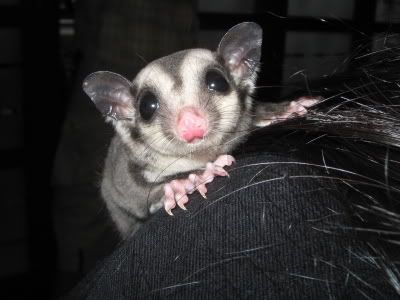
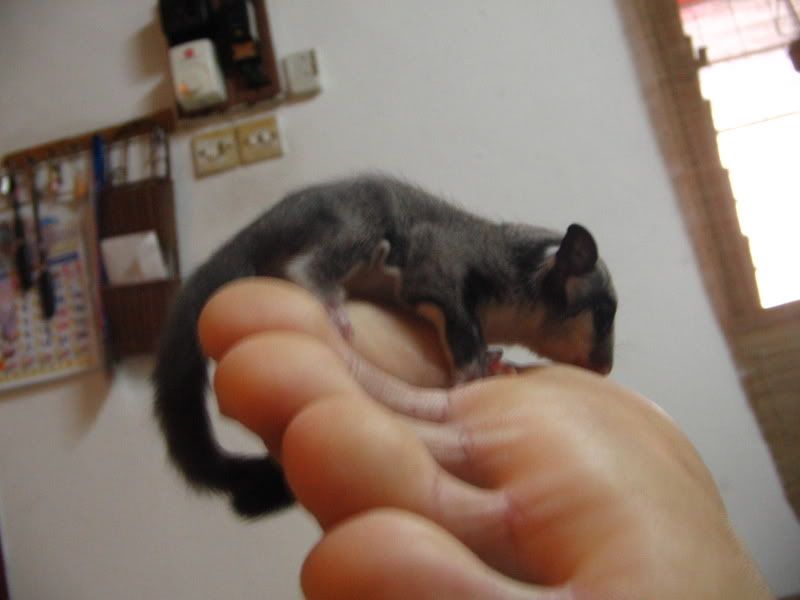
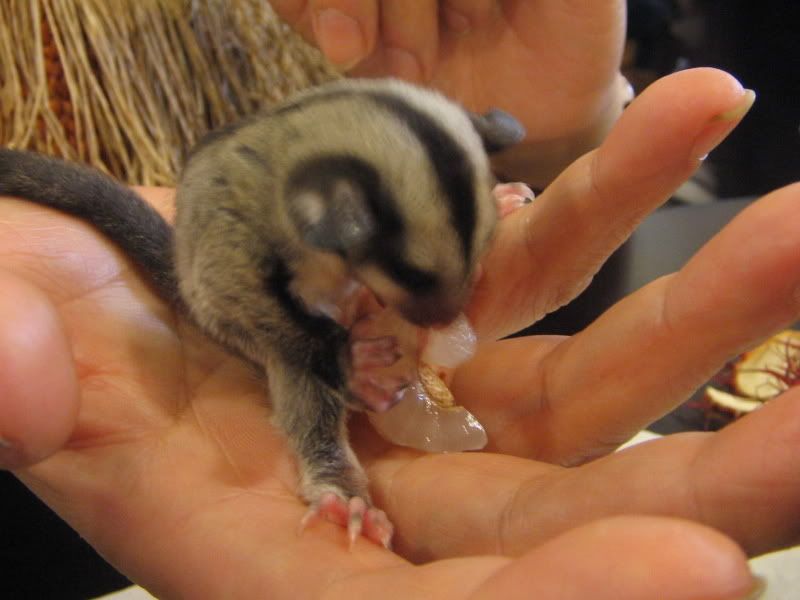
A young sugar glider is silver-gray with a black stripe that starts just above the nose leather and extends over the forehead, down the neck and back and joins the black tail. A dark stripe also runs from the outside corner of the eye to the ear. Captive-raised sugar gliders remain this color throughout their lives. Wild sugar gliders are born this color but usually become stained cocoa brown from the vegetation and tree sap in their nests. Their new coats will come in silver-gray after shedding the old coat.

The sugar glider's belly is a soft white, meeting the gray exactly at the outside edge of the fully furred gliding membranes. This gives a unique scalloped effect when they are relaxed. The sugar glider has four fingers and an opposable thumb on its hands and feet. The thumbs on the rear feet are without claws. Toes and fingers have small pads that help the animal grasp food and branches. Each toe and finger ends in a sharp claw that can hook like Velcro to nonslick surfaces.

Sugar Gliders as Pets

Sugar gliders are, without a doubt, the true pocket pet. A tame sugar glider is delighted to be in physical contact with its owner's body. It will sit on your shoulder, ride in your hair or nap in your shirt pocket. It is an indescribably delicious sensation to feel this warm, living creature lightly move in your pocket as you surf the net, wash the dishes or fix the car.

user posted image

You will fall in love with the sugar glider's attitude. This animal is not a pushover and cannot be trained to do anything with negative reinforcement. Isn't a shame that all pets do not have the sugar glider's degree of self confidence? Treated with kindness and love, your sugar glider will choose you as the most safe and desirable tree in the forest and treat you as an equal, somewhat larger, sugar glider.

You will love the sugar glider because it is such a unique adaptation of nature. A huge portion of its existence in the wild is spent in trees. Because of this habitat, the sugar glider developed the gliding membrane that allows it to travel from tree to tree without ever touching the ground in its entire life. Likewise, a sugar glider that is bonded to you will glide back to you, its one true and safe haven if placed on a stranger's shoulder or on top of your bookcase.

Properly fed and exercised, sugar gliders can live between 10 and 15 years in captivity. If you're looking for a charming, interesting pet, look no further than the sugar glider.

Housing

Adult gliders can tolerate a temperature range of 18°-31°C. At the low end of this range they definitely need warm bedding and a small enclosed space where they can cuddle to keep warm. You can use bird houses, coconut shells or any other thing that's suitable for the gliders to sleep in. It is better to use hiding places made of absorbant material like wood, fabric, etc. Absorbant materials keep humidity from building up inside, and also "breathe" so that moisture and smells don't build up. If you use materials such as plastic or glazed ceramic, your gliders will eventually take on a brownish tinge as their fur is stained by the trapped moisture, and they probably won't smell as nice as they should.

user posted image
user posted image

The cage should be at least 20" x 20" x 36".

user posted image

Natural branches or rope perches for climbing are good additions to your cage, but make sure any branches you use are free of pesticides and are not from a plant that could be toxic. Fruit tree branches are good. If you can find the large size exercise wheel made for guinea pigs, your gliders might learn to use it for exercise, but be sure not to get the smaller hamster size, as gliders can get their long tails caught in those, causing some serious injuries.

user posted image

Other decorations and toys that you can include for your gliders are bird swings, ladders, fake plants, vines and many others as long as they cannot harm your gliders.

user posted image

Food dishes and water bottles made for birds can be used for gliders.

user posted image

You can use woodshavings (NO CEDAR OR PINE!), newspaper, cloth and corn cob as the substrate at the bottom of the cage.

user posted image

This post has been edited by smellyocheese: Aug 2 2006, 09:46 PM
TSsmellyocheese
post Aug 2 2006, 02:38 PM

Quack
*******
Senior Member
2,599 posts

Joined: Oct 2005


Bonding and Socializing

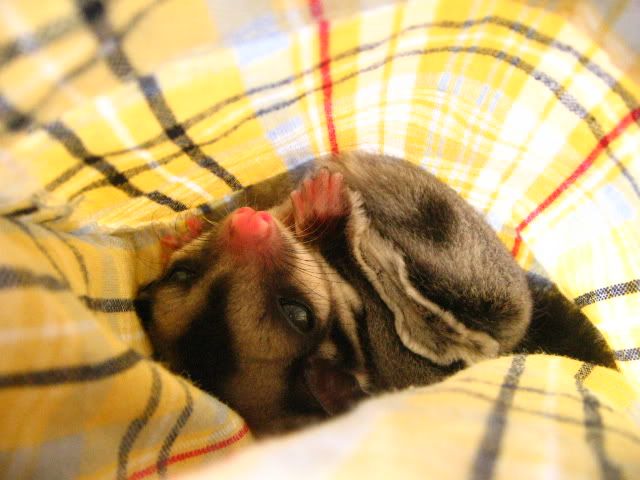
The first day in a new home for your glider will be quite scary. Once you've brought home your glider, leave it in its cage for a day so that it can get familiar with his new home. Playing with the new glider immediately will cause stress so it's best to leave the glider alone for awhile. Keep the cage in a dark and quiet place. You can even place a cloth or a t-shirt over the cage so that the glider will feel more secure.
user posted image

I personally find that the best way to bond with your glider is to keep it close to your body. During the day, keep them in your shirt pocket or in a pouch that you can hang from your neck. The glider will get accustomed to your smell. The breathing and warmth is also comforting to them. Bonding with a glider doesn't mean playing with the glider all the time. Gliders can get stressed when overplayed with. In the late evening or early morning (gliders are nocturnal meaning that they are active during the night), spend some time to socialise with your glider by letting it explore your body, hang it upside down and hand feed it.

Tame and bonded gliders can respond to their name and follow simple commands like "come here" or "let go" or "NO!" when commanded by their owners. They will also be very clingy and loyal towards their owners.
user posted image


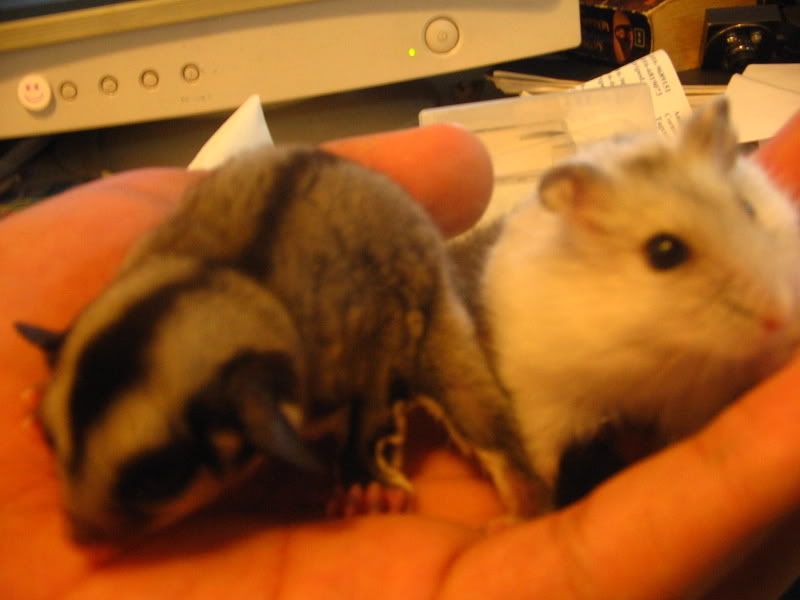
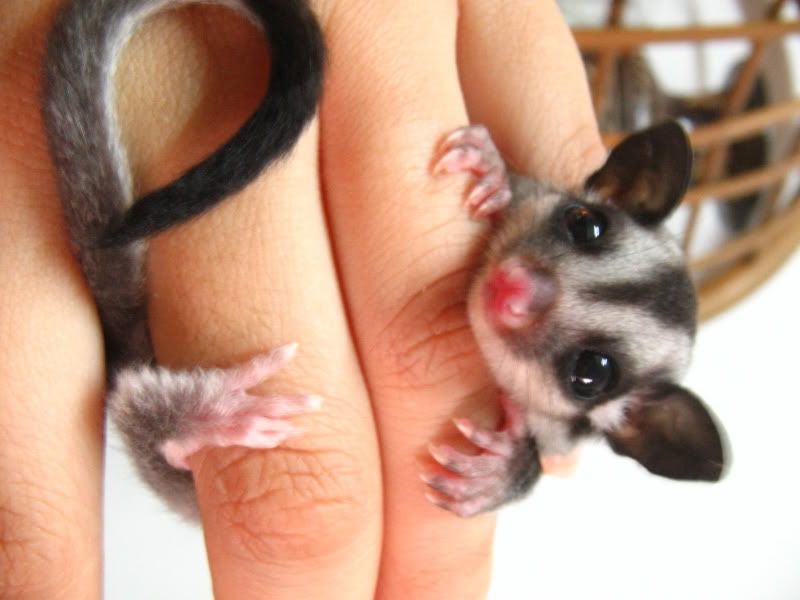
There are 2 types of gliders in the market. Baby gliders and adult gliders. Many people are excited over the cheaper prices of adult gliders but they do not realise that most of the adult gliders sold are wild gliders that has not been tamed from young and can be very very difficult to tame. Instead of a pocket pet that snuggles up to you, you'll get a scratchy, crabby and bitey glider. When you're considering sugar gliders as pets, make sure that they are either tamed or babies. Babies bond much better with their owners and they are much easier to tame. Even if they do bite and scratch at first, it won't be painful.

It easy to carry gliders around even when you go out to public places. They will snuggle in their pouches or shirt pockets. Use pouches that are made out of breatheable fabric.

user posted image
user posted image

Must Sugar Gliders be Kept in a Pair?

There are many cases against keeping sugar gliders along due to their nature in living in a colony of gliders. Keeping gliders in at least a pair is recommended because many people cannot give half of their time to their gliders.

Gliders can die from loneliness so there is no way to keep a glider alone locked up in the cage for most of its life.

Gliders can certainly be kept alone if the owner is able to spend tons of time with the glider (we're talking about at least 12 hours). This is easier than it's been made out to be. Gliders kept singly will only require 1 hour of play-time but snuggling up to their owner, seeing them every hour or two, receiving strokes murmurs from their owners is what keeps the glider from being lonely. Being pocket pets, gliders can be brought to almost everywhere so they're easy enough to keep by your side for 12 hours or more.

Glider Scent

Male sugar gliders have a scent gland in the middle of the top of their head, which causes the typical bald spot in the center of the wide part of the black stripe there. Another gland is located in the middle of their chest. A third gland, an anal one, is shared by males and females alike. The females also have a scent gland in their pouch.
user posted image

The male's forehead and chest glands are used in marking his territory and his mates with his scent. Gliders produce at least three distinct odors. One is a sweet, flowery smell; another I don't know how to describe, but it is not really offensive. It can get relatively strong at times, when they are breeding, but after a few days it dies away again. The third is a pungent smell that is produced by the anal gland when a glider is afraid.

Gliders use urine to mark their territory, so you will need to clean their cages and furnishings periodically. Otherwise though, they are very clean little animals

Glider Nutrition

In the wild Glider diet consists of insect and plant exudates such as nectar, pollen, tree sap, manna, honeydew and in some species fruit and seeds. Protein is supplied through the consumption of insects, moths, beetles, pollen and occasional small vertebrates. It is very difficult to duplicate this exact diet because the exact plants are not commonly availble in stores. However, there have been diets that have been used for several years that seam to provide all the nutritional value required for healthy gliders.

Gliders take variety food. The ideal diet for them would be a glider mix food (with various glider-safe ingredients), fruits/vegetables and pesticide free insects.

user posted image

Many gliders in captivity suffer from malnutrition because there are not many staple food that are well-balanced in the market and many keepers are misinformed on what to feed gliders.

Best nutrition and most widely accepted foods


apple (and apple juice), banana, blueberry, cantaloupe, carrot, cherry, chicken (boiled without skin), coconut, cucumber, eggs (hard boiled or scrambled no added butter or oil), fig, grape, honey, honeydew, insects (farm raised to be used as food such as crickets and meal worms), kiwi, mandarins, mango, melon, papaya, Peach, pear, pineapple, plum, prune, raisin, raspberry, squash, strawberry, sweet potato (not cooked), wheat Germ


Good Foods but should not be used every day for long periods

beans, beets, broccoli, cauliflower, corn, cottage cheese, grapefruit, greens (mustard, kale, collard, celery, stalks, turnip), kale, nectar, oranges, parsley, peas, spinach, turnips, yogurt
user posted image

Foods to avoid

caffeine (coffee, tea, soda, chocolate etc..), canned foods fruit or meat (most contain added salt and sugar), canned fruit, cheese May cause intestinal stoppage or "binding" leading to constipation, chives, chocolate It causes a toxic chemical reaction in most animals, fat (any food with high or added fat), Fire Fly (lightning bugs) or any other insect that was not farmed raised for food, fried foods, garlic, iceberg lettuce (non nutritional), insects that are wild caught, keels, milk, millet (or other very small seeds), nuts (possible exception of a uncooked, unsalted penult for very rare extra special treats), onions, phosphorus stay away from foods high in phosphorus. use a calcium that does not contain phosphorous., pinkys (although very nutritious we choose not to feed pinkies because of a few items that suggest feeding pinkies may increase the possibility of mothers eating their joeys.), pits (from fruit), processed meat, raw eggs, raw meat (except for live insects), rhubarb, salt (any food with added salt), scallions, sugar (foods with added sugar), sugar (refined sugar, table sugar), tofu / soy products (Even though tofu has been thought of as the perfect protein you may want to avoid this or use it very limited because of several recent articles which suggest "The facts are stated clearly - soy products in the diet of the studied animals is believed to have harmful effects on the body's digestive and reproductive systems."Why take the risk of Tofu when there are many other forms of protein

Reasons

1. Garlic, onions, scallions, chives, leeks, ramsons, (any member of the Allium genus).
These vegetables have been known to cause anemia in many domestic animal species.
Warning: Some baby foods contain onion or garlic powder. To be safe, always throughly scan the ingredients of prepared baby foods before purchase.

2. Millet
This popular item for birds is a definate no-no for Sugar Gliders. These small granules will likely cause intestinal impaction if too many are consumed.

3. Fruit Seeds
The seeds and pits of various fruits are sources of extremely potent toxins. To be safe, throughly check all food dishes before dinner-time to ensure you haven't mistakenly included any seeds, pits, stones, etc.

4. Nuts
With the exception of the occasional Brazil nut, avoid offering nuts. Nuts are high in fat and also oxalic acid, which interferes with calcium absorption. Nuts have also been linked to other health problems in Sugar Gliders.
Any benefits nuts have to offer can be derived from the rest of the diet, provided it is well-balanced.

5. Avocado
Although many Sugar Glider owners offer avocado flesh, this fruit is extremely high in fat and contains toxins known as cardiac glycosides. I recommend never offering this fruit to your gliders.

6. Citrus fruits (oranges, grapefruits, lemons, etc.)
Although offering citrus fruits on occasion will benefit your glider's health, overdoing it will result in diarrhea (which leads to dehydration and a host of other health problems).

7. Sunflower Seeds
Do not offer these seeds in excess. They are loaded with fat and may contribute to intestinal problems.

8. Peas, peanuts, and some plants belonging to the family Cruciferae (Brassicaceae) --- which include broccoli, kale, cauliflower, turnips, mustard, and Brussels sprouts --- have been known to repress the production of thyroid hormone in animals. Do not completely avoid offering these items (although peanuts should be avoided for other reasons as well); just limit your offering of them, and be aware of their potential interactions within the body.

9. Spinach, parsley, rhubarb, beets (and their greens), Swiss chard, mustard, kale, collards, celery stalks, turnip greens, many beans, and plants of the genus Rumex (sorrel, dock) contain oxalic acid, a chemical that binds with calcium and renders it unavailable to the body. (When offering leafy greens, try to stick with Romaine lettuce or other selections not listed above.)

10. Corn
This sweet vegetable is relished by most Sugar Gliders, but do not offer this as a staple, because it is loaded with phosphorous. An excess of this mineral in the diet may compromise proper calcium absorption. A few kernels or a small cob once and a while is fine.

11. Milk Products (yogurt, cottage cheese, etc.)
A Sugar Glider can tolertate lactose in its diet, but some individuals will be less tolerant than others. The keys are moderation and individual attention. Do not feed straight milk or overfeed lactose-rich foods. Observe what each of your gliders eats each night, and take note of how their bodies react to it. Even though it will be difficult to keep track of which gliders are producing which bowel movements, you can figure this out by close observation, or by temporarily separating an individual you suspect to be having a problem for a few hours.

Health Problems

Hind Leg Paralysis - caused by inadequate calcium absorption due to poor diet (low calcium, high phosphate, low Vitamin D) leads the glider's body to produce increased parathyroid hormone, which removes calcium from the bones It is one of the most prevalent dietary problems in gliders and is totally preventable in all cases except where a glider may have a genetic defect making the glider not able to metabolize calcium correctly. You will notice a glider back legs getting week and eventually the glider will be dragging himself by his front legs. This condition can successfully be treated if noticed early and immediately treatment is started. Your vet may want to (and should) rule out possible other causes by x-ray like broken bones.


Dehydration / Diarrhea
- Dehydration is simply a symptom to many other illnesses. A glider can die in as little as 10 hours in a hot environment from dehydration. Diarrhea is another symptom of many other illnesses and is it self a cause of dehydration. By pulling up the skin at the glider's shoulders and observing if the skin stays up or goes down very slowly suggest strongly that the glider is dehydrated. Mild dehydration for a known cause (like empty water bottle) can be treated simply by providing fresh water.

Stress / Isolation / No Socialization - Gliders cannot handle stress very well unless they are well bonded and receive a lot of security and comfort from their owner or cage mate. Environment changes like going to a new home wear there are different sundering, different smells and most likely different food can all cause stress. New people, new cage mates, other animals, children, and different sounds are among just some of the things that can cause stress. While stress may not be the same as a virus it can however cause the gliders immune system to weaken opening up additional possible avenues of getting sick. Further Gliders are very social animals and without other gliders or humans to have a social interaction with they will end up being stressed or depresses. The lack of socialization can actually lead to manifest in physical symptoms and severer depression. Some symptoms of stress are sudden change in attitude or behavior, intestinal problems. Cage circling, biting, loss of hair, self-mutilation, and repeated cage movements over and over again. Although I have never seen it in any of my Gliders, apparently self-mutilation has increased quite a bit and become a big concern among several Glider owners.

This post has been edited by smellyocheese: Aug 2 2006, 10:48 PM

TSsmellyocheese
post Aug 2 2006, 03:27 PM

Quack
*******
Senior Member
2,599 posts

Joined: Oct 2005


Joey Development (Seems like many have gliders in male-female pairs so this would come in handy)

Newborn Joeys- The trip into the pouch:

16 days after mating, sugar gliders birth up to 4 joeys at a time - 1-2 being most common, 3-4 being rare. When a joey is born, it is similar to a rodent baby. Joeys are born pink, naked (no fur), blind and deaf (the ears are fused to the head). Little pinhead sized black eyes are visible at this time.

user posted image

The mother will lick a path leading to the pouch so the baby can crawl in it. The fur is wet and licked down because the joey is sticky and will get caught and stuck in the dry fur where it will get cold, dry, get no food, and die. The mother will, of course, try to lick it out if it gets stuck, but that makes it worse. (I had this happen to me but thankfully my glider birthed them in my hands so I could help 'untangle' the joey and scoot it into pouch. She's a sweet, healthy joey now.) All they are capable of is crawling(barely tho- their legs are like little nubs). They're born live at about the size of a piece of uncooked rice and crawl into pouch; the whole process takes about 5 minutes for them to be completely in pouch and attached to the nipple. There they remain for another 2 months before they are developed enough to come out. Also, the mother is going to need more protein, so this is a good time to start feeding more.

It's very rare to see a joey born live and make the journey into the pouch. Few are lucky enough to catch it, some by just being around at the right time, others count the days after mating. Most joeys are born in the morning-noon, and I heard somewhere that gliders do not birth joeys at night. I dont know how true that is but with all of mine its held true.

user posted image

If you do happen to see a joey born or know there is one in pouch and you have little or no experience with gliders, resist all temptation and DO NOT attempt to open that pouch and peek inside. It is possible to do this, but very dangerous if done the wrong way. The joey MUST stay attached to that nipple until it comes off on its own. Joeys jaws aren't developed enough to hold on by themselves. The nipple swells in the joeys mouth causing it to stay latched on, if knocked off it WILL die because it can't open its mouth and get back on.

Newborn Joeys- 5-7 days in pouch:


Disappearing Joeys- Dont freak out if you just saw your joey born but can't see it in the pouch days later. Sometimes first time glider mothers lose their joeys, but dont forget momma glider can hide it in the back of the pouch so it's most likely still there. They haven't done much growing at this age yet and you may not be able to see if for a couple more weeks. It really depends on how observant each glider owner is, and how much you notice about your gliders.

Newborn Joeys- 14 days in pouch:

Not many physical changes are noticeable, the size has just about doubled since birth now. Feet are starting to form on the little nubby legs and tail should be slightly more than a stump. Not much else. If the owner is in tune with their glider it's possible to feel a tiny lump by now. Gliders are still capable of hiding the joey in the back side of the pouch and it's very easy to miss still.

Joeys- 21 days in pouch:

Growth has started to get very rapid and the joey is almost big enough now where the lump is obvious and can't be hidden any longer. The head has grown larger and the eyes are bigger. Ears are still fused to the head, but are bigger and the feet should have little nubby looking toes. The tail still isn't as long as the joey itself yet. Overall size of the joey has increased quite a bit.

Joeys- 30-35 days in pouch:

By now the joey should be a completely visible lump and can no longer be hidden. If you don't see a lump then 1 of a few different things may have happened"
# Cannabalized
# Mothers first litter of joeys.
# The mother was lacking something in the diet.
# Something was wrong with the joey.
# Mother may have been stressed.
# In a trio or more situation females may eat each others joeys.
# Rejected
# Too young for the glider to be a mother and she may not have known what to do.

These are the most common that I know of.

Joeys- 40-50 days in pouch:

The tail should be as long as the joey by now and the toes have little nails on them. The nose looks too big for the head right now, and whiskers are growing. The eyes should be pretty large and have a layer of skin over them. Ears are still fused. The joey will look like a peanut from the outside of the pouch. The head and back give it that peanut shape. Inside the pouch, the joey should be large enough now that its insides can be seen fairly well through the transparent skin. Now is the best time to just sit with the female on her back and watch the joey move around, provides hours of entertainment. May even get lucky enough to see a foot or tail tip pop out of pouch occasionally.

Joeys- 60-63 days in pouch/ Out Of Pouch(OOP):

user posted image

The joey should be coming OOP around this time. The jaw is developed enough where it can detach and get back on to eat.It can take up to a week for a joey to come fully out- meaning it's too big to fit back in the pouch.

There will be butts, tails, feet and everything hanging out of pouch. After a few days to a week the joey will be out of pouch and clinging to its momma. It just sticks its head into the pouch to nurse instead of the whole body being in there. When it comes OOP it should have a very fine layer of fur on it, the underside is all pink still, no fur. Ears are just starting to 'pop' out and with mine I've noticed that around 3-5 days after being fully OOP they start hearing. I don't know if that's just mine, though. The eyes are still closed but have enough skin over them now so it doesn't look like a big black dot anymore.

user posted image

Since the female has two uteri and three vaginas it is possible for her to have two different aged joeys in pouch. It's possible for joeys to come OOP 2 days apart to 2 weeks apart. Dont panic and think one is 'ahead' of the other. This is completely normal. Joeys start making little 'fussing' noises about now, if the mother leaves the joey in the nest and the father happens to be out too, when that joey cries they will come running to its aide. They make excellent parents.

It's possible right now to be able to tell what sex the joey is. Handling is encouraged at this time, but start out slowly. Start at 2-3 minutes and work up to 5 a day, then 10 and so on.

user posted image

Joeys- 7-15 days OOP:

Eyes should be opening and they should be able to hear by now. The fur is thicker on the shoulders and neck, but still very thin underneath. The teeth aren't very developed yet but there are tiny ones starting on the top jaw. The bottom 2 teeth aren't very long and it looks like a small lump on the gum.

The joey should be pretty vocal by now and riding on either of its parents backs when they go somewhere. The joey will not leave the nest alone and go exploring just yet. Joeys may 'jump' in your hands when held, I am not sure why but mine did that just when they were starting to sleep. This will go away around 30-45 days OOP.

user posted image

At this age the joeys lke to be kept warm since they dont have much fur on them yet, they like sleeping in hands and being kept warm. Also, now is a good time to move the nest/pouch to the bottom of the cage in case a joey happens to wander out by accident.

Joeys- 25-30 days OOP:

The eyes should be completely open and the joey more adventurous. The ears are up and listening to everything. Fur should completely cover the underside. Scrotum/inside of pouch won't have much fur yet, but very shortly will be fully furred. Some joeys may even start practicing small jumps or hops, most will not tho. Teeth are big enough where biting will hurt and the joeys will start to chew fingers/nails now.

Joeys- 45 days OOP:

Most joeys, by now, are looking to explore and are showing thier personalities. They should be running around the cage with the parents and riding on backs less, now is a good time to try playing games with them that you might play with the parents. Not too rough, be gentle. Joeys should be starting to pick up food, mostly fruit, off the parent's dishes and taste it. They most likely won't try tasting the meat or eggs till later. Just the juices and fruit, maybe some veggies is all the joey will eat. At this age they do like baby cereal, don't overfeed, just a little for a nice treat to help get them started on solids. It helps to mix the cereal with some juice.

Joeys- 55-60 days OOP:

At around this time the joey will be completely weaned and able to live on its own. It should have a fully fluffed out tail by now and eating most solid foods that are fed to the parents. It will want to come out and run and play with the parents at night and the parents(most of them anyway) will wrestle and play rough with the joeys. I don't mean rough like biting them, but rolling around and hollering at each other. Before seperating from the parents be SURE the joey is eating on its own and make sure it 'pees' and 'poos' by itself. If it doesn't, then it isn't ready to be on its own yet. If not ready yet, it may be another week before the joey is ready to live on its own.

This post has been edited by smellyocheese: Aug 2 2006, 10:49 PM
TSsmellyocheese
post Aug 2 2006, 03:27 PM

Quack
*******
Senior Member
2,599 posts

Joined: Oct 2005


To be updated later

This post has been edited by smellyocheese: Aug 2 2006, 10:49 PM
TSsmellyocheese
post Aug 4 2006, 11:47 PM

Quack
*******
Senior Member
2,599 posts

Joined: Oct 2005


V2!!!!! rclxm9.gif rclxm9.gif
TSsmellyocheese
post Aug 5 2006, 12:19 PM

Quack
*******
Senior Member
2,599 posts

Joined: Oct 2005


thanks everyone. I'll resize the pics later. will add more stuff later. (weekend I abit busy)

anyway, joeys are nutritious to gliders but it's a personal belief of many that it will up the chances of the gliders eating their own babies cuz after all, they look like pinkies when they're born.

but seeing how the gliders in the pics didn't eat their babies... so why not yeah?

but there are always alternatives.
TSsmellyocheese
post Aug 6 2006, 01:20 AM

Quack
*******
Senior Member
2,599 posts

Joined: Oct 2005


we're not too concerned with Pie's nails because she doesn't really dig her nails into the skin when walking. but donny's nails are pretty sharp. we just use a nail file.
TSsmellyocheese
post Aug 7 2006, 09:10 AM

Quack
*******
Senior Member
2,599 posts

Joined: Oct 2005


QUOTE(crazymouse_yyh @ Aug 6 2006, 08:56 PM)
Hehehe... not yet set up cage yet loh.... now Kiah in small hamster cage... temporary only, waiting for her exo terra cage...

Today I successfully filed Kiah's nails down... now not pain liao hehehe...
*
and where you gonna put the cage...? brows.gif

I'm also waiting for donny's and pie's cages.

haha. good la. but her nails weren't too bad to begin with.
i have to file pie's nails also.

they seem to like the new food you gave me rclxms.gif

QUOTE(dananmy @ Aug 6 2006, 09:30 PM)
At last!!  flex.gif I was looking for V2 for 2 days. Gong-Gong me, dunno how to find.  doh.gif Thanks Crazymouse !!

    By the way, bout the nail thing. I've trim their nails but when they climb on my shirt they will fall off like no ballance, but if I don't trim they will stuck on my shirt cannot move at all. Dunno wat to do vmad.gif

  And for the sandpaper, got poison or not? after they chew and eat then habis la... rclxub.gif
*
try not to trim so much lor.. I think just filing would do.

sandpaper.. just use it supervised... should be alright.
TSsmellyocheese
post Aug 7 2006, 02:21 PM

Quack
*******
Senior Member
2,599 posts

Joined: Oct 2005


best time to do their nails is when they're sleepy/sleeping.
TSsmellyocheese
post Aug 7 2006, 07:16 PM

Quack
*******
Senior Member
2,599 posts

Joined: Oct 2005


QUOTE(dananmy @ Aug 7 2006, 04:07 PM)
how does nail file look like? If I go to watson and ask them, they will know ar?

And for the bedding, do u guyz still put the metal thing on top of the bedding or just leave the beddin for them to walk on it? (hope U guys understand wat I mean-dunno how to explain) smile.gif
*
user posted image

nail file.


i don't use the metal bedding. when i was using the wood shavings the gliders sumtimes burrow in the woodshavings. no prob.

but I stopped using wood shavings because when everytime got ants I have to change the entire bedding. quite wasting so I just use newspaper and an old t-shirt/pillow case.
TSsmellyocheese
post Aug 8 2006, 02:04 AM

Quack
*******
Senior Member
2,599 posts

Joined: Oct 2005


QUOTE(pinchboyz @ Aug 7 2006, 08:08 PM)
i read that most suitable for SG is like 3 feet cage??
small cage also work well with them?
*
when they're young and only as a temporary enclosure it's fine.not forlongterm.

QUOTE(suiteng @ Aug 7 2006, 08:27 PM)
Mine are adults ler biggrin.gif My cage is 5ft x 2ft x 1ft... yeah.. quite big..
Hmm.. the metal thing I meant was the separator between the bedding and the cage thing wo.. how to say.. hmm..
Better dun use those small small cage lor.. they need more freedom to jump around. But dun simply buy cage la... if you find you dun have budget to buy a cage for your gliders then just use temporary hamster cage. When you save enough, then buy a big cage for them  thumbup.gif  thumbup.gif
*
yeah. I know what you mean. I typed wrongly.

TSsmellyocheese
post Aug 8 2006, 11:11 AM

Quack
*******
Senior Member
2,599 posts

Joined: Oct 2005


I'm not exactly sure if they'll break anything.... but to be on the safe side, I'd suggest that you play with your babies at night so that they'll be tired out and won't be overly hyper when you're asleep.
TSsmellyocheese
post Aug 8 2006, 05:23 PM

Quack
*******
Senior Member
2,599 posts

Joined: Oct 2005


QUOTE(Sugre @ Aug 8 2006, 03:21 PM)
Consists of:

Apple juice
Carrot juice
Wheat germ
Apple sauce
Yogurt
Oats
Broiled chicken
Wheatgerm

Can anybody tell me if this is ideal? I already bought the ingredients in bulk. So i better not waste it after I busted my wallet for it.
*
the mix doesn't have enough vitamin and calcium supplement. the chicken is sufficient for protein but not enough for you to lessen the feeding of insects.


QUOTE(suiteng @ Aug 8 2006, 03:36 PM)
If you have busted your wallet to buy a mixer especially for them, you can blend in mealworms too brows.gif

Trim their nails while they are sleeping. Then they can't grip that much, and doesn't hurt that much. I have red-dots on my hands too..
*
don't blend in mealworms as the mix will go bad faster. basically don't blend in anything that's "fresh". Those dried mealworms are fine I suppose but kinda pointless. they're dried.
TSsmellyocheese
post Aug 8 2006, 07:19 PM

Quack
*******
Senior Member
2,599 posts

Joined: Oct 2005


QUOTE(crazymouse_yyh @ Aug 8 2006, 06:33 PM)
Ahhhh.... I still got free Slurp samples.... who at Cyberjaya want?
*
lol. mine finish already. I made new batch la.
TSsmellyocheese
post Aug 10 2006, 12:59 AM

Quack
*******
Senior Member
2,599 posts

Joined: Oct 2005


calcium and vitamin in yogurt and processed fruits varies in brands though. In Gerber applesauce for instance, has 75% vitamin C but 0% vitamin A. Regular canned applesauce may have as little as 7% vitamin C but 1% vitamin A but of course we don't use that because many in the market have added sugar and salt.

Many yogurt have calcium as little as 4%. Some may have up to 45%.
TSsmellyocheese
post Aug 10 2006, 12:43 PM

Quack
*******
Senior Member
2,599 posts

Joined: Oct 2005


^ there's a thread dedicated to that.
TSsmellyocheese
post Aug 11 2006, 12:31 AM

Quack
*******
Senior Member
2,599 posts

Joined: Oct 2005


QUOTE(pinchboyz @ Aug 10 2006, 08:29 PM)
wanna assk, if those yogurt sell in pasar malam 1, homemade 1...
isit better???
*
the content has not been analised so you wouldn't know if it's better or not.

Just get plain yogurt with no sugar and funny stuff added. It's not that hard to supplement calcium with calcium powder or even Exo Terra's Calcimize than to go search one by one which yogurt has a higher content of calcium...
TSsmellyocheese
post Aug 11 2006, 12:55 PM

Quack
*******
Senior Member
2,599 posts

Joined: Oct 2005


haha. ours just sleep when at school or work. or just stay close by. at night only like monkey. in the car as well.
TSsmellyocheese
post Aug 12 2006, 02:00 AM

Quack
*******
Senior Member
2,599 posts

Joined: Oct 2005


haha. wait til pie and donny grows big... gonna feed em pinkies since they're gonnabe bred. unless pie gets a bf.... hmm...
TSsmellyocheese
post Aug 14 2006, 12:03 AM

Quack
*******
Senior Member
2,599 posts

Joined: Oct 2005


QUOTE(dananmy @ Aug 12 2006, 09:17 PM)
I wanna ask u all la, if u bring ur babies out, maximum how many hours? did they poopee in the pouch? I taught of bringing them out and is 12hour in office daily. If within the 12hour didn't feed them can ar? Because once I feed them they will poopee. I read somewhere that they only feed once in the evening because sg sleep the whole afternoon. icon_question.gif
*
since our gliders are single glider so they're out with us for very long.

Pie for instance... from say 8am she's already out of her cage... at night maybe around 11 she'll be back into her cage.. or if she stays over my place then she'll be in her smaller enclosure. We feed her every morning and every night. in between we'd feed her worms and fruits. and yeah. they poo and pee all the time so we have LOTS of tissue in handy.

Donny follow my mom to work so he's in his travelling bag from 7:30am after his meal... in the office his bag will be left open so he'll climb out to play if he feels like it. mom's lunch time he'll have his fruits and worms. Then he sleeps again. On the way home from work in the evening he'll be hyped out playing around in the car... around 8:30pm he'll be back in his cage. brought out again later at night for play time.

3 Pages  1 2 3 >Top
Topic ClosedOptions
 

Change to:
| Lo-Fi Version
0.0412sec    0.58    7 queries    GZIP Disabled
Time is now: 4th December 2025 - 10:38 AM