Product 1:****************************************************
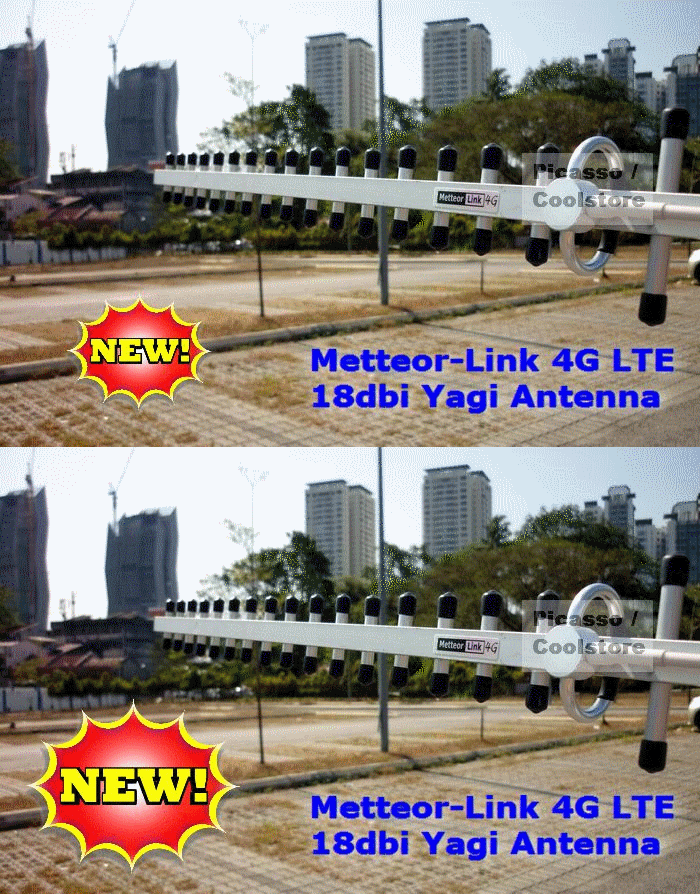
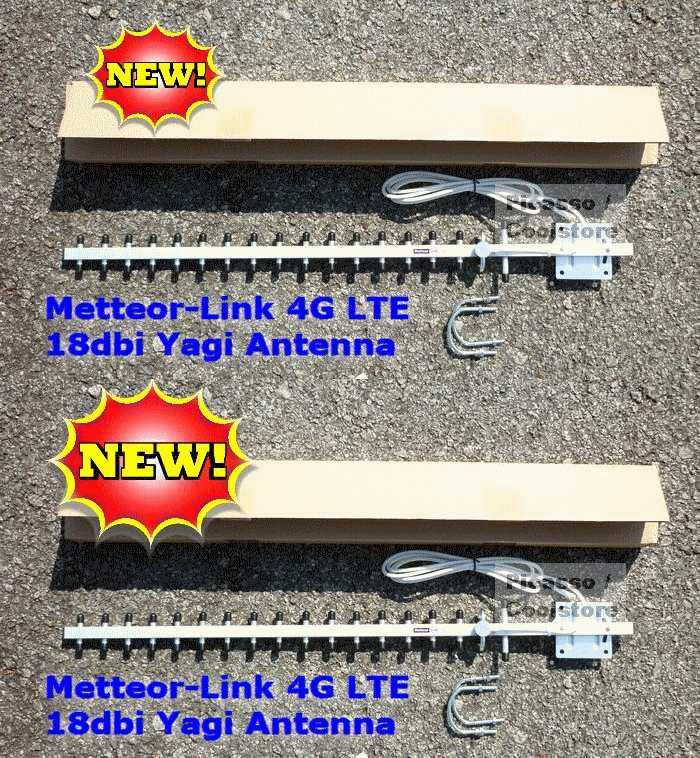
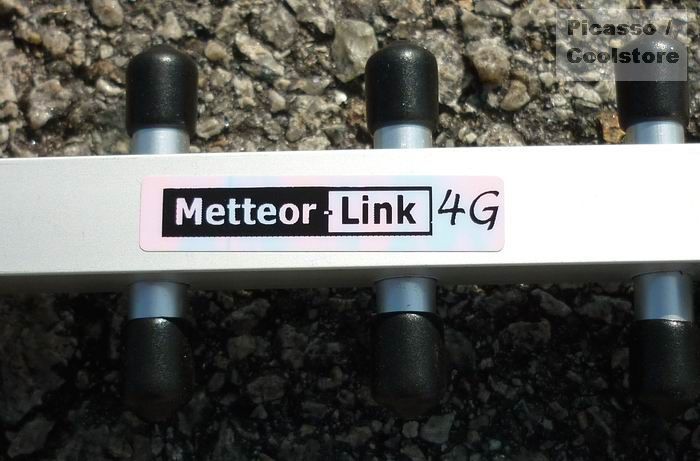
NEW: Metteor-Link 4G LTE 2.6GHz Yagi Directional Antenna 18dbi
****************************************************It is a
Dedicated LTE directional antenna, boosting high gain 18dbi for LTE 2.6GHz high speed band!
NOT generic wide band antenna with low dbi (< 10dbi) and no focus on specific frequency band.
True high gain 18dbi ~ King of LTE 2.6GHz antenna now! Ashame fake 35dbi panel from other factory!
Solving 2.6GHz LTE high frequency band poor indoor signal and smaller coverage problem!
Enjoy now the
fastest LTE band 2.6GHz instead of lower capacity band 1.8GHz!
Support
Maxis, Celcom, Digi, U-mobile, P1 TM , Yes, Redtone, Puncak Semangat LTE service!
Premium Grade antenna quality.
Outdoor type antenna that offering
superb durability. Put outdoor or indoor also can.
Solid aluminium body.
2.1 meter special fine tune cable length to meet 2.6GHz signal attentuation matter.
With
rp-sma connector that compatible with modem connector converter (crc9/ts9/sma converter cable)

 ===================================
LTE 2.6GHz (2600MHz) VS LTE 1.8GHz (1800MHz)
===================================Last year MCMC (SKMM) issued stern warning against telcos running 3G service at low band 900MHz instead of high speed 3G band 2100MHz. MCMC clearly indicated high frequency band brings about high capacity, speed and quality, whereas low frequency band meant for low capacity and quality. Running 3G at low band already jeorpardised Malaysia overall 3G service quality although coverage area has been improved. Telcos need to rectify this wrong-doing.
In 4G era now, there is also dual operating band locally: the common 2600MHz by all telcos and supplementary 1800MHz used by 2 telcos only. To avoid repeating the same tragedy of poor service running at low frequency band, MCMC has mandated 4G telcos to add in 1 new 2600MHz LTE base station for every 2 units of 1800MHz station in use. The 2600MHz high frequency band will deliver true lightning LTE speed and quality to end users justifying what users paying to telcos for 4G. 1800MHz is intended for handset low volume usage.
However high frequency band 2600MHz having weakness of much smaller coverage area and weaker indoor signal level compared to low frequency band such as 1800MHz. Therefore using external high gain 2600MHz LTE directional antenna to enjoy the benefits of 2600MHz LTE!
Full details about that MCMC news availble in "4G LTE Update information:" in no.#1 thread. Downloadable pdf file.
======================
Why pick Metteor-Link antenna?
======================Premium grade antenna made by tier 1 antenna pro factory. Not made by 2nd or 3rd class small factory in china.
Most local dealers sourcing overseas antenna stock by online purchasing without really been to the exact factory to do site survey:
a) quality of factory: small factory or large factory?
b) do they really have wireless engineers? how many workers there?
c) do they really equipped with advanced antenna making and testing pro machinery?
d) what are their standard Quality Control process?
d) do they ever manage to get western countries orders which require stringent antenna quality?
=================================================================
Why mention Metteor-Link 4G LTE yagi antenna 43dbi at title?
Reason: To combat with fake dbi antenna!
Comparison (1): Metteor-Link LTE 2.6GHz 18dbi yagi VS Fake 16dbi to 35dbi wide band antenna
=================================================================5 aspects analysis:
1st analysis: Relationship between antenna's size and dbi effect.
--------------------------------------------------------------------------------------------Rule of thumb: antenna physical size always commensurate with actual dbi effect.
Means: smaller size antenna = lower dbi, larger size antenna = higher dbi.
Therefore, no such thing small size (toy style/mini size/palm size) antenna can provide 20dbi or 30dbi or more, that are shameless fake dbi marking! (please download and read common Q&A pdf for details about this)
Now comparing physical size of 18dbi LTE yagi with some fake high gain dbi 4G antenna in market.
Metteor-Link 4G LTE 2.6GHz yagi 18dbi
VS brand W so-called 35dbi antenna (model: W435) (seems big in advertising photo ya...)
VS brand W so-called 25dbi antenna (model: W425) (seems big in advertising photo ya...)
VS brand W so-called 22dbi antenna (model: W422) (seems big in advertising photo ya...)
VS brand W so-called 16dbi antenna (model: W416) (seems big in advertising photo ya...)
Now, see the clear size gap!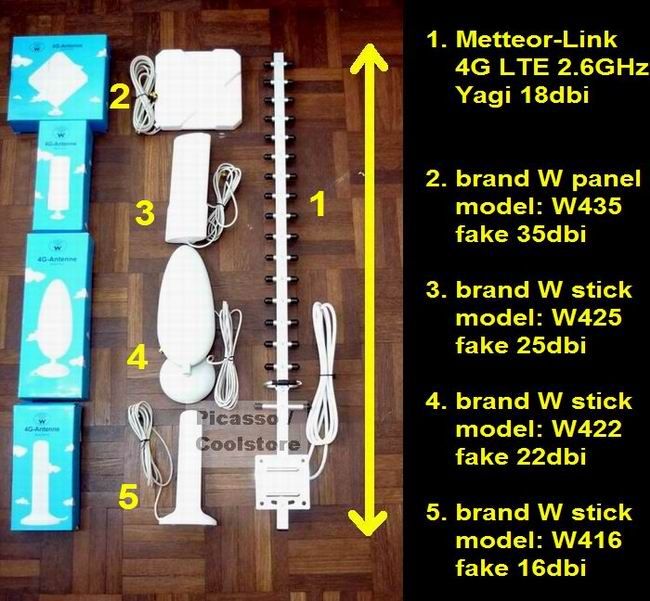
Results:
At this preliminary stage, based on the size of external plastic casing, that so-called 35dbi panel antenna should be around 10dbi only. Those so-called 16dbi, 22dbi, 25dbi stick antenna are around 5dbi to 8dbi. The size tells.
To be right, this physical test actually
should be judged on the size of internal antenna core components, which means should open up the plastic casing and seeing the size of internal antenna components because the real antenna core may even much smaller than plastic casing. The plastic casing do nothing but protecting internal core only. It is the internal actual antenna core that responsible for signal transmission/receiving thing. You may get shocked if u find out the internal actual antenna components are like these size/shape only...
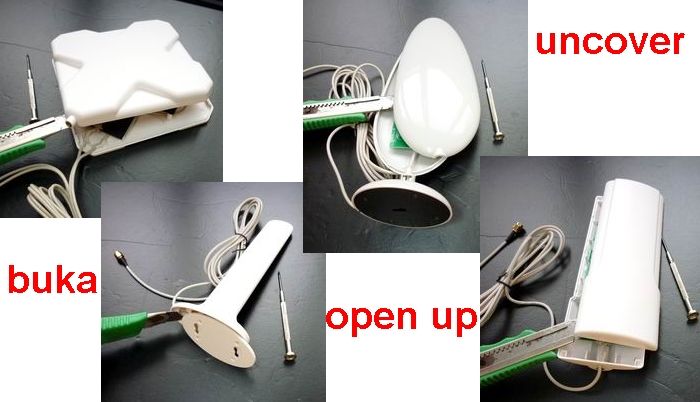 IN SHORT:
THAT SO-CALLED 35DBI PANEL = no more than 10DBI, METTEOR-LINK 4G YAGI = 18DBI, 8DBI HIGHER.
SO, IF YOU STILL BELIEVE IN THAT BRAND W ANTENNA GOT 35dbi, THEN JUST ADD 8DBI TO METTEOR-LINK YAGI TO 'MAKE IT' BECOME 43dbi ANTENNA!  2nd analysis: Relationship between wide frequencies band (MHz) and dbi.
-----------------------------------------------------------------------------------------A wide band antenna supports from low xxx MHz up to high xxxx MHz would provide different dbi level at different frequency stage. E.g. 5dbi at low 800MHz and 7dbi at upper 2100MHz. It can not keep provide a same dbi level throughout all low frequency to high frequency.
So it is IMPOSSIBLE AND RIDICULOUS that claim a wide band antenna got fixed/same XX dbi for all frequencies from 700MHz to 2600MHz (fake information).
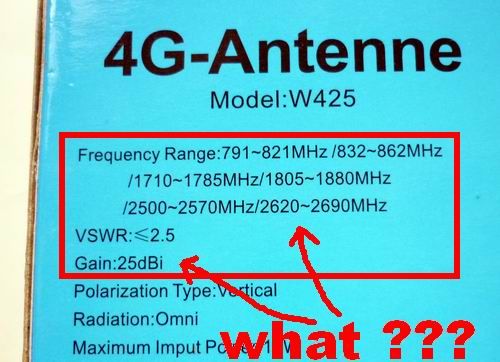 The above 2 comparisons indicates that fake dbi label and inacurrate dbi with frequency bands information are clearly dishonest antenna product/manufacturer.3rd analysis: VSWR value.
--------------------------------Apart from dbi analysis, VSWR value is important specification as well. Do u notice brand W antennas with VSWR value <2.5?
VSWR value: the lower the better. The ideal value is 1, but never possible in making antenna. Better antenna are always in range of <1.5, some other antenna may come with <2.0. This <2.5 is really considered under par.
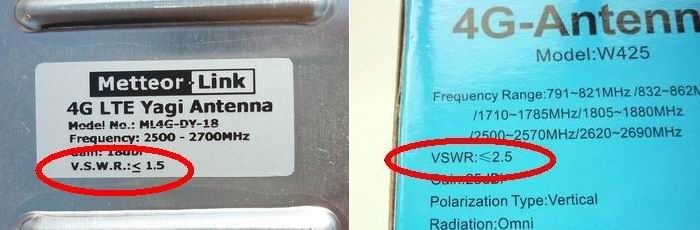 4th analysis: thick and thin cables.
-------------------------------------------Brand W antennas use thin cable RG174 (cost cutting) which causes higher signal loss per meter, whereby yagi antenna comes in RG58 thicker cable with less signal loss.
 5th analysis: the mounting accessories.
-----------------------------------------------Brand W antenna bundled with a low quality rubber suction cap, whereby pro-antenna manufacturer would only use standard alloy/steel mounting kit. Using this kind cheap suction cap more likely an insult to their antenna industry.
 =============================================
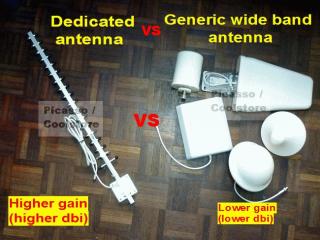
Comparison (2): Dedicated Antenna VS Generic Wide Band Antenna
=============================================What are them?
Dedicated antenna are made
specifically for a wireless frequency band to meet a wireless standard, say for ~2100MHz 3G, ~2400MHz WIFI, ~2600MHz LTE. They are
capable of providing high gain dbi over 10dbi and more!(but antenna size will be much bigger). Also they are having
better VSWR level.
Generic wide band antenna are
not specific to meet any wireless standard, they support wide range from low frequency xxx MHz up to xxxx MHz, e.g. from 800-2500MHz, from 700MHz to 2700MHz. Because of covering these wide distances frequencies, they
cannot offer high dbi, generally up to 10dbi limit only. And
lack of strict control of VSWR level.
 ===============================================================
Comparison (3): Metteor-Link LTE 2.6GHz yagi VS 3G 2.1GHz yagi, WiFi 2.4GHz yagi antenna
===============================================================Physically, different frequency yagi would have different elements design structure: the length and the gap.
So, you can see LTE 2.6GHz (2600MHz) yagi, WiFi 2.4GHz (2400MHz) yagi, 3G 2.1GHz (2100MHz) yagi
are all different product because of different frequency wave pattern.
To achieve high gain effect like 18dbi, use correct frequency antenna for specific wireless standard respectively. Using wrong frequency antenna for different wireless standard will see minimal or even no gain results.
 ======================================
4G LTE gadgets that work with Metteor-Link 4G antenna:
======================================a) Connect to
USB 4G LTE modem that with ready made external antenna connector, connect via a converter cable.
E.g. Huawei E3272, E3276, E398, E392, Vodafone K5005, Sierra 320U, 330U, etc.
b) Connect to
USB 4G modem that without ready made external antenna connector, connect by either soldering a pigtail cable into the internal board or using a specific converter cable.
E.g. ZTE MF820, etc.
c) Connect to
portable battery powered 4G LTE MIFI with ready made external antenna connector, connect via a converter cable.
E.g. Huawei 5776, Huawei E5372, ZTE MF91D, ZTE MF93Detc.
d) Connect to
portable battery powered 4G LTE MIFI without ready made external antenna connector, connect by either soldering a pigtail cable into the internal board or using a specific converter cable.
e) Connect to
4G desktop CPE gateway (all in one 4g modem + router + wifi) with ready made external antenna connector, connect via a converter.
E.g. Huawei B593.
f) Connect to
4G Repeater/Booster.
===================================
Antenna setup : Single or Dual (MIMO) LTE antenna
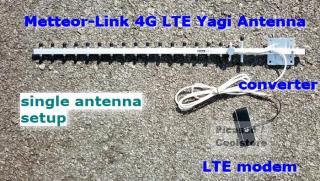
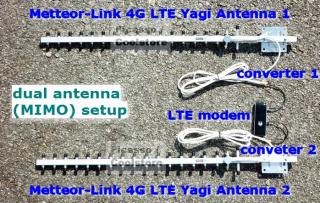
===================================Nowadays LTE modem mostly come with dual external antenna support because adopting MIMO technology, the same advanced feature in modern wifi.
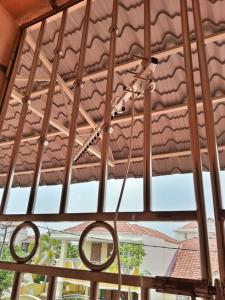
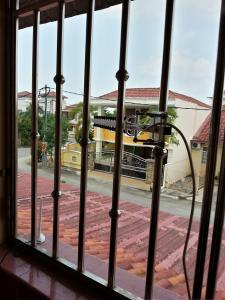
You may use only 1 4G external antenna, like this:
Or the best equip 2 4G external MIMO antenna, like this:
 =========================
Metteor-Link Antenna Testimonial
=========================Purpose: To ascertain the effectiveness of external 4G antenna Metteor-Link
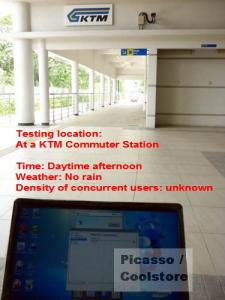
1) Location: KTM Commuter Station.
Time: Daytime afternnon.
Weather: shinny, no rain.
Density of Concurrent users on same base station: unknown.
Distance from base station: unknown.
2) LTE operator: Maxis 4G.
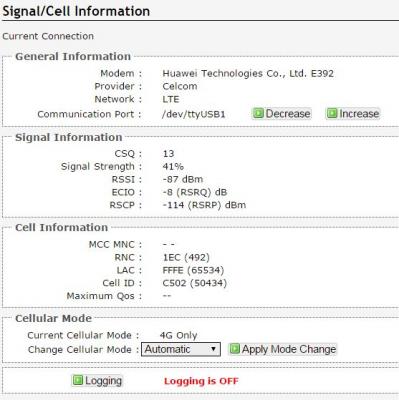
Modem: Huawei usb modem E392u-12
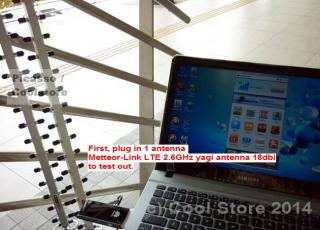
Antenna: Metteor-Link LTE 2.6GHz yagi antenna 18dbi
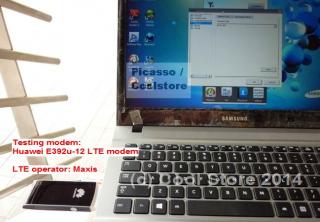
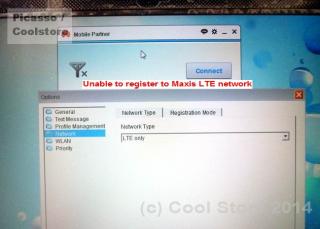
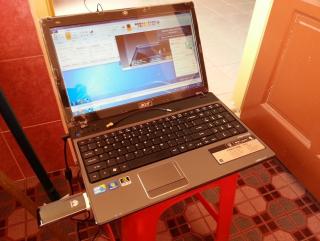
3) By using usb modem alone, it cannot even register to maxis 4G network.
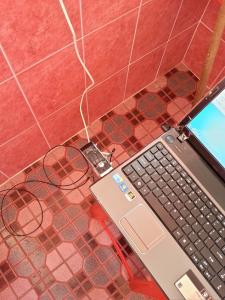
4) Unplug the modem, put in 1 Metteor-Link LTE antenna. Retry. Now it can register to Maxis 4G network! And with very good signal level.

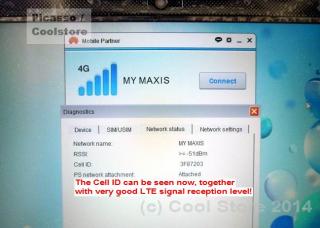
5) Next, it also can connect (dial up) to Maxis 4G network now!
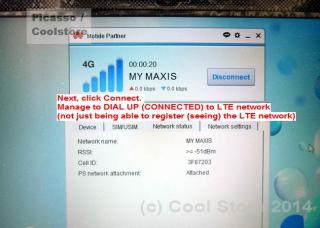
6) Did one time speed test, connection stable!
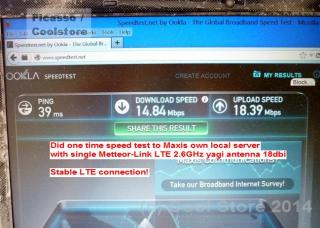
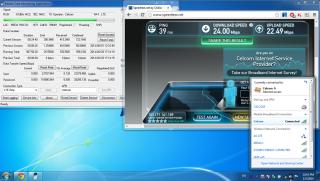
7) Now try with 2 Metteor-Link LTE antenna and did another speed test.
The results is pleasing with increased download speed and lower ping value! Thus dual antenna setup is ideal for LTE optimum performance!

 =========================
Metteor-Link LTE Yagi Specifications:
=========================Brand: Metteor-Link
Model No.: ML4G-DY-18
Frequency: 2500MHz~2700MHz
Gain: 18dbi
Horizontal Beamwidth: 26 degree
Vertical Beamwidth: 26 degree
Connector: RP-SMA
Cable: RG58/U 2.1 meter
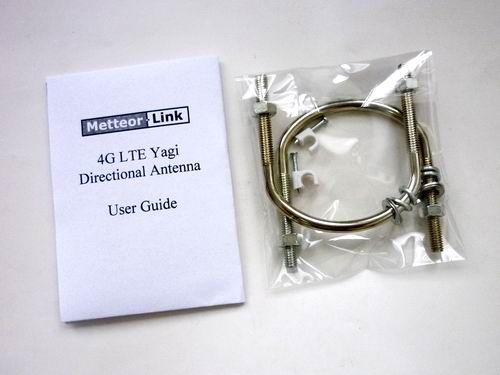
Accessories: Adjustable up/down mounting kit! *** (adjustable tilt direction, so that you can point upwards/downwards easily)
cable 2.1 meter? so weird?
~~~~~~~~~~~~~~~~~~Having read through 'common Q&A' pdf file yet? If not, pls download and read the 'I want to extend cable, please advise.' section.
LTE 2.6GHz is a higher frequency band which means any type of cables will render higher signal loss per meter compared to wifi 2.4GHz or 3G 2.1GHz.
So, Metteor-Link aleady fine tune and balancing between the needs for cable length and performance impact matter. Thus 2.1 meter RG58/u cable is economic yet ideal length, no more hassle!
===========
Price & Dealing:
===========18dbi 4G LTE yagi (Metteor-Link) = 1 antenna RM80 each, 2 antenna RM75 each
Adapter cable or adapter connector = RM9
Poslaju for single antenna package: RM9 Peninsular / RM13 Sarawak / RM15 Sabah
Poslaju for two antenna package: RM15 Peninsular / RM20 Sarawak / RM25 Sabah
COD available in KL at my preferred location only (free of charge).
PM Me or SMS/Whatsapp: zero one six -9963861This post has been edited by coolstore: Sep 7 2016, 10:28 PM 


 Apr 11 2014, 08:24 PM, updated 9y ago




 Quote
Quote



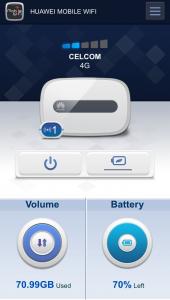
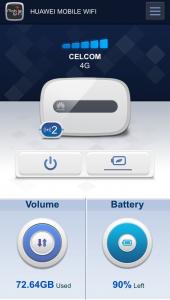

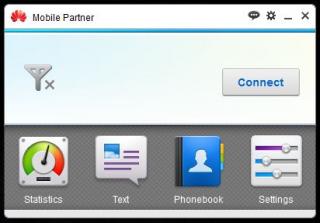




 can tell me bro ?


 :
:
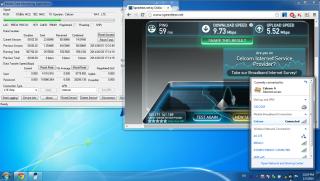
 sometimes i get until -57dbm too


































 0.2148sec
 0.64
0.64
 6 queries
 GZIP Disabled