“ Tamadun Awal Jepun : Orang Wa Perintis Pembinaan Peradaban Negara Bangsa Yamato ”
Jaafar Jambi
Abstract : Since the exodus of the Asian people to the island of Japan various knowledge and technologies from the mainland were introduced to the new world. These knowledge and technologies had been used wisely through the process of assimilation and adaptation toward the new environment. The outcome of this processes were the emerging of a new breed of people called Wa. The people of Wa started building their country‟s civilization beginning from the unification the Uji groups to the setting up of a country called Yamato. The Yamato reached a civilized nation status when it fulfilled the basic criteria of civilization which include criteria such as there must be a human residence and a few city centres, stable life span of the people, existence of social organizations and institutions and other characteristics.
Keywords : Negara Yamato, Jepun, orang Wa, Negara China, Asas Peradaban
Pengenalan
Negara Jepun merupakan sebuah kepulauan yang terletak di timur benua Asia yang mengandungi empat pulau utama iaitu Hokkaido, Honshu, Shikoku dan Kyushu dan empat ribu pulau-pulau kecil. Kepulauan Jepun memanjang dari hujung sebelah utara sehingga hujung sebelah selatan yang berukuran lebih kurang 3000 kilometer. Keempat-empat pulau utama itu merupakan tumpuan tempat tinggal dan aktiviti penduduk Jepun.1
Kepulauan Jepun terletak di garisan latitud 45° 33‟ utara dan 20° 25‟ selatan, di garisan longitud 122° 56‟ timur dan 153° 59‟ timur. Kepulauan ini mengalami iklim hawa sederhana dengan empat musim iaitu dari Julai ~ September adalah musim panas, Oktober ~ Disember adalah musim luruh/gugur, Januari ~ Mach adalah musim sejuk dan April ~ Jun adalah musim bunga.
Kepulauan Jepun terletak dalam lingkaran gunung berapi aktif Asia Pasifik. Oleh yang demikian hasil daripada aktiviti gunung berapi ini terdapat banyak gunung berapi dan kawasan bergunung ganang yang terbentuk di negara Jepun. Kawasan pergunungan ini meliputi kawasan yang luas menyebabkan kawasan tanah rata sangat sedikit sekali. Hanya 30 peratus sahaja kawasan rata yang membolehkan aktiviti manusia dijalankan dan di kawasan yang kecil inilah orang-orang Jepun tinggal dan menjalankan kehidupan seharian mereka.
Catatan Awal Berkenaan Negara Jepun
Pada kurun ke 3 M penghijrahan manusia telah berlaku daripada semenanjung Korea ke kepulauan Jepun. Beberapa kurun kemudian mereka telah menukar budaya zaman batu mereka kepada budaya pertanian dan seni logam. Dapat dipastikan bahawa kumpulan yang pertama inilah yang menjadi pewaris bahasa dan budaya Jepun.
Catatan sejarah tentang negara Jepun ini banyak didapati daripada catatan-catatan oleh pencatat-pencatat kerajaan negara China. Pada 82 M, catatan terawal tentang negara Jepun adalah catatan yang menyebut mengenai orang Wa (ŒT) yang dikatakan tinggal di pulau-pulau seberang laut dari Loulang, sebuah pangkalan tentera China di utara semenanjung Korea. Mengikut catatan kedua dalam The History Of later Han pada 445 pula menyatakan,
“ According to Hou Han Shu (The History Of Later Han) compiled about 445), the Chinese emperor Guangwu presented a seal and a ribbon to the Wa ruler of Na, thought to have been located in north Kyushu ”.
Berkaitan dengan it mohor (seal) yang tertulis “ Raja wilayah Na dalam negara Wa di bawah naungan Dinasti Han ” yang disahkan kesahihannya telah dijumpai dekat Shikanoshima di Fukuoka wilayah Kyushu.
Negara Jepun telah mengadakan perhubungan dengan negara China sejak 200 M lagi dan telah menjadikan negara China sebagai negara perlindungannya. Keakraban kedua-dua negara ini telah memperlihatkan aktiviti peniruan di pihak negara Jepun dari segi bentuk kerajaan, agama Buddha dan sistem tulisan daripada negara China. Catatan-catatan ini merupakan tulisan utusan-utusan kerajaan negara China yang dihantar ke negara Jepun.
“ When they (Japanese) go on voyages across the sea to visit China, they always select a man who does not comb his hair, does not rid himself of fleas, lets his clothing get as dirty as it will, does not eat meat, and does not lie with women……. ”
(Ganley A.C, 1989:15)
Catatan di atas telah diterbitkan pada 297 M yang menerangkan keadaan orang Jepun apabila mereka datang melawat negara China. Walaupun perhubungan dengan negara China sudah terjalin tetapi tidak meluas kerana kerajaan Yamato (kerajaan pertama negara Jepun) masih belum terbentuk. Kalau di banding dengan orang China, orang Jepun yang digambarkan di atas itu sangat mundur dan mempunyai pemikiran yang karut. Mereka percaya jika perjalanan mereka selamat orang hodoh yang digambarkan di atas itu akan diberikan hadiah dan jika perjalanan mereka ditimpa bencana dan kecelakaan, orang itu akan dibunuh kerana dikatakan melanggar pantang.
“ When lowly meet men of importance on the road, they stop and withdraw to the roadside. In conveying messages to them or addressing them, they either squat or kneel with both hands on the ground. This is the way they show respect. When responding, they say „ ah ‟ , which corresponds to the affirmative „yes ‟. ”
(Takeuchi L, 1999:2)
Di dalam satu lagi catatan yang direkodkan pada 297 M juga pencatat kerajaan negara China ada melaporkan tentang bagaimana orang Jepun memberi hormat kepada seseorang yang mempunyai status yang lebih tinggi daripada mereka. Mereka samada akan mencangkung atau pun melutut dengan kedua-dua tapak tangan di tanah sambil menyahut pertanyaan dengan berkata „ ah ‟ yang bererti „ ya ‟.
Catatan-catatan di atas merupakan catatan yang dilakukan oleh utusan atau wakil kerajaan negara China. Negara China merupakan negara luar yang pertama yang mempunyai perhubungan dengan negara Jepun sebelum pembentukan negara Jepun awal iaitu negara Yamato. Pada ketika itu masyarakat Jepun hidup dalam kumpulan-kumpulan masyarakat yang dikenali sebagai uji seperti mana yang tertera di bawah ini.
“During the reigns of Huan-ti (A.D. 147-168) and Ling-ti (A.D. 168-189) the country of Wa was in state of great confusion, war and conflict raging on all sides. For a numbers of years, there was no ruler. Then a woman named Himiko appeared. Remaining unmarried, she occupied herself with magic and sorcery and bewitched the populace. “
(Ganley A.C, 1989:16)
Catatan ini telah diterbitkan pada 445 M. semasa pemerintahan Maharaja Huan-ti dan Ling-ti di China. Utusan kerajaan telah melaporkan tentang keadaan huru hara negara Wa (Jepun kuno) dalam kancah peperangan dan ketidakstabilan. Setiap uji mempunyai seorang ketua (perempuan atau lelaki) dan beberapa orang pembantu bagi mentadbir kumpulan mereka. Semua kumpulan uji ini mengamalkan animisme dengan mempunyai kami (tuhan) yang berbeza-beza mengikut kumpulan uji. Oleh kerana setiap uji mempunyai pentadbiran yang berbeza-beza maka salah faham tentang wilayah sering membawa kepada peperangan. Peperangan di antara uji ini kerap berlaku sehingga Himiko (seorang ketua kumpulan uji perempuan) dapat menguasai kumpulan-kumpulan uji yang lain dan memerintah kumpulan yang besar itu dengan menggunakan ilmu hitam dan ajaran karut untuk menakut-nakutkan ahli masyarakat supaya patuh kepadanya.
Berdasarkan kepada kenyataan-kenyataan di atas dapat dilihat bahawa perhubungan antara negara Jepun dengan negara China telah terjalin sejak dari awal lagi. Negara China pada ketika itu telah pun menjadi sebuah masyarakat yang bertamadun tinggi. Oleh yang demikian segala urusan dengan negara luar telah direkodkan. Catatan di atas menunjukkan bahawa maharaja China berkenan memberikan hadiah yang merupakan lambang persahabatan di antara kedua negara. Perhubungan ini telah mendatangkan banyak kebaikan kepada pihak negara Jepun di mana maharaja-maharaja yang memerintah Jepun telah meniru cara atau gaya orang China dan Korea mentadbir negara. Di bawah adalah catatan mengenai kehidupan orang Jepun pada masa itu.
“There are about 100,000 households. It is customary to punish murder, arson and adultery with death. Thieves are made to make restitution in accordance with the value of goods stolen. ……. . As for musical instruments, they have five-stringed lyres and flutes. Both men and women paint marks on their arms and spots on their faces and have their bodies tattoed. They catched fish by diving into the water. They have no written characters and understand only the use of notched sticks and knotted ropes. ”
(Ganley A.C, 1989:16)
Catatan wakil utusan kerajaan negara China pada 630 M yang melaporkan tentang kegiatan kehidupan masyarakat Jepun. Masyarakat Jepun pada masa itu berjumlah sebanyak 100 ribu keluarga dan mereka juga mempunyai peraturan-peraturan mengenai hukuman mati terhadap pembunuhan, pembakaran rumah dan perzinaan. Dicatatkan juga alat-alat muzik yang dimainkan oleh orang Jepun iaitu alat muzik petikan dan seruling. Rupa bentuk orang Jepun juga diterangkan di mana orang lelaki dan perempuan mewarnakan tanda di tangan mereka dan menandakan tompok-tompok di muka serta membuat “ tattoo ” di badan mereka. Mereka menangkap ikan dengan menyelam. Mereka tidak mempunyai sistem tulisan dan berhubung dengan menggunakan tanda takekan di kayu serta ikatan kayu.
" 신라는 倭의 속국 " Silla was a vassal state of ancient Japan
2011-08-23
(서울=연합뉴스) 김태식 기자 = 한국 고대사 연구의 제1급 사료 중 하나로 간주되는 양직공도(梁職貢圖)에서 영영 사라졌다고 간주된 신라와 고구려에 대한 간략한 설명인 제기(題記)가 최근 발견됐다. 특히 이번에 발견된 신라에 대한 제기에는 신라가 왜(倭)의 속국이라는 구절이 있어 이른바 임나일본부설과 맞물려 논란이 일 전망이다.
Lian dynasty’s official history states " Silla was a vassal state of Japan "
An emissary from the kingdom of Langkasuka, details from a larger Chinese painting showing various emissaries to the Chinese court of Liang dynasty (502–587).
Selepas Qin Shihuang menjadi maharaja, beliau cuba hidup abadi. Beliau mendapat maklumat bahawa dalam Laut Bohai ada gunung kayangan dan ubat mukjizat hidup abadi. Maka beliau menghantar ahli nujum mencari ubat tersebut. Yang terlebih dahulu dihantar oleh Qin Shihuang mencari ubat itu ialah Lu Sheng. Lu Sheng bertolak dari Jieshi iaitu Pulau Qinhuangtao hari ini, tapi gagal mendapati ubat tersebut. Sekarang dalam Taman Dongshan di bandar Qinhuangtao masih ada tempat tinggalan sejarah tentang cerita itu. Pada tahun 1992, patong batu geranit warna hitam Qin Shihuang yang setinggi 6 meter dan seberat 80 tan telah tersergam di Taman Dongshan.
Lu Sheng gagal mendapati ubat mukjizat hidup abadi, Qin Shihuang menghantar lagi Xu Fu mencari ubat tersebut. Selepas Xu Fu pertama kali pulang selepas mencari ubat tersebut, beliau menyatakan bahawa beliau telah naik ke Gunung Fenglaixian dan melihat ubat mukjizat hidup abadi, akan tetapi dewa dalam gunung itu meminta beliau membawa lebih banyak cendera mata baru boleh membawa balik ubat tersebut dan mengatakannya jika hendak mendapati ubat mukjizat hidup abadi, mesti menghantar muda mudi dan tukang kraftangan. Qin Shihuang berasa sangat gembira selepas mendapat maklumat bahawa Xu Fu sudah melihat ubat mukjizat hidup abadi, dan segera memilih 3000 muda mudi dan beberapa tukang kraftangan kepada Xu Fu dan mengarahnya mengambil balik ubat mukjizat hidup abadi tersebut. Xu Fu gagal lagi mendapati ubat itu dari laut dan memberitahu Qin Shihujang konon kali ini gagal disebabkan ada ikan besar dalam laut, menghalangi kapal mendekati gunung kayangan, jika hendak pergi ke gunung itu, mesti dilengkapi pemanah mahir dan senjata maju. Seketika itu, Qin Shihuang bermimpi beliau bertempur dengan dewa laut, menurut penjelasan profesor nujum, dewa laut itu justeru lambang ikan besar. Maka Qin Shihuang percaya perkataan Xu Fu, dan menghantar pemanah dan menyediakan senjata kepada Xu Fu dan sendiri mengikuti kapal ke laut. Semasa kapal berlayar di tempat berdekatan Pulau Zhifu, telah nampak seekor ikan besar, Qin Shihuang sendiri membunuh ikan tersebut dan berpendapat tidak ada rintangan lagi menuju ke gunung kayangan. Tapi gunung kayangan dan ubat mukjizat tidak didapati, Xu Fu tidak berani menemui Qin Shihuang lagi. Beliau membawa 3,000 muda mudi dan sekumpulan tukang kraftangan telah pergi ke Jepun dan hidup di sana. Akhirnya, Xu Fu meninggal dunia di kawasan Gunung Fujishan Jepun. Di Jepun, ada legenda dan catatan tentang Xu Fu, ada sarjana berpendapat bahawa Xu Fu ialah raja Shenwu yang terkenal dalam sejarah penubuhan negara Jepun. Rakyat Jepun juga menyanjung Xu Fu dan menghormatinya sebagai “ dewa pertanian ” dan “ dewa ubat-ubatan ”. Bekas tempat Xu Fu termasuk makam, istana, batu dan tugu peringaatan Xu Fu dipelihara di Jepun setakat hari ini. Pada tahun 1991, rakyat Jepun juga mendirikan sebuah Taman “ Jalan Xu Fu ” di Ken Saga. Pada musim gugur setiap tahun, rakyat ken Saga akan menyumbangkan padi kepada patong Xu Fu. Upacara yang meriah juga akan diadakan setiap 50 tahun untuk memperingati Xu Fu.
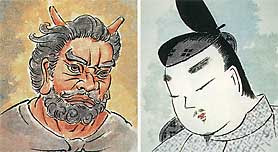
If you're currently staying in Japan, take close looks at faces of Japanese. Typically it is possible to categorize them into two :
The hairy face in the left is called " Jomon " face while the flat one " Yayoi " face. The terms you're going to remember are just two this time.
We tend to think that Japan is a unified country composed by a single race. However, Japanese people have been formed after thousands years of racial mixture between two, Jomon and Yayoi.
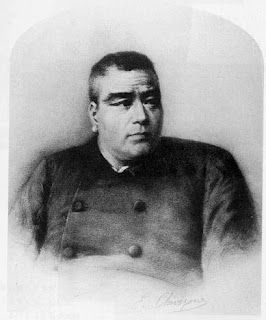
How about him below ? He is a typical kind of Jomon people. He was a popular leader of Kagoshima prefecture, southern part of southern island (Kyushu).
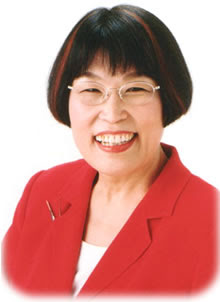
Then how about the woman below ? Please notice her characteristics such as thin eyes or big front teeth. Yes, that's a Yayoi face.
The Japanese rightist
Sunday, April 15, 2007 The faces of Japanese
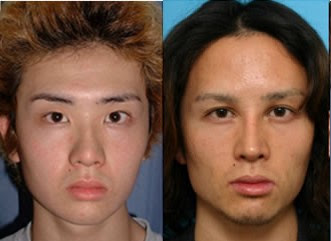
If you're currently staying in Japan, take close looks at faces of Japanese. Typically it is possible to categorize them into two:
The hairy face in the left is called "Jomon" face while the flat one "Yayoi" face. The terms you're going to remember are just two this time.
We tend to think that Japan is a unified country composed by a single race. However, Japanese people have been formed after thousands years of racial mixture between two, Jomon and Yayoi.
How about him below? He is a typical kind of Jomon people. He was a popular leader of Kagoshima prefecture, southern part of southern island (Kyushu).
Then how about the woman below? Please notice her characteristics such as thin eyes or big front teeth. Yes, that's a Yayoi face.
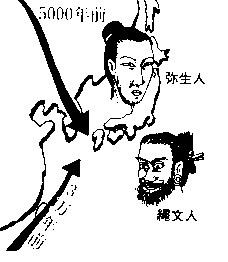
It is found from recent studies that the Jomon was a conquered race after the Yayoi gradually spreaded to the entire Japan (about B.C. 300 to A. D. 300). However, you can easily find the native Japanese, the Jomon, if you'd have a chance to visit Okinawa or Hokkaido. Of course there are a lot of people with " jomonized " features in the main island, too. But the pure Jomon are already almost extinct in the places where the traffic has been great. (The figure below indicates that the Jomon came from the south. However, there's another perspective that they came from North through Sakhalin. Either way, the history of the Jomon must have been quite old.)
Recently, Japanese have been suffering from a huge identity crisis : although they are identified by their Yayoi faces, the wintry-looking, mongol-oriented face tends to be repelled. Especially, plastic surgery for eyes, cutting " Mongolian fold ", is getting popular. The mongolian fold functioned to protect their tear duct with the thick eyelid, but the physiological need has disappeard. High cheekbone is another hated property the Yayoi have.
Look at the picture above. Can you believe that's the same person ? The main magic is cutting the " folds ", the eyelids, that cover a large portion of your eyes. This process exposes his lacrimal glands. The inclination to the plastic surgery we see these days was said as yearning for European. Regardless of which type they are craving for, European or Jomon, it's sure they have many complaints about what they inherited from their ancestors.
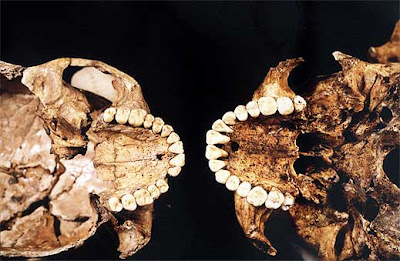
Another annoying part they hate is their teeth. Many Japanese have uneven teeth. Funnily, Korean or Chinese sometimes distinguish themselves from Japanese by the teeth. They have better evenness! The uneven teeth is a result of the race mixture as you might suspect. The size of the jaw from one race doesn't match the size of the teeth from the other race. My case by the way is OK. I have a combination of a big jaw and big teeth.
The above picture visually shows the difference of jaws and teeth between the Jomon (left) and Yayoi (right). If someone inherited a small jaw and big teeth as a result of blood mixture, they end up having very uneven teeth.
An old K forummer even concurred that there was also a documentary in History Channel which said that the first explorer who later become the first emperor was from a hokkien community. Because it is a paid channel , i didnt went to search for it.
Korean punya Claims......
China 中共 and Southern Asia were colony of Baekje, Korea 중공은 한민족 식민지
'Heukchi' means the land where people with Black Teeth live. ...The land to where the ancestors of Heukchi was sent as the governor of the land was hot humid southern land, somewhere in southern Asia
WHEN ninth-century Japanese monk Shinnyo (Imperial Prince Takaoka (799-881) left China on Jan 27, 865, to study Buddhism in India, it did not cross his mind that his final resting place would be a province on the southern tip of the Malay peninsula.
PRINCELY PRESENCE: A monk conducts a prayer session at the grave of Shinnyo at the Japanese Cemetery in Johor Baru. — Picture provided by the Japan Club of Johor
Although the exact location of his remains is unknown, there is a memorial headstone and shrine in honour of Shinnyo at the Japanese Cemetery in Johor Baru.
Born in 799, Prince Takaoka, as he was known at birth, was the third son of Emperor Heizei.
Although he later rose to become crown prince, Takaoka lost the designation. He then retired to become a monk in 822, taking the name Shinnyo.
Records state that while studying Buddhism in China, he decided to go to India to study the religion further and set out in 865 from Kwang Chu (probably modern-day Guangzhou).
Shinnyo, however, never reached his destination and at age 67, died in 866 in what is now Johor.
And for that reason alone, the headstone at the cemetery in Jalan Kebun Teh could be the oldest record of Japanese presence in Malaysia.
Japan Club of Johor secretary-general Nishikawa Takeshi said it was a mystery how Shinnyo ended up in Johor.
“It’s possible that he may have lost his way. Or perhaps he really did intend to stop here.
“All we know is that he never fulfilled his dream of going to India.
HONOURING THE DEAD: A boy and his father pray and place flowers at a grave at the Japanese cemetery.
“Because of the hardship he went through, in 1970, the head monk in Shinnyo’s order honoured him with this plaque.”
According to the club’s records, the cemetery was discovered in 1962 when development work was carried out in the area.
When the land was cleared further, 80 gravestones with Japanese writing were found, most of them broken.
Takeshi also points to an order dated April 13, 1924, by the Japanese government for the local Japanese community to manage and maintain the site.
“We believe that the cemetery was started by the community because they needed a place for their deceased.
“This means that Japanese were already staying here at the time.”
Research is consistent with this notion because there are records of Japanese businesses in Johor involved in the mining, commerce and plantation industries in the 1920s.
In fact, Johor had enjoyed good relations with Japan in the 19th century when Sultan Abu Bakar visited the country in the early 1880s.
Ties, it is reported, were strengthened when his son, Sultan Ibrahim, was bestowed an award by Emperor Hirohito.
Takeshi said since 1992, the Japan Club of Johor had been receiving monetary support from the Japanese embassy in Kuala Lumpur to manage and maintain the cemetery, which is cleaned every month.
“We also hold prayer sessions to honour the deceased twice a year, usually in March and September. We invited a praymaster from Japan to do this.”
Kofun Period dress is a clay figure from the burial mound and see. The women's wardrobe, men are saying and hakama garment, similar to the current suit. Feature in the previous match in the ceremony, the left anterior neck strap to fit in with a single point.
Asuka Era (645 - 710)
Asuka period, Buddhism was introduced, Tang-style clothing and textiles are used now. Both women are in short robe with long sleeves this one, there are two. The man's head is a crown of his head, the machine's claws-collar territory of wearing it long to scrap the waist, under a ceremonial skirt Yes.
Nara Era (710 - 794)
Yoro Code introduced, Copying Tang Lu (The Tang Dynasty Code)
Heian Era (794 - 1192)
Heian period clothing materials, silk aristocracy in the center. Hemp clothes are popular mainly in the silk is not permitted. From the era of Japanese-made climate-friendly as kimono. Women's clothes are of lesser juni-hitoe robe and beard, the wife formal costumes or costumes tone.The man was dressed.
Kamakura Era (1192 - 1333)
Kamakura period since the mid-term, on behalf amateurish way of a national dress.


 Aug 18 2013, 05:54 PM


 First emperor of japan was a hokkien
  Quote
Quote




 0.0162sec
 0.74
0.74
 6 queries
 GZIP Disabled