Welcome Guest ( Log In | Register )

Bump Topic Topic Closed RSS Feed

Outline · [ Standard ] · Linear+

 V11 - Property Prices Discussion, Intelligent debates only pls

views
     
cockee
post Jul 2 2013, 04:03 PM

Casual
***
Junior Member
416 posts

Joined: Apr 2008
Wealth is important but doesnt necessary reflects the quality of life. I knew a colleague who owned 5 properties but taking bus to work everyday. When we go for better food during lunch he always wont join (unless someone treating) because he wanted to save money. Last I heard, he suddenly passed away. He died a rich man, but lived his life like a poor man. What s the point?
cockee
post Jul 2 2013, 04:19 PM

Casual
***
Junior Member
416 posts

Joined: Apr 2008
QUOTE(AmayaBumibuyer @ Jul 2 2013, 04:08 PM)
Well thats not gonna be me. I dont save money, i spent it. I dont take bus, i take taxis. Just not gonna spend my money on cars....yet.
*
No sir I am not referring to you personally. Sorry if there is any offence.
My point is everyone has their own views towards happiness. Taking taxi is fine for someone, but a waste of time for others. Some enjoy dumping money into properties and see their wealth grow. Some enjoy driving around in a BMW instead of buying more properties. From financial perspective the former is smarter than the latter. But from enjoyment of life perspective, the latter could be wiser.
The problem is many forummers have a narrow point of view; either you are wrong or I am right kind of mentality. And making too much assumptions about the other parties.
I am from a DDD camp but doeant mean I think prices of ALL properties will come down, or there is no good buy in the market now. Nor affordability is an issue to me.
cockee
post Jul 2 2013, 04:36 PM

Casual
***
Junior Member
416 posts

Joined: Apr 2008
QUOTE(EddyLB @ Jul 2 2013, 04:25 PM)
Are you not having a narrow point of view too ?  laugh.gif

He may die a happy man. Just because he doesn't spend (like we did), doesn't mean he is not happy

Sometimes we put our value unto someone else's. And say they are wrong. But in life, there is no right or wrong  thumbup.gif

This thread is getting into cars, and now into philosophy too  laugh.gif
*
Err.. make make you said I have a narrow point of view?

Did I said that guy is wrong? Did I said he was not happy? I disagreed with his choice of lifestyle, but respected and did not condemn it. Then I asked a rhetoric question, to emphasize my opinion.

Your statement above is an example of jumping into conclusion. rolleyes.gif
cockee
post Jul 10 2013, 09:57 AM

Casual
***
Junior Member
416 posts

Joined: Apr 2008
Re-sharing an old article... just so that people realize property prices do collapse, and yes, it can go down more than 20-50%. If it can happens to a nation with such a huge population and real scarcity of land like Japan, it can happens anywhere in the world.

http://www.nytimes.com/2005/12/25/business...wanted=all&_r=0

By MARTIN FACKLER
Published: December 25, 2005
KASHIWA, Japan

FOURTEEN years ago, Yoshihisa Nakashima looked at this sleepy suburb an hour and 20 minutes from downtown Tokyo and saw all the trappings of middle-class Japanese bliss: cherry-tree-lined roads, a cozy community where neighbors greeted one another in the morning and schools within easy walking distance for his two daughters.

So Mr. Nakashima, a Tokyo city government employee who was then 36, took out a loan for almost the entire $400,000 price of a cramped four-bedroom apartment. With property values rising at double-digit rates, he would easily earn back the loan and then some when he decided to sell.

Or so he thought. Not long after he bought the apartment, Japan's property market collapsed. Today, the apartment is worth half what he paid. He said he would like to move closer to the city but cannot: the sale price would not cover the $300,000 he still owes the bank.

With housing prices in the United States looking wobbly after years of spectacular gains, it may be helpful to look at the last major economy to have a real estate bubble pop: Japan. What Americans see may scare them, but they may also learn ways to ease the pain.

To be sure, there are several major differences between Japan in the 1980's and the United States today. One is the fact that property prices rose much faster and more steeply in Japan, partly because speculators used paper profits from a booming stock market to invest in property, insupportably leveraging the prices of both higher and higher.

Another difference is that the biggest speculators in Japan's frenzy were deep-pocketed corporations, and they pumped up the commercial property market at the same time that home prices were inflating.

Still, for anyone wondering why even the possibility of a housing bubble in the United States preoccupies so many economists, it is worth looking at how the property crash in Japan helped to flatten that economy, which is second only to that of the United States, and to keep it on the canvas for more than a decade.

And as American homeowners contemplate what might happen if their property values fell -particularly if they fell hard - there are lessons in the bitter experiences of their Japanese counterparts like Mr. Nakashima.

JAPAN suffered one of the biggest property market collapses in modern history. At the market's peak in 1991, all the land in Japan, a country the size of California, was worth about $18 trillion, or almost four times the value of all property in the United States at the time.

Then came the crashes in both stocks and property, after the Japanese central bank moved too aggressively to raise interest rates. Both markets spiraled downward as investors sold stocks to cover losses in the land market, and vice versa, plunging prices into a 14-year trough, from which they are only now starting to recover.

Now the land in Japan is worth less than half its 1991 peak, while property in the United States has more than tripled in value, to about $17 trillion.

Homeowners were among the biggest victims of the Japanese real estate bubble. In Japan's six largest cities, residential prices dropped 64 percent from 1991 to last year. By most estimates, millions of homebuyers took substantial losses on the largest purchase of their lives

*** read more from the link***

cockee
post Jul 10 2013, 12:15 PM

Casual
***
Junior Member
416 posts

Joined: Apr 2008
QUOTE(AmayaBumibuyer @ Jul 10 2013, 11:08 AM)
This article always always come up from DDD campers...and I will always always highlight this part on the article..

In the 1980's, Professor Noguchi said, the frenzy in Japan reached such extremes that companies tried to outbid one another even for land of little or no use. At the peak, an empty three-square-meter parcel (about 32 square feet) in a corner of the Ginza shopping district in Tokyo sold for $600,000, even though it was too small to build on.

Now if a 32 square feet apartment in Malaysia is worth USD600,000!! then we can panic, currently we are not. I will always say that we are not the same as these countries over and over again..

Do you guys know there are no secondary car market in Japan? Becasue they have this mandatory 10 year scrap thing for cars..and why are we comparing with Japan again?

Let us compare how cheap is the car in Japan and how expensive cars in Malaysia, and why do people on Malaysia still buy super expensive cars? Psychology of people purchasing behaviour is important too. Did any of you guys take marketing as a subject? Well that is what they teach in marketing class.

Japan, US and Malaysia are seriously not the same.
*
Friend, you have to look at that price in relative to the circumstances at that point in time. On hindsight, it looked super dumb. But caught in the frenzy that time, the buyer of that land must have thought it was the right decision and pricing.

Same as here and now. RM800-1000 psf is becoming the 'norm', and people dont 'feel' it's excessive. But once we take off the rose-tinted glasses, it means RM500k for a 500sf studio, or RM1mil for a 1000sf condo. I repeat, RM1mil for a 1000 sf condo. Match that to the average income of Malaysian.. RM5000 per HOUSEHOLD. And you will see how 'unaffordable' our mass housing really is to the general public.

Well, I am not sure if marketing classes teach the basic Ps anymore.. but anyone who know anything about marketing will know one of the most important Ps is Pricing.

The article already mentioned the possible reactions to this kind of news..
THE BIGGEST LESSON IS NOT TO FALL INTO A STATE OF DENIAL

"Most of all, economists say, Japan's experience teaches the need to be skeptical of that fundamental myth behind all asset bubbles: that prices will keep rising forever. Like their United States counterparts today, too many Japanese homebuyers overextended their debt, buying property that cost more than they could rationally afford because they assumed that values would only rise. When prices dropped, many buyers were financially battered or even wiped out.

"The biggest lesson from Japan is not to fall into the same state of denial that existed here," said Yukio Noguchi, a finance professor at Waseda University in Tokyo who is perhaps the leading authority on the Japanese bubble.

During a bubble, people don't believe that prices will fall," he said. "This has been proven wrong so many times in the past. But there's something in human nature that makes us unable to learn from history."

Well, I am not comparing to Japan. It would be not be exactly the same circumstances, triggers or impacts. But there are many economy and financial ratios similarities, which many other posted here.
After the Japanese bubble popped, the Americans too thought it wont happen to them. US not same as Japan.
After the America, the Irish said it wont happen to them. Ireland diffent from America.
Then UK, Spain, Vietname etc.
biggrin.gif

This post has been edited by cockee: Jul 10 2013, 12:18 PM
cockee
post Jul 10 2013, 03:29 PM

Casual
***
Junior Member
416 posts

Joined: Apr 2008
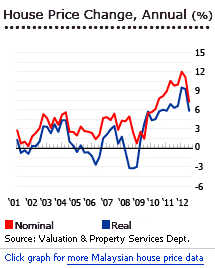
Attached Image
QUOTE(AmayaBumibuyer @ Jul 10 2013, 01:56 PM)
The Lesson is
WHO IS IN THE STATE OF DENIAL?

*
Well, the fact is property price growth is going downwards.. Just look at the graph. How long till it reaches negative territory?
so those think it's always going to be up, up and up is in a state of denial. biggrin.gif Q1 Q2 Q3 Q4
2012 0.00 0.00 -2.11 0.00
2011 1.29 4.02 -1.29 0.00
2010 0.59 2.48 2.42 2.44
2009 0.47 2.08 0.76 2.10
2008 2.22 0.16 1.94 -1.83
2007 0.24 0.16 1.21 0.64
2006 0.51 0.68 0.25 3.27
2005 0.70 1.82 -0.60 0.69
% change over a quarter

This post has been edited by cockee: Jul 10 2013, 03:37 PM
cockee
post Jul 10 2013, 03:44 PM

Casual
***
Junior Member
416 posts

Joined: Apr 2008
QUOTE(AmayaBumibuyer @ Jul 10 2013, 03:34 PM)

The problem here is the gap between the rich and the poor. Although there are rich people entering the market everyday, there are poor people entering the market too.
*
This is right. So we have the 5% rich and 95% poor. But if u look at the supply and pricing side, maybe 80% is only affordable for the rich.
So it becomes a game of musical chair.. the rich buying among themselves.. looking for the next fool?
cockee
post Jul 11 2013, 11:46 AM

Casual
***
Junior Member
416 posts

Joined: Apr 2008
QUOTE(AmayaBumibuyer @ Jul 11 2013, 10:06 AM)

And of course there are MORE poor people being created in Malaysia as well. The poor are created MORE than the rich are being created. The real true problem in Malaysia about people in Malaysia cannot own any property.

*
You are right. Poor people will always higher in numbers than rich people. And the gap is getting bigger.
The problem is the mismatch of housing price supply compared to affordability.

I'm talking about real affordability, not 'get loan and eat maggi mee' type of affordability.

Let's say in Malaysia we have 20% earning above RM15k, the rest 80% earning RM4k or less. (This is close to the statistic of median household income of RM5k)

At RM4-5k a month, the real affordable monthly mortage is around RM2k per month. (This is also stretching it). At RM2kper month payment, the loan should be around RM400k. So the affordable price should be around RM400k-500k.
If there is no mismatch, 80% of the property should be priced around RM400k-500k.

But look at new launches nowadays.. how many can you find at RM400-500k?
Hmm.. perhaps that's why developers are rushing to come out with pigeon holes at these prices.. because they know this is the 'affordable' price for majority of the people. But the catch is these RM500k new-launches are pigeon holes not suitable for married people with kids. But i digress.

Look at the new launches in the past 2-3 years.. how many are actually above the real affordability?

Sure, those 20% can sapu them. But not everyone in the top 20% are millionaires that have no financial concerns. Most importantly, look at the rental yield nowadays. Do you think those 20% people are so dumb to plough a huge chunk of their money on low-yield investments when they can earn more in other asset classes?

Just my two cents.
cockee
post Jul 15 2013, 11:17 AM

Casual
***
Junior Member
416 posts

Joined: Apr 2008
This article is close to what i had been saying in the past few postings..

Highlights:
"Wanting and actually being able to afford your own place are two very different things"

"For example, if both the borrower and the spouse each earns RM5,000, a month, the household income is RM10,000 a month or RM120,000 a year. The value of the house that the household should be looking at purchasing should at most be RM360,000," he explains. "

"Average house prices are RM497,535 in Kuala Lumpur, followed by Sabah and Selangor, with average prices of RM382,414 and RM372,499 respectively"

Conclusion:
1) Affordability has become a real and serious issue. "Got price, but no market"
2) A real disparity and mismatch of pricing (supply) and demand (affordability)

http://www.asiaone.com/News/AsiaOne%2BNews...4-437011/3.html


cockee
post Jul 16 2013, 05:58 PM

Casual
***
Junior Member
416 posts

Joined: Apr 2008
QUOTE(nevland @ Jul 16 2013, 05:46 PM)
whatever... how are you so sure?
*
Bro congrats on your bargain purchase. You shud ignore these fella asking so much. They will find many ways and excuses to justify the bargain price. Maybe they cant accept the fact the prices in certain places are coming down..

Topic ClosedOptions
 

Change to:
| Lo-Fi Version
0.0461sec    0.14    7 queries    GZIP Disabled
Time is now: 6th December 2025 - 05:24 AM