Welcome Guest ( Log In | Register )

Outline · [ Standard ] · Linear+

 EPF DIVIDEND, EPF

views
     
dasecret
post Oct 6 2016, 11:37 AM

Regular
******
Senior Member
1,498 posts

Joined: Nov 2012
QUOTE(nexona88 @ Oct 6 2016, 11:26 AM)
What else..
Housing market is kinda weak nowadays..
Then there's endless rumawip projects build by AK group.. How u sell all those units..
*
Yeah, that AK group is scary. I would stay away. At the rate that they are going, the risk of liquidity at the developer's end is very high. HDA type SPA generally means the developer has to have lots of own funds to cover the cashflow needs in the beginning of the project and the profit only materialises towards the end.
dasecret
post Oct 21 2016, 03:32 PM

Regular
******
Senior Member
1,498 posts

Joined: Nov 2012
QUOTE(plumberly @ Oct 21 2016, 09:30 AM)
Thanks.

AA
Scary reading this, partly due to my ignorance of the subject. What is " to help protect against volatilities in foreign currency and exchange rates"? How does it help to protect?

BB
Did a quick review on EPF a few weeks ago. See below.

[attachmentid=7825749]

The red and green lines are the average +/- 1 std deviation lines.  A guide where about 66% of the data should be. If above the red line, good news! If below the green line, gloomy news in coming EPF yearly announcement! Ha.

My gut feel is 5.7-6% for 2016.
*
QUOTE(plumberly @ Oct 21 2016, 03:20 PM)
My 2 cents....

I don't think it is one to one correlation here. Even if we got the same revenue as in 2013, now they have a bigger capital base and then the dividend will be smaller.

But I will always welcome a higher %!
*
yeah, I was going to say the same thing. The base is a lot bigger now so effectively the % of revenue per capital would be a lot lower
dasecret
post Nov 22 2016, 11:40 AM

Regular
******
Senior Member
1,498 posts

Joined: Nov 2012
QUOTE(nexona88 @ Nov 22 2016, 10:47 AM)
True.
Remembers reading somewhere got report saying those withdraw from EPF to invest in UT got worse return compare with EPF..
*
What to do? Public Mutual has >50% market share in EPF MIS business; and like I previously illustrated, withdraw in the last 5 years to put in approved funds in Public mutual memang didn't stand a chance to beat EPF

And you all wonder why I dislike PM so much
dasecret
post Nov 22 2016, 12:33 PM

Regular
******
Senior Member
1,498 posts

Joined: Nov 2012
QUOTE(dasecret @ Jun 11 2016, 04:54 PM)
I totally get what you are trying to say. Now, since sales charge is not necessarily that important in the long run, lets talk returns.

So I went to Morningstar to pick up 5 years fund returns; took the highest ones
[attachmentid=6821197]


*
QUOTE(prophetjul @ Nov 22 2016, 11:56 AM)
EPF returns beat PM funds in last 5 years?????  WoW!
*
Here, the information stands at that point in time. The top half are not EPF approved prior to 1 Aug 2016.
After 1 Aug 2016, some non-Malaysia funds are approved by EPF and therefore the situation is different
dasecret
post Dec 23 2016, 03:35 PM

Regular
******
Senior Member
1,498 posts

Joined: Nov 2012
QUOTE(pearl_white @ Dec 23 2016, 02:43 PM)
Selling FGV only materialises the loss now.

But in the books, provisions for investment impairments have been made in prior years. 

Hence, the loss has been taken into accounts ended 2015.  So, it will not affect 2017 dividend.

Based on culmulative performances of Q1 to Q3 2016 EPF results, the estimated dividend rate is < 5.5%

However, because of the strong dollar, we could see massive revaluation reserves, unrealised forex gain in the year end accounting.

So, my guess is 5% - 6% next year.
*
Well, this response may be accurate for EPF because they always claim that they would put the unrealised losses on income statement eventhough they don't need to

In the case of ASNB FP funds, for FGV they probably did it last year because the reduction in value is too prolonged and significant to be ignored.

In the case of Tabung Haji, I believe it is still sitting in AFS reserves which is resulted in negative reserves for 2 years already; 2016 can only be worse

as for weak ringgit, they would be some negative impact on UK investments since GBP is weaker than as of 31/12/2015 and the UK property market is weaker too. Aussie investments should do well though
dasecret
post Dec 27 2016, 04:06 PM

Regular
******
Senior Member
1,498 posts

Joined: Nov 2012
QUOTE(prophetjul @ Dec 27 2016, 11:03 AM)
stupid investment.

when they listed and raise more than
Myr2bil, think those crooks can tahan?

Buying all sorts of nonsense and poor management of their plantations says it all.
*
QUOTE(Hansel @ Dec 27 2016, 12:00 PM)
Very easy for them to make money in Msia,... Really easy, bros,.... thumbup.gif Just one round like this, transfer of wealth from us to them already. And this is LEGAL some more....

Then for us, even if we are smart enough not to be fooled by them by investing into FGV, ultimately we are affected by our pension fund's involvement. So,... staying in Msia, there is NO WAY OUT ! Left or right,... they will 'makan' us also !

So,..
*
Now, the question is, when EPF dump the shares, who picked it up?

Looks like it's Tabung Haji and KWAP, their respective holdings from bursa announcement is at 7.9% and 7.0% respectively
dasecret
post Dec 27 2016, 04:46 PM

Regular
******
Senior Member
1,498 posts

Joined: Nov 2012
QUOTE(nexona88 @ Dec 27 2016, 04:24 PM)
don't forget PNB & it's fund under management too  biggrin.gif  bruce.gif
*
Just that the individual ASx funds are not considered substantial shareholder (hold <5%), the acquisitions and disposals are not required to be announced in Bursa and hence could not tell if they picked up FGV shares in the past months while EPF is dumping them

As per 2015 annual report, ASB holds more FGV shares than EPF in March 2016
http://www.bursamalaysia.com/market/listed...cements/5072077
dasecret
post Jun 2 2017, 04:30 PM

Regular
******
Senior Member
1,498 posts

Joined: Nov 2012
QUOTE(plumberly @ Jun 2 2017, 04:09 PM)

Waited for the 2016 annual report. Wanted to learn more about the large impairment costs which resulted in a lower 2016 % though the total revenue for the year was very good. Like to know which investments are these impairment costs from. Any ones related to 1MXX? Please share if you can. Thanks.
*
The 2016 annual report was published since April 2017. You can get it here http://www.kwsp.gov.my/portal/en/web/kwsp/...p_p_col_count=2

So what exactly is your question?
The financial statements usually do not individually identify the stocks or bonds that they made an impairment on. The only person who would know is either working in EPF finance team or Auditor General office.

You would have a better chance of looking up the past CEO quotes during press release. The CEO has always said that the 1Mxx exposure is very minimal and it relates to the energy side and not the holding co. For FGV also, the impairment was made in previous year and therefore did not impact the 2016 numbers

One should bear in mind that Msia equities did very badly in 2016, the FBMKLCI actually made a loss in the calendar year. Therefore it's understandable that the EPF decided that they need to impair on some of the local equities. As to which one, I've no idea

Revenue is based on dividend income or realised gain/losses, the changes in market value for the securities held are not included in the income unless impairments are made.
dasecret
post Feb 6 2018, 10:17 AM

Regular
******
Senior Member
1,498 posts

Joined: Nov 2012
QUOTE(kpfun @ Feb 3 2018, 08:56 PM)
Shariah gives higher definitely sounds going to happen.

Think this way, launching shariah was in last year, basically, reallocating partly members' subscription into the fund. And, naturally, the reallocation came with reassigning some current EPF assets to the fund.

EPF hold some good assets, and some are bad.

So, do you believe in, EPF will assign those bad assets to Shariah. or picking the best assets for Shariah?

Such as, some good overseas properties, will go to Shariah, or ratains in convesional? Unless, that properties are non shariah complianced.

WHO MAKES THE DECISION? WHAT IS THE ADVANTAGE GETS FROM SUH DECISION?

The answer is pretty clear.

If so, it is an act of sin, cheating, indeed, insulting God's wonderful investment model.
*
Well said, there's always a way to steer things to the direction you want isn't it?

Well, one would be able to justify that shariah fund is young and therefore needs a kickstart with some good assets.
dasecret
post Jan 16 2020, 06:29 PM

Regular
******
Senior Member
1,498 posts

Joined: Nov 2012
QUOTE(romuluz777 @ Jan 16 2020, 09:16 AM)
Yes, there are retained profits as an umbrella for a rainy day in future.
*
Now, let's see how much retained profits are there in EPF as at 31 December 2018

Source: 2018 EPF annual report obtained from https://www.kwsp.gov.my/en/about-epf/news-h...ts/publications

Attached Image

If you include the unrealised losses on investments in the middle column, EPF has negative reserves as at 31 Dec 2018. Which is a similar situation to Tabung Haji 2016 and 2017.

I wished they have umbrella for rainy days too, but looks like the high dividend rates declared in the past few years have robbed us of the umbrella
dasecret
post Jan 17 2020, 10:54 PM

Regular
******
Senior Member
1,498 posts

Joined: Nov 2012
QUOTE(Cubalagi @ Jan 17 2020, 12:12 PM)
This is the results of new accounting standard MFRS 9, introduced in 2018. Won't impact our dividends. The more important number is the gross investment income.

Again, my projection s that it will be between 5.5%-6%. Lower than last year, but at least as good as ASB.
*
I don’t know why everyone kept saying it’s because of MFRS9; for AFS in 139, actually the treatment is exactly the same as FV through reserves in MFRS9. In the case of EPF, during MFRS139 days, they tend to be more conservative and would put through impairment charge on P&L earlier than maybe they absolutely need to. Good example is FGV shares, it’s not specifically disclosed, but I believe EPF impaired it way before ASNB fixed price funds and tabung haji.

The gross investment income only account for realized gains. While you are correct to say that EPF act allows dividends to be made out of the net profit of the fund; it’s not correct to think that we should ignore the negative reserves. Why so? The negative reserves is effectively the unrealized losses from investments held by EPF. If today EPF needs to liquidate everything to pay all its depositors, that is the losses they will make. And since the government guarantees the deposits in EPF, government has to fork out the money to pay the depositors.

This is exactly the basis of BNM’s advisory letter to tabung haji. That letter was leaked in 2017 I think. Fast forward to last year, tabung haji was bailed out by MOF by exchanging the bad investments with government issued instruments. So am I overreacting? I’m just applying what I learned from the BNM advisory letter to this case. Of course you may argue that it could be just temporary market downtrend and we should see a rebound.

I honestly hope to see the reserves going back to positive for dec 2019 report. Definitely looking forward to the release of annual report. Certainly hope I don’t have to wait until Q3 like this year

P/s: for variable price unit trust accounts, all investments are measured on fair value through P&L method and hence there’s no AFS reserves like EPF and tabung haji. Hence why you don’t have this concern for UT funds

This post has been edited by dasecret: Jan 17 2020, 10:58 PM
dasecret
post Jan 18 2020, 12:12 AM

Regular
******
Senior Member
1,498 posts

Joined: Nov 2012
QUOTE(T231H @ Jan 17 2020, 11:05 PM)
Under the new standard, capital gains on disposal of equity ............. will flow directly to retained earnings under the balance sheet instead of the income statement as under the previous MFRS 139. Alizakri also said the EPF will no longer recognise any impairment on its listed equity holdings.

EPF’s high 2018 payouts not due to MFRS 9
https://www.theedgemarkets.com/article/epfs...-not-due-mfrs-9
*
Thank you for highlighting the new rule on no recycling and therefore nothing goes through P&L for FVTOCI. It has little bearing on the negative reserves issue isn’t it? Same example of selling all the investment today at a loss would mean that there’s no loss recognize in P&L but the realized loss would be netted against retained profits and therefore resulting in accumulated loss. So who is going to cover the hole? Still MOF lor

Maybe need to read up on EPF act on the dividend issue is it based on profit for the year or retained earnings. Cos if it’s profit for the year then there would be a mismatch
dasecret
post Jan 29 2020, 08:26 PM

Regular
******
Senior Member
1,498 posts

Joined: Nov 2012
QUOTE(prophetjul @ Jan 29 2020, 11:07 AM)
If they cannot even beat FD rates, the management should resign en bloc. That's all I can say.
*
That’s why OPR is lowered by 0.25% lor
Gotta make sure the ASB loan folks don’t cancel their loans too

QUOTE(pearl_white @ Jan 29 2020, 03:59 PM)
Layman comparison.

Gross Investment Income (RM'bil)
Q1 2018 - 12.88
Q2 2018 - 12.39
Q3 2018 - 14.61
Q4 2018 - 11.00
------------------
Total  -    50.88

Gross Investment Income (RM'bil)
Q1 2019 -  9.66
Q2 2019 - 12.32
Q3 2019 - 13.50
Q4 2019 - 10.00 (est)
------------------
Total  -    45.48

Note : 2019 Have to adopt MFRS 9 (impairments of investments).  2018 was not adopted.

So, off the cuff maths, (45.48 / 50.88 ) * 6.15% = 5.5%

5.5% is before MFRS 9 and also new contributors contribution to the total contributor pool to the total existing funds in EPF.  This also assumes all financial ratios for its operations remain the same.
*
Good attempt. So the actual dividend is most likely going to be below 5.5% as the new contribution always exceed withdrawal of contributions (mainly due to the high dividends given that the retirees don’t withdraw even when they could)
Small correction there, MFRS 9 was already effective for 2018 accounts. The new MFRS applicable for 2019 is leases, MFRS16. Should not have super big effect to EPF accounts
dasecret
post Dec 23 2020, 04:26 PM

Regular
******
Senior Member
1,498 posts

Joined: Nov 2012
QUOTE(TOS @ Dec 18 2020, 03:32 PM)
Talk about last year's AR. 2020 is about to end, still nothing published. Any idea when do they usually publish the AR?
*
Not yet published, getting slower than slower
Before PH took over, they usually follow PLC reporting requirement to publish by April next year; last year it was only published in December, this year if they missed the parliamentary session this round; it would be next March ranting.gif

Tabung Haji 2018 was only publish July 2020 if I remember correctly
dasecret
post Jan 13 2021, 04:53 PM

Regular
******
Senior Member
1,498 posts

Joined: Nov 2012
QUOTE(TOS @ Jan 11 2021, 04:10 PM)
Thanks for the heads up thumbsup.gif

user posted image

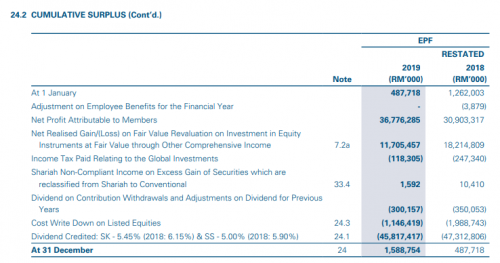
Happy to see that they "replenished" the reserves that were reducing last year; although the distribution is still drawing into unrealised profits which theoretically is non-cash

Also noted that the discrepancy of returns between Shariah and conventional if most likely attributed to the markets they can invest in; Shariah focuses on domestic equity market while conventional is better diversified with global equities.
dasecret
post Jan 5 2022, 12:13 PM

Regular
******
Senior Member
1,498 posts

Joined: Nov 2012
QUOTE(prophetjul @ Dec 30 2021, 07:49 AM)
It is one of the biggest retirement fund in the world. Pay peanuts, you know what they say.

In fact, do they declare the salary of the CEO and directors?  WE should write to them.
*
Well, the information is disclosed in the annual report albeit not as detailed and specific as you might want it to be. The 2020 annual report was just released, see if for yourself
https://www.kwsp.gov.my/annualreport2020/pdf/[ENG]KWSP_AR2020.pdf

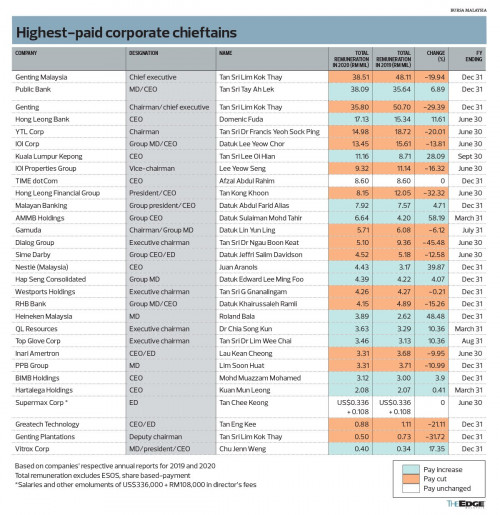
On page 40, it says CEO and Deputy CEOs earned RM9,027,542.51. Since there's no DCEO listed in the report, perhaps can assume that's the amount that the CEO earned.

How does it compare to the other PLC CEO remuneration you may ask? The Edge has just the answer for you
https://www.theedgemarkets.com/article/cove...-take-home-2020

user posted image

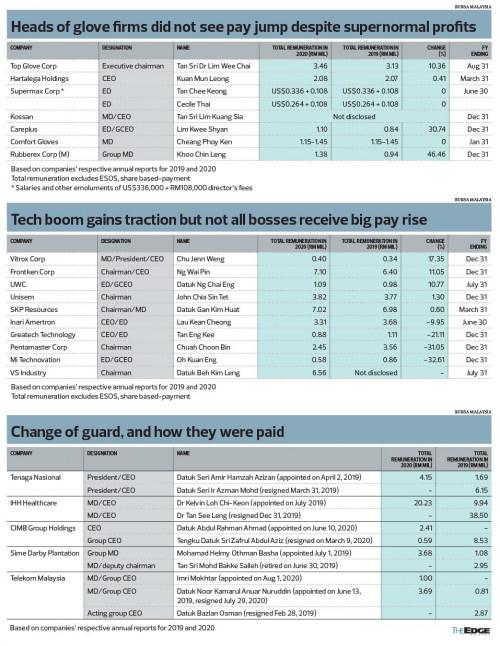
Interesting Amir Hamzah, the new CEO was earning significantly less as the CEO of TNB previously

user posted image
dasecret
post Jan 26 2022, 02:04 PM

Regular
******
Senior Member
1,498 posts

Joined: Nov 2012
QUOTE(return78 @ Jan 24 2022, 04:45 PM)
https://www.theedgemarkets.com/article/woul...-poorer-members

Another punishment suggestion to saver. Esp for to those elders which  higher saving.
*
This is going to be unpopular opinion in this forum, because I'm on the same page with the Edge's Cindy and the previous Mr Thomas.
People tend to react negatively to this sort of suggestion for a simple reason, all private sectors employees are vested in EPF. As soon as they hear their returns will be lower, they just shut off their mind and insists it's a terrible terrible idea. So I understand where you came from. But maybe you have not understood where the likes of Cindy and Thomas are thinking.

Well, before you start bashing me, I want you to do one thing - Pretend this is not EPF for a moment, it's a pension fund in another country with similar income disparity and aging population. Pretend you are running that pension fund, or running that country. What is best for the country, not what is best for an individual depositor.

Not every forummer would be able to do that, I've accepted the fact. But I hope you rise up to the challenge, and really use an objective mind to look at what I have to say

My suggestion would be taking some ideas from Cindy and Thomas, and added my own twist to it.

1. There would be a "bonus" dividend for those depositors having less than basic savings set by EPF at their age - This is a concept borrowed from Tabung Haji dividend distribution. It could be 3-5% and will give a boost to those who are not earning as much, and the power of compounding is going to work to the advantage of the younger population who are not making as much as they are expected to be able to have sufficient retirement savings. It also reduces the low income earners' urge to withdraw from EPF at every chance they have.

2. How to fund the extra dividend for (1)? For every RM above RM1million savings per depositors, they will get 1% less dividend than the dividend rate declared for that year. These people have the ability to withdraw at anytime, they are basically treating EPF as their personal investment manager without having to pay for it. This is the best risk free capital guaranteed, min 2.5% guaranteed return product you would ever find in Malaysia. Sure, the rich put their money elsewhere, but they also put some of their money in EPF as a replacement of FD. Remember - they can withdraw these savings ANYTIME, EPF had to keep buffer in cash because of these people and dragging down the returns. So it's not to OUR advantage that the rich keep a lot of money in EPF

3. You may ask, how can that 1% reduction in the rich's returns give 3-5% extra returns to those with less than basic savings? Well, because the rich are keeping so much money in EPF currently; and I dare say, even if this is implemented, most will still keep their money there as it's still higher than commercial banks. currently EPF targets inflation rate + 3% returns on 3 years rolling and it's really good for almost risk free investment
user posted image

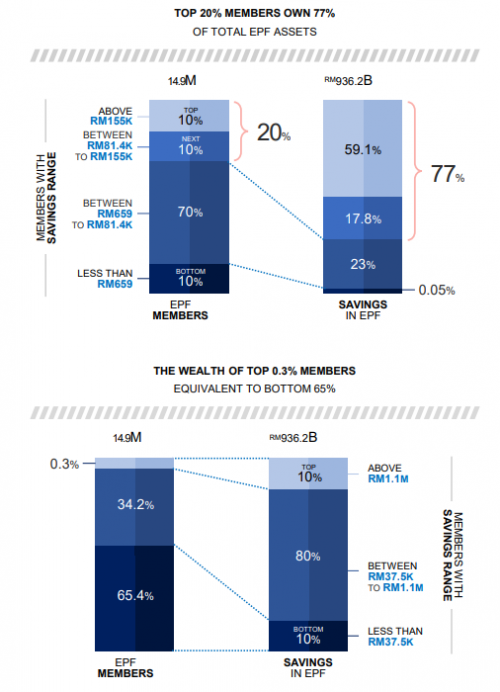
Only 0.3% of the depositors need to take this 1% hit actually and benefit more than 70% of the depositors. Sounds like a good impact to a country, no? Fairer distribution of income.

4. Many of you felt that these low deposit balance people "deserved being poor", or "did it to themselves". I tend to disagree, but I do feel that there need to be better social safety net to "help people help themselves"
How about this? In conjunction with the implementation of (1), which adds money to their account, it comes with a condition that at the retirement age, the amount below basic savings are retained to be put into annuity scheme, where they get paid an income on monthly basis, it's probably very little, like RM2000 or so with RM240,000 basic income at 55 yo. This is similar to what CPF had implemented a few years ago and it's again a necessary but unpopular move that EPF had shy away due to public negative reactions.
Why is this annuity scheme important? Obviously too many people spend the retirement savings soon after they took all of it, and research shows that poor people make poor decisions because of their circumstances, sometimes they couldn't help it, so it's necessary for policy making to take that into consideration.


Now, back to you as one of EPF depositor, why should you not react negatively to EPF giving more returns to the poor than the rich when you belong in the "rich group"?
Because, believe it or not, we pay for these poor people who have not enough retirement savings one way or another. If we don't pay for it in the form of lower EPF returns, we will pay for it in taxes (could be inheritance tax, capital gain tax, GST etc), or our future generation will pay for it, in both $$ and doomed future because the country is no longer competitive

For anyone who read all the way here, thank you rclxms.gif
You can now start bashing me rclxs0.gif
dasecret
post Jan 26 2022, 02:42 PM

Regular
******
Senior Member
1,498 posts

Joined: Nov 2012
QUOTE(akhito @ Jan 26 2022, 02:12 PM)
If tiered interest is implented, ppl higher than certain treshold will try to outsource their investment even before hitting the cap. There will way to withdraw from epf to channel other investment. It won't work as it was against meritocracy even less ppl would be interested in epf. The gov can use tax money to help the poor but blatantly using ppl money in social aid and economical restructure will not give good impression to the ppl.
Indirectly promoting u tak suka u keluar haha
*
I don't know why everyone thinks EPF love managing as much funds as possible. As the fund grows, it's a constant struggle to give a good and consistent return. Their work would be so much easier to only manage funds that have fixed withdrawal terms, and a long term horizon. So it's good not to have those "withdrawa-ble on demand" funds within EPF like above rm1million savings, and those above 55 year old but not withdrawn
Why do you think Alizakri kicked such a big fuss last year over i-Sinar that it costed him his job? It hurts the fund tremendously with large unscheduled withdrawal

QUOTE(KIP21 @ Jan 26 2022, 02:19 PM)
Good read. Now maybe 6%..maybe smile.gif
https://www.msn.com/en-my/money/topstories/...high/ar-AAT4PVy

As for those that keep on thinking that those with Rm1mil in epf need to be penalize for lowering the dividen that they deserve, this group of people is how many percent of the epf member? Then compare that with say the people with goverment pension of say monthly rm4k support by gomen. This 1mil fellow may just draw the dividen for their monthly expenses till old age. These two groups just the same... And again, it not easy to save and maybe top up too by tightening monthly expenses.. A lot of people get burnt from Bursa, bitcoin, and epf is a pretty safe place to save money for old age. I am not a politician and look, the politician should look at the amount of budget yearly for civil servants n pensions...

My 2cents
*
Sorry, I am a big opponent of the Malaysian government pension scheme. It is the single largest source of future liability to the country, even more so than 1MDB. Why so? Because the pension scheme is not funded, the gov doesn't put aside money with discipline to grow the fund the pay for pension. You may ask "isn't that what KWAP is supposed to do?" Well, theoretically yes, but the gov has not been paying the amount that they should be to grow KWAP funds all these while; so the pension continues to be paid from the annual bajet as part of operational expenditure and will continue to be; and mind you, this amount is ever growing. It's just a ticking time bomb and again, we the rakyat are paying for it


QUOTE(Wedchar2912 @ Jan 26 2022, 02:21 PM)
ask yourself first if EPF is the right platform/mechanism to help the poor: define poor while you are at it. If I am 40 years old and only have 10K rm in EPF, am I poor? If B is 56 and only have 20K in EPF, is B poor?
*
Answer the easy part first; both are considered poor, as their savings in EPF is below the defined basic savings at their age. And therefore both should enjoy the extra dividend that I suggested

Go back to the core purpose of EPF, or any pension scheme. Is it not for retirement savings, to build social safety net for EVERY retiree? If you look at how social security works in the US
I bet you would also think unemployment benefits are bad

I guess I'm right about the mindset that "It's MY money, no one should enjoy more returns than me"
dasecret
post Jan 26 2022, 03:11 PM

Regular
******
Senior Member
1,498 posts

Joined: Nov 2012
QUOTE(Human Nature @ Jan 26 2022, 03:05 PM)
Before people start bashing you, I want you to do one thing - Pretend this is not EPF for a moment, it's a piggy bank in another country with similar income disparity and voting population. Pretend you are running for the presidency. What is best for your votes, not what is best for the country.
*
Well said, summarised the problem of Malaysia in 1 single sentence. It's really not about the greater good of EVERYONE, but what is GOOD for ME

That mindset, have sent Malaysia to the trash and will keep us there for years to come
dasecret
post Jan 26 2022, 04:51 PM

Regular
******
Senior Member
1,498 posts

Joined: Nov 2012
QUOTE(Wedchar2912 @ Jan 26 2022, 03:48 PM)
Maybe another scenario to explain to you.

Say you had placed 100K rm into a 1 year FD with Bank Charity, with a contracted rate of 3% pa.

on the 10th month, Bank came to you and said that due to covid, many of the savings account customers are poor with lesser than 500 rm and need more income. So the Bank just inform you to be the bigger person since you have 100K rm in a FD, and you should just receive 0.5% pa interest. Eitherway, you are rich and do not need the interest to live off right?

Help the poor lar? why not?

I hope you be the bigger man and donate the interest (eitherway, the Bank don't give you a choice).
*
Well, the contractual agreement or commitment that EPF gave to us as depositors is only minimum 2.5%, so the analogy is not quite right.

On your other post about 56 years old, u are right, I forgot that person could have done the full withdrawal and the balance is from the golden account. So that person might not be entitled to extra dividend

QUOTE(romuluz777 @ Jan 26 2022, 04:20 PM)
If it really comes down to tiered dividends, make it an opt-in for those who feel very charitable and genuinely want to help out.

There are many members who skimp and save to reach > RM 1Mio
in the EPF, not everyone is a C-level executive or corporate tycoon.

Its our hard earned money, we deserve to gain the full blown dividend, not partial.

Period.
*
We all know that opt-in won't work.

Have you considered this, that the EPF doesn't need to work so hard to give maximum returns to the depositors, they could have done the CPF model, let Khazanah make all the alpha returns and keep it in the coffers (or worst, let the politicians used them as they pleased, to secure vote bank from the B40)

Let's look at the CPF model
https://www.cpf.gov.sg/member/growing-your-...active-interest

Hey, tiered interest rate IS ALREADY IMPLEMENTED in CPF

"Your CPF savings are invested in Special Singapore Government Securities (SSGS) which are guaranteed by the Government. SSGS are non-tradable bonds issued specifically to the CPF Board for the investment of CPF savings.

This ensures that CPF savings are safe, regardless of financial market conditions. The coupon rates which these SSGS earn for the CPF Board match the interest rates that you’ll receive."

EPF can move its investment team to Khazanah and no need to susah payah lobby for implementing new measures, or give less dividend in a bad year. Don't even need to disclose how much money they make from investments, just give fixed returns

Check out the historical returns of CPF and compare that with EPF
https://www.cpf.gov.sg/askjamie/user/upload...20Q1%202021.pdf

The top things to do for EPF in my opinion
1. Move full withdrawal age to the official retirement age in Malaysia, currently 60, could be later subsequently - When one take full withdrawal while still in full employment, they risk using the retirement savings too much too soon
2. Full withdrawal should deduct the basic savings amount, basic savings amount converted into annuity scheme - so that there would be constant income in the later years when the depositors most need it
3. Tiered interest rate, but only impact those who have withdrawa-ble sum and benefit those with amounts below basic savings

All of them are not popular move, but when you manage money for more than half the people of the nation, hardly any move can be favorable

3 Pages < 1 2 3 >Top
 

Change to:
| Lo-Fi Version
0.0548sec    0.73    7 queries    GZIP Disabled
Time is now: 18th December 2025 - 07:55 PM