Some pointers: 1. Educate yourself. First priority is to learn the big lifts, then a training program that you can stick to, then a nutrition plan. 2. Put your heart into it and start lifting hard. You will see significant results (in lifting numbers and body composition) in 6 months, doesn't take 2-3 years. 3. Weight is just an arbitrage number, it doesn't quite matter, more importantly is to gain as much muscle as possible and gradually lowering body fat percentage. Note that us Asian has a tendency to be underweight. Look at this small chick, she was only 164cm tall and weighted 65kg, but looked damn good. 4. There is no short cut but to lift heavy. Supplement is overrated.
Good luck.
This post has been edited by pleowcw: Jan 17 2013, 10:03 AM
"Here's a girl who does not shy away from heavy lifting, squats, and Grey Goose. Real training. Not the useless foo-foo bullshit many women call "training"."
"I just noticed I actually have a video of me deadlifting 205 lbs x 4 back in July (bodyweight 114-115lbs.. and after a night of drinking.. haha)."
Initially I wanted to post on another girl, but came across this guy on starting strength forum
Name: Milko Tokola, Finnish Age: 20, born in 10.10.1992 Training Body Weight (Competition Weight): right now 83kg (77kg-85kg) Height: 163cm
Personal Records Snatch: 141kg Clean & Jerk: 176kg Front Squat: 200kgx3, 205kgx1 Back Squat: 232,5kgx3, 245kgx1 Deadlift: (Snatch Grip: 215 kg, Clean Grip: 277,5 kg) Bench Press: 160kg, Military Press: 87,5kg x6
What’s impressive is the way he did snatch and clean & jerk in a very explosive, snappy way. In (Olympic) weightlifting, it is all about converting raw strength into power. Even though he is not world class yet, but heck, he is young.
Note: 1. He was doing high bar squat, which I think (not 100% sure though), has more carry-over effect for the front squat part on his snatch and c&j. Front squat and low-bar squat has very different mechanism. 2. He hyperextended on deadlift. That was not necessary. Chest up and lock is enough. Note that he wasn’t using mix grip. You see, can’t use mix grip on snatch and c&j. 3. Olympic weightlifter typically has smaller arms and chest relative to lower body and back. Other than >105kg category, there is weight limitation, so they want more muscles on the right places (ie, back, lower body), rather than less useful places like chest and arm. 4. I was thinking that given his height, maybe he should to cut down his weight to compete in 69kg categories, but starting strength’s rippetoe said he thinks he needs to bulk more. lol.
Joined: Dec 2004
From: Somewhere in Msia >.< I might b lost. I cant tell~
QUOTE(pleowcw @ Jan 6 2013, 03:22 PM)
Initially I wanted to post on another girl, but came across this guy on starting strength forum
Name: Milko Tokola, Finnish Age: 20, born in 10.10.1992 Training Body Weight (Competition Weight): right now 83kg (77kg-85kg) Height: 163cm
Personal Records Snatch: 141kg Clean & Jerk: 176kg Front Squat: 200kgx3, 205kgx1 Back Squat: 232,5kgx3, 245kgx1 Deadlift: (Snatch Grip: 215 kg, Clean Grip: 277,5 kg) Bench Press: 160kg, Military Press: 87,5kg x6
What’s impressive is the way he did snatch and clean & jerk in a very explosive, snappy way. In (Olympic) weightlifting, it is all about converting raw strength into power. Even though he is not world class yet, but heck, he is young.
Note: 1. He was doing high bar squat, which I think (not 100% sure though), has more carry-over effect for the front squat part on his snatch and c&j. Front squat and low-bar squat has very different mechanism. 2. He hyperextended on deadlift. That was not necessary. Chest up and lock is enough. Note that he wasn’t using mix grip. You see, can’t use mix grip on snatch and c&j. 3. Olympic weightlifter typically has smaller arms and chest relative to lower body and back. Other than >105kg category, there is weight limitation, so they want more muscles on the right places (ie, back, lower body), rather than less useful places like chest and arm. 4. I was thinking that given his height, maybe he should to cut down his weight to compete in 69kg categories, but starting strength’s rippetoe said he thinks he needs to bulk more. lol.
I feel bad but as soon as I got over being impressed at his records, I thought how its unfortunate he will be part of the reason people think body building & weight training before being a full grown adult stunts your growth..
What do you do when life deals you a shitty hand? Give up? Not this chick;
Name: Jeannie Bass Affiliation: CrossFit in Virginia Beach, VA
“When she was young she was diagnosed with pretty severe scoliosis, and had to wear a hard plastic body brace for over 2 years to keep her spine from getting any worse. She was told that the 38 degree curve in her spine would prevent her from doing most sports.“
A 38 degree curve on the spine is no laughing matter. Did she give up? Whine? Worry about pre or post-workout meal? Supplement shit? Waiting to be spoon-fed? No. She lifted.
“It was then she took action and began doing 'functional' movements in her room: squats, push-ups, sit-ups, pull-ups. Long story short, she went from a 38 degree to a 12 degree curve by working her muscles properly and efficiently.”
Here are two youtube clips on her working out:
Note: 1. You can clearly see that her spine was kinda weird on the deadlift video. Did that prevent her from doing 2x bw deadlift? No. 2. The two underhand grip was weird as hell too. Not sure if it has to do with her spine condition. 3. Personally, I think crossfit programming is nonsense for those who are interested in serious strength training (with all due respect to all crossfitters here), but I am eternally grateful to crossfit for introducing snatch and clean and jerk to the mass public. 4. Crossfit is now a worldwide phenomenon, there are even two gyms in Klang Valley now. Google it yourself if you are interested.
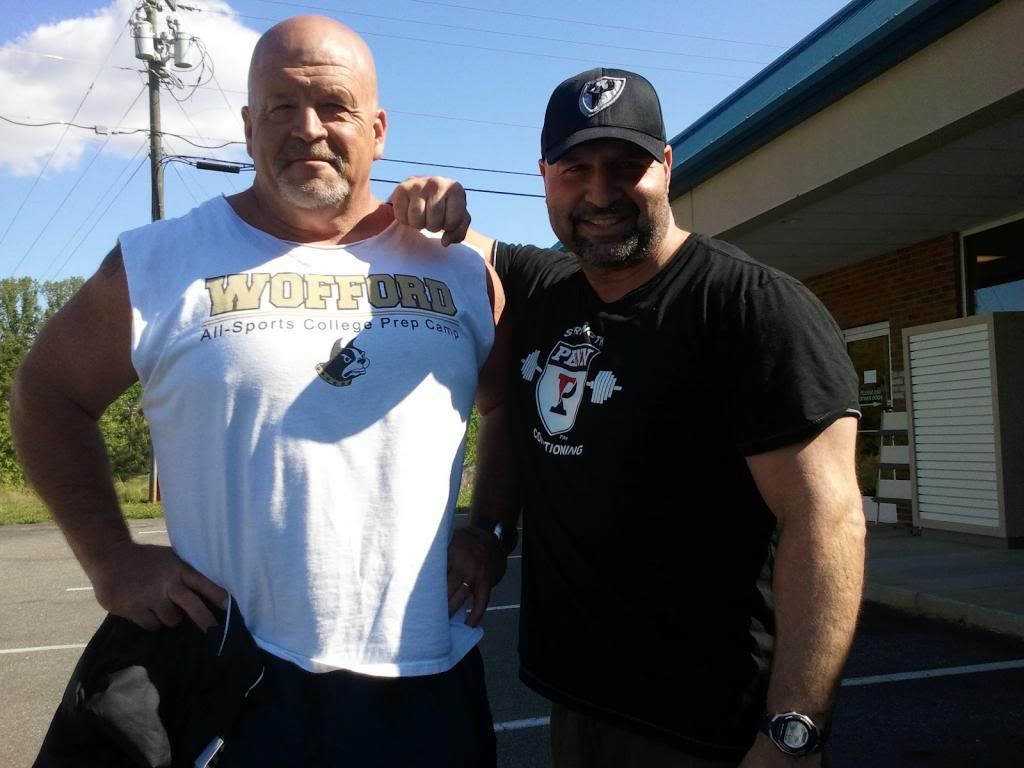
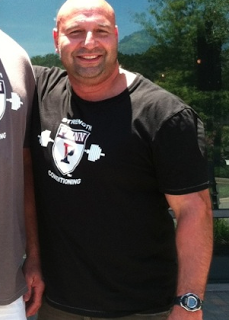
Name: Jim Steel Age: 45 Height: 5”9’ Weight: 211 – 315 lbs Occupation: Strength couch, University of Pennsylvania Affiliation: American Powerlifting Association Record: New Jersey state record holder in the 275-pound class in the squat (820 lbs.), deadlift (740 lbs.) and total weight (2,065 lbs).
Jim Steel @ 250 lbs or so, April 2012
Jim Steel: Aug 2012, 255lbs
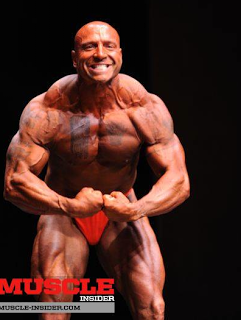
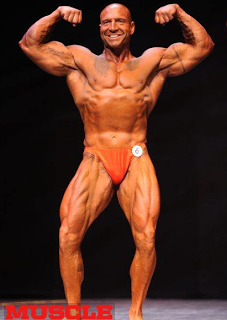
Jim Steel: Dec 7, 2012, 211lbs, at competition
Jim Steel: Dec 7, 2012, 211lbs, at competition
By Marty Gallagher
Jim Steel is no bodybuilder. In fact, Steel has little use for bodybuilders and their preening peacock affectations. Oh sure, as a young boy Jim used to idolize Arnold – but to hear Steel tell it now, those days are long gone. “Back in my younger days the bodybuilders of that era, the 1970s and 1980s, looked athletic and most of the best bodybuilders (Robbie, Franco, Arnold, Sergio) had in fact been fantastic athletes in other sports before becoming bodybuilders. Nowadays the IFBB professional bodybuilders are so bloated and swollen that they don’t look like they could possibly do anything remotely athletic.” Jim Steel is the longtime strength coach at the University of Pennsylvania, and is famous for training collegiate athletes; he is also famous for speaking his mind and not suffering fools lightly. Jim Steel is Old School all the way and defiant about it. “I have been accused of being stuck in the 80s.” he related. “I take that as a compliment.”
Six months ago about the furthest thing from this premature curmudgeon’s mind was the idea of entering a bodybuilding competition. It was far more likely that he would embark on a deadlift specialization program in order to push his current 700-pound deadlift maximum, up to 750 on his eventual way to 800. Those of us who knew Steel found it hard to imagine he would ever enter a bodybuilding competition, yet that is exactly what he did: two months and three days after commencing preparation, he walked onstage in front of a packed house at the 2012 NPC South Beach Bodybuilding Classic in Miami Beach. With just nine short weeks – 63 days – to prepare, Steel characteristically threw caution to the wind and leapt in feet first: he lost forty pounds of bodyfat while adding five pounds of muscle, and he did it in two months. He showed up in Miami wearing tiny trunks (“a banana hammock”), sporting a fake tan, and placed 5th in his class, an astounding feat for a 45-year old with no real bodybuilding experience…
Say what you will about bodybuilding, the participants are hands-down the world’s finest and most effective dieters. Go to any local-yokel bodybuilding event held in your very own neighborhood and you will see a dozen bodybuilders possessing sub 10% bodyfat. Thirty years ago this knowledge (how to get ripped) was tightly held by a few members of an elite bodybuilding inner circle. Nowadays the procedures used to attain a sub 10% bodyfat percentile are widely known and widely used. Anyone can lose a mountain of bodyfat in a relatively short period if they have the discipline and tenacity to stick to it through the requisite 60, 90 or 120-day timeframe….
Notes: 1. You can go to here: http://startingstrength.com/index.php/site...ey#.UOuyTG8p98G to read the full text. Also check out Jim’s blog at: http://www.basbarbell.com 2. Every newbies want “6-packs,” or be ripped, because they wanna get laid. That’s wrong, 6 packs don’t get you laid, 6 million cash in bank (preferably US dollar) does. 3. To get ripped is relatively easy, the much much more difficult part is to get muscle or gain strength. If you don’t have adequate muscle, you will look like an Ethiopian famine guy even if your bf% is below 10% anyway. 4. It is very difficult to get ripped and gain strength simultaneously. Even if you can do it (or attest that your uncle's nephew's grandmother did it) , it will most likely take you far longer than necessary to do it. Therefore newbies should not worry about body fat percentage initially, the focus is to learn big lifts and gain strength. 5. Linear programming is your friend; even if you are so weak that you cannot even squat with weight, you can always just squat body weight first, then add a broomstick, then an empty bar, then add more and more weights. First 1x your body weight, then 2x body weight, so on and so forth. Someday, you just might be able to squat like Jim.
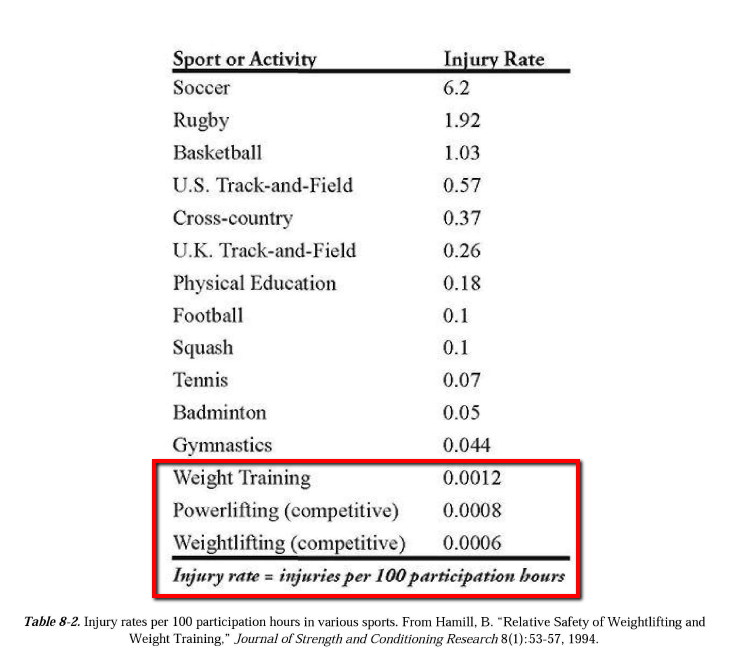
Bench press I would like to say a few things about bench press. Weightlifting is actually a very safe sport compare to other sport activities, provided that you lift with good form/ proper technique. How often do you see people injure themselves in deadlift, squat, overhead pressing, snatch or c&j? Very rarely.
Source: Starting Strength 3rd edition
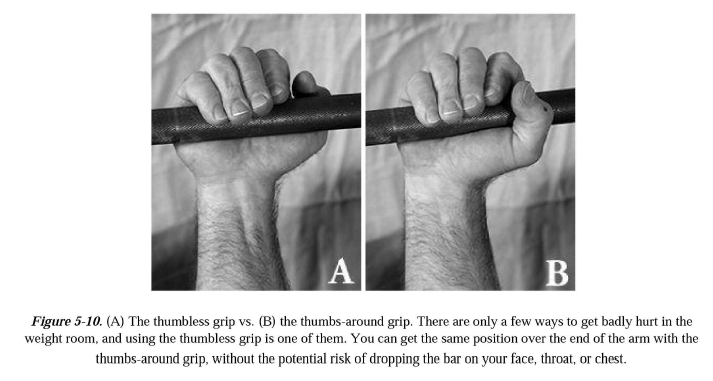
Not so with bench though. Every year, some 10-20 idiots got themselves killed in America, and the main culprit is… benching using SUICIDE GRIP.
Source: Starting Strength 3rd edition
Get this: There is ABSOLUTELY no rational explanation for using suicide grip, it doesn’t improve lifting efficiency or whatever. Newbies in the gym see someone else did it that way, and they mimicked. Monkey sees, monkey does. But please do yourself a favor and stop using suicide grip. I get really pissed off when I see those so-called “personal trainers” teaching newbies suicide grip. F*cking a**hole!
Bench is still dangerous even with the correct grip when the weight gets heavy. When the weight is still light, you can maybe lower the bar in a semi-control fashion and roll it to your stomach. But when the weight gets really heavy, like 1.5-2x your body weight, there is simply no way. Either lift using power rack, or have someone to spot you.
Third, I also don’t understand why some people benching with their legs on the air? What the hell are they trying to show? Improve balance? For Christ sake, you train for bench, then bench properly! You wanna train for balance, agility or whatever, then do something else! Source: Starting Strength 3rd edition
Muscle Imbalance A lot of so-called “gym bros” like to bench, and bench, and bench. Because bench number has somehow become the measurement of their manliness. Almost every time I meet a new gym buddy, their first question is usually, “how much do you bench?”
I am not against bench, just that some people benched so much but neglected their backs. Just the other day at gym, I overheard two uncles talking in Cantonese, the conversation went something like this, “Aiya, no need to train the back so much one lah, after all, cannot see from the mirror why. Chest more important lah…” At the back of my mind, I was like “aiyoyo…”
You see, if you have front/back muscle imbalance, you will have very problematic, injury prone shoulder somewhere down the road. So please, do not forget to row, chin, etc also.
Other form of commonly seen muscle imbalance includes strong upperbody + chopstick legs, strong quad + weak hamstring, left right imbalance (very common for tennis players). Strong lower body + weak upper body, I think, is somewhat ok though, from injury prone angle.
Addendum: Of Bench: You gotta lower to bar low enough to touch your lower chest area for it to count as a legit rep.
This post has been edited by pleowcw: Jan 11 2013, 06:57 PM
They say it can’t be done, but here is proof! My mother after 40+ years of ballet faced bilateral total knee replacements. Released from Rehab 5-6 weeks post surgery for both knees, she had attained full ROM but lacked strength to walk correctly or get in and out of a chair without assistance. She began strength training with Josh Wells (NorTex Strength & Conditioning and Wichita Falls Athletic Club (WFAC)) and excelled tremendously. Here she is pictured 7 weeks and 1 day post replacement of 2nd knee performing an almost full ROM squat (Below parallel…approximately 120deg flexion. Last few degrees prevented from residual swelling). She is now 10 weeks out: Current PR squat- Full ROM @ 45lbs, Deadlift- 55kg. So, yes…You can barbell train after joint replacements! Or start early (correctly) to help prevent! =)
Notes: 1. Here is a 60+ auntie, squatting to get healthier and to regain her full range of motion. I think the message is damn clear right, auntie also can do it, and I can’t? 2. Weightlifting is actually one of the most helpful rehabitation activities for people who have suffered various forms of injuries/surgeries to regain their old strength. Pretty much bar none. I will tell you a story of a 70 years old grandpa with Parkinson some other day. 3. In Asia, most of our elders spend way too much time in front of tv, chasing soup operas. Most likely most of them had a hard life earlier on, and now they associate working out as hard labor. I have heard stories after stories of elders just wasting away this way. If possible, try to get elders around you to the weight room loh. Also attached toward the end of this post is an article written by Dr. Jonathon Sullivan called: Barbell Training is Big Medicine.
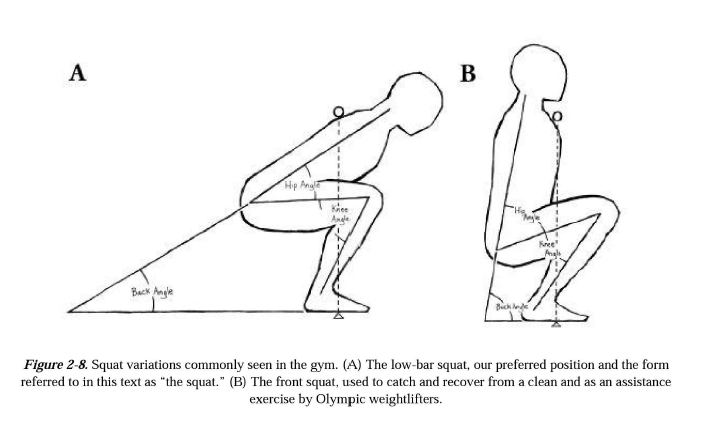
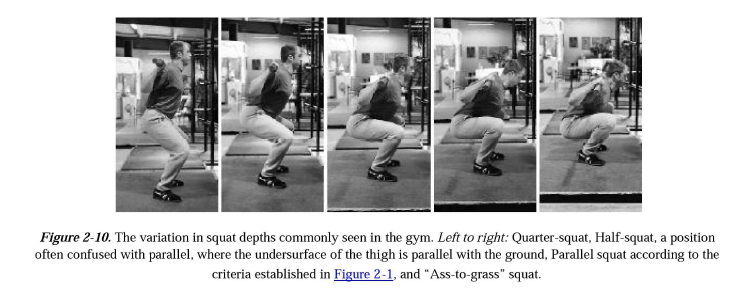
Squat Squat is the king of weight exercise. Done correctly, it engages all of your lower body muscle groups, and also your truck & back for stabilizing. There is just no substitute for it. Broadly speaking, there are 3 variations: low-bar squat, high-bar squat & front squat.
Source: Starting Strength, 3rd edition
I suggest you use low-bar squat initially, and add front squat into your program later on. High-bar squat share very similar mechanism compare to front squat, and you actually can cut it out.
Notes: 1. There is no substitute for squat; lunge, leg press or other fancy leg machines are not the same thing. 2. If done correctly, squat is a very safe exercise. Say you have a fail rep, you can dump the weight behind you (you gotta first learn how to do that though), or you simply get stuck at the bottom, happened to me all the time, so what? Get your gym buddy to help you up loh. 3. Don’t use smith machine for squat, it screws up the bar path. In fact, don’t use smith machine for anything! If you want, you can squat in power/squat rack though. 4. You gotta squat deep enough to engage all the muscle groups. By deep enough, I mean below parallel, but not ass-to-grass.
Source: Starting Strength, 3rd edition
Leg day In the old days, when I used the bodybuilding type programming split, I used to hate leg day with all my heart. A lot of people will probably feel the same. My lower body would be so sored after leg days that I couldn’t even walk and sit properly.
Newbies who just start out are usually full of enthusiasm. They will go through chest/shoulder/arm/abs day, enjoying the “pumps,” and telling themselves that no pain no gain. That is, until they experience leg day on Friday. Then, they will scream, “Oh my god! My ass!” on Saturday and Sunday. The pain is just excruciating. The next week, they can still go through Mon-Thurs, but will dread Friday. After a while, they will start to miss leg day. And 2 months down the road, >50% of them are gone forever.
With further thinking, I realized that training the leg muscles groups to total fatigue is just stupid. You see, we human being use our legs all the time all day long.
Nowadays, I just squat 3 times a week, and that’s all. No soreness, no fatigue at all. No special exercise for hamstring, nor groin muscle, nor calf, nor toes, nor ass. Squat covers them all.
Good luck.
Addendum: Of squat: Please also don’t use ***** pad on your back, not that it makes you look like a ***** (it does, actually), but the bar might slips. You don’t wanna hurt your elbows right? On the line of same reasoning, also don’t wear those slippy dry-fit shirt when you squat. I actually made that mistake on my 9th work-out session, thank god it was only 165 lbs. 100% cotton shirt is best.
This post has been edited by pleowcw: Jan 11 2013, 06:58 PM
I, personally, like suicide grips :/ especially on any type of overhead pressing. I read somewhere that its more of a 'natural movement' but might be a load of broscience. Powerlifters also tend to use suicide grips. Give them a shot before completely disregarding them -- once the lifter is experienced enough
I, personally, like suicide grips :/ especially on any type of overhead pressing. I read somewhere that its more of a 'natural movement' but might be a load of broscience. Powerlifters also tend to use suicide grips. Give them a shot before completely disregarding them -- once the lifter is experienced enough
The risk is too much for using suicide grip especially when you are doing your exercises almost to failure; and accident do happened. Late last year, a powerlifter was dead because of his grip slipped while doing bench press and the barbell + bench fell on his ribcage, destroying his internal organs. Guess what grip he used that time?
I, personally, like suicide grips :/ especially on any type of overhead pressing. I read somewhere that its more of a 'natural movement' but might be a load of broscience. Powerlifters also tend to use suicide grips. Give them a shot before completely disregarding them -- once the lifter is experienced enough
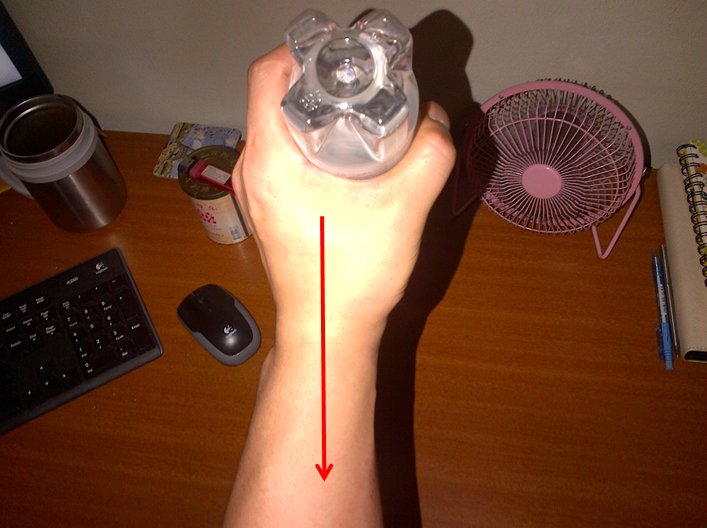
seriously bro, there is nothing 'natural' about thumbless grip. without getting into human anatomy, allow me to demonstrate to u:
now this is the correct grip, with center of mass directly applies to ur muscle/skeleton structure.
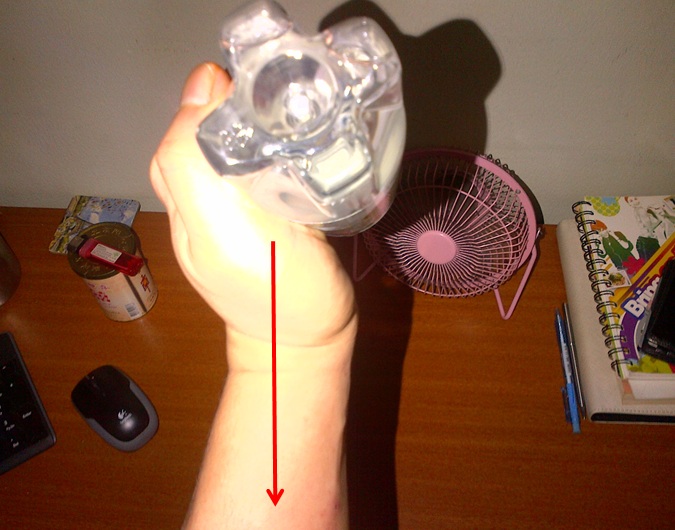
if u maintain the center of mass vertically but go thumbless, sooner or later u r gonna slip.
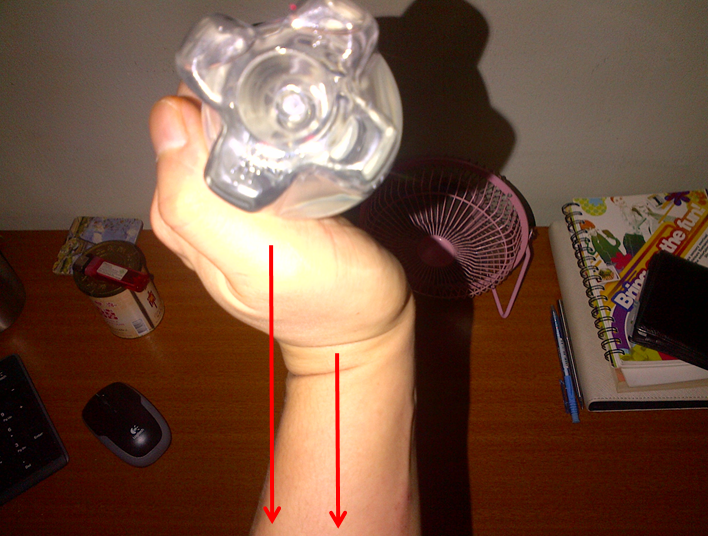
to reduce risk of slipping, chances are u'll bend ur wrist like this. this is not an efficient posture. u r applying far too much unnecessary pressure on ur wrist's tendon. and u r still gonna slip on a bad day.
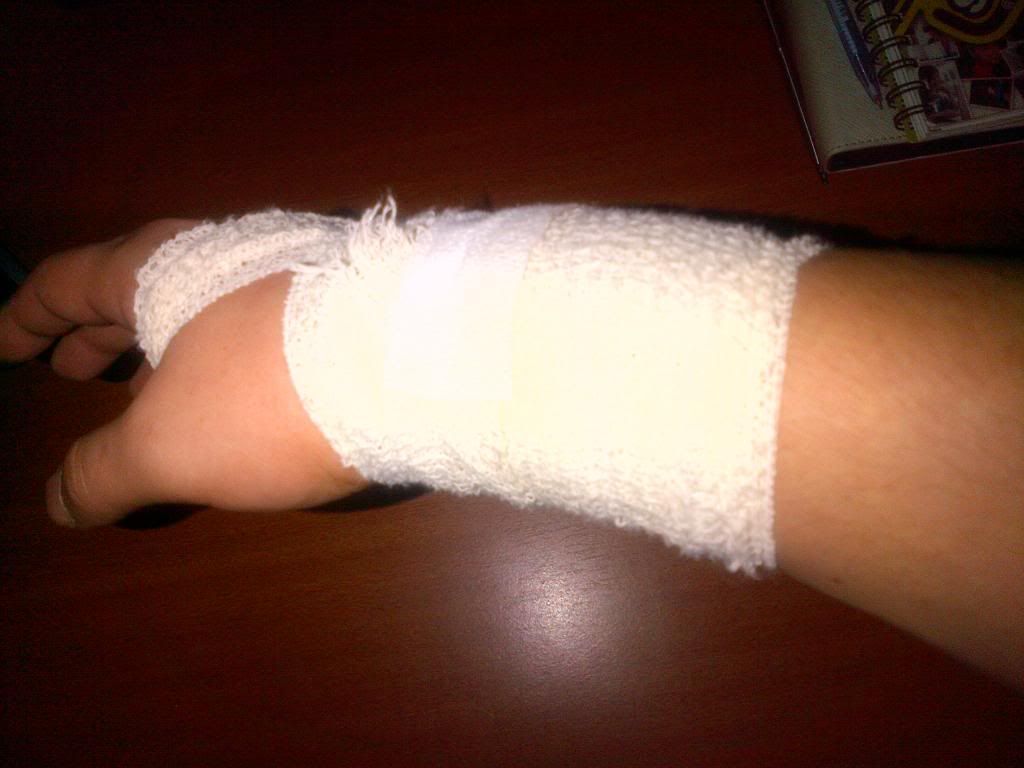
if u'd lift long and heavy enough the wrong way, u'll end up like this. i'd been visiting acupuncturist, on average, every fortnight, just to relieve the pain on my right wrist for almost 10 years now.
which brings me to another point: other than the occasional row just for fun, i now avoid dumbbell exercises like plague. i hurt my right wrist doing heavy dumbbell fry back in mid-00, stupid of me. barbell is safer (not to mention much easier to rack/unrack) because of its stricter range of motion. pretty much whatever u wanna do with dumbbell, u can do it with barbell.
err..didn't detect any hate..he was merely telling u it's dangerous..
i had the same issue in my Gym..the PT kept asking me to switch to suicide grip during my smith benching routine...said that it's the right way.. tbh i did try it..but with weak grip and wrist strength, i opted for the normal grip....been doing it till today..
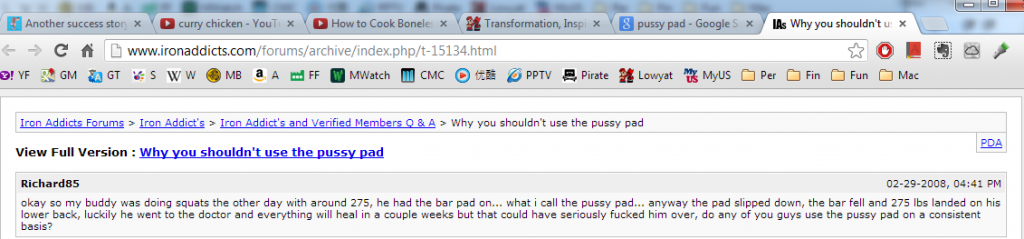
Addendum: Of Bench: You gotta lower to bar low enough to touch your lower chest area for it to count as a legit rep. Of squat: Please also don’t use p*ssy pad on your back, not that it makes you look like a p*ssy (it does, actually), but the bar might slips. You don’t wanna hurt your elbows right? On the line of same reasoning, also don’t wear those slippy dry-fit shirt when you squat. I actually made that mistake on my 9th work-out session, thank god it was only 165 lbs. 100% cotton shirt is best.
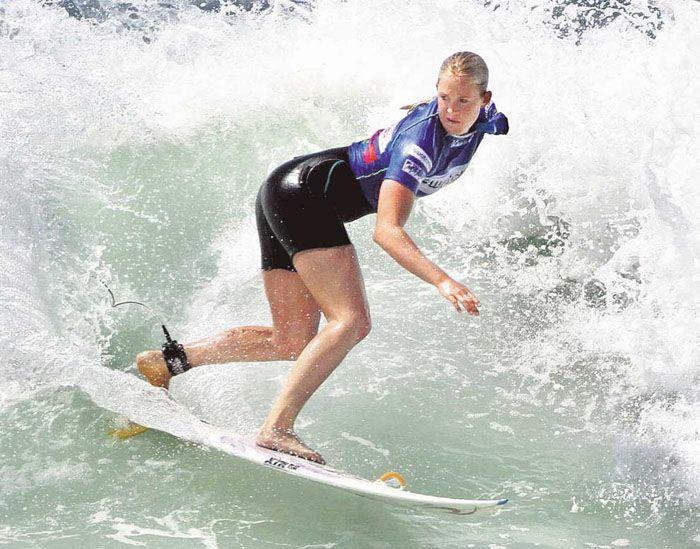
Name: Bethany Hamilton Age: 22, born Feb 8, 1990 Home country: USA, Hawaii Height: 1.80m Weight: 64kg Occupation: professional surfer
Bethany was born in a “surfing” family. Her parents Tom & Cheri, two brothers, Noah and Timmy are all suffers. She started surfing when she was 4.
On October 31, 2003, at the age of 13, Bethany went for morning surf with her best friend Alana Blanchard and Alana's father and brother. Around 7:30 a.m., she was lying on her surfboard with her left arm dangling in the water, when a 14 to 15 foot tiger shark attacked her, severing her left arm just below the shoulder. The Blanchards helped paddle her back to shore, then Alana's father fashioned a tourniquet out of a surfboard leash and wrapped it around the stump of her arm, before she was rushed to hospital. By the time she had gotten there she had lost over 60% of her blood. She then spent seven more days in recovery at the hospital.
Despite the trauma of the incident, Bethany was determined to return to surfing. Less than one month after the incident, she returned to her board. After teaching herself to surf with one arm, on January 10, 2004, she entered a major competition, winning 5th place. In 2005, she won 1st in NSSA National Competition! She is still a professional surfer today.
Some other interest tidbits: Having lost her arm, Bethany has become a pro at cutting fruit with the aid of her feet! She holds the fruit steady between her feet while sitting on the floor and then cuts them.
Aside from working with World Vision, she has also founded the Friends of Bethany Hamilton, a non-profit organization that provides support to amputees and shark attack victims. She also works with Walking on Water, Beating the Odds Organization and the Foundation for a Better Life, among a number of others.
She was at Bali teaching under-privileged kids to surf last year (2012).
She wrote about her experience in the 2004 autobiography Soul Surfer: A True Story of Faith, Family, and Fighting to Get Back on the Board.
In 2011, the movie Soul Surfer was released, Bethany was played by AnnaSophia Robb. Source: Wikipedia, http://bethanyhamilton.com/
I have yet to read the book, but I’d watched the movie 3 times, every time also touching as hell. Other good sport movies that I recommend are: The Rocky series, Cinderella Man. What can I say? I am a cheesy b*stard.
Not giving up This girl is truly amazing, that she immediately got back into water, less than a month after such a life-changing trauma! Have no fear!
Every time we feel like we might not be able to complete another set of workout due to heavy weight, we must remind ourselves of Bethany Hamilton. Never give up! What a role model! Reminder to myself: chant Bethany when I feel week.
Improvising Because Bethany has one arm less, she gotta improvise. She will always be out paddled by others; she has no choice but to utilize her lower body to kick also. The silver lining of the accident was that she’d customized a training program to make her lower body so much stronger. If you compare her photos, you can see that she has much stronger lower body today.
Bethany in those early days. The first photo above is more recent.
Also check out her unique training method on youtube:
I used to be a spoiled kid, always whined about certain lack of equipment in various gyms. Then, I was very fortunate to meet a very kind gym buddy (whom I can’t remember his name anymore). He taught me to improvise. No chin-up bar? No problem! Any place I can hang on to with my finger tips, I can chin/pull. No squat/power rack? No problem! Pull two of those triangular small barbell racks together, and I can squat. Don’t even have that? Never mind, I’ll squat using the inclining bench press rack. No calf rise machine? No problem! Grab 1 heaviest plate each arms and do it at the edge of staircase. Travelling and no access to gym? No problem! Do handstand pushup for upper body, front squat with suitcase on top of head for lower body. The list goes on…
Surfing I’d tried it twice, and I like it. On top of tremendous amount of agility, timing & control needed, I was surprised to find out that it also required a lot of upper and lower body strength. So heck, even though my wife surfs much better than I (she is a fast learner), but I out-surf her anytime!
p/s: If you are looking for companion for a quick-and-dirty weekend surfing at Bali, please pm me (after CNY though), am game. I got it all planned out. Take the last plane to Bali by AirAsia on Friday night around 10pm. Just 3 hours of flight time. Catch some sleep on the plane and some more at Bali airport. Hit the beach on first daylight for morning session surfing. Rest a little and continue for late afternoon/evening session. Night time reserved for makan and drinking. Another surfing session on Sunday morning. Take afternoon flight, and be back to KLIA by 8pm. Just nice!
Addendum: Of squat: Please also don’t use ***** pad on your back, not that it makes you look like a ***** (it does, actually), but the bar might slips. You don’t wanna hurt your elbows right? On the line of same reasoning, also don’t wear those slippy dry-fit shirt when you squat. I actually made that mistake on my 9th work-out session, thank god it was only 165 lbs. 100% cotton shirt is best.
I use the pad.
If you stick 200+lbs on the bar, it ain't gonna slip. True Story.
Ehem2, I would suggest you to not say anything about the big black pad that people use to wrap the barbell with.
I speak from past experience
Hahaha, yeah, the term is derogative, and I used that purposely. Old dogs know what it is, but it will get newbies’ attention.
QUOTE(joeblows @ Jan 11 2013, 07:58 PM)
I use the pad.
If you stick 200+lbs on the bar, it ain't gonna slip. True Story.
Good for you then, bro. But I guess you missed my point. The thing is, you actually don’t need it to squat.
Now of course, I can get into the ‘science’ part of argument, saying that, - wearing the pad changes the bio mechanics of the lift, which in turn stops you squatting with correct form. - at lighter weights, it pushes the bar away from your back and changes your balance - at heavier weights, the padding is completely compressed and provides no use - blah blah blah…
Or, I can do some simple googling and show you example of slipping:
But what I really want to rant is the psychological part of thing. It is the same for strap, glove, tape, belt, various kind of wraps, or even chalk.
They all make us psychologically depending on them in various degrees.
Of course all of them are case dependent and have their uses in individual situation. But the main principal is always, if it is not 100% necessary, ditch it. The p pad is just the worst offender on attire’s front.
On the supplement side, it is the same story for protein, amino acid, fat burner, creatine, vitamin, fish oil, minerals.
People always have this short-cut mentality. Oh I am too skinny, I gotta take some protein. Oh I am too fat, gotta take some fat burner… But refuse to invest some time to figure out the proper exercise regime and/or figure out the right way to eat.
Of adorable chick, the quick lifts & body fat percentage
Name: Samantha Wright
Age: 23-23 Height: 5”2’ Weight: 53kg Association: Ex-gymnast, weightlifter, Crossfit trainer. She has recently qualified to compete at the national level (The US of A) in Olympic weightlifting, so maybe we’ll see her at the 2016 games!
Below is the youtube clip of Sam in American Open 2011.
Notes: 1. Adorable huh? Apparently she carried her former gymnast postures and habits into weightlifting. Most of them are cute and harmless, maybe except how she closed her feet together at the end of lifts. That scares me a bit. 2. You can tell that she had put in a lot of hard work to train for oly lifts by just looking at her lower body. No way could she have such a thick, powerful lower body being a gymnast. 3. She cleaned pretty badly huh? Scary. 4. In US, there isn’t much systematic support for oly weightlifters, maybe that’s why she is involved with Crossfit. I guess we all gotta earn a living.
The quick lifts Snatch and clean and jerk are called the quick lifts, because they are finished in split second. You seldom see lifters struggling through a lift (other than getting up from the squat position part). It is either on, or off.
Of the two, snatch is the more technical-oriented one. You pull and move the bar into overhead position by extension of your body in one-go. Damn beautiful displays of explosive power. Typically one can only snatch up to 80% of c&j. Despite the lighter weight, it is actually a very hard lift; you have to extend and pull yourself underneath the bar in literally split second. The split second movement is actually one of the fastest moves in ALL sport activities. It is also almost impossible to save a lift if the bar is too far forward or too far behind. You just have to let go. If you train in a gym that can let you drop weight, give it a go, I suspect that you will like it.
C&J is more strength-oriented relative to snatch. It consists of 2 movements; first, you ‘clean’ the bar by racking it on your shoulder; then you jerk it overhead. You can lift heavier weight compare to snatch this way. The clean part requires a lot of shoulder flexibility.
Both lifts require tremendous amount of strength from lower body and back. The arms, chest and arbs serve primarily as stabilizing muscle. Note that even though both lifts end with bar at overhead position, you cannot actually pull the bar up with arms. Your arms are not strong enough to do that either. Arm pulling will also disqualify the lift. The bar is actually pulled up by extension of knee, hip, trap, etc. The arms are just there to support the weight at overhead position.
Body fat percentage Because of the peculiar nature or mechanism of the oly lifts, oly lifters have much stronger lower body and back relative to their chest and arms. For example,
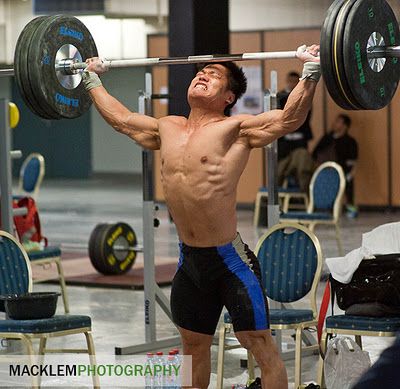
Lu XiaoJun, 77kg categories, world record holder for snatch and total. Yeah, he is freaking ripped overall, but pay attention to the proportion of his lower body & back vs chest and arms. Holy shit, those monster traps.
For the past 10-15 years or so, the Chinese lifters had been getting ripper and ripper, which kinda make sense. The Chinese primarily dominated the lower weight classes (56kg, 62kg, 69kg & 77kg), there are only so much muscle one can have with weight limitation, and the lower body fat they have, they can then have more rooms for muscle, which again, go to where it matters the most - lower body & back.
Lifters in the higher weight class (85kg, 94kg, 105kg & +105kg) are usually less ripped, probably because they have more rooms for error/maneuver.
Even though the Chinese are very ripped, they are not shredded like professional bodybuilders during contest time, whom have maybe 4-6% body fat. Judging from naked eye, the Chinese are more like 8-10%. I am 100% sure that they can get there if they choose to, after all, according to documentary, they lifted like 40-60MT PER DAY during intensive training period. I suspect that they find that once body fat % goes below certain level, it adversely impacts their lift. Just like professional boxers who also carry a little bit extra fat to cushion & buffer the impact of hits on their internal organs. But that is just my suspicion, I don’t know for sure. Maybe Darklight can enlighten us.
Lastly on a somewhat related note, since my current gym doesn’t have a power rack and a bit leceh for me to do heavy barbell shrug, I do clean high pull on non-deadlift day instead. I find that I like it, hit the traps real good. It looks like this. Give it a try, start with 50% of your max deadlift weight.
Having very low bodyfat does affect lifts but it's not directly because of the bodyfat level itself, AFAIK. It's more of the fact that to get to extreme low BF %s, you're eating a lot less. Also why bodybuilders are at their weakest around contest time.
Having very low bodyfat does affect lifts but it's not directly because of the bodyfat level itself, AFAIK. It's more of the fact that to get to extreme low BF %s, you're eating a lot less. Also why bodybuilders are at their weakest around contest time.
Good morning Dan. Watched any football last night? I think you are right about bodybuilders at their weakest around contest time. But I don’t think weightlifters eat less before competition (other than the usual fine-tuning and dehydration to make weight category). The whole point of them having lower body fat percentage in the first place is to make room for more muscle. So whatever body fat they manage to lose is replaced by lean muscle, maybe not ounce for ounce but as close as possible. So I was thinking, if this line of reasoning is right, then why don’t they go all the way down to maybe 5-6%? Could it be that 8-10% is more efficient in lifting compare to 5-6%? That being my original question.
Good morning Dan. Watched any football last night? I think you are right about bodybuilders at their weakest around contest time. But I don’t think weightlifters eat less before competition (other than the usual fine-tuning and dehydration to make weight category). The whole point of them having lower body fat percentage in the first place is to make room for more muscle. So whatever body fat they manage to lose is replaced by lean muscle, maybe not ounce for ounce but as close as possible. So I was thinking, if this line of reasoning is right, then why don’t they go all the way down to maybe 5-6%? Could it be that 8-10% is more efficient in lifting compare to 5-6%? That being my original question.
Sadly, I didn't. I had studying to do, heh.
Anyway, I didn't mean weightlifters purposely eat less before a competition. What I meant by bodybuilders around competition time as an example is that they need to be at quite a caloric deficit to maintain those levels of body fat and that does have an effect on lifting. Also, going by personal experiences of competitive bodybuilers, it gets exponentially more difficult to lower body fat past certain levels (like 7 or 6 or 5%) as the body is fighting to keep it on. I think that would have an effect on lifts and it probably is more efficient as you said, to stay at a slightly higher BF %. Sort of a balancing act.
So I was thinking, if this line of reasoning is right, then why don’t they go all the way down to maybe 5-6%? Could it be that 8-10% is more efficient in lifting compare to 5-6%? That being my original question.
Yes and there is a very good reason for this.
Most of the major joints around the body such as elbow and knee have a fat pad around it to act as a natural "cushion" for the impact often directed to the joints.
As a person gets too low in bodyfat, he loses fat from all areas of his body and this may directly affect the fatty padding around the joints.
Given that an Olympic weightlifter will likely be timing training so as to be hitting "peak" close to competition - he/she will not want the additional risk of injury.
TLDR - risk of getting injured outweigh the minute benefits.
Given that an Olympic weightlifter will likely be timing training so as to be hitting "peak" close to competition - he/she will not want the additional risk of injury.
TLDR - risk of getting injured outweigh the minute benefits.
lmfao... no offence bro, i don't think u know what u r talking about.
That's ok. The feeling is mutual after seeing your rants against pre workouts, supplements, straps and pads.
Also your claim of 190kg x 5 at 70kg.
Initially I was gonna ignore this, but on second thought…
The purpose of me opening up this thread is to share my experience/thought with forumers here, especially the newbies. God knows I’d made many mistakes along the way, and if you can somehow avoid making the same mistakes, perhaps you can reach your goal, whatever it is, easier or faster. If you are too stuck up to hear about ideas that are not familiar to you, you can ignore the thread. Or, we can engage in constructive discussion. If you however, talk nonsense here, I am gonna call you bluff.
Let me refute your points one-by-one: 1. We human being only has limited attention. Whatever limited attention we have are best used in getting ourselves stronger in lifting (raw strength wise, technique wise or overall program wise) & a proper diet plan we can stick to pretty effortlessly over longer run.
There is a place for supplements and all that, but if people fuss about the timing, frequency, dosage of supplements, so much so that, they don’t even lift and eat properly, then the priority is wrong, of course I am gonna laugh.
I come across this clip of the so-called ‘pre-workout meal’ of truly elite lifters. And what do they eat? Chicken soup, white rice & instant noodles. http://www.youtube.com/watch?v=1lJ0mMSaiis
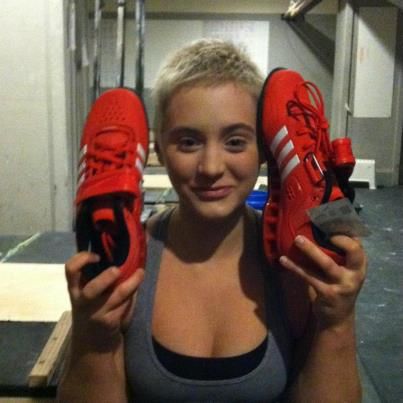
2. Straps, p pad, whatever. Why do you need all these things? You do realize that these are shits (including supplements) that manufacturers pay bodybuilders to wear/eat in magazines so that they can sell more of their products right? If you have a valid argument of why using the p pad is absolutely necessary for squatting, I will stand corrected.
As far as I am concerned, you only need an underwear (optional for female) and a pair of shoes to workout. If the guy who lifts barefooted wanna call me a p*ssy for wearing shoes, I have no defense.
I have been using belt for years, and I now regret it. Psychologically, it makes me dependent on the belt. Imagine if I didn’t belt up then, my progress most likely would be slower, but mentally I would be stronger. Lifting is as much about mental as physical.
3. About deadlifting. This is the one that prompts me to reply. I don’t understand why is it that deadlifting 3 x your bodyweight sounds so unbelievable to you? Heck, Darklight can lift more than that. You can also find hundreds of youtube clips of average people deadlifting 3x or more of their bodyweight. You think they are all genetic freaks? Chances are, they are as ordinary as you and me. The only different between them and you is, they aspired to reach that target and you don’t even believe that is possible. I did not say deadlifting 3x bodyweight is easy, but it is achievable for most of us. It is like having a 3.80 CGPA, tough, but doable if you work hard on it.
I think the take-home-point for newbies is; If you aspire for something, chances are, you will get there. If you are content to be a dochebag, chances are, you will remain so. In life or in lifting.
4. As for my so-called ‘claim,’ don’t you worry about it. I will surely post a video for your viewing pleasure when I get there. Heck, it is only another 100 lbs or so to go, what’s so hard about it?
p/s: since ur resolution is really low body %, i will try to write something that might be of your interest next few days.
No I don't squat. But let's you and me compare leg development since I have progress shots of my quads around the progress thread. What's with certain Nazis insisting everyone MUST squat. Tsk. Bench press isn't necessary, deadlift nor the squat isn't necessary even though they are very GOOD exercises. There are always other alternative COMPOUND movements.
2. Straps, p pad, whatever. Why do you need all these things? You do realize that these are shits (including supplements) that manufacturers pay bodybuilders to wear/eat in magazines so that they can sell more of their products right? If you have a valid argument of why using the p pad is absolutely necessary for squatting, I will stand corrected.
No one ever said all those were "necessary" but all of them serve a purpose.
If you choose not to use them as a matter of personal preference or some misguided belief that lifting raw makes you "hardcore" - that's fine, to each his own. But if others want to use them, that's our business. Don't hate us because we know how to use items like straps, pads or pre-workout supps to gain an advantage - real or perceived.
And so far as "real lifters" eating pre-workout meals of rice and chicken: more power to them, dude. I'm a busy man. I ain't got the time to go home and cook a pre-workout every day before I hit the gym. I do what works for me. So should everyone else.
QUOTE(pleowcw @ Jan 23 2013, 05:32 PM)
3. About deadlifting. This is the one that prompts me to reply. I don’t understand why is it that deadlifting 3 x your bodyweight sounds so unbelievable to you? Heck, Darklight can lift more than that. You can also find hundreds of youtube clips of average people deadlifting 3x or more of their bodyweight. You think they are all genetic freaks? Chances are, they are as ordinary as you and me. The only different between them and you is, they aspired to reach that target and you don’t even believe that is possible. I did not say deadlifting 3x bodyweight is easy, but it is achievable for most of us. It is like having a 3.80 CGPA, tough, but doable if you work hard on it.
I think the take-home-point for newbies is; If you aspire for something, chances are, you will get there. If you are content to be a dochebag, chances are, you will remain so. In life or in lifting.
4. As for my so-called ‘claim,’ don’t you worry about it. I will surely post a video for your viewing pleasure when I get there. Heck, it is only another 100 lbs or so to go, what’s so hard about it?
3XBW is elite level. You didn't just claim a 1RM (I'd have believed it no problem) you claimed 3x5 sets, which makes your 1RM close to 200-205KG (at a minimum).
Matt Kroc can claim anytime that he can squat 500lbs raw for reps and no one would bat an eyelid - cause we all know he can. If I go and claim those numbers though, I'd better be backing them up, or I'd expect people to laugh at me.
I'll be more than happy to eat my words and call you an elite DLer if you break the 200kg mark at 70. Malaysia needs more elite lifters. So, good luck I guess.
BTW, before you claim that others don't know what they're talking about - you may wanna consider that they may actually lift just as much if not more than you, as well as actually look like they lift. No offense.
No one ever said all those were "necessary" but all of them serve a purpose.
If you choose not to use them as a matter of personal preference or some misguided belief that lifting raw makes you "hardcore" - that's fine, to each his own. But if others want to use them, that's our business. Don't hate us because we know how to use items like straps, pads or pre-workout supps to gain an advantage - real or perceived.
And so far as "real lifters" eating pre-workout meals of rice and chicken: more power to them, dude. I'm a busy man. I ain't got the time to go home and cook a pre-workout every day before I hit the gym. I do what works for me. So should everyone else. 3XBW is elite level. You didn't just claim a 1RM (I'd have believed it no problem) you claimed 3x5 sets, which makes your 1RM close to 200-205KG (at a minimum).
Matt Kroc can claim anytime that he can squat 500lbs raw for reps and no one would bat an eyelid - cause we all know he can. If I go and claim those numbers though, I'd better be backing them up, or I'd expect people to laugh at me.
I'll be more than happy to eat my words and call you an elite DLer if you break the 200kg mark at 70. Malaysia needs more elite lifters. So, good luck I guess.
BTW, before you claim that others don't know what they're talking about - you may wanna consider that they may actually lift just as much if not more than you, as well as actually look like they lift. No offense.
Oh... oh.... I can deadlift 3x my bw. But i don't care. Lol. Eh you're still in TF?
No I don't squat. But let's you and me compare leg development since I have progress shots of my quads around the progress thread. What's with certain Nazis insisting everyone MUST squat. Tsk. Bench press isn't necessary, deadlift nor the squat isn't necessary even though they are very GOOD exercises. There are always other alternative COMPOUND movements.
QUOTE(joeblows @ Jan 24 2013, 12:26 PM)
Don't hate us because we know how to use items like straps, pads or pre-workout supps to gain an advantage - real or perceived....
Yo Darklight, why so pissed? You pulled my legs, I teased u back a little, no harm why? Hi Joe, nah, no hate. In fact, we are just arguing about small issues where nobody outside this small niche circle gives a damn about. Communication via internet is a b*tch, I am pretty sure if we meet up face-to-face to talk-cock-sing-song, we can become beer buddy. I am also sorry for some of the phases/words I used that aggravated u.
Come across this, can't resist to post, the body fat percentage article gotta wait:
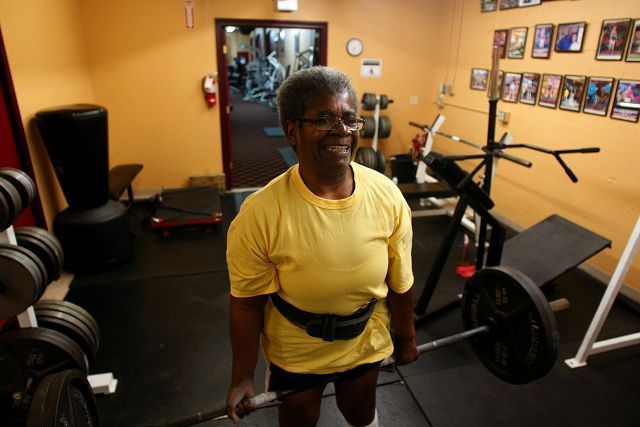
Name: Winifred Pristell Nick name: The Heavy Metal Great-Grandma Age: 72/73 Height: 5"4' Association: powerlifting Source: http://www.heraldnet.com
Winifred Pristell is 70 years old and lives in the Seattle, WA area. Three days a week she gets up at 3:30am in order to be at the gym by 5am.
Winifred has a reputation to uphold. She’s a great-grandmother who they call “Heavy Metal” because she’s a competitive weightlifter with two world records and aspirations for more.
When you watch the above video, you’ll learn more about Winifred and see her in action.
At 47, the 5-foot-5-inch-tall woman was dangerously obese, weighing 235 pounds, with a body mass index of about 40. A body mass index of 25 is considered overweight; obesity starts at 30.
Since then, she’s dropped five dress sizes. The weight just crept up on her, she says. She was working long hours, eating poorly and drinking and smoking too much.
One day while taking a bath, Pristell remembers feeling as though she was dying. She asked her daughter, Cynthia, if she would walk with her.
“I couldn’t walk but a block that first time,” she said.
Every morning the two walked together, a little farther each day. Within a year, Pristell was up to three miles, five days a week, she said. That’s about the point she walked into a gym for the first time in her life. She tried aerobic exercises, stationary bikes, and other machines and contraptions.
Years would pass before she tried free weights and more than a decade before she began lifting weights competitively at the age of 60.
At 68, Pristell set world records for her age in bench press, 176.2 pounds, and in dead lift, 270 pounds, for her age group and weight class, according to World Association of Bench Pressers & Deadlifters. And she’s set scores of other state and national records.
Because of her unhealthy background and where she is now, sometimes Winifred can be a bit blunt. On a recent day at the gym she told a teenage boy who works there that he is too fat. She’s not trying to be mean, she says. Sometimes she just says things without thinking first.
After all, she is a retired barber who was blessed with the gift of gab, so she just likes to talk it up. And she figures if she can do it, anyone can.
After all, she’s a world record holder.
“Sometimes they call me a freak,” Winifred Pristell says. “That’s OK. I like being called a freak sometimes. It’s kind of unheard of, a person being my age doing what I can do. For me, the older I’m getting, the stronger I’m becoming.”
How was it possible for Winifred to so drastically change her life? What lessons can be learned from Winifred that can help you lead a long and vital life?
Her incredibly positive attitude: Her trainer, Andrew “Bull” Stewart says of her, “She has no limitations. Mentally, physically, she just has a spirit about her, an attitude that she can do anything.”
Her perseverance: Three days every week she is up at 5:30am and goes to the gym to lift weights. She has integrated exercise and healthy eating habits into her normal routine of life.
Her belief in herself: Even though she has arthritis in her hands, feet, and back, Winifred believes she can overcome her challenges. “We are all dealing with something. If you let whatever you’re dealing with control your life, you have no quality of life.”


 Jan 5 2013, 12:36 AM, updated 13y ago


 Quote
Quote









 im just stating that i like the suicide grip..









 0.0546sec
 1.73
1.73
 6 queries
 GZIP Disabled