Welcome Guest ( Log In | Register )

Bump Topic Topic Closed RSS Feed
6 Pages « < 3 4 5 6 >Bottom

Outline · [ Standard ] · Linear+

 SPM 2013 Thread

views
     
Critical_Fallacy
post Oct 3 2013, 06:47 PM

∫nnộvisεr
Group Icon
VIP
3,713 posts

Joined: Nov 2011
From: Torino
QUOTE(manutd96 @ Oct 3 2013, 03:57 PM)
In physics, for potential energy, must we specify if its elastic or gravitational PE or just write potential energy, especially for questions on energy change
Still having a hard time getting over the potential energy? It's usually understandable if you just write "PE_object" when doing the calculation on paper. wink.gif
Critical_Fallacy
post Oct 4 2013, 03:12 PM

∫nnộvisεr
Group Icon
VIP
3,713 posts

Joined: Nov 2011
From: Torino
QUOTE(chun96 @ Oct 4 2013, 03:08 PM)
Do you guys ignore the homework given by your school teachers?
What is the real reason for asking this question? Are you having trouble with that? unsure.gif

This post has been edited by Critical_Fallacy: Oct 4 2013, 03:13 PM
Critical_Fallacy
post Oct 4 2013, 08:20 PM

∫nnộvisεr
Group Icon
VIP
3,713 posts

Joined: Nov 2011
From: Torino
QUOTE(chun96 @ Oct 4 2013, 05:24 PM)
It is not that I don't know how to do it. Just want to ask you all whether you do your school homework right now (which is sometime time consuming especially Mathematics).
Do our stories have any influential impact in your decision making? sweat.gif

Generally, we do homework assignments. More importantly, you've got to understand the main objectives and the teacher's intention of assigning homework to students. Are they particularly helpful? <--- (It's a dangerous question, might not be for everyone, so wise and discreet evaluation is recommended.) If they are Past Exam Papers and you've done them some time ago, it probably reinforce your understanding when you revisit and review the questions & solutions.

I know it can be very frustrating to do the homework especially when it upsets your Revision and Study plan as you are counting down for SPM 2013. unsure.gif
Critical_Fallacy
post Oct 5 2013, 01:38 AM

∫nnộvisεr
Group Icon
VIP
3,713 posts

Joined: Nov 2011
From: Torino
QUOTE(Screen @ Oct 5 2013, 01:26 AM)
Guys, mind explaining why is the answer B but not D?
Guess that you have justified it with the sketch diagram on the upper right corner. What else do you want?

Remember this: A good explanation doesn’t contradict established knowledge.
Critical_Fallacy
post Oct 5 2013, 10:14 PM

∫nnộvisεr
Group Icon
VIP
3,713 posts

Joined: Nov 2011
From: Torino
QUOTE(hong8888 @ Oct 5 2013, 09:47 PM)
Yea the unit vector formula i do know that. But i'm stuck on that. How could i apply unit vector formula into it? rclxub.gif
Given that

Vector PQ = (k − 3) i + (1) j

and

Vector PQ is a unit vector. (The hidden message is the magnitude |PQ| = 1)

Therefore,

|PQ| = √(x² + y²)

and you finish the rest... icon_rolleyes.gif

This post has been edited by Critical_Fallacy: Oct 5 2013, 10:15 PM
Critical_Fallacy
post Oct 5 2013, 10:39 PM

∫nnộvisεr
Group Icon
VIP
3,713 posts

Joined: Nov 2011
From: Torino
QUOTE(maximR @ Oct 5 2013, 09:19 PM)
B is the right answer . Where did you get this from ? I have past years before the year 2000 , but in B.M .
QUOTE(Just Visiting By @ Oct 5 2013, 10:14 PM)
D should be the correct answer. Since R, the resistance, is acting to the direction opposite of the motion of the ship, the resultant force should be the (horizontal force of two ships, 2F cos angle) - R. If you take F sin angle, you'll be taking the vertical motion of the ship.
To be safe, it can be shown that the magnitude of the resultant force, T = 2F cos 30° by applying the law of cosines on the addition of vectors (construct the parallelogram). icon_idea.gif

user posted image
Critical_Fallacy
post Oct 5 2013, 11:32 PM

∫nnộvisεr
Group Icon
VIP
3,713 posts

Joined: Nov 2011
From: Torino
QUOTE(Screen @ Oct 5 2013, 11:10 PM)
1st pic: Question 9
Q9 requires you to calculate the pressure at the base of the tank due to water.

And you seemed to know the formula Pressure = Force (or Weight) / Area.

You have calculated the mass of water (m) is 1050 kg. Can you find the weight of water? sweat.gif
Critical_Fallacy
post Oct 5 2013, 11:58 PM

∫nnộvisεr
Group Icon
VIP
3,713 posts

Joined: Nov 2011
From: Torino
QUOTE(Screen @ Oct 5 2013, 11:48 PM)
What I did:
Your approach is correct, but lacking experience.

Try multiply the mass of water with g = 9.8 m/s². icon_idea.gif
Critical_Fallacy
post Oct 6 2013, 09:26 AM

∫nnộvisεr
Group Icon
VIP
3,713 posts

Joined: Nov 2011
From: Torino
QUOTE(Screen @ Oct 6 2013, 12:43 AM)
Mind helping out on the other 2 questions?
Q3

Purpose:
Find the tension in the rope that holds the hot air balloon in equilibrium (static).

Understanding:
The balloon floats because of the buoyant force (from the surrounding air) exerted on it. Without the rope, the balloon will slowly lift up high into the air, because the pressure difference between the top and bottom of the balloon results in a net force that tends to accelerate an object upwards. That's the buoyancy effect.

Solution:
The tension in the rope = the net force (lift) = Buoyancy force (↑) − weight of balloon due to gravity (↓)

Buoyancy force = Weight of air displaced by the balloon

Can you do Q4 using Archimedes' principle? sweat.gif
Critical_Fallacy
post Oct 6 2013, 11:01 AM

∫nnộvisεr
Group Icon
VIP
3,713 posts

Joined: Nov 2011
From: Torino
QUOTE(kangaroo96 @ Oct 6 2013, 10:15 AM)
for Q9 is it a very direct question where Pressure = Depth x Density x 9.8

P = 0.7 x 1000 x 9.8 = 6860 Pa?
The pressure formula P = hρg (for fluid) can be derived from P = W / A.

weight, W = mg

mass, m = ρV

volume, V = hA

In fact, if the question asks for the total pressure below the base of the water tank due to the compression load on the concrete foundation, then the formula P = hρg is not sufficient. icon_idea.gif
Critical_Fallacy
post Oct 6 2013, 12:58 PM

∫nnộvisεr
Group Icon
VIP
3,713 posts

Joined: Nov 2011
From: Torino
QUOTE(maximR @ Oct 6 2013, 12:29 PM)
Tension = Upthrust / Buoyant force = Weight of water displaced by object = Weight of object ( since they're completely submerged )

So , based on my reasoning ,

T3 > T2 > T1

[ Ans : B ]
Although your answer B is correct, it is worthwhile to mention that, the weight of water displaced by a fully immersed polystyrene DOES NOT equal to the weight of the polystyrene, unless it floats freely on the water surface.

The weight of the polystyrene is negligible (0 N) because it has very low density.

Thus, we have

Tension = Weight of displaced water − 0.

Assuming that all Polystyrene (P) have the same cross section area, so volume of P3 > P2 > P1.

Since the parameters of water density and standard gravity, g are unchanged, then tension T3 > T2 > T1. icon_rolleyes.gif

This post has been edited by Critical_Fallacy: Oct 6 2013, 01:02 PM
Critical_Fallacy
post Oct 6 2013, 01:18 PM

∫nnộvisεr
Group Icon
VIP
3,713 posts

Joined: Nov 2011
From: Torino
QUOTE(maximR @ Oct 6 2013, 12:29 PM)
So , based on my reasoning , since the mass of 3 > 2 > 1 , weight of 3 > 2 > 1 ,

T3 > T2 > T1
Just want to be more specific. Because we are calculating the weight of the displaced water, W = mg,

where m, the mass of the displaced water is given by m = ρV, we have W = ρVg.

Therefore, it is easier to reason with the Volume of the displaced water because we can justify the volume of an object by vision alone. For mass, we need to measure since it is a fundamental physical property.
Critical_Fallacy
post Oct 6 2013, 01:46 PM

∫nnộvisεr
Group Icon
VIP
3,713 posts

Joined: Nov 2011
From: Torino
QUOTE(maximR @ Oct 6 2013, 01:11 PM)
user posted image
A biconvex lens is used to focus the light. If the lens is partially blocked, the light intensity is reduced. Thus, it affects the brightness of the spectrum of colors as well.

I is correct.

The display of the spectrum of colors depends on the prism, and it DOES NOT depend on the biconvex lens. The white light will still hit the prism and it causes the light to be refracted into full spectrum of colors.

IV is false.
Critical_Fallacy
post Oct 14 2013, 08:10 PM

∫nnộvisεr
Group Icon
VIP
3,713 posts

Joined: Nov 2011
From: Torino
QUOTE(Screen @ Oct 14 2013, 05:57 PM)
Guys, how to answer questions which requires a Boolean something in Physics? (Logic gates)
QUOTE(mingisms @ Oct 14 2013, 07:27 PM)
If the question asks you to state the Boolean expression/algebra, it's the stuff in the "operator" column in the image below...
user posted image
Remember to study the Truth Tables and De Morgan's laws as well. Sometimes you will be asked to simplify a complicated Boolean logic by sketching the Digital Logic Gates usually comprising NAND, NOR, XOR & XNOR. icon_idea.gif
Critical_Fallacy
post Oct 14 2013, 08:31 PM

∫nnộvisεr
Group Icon
VIP
3,713 posts

Joined: Nov 2011
From: Torino
QUOTE(Screen @ Oct 14 2013, 08:18 PM)
XOR and  XNOR are out of the syllabus, any X... gates are not in our syllabus anymore
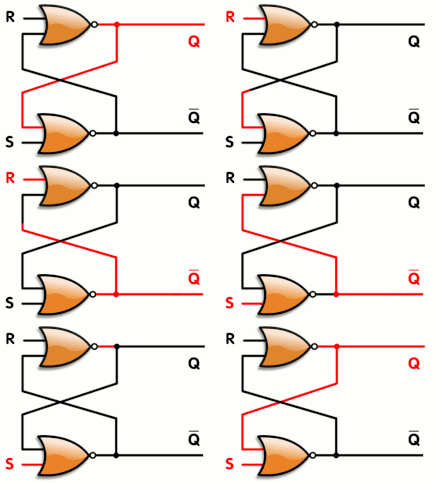
Thanks for the update. Is flip-flop circuit in the physics syllabus? icon_question.gif

A simple flip-flop circuit can be constructed from a pair of cross-coupled NOR gates!

user posted image

This post has been edited by Critical_Fallacy: Oct 14 2013, 08:32 PM
Critical_Fallacy
post Oct 17 2013, 01:17 AM

∫nnộvisεr
Group Icon
VIP
3,713 posts

Joined: Nov 2011
From: Torino
QUOTE(maximR @ Oct 16 2013, 02:30 PM)
user posted image
QUOTE(maximR @ Oct 16 2013, 07:37 PM)
Sorry five choose four . Hmmm , after asking seniors , I think 1200 is the best answer . Do you have any more seniors whom you can double check with ? But I think I'm quite sure now , seeing your reasoning and manutd's .
QUOTE(maximR @ Oct 16 2013, 07:40 PM)
There should be only six letters in a code .
Permutations of 6-letter code in which the letter U & E are side by side: P(6, U|E)

(1) Use 2 letters :: permutations of U|E :: 2!
UE
EU

(2) Use the remaining 4 letters :: order of 4 out of 5-letter alphabet: S|B|J|C|T :: 5P4
SBJC
SBJT
SBCJ
SBCT
SBTJ
SBTC
...

(3) Ways of arranging 4 out of 5-slot code where the inseparable 2-letter U|E is treated as 1 fixed slot and the order of the slots doesn't matter :: 5C4

U|E _ _ _ _
_ U|E _ _ _
_ _ U|E _ _
_ _ _ U|E _
_ _ _ _ U|E

P(6, U|E) = (permutations of U|E) × (order of 4 out of 5-letter alphabet: S|B|J|C|T) × (ways of arranging 4 out of 5-slot code)

P(6, U|E) = 2! × 5P4 × 5C4 = 1200 different permutations icon_rolleyes.gif

This post has been edited by Critical_Fallacy: Oct 17 2013, 08:46 AM

Critical_Fallacy
post Oct 17 2013, 10:09 PM

∫nnộvisεr
Group Icon
VIP
3,713 posts

Joined: Nov 2011
From: Torino
QUOTE(maximR @ Oct 17 2013, 09:39 PM)
Can I not use 5C4 instead , and just multiply by 5 ? This yields the same answer , but in proper Mathematics , is this acceptable ?

Thanks for the solution by the way !
hmm.gif How do you justify in choosing "5"? Where exactly does the "5" come from? You have to convince the exam markers that "5" is not your lucky pick or else ½-mark is a goner. In Permutations & Combinations, students are taught to use n!, nPr, nCr, and not supposed to list down all possible variations of things that can be arranged in certain manner. Remember that a Permutation is an ordered Combination. Perhaps, the following criteria are helpful in determining nPr or nCr :: icon_idea.gif

(1) Repetition is allowed
(2) No repetition
(3) Order doesn't matter
(4) Order does matter

This post has been edited by Critical_Fallacy: Oct 17 2013, 10:14 PM
Critical_Fallacy
post Oct 17 2013, 10:17 PM

∫nnộvisεr
Group Icon
VIP
3,713 posts

Joined: Nov 2011
From: Torino
QUOTE(maximR @ Oct 17 2013, 10:12 PM)
In SPM , we are taught to use only Permutation for questions with key-word 'Arrange' , and Combination for questions with key-word 'Choose' or 'Select' . We are also taught to list down all possible variations . icon_question.gif

5 because there are 5 different combinations where UE ( treated as a single unit ) can be arranged .
*
I suppose if the size of the set is small, you can list down them clearly to show the obviousness! icon_rolleyes.gif
Critical_Fallacy
post Oct 18 2013, 05:39 PM

∫nnộvisεr
Group Icon
VIP
3,713 posts

Joined: Nov 2011
From: Torino
QUOTE(assymessy @ Oct 18 2013, 05:05 PM)
How do you guys memorize all those food additives, composite materials and such for Chemistry? I find it a pain in the ass.
My brain matter is different from yours. I don't memorize but I do familiarize. It's a kind of backpropagation learning method, similar to the way a child learns to identify a motorcar from examples of 4-wheeled sedan cars. icon_rolleyes.gif
Critical_Fallacy
post Oct 18 2013, 06:50 PM

∫nnộvisεr
Group Icon
VIP
3,713 posts

Joined: Nov 2011
From: Torino
QUOTE(Heartnsoul @ Oct 18 2013, 06:27 PM)
Well, I look at the list or table a few times and I can form a blurry image in my brain. I then proceed to link the items I remember to their categories.
Could you describe exactly the PROCESS or METHODOLOGY of linking the items you remember to their categories? This way, assymessy might learn better. sweat.gif

This post has been edited by Critical_Fallacy: Oct 18 2013, 06:50 PM

6 Pages « < 3 4 5 6 >Top
Topic ClosedOptions
 

Change to:
| Lo-Fi Version
0.0608sec    1.03    7 queries    GZIP Disabled
Time is now: 19th December 2025 - 08:55 AM