Welcome Guest ( Log In | Register )

Outline · [ Standard ] · Linear+

 Private Retirement Fund, What the hell is that??

views
     
dasecret
post Jun 9 2014, 10:09 AM

Regular
******
Senior Member
1,498 posts

Joined: Nov 2012
QUOTE(tan1346 @ Jun 8 2014, 07:22 AM)
what's your view on Kenanga One PRS?
*
I just signed up for it, for employer additional contribution
I think it's good since it feeds into a good track record fund, if only there is one that contribute 100% into equity fund tongue.gif

Why do I say it's good? You save even the 2% sales charge if you were to contribute via FSM, be it cash contribution or EPF contribution
dasecret
post Jun 9 2014, 11:06 AM

Regular
******
Senior Member
1,498 posts

Joined: Nov 2012
QUOTE(David83 @ Jun 9 2014, 10:41 AM)
But FSM didn't carry Kenanga One PRS.
*
I was told by the Kenanga personnel that they are in the midst of getting the PRS funds onto FSM platform. So it's just a matter of time lor
dasecret
post Jan 28 2015, 02:19 PM

Regular
******
Senior Member
1,498 posts

Joined: Nov 2012
QUOTE(David83 @ Jan 28 2015, 01:24 PM)
PRS an effective channel for retirement savings
URL: http://www.theedgemarkets.com/my/article/p...irement-savings

Interesting? PRS hedges against inflation but as far as I know, most of the PRS funds introduced are feeder into several funds managed by its own fund manager.
*
I've no idea what she's talking about... doesn't make any sense to me rclxub.gif
dasecret
post Mar 20 2015, 02:46 PM

Regular
******
Senior Member
1,498 posts

Joined: Nov 2012
QUOTE(low yat 82 @ Mar 20 2015, 10:55 AM)
wat im tryin to say is feeder fund r not created purely for retirement plan. u can risk lose out alot bcoz d fund manager has different mindset from d original PRS funds.

imho, d real PRS  growth / moderate shall always less profitable / less risk compare to outside funds.
*
The Cimb asia pac PRS that feeds into Ponzi 2.0 is a non-core fund which is optional for PRS holders.
The core funds have rule of thumb and is easy for the investors to determine which one they should invest in. Example for those before 40, by default the core fund would be growth fund which has 70% equity and 30% bond.

I agree that forumers here generally look at returns solely when deciding what to invest in and therefore might end up with a fund not so suitable for their risk profile, but the design did take into consideration of risk profile, age etc for retirement purposes. Investors however is given the option to deviate from the default 'recommended' fund type, which I think is brilliant, as compared to EPF style of 'one size fit all'
dasecret
post Nov 26 2015, 10:14 AM

Regular
******
Senior Member
1,498 posts

Joined: Nov 2012
QUOTE(nashburn @ Nov 16 2015, 04:18 PM)
I think some people misunderstood how to claim tax relief for PRS.

When you save RM3k in your PRS account, it does not mean you can claim RM3k from LHDN.

This is how to calculate:
Let's say you earn RM100k annually
And you save RM3k in your PRS account

RM100k-3k = 97k

So, RM97k is your taxable income.

I would say PRS is a very good investment scheme
If I can switch EPF to PRS I would do it
*
For the default 12% EPF contribution you can't. But if your employer pays more than 12% as an employee perk, a lot of banks offer that; then the additional percentage, you can put in PRS and employer will still get tax deduction up to 19% just like additional EPF contribution

The only trouble is, most HR is too lazy to provide this option as it means more work to them, especially if the employees want to contribute to different funds under different PRS providers

I highly recommend this option to those Sdn Bhd business owners as it is tax advantageous and less sales charge compared to if you take out from EPF account 1 to invest in UT
dasecret
post Nov 30 2015, 11:47 AM

Regular
******
Senior Member
1,498 posts

Joined: Nov 2012
QUOTE(xuzen @ Nov 30 2015, 11:02 AM)
Based on Affin Hwang PRS Growth Fund Annual Report dated 31st July 2015, page 11 of 41, I wish to highlight two expense items; namely:

I) Management fee: RM 17,103.00

II) Collective Investment Schemes Trade Settlement: RM 160,000.00. I believe the sales charge / transaction fees MNet mentioned is item (II).

Total number of units in circulation is 85,969,000 units. Based on NAV as of 27/11/2015 @ RM 0.5675/unit; the total asset value of the fund  is 0.5675 x 85,969,000 = RM 48,787,407.50

The percentage of trade settlement = 160,000 / 48,787,407.50 x 100 = 0.3280% p.a.

How did you come out with 2 - 5% sales charge? You sound like another "suara-hebat feller"

» Click to show Spoiler - click again to hide... «


Xuzen

p/s On page 27 of 41 under Note 4: Management fee, it is stated any management fee charged by the unit trust are fully refunded back to the PRS fund. Accordingly, there is no double charging of management fee.
*
thumbup.gif

I tried to find out on CIMB PRS as well
http://www.fundsupermart.com.my/main/admin...tsMYCIPRS5C.pdf
Page 29 states that although the fund trust deeds say they can charge 3%, and their fact sheet say they will charge 1.4%, the management fee was actually waived by the PRS provider icon_idea.gif

So for now it's not double charged
And from the 1 year return; ponzi 2.0 is 9.0% while AsiaPac PRS is 8.7%. I think the difference is the expenses, which worked out to be 0.54% last financial year. Should be safe to assume that there is no sales charge when PRS purchase the unit trust?
dasecret
post Nov 30 2015, 12:14 PM

Regular
******
Senior Member
1,498 posts

Joined: Nov 2012
QUOTE(T231H @ Nov 30 2015, 12:10 PM)
PM PRS is charging SC of 3%
*
Seriously?!
And yet the fund size for Public Mutual PRSs is the biggest... such a con job

I guess they can attribute their success to the massive selling network

Their performance is also lacklustre; only 1 fund made it to the top 20 for YTD returns
http://gllt.morningstar.com/e6qvxuu98r/fun...B&tab=ShortTerm

dasecret
post Nov 30 2015, 02:05 PM

Regular
******
Senior Member
1,498 posts

Joined: Nov 2012
QUOTE(wil-i-am @ Nov 30 2015, 02:01 PM)
Some Ppl who dunno how to DIY will deal with Agents on face-to-face basis
*
They can just walk into a CIMB and they can buy CIMB PRS over the counter, no sales charge and most bankers recommend Asia Pac PRS this year
dasecret
post Nov 30 2015, 03:40 PM

Regular
******
Senior Member
1,498 posts

Joined: Nov 2012
QUOTE(xuzen @ Nov 30 2015, 03:08 PM)
The difference between a product pusher i.e., bank front line wealth advisor who will push the best product to the customer versus a Lic Financial Planner who will first analyse the client first.

For example: The LFC will most probably not recommend the CIMB PRS Asia-Pac Ex Japan Fund to a client who already has high exposure to Ponzi 2.0. He / she would provide alternative.

Xuzen
*
But the public mutual agents can only sell PM PRS and all of them sucked... macam mana?
Anyway... my way forward - DIY
dasecret
post Mar 6 2016, 05:34 PM

Regular
******
Senior Member
1,498 posts

Joined: Nov 2012
QUOTE(lukenn @ Mar 6 2016, 01:10 PM)
I'm not quite sure if that specific plan is termed as an annuity. Some savings plans are par or endowment plans. As far as I know, very few insurance companies still practice annuity plas. The insurer should send a statement early in the year stating the exact amount that can be claimed in each category.
*
I supposed savings plan should qualify as annuity plans for tax relief purposes. In a way the pay out pattern is similar to annuity plan

I wonder how the insurance companies classify the premiums into different tax relief categories. I have a policy that only covers life, TPD and critical illness, but the tax relief also goes to health insurance. Oh well, I should not question a good thing. Not easy to max out the health insurance with only medical card

dasecret
post Mar 10 2016, 01:25 PM

Regular
******
Senior Member
1,498 posts

Joined: Nov 2012
QUOTE(OhNooy @ Mar 10 2016, 11:05 AM)
I was approached by Public Mutual agent to talk about PRS. From their figure, the average performance is about 2.x% to 3.x%, except 1 fund which is called Islamic Growth or Islamic Equity (forgot to jot down of that) which performance is about 6.x%. Somehow it would be higher risk over there.

What do you guys think about Public Mutual PRS?
*
You can look at the fund performance for all PRS funds here
http://gllt.morningstar.com/e6qvxuu98r/fun...B&tab=ShortTerm


dasecret
post Mar 16 2016, 12:39 AM

Regular
******
Senior Member
1,498 posts

Joined: Nov 2012
QUOTE(xuzen @ Mar 15 2016, 11:21 AM)
On page 26 on the Annual Report Dated 31st Jul 2015 of Affin Hwang PRS Moderate Fund:

Item 4: There is no double charging of management fee.

Xuzen

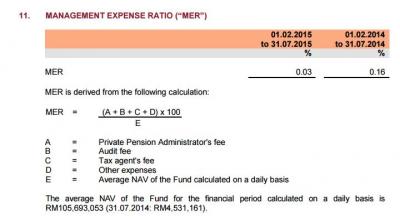
p/s On a totally unrelated note: The MER for Kenanga OnePRS Growth Fund is gasp! hackle! choke! gag! 0.72%

rclxs0.gif  thumbup.gif  thumbsup.gif
*
Hmm.... if we use MER to decide what fund to buy then CIMB Asia Pac is the one to go for!

Management fee waived! thumbsup.gif
Attached Image

On a more serious note, Kenanga PRS started later, so the AUM is rather small for the last financial year end also compared to Affin moderate fund, Expenses in MER includes fixed costs like audit and tax fees which should go down when the AUM is bigger

This post has been edited by dasecret: Mar 16 2016, 12:45 AM
dasecret
post Mar 16 2016, 12:51 AM

Regular
******
Senior Member
1,498 posts

Joined: Nov 2012
QUOTE(adele123 @ Mar 15 2016, 08:14 AM)
This may not be true... the underlying funds can sort of discount the charges and return some of it back to the feeder funds. In reality this do happen, though i'm not sure of the actual mechanics.

So reality? not yet....?

We do have regulators to ensure we are not being double charged. Or at least, I hope so
*
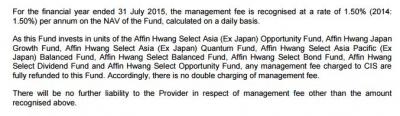
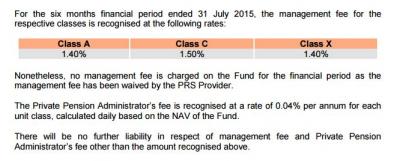
From what I can see, that's exactly what happened in Affin Hwang and Kenanga case. In the case of CIMB-Principal, they waived the management fee altogether

For Affin Hwang:
Attached Image

For Kenanga:
Attached Image

So seems to me the management fee recognised as expense in both PRS funds are the net of the refund of management fees for the funds they invested in. But ultimately, the total management fee charge is still 1.5% although it's not reflected as expenses in the PRS fund itself. It is however reflected in the NAV of the funds since the funds invested in is net of NAV....

Am I making sense? I'm also speculating from what I read in the financial statements only... but reading financial statements is what I do for a living la tongue.gif

This post has been edited by dasecret: Mar 16 2016, 01:01 AM
dasecret
post Mar 16 2016, 04:10 PM

Regular
******
Senior Member
1,498 posts

Joined: Nov 2012
QUOTE(dasecret @ Mar 16 2016, 12:39 AM)
Hmm.... if we use MER to decide what fund to buy then CIMB Asia Pac is the one to go for!

Management fee waived! thumbsup.gif

*
QUOTE(xuzen @ Mar 16 2016, 03:33 PM)
Tricky tricky trickster CIMB. Their MER exclude management fee. I guess the lesson learned here is that we must see the actual annual report to know the truth.

Xuzen

p/s: Actually the MER should reflect all expenses and not exclude a certain expenses up to the whims and fancy of the Fund Manager.
*
Boss.... they waived management fee, so have to exclude from MER la, since 0 amount was charged

Attached Image

But like my earlier post, it's just not reflected in the PRS P&L, but the truth is management fee is charged on the fund it invested into and therefore reflected in NAV... so in the case of a feeder/wrapper fund, MER is not very meaningful
dasecret
post Mar 18 2016, 01:32 PM

Regular
******
Senior Member
1,498 posts

Joined: Nov 2012
I was thinking.... why CPAM so generous, waive management fee altogether.
Other than to ease the administrative burden of calculating refund of management fee.... I realise that ponzi 2.0's management fee is 1.8%
Attached Image

Whereas all the CPAM PRS funds' management fee is 1.5%
Attached Image

So if the refunds happen, then the Asiapac PRS would end up with a negative management fee in its P&L (approx 0.3%) and therefore a negative MER brows.gif

That I supposed would look really bizarre
dasecret
post Mar 21 2016, 12:38 PM

Regular
******
Senior Member
1,498 posts

Joined: Nov 2012
QUOTE(dasecret @ Mar 16 2016, 12:51 AM)


So seems to me the management fee recognised as expense in both PRS funds are the net of the refund of management fees for the funds they invested in. But ultimately, the total management fee charge is still 1.5% although it's not reflected as expenses in the PRS fund itself. It is however reflected in the NAV of the funds since the funds invested in is net of NAV....


*
QUOTE(xuzen @ Mar 21 2016, 12:13 PM)
I did my homework; I contacted the AHAM PRS customer service and seek further clarification on the MER and annual management fee method of calculation.

1) The annual report of Affin-Hwang Moderate PRS fund states the annual management fee as 1.5% p.a.

2) In that same report, the MER is 0.32% p.a. NB: MER is the total expenses that includes annual management fee. To my layman mind; this is confusing because how could MER be less than management fee? Logically it should be more!

3) The explanation given is that the PRS provider will multiply 1.5% x average daily NAV over one financial year.

4) Let's take average NAV over a financial period as equal to  RM 1.00. Lets assume one holds 1,000 units, therefore, 1.5% x RM 1.00 x 1,000 units = RM 15.00 to be withheld by the PRS provider as revenue.

5) The PRS fund invests in a basket of other funds and all of these funds impose an annual management fee to the PRS fund. However, based on SC guideline, fund house cannot double-charge on annual fees therefore, the underlying fund must refund whatever is charged to the PRS fund.

III) After the refund while adding the trustee, tax agent and other miscellaneous expenses the MER comes to 0.32% p.a.

IV) This means that in the final calculation: 0.32% x RM 1.00 x 1,000 units = RM 3.20 is withheld instead as revenue by the PRS provider after the refund from the underlying funds, instead of the initial RM 15.00.

Hope this makes sense to clears up the confusion.

Xuzen

p/s Based on my above understanding, this means that PRS is a more efficient way to enter into the unit trust fund. Zero sales charge, relatively low MER, one entry point to expose to a professionally asset allocated global portfolio.... apa lagi lu mau?
*
Err... In summary, so my understanding was correct?
If you remember some of my previous posts, I am a firm believer of PRS with my additional employer retirement benefits going into PRS instead of EPF. So I don't dispute its advantages eventhough we pay a bit more MER (effectively target fund MER + PRS fund MER). But the biggest freebie is still the tax relief la and the flexibility to buy non-Msia funds compared to EPF MIS

p/s: On second thought, maybe the additional MER would outweigh the benefit for employer contribution or employee contribution in excess of RM3k since the amount adds up over the years until retirement age cry.gif

dasecret
post Apr 12 2016, 06:03 PM

Regular
******
Senior Member
1,498 posts

Joined: Nov 2012
QUOTE(adele123 @ Apr 12 2016, 05:49 PM)
Insurance agent spotted.  cool2.gif  bruce.gif

you still don't understand do you? mostly if not all of those who buys prs, is really more into the tax relief than the actual retirement. no doubt, prs is a tool for retirement as well.

don't have to oversell insurance. there's a purpose for every tool out there.
*
This is the same troll we spotted last week, he uses both nick interchangeably. And he claims he's not an insurance agent and I should not comment on things I dont understand.... whistling.gif

Anyway, this is not the right place for this debate... this is a PRS thread; tax savings is only a side topic
Unfortunately PRS has not been very successful to move away from the tax savings model
dasecret
post Apr 13 2016, 09:28 AM

Regular
******
Senior Member
1,498 posts

Joined: Nov 2012
QUOTE(ChloeKhar @ Apr 12 2016, 10:50 PM)
Just feel weird.. Government encourage to have private retirement but limit the year of tax relief.. What for.. 😒😒 it should continue the tax relief benefit 😙😙
*
Who knows, they may increase the quantum like PTPTN, or extend it after 2021


dasecret
post Apr 13 2016, 09:35 AM

Regular
******
Senior Member
1,498 posts

Joined: Nov 2012
QUOTE(adele123 @ Apr 12 2016, 10:07 PM)
Yes. I have been encouraging my peers to invest in prs. Mainly for the youth incentive and the tax relief. With prs provider feeding the prs fund to the normal unit trust fund, as an informed consumer, makes no sense to invest in prs given that I can buy the normal unit trust fund.

One may argue prs indirectly will force us to save for retirement. As the funds in the normal unit trust can be withdrawan at any time. But I think most ppl will just stop buying into prs after 2021. Myself included.
*
Got geh, no need to pay sales charge tongue.gif

But to make PRS a successful product, it takes more than tax relief and youth incentive la. People would just contribute to get those benefit, nothing more

If ever the PPA guys read this thread, I wish so convey these messages:
- Having your CEO face in ads doesn't help cool2.gif

- There should be review mechanism on the approved providers and approved funds; some of the funds have not done well since inception. Should PPA does something like EPF on the MIS funds to vet through performance on regular intervals?

- There should be more awareness campaigns on the employer contributions; more aggressive product development on the employer solutions; even tax breaks like double deductions to kick that off

My 2 cents as someone who wants this to work... if PRS works, maybe more people would invest in unit trust so this is bigger than just RM3k tax relief
dasecret
post Apr 25 2016, 10:19 AM

Regular
******
Senior Member
1,498 posts

Joined: Nov 2012
QUOTE(sniperz @ Apr 23 2016, 07:57 AM)
It's a corporate unit trust. Definitely, they will charge certain fee. If you feel more suitable with a licensed consultant personally, you can go for that too as long they are doing their job and not just selling you. Personal experience.  innocent.gif
*
QUOTE(LNYC @ Apr 25 2016, 12:56 AM)
Ah~~ blink.gif ~~

Tq.
*
Please note that this information is not accurate.

I can positively confirm that FSM does not charge any sales charge for all of the PRS funds

Even if you walk into a CIMB bank and ask to buy CIMB Principal PRS funds you would not be charged any sales charge. It's correct for the past 3 years

There are other ways to make money when distributing funds, not necessarily out of the end purchasers pocket directly. Agents who charges a fee would want to make you think so for their own personal agenda ranting.gif

2 Pages  1 2 >Top
 

Change to:
| Lo-Fi Version
0.0315sec    0.40    7 queries    GZIP Disabled
Time is now: 9th December 2025 - 02:22 AM