


 Aug 12 2005, 01:37 PM, updated 20y ago


A pickup device acts as a transducer that captures mechanical vibrations (usually from suitably equipped stringed instruments such as the electric guitar, electric bass guitar or electric violin) and converts them to an electronic signal which can be amplified and recorded.
What's the meaning of s-s-s ?
Usually an electric guitar has more than one magnetic pickup. A combination of pickups is called a pickup configuration. It is usually notated by just writing out the pickup types, using "S" for single-coil and "H" for humbucker, in order from neck pickup to bridge pickup.
Popular pickup configurations include:
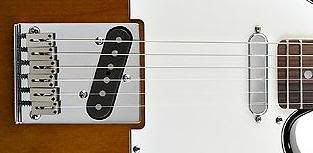
A S-S pickup configuration on a 60th Anniversary American Telecaster®
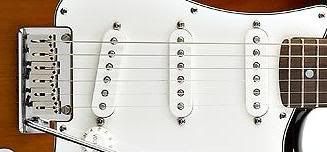
A S-S-S pickup configuration on a 60th Anniversary American Stratocaster®
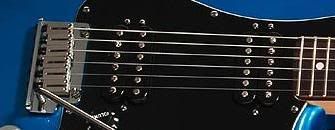
A H-H pickup configuration on an American Stratocaster® HH
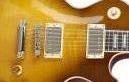
A H-H pickup configuration on a Gibson Les Paul® Standard
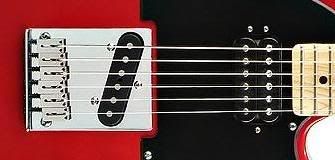
A H-S pickup configuration on an American Telecaster® HS
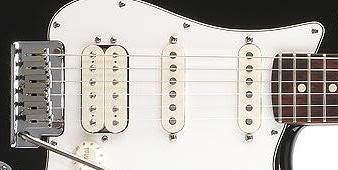
A H-S-S pickup configuration on an American Stratocaster® HSS
How does the pickup "sound" ?
The turns of wire in close proximity to each other have an equivalent self-capacitance which, when added to any cable capacitance present, resonates with the inductance of the winding. This resonance can accentuate certain frequencies, giving the pickup a characteristic tonal quality. The more turns of wire in the winding, the higher the output voltage but the lower this resonant frequency. The inductive source impedance inherent in this type of transducer makes it less linear than other forms of pickups, such as piezo-electric or optical. The tonal quality produced by this nonlinearity is, however, subject to taste, and may therefore also be considered by some to be aesthetically superior to that of a more linear transducer.
The external load usually consists of resistance (the volume and tone potentiometer in the guitar, and any resistance to ground at the amplifier input) and capacitance between the hot lead and shield in the guitar cable. The cable capacitance has a large effect and must not be neglected. This arrangement of passive components forms a second-order low-pass filter. Electromagnetic pickups are usually designed to feed a high input impedance, typically a megaohm or more and a low impedance load will reduce the high-frequency response of the pickup because of the filtering effect of the inductance.
What's a humbucker ?
One problem with electromagnetic pickups is that - along with the musical signal - they also pick up mains hum. Mains hum consists of a fundamental signal at a nominal 50 or 60 Hz, depending on local alternating current frequency, and usually some harmonic content. The changing magnetic flux caused by the mains current links with the windings of the pickup, inducing a voltage by transformer action.
To overcome this effect, the humbucking pickup was developed, originally by Seth Lover of Gibson. A humbucking pickup comprises two standard pickups wired together in series. However, the magnets of the two pickups are reversed in polarity, and the windings are also reversed. Thus, any hum or other common mode extraneous noise that is picked up is canceled out, while the musical signal is reinforced. A side effect of this technique is that the overall inductance of the pickup is increased, attenuating the higher frequencies and giving a duller tone.
What's a passive and active pick-ups ?
Pick-ups can be either active and passive. Pickups, apart from optical types, are inherently passive transducers. So-called active pickups incorporate electronic circuitry to modify the signal. Passive pick-ups are usually wire wound around a magnet. They can generate electric potential without need for external power, though their output is relatively low, and the harmonic content of output depends greatly on the winding.
Passive pick-ups are very convenient as they require no power source to operate. They are most popular and widely used pick-up type on electric guitars, and their frequency response curve is unique to the type and manufacturer.

EMG 85 - one of the most famous active pickups in the world
Active pick-ups require an electrical source of energy to operate and include an electronic preamp, active filters, active EQ and other sound-shaping features. They can sometimes give much higher possible output (in comparison to passive) and much flatter frequency response curve. They also are less affected in tone by varying lengths of amplifier lead, and amplifier input characteristics. Magnetic pick-ups used with 'active' circuitry usually feature a lower inductance (and initially lower output) winding that tends to give a flatter frequency response curve.
The disadvantages of active pick-ups are the power source (usually either a battery or phantom power), cost, and less defined unique tonal signature. They are more popular on bass guitars, because of their solid tone; most high-end bass guitars feature an active pick-up. Most piezoelectric and all optical pick-ups are active and include some sort of preamp.
Review of EMG 85 and EMG 81 active pickups, by Everdying
Does the pickup affects the guitar's sustain ?
Sustain is also affected by magnetic pull exerted by the pickup magnets. There are 2 ways this happens:
1) Direct magnetic attraction causes damping of the strings.
2) The magnetic attraction causes the strings to crash into the frets, the consequent rattling or buzzing thereby robs them of energy and thus shortens sustain.
Most single coil pickups use Alnico-5 magnets that are quite strong, actually it's excessively strong. A Stratocaster, and some Telecasters, use 3 magnets under each string so are the worst affected instruments. Most Telecasters use 2 magnets under each string and are less affected. Side-by-side humbuckers exert very little magnetic damping. Magnetic pull on the strings can be allievaited by adjusting the pickups away from the strings but that reduces output and adversly affects signal/noise ratio.
Can I make my own pickup ?
QUOTE(bartimaeus @ Apr 12 2006, 03:49 PM)
What other pickup brands are available ?
The famous brands are DiMarzio, EMG and Seymour Duncan (this is based on what LYN Musicians posted). There are many other brands .... just GOOGLE LA

Credit to: Wikipedia®, Fender, Gibson, EMG and all LYN Musicians
This post has been edited by Pix: May 15 2006, 04:21 PM
 Quote
Quote
 0.0276sec
 0.40
0.40
 7 queries
 GZIP Disabled