QUOTE(leafy @ Jun 13 2011, 11:36 AM)
sifu and sijie... one question to ask...
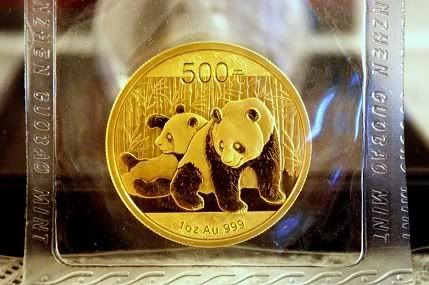
i went to goldsmith shop the other day (normal shop at klang) and the boss is selling rm15,300 for 100 gram of 999 type of gold bar and i went to Poh Kong and Wah Chan and they all are selling rm17,700 for 100 gram of gold bar with exact specification, and my question is that why is this klang's shop can sell his gold bar at RM15,300??
sorry for my noob question....

Thank you...
Perhaps the Klang goldsmith shop needs the cash flow? Can happen. Then you got it for a steal!

Really 999 gold or 916 look alike? What's the brand?
For those interested, read this article:
The Real Gold Price Each morning you turn to your favorite gold investment website to see the current gold price. What you see is the correct price, but in the currency of your choosing. There are two prices, the buy and sell price. You assume these prices allow the dealer to make an income from the difference. You assume that these prices are an accurate reflection of supply and demand.
But are these prices accurate? The answer is far from easy.
We begin by observing the global market.
Gold's Global MarketThe day starts just after the dateline in Japan and China. If you were there and wandered down to your friendly neighborhood bank and asked for the latest gold prices, they would give you prices they were prepared to buy and sell gold. They allow their costs to get the gold from source, transporting it to their branch. From there, they are onto the 'international' price spread, widening it to their quote price.
The time involved to make such a delivery is factored into the price by matching the bank price and the price it charges. But their bank has to get that gold from source too. The average Chinese bank imports the gold they sell, so they must allow for the transport from source. They turn to the largest source of physical gold, London, where the five member banks of the gold Fixing handle about 90% of the world's physical gold.
The Chinese bank would be able (by phone or electronically) to buy their gold at the twice daily Fixings in London (www.goldfixing.com), a price that has no buy/sell spread. The 'Fixed' price is the price that both buying and selling takes place. Often it is bought "loco London – delivery Zurich" or some other place (i.e. Hong Kong). This allows the members to sell gold held in Zurich and not London. Of course, there are variations. In China, we pay a price that relates to the present gold price. This price might be different from the price the bank paid weeks before. This all seems risky...
Removing Price RiskIt sounds risky, but the banks are not there to take risks.
They turn to COMEX and its futures and options gold market to allay these risks.
It works like this: let's say the Chinese bank bought 10,000 ounces of gold to sell through their branches in China. Knowing the price, they immediately sell the same on the futures market for 'delivery' (it would not be delivered because only 5% of COMEX deals are for physical delivery) at around the time they believe it would be sold in China. (They fall into the category of Commercials' in the above COT report)
With the price risk neutralized, they would aim to make their profits based on total costs (i.e. transport, Insurance and holding costs until the gold is sold) plus their mark-up. The buying/selling price would reflect these costs in the 'spread' (between buying and selling).
So the price in China at the first part of the day will reflect the stock they have there for sale and the demand supply pressures at the moment. Until the bank can offset the market pressures (once London opens) there is greater volatility because it is a smaller market. So the 'real gold price' in China is a wider spread price than you see on your computer screen.
In the U.S.The same pressures apply in the United States. Although it is a far more developed market, it is still not the home of the physical gold market. Electronically, the developed world markets are able to smooth out price differentials (right through to the London gold Fixing member banks) between the Fixes. This is called Arbitrage. This gives the impression of a faster flow of gold between markets, but essentially the ability of the banks and markets to reflect the bulk of global demand/supply quickly is remarkable and efficient. Actual supplies follow up days after the original transactions to their final destination. In the U.S. the real price of gold is very close to the price on your computer screen; the spread, however, widens with the lower quantity you buy. The more you buy the narrower the spread.
Most U.S. investors want the price of gold to be the price they see on their screen. And that's why the gold Exchange Traded Funds did so well. At 1% costs or less, these shares were 'cheaper' than other forms of physical gold and cheaper to store and insure. No shipping costs are involved, so U.S. investors can rely on their screen prices to represent the price of gold they pay, plus a little brokerage commission.
Price 'smoothing'The larger gold markets of the world, centered in London, have the ability to quickly 'net out' transactions down to the final buyer and seller of the gold. A gold producer will have a buyer on contract for the bulk of his supply as it comes out of the refinery. This is to secure his cash flow without having to wait for buyers.
We would venture to say that 90% - 100% of gold producer's have instant buyers to take contracted amounts. This figure may well be in excess of 90% of his supply and often 100 %. This process has allowed the 'real' price of gold to be closer to investor's expectations than in the underdeveloped world. (Asia will get there in time) Buying shares in gold Exchange Traded Funds in South Africa, Australia, the U.S. or Europe is done at the price shown on the sites of the gold Exchange Traded Funds. It is the real price of gold.
With the bullion banks now supplied on contract to pay the market price of those supplies (with margins built into the contract) they now face only the risk of finding buyers.
Read the rest of this interesting article at
http://www.marketoracle.co.uk/Article28629.htmlCheers!



 May 6 2011, 04:13 AM


 Quote
Quote )
)




 0.2469sec
 0.69
0.69
 7 queries
 GZIP Disabled