

Currently a teacher based in KL / Klang Valley, let me know if you need any upfront instruction.
http://briensax.blogspot.com

This post has been edited by brien1193: Feb 7 2011, 12:02 AM
Any Questions about Learning a Wind Instrument?, Just ask and I'll do my best to answer!
|
|
 Feb 7 2011, 12:01 AM, updated 12y ago Feb 7 2011, 12:01 AM, updated 12y ago
Show posts by this member only | Post
#1
|
 
Junior Member
144 posts Joined: Jan 2011 
|
Any questions any of you have about saxophones, clarinets, or flutes, I'll be glad to contribute and answer them to the best of my ability.
Currently a teacher based in KL / Klang Valley, let me know if you need any upfront instruction. http://briensax.blogspot.com
This post has been edited by brien1193: Feb 7 2011, 12:02 AM |
|
|
|
|
|
Feb 7 2011, 09:28 AM
Show posts by this member only | Post
#2
|

Senior Member
4,515 posts Joined: Mar 2010
|
I dont like wind instrument because I cant blow any sound out from the mouth piece. I am mainly into strings now and have no intention to take up wind instrument anymore. I am just curious what tip have you got for people like me who cant blow sounds out of the mouth piece.
Thanks.  |
|
|
Feb 7 2011, 05:07 PM
Show posts by this member only | Post
#3
|
|
Junior Member
144 posts Joined: Jan 2011
|
QUOTE(faceless @ Feb 7 2011, 09:28 AM) I dont like wind instrument because I cant blow any sound out from the mouth piece. I am mainly into strings now and have no intention to take up wind instrument anymore. I am just curious what tip have you got for people like me who cant blow sounds out of the mouth piece. Thanks for your interest! Thanks.  Your problem is also the SAME problem that makes so many people give up on wind instruments: because they can't get the first sound. As a teacher I know the first sound is really hard to get, it is also the most important, as it builds confidence and forms the foundation for the instrument that you are playing. you mentioned a mouthpiece, so I'm assuming you play clarinet or saxophone. It is not easy to get the first sound out of these mouthpieces, yet the first sound is so important. The technique is actually quite simple: 1) Curl lower lip over bottom teeth. 2) Put mouthpiece on curled lower lip, then bite the top with your teeth. 3) RELAX. then blow. Usually most people focus WAY TOO MUCH on the mouthpiece in their mouth and forget about what's really important: BREATHING AND BLOWING!!! Of course, if you want me to tell you more, I actually have to see you blow to troubleshoot. But trust me with PROPER GUIDANCE it is not difficult at all. Of course sufficient practice must be put in as well. everyone has to start somewhere. 
This post has been edited by brien1193: Feb 9 2011, 03:19 AM |
|
|
Feb 7 2011, 05:24 PM
Show posts by this member only | Post
#4
|

Senior Member
2,549 posts Joined: Apr 2008
|
Brien...good points! It is always better to have a teacher in front of you to correct you.
|
|
|
Feb 7 2011, 10:02 PM
Show posts by this member only | Post
#5
|
|
Junior Member
144 posts Joined: Jan 2011
|
Yeah, it is...Although learning from a book is possible, especially with youtube and stuff nowadays, nothing beats a DEDICATED and COMPETENT teacher's guidance.
Why, you might ask? because you want to NOT DEVELOP BAD HABITS. That is the biggest killer of good technique. If you develop bad habits and bad form when playing your instrument, you automatically set a ceiling to your skill, which you cannot progress above because of the limitations of your technique. However good anyone can claim to be, even myself, I owe it all to a fantastic instructor. I aim to put the same kind of feeling, and pride, and satisfaction, to those who learn from me. As far as blowing a mouthpiece goes, the biggest problem with students is BREATHING. They ALWAYS neglect that. No wonder when they start to play more advanced stuff they sound like CRAP. When you play your wind instrument, the only resistance or resonance you should feel around your mouth is FROM YOUR LIPS. ONLY. IF you feel something anywhere else (aka nose, throat, teeth, etc, other than LIPS) then your technique is WRONG!!! 
This post has been edited by brien1193: Feb 9 2011, 03:20 AM |
|
|
Feb 8 2011, 12:03 AM
Show posts by this member only | Post
#6
|

Senior Member
3,242 posts Joined: Apr 2008 From: From: From: From: From: From: From: From: From:
|
i'll contribute more. anything you want to ask about this guy you can PM me. i know him quite a bit. kekeke...
 |
|
|
|
|
|
Feb 8 2011, 08:36 PM
Show posts by this member only | Post
#7
|
|
Junior Member
144 posts Joined: Jan 2011
|
Most people, when playing woodwinds, neglect scales.
This is a big mistake. BIG MISTAKE! There's a reason why exams require you to play a certain number of scales. This is because scales form THE BACKBONE OF YOUR TECHNIQUE. If you know your scales very well, you know your instrument very well, and to master the instrument, you must MASTER THE SCALES! I have a much more complete article on the benefits of scales right here: http://briensax.blogspot.com/2009/11/scales.html so practice your scales, people! 
This post has been edited by brien1193: Feb 9 2011, 03:19 AM |
|
|
Feb 8 2011, 10:03 PM
Show posts by this member only | Post
#8
|
|
Senior Member
3,242 posts Joined: Apr 2008 From: From: From: From: From: From: From: From: From:
|
EDIT: duh...nothing...
This post has been edited by little ice: Feb 9 2011, 11:09 AM |
|
|
Feb 9 2011, 03:21 AM
Show posts by this member only | Post
#9
|
|
Junior Member
144 posts Joined: Jan 2011
|
Noted and amended.
P.S: How would you know me? professionally or personally? 
|
|
|
Feb 9 2011, 05:53 AM
|

Senior Member
2,451 posts Joined: Jan 2011 From: The Vortex 
|
Am thinking of trying out harmonica.
What skill do I need in order to start? And what should I know? Any important basics that you can share? |
|
|
Feb 9 2011, 09:12 AM
|
|
Senior Member
4,515 posts Joined: Mar 2010
|
QUOTE(brien1193 @ Feb 7 2011, 05:07 PM) you mentioned a mouthpiece, so I'm assuming you play clarinet or saxophone. I am referring to all the wind instruments in a typical school's marching band. That was a long time ago for me and I have move on to string instruments already. QUOTE(Lucidus @ Feb 9 2011, 05:53 AM) Am thinking of trying out harmonica. Harmonica is the only wind instrument I play. There is no need to worry about getting the first sound from the mouth piece. Just blow into any hole and there is bound to be sound. There are actually little metal pieces (like tuning fork) that vibrates when you blow into it. The tone is sure to be accurate. Unlike other wind instrument you dont need to cover the the holes properly to ensure no air gets out to get the right tune. It is the easiest wind instrument to play. Just pick it up and blow. There is no effort need to get first sound or the right notes. What skill do I need in order to start? And what should I know? Any important basics that you can share? The next thing is to know is to blow the 4th hole for the note C. If you suck (known as "draw" in harmonica terms) 4th hole you get the note D. Go up the holes in ascending order.This post has been edited by faceless: Feb 9 2011, 09:14 AM |
|
|
Feb 9 2011, 09:20 AM
|

Senior Member
1,346 posts Joined: Jun 2007
|
There are many types of harmonica... The diatonic, the chromatic, the tremolo n' echo, the octave, the orchestral harmonice adn etc....
iirc... you breath played harmonica which a lil differs playing it like how one plays other woodwinds and brass. Here are some of the basic notes on harmonica. 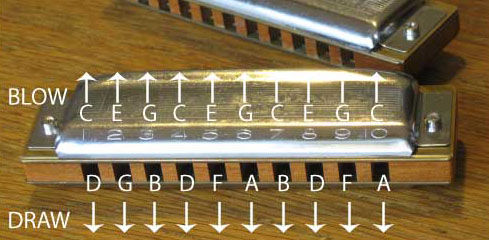 |
|
|
Feb 9 2011, 12:27 PM
|
|
Junior Member
144 posts Joined: Jan 2011
|
As far as harmonica is concerned, it's not a very difficult instrument to pick up. Just blow and you'll get a sound. However, to become really good at harmonica, it takes more than just knowing where the notes are.
The 3 important aspects in reference to harmonica playing (And I'm referring to a blues harmonica), is LIPPING and STOPPING, and BREATH MANAGEMENT. LIPPING involves changing your embouchure (as in the shape of your lips and mouth on the harmonica) to bend the pitch of the note you're playing up or down. This takes A LOT of practice, but the benefit is that you can now play harmonica chromatically (as in all the notes, like a piano or clarinet) STOPPING involves using your tongue to stop certain holes and release others (aka, so no air goes into some, and air goes into others) so that you can get a combination of thirds or chords. This is applicable to both standard and blues harmonicas. Mastering this skill will allow you to play melody AND simple rhythm at the same time!!! BREATH MANAGEMENT involves noting when to blow and when to draw air through the harmonica, to achieve certain notes. This is a fundemental skill and should be worked on until it becomes second nature. a good way to practice this is the really know your scales and arpeggios and scale variations. I'm not an expert in harmonicas (I play sax, flute, and clarinet), but i hope the above tips help. 
|
|
|
|
|
|
Feb 9 2011, 04:50 PM
|
|
Senior Member
2,451 posts Joined: Jan 2011 From: The Vortex
|
Err.. Any tips on how to avoid your harmonica gets smelly?
|
|
|
Feb 9 2011, 08:22 PM
|
|
Junior Member
144 posts Joined: Jan 2011
|
Rinse it after every use, and i think most harmonicas are safe to be cleaned with dishwashing liquid. Well, at least mine are.

|
|
|
Feb 10 2011, 08:31 AM
|
|
Senior Member
4,515 posts Joined: Mar 2010
|
QUOTE(Lucidus @ Feb 9 2011, 04:50 PM) Err.. Any tips on how to avoid your harmonica gets smelly? Sorry to say this but I think you have bad breath. Mine harmonica dont stink. Harmonicas with fret made of wood I will dont dare to rinse. |
|
|
Feb 10 2011, 04:56 PM
|
|
Junior Member
144 posts Joined: Jan 2011
|
For Beginner Learners of a Wind Instrument, There are a few key principles that are rather unique to wind instruments, and must be mastered in order to really succeed.
1) EMBOUCHURE: This is defined as the connection between your mouth and the Instrument you're playing. The tricky part about this technical ability is that the EMBOUCHURE is always changing, but you should NOT be changing it yourself. I correct embouchure helps to produce the right pitch in notes, with the correct timbre (or quality of sound) and makes it easy to control volume, tonguing and phrasing. A Bad embouchure makes it really difficult to produce a good sound or control it properly, and makes some difficult tunes that require proper air and sound control Almost impossible. Usually the Basic principles of an embouchure for like for example a clarinet or a flute are very SIMPLE. in fact, most people OVERTHINK their embouchure, to the detriment of other important aspects such as BREATHING AND BLOWING. The SECRET to finding out whether your embouchure is correct is to ask yourself 2 very simple questions: Are you getting the sound you like? Is it easy to get the sound you like? If the answer is no, then you have fault with your embouchure. The best person to show you how to do a correct embouchure is YOURSELF. Your teacher cannot have xray vision to look into your mouth, but he can recommend certain adjustments that he has learned through experience to improve your tone and ease of playing. Hope this little tip helps. I'll post again on BREATHING AND BLOWING in my next post. 
|
|
|
Feb 12 2011, 09:56 AM
|
|
Junior Member
144 posts Joined: Jan 2011
|
Hey people! Not muct activity around here eh? Anyways, since there are no questions I will continue my series of helpful tips that serve as foundation building for the beginners and reminders for the advanced players.
BREATHING AND BLOWING: This next part of your technique is a very very crucial one. It forms the power source with which you power your instrument. Have any of you experienced brownouts or burnouts due to your electricity supply varying? (Hi-fi enthusiasts should know). Same way, if you do not have a consistent, high quality supply of air to your instrument, then you can kiss your chances of playing good tones goodbye, especially since the more advanced techniques require even more breath control. So how are you supposed to blow and breathe efficiently and effectively? The simplest and easiest way is to imagine your lungs (in effect, your diaphragm) as a TRAMPOLINE, or like some kind of rubber sheet that supports your lungs. what happens when you jump on a trampoline? your body weight will press down into it, but after that, you don't need to apply much effort to help the trampoline bounce you meters into the air! Following the same principle, you only need to BREATHE IN with a certain amount of force. For breathing out, just blow normally, WITHOUT STRESSING your body or muscles. The key principles for practicing each motion, with or without an instrument, are as follows: 1) BREATHING IN: As you practice breathing in, attempt to expand your stomach instead of your chest. you will know you're doing it right when you feel your diaphragm press down on your stomach. be sure to breathe in a slow, measured intake. 2) Breathing OUT: don't worry about blowing!!! blow out in a slow, measured pace, and focus on avoiding any RESISTANCE in your airways. The only place you should feel resistance in on your LIPS. No where else! So if you have resistance any where else (eg. throat, nasal area, teeth, tongue), then you're doing it wrong. So there you go, the basic foundation to breathing and blowing right! You might notice it's the same techniques used in YOGA. ;-) Please note that the way to play a wind instrument properly is the coordiantion and synergy in all the areas of your technique, so don't take this too rigidly. Good embouchure (previous tip) will help correctly shape the high quality air you produce from your core. signing off! let me know if you need any additional information. 
This post has been edited by brien1193: Feb 12 2011, 10:01 AM |
|
|
Feb 19 2011, 09:20 AM
|
|
Junior Member
144 posts Joined: Jan 2011
|
Hi guys, this is the next installment of my TIPS series, and I'm going to score simple pointers involving fingering.
Now, this is not especially the most difficult part of playing a wind instrument, despite wind instruments being so complex and all (except for certain brass instruments and harmonicas). A lot of players suffer the following problems: STIFF JOINTS: this happens when you're trying to play fast, but have developed a bad habit a while ago where you fingers are not CURLED PROPERLY. So for example when you try to move your right hand index finger quickly, only the first joint of that finger moves. This is a very serious problem that will severely impede your skill, especially if you're trying to play to a standard of Grade 6 or higher. HEAVY FINGERING: This occurs when you are stiffening up the muscles in your fingers while playing. while this doesn't actually affect your sound, it will severely impede SPEED. Which means you'll get tons of double notes and messy lines and mucky movements, because your fingers are too slow. EXCESSIVE MOVEMENT: THis is defined when your fingers move too far from the instrument. if your fingers are very far away from the instrument when not pressing a key, they'll require a longer time to reach the key when you decide you want to close it, again severely impacting speed. HARD PRESSES: WHen you close the key with a "popping" sound, or you can actually hear the effects of your fingers on your sound, it means that your fingers are not being gentle enough with the keys. This will lead to very difficult to control tone and phrasing, especially where dolce or pianissimo passages are involved. SO what are you supposed to do? The correct approach involves the following principles: 1) Keep your fingers curled. Doing this ensures the most efficient form of movement of your fingers, and prevents lockup of the joints, and requires much less force to move the keys, as the big muscles in your forearm are involved. 2) Keep your fingers light. You don't need to use a lot of power to move half an inch to open or close a tone hole or press a key. the bare minimum will suffice. It's more important to focus on proper tone hole closure (if your instrument has tone holes that are not covered by keys aka recorder or clarinet), or the mechanics of your movement, which I will expound below. 3) Keep your fingers low. When moving, keep them close to the keys and minimize movement. This will allow them to move much quicker and require less energy, which helps with tip number 2 above. The way to practice for this is to play passages slowly while keeping very close attention to how far your fingers move from the instrument, and correcting and guiding where necessary. In time, proper practice will make this a GOOD HABIT. 4) Keep your fingers mechanical. What does this mean? Imagine your fingers are pistons in an engine, or a hammer to strike a nail. They will be performing at their fastest and best if your finger movement is limited to an action perpendicular to the surface of the instrument. Meaning to say, if you feel that to play fast you need to "roll" your hands to move your fingers, then that is WRONG. Keep your finger action in an up and down motion perpendicular to the surface of the instrument. This will help to develop your key power muscles in your forearm as well as preventing excessive movement and loss of control. Hope this little article helps with your playing!!!! Feel free to PM me if you need to know more. 
This post has been edited by brien1193: Feb 19 2011, 09:20 AM |
|
|
Mar 7 2011, 06:27 PM
|
|
Junior Member
144 posts Joined: Jan 2011
|
A lot of people get put of playing a music instrument in general because they don't get to play the songs they like. Well, the solution to this is:
Play by ear. But how do you play by ear? There are 3 levels of mastery that a musician will have as he goes through playing by ear: 1) Copying: the ability to listen to a song and copy it on the instrument, and preferably write it down as well. 2) Improvising: Modifiying an existing song with effects, alternative melodies, etc, together with the chords of a particular song. 3) Creating: Using musical ability and technique to create new songs, melodies, and chord movements, either entirely original, or with "influences" from existing music. If there were a key thing to playing the songs you love the way you want them to sound, then the key is this: SIMPLIFY. Don't try to do too much at one time. There are many aspects of the musical journey that need to be practiced and mastered, even at level 1 above. I'll post an article on that soon! B signing out! 
|
| Change to: |  0.0259sec 0.0259sec
 0.74 0.74
 6 queries 6 queries
 GZIP Disabled GZIP Disabled
Time is now: 16th December 2025 - 08:15 PM |
 Quote
Quote