Welcome Guest ( Log In | Register )

Bump Topic Topic Closed RSS Feed

Outline · [ Standard ] · Linear+

> Military Thread V6, Selamat Hari Raya dan Kemerdekaan ke-54

views
     
TSwanvadder
post Jun 27 2011, 02:17 PM

Getting Started
**
Junior Member
94 posts

Joined: Aug 2008
From: Tristram


N Korean children begging, army starving

Footage shot inside North Korea and obtained by the ABC has revealed the extent of chronic food shortages and malnutrition inside the secretive state.

The video is some of the most revealing footage ever smuggled out of the impoverished North Korean state.

Shot over several months by an undercover North Korean journalist, the harrowing footage shows images of filthy, homeless and orphaned children begging for food and soldiers demanding bribes.

The footage also shows North Koreans labouring on a private railway track for the dictator's son and heir near the capital Pyongyang.

Strolling up to the site supervisor, the man with the hidden camera asks what is going on.

"This rail line is a present from Kim Jong-il to comrade Kim Jong-un," he is told.

The well-fed Kim Jong-un could soon be ruling over a nation of starving, impoverished serfs.

The video shows young children caked in filth begging in markets, pleading for scraps from compatriots who have nothing to give.

"I am eight," says one boy. "My father died and my mother left me. I sleep outdoors."

Many of the children are orphans; their parents victims of starvation or the gulag.

But markets do exist - private markets that stock bags of rice, pork, and corn. The state no longer has any rations to hand out.

But the state wants its share of this embryonic capitalism.

In the footage, a party official is demanding a stallholder make a donation of rice to the army.

"My business is not good," complains the stallholder.

"Shut up," replies the official. "Don't offer excuses."

It is clear that the all-powerful army - once quarantined from food shortages and famine - is starting to go hungry.

"Everybody is weak," says one young North Korean soldier. "Within my troop of 100 comrades, half of them are malnourished," he said.

Jiro Ishimaru is the man who trained the undercover reporter to use the hidden camera.

"This footage is important because it shows that Kim Jong-il's regime is growing weak," he said.

"It used to put the military first, but now it can't even supply food to its soldiers. Rice is being sold in markets but they are starving. This is the most significant thing in this video."

Kim Jong-il's grip on power depends on the military and if some of its soldiers have growling, empty bellies, it is bad news for the dictator and his hopes for a smooth transition to his son.

"The priority for Kim Jong-il is the succession," said Mr Ishimaru.

"But Kim Jong-un is still very young, just 27 or 28. He doesn't have any experience and hasn't achieved anything. So opposition to a third generation of the Kim family taking over is growing."

But this dynasty of dictators has proven that it is more than capable of keeping its wretched population in line through gulags, hunger and a total control over every aspect of life.

But as this footage shows, occasionally, a crack of light emerges from this dark, dark place.

Sauce : http://www.abc.net.au/news/stories/2011/06/27/3253979.htm
TSwanvadder
post Jul 1 2011, 08:32 PM

Getting Started
**
Junior Member
94 posts

Joined: Aug 2008
From: Tristram


QUOTE(Fadly @ Jun 30 2011, 10:33 PM)
Must've been from the Eurocopter facility there.
*
It was AugustaWestland. My friend werks in the aviation section, he informed me of the accident.
TSwanvadder
post Jul 8 2011, 08:13 PM

Getting Started
**
Junior Member
94 posts

Joined: Aug 2008
From: Tristram


user posted image

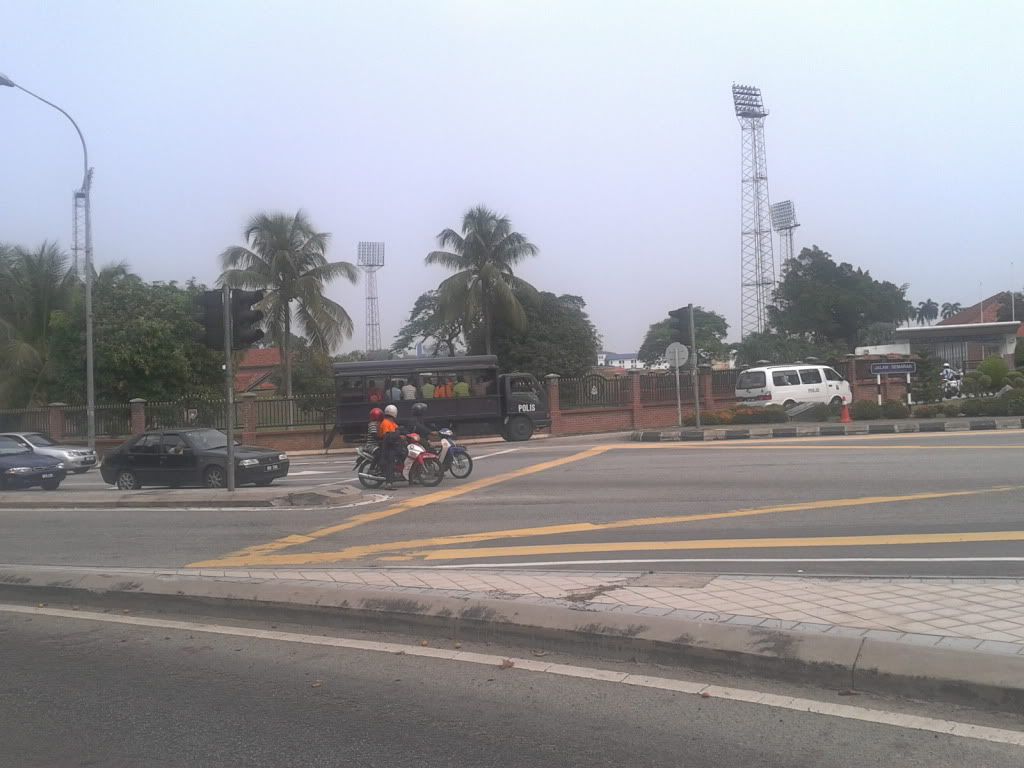
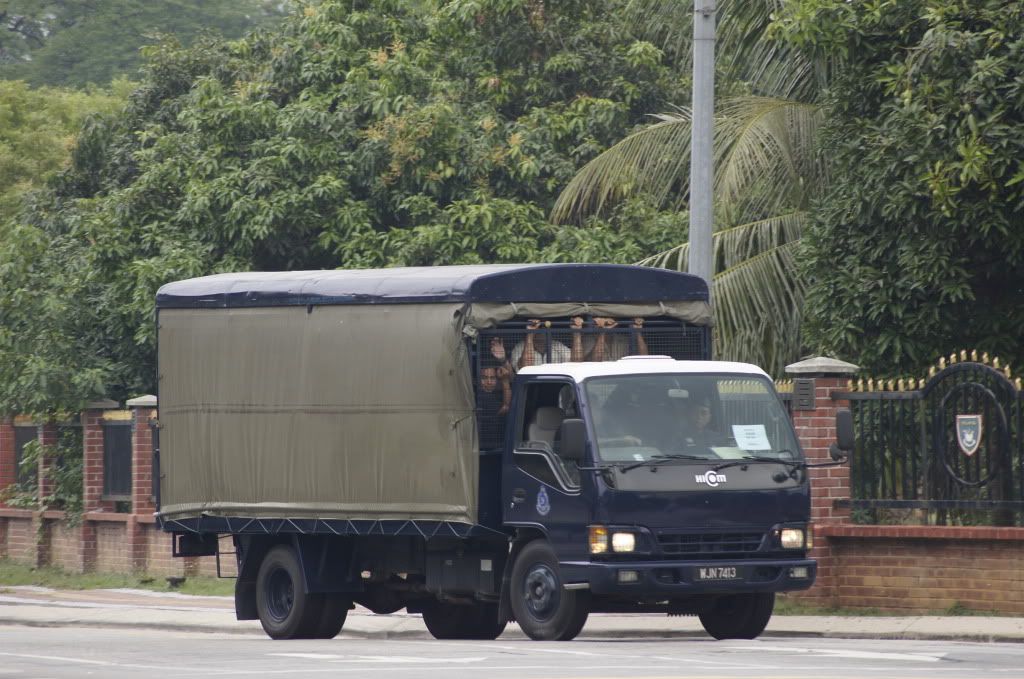
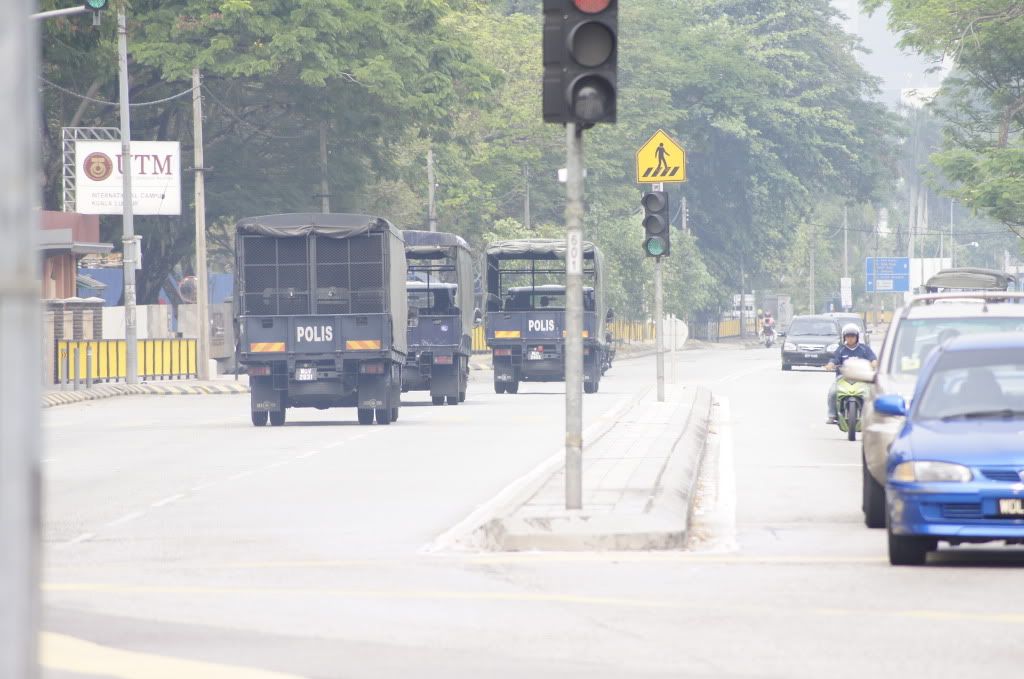
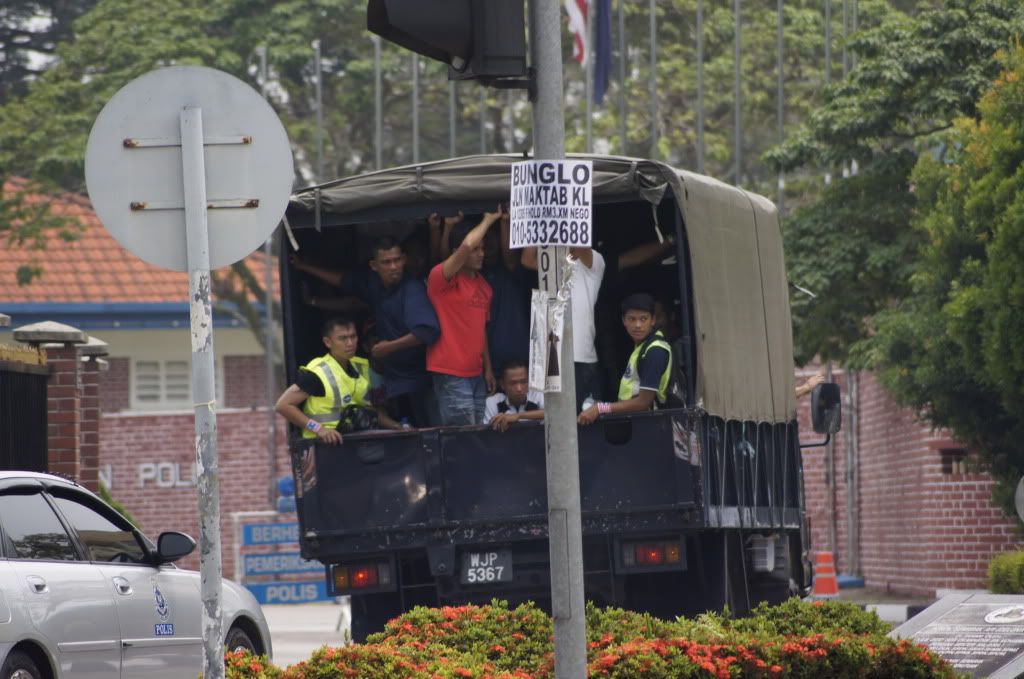
Stadium Merdeka secured. PDRM and MAF trucks have been going out by the dozens each minute here at Jalan Semarak.
TSwanvadder
post Jul 8 2011, 11:43 PM

Getting Started
**
Junior Member
94 posts

Joined: Aug 2008
From: Tristram


user posted image

user posted image

user posted image

user posted image

user posted image

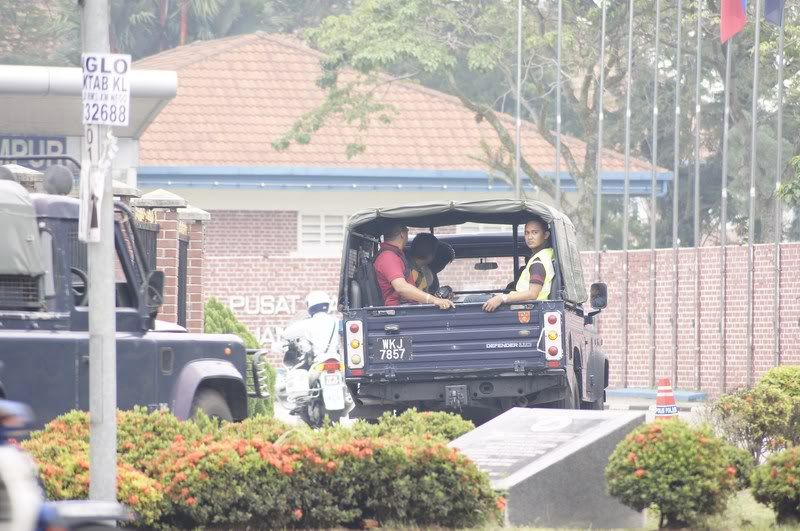
Kasual sungguh Unit Tampak Kasual. Sniper team siap ada botol air mineral terpampang.

This post has been edited by wanvadder: Jul 9 2011, 10:20 AM
TSwanvadder
post Jul 9 2011, 12:30 PM

Getting Started
**
Junior Member
94 posts

Joined: Aug 2008
From: Tristram


'Intake' July 2011 untuk PULAPOL, fresh dari Dataran Merdeka, Masjid Negara, dan orang-orang yang nak sangat pakai baju warna kuning.

Batch pertama.

user posted image

Batch keempat.

user posted image

The ones going in and out.

user posted image


Added on July 9, 2011, 12:38 pm6th and 7th batch arrives at PULAPOL. 4 female spotted in the 7th batch. Pictures later.Best la kadet PULAPOL malam nih whistling.gif

This post has been edited by wanvadder: Jul 9 2011, 12:38 PM
TSwanvadder
post Jul 9 2011, 02:09 PM

Getting Started
**
Junior Member
94 posts

Joined: Aug 2008
From: Tristram


user posted image

user posted image

Some new batch, these guys gonna have some good orientation night literally.
TSwanvadder
post Jul 9 2011, 03:06 PM

Getting Started
**
Junior Member
94 posts

Joined: Aug 2008
From: Tristram


user posted image


TSwanvadder
post Jul 9 2011, 09:00 PM

Getting Started
**
Junior Member
94 posts

Joined: Aug 2008
From: Tristram


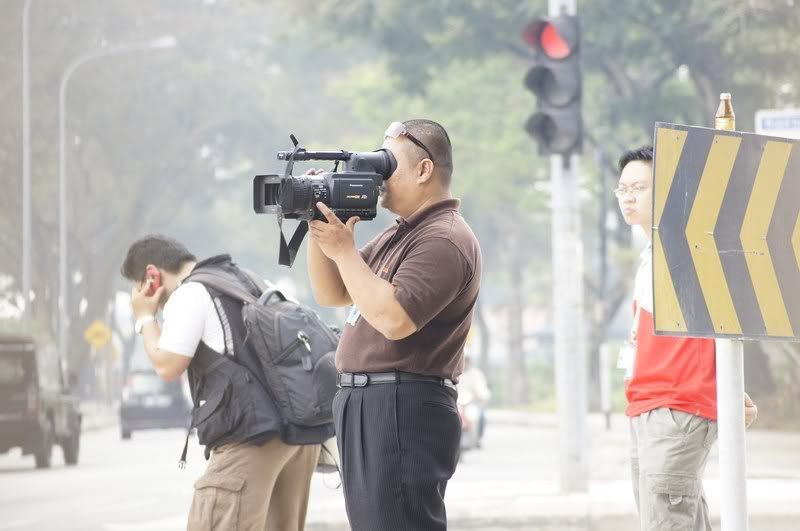
Media crowding PULAPOL just now.

user posted image

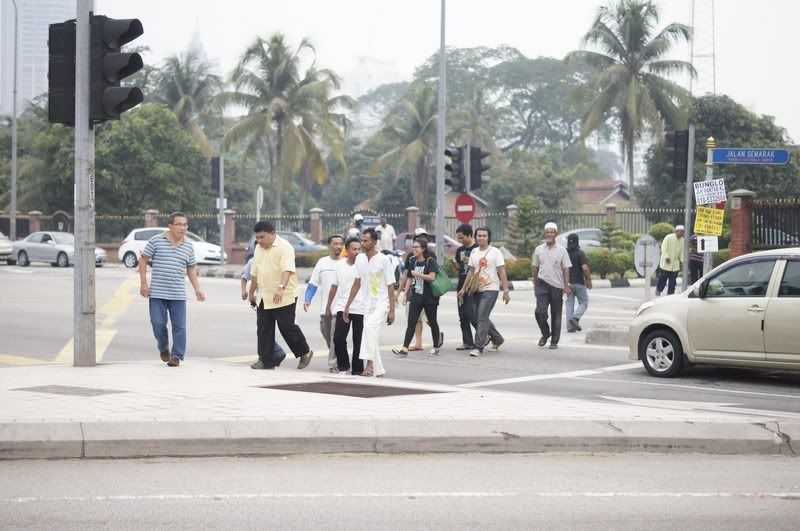
Families of those who were 'submitted' into July 'intake'

user posted image

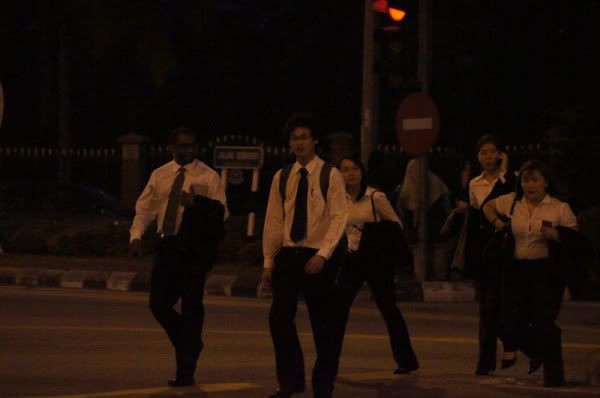
Lawyers incoming to provide legal assistance.

user posted image
TSwanvadder
post Jul 9 2011, 09:32 PM

Getting Started
**
Junior Member
94 posts

Joined: Aug 2008
From: Tristram


QUOTE(atreyuangel @ Jul 9 2011, 09:08 PM)
ko tak pergi makan2 dlam tu ka?
*
Maleh nak melintas jalan. Dah deploy semua peralatan diperlukan kat Selera Semarak (seberang jalan).
TSwanvadder
post Jul 10 2011, 12:28 AM

Getting Started
**
Junior Member
94 posts

Joined: Aug 2008
From: Tristram


QUOTE(atreyuangel @ Jul 9 2011, 09:41 PM)
wei amik la gambar ko punya operation table!
*
Laptop aku ngan member, satu smartphone buat jadi router, satu DSLR member dan beberapa sirap limau dan teh o ais. Gambo takde sad.gif
TSwanvadder
post Jul 30 2011, 11:47 PM

Getting Started
**
Junior Member
94 posts

Joined: Aug 2008
From: Tristram


Marines' War-Fitness Program Targets Crisis Response

Like an overweight boxer seeking to get back into fighting shape, the Marine Corps is ramping up training focused on making units leaner and faster.

Marine Corps Commandant Gen. James Amos and his predecessor Gen. James Conway for several years have fretted about the Corps losing its edge as a sea-based rapid-response force and becoming a plodding, sedentary army.

The latest effort to shed fat and build muscle was an exercise in California this week where a brigade of 5,000 marines — most of them reservists — trained for how they would respond to a crisis that required them to show up on the scene quickly, but also bring enough equipment to sustain themselves for weeks or months.

Marine leaders believe this is the sweet spot that makes the Corps invaluable to the United States: It can serve as a “middleweight” force that brings more staying power than light infantry but can move much faster than Army brigades.

After two major ground wars, the Marine Expeditionary Brigade, or MEB, has seen its “contingency response” skills atrophy, said Maj. Gen. Melvin G. Spiese, commanding general of 1st MEB — based at Camp Pendleton — that participated in the Javelin Thrust 2011 exercise this week.

“The commandant sees a gap in our ability to respond to unplanned crises around the world,” Spiese said in an interview.

Marine Expeditionary Units, or MEUs, can rush to a crisis within hours, but they don’t bring enough equipment to stick around. A MEF, or Marine Expeditionary Force, has enormous resources, but can take weeks to mobilize. That gap in between will be filled by MEBs, Spiese said. This is how the Marine Corps believes it can fill a unique role in national security: A MEB could reach the scene of a crisis within 96 hours, set up a base of operations and keep chaos under control until the civilian leadership figures out how to handle the situation. “We really can be a force that buys time for decision makers,” Spiese said.

No other military service can do this, Spiese said. Special operations forces and MEUs can move quickly, but their capabilities are limited. Army brigades are not easy to transport. The Air Force drops bombs and leaves. The Navy can influence from the sea.

A MEB could deliver up to 15,000 troops, and based on the specific circumstances, could deploy tactical aviation, ground vehicles, infantry weapons, humanitarian and disaster relief supplies. To expedite deployments, a MEB would only bring essential equipment aboard its amphibious ships and would then cherry-pick what it needs from the Marine Corps’ three “maritime prepositioned force” ships that float in strategic areas on the world’s oceans. MPFs contain most of the heavy hardware that would conceivably be needed by commanders on the ground.

A MEB-like response, said Spiese, “would be very difficult to pull together through a joint force” of Army, Air Force and Navy units.

Spiese echoed Amos’ pitch on behalf of several new weapon systems that they believe the Marine Corps will need to fulfill its role as the nation’s 911 force. What are needed, he said, are “capabilities coming from the sea” that can deploy from amphibious ships. That means: the V-22 Osprey, F-35B Joint Strike Fighter, cargo hovercraft and a fast swimming armored vehicle that can ferry troops to the shore.

Some of these programs, particularly the F-35B and a new amphibious vehicle, are now threatened by budget cuts and by criticism that they are both too expensive and easily replaced by other assets.

For the Marine Corps, Spiese said, vertical-takeoff aircraft are non-negotiable. “If we’re stuck with tailhook [Navy carrier-based] fixed wing aircraft, we’ve got problems. We lose flexibility.” High-speed vessels also are important, he said.

One area where improvements may be needed is communications and data networks. A MEB that shows up to support disaster-relief operations, for example, needs to be able to talk and exchange messages with other government agencies and NGOs. Non-military organization would have no interoperability with the U.S. military’s secure radio networks and computer systems.

In the Javelin Thrust exercise, 1st MEB’s communications staff set up open networks with commercial cell phones and Internet-enabled computers. This created difficulties for marines because they could not access data that they needed but reside in classified networks, said Maj. Cedric Lee, 1st MEB’s communications operations officer. “Reach-back capability into our existing networks is absolutely key,” Lee said in an interview. The problem is not unlike what the average person might face if his email could only be accessed from a local Outlook account, as opposed to being able to tap into Gmail or Hotmail from any computer that can access the Internet. “That’s the kind of reach-back we are talking about.” That option is not available to the military because of security restrictions that keep most of the data secluded in classified networks that cannot be accessed from unclassified computers.

The middleweight force also could use some help with electricity sources. Deployed units have to carry huge loads of batteries in areas where there is no electric grid. “The battery loads associated with the equipment we have today becomes a logistical burden and shortens the time we can be away,” Lee said. Recent advances in renewable energy sources, such as solar powered battery rechargers, may eventually ease that burden, he said.

The limitations of the military’s communications systems is “one of the most poignant things that came out of this exercise,” said Lt. Col. Maura Hennigan, logistics operations officer for 1st MEB. Establishing reliable connectivity among all the segments of brigade “can be one of the most challenging things,” Hennigan said in an interview. Marine logisticians, for instance, rely on three different computer systems to manage supply requests, deliveries and transportation. Sometimes requests for supplies do not get through, she said. “Finding workarounds was part of the [Javelin Thrust] exercise,” she said. “If we can’t get on our systems, we find other ways around them, like Sharepoint or email.”

The Corps’ middleweight force also will have to figure out how to fight with less armor. The weight of today’s vehicle armor is a huge burden, Spiese said. Every Humvee truck now has been saddled with thousands of pounds of armor, and every unit in Iraq and Afghanistan was equipped with heavy mine-resistant ambush protected (MRAP) trucks to protect troops from roadside bombs. Those vehicles are not fit for crisis response, and overload the limited capacity aboard cargo ships, said Spiese. Armored Humvees stick out several inches more than they did before, so there is less room. The added weight means that the ship’s load often is maxed out before the cargo space is filled. “The vehicles have grown so heavy that we are hitting the weight constraints before we fill up the ship,” he said. “That really has complicated everything. … Even moving vehicles by C-130 and C-17 [aircraft] has become really problematic.”

Light trucks are available, but would only be used in “maneuver combat’ where the enemy would not know the locations of U.S. forces and would not have enough time to plant landmines or bombs.

Lt. Gen. George Flynn, former commander of Marine Corps Combat Development Command, lamented the weight of today’s equipment. “How did we get so heavy?” he asked. “The enemy made us heavier. … Just about everything we have procured is heavier than what it’s replaced.”

Sauce

TSwanvadder
post Aug 10 2011, 08:09 PM

Getting Started
**
Junior Member
94 posts

Joined: Aug 2008
From: Tristram


Renewed tension on the Northern Limit Line


The NK seems to be doing this at the right time when US market is still at deep shit.
TSwanvadder
post Aug 12 2011, 06:09 PM

Getting Started
**
Junior Member
94 posts

Joined: Aug 2008
From: Tristram


Britain 'woefully unprepared' for Arctic warfare
Britain's armed forces, already stretched by operations in Libya and Afghanistan, are "woefully unprepared" for operations on a new front - the Arctic circle.

A leaked report drawn up by Ministry of Defence and Foreign Office experts raises concerns as the Arctic ice cap melts the Royal Navy's warships are ill-equipped to deal with a new era of territorial disputes and piracy.

The paper details how the expanding seas will create a "new territorial front" and dramatically reduce shipping times, with Britain potentially drawn into conflicts to assist its assist allies.

The paper, entitled Arctic Strategic Implications for the UK, states: "This may manifest itself in the forward deployment of surface vessels into previously inaccessible space, or military presence in disputed territorial waters.”

The new challenge comes after after a string of severe cuts to the Navy almost halved its surface fleet to 19 frigates and destroyers, as well as the loss of aircraft carriers.

The Royal Navy has already been forced to reduce its operations, including the withdrawal of a year round counter narcotics warship from the Caribbean. Admiral Sir Mark Stanhope, the First Sea Lord, recently warned that the Navy would not be able to sustain its part in the Libya campaign without cuts elsewhere.

But the paper warns that Britain would need a “greater role for maritime power as the Arctic represents a water-based theatre of interest”.

“Balancing this however are concerns at how this capability may also be seen as a burden, placing further resource demands on defence," it states.

The paper says that there is still a pressing need for the Navy to “operate in the region” as well as a requirement for “cold-weather capability” in all warships.

However Navy sources have indicated that no cold weather measures have been built into warships, including the new £1 billion Type 45 destroyers.

Disputes over access to the Arctic’s energy and rich fishing areas would mean that the “prime security threat is that access to resources will drive conflict”.

A failure to resolve territorial claims between Russia, Norway, Canada and America will “lead to ungoverned spaces” with the possibility of criminality and piracy.

The report also exposes glaring gaps in the current Government’s much-maligned Security and Strategic Defence Review and National Security Strategy neither of which makes any mention of the Arctic.

However the report, which was written before last year’s defence review, insisted that the Arctic “should feature in MOD regional analysis”.

The report criticised the lack of “systematic coordination of Arctic policy at either departmental or Whitehall level” and that the implications had not been “fully examined and taken on board across HMG”.

“If we do not take action, international policies and positions may be developed which do not take account of UK national interests.”

Britain could also come into conflict with long-standing friends with the document warning that the country’s interests “may conflict with those of traditional allies for example Canada and the US”.

The Navy will also be expected to assure Britain has access to fish stocks found in rich supply as the ice melts.

Britain could also benefit from the new sea corridors by becoming a “trading hub” for ships coming from the Arctic.

It warns that the countries that earn large revenues from the Panama and Suez Canals could face “heightened social tensions and risk of instability” with the introduction of shorter northern routes.

The document also points to Norway being “highly sensitive” about the issue of the Svalbard archipelago over which it was given sovereignty in 1920 but could become a battleground as it hold large hydrocarbon resources.

An MoD spokesman sad: "The Royal Navy maintains the capability to operate in the Arctic using our submarine fleet, survey vessels and the ice patrol ship HMS Protector.

"We continue to work closely with Allies and partners to ensure security in the region."

Sauce
TSwanvadder
post Aug 14 2011, 03:06 PM

Getting Started
**
Junior Member
94 posts

Joined: Aug 2008
From: Tristram


Taliban who shot at US helicopter 'are dead'

US general says Afghan fighters who shot at helicopter which crashed leaving 38 personnel dead have been "dealt with"

An air strike by NATO-led forces in Afghanistan has reportedly killed Taliban fighters, including a local leader, who were responsible for a weekend helicopter crash that left dozens of US navy SEALs and Afghan troops dead.

The NATO-led International Security Assistance Force (ISAF) said in a statement: "The [Wednesday] strike killed Taliban leader Mullah Mohibullah and the insurgent who fired the shot associated with the Aug 6 downing of the CH-47 helicopter, which resulted in the deaths of 38 Afghan and coalition service members."

The statement did not say explicitly that the Taliban fighters had shot the helicopter down, although it was the clearest indication yet from NATO sources that it was the likely cause.

The top US commander in Afghanistan also spoke about Monday's retaliatory mission.

"At approximately midnight on 8 August, coalition forces killed the Taliban insurgents responsible for this attack ... We dealt with them in a kinetic strike," General John Allen, the commander of US and NATO forces in Afghanistan, told reporters at the Pentagon.

Allen also described the Saturday mission in depth for the first time, saying that the helicopter had been sent as a part of an operation targeting a Taliban leader.

The attack took down a Chinook helicopter in the remote Tangi Valley in Afghanistan's Wardak province, causing the biggest loss of life for the US and its allies in a single day in the 10-year-long war.

When elements of the Taliban fighters were seen "escaping", the Chinook helicopter, carrying Navy SEAL commandos and Afghan soldiers, was ordered in to head them off, said Allen.

The helicopter was then shot out of the sky with a rocket-propelled grenade.

US forces then tracked the fighters they said were responsible, calling in an air strike on Monday night with a F-16 fighter jet.

The Taliban leader originally targeted in Friday's mission was not killed, Allen said.

There have been at least 17 coalition and Afghan aircraft crashes in Afghanistan this year.

Sauce
TSwanvadder
post Aug 17 2011, 11:14 PM

Getting Started
**
Junior Member
94 posts

Joined: Aug 2008
From: Tristram


Guatemala's feared special forces


A few days ago, Mexican authorities captured Osvaldo Garcia Montoya, alias El Compayito, one of the most brutal of the new drug lords and the leader of the Hand with Eyes Cartel that operates in Mexico State and parts of Mexico City.

He is said to have admitted responsibility for killing more than 600 people, most of them rivals who were beheaded and further dismembered.

In fact, he was supposedly planning to kill five members of his own gang who were going to desert, and then post the gruesome murders on the internet, when he was captured.

What really drew my attention, though, was Garcia Montoya’s background: he was a former Mexican military officer who had been trained in Guatemala at the Kaibil Academy.

The Kaibils are Guatemala’s Special Operations Group, arguably one of the world’s toughest, best trained and most ruthless commando forces.

Their war cry was first coined by the Spartans: ”If I advance, follow me; if I stop, urge me on; if I retreat, kill me."

They were formed in the 1970s to combat Guatemala’s leftist insurgency and quickly earned a reputation as killing machines, because of the massacres they carried out against entire villages of mainly Mayan Indian peasants.

Today they are struggling to change that image.

After the war, Guatemala’s government decided not to disband the Kaibils, but rather to use them to fight another battle: against drug traffickers and organised crime.

Kaibils have also gone to the Congo and to Haiti as United Nations peacekeepers. They are called on during hurricanes and other natural disasters to come to the rescue of ordinary citizens.

That is not, however, why they've been making the headlines recently.

I recently spent time at the Kaibils’ Academy in Guatemala’s Peten jungle. I’d gone to see just how these men were trained, and to try to understand why some of them have become a powerful weapon at the service of Mexico’s Zetas cartel.

At the entrance of the school there is a sign: WELCOME TO HELL.

All those who do the special operations course are officers, who must leave their rank insignias in an envelope until it is over. The idea is that rank no longer counts.

They must be able to survive extraordinary humiliation, abuse and psychological pressure, as well as hunger, exhaustion and danger.

“The Kaibil is trained to go [to] his limit and beyond, to survive physical and psychological demands that no normal person could," said Major Caceres, the head of the training school.

I had heard the stories about how the Kaibils were made to not only raise a pet dog and then kill it, but also to eat it raw.

I saw the signs in the canteen that read: "Food is a fuel, not a delight."

I watched as they went through their gruelling obstacle course, which requires extraordinary energy, strength, skill and courage.

I was told that several “students” have died throwing themselves out of helicopters into rivers and other dangerous feats.

The amazing thing is that all of those who do the course are volunteers. They are fiercely proud to be a Kaibil, which despite their controversial reputation also comes with prestige.

They are undeniably good at what they do: the question is, do they do good with it?

I found that all the publicity about former Kaibils being recruited by Mexico’s violent Zeta’s cartel to train their henchmen in the finer arts of military warfare is a matter of great embarrassment to the Kaibils.

There is no denying that many of the retired Kaibils hired by the Zetas to form a sophisticated and disciplined army of their own, are likely the same ones that took part in Guatemala's wretched Dirty War.

But it is also clear that Guatemala’s government is largely to blame for not ensuring that when these soldiers retire and return to civilian life they find a better alternative to the easy money offered by organised crime.

It is absurd to think that elite soldiers, whose only profession is the art of warfare, can simply return to their poor villages to become bakers or tailors.

Most Kaibils have little choice but to work as bodyguards, or advisers for security firms, when they leave the army.

Clearly, if the state created them, it has the responsibility to ensure they can reintegrate into society without leaving them so openly at the mercy of temptation.

Sauce
TSwanvadder
post Sep 8 2011, 01:06 PM

Getting Started
**
Junior Member
94 posts

Joined: Aug 2008
From: Tristram


Forming JSDF Marines

It’s really happening: Japan is getting Marines. Corey Wallace at Sigma1 summarizes from a Asahi article that hasn’t made it into English yet.

According to an Asahi Shimbun article here (jp), the MoD plan to convert a GSDF infantry regiment into a US-style amphibious unit is proceeding. Given the rapid modernization of Chinese defense forces, the plan will become an important part of the new and revised defense guidelines to be released at the end of the year. The new unit’s prime responsibility will be filling the perceived Nansei Island security vacuum between Tsushima and Yonaguni islands, which is 1200 kilometres North-South and 900 kilometres East-West. With an estimated 2500 islands, the only permanent forces responsible for the islands’ protection are the Okinawan 15th Brigade and a garrison on Tsushima (JGSDF Tsushima Area Security Force), with the rest being covered by the GSDF Western Army Infantry Regiment(Light) (WAiR) stationed in Nagasaki prefecture. WAiR’s ability to cover the region in case of an armed landing is, and has been in doubt for some time.

The thinking here is that either the JGSDF 8th Division (in Kumamoto) or an infantry regiment from the 15th Brigade be converted to not only provide relief in the case of disaster and other emergencies but also be equipped to recover islands taken by hostile forces. The model will be the US Marine Corps concept, and since 2006 WAiR and the 8th Division have already been training with the US Marines in California in activities related to recovering lost islands.


Japan is smart in creating a unit to retake islands, instead of concentrating on garrisoning them with troops. Trying to defend all 2,500 islands would be a fool’s errand. Once an island is isolated by air and naval power the success of any reasonably well executed amphibious invasion is guaranteed. But once landed, the tables are turned and the invasion force can then become equally isolated and then defeated. Japan should make an effort to garrison the larger populated islands, but the GSDF can’t be everywhere.

Read Moar : Sauce

5 Pages « < 3 4 5
Bump Topic Topic ClosedOptions New Topic
 

Change to:
| Lo-Fi Version
0.3271sec    0.69    6 queries    GZIP Disabled
Time is now: 21st December 2025 - 01:14 PM