QUOTE(TheWandererX @ Dec 22 2010, 02:43 AM)
Been doing a little midnight reading and found out quite a bit about SB.
Just my opinion here, Sandy Bridge doesn't seem to be going to bring a BIG difference. In my opinion, I repeat. Refer here:
» Click to show Spoiler - click again to hide... «
http://www.anandtech.com/show/3871/the-san...-wins-in-a-row/We have here, 3 potential SB chips that will go into our laptops next year.
Looking at the specs, the difference is marginal, no? I know there's a smarter turbo mode and the components are more integrated, but honestly, how much difference will it bring to our current laptops? I agree that the desktop CPUs will seriously kick the current-gen i-processors into the dust, but how about the laptop chips?
I know I may be wrong in some points stated here, but I am open for discussion, and want to learn a little more about Sandy Bridge too, so your kind understanding would be appreciated.
Cheers!
EDIT: Quoted from a website (http://blog.laptopmag.com/help-me-laptop-should-i-wait-for-intel-sandy-bridge):
Also, then there's this handy chart thanks to AnandTech.com which will give us a rough idea of what we will get:
So what do you guys think?
If we're looking at dual core Intel Core i3, i5 & i7 (Arrandale).
Things wouldn't be that much of a difference as Arrandale already share the same 32nm process as Sandy Bridge.
This is due to Intel Tick Tock philosophy.
The 'Tick' happens in Westmere, to shrink Nehalem micro-architecture from 45nm to 32nm.
Now, it's time for the 'Tock', a new micro-architecture, Sandy Bridge.
As a result, dual core Sandy Bridge i3, i5 & i7 would only have marginal improvements over Arrandale.
This gain is mainly contributed by the changes from Nehalem to Sandy Bridge such as better Turbo Boost for CPU and new GPU with Turbo Boost.
On the other hand, if we're look at quad core Intel Core i7 (Clarksfield).
Here, the changes are even more as compared to Arrandale.
The most notable changes are process shrink from 45nm to 32nm and finally the inclusion of integrated graphics in quad core.
Therefore, quad core Sandy Bridge would at least benefit from the process shrink to have higher standard CPU clock speed and longer battery life with the new integrated graphics.
QUOTE
Noticed the increase in standard CPU clock speed from current i7 740QM 1.73GHz to 2.2GHz
CODE
Model Standard Turbo
Core i7 2820QM 2.3 GHz 3.4 GHz
Core i7 2720QM 2.2 GHz 3.3 GHz
Core i7 2630QM 2.2 GHz 2.9 GHZ
Source:
click hereMy opinion would be potential buyers that're looking into quad core mobile computing are starting to see hope with the launch of Sandy Bridge.
For others, either stick to the cheaper and on par Arrandale or splash your money on Sandy Bridge if you can afford.
This post has been edited by J.J: Dec 22 2010, 09:21 AM 

 Dec 21 2010, 09:04 AM


 Quote
Quote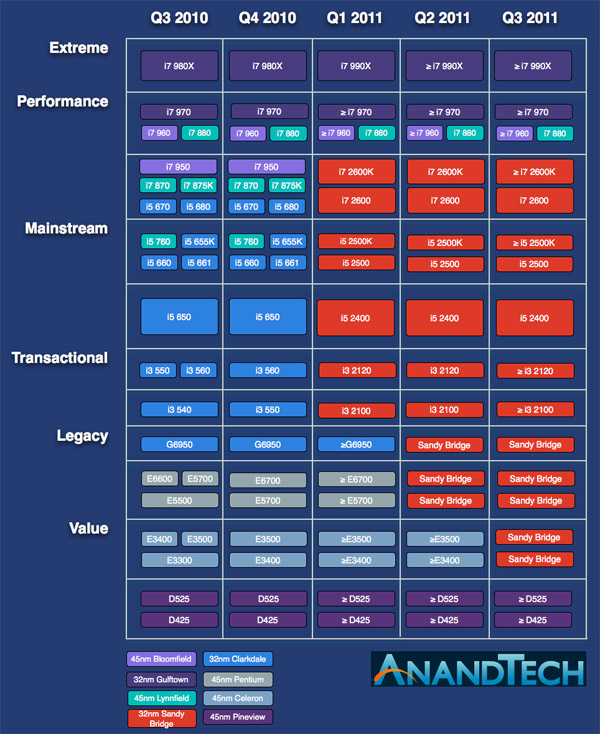

 0.0529sec
 0.38
0.38
 7 queries
 GZIP Disabled