Welcome Guest ( Log In | Register )

Outline · [ Standard ] · Linear+

DIY T-Amp User V2, TA2020 AIR CORES!, ~~~~~~~~~~~~~~~~~~~~~~~~~~~~

views
     
Y.C.
post Nov 25 2008, 04:41 PM

Casual listener
*****
Senior Member
906 posts

Joined: Dec 2006


Ijan, do check out these brand new pairs of Denon SC-M51 2 bookshelf loudspeakers at RM390. Try to negotiate further with them (CMY Electronics) as during the KLIAV 2008 show, their show price is only RM299.

Y.C.
post Nov 25 2008, 09:06 PM

Casual listener
*****
Senior Member
906 posts

Joined: Dec 2006


I believe the nett SP of Wharfedale 8.1 would be in the region of RM800-RM900 previously. I've no personal experience with them but if this Audiofile review wayback in 2002 is anything to be relied upon, they should be pretty good. IMO, a single TA-2024 T-amp should drive them well unless you're very much into headbanging level. Enjoy.

Y.C.
post Nov 28 2008, 01:43 AM

Casual listener
*****
Senior Member
906 posts

Joined: Dec 2006


I'd agree fully with Bsl’s comment above.

I replaced the stock 220uF 25V caps on my 1st board with Panasonic FM 1000uF 16V ones. First impression is not much of difference lah and what a waste of money! How wrong I was as I discovered later the bass and its weight was way too much for my liking and it overpowered the "micro details". I subsequently replaced them with Panasonic 470uF 25V ones. Moral of story, real sonics could only be realised after a while, ie. after running in the caps.

On input caps, a change from stock caps to more decent ones like Vishay MKT1813 you're having would tell the diff almost immediately. Nevertheless, if you were to do a comparison with another unit with stock caps on board now, the diff is even more pronounced. Do spend the money saved from not buying boutique caps for a better vol pot for better transparency and musicality.


Y.C.
post Nov 29 2008, 12:44 AM

Casual listener
*****
Senior Member
906 posts

Joined: Dec 2006


CYL, you sure are unlucky or been extremely critical of JP volume pots. Lai and I also bought ours from RE Spares but there is no problem so far. You already changed the input and power buffer caps? What caps did you opt for? How's the SQ so far?

If you feel the presence of discreet resistors and caps would make your T-amp board look ugly, you could instead opt for better grade SMDs from Vishay or others which are available at Farnell. Bsl is right that changing SMDs to discreet components would dirty up the sound and increase distortion figures. I would not be worried with that myself as that is exactly my aim here. Most critics of T-amp find it too clean-sounding and some of us here do know that absolute accuracy, neutrality and sounding clean could not be equated with musicality and ultimate music enjoyment. Tonal colour is important and should music lovers worry too much about dirty sound and distortion figures, many of them would not have ventured into "valves and vinyl".

I am happy your friend got himself a T-amp too. One more guy converted, who is next? tongue.gif

QUOTE(cyl1000 @ Nov 28 2008, 07:23 PM)
Apart from the two caps, what minor mods can be done to further improve the sound? Getting bigger resistors/caps to replace those SMD will make the T-Amp look ugly  tongue.gif
*


This post has been edited by Y.C.: Nov 29 2008, 12:47 AM
Y.C.
post Nov 29 2008, 09:20 AM

Casual listener
*****
Senior Member
906 posts

Joined: Dec 2006


The difference in SQ of using discreet compos are quite pronounced (we never tried out better SMDs). The 4 pcs of 20K input resistors actually increased overall resolution and clarity of the T-amp further. As for the rests of 0.47uF and 0.1uF caps, Jazzy wrote a review immediately after he completed his stage 1 mods; try finding it in the Ver 1 thread. During our 1st T-amp t/t, I believe most of us who heard actually like SQ of Jazzy’s T-amp with discreet compos, so question of reverting back to SMDs never arise. We didn't hear noises; the discreet compos are slightly more colourful and dirty-sounding just like using a discreet attenuator over carbon volume pot.

Main problem is with desoldering out the SMDs and soldering in the discrete compos. Try to keep the legs as short as possible and use a 15W fine tip Eltax soldering iron. I finally got one myself but as I need to be out of town this weekend, no fiddling with my 3rd T-amp until next week or so.

QUOTE(cyl1000 @ Nov 29 2008, 08:48 AM)
For discrete upgrade, can you guys comment more on its sonic improvement? How much different does it make with SMD..Do you like it with discrete? Since its picking up noise, the result would be different for each of us...if it is not to our liking, hard to revert back unless spend another RM55 and time to run in the T-amp again...
*


Y.C.
post Dec 2 2008, 02:57 PM

Casual listener
*****
Senior Member
906 posts

Joined: Dec 2006


My 2nd unit of T-amp (with Vishay MKT1822 2.2uF 100V and Panasonic FM 470uF 25V caps) + JP’s Alpha 50K volume pot + computer-notebook-style 12V DC 2.5A SMPS are currently with a very close friend in his office. He uses it over his Cyrus 1 amp driving a pair of Celestion 3 and loves the T-amp instantly. His words: “Sound from your tiny amp is excellent. It’s fast and transparent. My Cyrus 1 sounds slower and less transparent by comparison.” He, however, acknowledges impact of bass of the T-amp is light to which I recommend a 12V DC 7Ah Hitachi battery as he is a firm believer in battery power.

I shall need to buy another new board from Xtorm to build an unit of T-amp for my friend.

Y.C.
post Dec 2 2008, 07:04 PM

Casual listener
*****
Senior Member
906 posts

Joined: Dec 2006


Jazzy, many thanks for offer.
The last round, Lai and I wanted 3 pcs of T-amp boards but Xtorm only has 2 pcs to supply so there is a backorder of 1 pc still unfulfilled. If we need more, we would revert to you accordingly. Thanks again. smile.gif

QUOTE(jazzy939 @ Dec 2 2008, 04:20 PM)
Y.C.,
More T-Amp purchase eh? Would there be another bulk? biggrin.gif
I have two spare/unused T-Amp boards.. PM me if interested wink.gif
*


Y.C.
post Dec 2 2008, 08:14 PM

Casual listener
*****
Senior Member
906 posts

Joined: Dec 2006


I was at my old folks’ place during the last weekend. I have a Denon DCD-690 cdp, Denon PM-360 integrated amp driving a pair of 86dB Celestion 7 (sealed boxes) there. After so many years of hardly playing them, I found the sound to be slightly out after their set-up. I’m contemplating selling everything away and build a T-amp (and just make use of a Sharp DVD player) to drive a smaller pair of entry level mini monitors to obtain neater looks, good sound and get back some money in return. If the plan is on with no objection from my old folks, I’ll PM you guys.

Jazzy, that is small issue. When we meet up next time or we actually have the TT t/t session in the Sin City. tongue.gif


This post has been edited by Y.C.: Dec 2 2008, 08:24 PM
Y.C.
post Dec 3 2008, 01:31 AM

Casual listener
*****
Senior Member
906 posts

Joined: Dec 2006


Here is an interesting documentary at YouTube on Surface Mount Soldering. With the right tools, it does not look that scary to work on including the TA2024 chip.
Y.C.
post Dec 4 2008, 01:19 PM

Casual listener
*****
Senior Member
906 posts

Joined: Dec 2006


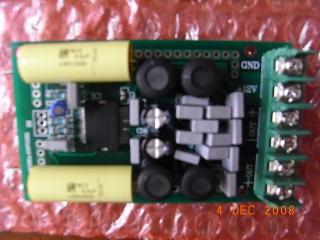
My almost completed 3rd T-amp board (supposed to be with full discrete parts) which would eventually find its way into the casing of my 1st T-amp:
Attached Image

As of now, there are only 2 SMDs remaining on the board: R7 and C5.
R7: 8.2K 1W resistor, the discrete resistor from Farnell is ¼W and I don’t quite trust the JP resistor (I bought both).
C5: 1.0uF capacitor. I’ve yet to figure out the placement of polarity of Panasonic cap for it. No specification from the schematics, this is output from pin 36 of TA2024 chip going to VDD.

The T-amp board with full discrete components doesn’t look too ugly, ya? tongue.gif

Y.C.
post Dec 4 2008, 11:00 PM

Casual listener
*****
Senior Member
906 posts

Joined: Dec 2006


Thanks Bsl. I actually soldered the electrolytic cap (C5) with its negative terminal to pin 36 as I thought its other link is to positive side of the 12V DC input by looking at the physical T-amp board. My apology for the incomplete infomation provided.

For info of all, I've fitted the T-amp board with discrete components into the casing of my 1st T-amp in the office after work today. I shall post a picture of it later tonight. As the T-amp board plus all discrete components (apart from my 24-steps 50K discreet attenuator) are brand new and yet to be run-in, I can't really pass a judgment on its sound now but my first impression is a more transparent, more mellow and less clinical sound but slightly softer at the same volume. I thought this T-amp sounds more analogue than my other units. Some of us heard Jazzy's T-amp also replaced with discrete components during our T-amp t/t session and I like it a lot. Cost of discreet components (all from Farnell) used on my T-amp board are as per below. Do note that some of the caps are sold in multiple of 5 or 10.

Vishay Roederstein MKT1813 2.2uF 250V coupling caps (2) - RM14.66
Panasonic FC 470uF 25V electrolytic caps (2) - RM4.82
Vishay BC 0.47uF 63V caps (6) - RM15.84
Vishay BC 0.1uF 63V caps (6) - RM7.02
Vishay BC 1000pF 400V caps (4) - RM2.68
Vishay BC 100pF 50V caps (2) - RM2.58
Panasonic Audio Grade 1uF 50V electrolytic caps (2) - RM1.90
Vishay BC 1% Metal Film 20K ohm resistors (4) - RM1.68
Vishay BC 1% Metal Film 10 ohm resistors (2) - RM0.84
Total: RM52.02

If electrolytic caps are to be used (I myself use Panasonic 1.0uF caps in C5 and C17), please observe their polarity. A better way to mount the resistors on the T-amp board would be to let them stand parallel instead of being horizontal as in my case. I could hardly find enough space to mount them in R9 and R10 so much so that I need to remove the 10ohm resistor after having soldered it properly and in the process accidentally lifted the soldering pad of R9 bottom and ended up having to tap its leg to the blotch of solder below C28 bottom. Please exercise care and do not solder and desolder many times as the soldering pads could come out quite easily. If the power buffer caps are to be replaced, the stock caps should to be removed prior to the soldering in of the discrete components.

This modification is rather 'absurd' as we are putting in discrete components onto the T-amp board meant for SMDs. It took me 6 hours to complete mine but I feel the outcome to changes to sound of the T-amp is totally fantastic, no regrets. Most important of all, at the end of day we are using it to listen to our music. Enjoy. biggrin.gif


This post has been edited by Y.C.: Dec 5 2008, 12:47 AM

Y.C.
post Dec 5 2008, 12:53 AM

Casual listener
*****
Senior Member
906 posts

Joined: Dec 2006


Thanks for the compliment, Jazzy

I would be game for another T-amp session but if possible let us have one towards end of the month if the timing is also okay to most who are looking forward to it.

Y.C.
post Dec 5 2008, 05:37 AM

Casual listener
*****
Senior Member
906 posts

Joined: Dec 2006


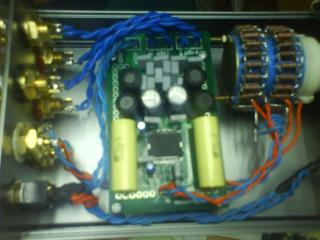
I promised a picture of my T-amp board with discrete components in casing of my 1st T-amp earlier. Here it is:
Attached Image

On its sound quality, after playing non-stop for 6 consecutive hours, it is so beautiful now and easily some 20% better in all areas (resolution, expressiveness, micro details, pace, 3D soundstaging, dynamics and even dynamic shadings) in comparison to my 1st board. As I am using a discrete attenuator rather than a carbon type volume pot, I find the high frequencies extended yet not bright sounding to the extent of being unforgiving as reported by Jazzy after his stage 1 mod. Total cost to for discrete components replacement is RM52 as per my earlier comment, almost the price of 1 T-amp board. However, to me, the mod is well worth every sen spent so for those who could handle the soldering iron reasonably well and are deliberating whether to perform the mod or otherwise, my advice would be to go for it and tell me later if I have been incorrect in my assessment.

Y.C.
post Dec 5 2008, 03:48 PM

Casual listener
*****
Senior Member
906 posts

Joined: Dec 2006


Thanks for compliment, Bsl.

I've always like passive preamps myself for their sheer resolution and transparency. However, in order for passive preamps to weave their magic, output impedance of our cdp/DAC must be low and their output voltage high. Length of the 2 pairs of interconnects used should be kept as short as possible avoiding unscreened cables and those with high capacitance value. Lastly, the need to match them to power amps capable of higher gain/sensitivity. After some readings, apparently a 10K attenuator is the more commonly adopted value for passive preamps as the aim here would be to increase the input impedance and lower the output impedance. The reknown Audio Synthesis Passion uses a 15K attenuator. As for preamps with active buffering stage, some of the resolution and transparency are sacrificed for more drive and dynamics.

Y.C.
post Dec 6 2008, 12:47 AM

Casual listener
*****
Senior Member
906 posts

Joined: Dec 2006


Thanks. I only used a Antax 18W soldering iron with fine tip for the soldering job and my fingers to hold them, no 'surgery' tools. I removed the 2 rear ferrite inductors before I desolder the SMDs and solder in the discrete caps and resistors. I should have also removed the 2 front ones as the Panasonic FC470uF 25V caps are way too 'fat'.
QUOTE(cyl1000 @ Dec 5 2008, 06:53 PM)
It looks great but I was wondering you must have use some sort of "surgery" instrument to put up all these puzzles (caps) so close together   tongue.gif
*


Thanks. We certainly look forward to have you around this time around.
QUOTE(xtorm @ Dec 5 2008, 10:52 PM)
wow nice!!! notworthy.gif
im in for TT session if time and work premits biggrin.gif, getting back on my feet now smile.gif
*


This post has been edited by Y.C.: Dec 6 2008, 12:57 AM
Y.C.
post Dec 7 2008, 07:34 PM

Casual listener
*****
Senior Member
906 posts

Joined: Dec 2006


After 3 days of continuously being powered up by a Meanwell S-50-12 SMPS and playing music several hours a day, I dare pronounce that my discrete parts T-amp will take on and give many highend amplifiers a run for money. What it could not produce in quantity (huge wattage) is compensated by the sheer quality which oozes from it. tongue.gif


Y.C.
post Dec 9 2008, 02:14 PM

Casual listener
*****
Senior Member
906 posts

Joined: Dec 2006


I agree fully with the remark of "good sound has universal standards" that I read in an online article rather than the frequently uttered defensive ones such as "I like how my system sound and I don’t give a damn to how others perceive it".

I have the pleasure of having the presence of a fellow forumer over at my place during the weekend to listen to my main system. Towards the end of the listening session, he pointed out that my system sounded a wee bit too fast that the low bass just does not have enough 'grunt'. Since I have always like my music to sound fast and rhythmic, this realisation came as a shock to me. I later zoom down and thought the culprit to be my vdH First interconnects as I have adopted the best compromise (I wanted to tame the rather harsh digital sound to make it sound more closer to analogue) here for the least trade-off. Apparently the trade-off is not the least now or so it seems.

The equipment used as benchmark to illustrate the shortcoming further is none other than my T-amp with discrete components which is much more transparent and sounds airier with better decay. I think the fellow forumer may find the sound of T-amp to be acceptable now.


This post has been edited by Y.C.: Dec 9 2008, 08:24 PM
Y.C.
post Dec 11 2008, 10:19 AM

Casual listener
*****
Senior Member
906 posts

Joined: Dec 2006


Jazzy, it looks like we are the only ones raving about out T-amps now. Anyhow, enjoy our music with our T-amps. flex.gif biggrin.gif

Y.C.
post Dec 11 2008, 07:43 PM

Casual listener
*****
Senior Member
906 posts

Joined: Dec 2006


Further update to the sound of my T-amp with full discrete components: A full week has elapsed since I completed the modification; the sound of it now varies very substantially to when it was newly done. Who were arguing that amplifiers need no running in?

Okay, back to how it sounds now. I have used much bigger caps of Vishay Roederstein MKT1813 2.2uF 250V in the input stage and Vishay BC 1000pF 400V in the output biasing stage and a result of this is my T-amp sounds very much smoother and fuller. (I like MKT1813 2.2uF 63V caps a lot and whatever they do to the sound, the effects of these bigger 250V ones are even more pronounced. Monkey King only used an adjective to describe them: 'goosebumps' to which I totally agree). Absolute speed is just a tad slower compared to my other units of T-amp with SMDs or even Jazzy’s unit where a substantial lot of SMDs were replaced with discrete components. I have not installed any additional PSU cap(s) so as to maintain the same level of 'micro details' and overall balance of sound. I thought its timing now is almost perfect. Bsl has commented in this thread recently that replacing SMDs with discrete components will induce noise, distortion and make the T-amp sound 'dirty'. I think he is right but whatever noise induced is certainly not audible (although I must admit the T-amp is less clean and clinical-sounding now) and could the distortion be the 'even-order harmonic distortion' which are pleasing to our ears? Yes, you got me correctly, I am inferring that my T-amp with full discrete components (without a single SMD on board) is sounding pretty close to a valve (tube) amplifier not only in its smoothness, warmth and micro dynamics but also with its timing gotten right, lots of rhythmic bounce and sufficient bass and bass weight we could possibly seek from an amplifier.

And I believe I am certainly not the only guy to have raved that the T-amp sounds pretty close to a valve amp as many others have actually indicated their preference of T-amps over their other exotic valve amplifiers they also owned. Hmmm… life is certainly good to me. biggrin.gif


This post has been edited by Y.C.: Dec 11 2008, 11:32 PM
Y.C.
post Dec 15 2008, 09:53 AM

Casual listener
*****
Senior Member
906 posts

Joined: Dec 2006


kww, from the pictures your T-amp mod looks fine to me. How is the sound now? Share with us?

paskal and Monkey King, my regrets that your T-amp boards are ruined by the charger/car battery.


2 Pages  1 2 >Top
 

Change to:
| Lo-Fi Version
0.0321sec    1.06    7 queries    GZIP Disabled
Time is now: 11th December 2025 - 07:07 AM