Its highly doubtful that Deneb can clock better than 4.0Ghz, unless AMD is building them using Si-Ge (not likely due to additional R&D). And even then power efficiency may not be as good as Penryn, which uses a high-K dielectric to reduce leakage (which was resposible for the catastrophic power consumption of Pentium D at high clockspeeds, even on idle). AMD will not be changing their dielectric layer till 32nm, but there is talk of a possible late introduction at 45nm in a future revision.
Here's the current facts we know about processor performance from both AMD and Intel
-At the same clockspeed, running single threaded applications, K10 and Core architecture perform within 5% difference of each other if both chips are having the almost same cache (impossible to be identical, as only one of the 512kb L2 caches is being used). Typically this would be a e4xxx vs a identically clocked Phenom
-At the same clockspeed, Conroe and Penryn perform within 3% difference or less (often ~1%). This shows that beyond 4-6mb cache, most appplications don't show much improvement.
-Phenom (65nm) suffers from lower clockspeed (with or without overclocking), lower cache transfer rates and smaller cache than C2D/C2Q.
Known details on Deneb-
45nm process, using immersion lithographyImmersion lithography typically produces better images than double imaging (which Intel uses for 45nm), meaning defect rate would be lower and supply would be better. (It is known that at this time Intel cannot keep up with demand for 45nm procs)
-
6mb L3 cacheThis would elimininate the cache difference between AMD and Intel. While Intel still has more cache (12mb for C2Q), programs are not known to utilise that much.
-
socket AM2+Compatible with all current AM2/AM2+ boards, at most requiring only a BIOS update.
-
otherwise, everything else is very similar to AgenaKnown details on Nehalem-
will use QuickPath interconnect and new socketThis means new motherboards are required, as the socket pinout is completely different (something like PCI-E vs AGP). It may be possible to use current chipsets with modifications and a FSB to QuickPath adapter, but this is hardly an ideal solution. Nehalem will only perform properly with a new chipset.
-
will have hyperthreadingThough from Skulltrail (dual socket Penryn), very very few programs are optimised to run on more than 4 cores/virtual threads.
-
highest end processors will have Integrated Memory Controller (IMC) using dual/triple channel DDR3DDR3 incurs quite a penalty in terms of latency, even the best current DDR3 has problems going up against most DDR1000-capable DDR2. This could easily negate the latency advantage of using a IMC. Bandwidth wise, memory overclocking has shown that at the moment latency is a much more severe constraint, the wait time for data to arrive is pretty large compared to the time required to transfer data to the cache (processors mostly work on data in cache).
-
otherwise, as far as details are known, everything else is quite similar to Core Micro architectureComparision of Deneb vs Nehalem-Intel's promise that Nehalem would beat C2D/C2Q like C2D beat Pentium D is most likely largely overrated. Core Micro was developed over 3-5 years, with all the processor R&D teams (Laptop, Desktop-former P4 team, Server) working together. After Core Micro was done, the team split in 2, one to work on Penryn, the other on Nehalem, meaning Nehalem has half the workforce available compared to Core Micro, and probably only half the ammount of time. Under that circumstances, its not wise to expect a miracle. Moreover, it didn't take much effort to beat Pentium 4/D, which was terribly inefficient to start with, and hence easy to beat. An article on Intel's R&D
http://tweakers.net/reviews/740/1/chip-mag...m-pagina-1.html-Its not likely that Nehalem would clock higher than Penryn. When both Penryn and Conroe are under extreme cooling, Penryn doesn't clock that much higher than Conroe, showing that there is a limit on current design. Nehalem is not likely to be that significantly different from Core Micro, and the IMC adds complexity which could hinder overclocking (which is the case for AM2 processors)
-What Nehalem is GOOD at is, multi-processor environments. Currently, even Core Micro Xeons cannot outperform AMD's processors in multi-processing environments due to chipset bottlenecks, and the multiprocessor-supporting chipsets are atrociously power-hungry.
In a way, they're right. Agena is a HUGE chip, difficult to manufacture. When you shift from 65nm to 45nm, the chip size is halved (which is how AMD can finally fit in 6MB L3 cache). However, while OC headroom should improve, I'm not expecting a miracle.
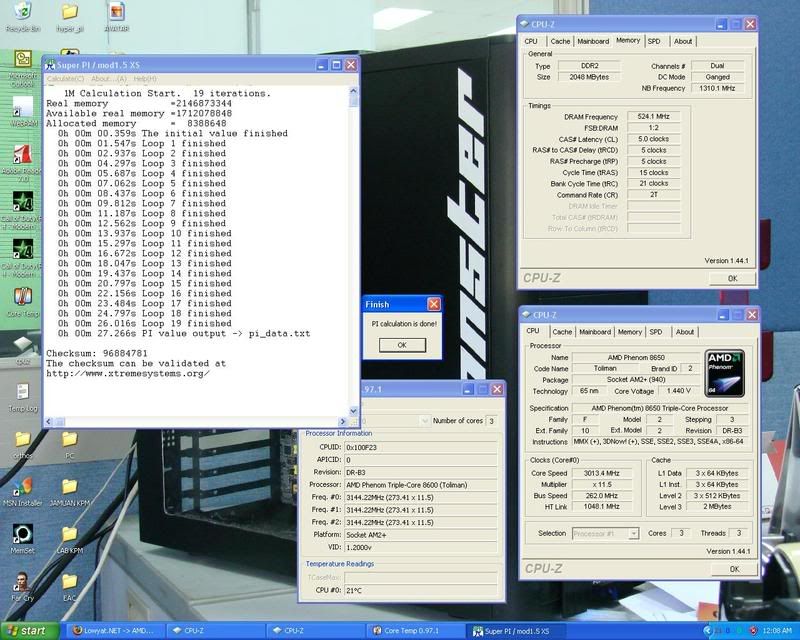
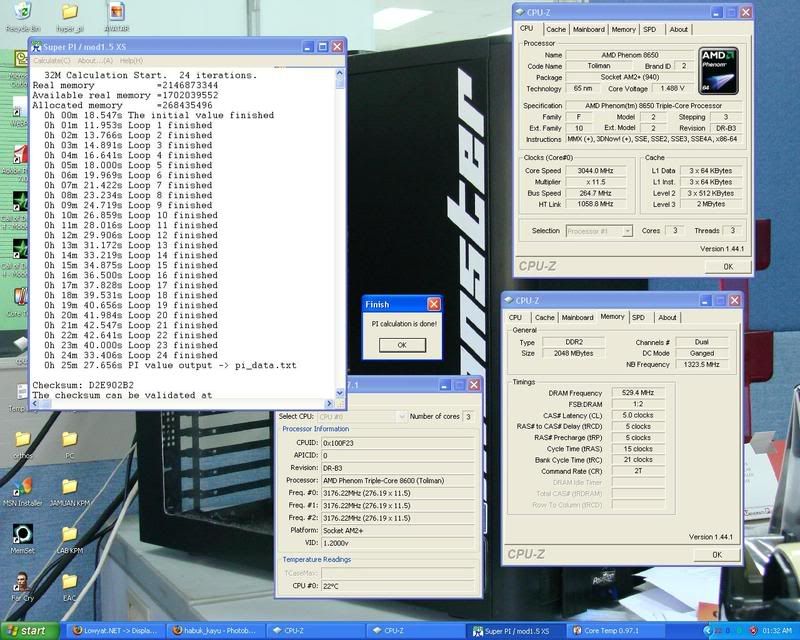
No difference bro, even the best B3 are struggling to go beyond 3Ghz.
Same here.
Though I think 3.6Ghz on air would be good enough to remain competitive, I'm not expecting Nehalem to be a performance miracle anyway. C2D took nearly a year to become affordable, and even then ram cost was no problem and high-end boards could still be reused. Nehalem will require both board and ram to be changed, and with AMD staying away from DDR3 for another year or more, its not likely that DDR3 prices will drop anytime soon. And Intel board have typically been expensive at launch, and slow to drop in price.
If Deneb + AMD 7 series chipset power consumption is better than Penryn + P35/X38, I'll consider it good enough already. Currently on idle both are similar since AMD's 7 series chipsets are way more efficient compared to the P35/X38 that the low power consumption of Penryn is cancelled out. Its on load thats a problem, Penryn hardly moves while Agena's power consumption skyrockets. As for Nehalem, the IMC will cause processor power consumption to go up, while chipset power consumption goes down due to the memory controller removed, Intel has often been stubborn about chipset die shrinks and chipsets are pretty backward in power efficiency. Nehalem will probably still be better than Deneb in power consumption when the whole system is taken into account, but I think Deneb should be close enough to be competitive.
I'm not expecting AMD to take back the performance or power efficieny crown anytime soon, at least not till the Bulldozer architecture is ready. However, if AMD makes no major mistakes with Deneb, AMD will probably survive well enough to make a real comeback.
Are you dreaming?
3.9Ghz would put you in the world top 10 for F3 already..
And obviously none of them were done using 'just' water cooling..
And even to reach 3.6Ghz on any cooling the voltage required is starting to get uncomfortable, what more 3.9Ghz..
I think there are misconceptions there.
1.The High-K gate dielectric is mainly design for gate leakage control.
How far the processor can go, it's more likely depend transistor characteristic, amount of transistors, quality and purity of the wafer used etc.
In those old days, Pentium 4s are screw up big time in term of power consumption control, but they have no problem to hit 8GHz
Agreed with that point AMD processors hardly can break through 4GHz region, eventhough they are moving into 45nm fabrication technology
2. Best B3 has no problem to do 3.5GHz above
3. I would say that 6MB L3 cache can never on par with 6MB unified L2 cache
4. For F3, 3.6GHz is achievable with air cooling, in the case ambient temperature must be low.
eldera from beijing , but he bench it in winter season.
The CPU-Z validation thingy actually is not hard to do so.
It depends on how good your cooling + how well you can play with clockgen / setfsb + how fast you can save the validation file


 Apr 28 2008, 09:23 PM




 Quote
Quote


 and SE version has a slightly different PWM design but sound quite old version


 0.0458sec
 0.60
0.60
 7 queries
 GZIP Disabled