

 Dec 14 2025, 04:36 AM, updated 7d ago


China Aims To Make Childbirth Cost Completely Free By 2026
China has unveiled an ambitious plan to significantly reduce, and potentially eliminate, out-of-pocket childbirth costs for families by 2026, as part of a broader push to arrest the country’s declining birth rate and ease the financial burden of raising children.
The initiative was announced during a national healthcare security conference on Saturday, where authorities outlined new national medical insurance guidelines aimed at expanding coverage for childbirth-related expenses.
Under the plan, delivery costs — including prenatal care, labour and postnatal medical services — will be increasingly absorbed by China’s public health insurance system, effectively making childbirth “near free” for most parents by 2026.
In response, the authorities have introduced a series of policies to encourage childbirth, including cash subsidies, improvements to childcare and early education services, and extended paternity and maternity leave. They have also announced guidelines aimed at reducing “non-medically necessary” abortions.
In addition, starting next year, China will impose value-added tax (VAT) on😤😱😤😤😱😱 contraceptive medicines and products,
😱😱😱😱😱😱😱😱😱😱😱😱including condoms.😱😱😱😱😱😱😱
The policy is expected to standardise and expand insurance reimbursements across provinces, reducing disparities in maternal healthcare costs nationwide.
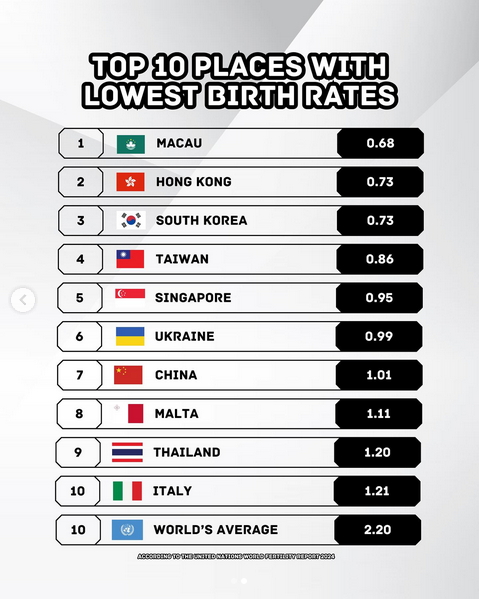
The move comes as China faces mounting demographic pressures, with birth rates falling to record lows despite the removal of its decades-long one-child policy and the introduction of two- and three-child allowances in recent years.
Rising living costs, expensive childcare, housing affordability challenges and career pressures have discouraged many couples from having children.
Policymakers now see direct financial support around childbirth as a critical lever to reverse the trend.
“This is the first time the nation is providing broad financial support for childbirth.”
“Nothing motivates people more and signals commitment better than distributing cash.”
According to the 2024 central government fiscal final accounts, that year the central government’s general public budget expenditure was 14 trillion CNY (≈ RM 8.15 trillion), with a budget surplus of 300.11 billion CNY (≈ RM 174.4 billion). The pressure from childcare subsidy spending is relatively small.
The issuance of birth subsidies cannot be driven only by local governments: “Investment in encouraging childbirth cannot form a closed loop of cost-benefit locally — it can only be realized nationwide.”
This article first appeared in Southern Weekly. Unauthorized reproduction is prohibited.
By Southern Weekly Reporter Wu Chao
Editor|Zhang Yue
On July 28, 2025, the General Office of the CPC Central Committee and the General Office of the State Council issued the National Childcare Subsidy System Implementation Plan, clarifying that from January 1, 2025, whether it’s a first, second, or third child, parents will receive an annual subsidy of 3,600 CNY (~RM 2,095) per child until the child reaches the age of three.
For children born before January 1, 2025 but who are not yet three years old, subsidies can be paid on a pro-rata basis based on the number of eligible months.
In other words, children born on or after January 1, 2022 will also qualify for the childcare subsidy. Parents or other guardians may apply through the online Childcare Subsidy Information Management System in the child’s place of household registration, or via an offline application if needed.
On the afternoon of July 30 at a State Council Information Office press conference, Guo Yanhong, Deputy Director of the National Health Commission, said, “Childcare subsidy is the first broad, universal, direct cash transfer to the public in the history of New China.”
“From the national level, this is the first time fiscal support has been offered for childbirth. This is a positive signal, showing more people that having a child is not just a private matter, but a national matter,” said Lu Jiehua, Vice President of the China Population Society and Professor in the Sociology Department at Peking University, in an interview with Southern Weekly.
---
1. Without the first child, there’s no second or third
Guo Yanhong, Deputy Director of the National Health Commission, stated at the press conference that the annual 3,600 CNY (~RM 2,095) per child until age three was set after considering China’s current development phase, parents’ costs of raising children, government fiscal capacity, and international childcare subsidy practices — following the principle of doing what’s feasible and within means.
Guo Yang, Director of the Social Security Department of the Ministry of Finance, said the central government will set up a shared fiscal transfer payment item called Childcare Subsidy Funds, and this year has preliminarily allocated a budget of about 90 billion CNY (~RM 52 billion) for it.
Population scholar Huang Wenzheng, Executive Director of the Yiwu Population Think Tank, told Southern Weekly that “the 3,600 CNY (~RM 2,095) standard is mainly determined by the current fiscal capacity and also reflects that the program is still in its early stage, so the initial funding is not very large.”
In Hohhot, mothers who have just given birth receive milk vouchers from
China Mengniu Dairy Company Limited (2319.HK)
内蒙古 蒙牛乳业(集团)股份 有限公司
and
Inner Mongolia Yili Industrial Group Co., Ltd. (600887.SS)
, provided on a “no application needed” basis.
After completing hospital discharge procedures, mothers receive a text message informing them that they have received 3,000 CNY (≈ RM 1,740) in milk vouchers — 1,500 CNY (≈ RM 870) from Mengniu and 1,500 CNY (≈ RM 870) from Yili — which can be used to freely select products on the online mall.
Regarding the newly announced national subsidy, her attitude is one of “contentment and gratitude”:
“Since the country is providing subsidies, we will accept them calmly and responsibly.”
However, most people will not decide to have children solely because of subsidies. Issues such as maternity leave, postpartum care, and broader maternal support systems still require comprehensive backing.
Among nearly one hundred regions that already offer childbirth subsidies, Tianmen City in Hubei Province stands out. In addition to one-off birth rewards and childcare subsidies, the city also provides housing purchase incentives.
For families having a second child, the maximum total subsidy reaches 287,188 CNY (≈ RM 166,600), while for a third child, it can go up to 355,988 CNY (≈ RM 206,500).
In 2024, Tianmen recorded 7,217 births, representing a 17% year-on-year increase, compared to the national growth rate of 5.8% during the same period.
According to the official website of the Hong Kong Special Administrative Region Government,
babies born on or after October 25, 2023, are eligible for a 20,000 HKD (≈ RM 12,000) reward paid to their parents over a period of 3 years.
At the time of application, at least one parent must be a Hong Kong SAR permanent resident.
Looking at other countries globally, providing childbirth subsidies through fiscal funding is also common practice.
An information booklet released by Japan’s Ministry of Justice states that residents enrolled in Employees’ Health Insurance or National Health Insurance are entitled to a 500,000 JPY childbirth allowance (≈ RM 16,000) upon delivery.
This post has been edited by plouffle0789: Dec 14 2025, 01:25 PM
China Aims To Make Childbirth Cost Completely Free
 Quote
Quote


























 0.0286sec
 0.42
0.42
 5 queries
 GZIP Disabled