

 Sep 13 2025, 09:29 PM, updated 3 months ago


https://malaysia.yahoo.com/news/lawyer-air-...-033000288.html
QUOTE
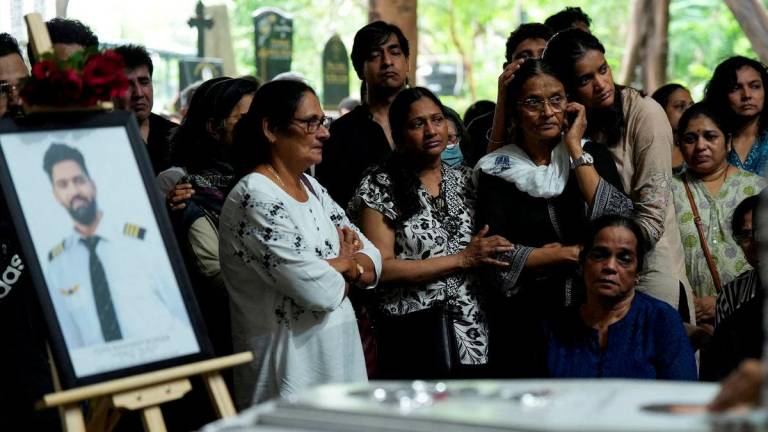
Lawyer for Air India families says one key theory has emerged to explain crash
Namita Singh
Sat, 13 September 2025 at 9:10 pm MYT·9-min read
Lawyer for Air India families says one key theory has emerged to explain crash
A lawyer representing families of those killed in June’s devastating Air India crash has dismissed claims that the pilots may have deliberately or mistakenly shut off fuel controls before the aircraft plunged into a building, killing 260 people.
Mike Andrews, who is pursuing lawsuits against Boeing on behalf of more than 100 families, said in an interview with The Independent that the suggestion of “self-sabotage” or gross pilot error is not only unsupported by evidence but also unjust to the dead.
The Dreamliner was also friendly to airlines’ bottom lines, burning about 20 per cent less fuel than the 767, and allowed airlines’ network planners to dream of ultra-long routes.
But Mr Andrews argues that the aircraft had been dogged by technical concerns, particularly involving its potable water system – that supplies safe, drinkable water for passengers and crew – and its proximity to sensitive electronics.
He pointed to a trail of Boeing bulletins to airlines dating back years and recent regulatory warnings from the US Federal Aviation Administration (FAA), all raising alarms over water leaks.
“Going back to 2016, 2017 and 2018 there were bulletins to air carriers in the United States to perform waterproofing maintenance,” Mr Andrews said.
“In particular, it speaks to couplings that join water lines underneath lavatories and galley areas. I’ve purchased some of these couplings myself – they’re simple clamshell devices that hold two lines together.
“But the way the final shroud is fitted can loosen the latch, and over time that leads to leaks. We know from FAA notices and directives that water has been found on 787s leaking into equipment bays, and in some cases equipment had to be replaced.”
The compartment he refers to is the aircraft’s electronics equipment bay, or EE bay. It sits beneath the cabin floor and houses the computers that control almost every aspect of the flight, including the full authority digital engine control, known as Fadec.
The Fadec is essentially the aircraft’s engine brain. Unlike older jets, where pilots manually controlled fuel flow, modern engines depend on this computer to regulate thrust, fuel injection and performance.
Fadec is a sophisticated digital computer system in aircraft that automatically controls all aspects of engine performance by receiving data from sensors, calculating optimal settings, and adjusting fuel flow and other engine parameters to maximise efficiency and performance while ensuring safety.
According to the FAA, “if the Fadec fails, the engine fails”.
Mr Andrews said a water leak does not have to destroy equipment outright to be dangerous. “Even if it doesn’t ruin the component, it can trigger a reset. And that cascade can initiate an engine shutdown. In Ahmedabad, we saw both engines shut down or lose thrust within seconds – that is extraordinarily unlikely without a common cause. Water reaching those systems is one plausible explanation.”
The FAA itself highlighted the risk only weeks before the crash.
On 14 May, the regulator issued an Airworthiness Directive – an order that requires mandatory checks – warning that “water leakage from the potable water system due to improperly installed waterline couplings” had been reported, and that such leaks could cause “equipment in the EE bays to become wet resulting in an electrical short and potential loss of system functions essential for safe flight”.
Namita Singh
Sat, 13 September 2025 at 9:10 pm MYT·9-min read
Lawyer for Air India families says one key theory has emerged to explain crash
A lawyer representing families of those killed in June’s devastating Air India crash has dismissed claims that the pilots may have deliberately or mistakenly shut off fuel controls before the aircraft plunged into a building, killing 260 people.
Mike Andrews, who is pursuing lawsuits against Boeing on behalf of more than 100 families, said in an interview with The Independent that the suggestion of “self-sabotage” or gross pilot error is not only unsupported by evidence but also unjust to the dead.
The Dreamliner was also friendly to airlines’ bottom lines, burning about 20 per cent less fuel than the 767, and allowed airlines’ network planners to dream of ultra-long routes.
But Mr Andrews argues that the aircraft had been dogged by technical concerns, particularly involving its potable water system – that supplies safe, drinkable water for passengers and crew – and its proximity to sensitive electronics.
He pointed to a trail of Boeing bulletins to airlines dating back years and recent regulatory warnings from the US Federal Aviation Administration (FAA), all raising alarms over water leaks.
“Going back to 2016, 2017 and 2018 there were bulletins to air carriers in the United States to perform waterproofing maintenance,” Mr Andrews said.
“In particular, it speaks to couplings that join water lines underneath lavatories and galley areas. I’ve purchased some of these couplings myself – they’re simple clamshell devices that hold two lines together.
“But the way the final shroud is fitted can loosen the latch, and over time that leads to leaks. We know from FAA notices and directives that water has been found on 787s leaking into equipment bays, and in some cases equipment had to be replaced.”
The compartment he refers to is the aircraft’s electronics equipment bay, or EE bay. It sits beneath the cabin floor and houses the computers that control almost every aspect of the flight, including the full authority digital engine control, known as Fadec.
The Fadec is essentially the aircraft’s engine brain. Unlike older jets, where pilots manually controlled fuel flow, modern engines depend on this computer to regulate thrust, fuel injection and performance.
Fadec is a sophisticated digital computer system in aircraft that automatically controls all aspects of engine performance by receiving data from sensors, calculating optimal settings, and adjusting fuel flow and other engine parameters to maximise efficiency and performance while ensuring safety.
According to the FAA, “if the Fadec fails, the engine fails”.
Mr Andrews said a water leak does not have to destroy equipment outright to be dangerous. “Even if it doesn’t ruin the component, it can trigger a reset. And that cascade can initiate an engine shutdown. In Ahmedabad, we saw both engines shut down or lose thrust within seconds – that is extraordinarily unlikely without a common cause. Water reaching those systems is one plausible explanation.”
The FAA itself highlighted the risk only weeks before the crash.
On 14 May, the regulator issued an Airworthiness Directive – an order that requires mandatory checks – warning that “water leakage from the potable water system due to improperly installed waterline couplings” had been reported, and that such leaks could cause “equipment in the EE bays to become wet resulting in an electrical short and potential loss of system functions essential for safe flight”.
tldr; maybe wanna save face lawyer disputes authority investigation result
say that maybe water/liquid ingress into important components and damages them resulting in the crash
This post has been edited by DDG_Ross: Sep 13 2025, 09:31 PM
 Quote
Quote





 0.1504sec
 0.31
0.31
 5 queries
 GZIP Disabled