

to the whole world from word kecap
Ketchup spread from Malay
Ketchup spread from Malay
|
|
 Oct 12 2024, 09:40 PM, updated 2y ago Oct 12 2024, 09:40 PM, updated 2y ago
Show posts by this member only | Post
#1
|
 
Junior Member
328 posts Joined: Jan 2015 
|
to the whole world from word kecap
|
|
|
|
|
|
Oct 12 2024, 09:51 PM
Show posts by this member only | Post
#2
|

Junior Member
90 posts Joined: Sep 2011
|
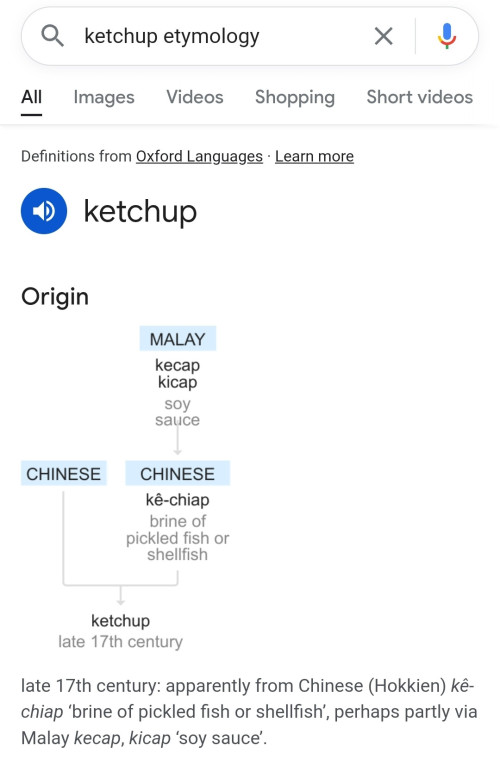 google say otherwise. it say it was first a malay word. then borrowed by the hokkien chinese. |
|
|
Oct 12 2024, 09:51 PM
Show posts by this member only | Post
#3
|

Junior Member
100 posts Joined: Jan 2003
|
Shameless. I am Chinese but this is crap.
|
|
|
Oct 12 2024, 09:54 PM
Show posts by this member only | Post
#4
|
|
Junior Member
90 posts Joined: Sep 2011
|
QUOTE(kcal @ Oct 12 2024, 09:51 PM) google say otherwise. it say it was first a malay word. then borrowed by the hokkien chinese.  gemusw liked this post
|
|
|
Oct 12 2024, 09:54 PM
Show posts by this member only | IPv6 | Post
#5
|
|
Junior Member
328 posts Joined: Jan 2015
|
QUOTE(kcal @ Oct 12 2024, 09:51 PM) google say otherwise. it say it was first a malay word. then borrowed by the hokkien chinese. |
|
|
Oct 12 2024, 10:00 PM
Show posts by this member only | IPv6 | Post
#6
|

Junior Member
98 posts Joined: Mar 2018 From: Land of the Hornbills, Land of the Free 
|
Soy sauce transition become tomato sauce?
The transition pretty much eliminated the original meaning This post has been edited by Chowda: Oct 12 2024, 10:00 PM |
|
|
|
|
|
Oct 12 2024, 10:01 PM
Show posts by this member only | Post
#7
|
|
Junior Member
90 posts Joined: Sep 2011
|
QUOTE(Chowda @ Oct 12 2024, 10:00 PM) Soy sauce transition become tomato sauce? same like char kuey tiaw.The transition pretty much eliminated the original meaning gemusw liked this post
|
|
|
Oct 12 2024, 10:03 PM
Show posts by this member only | IPv6 | Post
#8
|

Newbie
10 posts Joined: Jun 2017
|
What does the big tomato say to the small tomato? Catch up! 😂 novblaze liked this post
|
|
|
Oct 12 2024, 10:09 PM
Show posts by this member only | Post
#9
|

Senior Member
1,374 posts Joined: Feb 2016 From: Milky Way
|
In Cantonese, 茄汁 pronunciation sound exactly like ketchup, tomato sauce, exact same meaning.
 Kicap in Malay can be soya sauce and many other sauce. |
|
|
Oct 12 2024, 10:28 PM
Show posts by this member only | IPv6 | Post
#10
|

Junior Member
101 posts Joined: Jul 2022 From: Kelantan
|
In b4 the indon
|
|
|
Oct 12 2024, 10:34 PM
Show posts by this member only | IPv6 | Post
#11
|

Junior Member
28 posts Joined: Jun 2011
|
PuAS: Ini boleh claim royalti tak? gemusw liked this post
|
|
|
Oct 12 2024, 10:36 PM
|

Senior Member
2,063 posts Joined: Jan 2003 From: Konoha
|
cat sup
|
|
|
Oct 12 2024, 10:46 PM
|

Junior Member
355 posts Joined: May 2022
|
later they will claim that sri vijaya and chola is also from china lol
|
|
|
|
|
|
Oct 12 2024, 10:56 PM
Show posts by this member only | IPv6 | Post
#14
|

Junior Member
114 posts Joined: Nov 2008 From: Shah Aley
|
Anchovies? Then its budu
|
|
|
Oct 12 2024, 10:56 PM
|
|
Junior Member
150 posts Joined: Nov 2020
|
Singapore say no
|
|
|
Oct 13 2024, 12:10 AM
Show posts by this member only | IPv6 | Post
#16
|

Junior Member
334 posts Joined: Jun 2015 From: underneath the grove of sycamore
|
QUOTE(niwde @ Oct 12 2024, 09:51 PM) Shameless. I am Chinese but this is crap. It is a fact.This theory is proposed by Oxford English Dictionary and there are written record supporting 膎汁 origin. It is ashamed that some have lost their way to identify their culture. |
|
|
Oct 13 2024, 12:25 AM
Show posts by this member only | IPv6 | Post
#17
|

Senior Member
875 posts Joined: Jul 2016
|
QUOTE(kcal @ Oct 12 2024, 09:51 PM) google say otherwise. it say it was first a malay word. then borrowed by the hokkien chinese. 3rd Century BCE — Early Chinese Fermented Sauces China had a long tradition of producing fermented fish sauces, with references found in ancient texts like the Zhou Li (周禮) and other historical documents. While these early sauces were ancestors of what would later become kê-tsiap, they were not yet called by that name. However, they were widely consumed throughout southern Chinese provinces. 16th - 17th Century — Chinese Fish Sauce and Maritime Trade Hokkien-speaking traders from southern China (Fujian province) were involved in extensive maritime trade across Southeast Asia. This is the period when the term kê-tsiap (鮭汁), meaning "pickled fish brine" or "fermented fish sauce," is believed to have emerged in the Amoy (Xiamen) dialect of Hokkien Chinese. Evidence: Hokkien-speaking traders were historically known for introducing their language, foods, and condiments to areas they traded with, such as the Malay Archipelago and Indonesia. 17th Century — Adoption of Fermented Sauces in Malay Culture The spread of Chinese-style fish sauce through Chinese traders likely influenced local Malay languages and culinary practices. In the Malay language, the word kecap (or kicap) came to describe a variety of fermented sauces, such as soy sauce (kecap manis) and other fish-based condiments. Evidence: The adaptation of Chinese food culture into Malay cuisine during this time is well documented, especially in the spice trade regions where Chinese migrants settled. 1690s — First Appearance of 'Catchup' in English The first written use of the word catchup appears in British texts, referring to an imported sauce resembling the fermented fish sauces found in Southeast Asia. Example: A 1690 dictionary entry in England refers to a sauce called catchup, suggesting it was already known among British traders and seafarers. 1711 — Jonathan Swift's Use of 'Ketchup' The term ketchup appears in literature when Jonathan Swift uses it in his writings, further cementing its place in English vocabulary. Early English ketchup recipes did not include tomatoes but rather used ingredients like anchovies, mushrooms, and walnuts to replicate the umami flavor of the original fermented sauces. 1748 — First Ketchup Recipe Published in English A recipe for ketchup appears in Hannah Glasse’s famous cookbook The Art of Cookery Made Plain and Easy, featuring a mushroom-based ketchup. This recipe reflects the British attempt to adapt the Chinese and Southeast Asian sauces to local tastes using available ingredients. 19th Century — Transition from Fish to Tomato Ketchup By the 19th century, tomatoes became a common ingredient in ketchup, especially in the United States, where regional producers experimented with the formula. Heinz introduced the modern sweet, tomato-based ketchup in 1876, shifting ketchup’s identity away from the original fermented sauces. Modern Day — Survival of Kecap and Chinese Condiments Today, kecap is still used in Indonesia and Malaysia to describe soy sauces and other fermented condiments, illustrating the persistence of the original term. In contrast, ketchup in Western cuisine is now almost exclusively associated with a tomato-based sauce. This post has been edited by Hoka Nobasho: Oct 13 2024, 12:27 AM kcal liked this post
|
|
|
Oct 13 2024, 12:27 AM
|
|
Junior Member
90 posts Joined: Sep 2011
|
QUOTE(Hoka Nobasho @ Oct 13 2024, 12:25 AM) 3rd Century BCE — Early Chinese Fermented Sauces tq.China had a long tradition of producing fermented fish sauces, with references found in ancient texts like the Zhou Li (周禮) and other historical documents. While these early sauces were ancestors of what would later become kê-tsiap, they were not yet called by that name. However, they were widely consumed throughout southern Chinese provinces. 16th - 17th Century — Chinese Fish Sauce and Maritime Trade Hokkien-speaking traders from southern China (Fujian province) were involved in extensive maritime trade across Southeast Asia. This is the period when the term kê-tsiap (鮭汁), meaning "pickled fish brine" or "fermented fish sauce," is believed to have emerged in the Amoy (Xiamen) dialect of Hokkien Chinese. Evidence: Hokkien-speaking traders were historically known for introducing their language, foods, and condiments to areas they traded with, such as the Malay Archipelago and Indonesia. 17th Century — Adoption of Fermented Sauces in Malay Culture The spread of Chinese-style fish sauce through Chinese traders likely influenced local Malay languages and culinary practices. In the Malay language, the word kecap (or kicap) came to describe a variety of fermented sauces, such as soy sauce (kecap manis) and other fish-based condiments. Evidence: The adaptation of Chinese food culture into Malay cuisine during this time is well documented, especially in the spice trade regions where Chinese migrants settled. 1690s — First Appearance of 'Catchup' in English The first written use of the word catchup appears in British texts, referring to an imported sauce resembling the fermented fish sauces found in Southeast Asia. Example: A 1690 dictionary entry in England refers to a sauce called catchup, suggesting it was already known among British traders and seafarers. 1711 — Jonathan Swift's Use of 'Ketchup' The term ketchup appears in literature when Jonathan Swift uses it in his writings, further cementing its place in English vocabulary. Early English ketchup recipes did not include tomatoes but rather used ingredients like anchovies, mushrooms, and walnuts to replicate the umami flavor of the original fermented sauces. 1748 — First Ketchup Recipe Published in English A recipe for ketchup appears in Hannah Glasse’s famous cookbook The Art of Cookery Made Plain and Easy, featuring a mushroom-based ketchup. This recipe reflects the British attempt to adapt the Chinese and Southeast Asian sauces to local tastes using available ingredients. 19th Century — Transition from Fish to Tomato Ketchup By the 19th century, tomatoes became a common ingredient in ketchup, especially in the United States, where regional producers experimented with the formula. Heinz introduced the modern sweet, tomato-based ketchup in 1876, shifting ketchup’s identity away from the original fermented sauces. Modern Day — Survival of Kecap and Chinese Condiments Today, kecap is still used in Indonesia and Malaysia to describe soy sauces and other fermented condiments, illustrating the persistence of the original term. In contrast, ketchup in Western cuisine is now almost exclusively associated with a tomato-based sauce. |
|
|
Oct 13 2024, 12:53 AM
Show posts by this member only | IPv6 | Post
#19
|

Junior Member
12 posts Joined: Jul 2022
|
Originate from Cantonese.
番茄= tomato 汁= sauce 茄汁 = ke zhap = ketchup. This post has been edited by Sam Loo: Oct 13 2024, 12:55 AM |
|
|
Oct 13 2024, 08:39 AM
Show posts by this member only | IPv6 | Post
#20
|

Junior Member
405 posts Joined: Mar 2013
|
QUOTE(Hoka Nobasho @ Oct 13 2024, 12:25 AM) The Malay term kecap likely derives from Chinese, evidenced by the similarity in phonetics and the historical presence of Chinese traders in the region. can you cite your reference point? it would have more credibility in that way  |
| Change to: |  0.0195sec 0.0195sec
 1.00 1.00
 5 queries 5 queries
 GZIP Disabled GZIP Disabled
Time is now: 19th December 2025 - 04:01 AM |
 Quote
Quote