Outline ·
[ Standard ] ·
Linear+
Home solar 4 months in.
|
hjh87
|
 Feb 25 2024, 09:24 PM Feb 25 2024, 09:24 PM
|

|
Love to hear from NEM 2.0 adopters as it's almost been 5 years since this scheme was introduced on January 1st, 2019. What's the ROI to date? And over the 5-year period, how much have you spent on unforeseen costs like maintenance, malfunctions, and others? This way, most of us can understand the actual case: is solar worth it?"
|
|
|
|
|
|
hjh87
|
Jun 25 2025, 03:41 PM
|
|
|
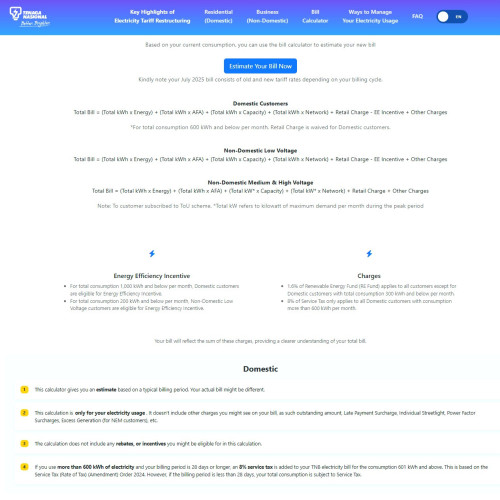 Look at Point No.2 Installing solar is mainly to hedge against future tariff hikes. The real concern now is the new additional charges — the network and capacity fees. It seems like TNB wants to charge you for simply using their infrastructure, that’s all. |
|
|
|
|
|
hjh87
|
Jun 26 2025, 08:36 PM
|
|
|
Guys, just wait for the July usage and the bill generated in August to truly gauge the impact. Don’t rush into opting for the TOU (Time of Use) scheme. TNB usually isn’t generous enough to let you opt in and then opt out again after a few months. For the off-peak and peak period tracking, they need to change the meter.
As far as I know, capacity charges for non-domestic users have always been calculated based on kW, but now even domestic users are being charged based on kWh. Some people keep emphasizing that off-peak rates will be cheaper, but let’s be realistic — the 10 PM to 2 PM off-peak window only benefits certain users. You’re not going to stay up all night just to use cheap electricity, and it’s not practical to leave appliances running in the morning while you're away at work.
|
|
|
|
|
|
hjh87
|
Jun 27 2025, 11:42 PM
|
|
|
I think many people still have misconceptions about the NEM (Net Energy Metering) scheme. It has always been based on a one-to-one offset. In layman's terms, if your previous electricity bill was RM500, and after installing solar it drops to RM350, that’s a saving of RM150. Even if, years down the road, the tariff increases and your bill becomes RM650, you would still enjoy a similar RM240 saving and pay RM410—because of the one-to-one offset mechanism (ignoring solar performance degradation for simplicity).
As for those suggesting installing excess capacity to sell energy back to the grid—this becomes pointless after the contract ends, as any surplus energy will be given to TNB for free.
Some also argue that the new tariff structure is unfair to solar owners. But have you considered whether the 1.6% KWTBB surcharge, which is applied to all users to fund renewable energy initiatives, is fair to regular users too?
|
|
|
|
|
|
hjh87
|
Jun 28 2025, 10:48 AM
|
|
|
QUOTE(bee88 @ Jun 28 2025, 08:26 AM) 1.6 kwtbb is paid by all la. Solar and non solar. So there is no issue of fairness here. That's the main reason I'm saying this—how can TNB force everyone to join this initiative? If someone truly wants to help save the environment, they can install solar PV using their own money. It shouldn't be the government's job to forcefully collect funds under the pretext of a so-called 'saving the world' initiative. |
|
|
|
|
|
hjh87
|
Jun 29 2025, 09:33 AM
|
|
|
There is an argument that if TNB is purchasing the generated electricity while the owner is using their own cables, then it may be better to opt for SelCo (self-consumption) without signing the NEM contract. This way, you don’t have to pay for network and capacity charges. Essentially, you only pay TNB for what you use during non-generation periods. Isn't this the best way to achieve ROI as quickly as possible?
Again, solar PV is not as straightforward as many people think. When generation happens during the day, most of you are away at work, and the electricity is definitely fed back into the grid. It’s only when you return home and start using electricity that your bill is offset against what you’ve previously generated. In layman’s terms, TNB acts like a big power bank—either storing your generated electricity or distributing it to nearby users.
|
|
|
|
|



 Quote
Quote

 0.1224sec
 0.42
0.42
 7 queries
 GZIP Disabled