

 May 7 2023, 07:30 PM, updated 3y ago


All 10Gbps plans are now fully provisioned with ONLY IPv6 over IPoE to minimize unnecessary overheads and external remote client authentication.
This method is NOT even implemented by Singapore yet as of writing and Low Latency Gaming ISPs in Japan are adopting this method to offer internet plans to provide very low ping rates, higher speeds which is closer to advertised and easing congestion.
Japan's First e-Sports Low Latency Gaming ISP Gaming-Plus uses MAP-E IPv4 Over IPv6 RFC 7597 Encapsulation
https://www.gaming-plus.net/
GMOとくとくBB Gaming Optimized ISP Service
Huawei Network Encyclopedia IPv4 Over IPv6 Tutorial by Amoi

MAP-E testing helps IPv6 carry IPv4 traffic
https://www.edn.com/map-e-testing-helps-ipv...y-ipv4-traffic/
Internet service providers (ISPs) are running out of public IPv4 addresses and want to move away from IPv4 in their internal network. Mapping of Address and Port with Encapsulation (MAP-E), an IPv6 transition mechanism for transporting IPv4 packets across an IPv6 network using IP encapsulation, lets ISPs provide IPv4 services without deploying a full dual-stack network. MAP-E saves money on network upgrades and speeds the migration to IPv6. MAP-E also helps relieve the issue of IPv4 address exhaustion by letting multiple CPE's share the same public IPv4 address through a form of Carrier-Grade NAT (CGN).
This article discusses the mechanisms that MAP-E needs to function, explains the MAP-E configuration options and how they can be provisioned, and describes what you should test when developing a MAP-E implementation.
MAP-E architecture
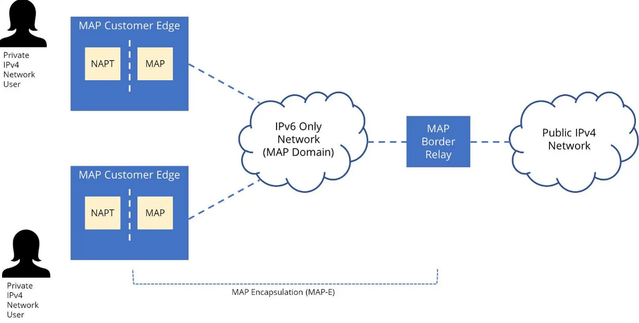
IPv4 address sharing is a Carrier-Grade NAT (CGN) technique to allow sharing a single IPv4 address amongst multiple customer edge (CE) devices. MAP-E, defined in RFC 7597, enables this sharing by requiring each CE with the same IPv4 address to use different TCP/UDP ports. It is a mechanism to statelessly provide IPv4 connectivity via shared IPv4 addresses in an IPv6-only ISP network. DHCPv6 configuration options for MAP-E are defined in RFC 7598 to allow autoconfiguration of the use of MAP-E.
In MAP-E, IPv4 packets moving between the CE and the public IPv4 internet are encapsulated in IPv6 packets while transiting the IPv6-only ISP network. A MAP-enabled router inside the ISP network known as the MAP-E Border Relay (BR) receives MAP-E traffic from the CE and acts as the gateway between the ISP’s IPv6-only internal network and the public IPv4 internet. The IPv6-only internal network is known as the MAP domain. The IPv6 destination address for all outbound MAP-E traffic from the CE is set to the address of the BR.
The CE performs the normal Network Address and Port Translation (NAPT) processing on IPv4 packets prior to IPv6 encapsulation and after IPv6 decapsulation (Figure 1 ). NAPT maps private IPv4 addresses and UDP/TCP ports from the CE’s LAN clients onto the CE’s public IPv4 address. Thus, for outbound traffic, the CE rewrites the private source IPv4 address to be the CE’s public IPv4 address and rewrites the TCP/UDP source port from the list of available ports on the CE’s public IPv4 address. To do this, the CE maintains a table of NAPT bindings for all IPv4 traffic passing through the CE to its LAN clients.
Encapsulating IPv4 within a MAP domain
In MAP-E, multiple CE’s in a MAP domain share the same public IPv4 address. Each CE is assigned a Port Set Identifier (PSID) that determines the ports it's allowed to use with its assigned public IPv4 address. Therefore, MAP-E requires that the CE’s NAPT implementation be aware of this additional restriction and only create NAPT bindings with port numbers on the public IPv4 address that are within the CE’s MAP-E port set.
Each CE is provisioned with a Basic Mapping Rule (BMR) and PSID offset, which can be provisioned via DHCPv6 options and must be the same for all CE’s within a MAP domain. The BMR contains a Rule IPv6 prefix, a Rule IPv4 prefix and a Rule Embedded Address bits (EA-bits) length. In addition to a BMR, each CE is assigned an End-user IPv6 prefix, most likely provisioned via DHCPv6 as an IA_PD prefix. The CE uses the End-user IPv6 prefix to determine its public IPv4 address and possibly its PSID, although this may be provisioned via DHCPv6 instead.
Dual stacking and tunnelling IPv6 over IPv4 is resource consuming and inefficient. Also if a ISP decides to phase out IPv4 and solve its bottlenecks completely, it is advisable for them to go full IPv6 to give dedicated addresses to their customers for almost every device and legacy IPv4 multicasting, CGNAT, gaming server access can be routed over IPv6 efficiently with additional benefits of lower latencies and congestion issues.
Below is a method Genshin Impact gamers used to resolve their server access congestion problem with some minor tweaking with Window's registry:
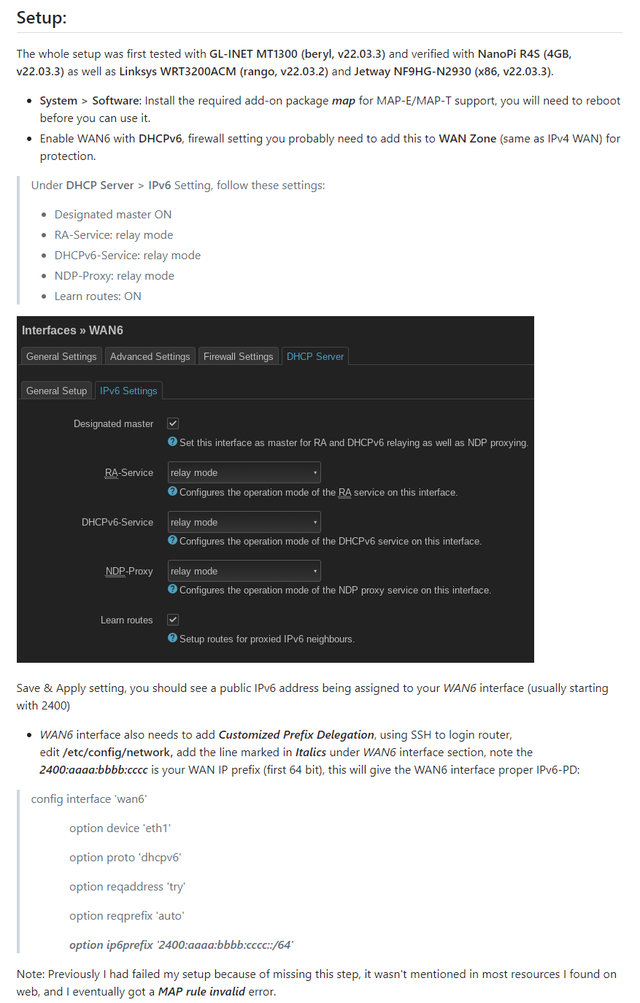
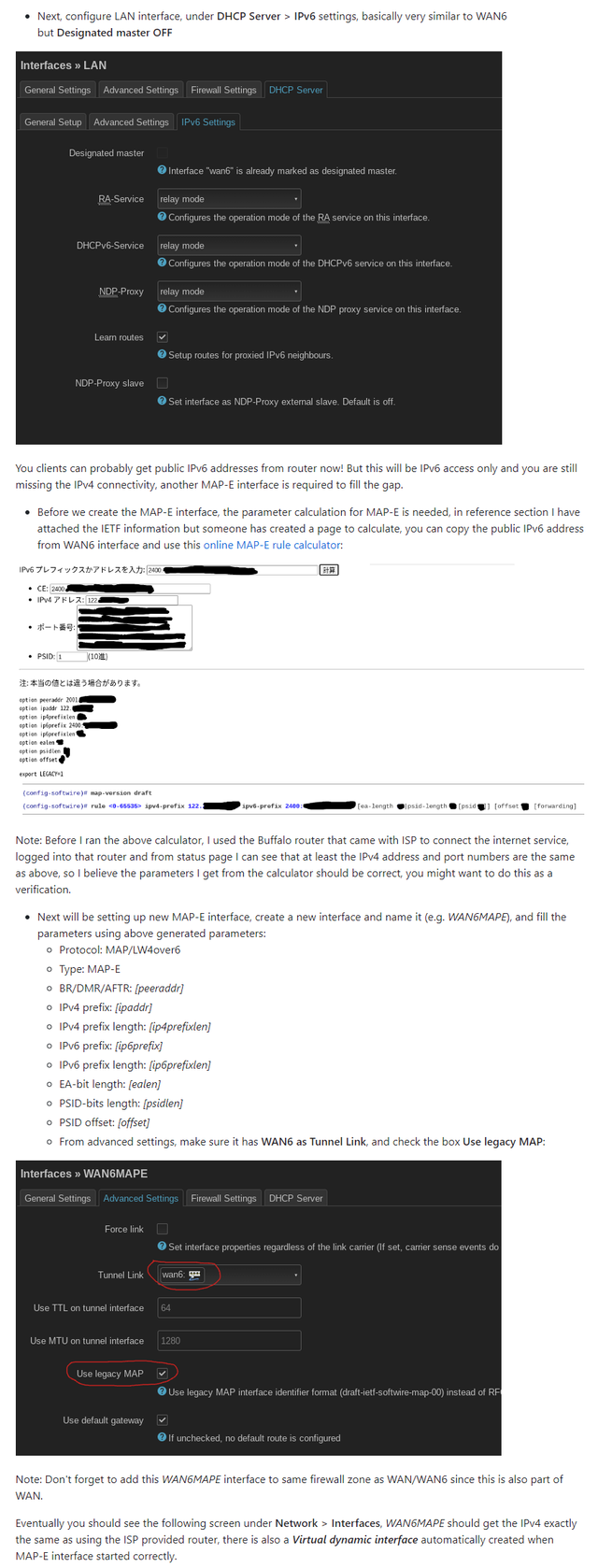
Significant Speed Improvement and Latency Decrease Observed When Tunneling IPv4 Over IPv6 (MAP-E) Using the Softwire Method (From 101Mbps, Speeds Increased 6X to ~640Mbps Both Directions.
 Quote
Quote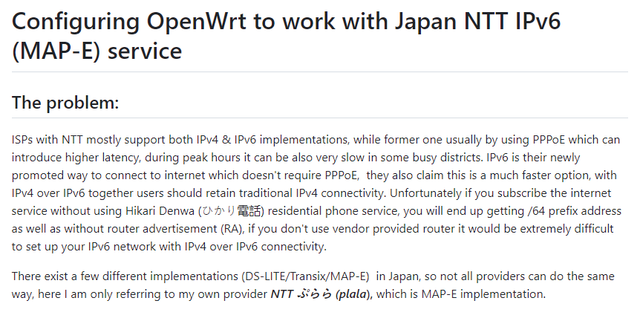

 0.0165sec
 0.74
0.74
 5 queries
 GZIP Disabled