Welcome Guest ( Log In | Register )

Outline · [ Standard ] · Linear+

 Water Heater question, Safety installation with RCCB

views
     
Kytz
post Oct 20 2022, 12:03 PM

On my way
****
Junior Member
572 posts

Joined: Jun 2005
QUOTE(ceo684 @ Oct 20 2022, 01:25 AM)
1) It is not ST allow, it is because people want cheap and a black market of unlicensed unqualified "faux electricians" who know nuts exist

2) Do the price /30 years its already super cheap lah. Electrical safety kena question like FBI interrogation how to cari makan. It could actually be less sensitive due to metal spring lose tension.
*
Actually ST requirements are 100mA for lighting and 30mA for plug points (power points for equipment easily accessible by hand). In this case, 100mA main RCDs are acceptable, provided that you have 30mA to cover the plug points in addition to the main RCD. If there is only main RCD it has to be a maximum of 30mA, but ST doesn't really recommend 1 RCD for the whole DB.

Of course, this is in addition to water heater circuits which are required to be protected by 10mA RCD (dedicated).

QUOTE(pmaxv @ Oct 20 2022, 09:45 AM)
Hi ceo. I've got a question on point 3 of yours. How do you add the 10ma RCD under the 30ma/100ma RCD? my electrician told me if I do a hierarchy level that will cause side effects. eg. they trip each other off. so he told me to install flat level instead. eg. the rcds are totally isolated.
*
Adding a 10mA RCD in cascade with a 30mA/100mA is not an issue. The device is meant to trip the power due to safety reasons, what may happen is that both may trip at the same time if there is a problem, which is more preferable to it not tripping when the problem occurs.

Doing it "flat" is of course preferable but will involve alot of work at the DB, which is dangerous if not done properly.

QUOTE(Momo33 @ Oct 20 2022, 10:32 AM)
they  will not trip each other off.

example  if  there is leakage of 20mA  in the WH  ,  only the 10 mA  RCD  will trip.
*
Both may still trip, due to tolerances of the device itself especially when 10mA and 30mA are quite close in rating. There is a proper way to do discrimination of tripping for the devices, but even without the discrimination it's still preferable to put them in cascade rather than not having sufficient protection.

Kytz
post Oct 20 2022, 01:49 PM

On my way
****
Junior Member
572 posts

Joined: Jun 2005
QUOTE(pmaxv @ Oct 20 2022, 01:30 PM)
Hi Kytz, thanks a lot for your reply.

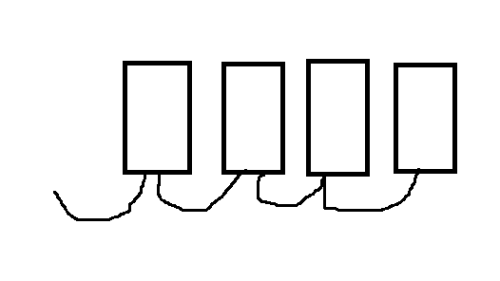
For my RCDs, my electrician just daisy chain them from one RCD input to another RCD input. Ended up quite a long chain cause I've multiple RCDs. Is that dangerous?
 

user posted image

As for discriminate tripping, I think this one really need proper sifu. I think 99% street sifu don't know this. Mine also don't know.
*
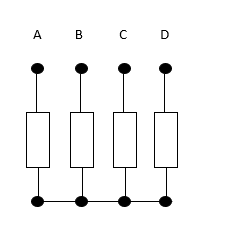
Physical installation of electrical circuits can get quite misleading. If the cables are terminated in a daisy chain as per your picture, that is a parallel(flat) installation instead of cascading. Because the looping is happening at input of RCD only.

For example in below case the RCD are separate and will only trip 1 RCD if a fault happens at A / B / C / D respectively.
user posted image

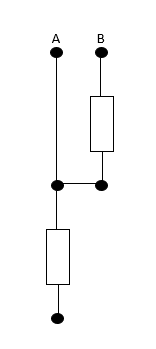
But if cascaded like below any fault in B may trip both RCD, but a fault at A will only trip the bottom RCD.
user posted image

It's considered cascaded when output of the RCD is connected to the input of the next RCD, as you can see in the picture above.

In your case, if all 4 RCD are installed in a cascade, it's not dangerous but likely to be redundant because any fault at the end of the RCD will likely trip all of them, unless there is sufficient discrimination between them. RCDs are protective devices, so they don't introduce danger through their operation. But if RCD is not installed or is faulty, then the lack of protection from the RCD can be a hazard instead.

Kytz
post Oct 20 2022, 02:21 PM

On my way
****
Junior Member
572 posts

Joined: Jun 2005
QUOTE(pmaxv @ Oct 20 2022, 02:00 PM)
Yes indeed you're right. Mine is linked parallel. Not cascade. Which I thought might be dangerous cause if the 10ma RCD failed means no more protection. So was wondering if I should change it to cascade.
*
Actually devices that can cause safety hazards like water heaters already come with built in RCD nowadays, so it's not necessary to cascade multiple RCDs (as long as all DB circuits are properly protected already with the correct ratings).
Rather, it's recommended (and also more important) to test the RCD regularly instead to ensure that protection is intact. Some water heaters even allow you to test their RCD.
Because like what ceo684 has mentioned, the RCD will fail someday, and the only way to find out is by testing them.


Kytz
post Oct 21 2022, 09:11 AM

On my way
****
Junior Member
572 posts

Joined: Jun 2005
QUOTE(ceo684 @ Oct 20 2022, 09:33 PM)
Actually not a problem.. 30mA built in modern day with anti nuisance trip trips very little
Correct. It should be tested as part of every new year/CNY routine maintenance.
This is a plan B solution, but for ease of troubleshooting it is safer to put everything at the main DB.
*
Actually ST recommends monthly testing for RCDs, which i believe most people do not and will not do due to the hassle.
But if someone were to practice it, having all the RCDs in the DB would be an easier task than testing DB and all water heater switch locations. So the recommendation to have them in DB rather than at the switch is a sound one.

Kytz
post Oct 21 2022, 09:14 AM

On my way
****
Junior Member
572 posts

Joined: Jun 2005
QUOTE(ceo684 @ Oct 20 2022, 09:35 PM)
Not many - its common in retrofitted and new build in SG
But in MY.. new builds got put but mainly China brands to save cost
Rarely you will get Schneider nowadays even for half million dollar place
30mA RCD, whole house (sum of all L - sum of all N return = acceptable losses)
Branches out from here to a bunch of little MCBs.
The 10mA is just for WH's own single L and single N. Input=output = acceptable losses and won't trip. IF the WH N is shared that means:
1) Installation is wrong in the first place
2) Useless for purpose of RCD, forever trip.
3) Most likely because it is not a dedicated LNE run from DB box to the WH unit.

Impossible they will trip each other off unless the WH circuit is shared neutral.
Correct.
And if there's a leakage of 20mA in a socket or light outlet unrelated to WH circuit, the 10mA will not trip.
No, this is acceptable.
Mana ada WH with built-in RCD.
ELCB got lah.

RCD is god tier protection (think of it as modern airbags)
ELCB is antiquated retired era stuff because "what if leakage don't leak nicely through Earth" aka leak elsewhere e.g. humans = don't t
*
RCD is just a name for a class of devices that protect people against earth faults. What you probably mean is RCCB which are common used electrical devices.
Higher range devices are ELR and EF relays, which are overkill for domestic use. (for example RCD = vehicle, RCCB = car, ELR = lorry, EF = trailer)
That said, water heaters should be using RCD nowadays since ELCBs are no longer allowed due to obselete technology(voltage based) compared to RCDs (current based).


Change to:
| Lo-Fi Version
0.0204sec    0.26    7 queries    GZIP Disabled
Time is now: 2nd December 2025 - 06:42 AM