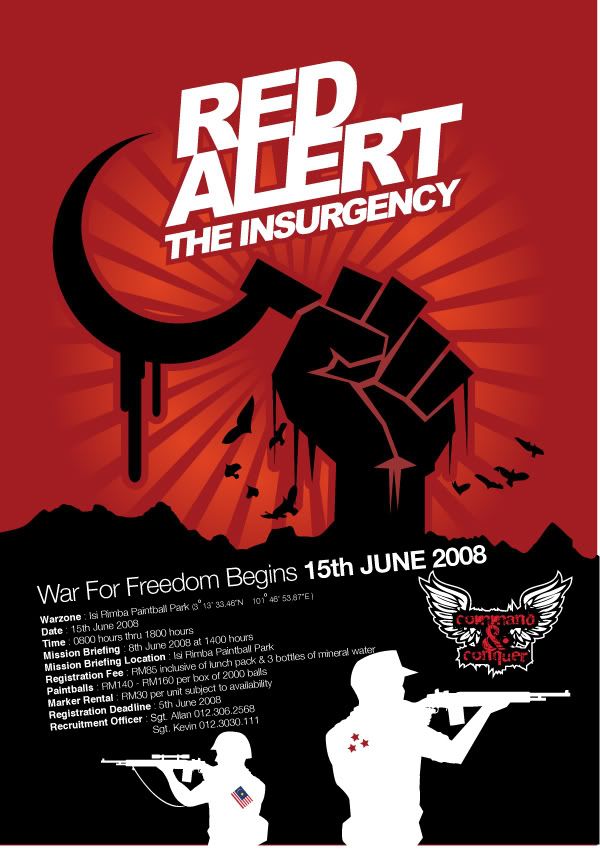
The Malayan Communist Party (MCP) was founded in 1930. Illegal from the outset, it advocated an end to British colonial rule, and was active in forming trade unions. When Japanese ruled Malaya (1942-1945) the MCP put together a Malayan Peoples Anti-Japanese Army (MPAJA) which waged guerrilla war against the Japanese. When the British returned to Malaya they at first allowed the MCP to operate legally, but in 1948 hostilities erupted between them, and the MCP raised a new army called the Malayan People's Anti-British Army (MPABA); this changed its name a year later to Malayan Peoples Liberation Army (MPLA). It caused the British considerable difficulty at first, but by the mid-1950s a renewed emphasis by the MCP on politics instead of armed struggle and the success of the colonialists' strategy of alienating the guerilla from their supporters among the population (by 'psy war', mass detention and political concessions), had essentially decided the war in the government's favour. The 12-year state of emergency declared by the British to combat the guerrillas was ended in 1960. The MCP continued to exist as a small group of about 500 near the Thailand border. In the late 1960s and early 1970s the MCP experienced a resurgence and once again became militarily active in parts of Malaya
........the date is now 15th of June 1969....Leaders:Chin Peng, Rashid Maidin and Abdullah C. D.
-Abdul Rashid bin Maidin (Rashid Maidin). Attended the 'Empire' communist conference in London. May have met Ahmad Boestemam in May and eary June 1948 to plan an insurrection to begin in 1950. Arrested at the beginning of the emergency but sprung from a camp in Malacca. One of the three MCP signatories at Haad Yi, 1989.
-Chin Peng. Secretary-General 1947 - present.
-Abdullah C. D. May also have been in Malay Nationalist Party (MNP). Went into the jungle when the emergency was instituted. One of the three MCP signatories at Haad Yi, 1989.
Structure of the MCPThe MCP was headed by a Central Executive Committee whose size varied between about twelve and fifteen members. Out of this, a Political Bureau (Politburo) of about six members was selected which ran the Party when the C.E.C was not in session. In each State was a State Central Executive Committee. Each State was subdivided into several Districts. The smallest unit of organisation was the Party cell, which typically consisted of the members from one workplace or village.


 Jan 13 2008, 11:15 PM


 Quote
Quote




 0.0495sec
 1.03
1.03
 7 queries
 GZIP Disabled