Welcome Guest ( Log In | Register )

Outline · [ Standard ] · Linear+

 Can I SELL if I can't afford my Mortgage?

views
     
TSKar Weng
post Aug 20 2021, 10:11 AM, updated 5y ago

Kar Weng | Physiotherapist
*****
Junior Member
840 posts

Joined: Apr 2014


Hi sifu sekalian, 1st of all please assume that I have almost 0 knowledge when it comes to anything property related. It has never been my area of interest. I've been a renter around KV all along and I live by the mantra of being debt-free. I was always on the RENT side of the "buy vs rent" dilemma until recently.

However due to lifestyle inflating my rents has climbed up significantly, upgrading to a better place with each move. Many people are saying I might as well buy a house for myself (most would use the notion I'm "paying for my landlords' mortgage"). I always hated that idea because I like to remain debt-free for my own peace of mind. 30-35 years of commitment with no way to back off is very intimidating for me.

Right now I'm only seriously considering the possibility of buying a house. I had a light discussion with a friend the other day and she strongly encouraged me to buy my 1st house. She said I can always sell my house if, worse comes to worst, things don't work out, so I shouldn't worry too much. However, I like to understand my escape plan or I'll be too paranoid to commit.

So a few questions here:
1) If I decide to sell my house before finishing my mortgage for any reason, how exactly does that work? Assuming the property did not appreciate / depreciate, do I get all the money (principal + interest paid) back to me as cash? What if the buyer is also buying from me with a housing loan?
Frankly I just can't wrap my head around this since it involves a loan. I'm very confused with the "who's paying who?" in this scenario.

2) Assuming a RPGT of 5% (if I'm only selling after the 5th year of ownership), how many % of appreciation does it take for me to BREAKEVEN after all the other related fees considered?

3) What are some of the hidden CONS of selling my own-stay that is different from selling an investment property?(e.g. the inconvenience to move away easily, things like that...)

4) Why is selling your own home always regarded as a BAD last resort? Assuming I still have cashflow to rent somewhere cheaper in KV again or even go back to my hometown. Is there anything I overlooked?

*A thing to note: If I'm to buy a house I'd probably be doing a joint mortgage with my gf, not sure if that changes/affects anything asked above.

EDIT: Please focus on my listed questions above and no cliché advice like "get a home you're 100% certain you can afford so you won't run into issue with mortgage" etc. I might lose my ability to earn suddenly, I could be selling it off for many other reasons than affordability. So let's not go into that discussion. I just want to understand my options clearly.

In any case thanks in advance for your insights and time! notworthy.gif

This post has been edited by Kar Weng: Aug 20 2021, 11:07 AM
kelvinfixx
post Aug 20 2021, 10:21 AM

Regular
******
Senior Member
1,588 posts

Joined: Sep 2011
If you have the idea of cannot afford, I would suggest that you are not ready for it, and not to buy it.

You can sell a house anytime if there is demand and the price is right for both parties, but you have to factor in the cost of legal and agent fees too.

Renting is very different from buying it. Buy a property you need to have higher commitment and much more money.

Renting is 1 year contract, home loan is 30-35 years contract with bank and you have to pay interest too.


One more thing I will never loan with GF name in it.

This post has been edited by kelvinfixx: Aug 20 2021, 10:27 AM
acbc
post Aug 20 2021, 10:24 AM

Look at all my stars!!
*******
Senior Member
9,041 posts

Joined: Jan 2003
U can sell but usually both lawyer and agent fees will take a chunk from the profit.
TSKar Weng
post Aug 20 2021, 10:59 AM

Kar Weng | Physiotherapist
*****
Junior Member
840 posts

Joined: Apr 2014


QUOTE(acbc @ Aug 20 2021, 10:24 AM)
U can sell but usually both lawyer and agent fees will take a chunk from the profit.
*
Hey I understand that, hence my question 1) and 2).

1) If I decide to sell my house before finishing my mortgage for any reason, how exactly does that work? Assuming the property did not appreciate / depreciate, do I get all the money (principal + interest I ALREADY PAID) back to me as cash?

2) Assuming a RPGT of 5% (if I'm only selling after the 5th year of ownership), how many % of appreciation does it take for me to BREAKEVEN after all the other related fees considered?


Hope they're well elaborated enough!
mini orchard
post Aug 20 2021, 01:57 PM

10k Club
********
All Stars
14,511 posts

Joined: Sep 2017
QUOTE(Kar Weng @ Aug 20 2021, 10:59 AM)
Hey I understand that, hence my question 1) and 2).

1) If I decide to sell my house before finishing my mortgage for any reason, how exactly does that work? Assuming the property did not appreciate / depreciate, do I get all the money (principal + interest I ALREADY PAID) back to me as cash?

2) Assuming a RPGT of 5% (if I'm only selling after the 5th year of ownership), how many % of appreciation does it take for me to BREAKEVEN after all the other related fees considered?


Hope they're well elaborated enough!
*
1) Majority of home buyers (borrowers) seldom complete the housing loan. You wont be the first and neither the last.

If seller sells the property above purchase price, is quite straight forward. Seller will make some profit after minus cost.

However, if is below, then seller will make a loss. How to deal with this situation ....

a) if the SP is above outstanding loan, then is straight forward again. You will make a paper loss but you will receive some cash balance after the sale completed.

b) If the SP is below outstanding loan, the seller have to settle first the differential sum before the sale can be completed.

2) Rpgt is calculated based on sales profit minus sales, purchase and initial property improvement expenses.

Is difficult to say how many % of appreciation does it take to BREAKEVEN after all the other related fees considered as it depends on Purchase Price, Selling Price and cost.

Purchase cost is about 5% of purchase price.

Selling cost
a) Agent fees is 3% of Selling Price
b) Legal fees is about 3% of Selling Price if you appoint a lawyer.
c) Improvement cost ..... ?

Every citizen is allowed once is a lifetime exemption from rpgt tax for residential property only. Is not specific to the first sale and seller can select which property to claim exemption.

Property topic is very wide and every situation have different asnwers to suit individual. It can never be always 1 answer fit all.

What I have explained above is brief as I have not taken every details into consideration but what you want to know as a layman is there. Unless you have specific questions or problems, answer will be simple without taking consideration of the technicality.

TSKar Weng
post Aug 20 2021, 03:35 PM

Kar Weng | Physiotherapist
*****
Junior Member
840 posts

Joined: Apr 2014


QUOTE(mini orchard @ Aug 20 2021, 01:57 PM)
1) Majority of home buyers (borrowers) seldom complete the housing loan. You wont be the first and neither the last.

If seller sells the property above purchase price, is quite straight forward. Seller will make some profit after minus cost.

However, if is below, then seller will make a loss. How to deal with this situation ....

a) if the SP is above outstanding loan, then is straight forward again. You will make a paper loss but you will receive some cash balance after the sale completed.

b) If the SP is below outstanding loan, the seller have to settle first the differential sum before the sale can be completed.

2) Rpgt is calculated based on sales profit minus sales, purchase and initial property improvement expenses.

Is difficult to say how many % of appreciation does it take to BREAKEVEN after all the other related fees considered as it depends on Purchase Price, Selling Price and cost.

Purchase cost is about 5% of purchase price.

Selling cost
a) Agent fees is 3% of Selling Price
b) Legal fees is about 3% of Selling Price if you appoint a lawyer.
c) Improvement cost ..... ?

Every citizen is allowed once is a lifetime exemption from rpgt tax for residential property only. Is not specific to the first sale and seller can select which property to claim exemption.

Property topic is very wide and every situation have different asnwers to suit individual. It can never be always 1 answer fit all.

What I have explained above is brief as I have not taken every details into consideration but what you want to know as a layman is there. Unless you have specific questions or problems, answer will be simple without taking consideration of the technicality.
*
That gave me a pretty good insight. Thanks for your input!

To make things more concrete: For example, if I bought a 800k house but so far I only paid 200k (downpayment + principal + interest), and I sell it for 900k 5 years later, do I immediately get back my 200k paid?
mini orchard
post Aug 20 2021, 04:44 PM

10k Club
********
All Stars
14,511 posts

Joined: Sep 2017
QUOTE(Kar Weng @ Aug 20 2021, 03:35 PM)
That gave me a pretty good insight. Thanks for your input!

To make things more concrete: For example, if I bought a 800k house but so far I only paid 200k (downpayment + principal + interest), and I sell it for 900k 5 years later, do I immediately get back my 200k paid?
*
You need to specific ....

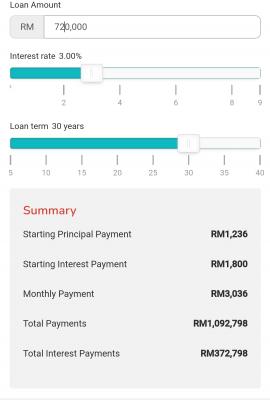
The breakdown for 200k assuming ......

Down payment ..... 80k

Loan ...... 90% ..... 720k

Repayment ..... 120k paid for 5 years .... 2,000 per month.

In a housing loan, the initial monthly repayment of which a large portion (60%) goes towards interest charged. 40% will be princpal reduction.

So, 1,200 will be interest and 800 to reduce principal. After 5 years, principal loan will reduce by 48 000. So nett principal after 5 years will be 672k.

If selling price is 900k, the cashback 228k.

Gross profit from sale is 100k.

Assuming total cost incurred is 40k nett profit is 60k.

The above is calculation is for easy understanding ......but

The monthly repayment should be more than 2k per month and interest higher. The total payment will be more than 200k. Your cashback should be lower than 228k.

Attached Image

This post has been edited by mini orchard: Aug 20 2021, 08:19 PM
digitalz
post Aug 20 2021, 05:13 PM

The only thing we have to fear is fear itself.
*******
Senior Member
2,030 posts

Joined: Oct 2011


TS.. it's actually the 6th year (5+1) for RBGT. Don't be mistaken.

Also, next up - for your own stay. You buy 800k + renovation 100k. You sell 900k..

Then its the calculation on how much interest paid, how much principle deducted, how much service charges/maintenance fees etc paid too. Not only loans.

So the who pay who question is this.

You loan from bank > then you proceed to sell > the new owner's bank will settle whatever outstanding there is for you with your bank > release the remaining balance to you.


mini orchard
post Aug 20 2021, 07:24 PM

10k Club
********
All Stars
14,511 posts

Joined: Sep 2017
QUOTE(digitalz @ Aug 20 2021, 05:13 PM)
TS.. it's actually the 6th year (5+1) for RBGT. Don't be mistaken.

Also, next up - for your own stay. You buy 800k + renovation 100k. You sell 900k..

Then its the calculation on how much interest paid, how much principle deducted, how much service charges/maintenance fees etc paid too. Not only loans.

So the who pay who question is this.

You loan from bank > then you proceed to sell > the new owner's bank will settle whatever outstanding there is for you with your bank > release the remaining balance to you.
*
Maintenance and interest expense are consumption cost which cannot be taken as cost of ownership which is in lieu of rental payment.

In investment, those are taken as expenses against rental income.

At the end, one must compare consumption cost against rental to make a decision whether which is a cheaper option.


TSKar Weng
post Aug 20 2021, 08:32 PM

Kar Weng | Physiotherapist
*****
Junior Member
840 posts

Joined: Apr 2014


QUOTE(digitalz @ Aug 20 2021, 05:13 PM)
TS.. it's actually the 6th year (5+1) for RBGT. Don't be mistaken.

Also, next up - for your own stay. You buy 800k + renovation 100k. You sell 900k..

Then its the calculation on how much interest paid, how much principle deducted, how much service charges/maintenance fees etc paid too. Not only loans.

So the who pay who question is this.

You loan from bank > then you proceed to sell > the new owner's bank will settle whatever outstanding there is for you with your bank > release the remaining balance to you.
*
Thanks, this actually makes it so much clearer for me.
So if I sold my house before completing the mortgage fully, I do get the remaining balance that I paid for ONLY ON THE PRINCIPLE. My potential loss would be the amount I paid for interest, renovation and the misc. fees of transaction. Am I getting it right?

Even if the new homeowner is paying by installment (since it's his mortgage), I'll also get a lump sum of cash back immediately since his bank will me paying the remaining balance (after the outstanding) to me right?

TSKar Weng
post Aug 20 2021, 08:40 PM

Kar Weng | Physiotherapist
*****
Junior Member
840 posts

Joined: Apr 2014


QUOTE(mini orchard @ Aug 20 2021, 04:44 PM)
You need to specific ....

The breakdown for 200k assuming ......

Down payment ..... 80k

Loan ...... 90% ..... 720k

Repayment ..... 120k paid for 5 years .... 2,000 per month.

In a housing loan, the initial monthly repayment of which a large portion (60%) goes towards interest charged. 40% will be princpal reduction.

So, 1,200 will be interest and 800 to reduce principal. After 5 years, principal loan will reduce by 48 000. So nett principal after 5 years will be 672k.

If selling price is 900k, the cashback 228k.

Gross profit from sale is 100k.

Assuming total cost incurred is 40k  nett profit is 60k.

The above is calculation is for easy understanding ......but

The monthly repayment should be more than 2k per month and interest higher. The total payment will be more than 200k. Your cashback should be lower than 228k.

Attached Image
*
Sorry for giving such a bad example. I had no idea about the proportion.

Why is such a large portion going to interest first before allocating to principle, when the principle is overall larger? So the proportion will shift more towards the principle's side overtime? Doesn't it make more sense to allocate more of my monthly mortgage payment on the principle 1st instead? I understand we don't have a say on this and it's up to the loaning bank, but why does it work that way cause it looks strange to me.

Thanks again for your help.
mini orchard
post Aug 20 2021, 08:55 PM

10k Club
********
All Stars
14,511 posts

Joined: Sep 2017
QUOTE(Kar Weng @ Aug 20 2021, 08:40 PM)
Sorry for giving such a bad example. I had no idea about the proportion.

Why is such a large portion going to interest first before allocating to principle, when the principle is overall larger? So the proportion will shift more towards the principle's side overtime? Doesn't it make more sense to allocate more of my monthly mortgage payment on the principle 1st instead? I understand we don't have a say on this and it's up to the loaning bank, but why does it work that way cause it looks strange to me.

Thanks again for your help.
*
Interest is calculated based on the outstanding loan sum.

Naturally, is higher at the begining and therefore higher interest. Towards the end of 30 years, the reverse happen. As principal slowly decreases, interest becomes less.

Similar to fixed deposit. A higher principal will have higher interest earn. If you reduce the principal every year the interest becomes less. I am sure you wont agrees bank pays lower interest on fd at the begining.
TSKar Weng
post Aug 20 2021, 10:07 PM

Kar Weng | Physiotherapist
*****
Junior Member
840 posts

Joined: Apr 2014


QUOTE(mini orchard @ Aug 20 2021, 08:55 PM)
Interest is calculated based on the outstanding loan sum.

Naturally, is higher at the begining and therefore higher interest. Towards the end of 30 years, the reverse happen. As principal slowly decreases, interest becomes less.

Similar to fixed deposit. A higher principal will have higher interest earn. If you reduce the principal every year  the interest becomes less. I am sure you wont agrees bank pays lower interest on fd at the begining.
*
The strange thing for me is the 60:40 ratio. Take as an example the pic you posted, I'm paying 1.8k on interest and 1.2k+ on the principal. I shouldn't get more interest than the amount I deposit into FD right?

I don't see why I can't pay 1.8k on principal and 1.2k+ on interest instead (other than the bank having slightly less profit at the end because I clear off my principal faster). But in any case, there's no changing to this fact let's just be glad I learned something new!

Speaking of which, if this 60:40 ratio is how it starts off: What if I use a "flexi-loan" where I can pay a lump sum if I have a greater cashflow? I'll still be paying in a high interest:low principal ratio at the beginning right?

What I meant is, is the progression of this "ratio" fixed? If that's the case, why do people say paying faster with flexi loan save you from paying more interest at the end? Since I'm stuck in a ratio fixed by the bank, no matter how early or late I pay, the principal will always shrink by the same proportion (so no change on my overall interest) regardless of my timing right?

In other words, even if I pay earlier with a larger sum, I don't get to shrink the principal at a faster rate, since I'm always forced to pay the interest 1st by a progressive ratio fixed by the bank. How does the "pay more earlier, pay less overall" logic work here? Obviously I'm missing something!

This post has been edited by Kar Weng: Aug 20 2021, 10:10 PM
mini orchard
post Aug 21 2021, 06:49 AM

10k Club
********
All Stars
14,511 posts

Joined: Sep 2017
QUOTE(Kar Weng @ Aug 20 2021, 10:07 PM)
The strange thing for me is the 60:40 ratio. Take as an example the pic you posted, I'm paying 1.8k on interest and 1.2k+ on the principal. I shouldn't get more interest than the amount I deposit into FD right?

I don't see why I can't pay 1.8k on principal and 1.2k+ on interest instead (other than the bank having slightly less profit at the end because I clear off my principal faster). But in any case, there's no changing to this fact let's just be glad I learned something new!

Speaking of which, if this 60:40 ratio is how it starts off: What if I use a "flexi-loan" where I can pay a lump sum if I have a greater cashflow? I'll still be paying in a high interest:low principal ratio at the beginning right?

What I meant is, is the progression of this "ratio" fixed? If that's the case, why do people say paying faster with flexi loan save you from paying more interest at the end? Since I'm stuck in a ratio fixed by the bank, no matter how early or late I pay, the principal will always shrink by the same proportion (so no change on my overall interest) regardless of my timing right?

In other words, even if I pay earlier with a larger sum, I don't get to shrink the principal at a faster rate, since I'm always forced to pay the interest 1st by a progressive ratio fixed by the bank. How does the "pay more earlier, pay less overall" logic work here? Obviously I'm missing something!
*
The 60:40 ratio is to accomodate borrowers ability to repay the loan. The interest portion is oredi fixed as is based on principal outstanding. Anything less means the bank is giving discounted interest loan something similar like the moratorium....without collecting interest for 6 months.

If borrower wish to increase monthly repayment, he can take a shorter loan tenure to spread the principal over shorter months.

Paying more monthly or a certain lump sum to reduce principal sum is allowed and depends on the type of loan agreement.

If the agreement doesnt provide for it or if the bank is not given notice as required in the agreement or if the minimum lump sum is less than required, any excess money paid will be treated as advance instalment.

Signing up for the right loan package is important and an experience bank officer can guide you.

There is alway mix and match package available to suit borrowers.

This post has been edited by mini orchard: Aug 21 2021, 09:16 AM
digitalz
post Aug 21 2021, 04:53 PM

The only thing we have to fear is fear itself.
*******
Senior Member
2,030 posts

Joined: Oct 2011


QUOTE(mini orchard @ Aug 20 2021, 07:24 PM)
Maintenance and interest expense are consumption cost which cannot be taken as cost of ownership which is in lieu of rental payment.

In investment, those are taken as expenses against rental income.

At the end, one must compare consumption cost against rental to make a decision whether which is a cheaper option.
*
I agree with what you are saying but since TS is going for own stay + he's already thinking of appreciation and breakeven... might as well throw more to him tongue.gif

QUOTE(Kar Weng @ Aug 20 2021, 08:32 PM)
Thanks, this actually makes it so much clearer for me.
So if I sold my house before completing the mortgage fully, I do get the remaining balance that I paid for ONLY ON THE PRINCIPLE. My potential loss would be the amount I paid for interest, renovation and the misc. fees of transaction. Am I getting it right?

Even if the new homeowner is paying by installment (since it's his mortgage), I'll also get a lump sum of cash back immediately since his bank will me paying the remaining balance (after the outstanding) to me right?
*
Well, generally you are correct. You are getting the remaining balance on whatever is due and owing to the Bank (fees/charges/outstanding interest etc). Different bank, different charges.

And yes, you will be getting the lump back. However, that is to be taken into account that your sale price is > than your purchase price. This does not include the ones you might potentially lose out on too (lower than your previous purchase price etc).
TSKar Weng
post Aug 21 2021, 07:00 PM

Kar Weng | Physiotherapist
*****
Junior Member
840 posts

Joined: Apr 2014


QUOTE(digitalz @ Aug 21 2021, 04:53 PM)
I agree with what you are saying but since TS is going for own stay + he's already thinking of appreciation and breakeven... might as well throw more to him  tongue.gif
Well, generally you are correct. You are getting the remaining balance on whatever is due and owing to the Bank (fees/charges/outstanding interest etc). Different bank, different charges.

And yes, you will be getting the lump back. However, that is to be taken into account that your sale price is > than your purchase price. This does not include the ones you might potentially lose out on too (lower than your previous purchase price etc).
*
I understand the greatest distinction one has to make when buying a property is whether it's for own-stay or for investment. I'm just concerned with the appreciation/breakeven in the rare case I need to sell it off (for whatever reason, maybe I'm going broke and can't afford mortgage, maybe I'm going rich and wanna upgrade somewhere, maybe I leave Bolehland) much earlier than expected.

Thanks for the confirmation. Well it seems like it'll all come down to the nitty-gritty and it's hard to say roughly what % of appreciation will give a breakeven. At least the "fuck it" escape route is always there even if a slight loss may be incurred.
mini orchard
post Aug 21 2021, 07:08 PM

10k Club
********
All Stars
14,511 posts

Joined: Sep 2017
QUOTE(digitalz @ Aug 21 2021, 04:53 PM)
And yes, you will be getting the lump back. However, that is to be taken into account that your sale price is > than your purchase price. This does not include the ones you might potentially lose out on too (lower than your previous purchase price etc).
*
As long Sale Price is above Purchase Price or Loan Outstanding, seller will received some money upon completion.

Profit is another matter.
TSKar Weng
post Aug 21 2021, 08:06 PM

Kar Weng | Physiotherapist
*****
Junior Member
840 posts

Joined: Apr 2014


QUOTE(mini orchard @ Aug 21 2021, 07:08 PM)
As long Sale Price is above Purchase Price or Loan Outstanding, seller will received some money upon completion.

Profit is another matter.
*
That's also what I wanted to know thumbsup.gif


Change to:
| Lo-Fi Version
0.0216sec    0.32    6 queries    GZIP Disabled
Time is now: 2nd December 2025 - 04:52 AM