

 May 11 2021, 02:19 AM


QUOTE
Dear ceo684, ozak, weikee and sifus,
Sorry for the super long post, I need some advise. Apologies again, I have to post some pics separately due to my restriction as newbie on LY. The more I speak to “contractors”, the more I’m picking up mixed messaged on how to proceed. Was hoping I may I get some advice on electrical related matters for my home renovation.
It’s a sub-sale house which is currently non-tenanted, double semi-D about 4000sf built up, 6 bedrooms.
Major reno done 2002. I was thinking of re-wiring my whole house, new DB and adding DB at 1st floor. Reno would also include piping (will post separately on this to get advise if needed to redo), retile whole GF, new built-in carpentry works, redo entire GF plaster ceiling, repainting whole house, roof tiles, windows/doors. No major structural works.
This home is for own family long term stay (>=20 yrs). 3 adults, 3 primary school going children
Some info on the reno/current status:
- It’s currently 3 phase
-Estimated reno to have about :
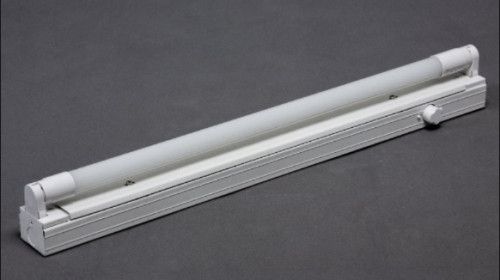
100 x downlights (mostly 4” indoor and 6” outdoor) – likely to get casing + LED bulb (9-11W)
65 x 13AMP sockets
6 x 15AMP or 20AMP for instant/storage heater for 6 bathrooms (15 or 20AMP?)
Sorry for the super long post, I need some advise. Apologies again, I have to post some pics separately due to my restriction as newbie on LY. The more I speak to “contractors”, the more I’m picking up mixed messaged on how to proceed. Was hoping I may I get some advice on electrical related matters for my home renovation.
It’s a sub-sale house which is currently non-tenanted, double semi-D about 4000sf built up, 6 bedrooms.
Major reno done 2002. I was thinking of re-wiring my whole house, new DB and adding DB at 1st floor. Reno would also include piping (will post separately on this to get advise if needed to redo), retile whole GF, new built-in carpentry works, redo entire GF plaster ceiling, repainting whole house, roof tiles, windows/doors. No major structural works.
This home is for own family long term stay (>=20 yrs). 3 adults, 3 primary school going children
Some info on the reno/current status:
- It’s currently 3 phase
-Estimated reno to have about :
100 x downlights (mostly 4” indoor and 6” outdoor) – likely to get casing + LED bulb (9-11W)
65 x 13AMP sockets
6 x 15AMP or 20AMP for instant/storage heater for 6 bathrooms (15 or 20AMP?)
Lighting & 13A SSO, see below vv
QUOTE
I’ve done quite a bit of reading and getting tips from you guys and other sifu’s posts, but a bit info overload especially when the topics becomes overly technical. May I humbly get advise on:
1. How do I determine if my current wiring and DB is fine and don’t need to spend a bomb to rewire + change DB + add DB? Or based on 20 years ago reno, I should just get it done?
Turning on lights and fans so far no issues, fast and immediate. Not sure if pics would help, this is the DB.
(snipped pics)
1. How do I determine if my current wiring and DB is fine and don’t need to spend a bomb to rewire + change DB + add DB? Or based on 20 years ago reno, I should just get it done?
Turning on lights and fans so far no issues, fast and immediate. Not sure if pics would help, this is the DB.
(snipped pics)
Usually if the cables are in good condition, i.e. not chewed by rats in the ceilings and
voltage test is consistent between L-N, and
insulation resistance pass megger test Uni-T megger
you may not need to replace the cables.
More often than not, for <2000 homes the sockets' backbox may need replacement if they're iron when new, are likely to be titanic rusty iron.
I replaced those rusty backboxes to the China spec 86x86mm ones like these: https://shopee.com.my/Atlectric-Internal-Bo...5267.6809104931
These will need a bag of M10 screws from the bolts and nuts store (the usual ones that come with switches do not fit), but small issue. These plastic boxes are deeper than the normal ones and will require a bit of chiseling to expand them but they're hard plastic, not the (since 1980s till now) local made soft plastic backboxes that deform just from the cement used to mount them in place.
QUOTE
2. I spoke to a contractor 2 days back, he mentioned that to do change new DB and install new DB upstairs, I’ll have to call TNB to do it. Another electrician didn’t mention anything about TNB and quoted RM6500 (to replace current GF DB and to add new DB at 1st floor).
Is the TNB part true?
Is the quoted price “Reasonable”?
To be prepared with some knowledge of whether the electrician contractor are doing/recommending the safe/right way, is the below list what is required for 2 units DB (ground floor + 1st floor)?
* I hope I’m not creating a Frankenstein DB below, but no worries guys, I’m not gonna DIY at all, just wanting to make sure I have the right “internal organs” in the DB when I clarify with the electrician. Will be going for branded ones like Hager, ABB, Schneider (not that budget is not of concern, but when it comes to electrical, I believe must be willing to spend for safety)
Is the TNB part true?
Is the quoted price “Reasonable”?
To be prepared with some knowledge of whether the electrician contractor are doing/recommending the safe/right way, is the below list what is required for 2 units DB (ground floor + 1st floor)?
* I hope I’m not creating a Frankenstein DB below, but no worries guys, I’m not gonna DIY at all, just wanting to make sure I have the right “internal organs” in the DB when I clarify with the electrician. Will be going for branded ones like Hager, ABB, Schneider (not that budget is not of concern, but when it comes to electrical, I believe must be willing to spend for safety)
Not required to call TNB if you're not messing with the meter. Things after the meter are homeowner responsibility.
QUOTE
Main switch x 2 DBs : is this main switch necessary (I see it in the existing DB, above pic)? I don’t see one in my current condo DB or those “full set DB sold on Lazada/shopee”.
Laz/Spee are usually general parts only, for unlisted parts the electrical supply stores can get, sometimes I even ask them to list and I'll buy it once its up.

This main switch is commonly known as main switch isolator. A fancy name for an "on-off switch" that cuts off power to Live phases + Neutral, if installed at the main incomer, your whole house can be safely ISOLATED (off grid) and safe to work on.
QUOTE
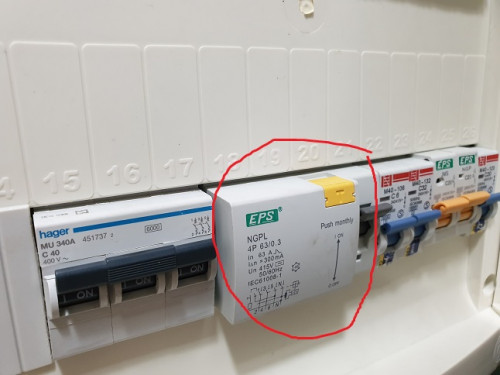
RCCB : 63A, 4P, 300mA = RM145 x 2 DB = RM290 (is this known as the main RCCB to protect from fire/equipment protection?)
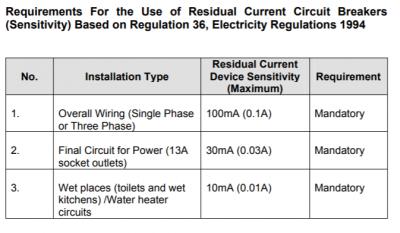
In residential, the 30mA is max tolerance for 13A SSO and 100mA for light circuits.
This is main RCCB/RCD. 300mA is NOT according to code. I uninstalled mine for a 30mA.

30mA, still got chance to survive (life protection).
100mA, 300mA...bye bye

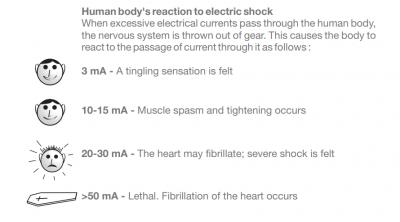
RCD is a highly sensitive Income Tax agent, you cannot cheat them of taxes. If INCOME is this much then the OUTGOING taxes must match the income you earn, up to the tolerance level.
The RCD works on principal of current in = current out + some minor losses due to cable resistance. This is safe.
But when the Total current in on live phase(s) is much higher than Total current out on the neutral, we have a 2MDB situation (current CANNOT be missing that much beyond RCD tolerance), as current NOT returned on outgoing neutral is something very wrong (i.e. can mean leakage through humans), and it will trip because it is a fault condition.
High sensitivity 30mA (0.03A) better than mid sensitivity or low sensitivity RCDs (100mA aka 0.1A or 300ma or 0.3A) respectively.
In smaller places with tiny DB box for 3phase, the usual way is to have a 3 phase (one piece RCD) to protect everything.
--This is like a one-piece dress lah, once coffee spill you need to drop everything immediately (leave the meeting) and wash the whole thing.
--This is up to code but the risk is that if any (current imbalance) fault happen, it will trip of course, but whole house blackout.
For a bit more money it is also OK to do 3 pieces of single phase RCD, one ea for Red/Yellow/Blue phases.
--This is like wearing a business suit. Coffee spill on the blazer, you can just wash the blazer. The top and skirt still can continue to wear. Continue with meeting
--This is recommended by ST for "business continuity" since one phase has fault, the other two still work as normal.
QUOTE
MCB : 3P, 40Amp, 6kA = RM65 x 2 DB = RM130 (what is the purpose of this thing?)
This is a "total load" OCPD (overcurrent protective device) to make sure that all the combined loads in the little MCB's (think the little branches on a tree) do not overload the main tree trunk (the main trunk cable).
If the main tree trunk is overloaded, the last protection will be the TNB fuse next to the meter will blow.
QUOTE
RCCB 25A /10mA x 6 heaters ; RM170 x 6 = RM1020 (this is for “life saving” shock protection right? Does each heater require additional MCB again on top of this RCCB? Sorry if it’s a silly question)
Yes, WH RCD protection is just for current leakage (Income Tax agent specifically targeting your business) and
MCB gives you TreeBranch overload protection for short circuit.
Two separate functions and must go hand in hand.
QUOTE
8 MCB for 8Airconds : Is this right? 1 MCB per AC?
2.5 HP x 2, 1.5HP x 6 What MCB rating should be used 16, 20 or 32A?
2.5 HP x 2, 1.5HP x 6 What MCB rating should be used 16, 20 or 32A?
Running current of the NON inverter Pana 2.5hp (2.5HP Standard Non-Inverter R32 Aircon CS-PN24VKH-1) taken as reference = 9.7A. 20A MCB will be sufficient (C20).
Running current of 1.5hp will be around 6A for modern aircons. C16 also more than enough actually.
Note: MCBs are sized to the cable size NOT the APPLIANCE. Its purpose is to trip before the (overloaded) cable gets too hot to start fires.
C curve MCBs are VERY forgiving stuff. Aircons nowadays have soft start and delay randomiser so not all 8 will come on at the exact same moment.
QUOTE
20 MCBs (6 or 10A?) for 65 (13amp sockets) = 20 x RM10 = RM200 (am I over/under estimating MCB’s required)
100 downlights = ?20 MCBs x RM10=RM200 (5 downlights to 1 direct DB, is it over or underestimation? Using 9-11W LED bulbs)
100 downlights = ?20 MCBs x RM10=RM200 (5 downlights to 1 direct DB, is it over or underestimation? Using 9-11W LED bulbs)
For ABB 6kA MCBs, is around 7.50-8.00 each. Hager MU (6kA) tend to be more expensive ~12.50 ea for some strange reason.
Lighting - Depending on how the lights are set up it is unlikely you will have 125pcs of 11W on just one circuit (i.e. 6A x 230V = 1380W). I personally prefer to use 6A for lighting circuits' MCBs since nowadays LEDs consume very little power.
13A SSO if heavy usage places like kitchen, living room, then can run dedicated circuit each. Per ST rules on radial circuit, how many final circuits needed at a minimum, and whether you need 2.5mm² / 4.0mm² will be guided by the floor area to be served:

DB box x 2 = 30 ways + 45 ways? (Should I go for plastic or metal DB box?)
Metal DB box are the ones specified US latest code. Plastic is still combustible. I'd use metal if possible.
Eaton 48 ways are also available (16x each row). EPS or GEM local made metal boxes also available.
The configuration of the box (2x16 or 1x27 for example) you buy may be limited by the physical wires length coming out of the wall (if you are not replacing the whole wiring if they're in good condition).
QUOTE
Should I invest in a T2 SPD?
tinyurl.com/m9kmxyms : Maxguard ok? Half the price of ABB
tinyurl.com/k78kbns7 : ABB
tinyurl.com/m9kmxyms : Maxguard ok? Half the price of ABB
tinyurl.com/k78kbns7 : ABB
T2 SPD look like the pic in my post (ignore the video using RCD as SPD)
 https://forum.lowyat.net/index.php?showtopi...ost&p=100886222
IMO if you have frequent lightning storms in the area (some areas are quite prone) then it is good insurance as lightning surges can kill devices.
QUOTE
3. For cable thickness, is this recommended? :
Water heater : 2.5mm or 4mm?
AC / kitchen sockets (loose electrical appliance, built-in oven) : 2.5mm
Other sockets/lighting/fan : 1.5mm
4. Kitchen appliance, aside from built-in oven, fridge and electric hob, any other kitchen appliance would require a dedicated cable from DB? Eg. electric kettle, toaster, rice cooker, air fryer, coffee machine, non-built in microwave, LG puricare (hot/cold water purifier/dispenser)
(Assuming that 2-3 appliance likely used at same time, eg. electric kettle + rice cooker + air fryer)
Water heater : 2.5mm or 4mm?
AC / kitchen sockets (loose electrical appliance, built-in oven) : 2.5mm
Other sockets/lighting/fan : 1.5mm
4. Kitchen appliance, aside from built-in oven, fridge and electric hob, any other kitchen appliance would require a dedicated cable from DB? Eg. electric kettle, toaster, rice cooker, air fryer, coffee machine, non-built in microwave, LG puricare (hot/cold water purifier/dispenser)
(Assuming that 2-3 appliance likely used at same time, eg. electric kettle + rice cooker + air fryer)
WH use 4mm² if pulling new wires as this is still the biggest or 2nd biggest power hungry device in the whole house.
AC 2.5mm² minimum
13A SSO 2.5mm² minimum (up to 20m² floor area); 4.0mm² (up to 50m² floor area). Kitchen ones if you wanna save one cable run (to use the double sockets with two heavy appliances on one LNE run) can use 4mm².
Built in oven 4.0mm² or better (can also run 6mm²) depending on the wattage of the oven. If it does NOT come with 13A plug from factory this need fixed installation OR high amp (32A) commando plug.
QUOTE
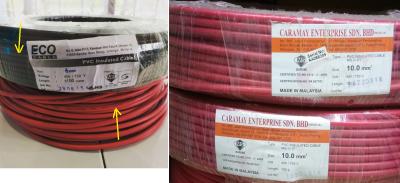
4. For cable quality, I read a recent post by CE0684, to either go for:
caramay, Mega kabel (solid cables) ; Fajar cables ( flexicord). Any other brands I should "accept" if my contractor shows me other brands?
And from other sifu’s I read that, it must have at least SIRIM endorsed labelling and the specs on the cable
caramay, Mega kabel (solid cables) ; Fajar cables ( flexicord). Any other brands I should "accept" if my contractor shows me other brands?
And from other sifu’s I read that, it must have at least SIRIM endorsed labelling and the specs on the cable
Many fake cables out in the market.. there are many ways to cut corners or fake certification.
MS 2112-3 + SIRIM QAS + cable size (how many mmsq) + mfg name will be embossed or lasered into the quality cables.
If im a mfg and my cables are subpar.. I'll prefer not to label them.. if anything catch fire don't find me pls..

QUOTE
5. Last but not least, would you still use this existing storage heater + water pump?
(snip pics)
All 6 bathrooms have existing joven 25L storage heater, which is at least 10-15 years old.
Would it be best to change all to new ones considering the wear and tear, heating element life span OR invest in solar heater (based on my calculation, cheaper than 6x25L joven storage heaters. Just concerned if my existing roof wood truss can handle 500kg)
(snip pics)
Grundfos pump 7 years old – need to replace? Seem to be working, based on the sound I hear while in the roof and also 1-2 sinks I turned on had high pressure
Many many many thanks in advance for any advise/suggestions provided
(snip pics)
(snip pics)
All 6 bathrooms have existing joven 25L storage heater, which is at least 10-15 years old.
Would it be best to change all to new ones considering the wear and tear, heating element life span OR invest in solar heater (based on my calculation, cheaper than 6x25L joven storage heaters. Just concerned if my existing roof wood truss can handle 500kg)
(snip pics)
Grundfos pump 7 years old – need to replace? Seem to be working, based on the sound I hear while in the roof and also 1-2 sinks I turned on had high pressure
Many many many thanks in advance for any advise/suggestions provided
(snip pics)
If existing storage heater is connected via a quality 10mA RCD, as it is a highly sensitive device any fault also will trip (including imbalance due to shared neutral on WH circuit but its not due to faulty appliance) then yes I still dare to use. For preventive maintenance - may want to double check the tank condition for signs of internal corrosion just to be sure.
Pump normally if its working fine then no issue, usually pump motor failure to turn (if it jammed) will create Imax and overheat the motor itself (will be more likely to trigger MCB in this case).
This post has been edited by ceo684: May 11 2021, 02:33 AM
 Quote
Quote










 0.0641sec
 0.67
0.67
 7 queries
 GZIP Disabled