Welcome Guest ( Log In | Register )

21 Pages « < 17 18 19 20 21 >Bottom

Outline · [ Standard ] · Linear+

 Insurance Talk V7!, Your one stop Insurance Discussion

views
     
hafizmamak85
post Apr 26 2025, 11:52 PM

Casual
***
Junior Member
463 posts

Joined: Nov 2009

QUOTE(hafizmamak85 @ Apr 26 2025, 07:30 PM)

user posted image
*
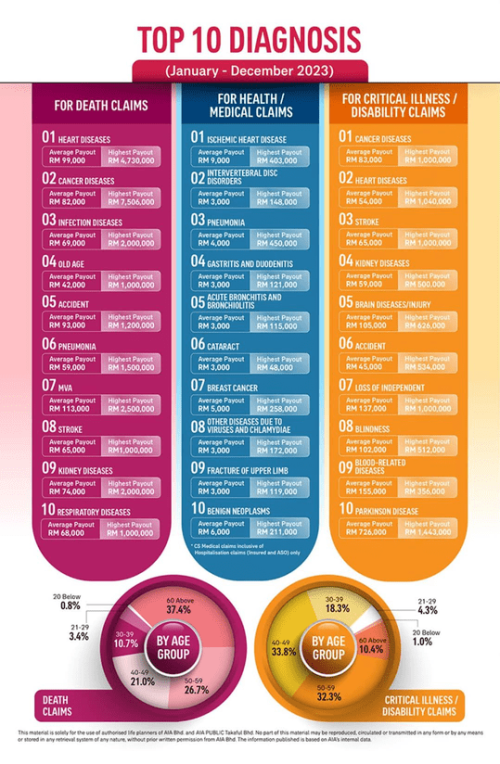
Btw, to those claiming RM 150k - 200k annual limits are sufficient, have a look at the highest payout for each of the diagnoses:

Ischemic Heart Disease: RM 403k
Intervertebral Disc Disorders: RM 148k
Pneumonia: RM 450k
Gastritis & Duodenitis: RM 121k
Acute Bronchitis & Bronchiolitis: RM 115k
Cataract: RM 48k
Breast Cancer: RM 258k
Other Diseases Due to Viruses & Chlamydiae: RM 172k
Fracture of Upper Limb: RM 119k
Benign Neoplasms: RM 211k
hafizmamak85
post Apr 28 2025, 01:35 AM

Casual
***
Junior Member
463 posts

Joined: Nov 2009

QUOTE(hafizmamak85 @ Apr 22 2025, 11:32 PM)
Looks like medical inflation hasn't impacted Great Embarrassment's bottom line at all.

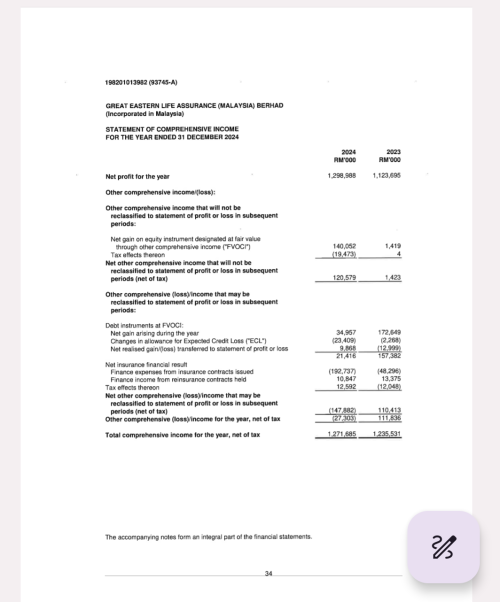
FYE 2024 total comprehensive income of RM 1.27 billion!!!!!!!! - RM 1.24 billion in FYE 2023.

» Click to show Spoiler - click again to hide... «


Fellow Malaysians, this is where a big chunk of your IL premiums have gone to - be glad for the GE Gods drink full from thy cup, blessings abound for thy health.

A round of applause for GE for getting through unscathed, unharmed by the very debilitating medical inflation epidemic. No bloodthirsty hospital may sink their teeth and harm the Great GE balance sheet. All hail The Great Embarrassment Balance Sheet🙌🏾🙌🏾🙌🏾🙌🏾🙌🏾

» Click to show Spoiler - click again to hide... «


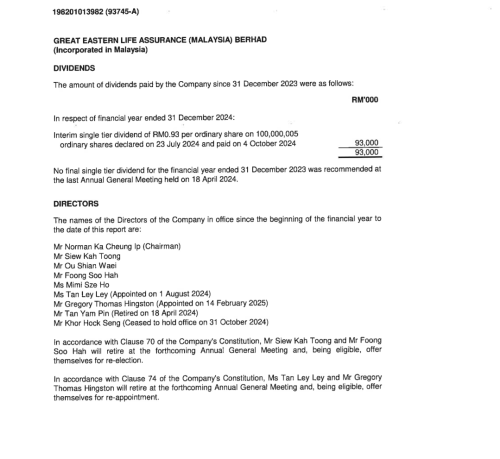
Buggers even dared to pay RM 93 million in dividends. This is even after being exposed for misappropriating RM 2.37 billion from their participating policyholders.
*
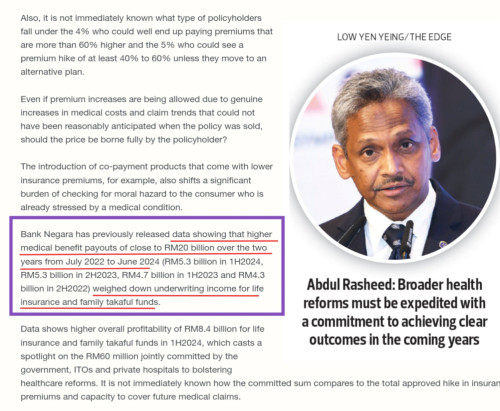
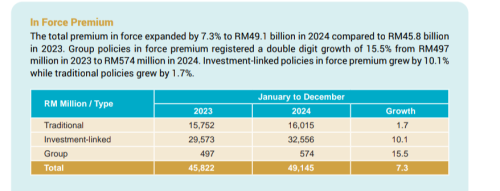
Bank Negara Malaysia (BNM) says the interim measure of spreading medical premium adjustments over three years is expected to negatively impact the net underwriting income of life insurers and family takaful operators.

This increase in medical payouts was due to a rise in overall average cost and utilisation of medical treatments, particularly for chronic and acute cases, according to BNM

BNM: Staggered medical premium hikes to weigh on insurers’ underwriting income

We can guess, by analysing AIA's 2023 average medical claim payouts for its top 10 diagnoses, that it's likely the growth in size and higher utilisation of small claims which are causing an increase in medical payouts.

So, it's really puzzling that BNM is pinning the blame partly on chronic cases. If anything, any growth in claims for chronic cases would have been likely due to prior suppression of such cases through denial and delay tactics.

QUOTE(hafizmamak85 @ Apr 26 2025, 07:30 PM)
There are only two conditions within the top 10 that could fall comfortably under bucket A, and that would be ischemic heart disease and breast cancer.

What’s really surprising is that the average claim payouts, assuming these payouts are per life insured per diagnosis, for both these diseases are less than RM 10k - RM 9k for ischemic heart disease and RM 5k for breast cancer. Understanding this would solve half the small average claim size puzzle.

In bucket B, we have the usual suspects, respiratory tract infections; gastrointestinal inflammations; non-cancerous growths or lesions; fractures / orthopedic trauma; infectious diseases; cataracts and other eye disorders.

Again, all conditions within bucket B also have average claim payouts less than RM 10k - in fact, it's mostly less than RM 5k. Serious cases for bucket A would likely have an average of over RM 50k and for bucket B, the serious case averages would in general be between RM 10k and 50k.

So, why aren’t the average claim sizes much higher then? How is it possible for 7 out of the top 10 diagnoses to have less than RM 5k payout averages?

» Click to show Spoiler - click again to hide... «

*
What about BNM's view that the interim 'cap in premium hikes' measure is expected to negatively impact the net underwriting income of life insurers and family takaful operators (LIFTOs)??? Are medical claims really affecting the profitability of LIFTOs?????

Everyone loves to bash on private hospitals, myself included, but anyone looking at their profit margins (forget profits, even EBITDA margins) will see that they are not the ones making the bulk of the blood money.

It's the LIFTOs/TPAs who have killer profit margins, high expenses and crazy agency force remunerations. All made possible by an agency dominated, kootu medical anchoring other fluff coverage ILP business model.

But how is it that mainstream sources don’t seem to cotton on to this fact? They know that LIFTOs make substantial profits, far exceeding those of private hospitals, but have difficulty in attributing their money making abilities to IL underwriting and expense margins embedded within the product’s cost of insurance/takaful and other charges (amount pooled from each policy to finance expenses and benefit payouts for insured/takaful events).

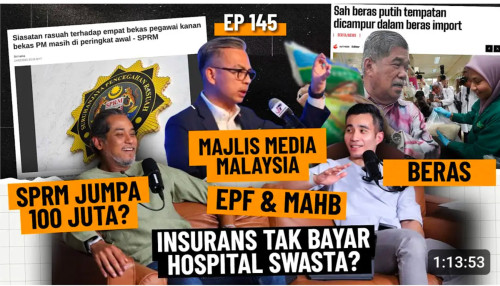
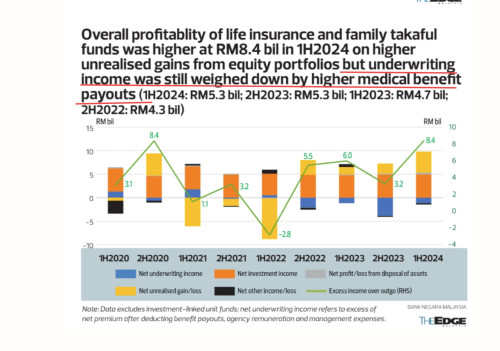
There is one main cause for this, and it's BNM’s to own. Media outlets from The Edge to podcasters like Khairy Jamaluddin & Shahril Hamdan continuously quote the net underwriting income figures (blue colored bars in bar chart below), as derived from an excess of income over outgo analysis - a flawed way to measure a LIFTO’s profitability - in explaining why it may be justifiable for life insurers and family takaful operators to hike premiums.

Someone or a group of people within BNM has to be held accountable for handing these irresponsible talking points to the media.

user posted image
Keluar Sekejap Ep. 145 (Min 33)

user posted image

user posted image
Cover Story: Who pays the price of runaway healthcare inflation?

The major flaw in using an “excess of income over outgo” analysis is that it is an EXCESS OF INCOME OVER OUTGO ANALYSIS.

Unlike a SURPLUS ARISING ANALYSIS (INCLUDING/EXCLUDING PARTICIPATING FUNDS) which would holistically capture all revenue sources and margins, including those from release in reserves, this analysis makes it seem LIFTOs are making a substantial portion of their earnings from investment returns. And that LIFTOs, who have done everything that could have been reasonably expected of them, are being weighed down by too many insurance/takaful (including medical) claims. Nothing could be further from the truth.

Most profitable LIFTOs, especially the big three (AIA, Great Eastern and Prudential), make most of their profits from margins embedded within IL cost of insurance/takaful and other charges and the insurance/takaful benefit component of other policies.

What's missing in an excess income over outgo analysis are two main items, the release in reserves needed to sustain current benefit payouts, for policies whose current payouts are much higher than premiums collected, and the addition to reserves needed to sustain future benefit payouts, for policies whose current benefit payouts are much lower than premiums collected.

The release in reserves include those for participating savings plans which have built up significant cash values, values which far exceed the annual premium amounts collected, and those for single premium mortgage (MRTA, MLTA etc.) and other long term products, whose premiums are initially reserved, only to be released later over time.

Whether it's for maturity, surrenders or payouts related to insurance claims, these reserves will have to be released throughout the policy’s term to make those payments.

The payments can't be sustained by annual premiums alone and that is why the excess income over outgo analysis gives the false impression of LIFTOs having thin underwriting margins.

Also, participating funds are 'owned' by policyholders. There is no point in including them in analysing an insurer's profitability as most of the surplus (90%) will be distributed, in due time, to policyholders.

The release in reserves would flow mostly to the net underwriting income component (blue colored bars in the bar chart above), while the addition to reserves would be deducted mostly from the investment return components (net investment income, net unrealised gain denoted by the orange and yellow colored bars in the bar chart above).

If incorporated into the excess income over outgo analysis, it would result in a 180° flip. The blue bars (net underwriting component) would appear to be more significant than the orange/yellow bars (net investment income, net unrealised gain components).

LIFTOs have been mercenary for a long time towards their policyholders. It's the LIFTOs who are with excessive profits.

So, why is BNM so invested in painting a false narrative when it comes to the LIFTOs profitability????

Why does BNM not want the public to be aware that LIFTOs are profitable, and that it's mostly due to the margins embedded with IL cost of insurance/takaful charges????


This post has been edited by hafizmamak85: Apr 28 2025, 01:29 PM
hafizmamak85
post Apr 30 2025, 03:23 AM

Casual
***
Junior Member
463 posts

Joined: Nov 2009

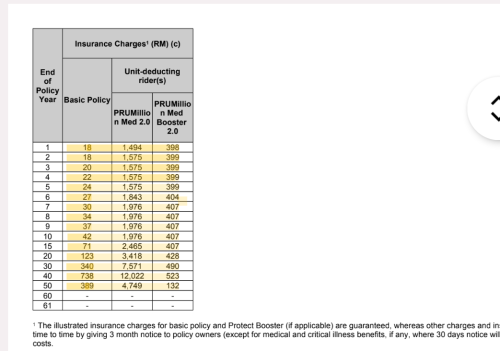
How much do you think Prudential's margin is? A RM 500 deductible policy for a 40 year old has got a cost of insurance charge of RM 1.9k for the medical coverage component (PruMillion Med 2.0 with Booster). Even if the average medical pool claims cost is RM 1.3k, that would still leave a RM 600 margin.

Are insurers and takaful operators truly making a loss from managing medical portfolios????

user posted image

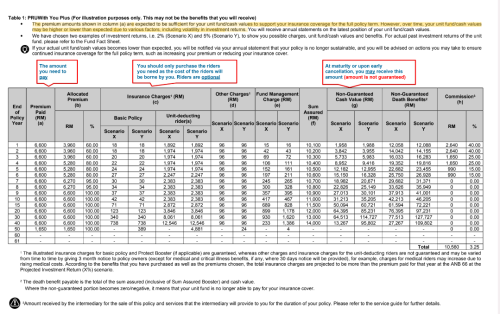
The premium amounts shown in column (a) are expected to be sufficient for your unit fund/cash values to support your insurance coverage for the full policy term

user posted image

Whatever the case may be, just remember that this expectation of premium sustainability has value. Don't let anyone tell you otherwise.

The expectation should rightfully mean a no lapse guarantee as long as premium payments are maintained per the original payment schedule set at the policy's inception.

user posted image

user posted image

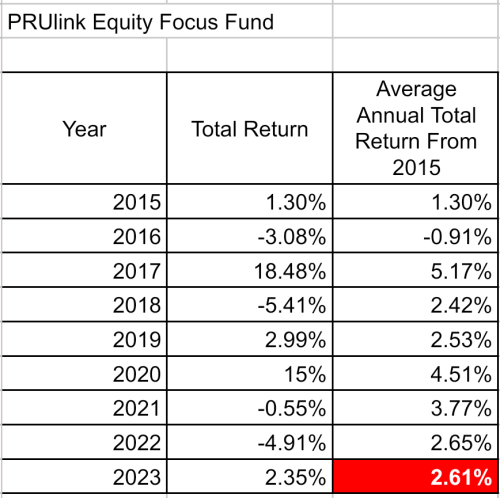
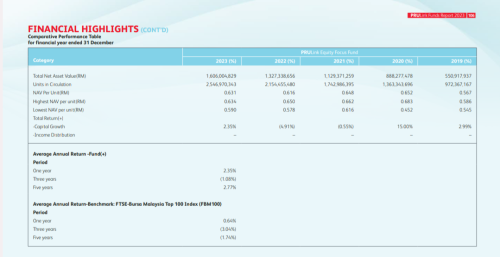
The policy assumes more than 5% in annual total returns to ensure sustainability until end of term, but the PRUlink Equity Focus Fund - one of Prudential's equity funds, with over RM 1.5 billion in NAV - has less than a 3% (2.61%) average annual total return between 2015 and 2023.

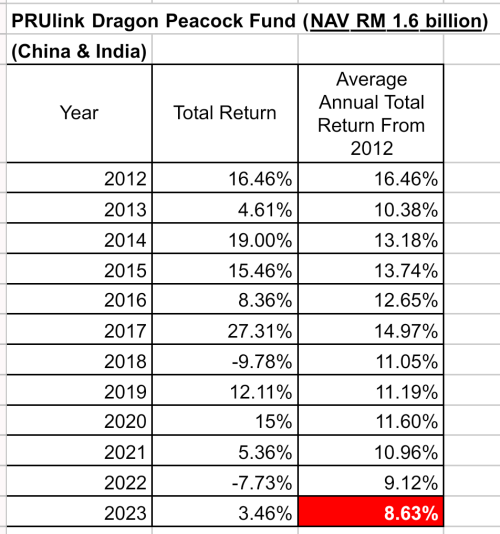
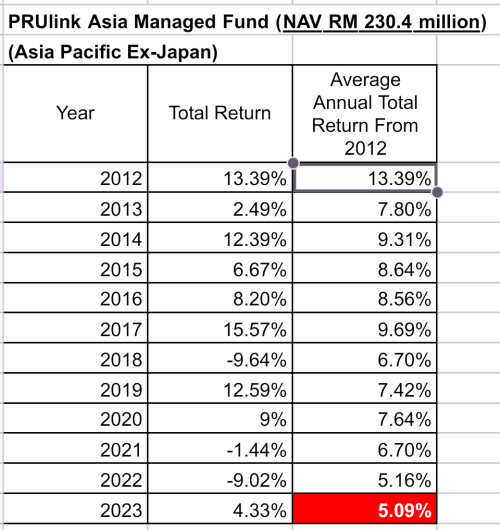
If not locally, where else can we go to source such returns? Asia Ex. Japan???? China??????? India????? How sustainable is this strategy?????? Can we keep expecting these markets to provide above 5% returns per annum for the next 30 - 50 years?????

user posted image

user posted image

Investment-Linked has got nearly RM 33 billion in annual premiums. If total NAV is around/reaches 6x annual premiums, that would mean nearly RM 200 billion in Malaysian funds may need to be invested abroad to achieve such returns. Sustainable?????

user posted image

This post has been edited by hafizmamak85: Jun 14 2025, 02:02 PM
hafizmamak85
post May 1 2025, 05:49 PM

Casual
***
Junior Member
463 posts

Joined: Nov 2009

QUOTE(contestchris @ Apr 30 2025, 09:28 PM)
I then look at Kaotim Legasi, it is an online product sold by Syarikat Takaful. With the exact same parameters as the other plans, it costs RM1,440 for 20 years and RM2,160 for 30 years cover. This is so much cheaper than the agency plans. But sadly, there is no 25 years option. 20 years might just be too short, 30 years is rather wasteful.

What basic term life insurance (or takaful) plan do you have? Have you researched into this, and if yes, what are your findings?

Thank you!
*
Please be careful when buying 'cheap products', especially when they are long term - e.g. 20, 30 years.

The problem with the big insurers and takaful operators (ITOs) is that they have huge margins and fees. That is how policyholders get screwed.

The problem with mid to small ITOs is that they have another way of shortchanging consumers, and that is through designing or pricing the products as lapse supported. Not to say big ITOs don't do this, but I think the smaller guys will feel the urge to do this more often than not.

I used to think this problem wouldn't plague takaful operators as there was usually this split, where any remainder premium amount (contribution amount) - after deduction of wakalah (management) fees - would flow to something called the savings account first, before monthly drips or deductions from the savings account to the tabarru fund (risk fund) are made.

So, if you die, your beneficiaries will receive any remaining amount retained within the savings account, and the sum assured will be separately paid to your beneficiaries from the risk fund. If you surrender your policy, you will receive the savings account amount.

The savings account amount can also be thought of as the 'Asset Share' of the policy.

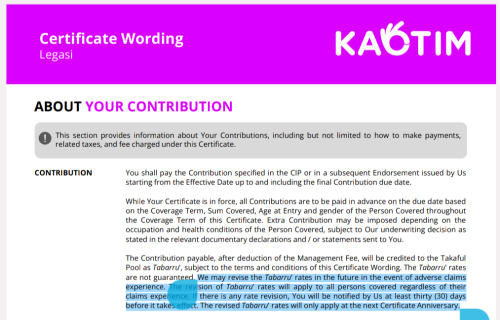
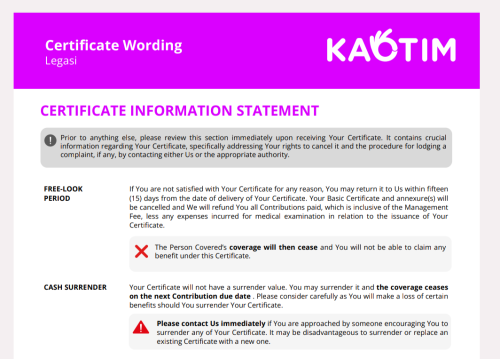
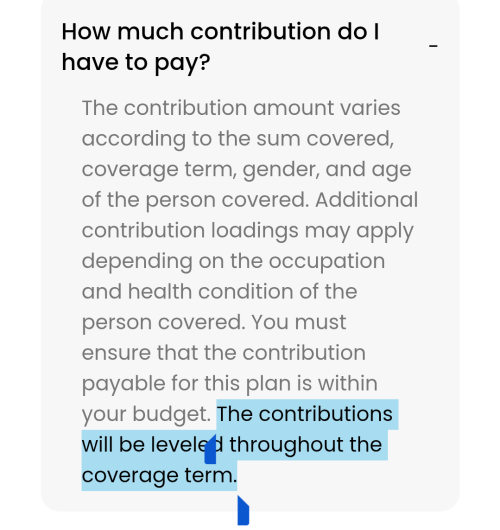
The Kaotim Legasi death benefit 'more than 1 year term' products by STMB (Syarikat Takaful Malaysia Berhad) are suspiciously cheap and not designed and priced fairly, as there is no separation between the savings accounts and risk fund, and there is no surrender value. Kaotim also, very strangely, reserves the right to reprice the tabarru charges at any time during the policy's term. Again, this should only be exercised if the ITO faces going concern risks.

user posted image

user posted image

I suspect that these products may also be benefiting from STMB's Estate. Yes, Great Embarrassment is not the only ITO with an Estate.

This 'no surrender value, lapse supported design' means that the proper management of the Kaotim Legasi product requires either a part, or the entirety, of the Asset Shares of policyholders who leave the fund during the middle of the contract term, to sustain future benefit payouts of remaining policyholders.

Why should you, the leaving policyholder, fork out any amount belonging to you, for the benefit of the other remaining policyholders???? You have no stake in the pool anymore, you're not being afforded any protection. So, why should you and your funds be bothered???

And what happens if all policyholders decide to simultaneously leave the fund??? That money will then languish within the tabarru fund, which would then allow the takaful operator to further underprice the products and claw as much management fees from future policyholders. And when the tabarru fund closes, the government gets the money. What a sham and a scam. Boycott STMB!!!!!.

Again, this is a very unfair contact term and the way the products are designed and managed, without any proper separation between the risk fund and savings account, is also unfair.

Stay Away from it. SAY NO to lapse supported products.

Also, demand that Great Embarrassment calculates the Asset Shares of participating policies within closed funds properly by accounting for the Estate, which is technically not really an Estate, within its computation. Demand that Great Eastern pays out the entirety of the Asset Share and Estate, to participating policyholders within their closed funds, by the time the last policyholder leaves the fund and in line with the 90/10 rule.

I'm truly surprised that STMB is doing this.

This post has been edited by hafizmamak85: May 1 2025, 06:57 PM
hafizmamak85
post May 2 2025, 04:27 AM

Casual
***
Junior Member
463 posts

Joined: Nov 2009

QUOTE(contestchris @ May 1 2025, 07:14 PM)
I think you are jumping to the wrong conclusions here. Yes, the product is lapse supportable because it contains no surrender value.

But insurers CAN design such products.

If too many policyholders buy long-term cover and the lapse just 2 or 3 years into the policy, the insurers make bank. Why is this wrong though?

Cause on the flip side, by buying such a product, you pay significantly lesser.

In pricing the product, the insurer will make certain lapse assumptions, possibly by drawing from the experience of similar products.

By pricing the product such that there is no surrender value, we customers get to buy "cheaper" term cover. This is proven by the fact that Kaotim Legasi is cheaper than almost every other term insurance covering death and TPD.

There is nothing shady here. It is written clearly in the PDS and policy contract that there is no surrender value.

As a customer looking for the absolute cheapest insurance coverage, I am OKAY with this. I don't need any surrender value from my pure protection policies.

Regarding the company's ability to reprice, I believe it is a standard wording for "non-guaranteed" products. Most term cover products have this clause. Those with guaranteed rates, are generally more expensive. However, given the trend of Malaysians living longer, this should not be a concern. It is fairly unlikely, probably unheard of, for an insurer to reprice pure death+TPD products, and if they do, they will come under significant scrutiny from BNM. If they intentionally underpriced the product, they will not get the approval from BNM to reprice the product. BNM has access to all the assumptions used in pricing the product.

As to the question of the use of estate, I am not sure if STMB has any estate, and if they do, is it even significant? Do takaful operators even have an estate? Is a estate even applicable to non-participating policies such as this? In any case, that's not an issue and BNM has got stringent policies on the management of estates and not a relevant consideration as to whether one should buy this product or not.

Edit: My man, you do know that for pure protection non-participating product from conventional insurance, the customer gets nothing as well right, if ultimately the fund has excess monies due to high lapses, or better-than-expected claims experience.
*
Seriously, who in the world is feeding you these talking points????? Whatever the case may be, let's go through it.

Can insurers and takaful operators (ITOs) design and price such lapse supported products? Short answer, no. As ITOs are required to treat consumers fairly, which would not be possible in a lapse supported scenario. If ITOs are legally allowed to treat consumers unfairly, then yes, all is good.

The question is, in constructing the terms of the insurance and takaful (IT) contract, what are the implied terms of a fair and just IT contract and why is a lapse supported design inherently unfair, regardless of disclosure?

For one, disclosure is not a carte blanche to treat consumers unfairly. One can't disclose unfair term X to consumers and consider such disclosure sufficient to turn unfair term X to fair term X. Especially in a consumer insurance/takaful contract where consumers have no say in shaping the terms of the contract.

So, what is it about term X (lapse supported design and pricing) that makes it an inherently unfair term in the construction of IT contract terms?

One of the implied terms in any long term IT contract which has a pre-funding element is that there must be a fair surrender value which would pass back to consumers the unused pre-funded amount. Why? Because fairness is linked to equity and equity does not allow for 'Robbing Peter to pay Paul' scenarios.

So, the points about policyholders, as a group, getting cheaper premiums or shareholders getting a bigger share of profits from surrendered policies don't count.

Equity requires a 'proper' balancing of the rights and interests between each individual within a group (between each policyholder within a pooled fund/group of policyholders), and between different groups or parties within the contract (policyholders vs shareholders) over various contemporaneous and non-contemporaneous risk sharing time periods.

Policyholders in a risk pool/fund typically have their cost of insurance/takaful charges calculated based on their individual or group risk exposure levels and duration of exposure.

For a leaving policyholder, their risk exposure is limited to the duration they were in the fund - up until the policy's termination. Therefore, the amounts deducted for insurance/takaful coverage should commensurate with the level of risk exposure for the duration the leaving policyholders were at risk. Not more, not less.

Insurance/takaful is mostly a form of risk sharing within contemporaneous time periods. There is no risk sharing within non-contemporaneous time periods, such as the smoothing of investment returns in a participating fund setting, which would allow for deductions from the policy's asset share. The fact that it is pre-funded means the amount is required for future risk sharing, not present risk sharing.

The excuse that insurance/takaful may involve risk sharing within non-contemporaneous time periods as surpluses may be retained and built up for future generations is misapplied in this scenario. Mortality risk is much less volatile compared to investment returns. And any deductions from the policy's Asset Share for the build-up of surpluses should be done incrementally, applied across the board throughout the term of the policy and shouldn't just target surrendering policies. It is not an excuse to not provide a fair surrender value.

Shareholders also deserve their fair share of profits from a long term contact and the level of profits is tied to the level of service/risk protection provided within the period the leaving policyholder was serviced/at risk. Not more, but can be less. And the amount shareholders may take as profits has nothing to do with the pre-funded amount.

In the case of STMB's Kaotim, there are no profits to be made by STMB from the tabarru fund (risk charges). What they have are only wakalah fees. Very, very high wakalah fees which are charged to the premium (contribution) amount, prior to the remainder being allocated to the tabarru fund.
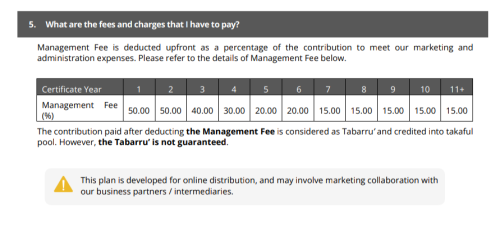
user posted image

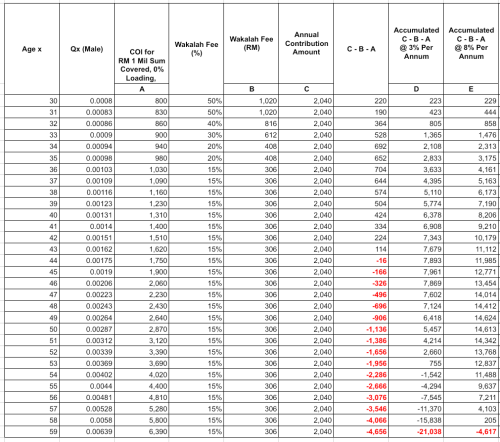
Sidenote: The more one looks at the pricing of the premium amounts, the more suspicious it gets. They are either expecting very high lapse rates, perhaps even as high as 5% per annum or above, during the initial 10 - 20 years of the policy, or are relying on the investment returns generated by the Estate within the tabarru fund, or both, or worse, just downright expecting some Estate or other surplus resource within the fund to finance any deficit - I'm pretty confident they may even be praying for mortality to be low. I just don't see how the Kaotim policy can be sustainable with such high wakalah fees and low premium amounts.

Even with a projected 8% return per annum, a 30 year term Kaotim policy for RM 1 million in coverage for a 30 yr old, under a 0% lapse scenario and RM 2040 in annual premiums, still yields a tabarru fund deficit of RM 4.6k at end of the policy's term.


user posted image

Btw, can you imagine, spending RM 50,000 or RM 60,000 on a single premium 30 yr mortgage reducing term assurance product, only to be told that your policy doesn't have any surrender value as the product was designed to be lapse supported, and you are in the midst of settling the loan during the 5th year.

Also, takaful is a participating type policy by its very nature (not non-participating). The tabarru funds (risk funds) are 'owned' by policyholders.

As for BNM, just as what they keep conveying to the media, they do not 'approve' of a product's pricing/re-pricing or design.

Having said that, BNM does have the authority to issue any direction to the lTO, as they deem fit and pursuant to the objectives of the Financial Services Act. These directions may include putting a stop to any re-pricing efforts or the launch of any product, if they deem such efforts may lead to policyholders being treated unfairly or adversely affected. Why didn't BNM issue such directions to put a stop to so many unfair/unlawful practices????

BNM as an institution has failed many a time in protecting the rights and interests of policyholders. We have to stand up to them. They are only human. They have been lulled by the very power they have wielded for so long that they have forgotten their duties or failed to carry them out properly.

Case in point, how did Great Eastern's Estate grow from RM 1.8 billion in 2001 to + RM 10 billion in 2018????? If BNM and Great Embarrassment were so competent and fair to consumers, this wouldn't have happened in the first place.

Why and how did it come to be that BNM ended up conspiring with MOF, Great Eastern in misappropriating RM 2.37 billion from their participating policyholders????

Why haven't any of the other foreign insurers complied with the in-lieu-of-divesting condition: contribution to the mySalam trust fund???

How is it that long term level premium IL policies with medical coverage still face the risk of re-pricing year in, year out??? Why were these policies allowed to be priced without accounting for the long term effects of medical inflation, and with such high expenses and profit margins???? Why have claim delay and denial tactics been allowed to fester?????

Why were are all these unfair/unlawful practices allowed to run rampant????

This post has been edited by hafizmamak85: May 3 2025, 05:00 PM

hafizmamak85
post May 2 2025, 10:49 AM

Casual
***
Junior Member
463 posts

Joined: Nov 2009

QUOTE(contestchris @ May 2 2025, 08:40 AM)
Hafiz, you're a smart guy and you're very correct in whatever you're saying.

But I don't understand your issue with building lapse supportable products and pricing them cheaper than they otherwise would be, by designing them such that there is no surrender value.

If this was wrong, BNM and other insurance regulators around the world would outlaw it...but it is perfectly legal and even the "Big 3" design some products like this.

As for single premium products...actually I would for all intents and purposes be happy to buy such a product without a surrender value, if it means the single premium is 20% to 30% cheaper and if it is disclosed upfront.
*
You can feel however you feel, that is your right as a consumer.

But, this product is being sold to the masses, to others than yourself, and who themselves have very different appetites, very different life circumstances/financial situations.

Anything can happen in future, 20 - 30 years is a very long time period. Consumers deserve the right to pivot according to their changing circumstances and shouldn't be penalized for it.

It is unethical, unfair and very predatory to have a product design where ITOs are incentivised to target vulnerable consumers. The ITO's financial position or standing is directly linked to the number of surrendering policies.

Another way to look at it, the ITO requires for a proportion of the insurance/takaful pool to surrender every year so that the tabarru fund (risk fund) or the non-participating fund does not have a deficit. If they have less than the expected proportion of policies surrendering, say 5% per annum, they are in trouble and would have to pump money into the tabarru or non-participating fund.

Do you know what a 5% surrender rate per annum means? It means that if an ITO had a million policies at the beginning of a 30 year policy term, they would only have around 600k policies by the 10th year, 463k by the 15th year, 359k by the 20th year, 277k by the 25th year, and 215k by the 30th year.

So, the ITO needs to go out there and find a million policies, out of whom 401k need to leave by the 10th year, 537k by the 15th year, 642k by the 20th year, 723k by the 25th year and 785k by the 30th year.

That is the number of people we are telling to go fly kite. It's just a disaster waiting to happen.

It's even better for the ITO if more than the expected number of policies surrender. They would then be in surplus position and they get to keep all the profits from it. A horrendous incentive structure.

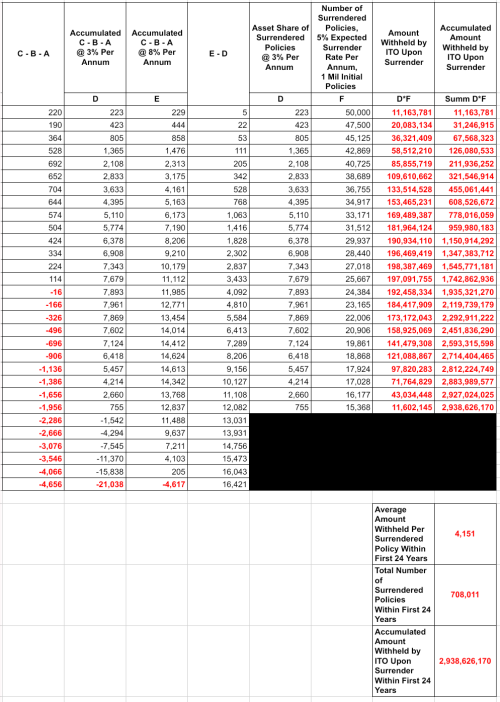
This is the impact. For the Kaotim product, assuming 1 million 30 yr old males signed on for the RM 1 million coverage, 30 year plan @ RM 2040 per annum, a 5% expected surrender rate per annum yields over 700k surrenders within the first 24 years of the plan and an average withheld amount per surrendered policy of RM 4151 and an accumulated withheld amount of RM 2.94 billion.

user posted image

user posted image

Edit: I should add that this lapse supported design and pricing model is also a death supported design and pricing model, as the Asset Shares of policies terminated due to death events are also unfairly withheld by the ITO within the tabarru fund or non-participating fund (conventional). Whether a policy is terminated due to a surrender or an insured/takaful event, in this case 'death', it's unfair to withhold any remaining Asset Share amount. A surrendered policy should by right receive the policy's remaining Asset Share amount upon surrender while a death event policy should receive both the sum assured amount as well as the Asset Share amount.

So, while the above projections on the number of expected surrendered policies do not include death, it should have. Within the first 24 years, there are expected to be around 20k deaths after accounting for the surrendered policies. It would not add much to the surrendered policy numbers, but the point remains. Both the death event and surrendered policies have the same level of withheld Asset Share amounts, per policy, within the tabarru fund.

Interesting thought experiment. Most takaful models and investment-linked policies operate on a drip model, where regular deductions are made from the savings account (unitised fund account) to finance the insurance/takaful coverage component. The only difference being the frequency of drips, with some done on a monthly basis, while others weekly.

When a policy is surrendered during the period between two drips, it would only be fair for a portion of the insurance/takaful coverage charges to be returned to the policyholder. The amount returned should commensurate with the charges that would have been levied for the period between the surrender date and the end of the drip coverage period. E.g., if RM 200 was deducted at the beginning of the month for a monthly coverage, and the policyholder decided to surrender the policy on the 10th day of a 30 day month period, then the amount returned to the policyholder should be two-thirds of the RM 200 insurance/takaful charge or RM 133.3.

The question is, should this also be done for a policy terminated due to an insurance/takaful event such as death? If no, why not? I would argue that the same principles should apply.

Btw, the projections in the earlier example don't provide for a return to policyholders of the unexpired risk amounts, so that's another thing to look out for.

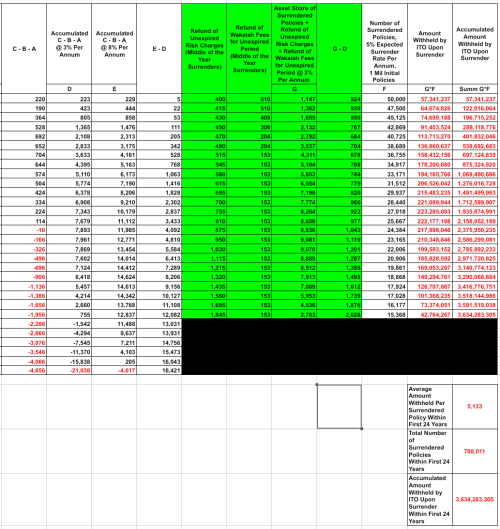
The following table has accounted for the refund or return of both the unexpired risk charges and wakalah fees. Yes, the same principle should also apply for wakalah fees covering the unexpired period.

The average amount withheld per surrendered policy jumps from RM 4151 to RM 5133 once the unexpired risk charges and wakalah fees are accounted for. And the accumulated withheld amount grows to RM 3.6 billion from RM 2.94 billion.

user posted image

For anyone who challenges the need to refund the risk charges and wakalah fees for the unexpired period, ask them to play out the various scenarios where policyholders are allowed to pay premiums based on various payment modes (monthly, quarterly, annually). Compare the financial outcomes under various decrement events (death, surrender etc.) happening on a specific date for the various payment modes, and then compare those financial outcomes with the financial outcomes under various decrement events of a theoretical policy having a daily premium payment mode and daily deductions for wakalah fees and other charges (incl. risk charges).

This post has been edited by hafizmamak85: May 3 2025, 03:49 PM
hafizmamak85
post May 7 2025, 02:21 AM

Casual
***
Junior Member
463 posts

Joined: Nov 2009

QUOTE(hafizmamak85 @ May 2 2025, 10:49 AM)
Do you know what a 5% surrender rate per annum means? It means that if an ITO had a million policies at the beginning of a 30 year policy term, they would only have around 600k policies by the 10th year, 463k by the 15th year, 359k by the 20th year, 277k by the 25th year, and 215k by the 30th year.

So, the ITO needs to go out there and find a million policies, out of whom 401k need to leave by the 10th year, 537k by the 15th year, 642k by the 20th year, 723k by the 25th year and 785k by the 30th year.

That is the number of people we are telling to go fly kite. It's just a disaster waiting to happen.

It's even better for the ITO if more than the expected number of policies surrender. They would then be in surplus position and they get to keep all the profits from it. A horrendous incentive structure.

This is the impact. For the Kaotim product, assuming 1 million 30 yr old males signed on for the RM 1 million coverage, 30 year plan @ RM 2040 per annum, a 5% expected surrender rate per annum yields over 700k surrenders within the first 24 years of the plan and an average withheld amount per surrendered policy of RM 4151 and an accumulated withheld amount of RM 2.94 billion.

» Click to show Spoiler - click again to hide... «


*
I think investors need to short STMB stock. STMB's management and board of directors need to be taught a lesson.

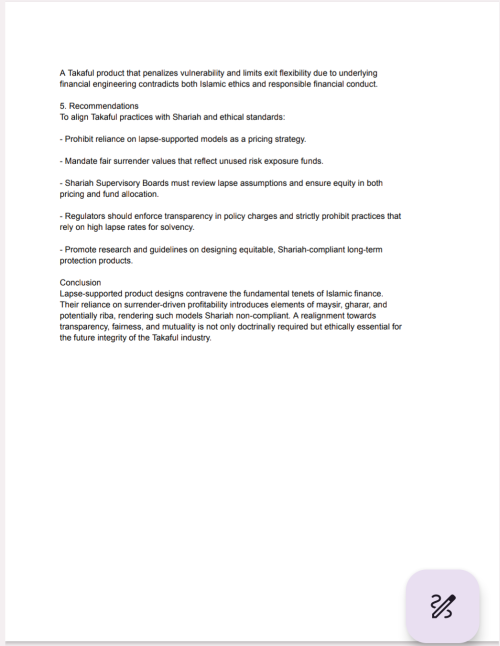
Not only should investors short the stock, they and affected certificate holders should also demand a response from both STMB and BNM's Shariah Advisory Panels. The panels should clarify their stance on the shariah permissibility of lapse supported takaful products or tabarru contracts with either low or no surrender values.

Kaotim Legasi products are clearly shariah non-compliant as they are lapse supported with no surrender values.

Even an 8% per annum investment return still results in a deficit in the final year of a 30 year, RM 1 million sum covered, Kaotim Legasi plan for a 30 year old male.

So, Kaotim Legasi has to assume a surrender rate of around or at least 5% per annum, coupled with an investment return on traditional investment assets of around or at least 3% per annum, to obtain the required above 8% per annum return rate.

Two key non-shariah compliant elements in the Kaotim Legasi product design need to be emphasized and brought to attention:

- The predatory and unfair nature of requiring or expecting a portion of certificate holders within the tabarru pool to surrender their certificates on a regular basis (yearly), and requiring the Asset Shares of surrendered certificates (pre-funding element) to ensure the sustainability and viability of the tabarru fund (without which the fund would be in deficit).

- The maysir (gambling) and perverse incentive structure elements present in the management or performance of the tabarru fund, where the tabarru fund benefits financially as surpluses arise when the number of surrendering certificates exceed expectation.

Certificate surrenders are not takaful events for which the tabarru fund provides cover. The tabarru fund owners (the current and future group of certificate holders) and takaful operator managing the tabarru fund are incentivised to target vulnerable consumers as that would yield a more preferable financial outcome (surplus position within the tabarru fund).

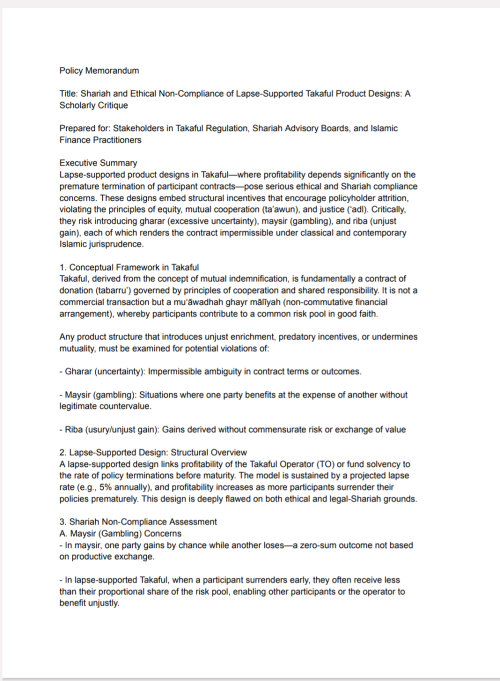
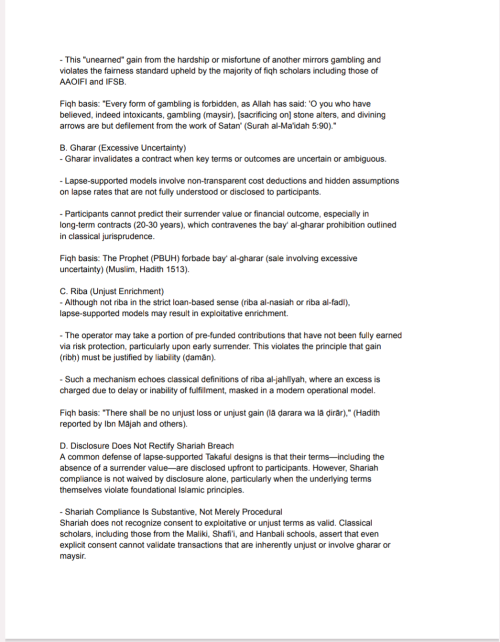
Even Ustaz/Actuary/Shariah Scholar/Insurance Expert Dr Chatgpt understands that lapse supported takaful products are shariah non-compliant.

Chatgpt Insurance Expert (Takaful) Opinion

» Click to show Spoiler - click again to hide... «


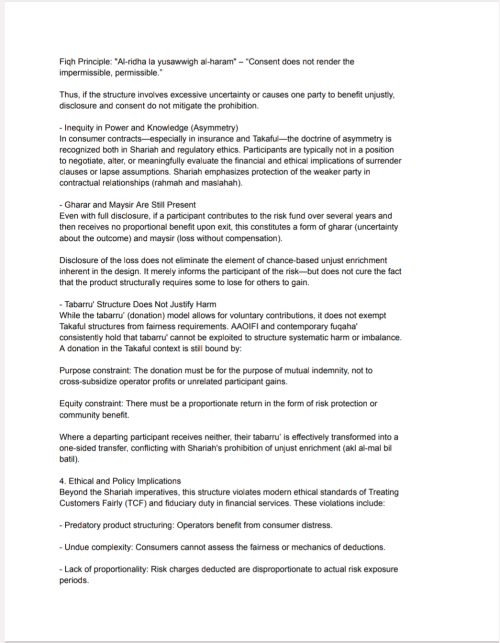
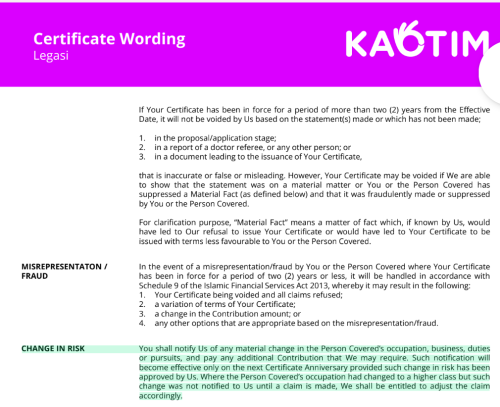
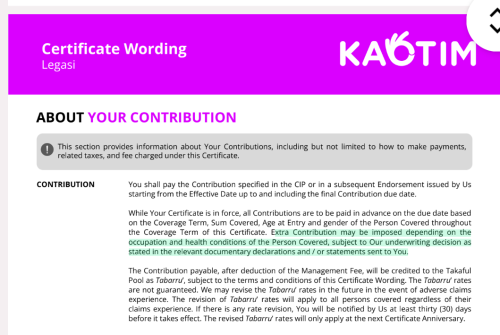
It's also really puzzling that Kaotim Legasi, while being long term regular level contribution plans, require their certificate holders to notify of material changes in risk of the person covered arising from changes to their occupation, business, duties or pursuits, and pay any additional contribution the takaful operator may require, during the ongoing term of the certificate.

user posted image

user posted image

user posted image

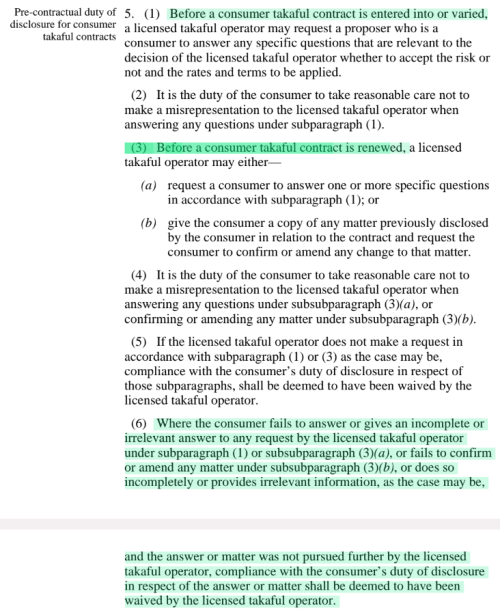
This is not lawful as the certificate holder's duty of disclosure is only limited to pre-contractual stage (prior to entering into the takaful contract), as per paragraph 5, Schedule 9 of the Islamic Financial Services Act.

user posted image

The changes in risk of the person covered, due to changes in occupation, business, duties or pursuits, during the ongoing term of the takaful certificate, are not variations to the takaful contract.

There can be no changes to the regular contribution amount of a long term plan during the middle of the certificate term.

This post has been edited by hafizmamak85: May 7 2025, 03:24 AM
hafizmamak85
post May 7 2025, 11:31 AM

Casual
***
Junior Member
463 posts

Joined: Nov 2009

QUOTE(contestchris @ May 7 2025, 09:01 AM)
Hafiz I agree that the perverse and aggressive lapse-supportable assumptions may not be in line with Shariah principles, especially since the premiums will eventually have to be revised higher (and they can do it based on the policy contract). However, they are not the only ones to do this - even FWD Takaful's Protect Direct term insurance plan is designed similarly.

There is another privision that drew my attention.

"DISTRIBUTION OF SURPLUS
Any surplus arising from the Takaful Pool will be kept in the Takaful Pool to prepare and provide for any high claims experience."

Can they withhold surplus like that?

Seems like this product is designed pretty much like any basic term life insurance plan and doesn't confirm to Shariah norms for a Takaful contract.

Your lapse assumptions of 5% might be too aggressive. First/second year lapses might even be double digits, but as the term of the plan progresses, lapses are likely to head to zero over time. At the halfway point, it would be foolish to lapse as your cover is going to be a lot cheaper than what you should be paying, given the front-loaded nature of level term products.
*
It doesn't matter who does it. Lapse supported product designs are just wrong. Whether it's another family takaful player (FWD, Great Eastern Takaful, PruBSN Takaful etc.) or another conventional player (Prudential etc.), it's not a fair product design or contract term to not have a fair surrender value or to indiscriminately use the Asset Shares of surrendering policies to sustain future benefit payouts of the other remaining policies. They all need to be called out. That is the point.

Just because a contract term says premium or contribution amounts can be revised does not mean that it is a fair contract term or one that is lawful or legal.

These are all level premium / contribution long term plans. The premium or contribution amounts are set at the policy's inception and cannot be revised later. That is the policyholder's understanding and expectation.

If the ITO wished to review contribution amounts on a regular basis, they should sell yearly renewable products instead of long term ones.

The duty of the insurer or takaful operator is to price the policy appropriately at the policy's inception. If a pricing error occurs, the ITO would have to foot the bill, not the consumer.

But even with the unlawful / illegal right to review premium / contribution amounts during the ongoing term of the policy, why would an ITO selling lapse supported products be incentivised to exercise it???

The ITO would find it easier to just keep targeting / onboarding vulnerable consumers who are bound to surrender their policies and use their Asset Shares to make up for any deficit rather than risk the wrath of the remaining policyholders.

I'm just stunned that this is happening. I guess I haven't been paying attention. Never thought I would see takaful operators doing this.

Takaful operations by local outfits may have more operational issues compared to their foreign owned or conventional counterparts, but not when it comes to substantive matters like the adopted operational model itself.

Takaful models are supposed to be better as they usually have a clear separation between the savings or pre funding component and the insurance pooling component (tabarru or risk fund).

FWD is a very aggressive HK outfit - HK outfits are desperate for yield, and money is cheap. Just look at how much they spend on marketing.

It must be emphasized that a lapse supported product design does not automatically result in a surplus position within the risk or non-participating funds.

It would only result in a surplus position if the number of surrendering policies exceed expectation. So, if a lapse supported product assumes a 5% surrender rate, a surplus would only arise when the surrender rate exceeds 5%.

The Asset Shares of the expected 5% surrendering policies are required to meet the expected future benefit payouts of the remaining policies - these amounts will have to be reserved for. Anything below the 5% surrender rate will result in the fund being in a deficit position.

No takaful operator can withhold any surplus amount within the fund that is more than necessary for the ongoing operations of the fund. Surpluses within takaful funds belong to policyholders and have to be eventually returned to them.

Having said that, there are other ways of distributing the surplus without "distributing" it. The ITO may sell underpriced or loss making products to underserved segments, with the surplus amounts being earmarked to make up for the difference. Noble though this may be, it is not shariah compliant or lawful or legal as the equity principle is not being respected.

You have to also make the argument that my projections are wrong or faulty in some areas if you would like to make the argument that my 5% lapse assumption might be too aggressive.

My projection shows that even an 8% investment return still yields a deficit during the last year of a RM 2040 annual contribution 30 year Kaotim Legasi plan for a 30 year old male with RM 1 million sum covered.

Even if the investment assets of the fund yield a steady 3% per annum, the policy would still need an extra +5% per annum to make up for the difference. This can only happen if 5% of policies within the pool surrender every year for 30 years. This would release 5% of the total Asset Shares or pre funded amounts within the fund to the remaining policyholders every year.

Surrendering a policy during the middle of a policy term being a foolish decision or otherwise is personal matter that is only of concern to the surrendering policyholder. Not for us to question their conduct.

Foolishness or being foolish is not a license to rob from surrendering policyholders. Their equity is still their equity.

This post has been edited by hafizmamak85: May 7 2025, 11:44 AM
hafizmamak85
post May 7 2025, 12:45 PM

Casual
***
Junior Member
463 posts

Joined: Nov 2009

QUOTE(togekiss @ May 7 2025, 12:20 PM)
very good explanation. thank you hafiz. have you thought of writing a piece of your mind to news portal like malaysiakini, so general people like us can share to others to create awareness?
*
I don't think they would be interested - either the issues are too complex or sensitive.

I tried reaching out to them and having them put out a piece about Great Eastern misappropriating RM 2.37 billion from their participating policyholders to fund the mySalam scheme, but that went nowhere.

I can't imagine them taking on the issues being discussed here.
hafizmamak85
post May 7 2025, 01:11 PM

Casual
***
Junior Member
463 posts

Joined: Nov 2009

QUOTE(MUM @ May 7 2025, 12:51 PM)
Are the details that you put up to them substantiated with any "real" proof and did you provides them with your real personal details and contact details, else they may not entertain.

Posting here are anonymous and are just sort of Kopitiam talks....Posting in MK are not, for the editors and publishers will be subjected to strict guidelines
*
What "real" proof are you talking about???? If you're talking about my personal and professional details, yes the Mkini writer has it. The Mkini writer didn't question whether I was real or not. That wasn't the issue.

The issue was the matter was too complex and sensitive.

Anyone can go online and see Great Eastern's financial statements and annual reports. It's clear to everyone that they took out RM 2.37 billion from their participating funds to fund mySalam. The withdrawal of RM 2.37 billion from the participating funds is clearly disclosed.

Up to you whether you want to believe it or not.

I'm also pretty confident that BNM staff also know who I am and my previous bosses there can easily know that it's me, Hafiz Ipaldin, doing the writing and not someone else.


This post has been edited by hafizmamak85: May 7 2025, 01:16 PM
hafizmamak85
post May 7 2025, 01:17 PM

Casual
***
Junior Member
463 posts

Joined: Nov 2009

QUOTE(MUM @ May 7 2025, 01:15 PM)
If the details or the case you wanted to project are really of interest to the nation and if those details and the case that you presented are really as what you speculated it to be,
.....what has BNM made of it?
*
You go ask n hentam BNM, ask me for what?

Go la ask the crook, BNM, what they have made of everything I've said. Ask them urself. See if the crook wants to layan u or not

This post has been edited by hafizmamak85: May 7 2025, 01:30 PM
hafizmamak85
post May 7 2025, 03:38 PM

Casual
***
Junior Member
463 posts

Joined: Nov 2009

This is really tragic and comical at the same time.

KJ, Kian Ming & Tony Pua Are Your New Lecturers (Sort Of) At Taylor’s PPE Bachelor’s Programme

Ong Kian Ming and Tony Pua are now lecturing for Taylor's Philosophy, Politics and Economics (PPE) Program.

TP (Part 3: Tony Pua responds to Tun M): I would listen and bring the proposals back to the minister for consideration. Many excellent proposals were sourced via these meetings. These would include the setting up of a RM2 billion MySalam critical illness and hospitalisation fund for the B40, contributed by the insurance industry. This fund has benefited more than 120,000 Malaysians to date…..I would however avoid parties who are only interested in securing contracts via direct negotiation with the government. The minister would always tell me to inform them that in the event the government is interested in the project, an open tender would be called, and they would be invited to participate.

There was no open tender for the mySalam scheme, even after two years of being in operation. This was the finding and opinion of the Auditor General in the LAPORAN KETUA AUDIT NEGARA 2019 SIRI 2.

Tony Pua And Dr Ong Kian Ming Are Helping Out The Finance Ministry For Free

Maybe these two champions can provide their PPE students a detailed international relations, geo-economic/strategic/political and local political/strategic analysis of allowing Great Eastern Malaysia to:

- Swindle RM 2.37 billion from their participating policyholders to fund the mySalam scheme;

- Providing Great Eastern Malaysia RM 569 million in income tax exemption for the amount transferred from the participating fund to fund mySalam; and

- Awarding Great Eastern Takaful the contract to run mySalam without going through an open tender (direct negotiation) and which benefited Great Eastern Takaful through probably over RM 150 million in wakalah (management) fees.

Perhaps also delve into whether mySalam helped PH gain Malay heartland support.

Also, they should do an analysis on why BNM has failed in getting the other foreign insurers to either divest or contribute to the mySalam trust fund.

Our national brain trust. Best believe them.

All jokes aside, this is a very serious matter.

Our Central Bank (BNM) truly did conspire with MOF, Great Eastern Malaysia and Great Eastern Singapore to misappropriate RM 2.37 billion @3 March 2020 from participating policyholders within Great Eastern Malaysia's closed participating funds.

I hope anyone coming to this forum and chancing on this post takes the time to truly understand what happened.

It's not something to be scoffed at or ridiculed.

By all means, please be sceptical of all claims, including mine.

Question everything, but please keep an open mind to what is being presented.

Follow the evidence.

There are plenty of official accounts, including disclosures within Great Eastern Malaysia's financial statements and annual reports that would corroborate, at the very least, the transfer of RM 2.37 billion from their participating funds on 3 March 2020 and subsequent payment of the same amount by Great Eastern Singapore to the mySalam Trust Fund on 5 March 2020.

Please read the following articles within Murray Hunter's Substack to understand what happened.

Billions up in the air? Why haven't other foreign insurers operating in Malaysia complied with the divestment condition?

Guest Editorial: Will Bank Negara Malaysia (BNM) be putting pressure on AIA, Prudential, Tokio Marine, Zurich, Chubb and AIG to contribute to the mySalam Trust Fund?


This post has been edited by hafizmamak85: May 7 2025, 05:23 PM
hafizmamak85
post May 8 2025, 11:36 AM

Casual
***
Junior Member
463 posts

Joined: Nov 2009

QUOTE(togekiss @ May 8 2025, 10:04 AM)
by the way hafiz, have you created a website/blog to detail your explanation. coz it's easier to spread awareness that way when the information is all in one play. whereas in the forums, the info is in a few pages. normal people wouldn't scroll through various pages to find your points to read them.
*
Just a Substack - with screenshots of some of the things I had posted in this forum.

To be frank, communications is not my area of expertise - I don't know how to write things simple enough for a mass audience.

No point writing something technical if the layperson who is actually impacted doesn't get the point and feels there is nothing much they can do about it.

I was hoping for others working in media to carry forward this issue. They are the ones with the platform to spread awareness, not me. But maybe it's too much of an ask.
hafizmamak85
post May 8 2025, 12:04 PM

Casual
***
Junior Member
463 posts

Joined: Nov 2009

QUOTE(Ramjade @ May 8 2025, 11:46 AM)
Write in what you post to that MP going after the insurance company. No point you write here. No politician going to read this.
*
I've written. Didn't hear back from them. This is the best option.

Write here, just like you or any other regular forummer. Anyone affected can come here by word of mouth and be informed, take from it what they may.
hafizmamak85
post May 8 2025, 12:25 PM

Casual
***
Junior Member
463 posts

Joined: Nov 2009

QUOTE(bill11 @ May 8 2025, 11:31 AM)
» Click to show Spoiler - click again to hide... «

I am wondering why cant we roll back the initial agreement, let them sell the 25% of the shares, let EPF take those portion,

also i am sure this MySalam insurance hardly anyone know how to use or claim it like what they always claim it is to benefit the B40. I rather they pay the tax and use it to upgrade/build new/purchase new infra/hospital.
*
Before even broaching the divestment condition mess, I think the first issue to resolve are all these unfair insurance contract practices.

Settle the RM 2.37 billion misappropriation from Great Eastern's participating policyholders and all these unlawful premium hikes for long term level premium IL policies first.

Money has lost its value in this region. Insurance companies and banks are selling nonsensical products to suck the money out of the system, to destroy it.

You buy an idea, a notion - insurance protection is one of them, financial safety/security another. In the end u get no or limited insurance protection and financial safety/security.
hafizmamak85
post May 8 2025, 12:44 PM

Casual
***
Junior Member
463 posts

Joined: Nov 2009

QUOTE(jutamind @ May 8 2025, 11:21 AM)
common guidance for critical illness (CI) coverage is 3-5x of your annual income.

If you have annual income of 100k, that's 300k of CI coverage which is probably not cheap for most folks.

What's your CI coverage currently? is it following this common guidance/guideline of 3-5x of your annual income?
*
Critical Illness is another poorly designed product. Why do you need CI coverage when you already have a medical card?

If the excuse given is that the critical illness means you can't or need help to do your activities of daily living or can't work anymore, wouldn't that mean that you are either permanently or temporarily disabled?

Why not buy disability insurance instead of CI coverage then?

What is it that the CI cover is actually helping you to solve?
hafizmamak85
post May 8 2025, 02:15 PM

Casual
***
Junior Member
463 posts

Joined: Nov 2009

QUOTE(hafizmamak85 @ Apr 10 2024, 01:56 AM)
Selamat Hari Raya, Maaf Zahir & Batin

One of BNM's senior management personnel gave me this reply in response to my concerns regarding the ethicality and legality/lawfulness of abusing the estate for shareholder purposes. I would ask all of you to steelman his/her/their arguments and not strawman it. For those who are keen, walk me through your thought process. Also, some things to highlight re language used, e.g. "orphan estate", "luxury of time and circumstance", "ideal situation", "assured of this", "independent parties", "legal and actuarial experts", "savings from not going through lengthy court process", "no worse off", "sustainable", "not-for-profit", "exercise to reduce the size", "precedents", "not compromised", "carefully studied", "distributed/reattributed", "improvement on the UK experience", "reduction proceeds", "neither illegal or unethical", "expensive lawyers", "have to paid from the estate funds"

Email is probably not a good way to have this discussion. But I must make it clear that there is no abuse of the Par fund estate. It is an exercise to reduce the size of the estate, and distribute the proceeds to policyholders as well as to the IDF and shareholders. Whilst there are some elements of the exercise which in an ideal situation could be done/sequenced better if we had the luxury of time and circumstance, the outcome of the proposed exercise is neither illegal nor unethical. To be assured of this, the exercise will be reviewed by independent parties, as well as legal and actuarial experts to ensure that policyholders interests are not compromised (i.e. that policyholders receive their fair share from the reduction proceeds) and the exercise remains in compliance with the relevant requirements. There are also precedents in the UK where orphan estates have been distributed/reattributed, which were carefully studied in coming up with the current exercise. If some of the savings from not going through a lengthy court process (which involves expensive lawyers which have to paid from the estate funds) can be channelled to the B40 group in a way that helps them meaningfully, I would consider it an improvement on the UK experience, while being no worse off for policyholders. We are focusing our energies now on ensuring the scheme delivers the intended results (B40 truly benefit and are able to "graduate" to commercial insurance in years to come) and designing a scheme that is both sustainable and not-for-profit.
*
The BNM senior management personnel who wrote this reply to me is still in BNM.

Maybe Tony Pua and Ong Kian Ming can tell us more about this plan.

But I must make it clear that there is no abuse of the Par fund estate. It is an exercise to reduce the size of the estate, and distribute the proceeds to policyholders as well as to the IDF and shareholders....

There are also precedents in the UK where orphan estates have been distributed/reattributed, which were carefully studied in coming up with the current exercise......

If some of the savings from not going through a lengthy court process (which involves expensive lawyers which have to paid from the estate funds) can be channelled to the B40 group in a way that helps them meaningfully, I would consider it an improvement on the UK experience, while being no worse off for policyholders.

hafizmamak85
post May 8 2025, 08:48 PM

Casual
***
Junior Member
463 posts

Joined: Nov 2009

QUOTE(Wedchar2912 @ May 1 2025, 08:18 PM)
these are the highest per disease rite? cos the average payout remains below 10K rm.

in some sense, 200K annual limit does serve its purpose for most people... definitely most people.

of course, higher limit is better but comes with higher cost rite?
*
Not really.

Higher claim sizes, above RM 500k, have very low frequency (number of claims), and very low volatility in claims size.

So, generally, even if you were to increase the annual limit, say from 1 mil to 5 mil, there theoretically shouldn't be a significant difference in the premium amount.

It's the small claims that exhibit inflation or volatility both in terms of frequency and claims size.

The bigger and more pressing issue is that even if you were to purchase a modest 200k annual limit product, you may not be getting your money's worth due to claim delay and deny tactics.

Even if the premium is around RM 1.6k per annum, maybe only RM 1k or less goes towards paying medical claims. Which, in turn, would reasonably mean that most of the medical claims are below RM 30k in size.

So, an ITO that doesn't practice delay and deny tactics and genuinely pays for all claims below RM 200k may have a premium amount of RM 2.2k per annum, with around RM 2k per policyholder going towards paying claims.

user posted image

QUOTE(hafizmamak85 @ Apr 23 2025, 12:59 PM)

You don't have to take my word for it. You can read this write up by one Dr Gunalan Palari Arumugam in CodeBlue

The Private Medical Insurance And Hospital Charges Conundrum: Part 2 — Dr Gunalan Palari Arumugam

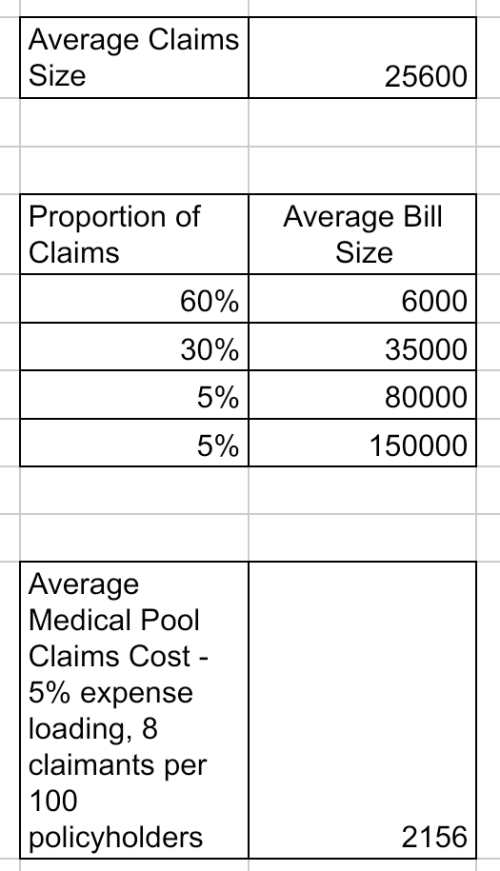
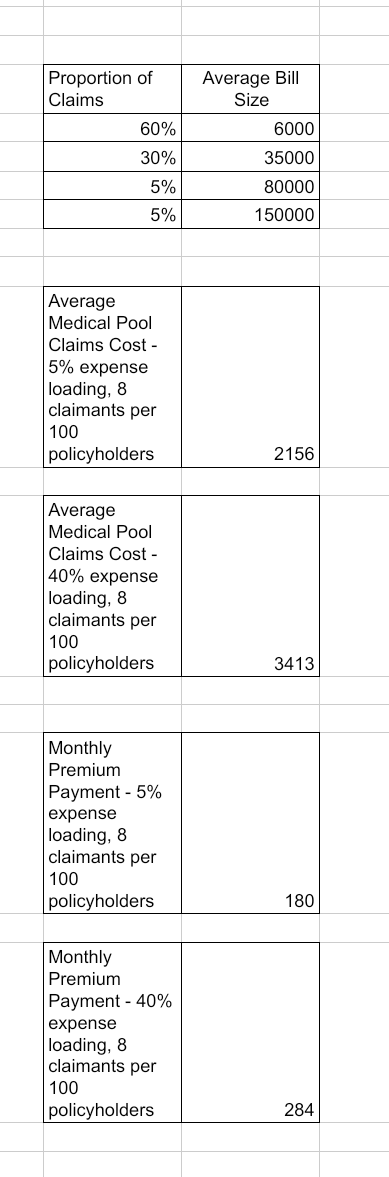
The misconception is that our fees are bankrupting patients. Just an example of range of fees, about 60 per cent of hospital bill sizes fall below RM10,000 (mainly medical admissions), 30 per cent between RM10,000 and 50,000 (simple surgeries), and 5 per cent RM50,000 and RM100,000 (complex surgeries),

Only about 3 to 5 per cent of cases actually exceeded RM100,000, and this is when a patient presents with a complicated problem (cardiovascular or neurology) and multi-organ failure that needs end organ support via ventilation, dialysis, interventional radiology (coronary or neuro). These are the bills that generally depletes the savings of our patients, if the insurance is not able to cover the costs.


Using the above bill size distribution and assuming 8 per 100 policyholders make claims (8%) every year, the monthly premium comes up to RM 180 with a 5% loading and RM 280 with a 40% loading (loading for expenses/profit etc.).

It's still going to be somewhat pricy.
» Click to show Spoiler - click again to hide... «

*
QUOTE(hafizmamak85 @ Apr 21 2025, 08:17 PM)
This has been explained before. It's not the big claims that are an issue, it's the more frequent small claims that are causing premium prices to increase. The difference in annual limits at the higher end don't make much of a difference. It all depends on the types of treatments, procedures available. It is not the case, to my mind, that there is a RM  500k treatment option under the 1 million annual limit and another RM 1.5mil treatment option under the 2 million annual limit for the same type of disease/disability burden - and even if that was the case, the frequency of such a disease/disability burden would be minimal enough to not make much of a difference for the purpose of pricing premiums. It would be more impactful from a premium pricing perspective if there were two treatment options, with one being RM 2k and another RM 5k, both covered under the 1 mil and 2 mil annual limit options for the same disease/disability burden, as the smaller claims tend to have a much higher claims frequency and variations in claims severity for the same type of disease/disability burden.
*
QUOTE(hafizmamak85 @ Apr 23 2025, 05:06 PM)
And I'm telling you those champions are probably denying or delaying claims. Just because Generali and others like Etiqa priced those products below or around RM 1.5k doesn't means that you're getting your money's worth. Assuming a 40% margin means a RM 1.6k product is only paying less than RM 1k in average medical pool claims cost. Probably most of their claims are below 30k. You're buying it at your own peril. So please be aware. Do ask on their average claims payout, average medical pool claims cost and other key statistics.
*
hafizmamak85
post May 8 2025, 09:01 PM

Casual
***
Junior Member
463 posts

Joined: Nov 2009

QUOTE(jutamind @ May 8 2025, 07:56 PM)
I do share the same believe with you partially but CI payout probably helps if you are unable to work short/long term due to dreaded disease but not permanently/temporarily disabled in the sense of TPD

CI is another expensive product which I might eventually cut during advance age to sustain my medical card longer
*
The language in the disability contract I believe does cover for inability to do activities of daily living whether temporarily or permanently. Correct me if I am mistaken.

If not, it can always be amended to cover all those CI episodes from a disability perspective. Like, when there is a need to take leave for convalescence or treatment or other medical reasons or if cannot continue work as before anymore due to CI, maybe they are only 50 - 60% of their previous capability/capacity, the language in the contract can me amended to account for those scenarios.

The problem with the current CI design is that a diagnosis based claims payout can be truly unnecessary.

A stage 4 cancer diagnosis does not automatically mean the person is disabled or cannot continue his or her life as before.

Treatments now can mean really good chance of recovery. Maybe they have brain fog n some other issues, but can still do activities of daily living and continue work at 80% previous capability/capacity.

This post has been edited by hafizmamak85: May 8 2025, 09:12 PM
hafizmamak85
post May 9 2025, 10:17 AM

Casual
***
Junior Member
463 posts

Joined: Nov 2009

QUOTE(togekiss @ May 9 2025, 09:53 AM)
if bigger players like malaysiakini is too afraid in taking up the matter, may i suggest the smaller ones like cilisos. i've seen them touch on more complex topics before.
https://cilisos.my/contact/
*
I don't see how they would respond any differently. Local media outfits are usually constrained.

Cilisos, FMT, BFM & The Edge Media Group outlets, The Star Media Group outlets, The Fourth can always interview Ong Kian Ming and Tony Pua and find out for themselves.

Aren't they supposed to be interested in exposing corruption???

Or maybe the owners of these media outlets don't want to whip their own stable horses.


Tony Pua said that he met up and discussed, presumably with Great Eastern's management, the setting up of the mySalam scheme.

Maybe this Oxford PPE rockstar can help us understand the thought process behind not going to court 'court' and appointing a 'kangaroo court' to settle the 'Resolution of Great Eastern's Estate(s)' issue .

I look forward to Tony Pua footing the RM 2.37 billion and more restitution and compensation bill.

And Guan Eng. Guan Eng needs to foot the bill too. He must have given his greenlight to Great Eastern using the estate to fund mySalam.

He did exempt Great Eastern from the divestment condition even before the conclusion of the so-called 'independent review panel'.


Great Eastern exempt from foreign ownership ruling after pledging RM2 bil to B40 health scheme

QUOTE(hafizmamak85 @ May 8 2025, 02:15 PM)
The BNM senior management personnel who wrote this reply to me is still in BNM.

Maybe Tony Pua and Ong Kian Ming can tell us more about this plan.

But I must make it clear that there is no abuse of the Par fund estate. It is an exercise to reduce the size of the estate, and distribute the proceeds to policyholders as well as to the IDF and shareholders....

There are also precedents in the UK where orphan estates have been distributed/reattributed, which were carefully studied in coming up with the current exercise......

If some of the savings from not going through a lengthy court process (which involves expensive lawyers which have to paid from the estate funds) can be channelled to the B40 group in a way that helps them meaningfully, I would consider it an improvement on the UK experience, while being no worse off for policyholders.

*
QUOTE(hafizmamak85 @ May 7 2025, 03:38 PM)
This is really tragic and comical at the same time.

KJ, Kian Ming & Tony Pua Are Your New Lecturers (Sort Of) At Taylor’s PPE Bachelor’s Programme

Ong Kian Ming and Tony Pua are now lecturing for Taylor's Philosophy, Politics and Economics (PPE) Program.

TP (Part 3: Tony Pua responds to Tun M): I would listen and bring the proposals back to the minister for consideration. Many excellent proposals were sourced via these meetings. These would include the setting up of a RM2 billion MySalam critical illness and hospitalisation fund for the B40, contributed by the insurance industry. This fund has benefited more than 120,000 Malaysians to date…..I would however avoid parties who are only interested in securing contracts via direct negotiation with the government. The minister would always tell me to inform them that in the event the government is interested in the project, an open tender would be called, and they would be invited to participate.

There was no open tender for the mySalam scheme, even after two years of being in operation. This was the finding and opinion of the Auditor General in the LAPORAN KETUA AUDIT NEGARA 2019 SIRI 2.

Tony Pua And Dr Ong Kian Ming Are Helping Out The Finance Ministry For Free

Maybe these two champions can provide their PPE students a detailed international relations, geo-economic/strategic/political and local political/strategic analysis of allowing Great Eastern Malaysia to:

- Swindle RM 2.37 billion from their participating policyholders to fund the mySalam scheme;

- Providing Great Eastern Malaysia RM 569 million in income tax exemption for the amount transferred from the participating fund to fund mySalam; and

- Awarding Great Eastern Takaful the contract to run mySalam without going through an open tender (direct negotiation) and which benefited Great Eastern Takaful through probably over RM 150 million in wakalah (management) fees.

Perhaps also delve into whether mySalam helped PH gain Malay heartland support.

Also, they should do an analysis on why BNM has failed in getting the other foreign insurers to either divest or contribute to the mySalam trust fund.

Our national brain trust. Best believe them.

All jokes aside, this is a very serious matter.

Our Central Bank (BNM) truly did conspire with MOF, Great Eastern Malaysia and Great Eastern Singapore to misappropriate RM 2.37 billion @3 March 2020 from participating policyholders within Great Eastern Malaysia's closed participating funds.

I hope anyone coming to this forum and chancing on this post takes the time to truly understand what happened.

It's not something to be scoffed at or ridiculed.

By all means, please be sceptical of all claims, including mine.

Question everything, but please keep an open mind to what is being presented.

Follow the evidence.

There are plenty of official accounts, including disclosures within Great Eastern Malaysia's financial statements and annual reports that would corroborate, at the very least, the transfer of RM 2.37 billion from their participating funds on 3 March 2020 and subsequent payment of the same amount by Great Eastern Singapore to the mySalam Trust Fund on 5 March 2020.

Please read the following articles within Murray Hunter's Substack to understand what happened.

Billions up in the air? Why haven't other foreign insurers operating in Malaysia complied with the divestment condition?

Guest Editorial: Will Bank Negara Malaysia (BNM) be putting pressure on AIA, Prudential, Tokio Marine, Zurich, Chubb and AIG to contribute to the mySalam Trust Fund?

*
This post has been edited by hafizmamak85: May 9 2025, 04:19 PM

21 Pages « < 17 18 19 20 21 >Top
 

Change to:
| Lo-Fi Version
0.5335sec    0.45    7 queries    GZIP Disabled
Time is now: 13th December 2025 - 05:46 AM