

 Oct 23 2020, 11:19 AM, updated 5y ago


1.0 Speakers
1.1 Types of Speakers
1.1.1 Active Speaker - Also known as powered speaker where there are build in amplifier within the speaker cabinet itself. Its easily recognized as this type of system comes with power cord. Most of the PC speakers system are active speakers. Popular among newbies as you will get close to perfect audio output with proper pairing of amplifier and drivers done directly by manufacturer.
1.1.2 Passive Speaker - Speakers that required external device (amplifier) to power them. This type of speaker open up more possibility in trying and upgrading. This is like a DSLR with interchangeable lens. When you change the lens (speaker) it give you different output, or you take the same lens (speaker) to another camera body (amplifier), it give you another kind of feel. Popular among old timer with experience in audio field.
1.1.3 Hybrid Speaker - Combination of passive and active speaker within the same cabinet. Rare but brand like Definitive Technology produce such speakers. Binding post for passive connection with LFE input for powered sub.
1.2 Speakers Parts
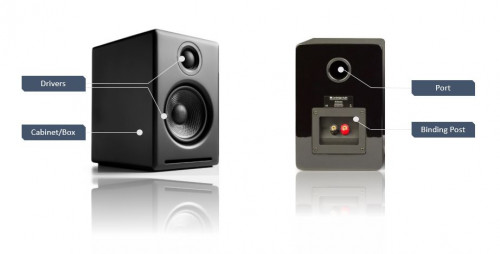
1.3 Speakers Spec
1.3.1 Frequency Response - Human audible frequency range is between 20hz to 20khz. A proper audio setup is trying to mimic what we can hear and often divide the range into 3 groups from low (bass), mid (vocal) and high (treble). Ideally, a proper speaker design should be capable to produce frequency between 20hz to 20khz (or try to get close to it) without any dip in volume in any frequency level. However, in reality, we often will observe dip in low frequency where the normal drive isn't capable to drive low frequency loud (due to the power demand, due to physical size, etc etc). Hence, subwoofer comes into picture to cover the low frequency.

There are cases where some speaker flag themselves with frequency response >20khz and classified themselves "hi definition speaker". Well, most probably you cant hear the high frequency with your ear but manufacturer claims that this help on high frequency positioning. Similarly some subwoofer can dive below 20hz, you may not be able to hear it but you will certainly feel the vibration from these low frequency if you are sitting close enough.
In speaker spec, the wider the frequency range, the better/fuller the speaker will sound. Professional speaker manufacturer often will share their frequency response graph. db vs frequency response graph. This graph is useful to tell how good the speaker perform in all frequency range. If you see a dip in the graph, most likely you will experience muddiness when your music is being play at that frequency. Similarly, if you see peak in the graph, you will experience that part of frequency is brighter as compare to other frequency. Understanding of frequency response graph will allows you to compare different types of speakers and see how well they perform against one another.
1.3.2 Nominal Impendence - the resistance of the speaker. Often goes from 2 ohm, 4 ohm, 6 ohm to 8 ohm. The higher the number the more resistance and required more power to drive this speakers. You can imagine 2 ohm speakers is like a car carrying 2 person and 8ohm speaker carrying 8 person in the same car. Will impendence affect the sound quality? Unlikely, its mode to the design of the speaker. In general, we wont says 8ohm will sound better than 4 ohm or like wise.
Understanding impendence is important because you need to know if your amplifier is capable in driving your speakers. If you have a 4ohm capable amplifier and you have 8ohm speakers, your amplifier may work extra hard to drive the speaker to your listening volume. Modern amplifer/avr often capable wide range of speaker impendence. However, understanding impendence will help you to read and understand amplifier power output rating. These amplifier often advertise themself with the highest output while connecting to their lowest supported impendence speaker output. If an amplifier advertise the capability to deliver 125w to 6ohm but if you are having a 8ohm speaker connected, you will only get 95w for your speaker.
1.3.3 Recommended Power - the required power to drive the speaker. Normally its a range between 20W to 300W. Normally determined by the speaker sensitivity and driver size. Bigger the driver, the more power it required.
Underpower - small amplifier driving big speaker. If you are playing high high volume (most likely you will because the amp is need to push hard to drive the speaker), the amplifier will lose it efficiencies, and clipped signal will be send to speaker and can cause irreversible damage to speaker (tweeter normally will go first).
Overpower - big amplifier driving small speaker. Although this often is the ideal case but playing it too hot will damage your driver coil.
1.3.4 Finishing - this contribute to the look of the speaker and play minimal effect to the sound of the speaker. Entry level speakers often made from compressed mdf board for its cabinet. Expensive speaker use solid wood and some uses rare wood for their cabinet finishing. Often, the sound that we hear from the speaker is not 100% coming from the driver itself but also the resonance within the speaker cabinet itself. That's why the same driver if its being place on a bookshelf cabinet will sound different if the driver are being installed on a floorstand speaker.
1.3.5 Sensitivity - This is a reference value provided by manufacturer to tell you how easy the speaker can be driven. Normally its being measure in dB. The higher the number the easily it can be driven. Speakers are given same power and being SPL output being measure at the same distance to give this reference value.
1.4 Speakers Terminal
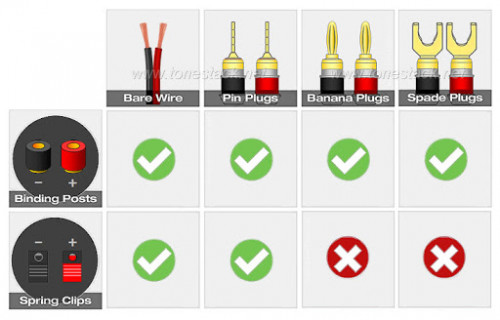
This is where you will connect your speaker wire. There are 2 types of common terminal.

The right terminal is the spring clip and the right terminal is the binding post.
1.4.1 Spring clip is often found in entry level speaker with limited option of connector available. Will discuss this is speaker cable chapter.
1.4.2 Binding post is often provided with higher ends speaker that support more speaker cables connectors.
Some high end speakers often come with more than 1 set of terminal.
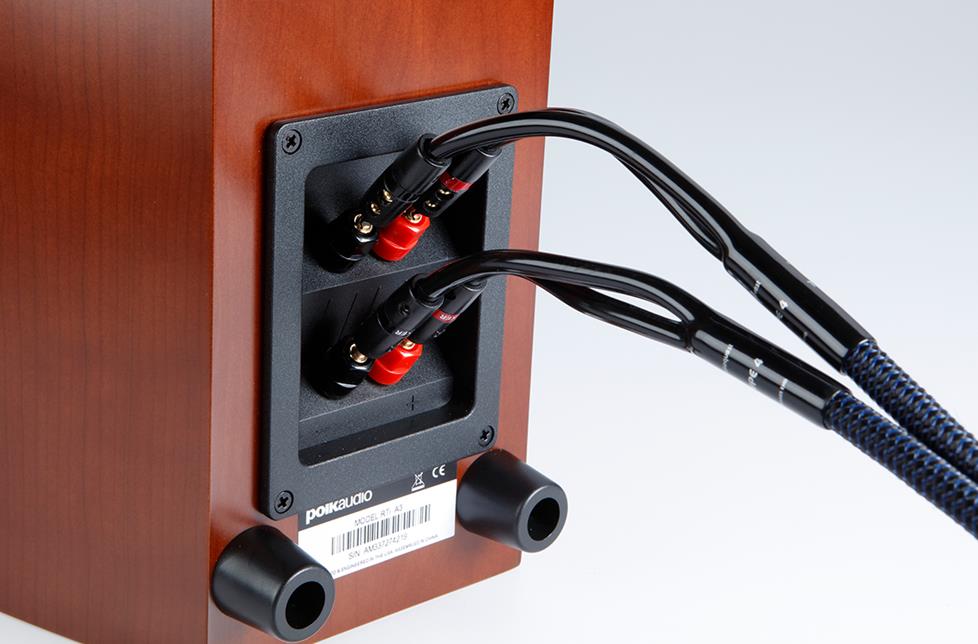
This kind of speakers terminal will allow you to do bi-amp/bridge connection. Split the terminal to drive high frequency and low frequency to maximize your speaker potential.
Take note the polarity - red vs black. Mixing up the polarity will cause your driver to be push in a different way causing very thin sound and you will feel the lack of bass.
1.5 Cabinet Design
1.5.1 Sealed Cabinet - Sealed cabinet design doesn't have air vent / port in the cabinet of the speaker. This kind of design will allow more flexibility in the placing of speaker. Also, you will expect tighter low frequency with better control of the driver.
1.5.2 Ported Cabinet - Ported cabinet design will have 1 or more air vent / port for air to be push out from the cabinet generated by the movement of your driver. You need to be careful where you are going to place speaker with ports. The ports shouldnt be blocked by your external furniture. Thus, its not recommended for ported speaker to be placed close to wall (for rear port design) or being place in an enclosed cabinet. Speaker with ported cabinet design often will provide wider frequency response compare to sealed cabinet design.
1.6 Speakers Layout
How many speakers i need to buy? the more the better?
1.6.1 Stereo HiFi - If you are serious in music only experience, the basic setup would be Stereo (2 speakers left and right). You can also extend it to 2.1 (2 bookshelf or floorstand speakers + 1 subwoofer) OR 2.2 (2 bookshelf or floorstand speakers + 2 subwoofers). Normally, we wont setup more than 2 speakers for our main system, as anything more than that is going to be complicated having the frequency response interfering one and another causing peak/null for some frequency range.
1.6.2 Home theater - 5.1? 7.2.4? What does the number stand for?
X.Y.Z
X stands for number of speakers that you have for traditional surround effect for your movie listening. Conversation, music, sound effect will be played from these speakers. Each speakers will have their role to play in a surround system.
Y stands for number of low frequency capable sub woofer. This gives the impact to your movies on action movies - gun firing scene/explosive scene.
Z stands for number of speakers that you have setup for sound effect that comes from the top of your main listening position. This is relatively new format only being introduced for object based surround technology (Atmos / DTS:X)
If you are starting on a budget for home theater, you can start with configuration below by sequence:
1) AV Receiver + 1 pair of bookshelf/surround speakers (bookshelf normally more expensive and have better frequency response compare to surround speaker)
2) Center
3) Mains/Fronts (can be a floorstand and demote your existing bookshelf to make it your surround)
4) Surround back / height / Atmos speaker
After step 1 the sequence is interchangeable and if you pay enough attention here, i may have left-out subwoofer. I do not have a recommendation on when you should be buying your subwoofer. It can as early as step 2 and it can be as late as step 3 or even after step 4. Its up to you to decide, if you think low frequency is more important than center, you can push back center after you have your subwoofer. Put more weightage of budget over critical speakers like center / fronts / subwoofer where most of the sound will be focused on. For tonal balance, you are encourage to use the speaker from the same brand if not same model family. Tonal balance is important for surround, esp. when you are experiencing a Ferrari being drive from left to right on your screen and your sound that you hear is different when the sound span from your left to center then to right again. The selection of AV receiver is important when it comes to the number of speakers you plan to install along your upgrade path.

This post has been edited by kevinlim001: Jan 22 2021, 11:53 AM
 Quote
Quote
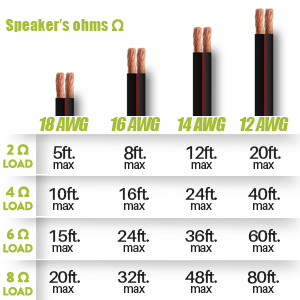

 0.0145sec
 0.73
0.73
 5 queries
 GZIP Disabled