-On 30 April 1975, the Vietnam War ended with the evacuation of the American Embassy and the fall of Saigon to the North Vietnamese Army.
-Millions of people tried to flee the new Communist rule in Vietnam. In May 1975, the first boat with 47 refugees arrived in Malaysia from Vietnam. They were called “boat people.”
-However, the number of boat people fleeing Vietnam was relatively small until 1978. Bidong Island was officially opened as a refugee camp on 8 August 1978 with 121 Vietnamese refugees.
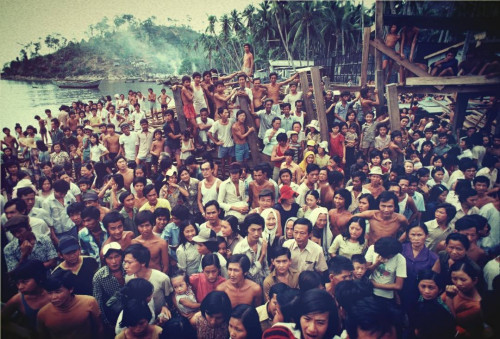
-The capacity of the camp was said to be 4,500. Another 600 refugees arrived in August and thereafter the arrival of boats from Vietnam was a near daily occurrence.
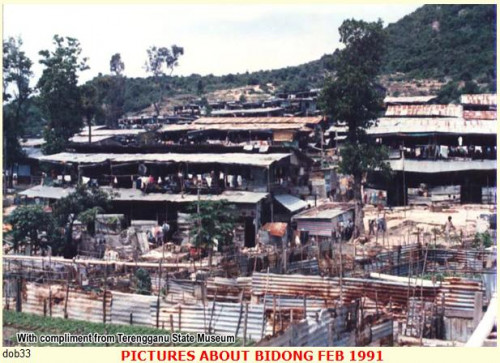
-By January 1979, there were 18,000 Vietnamese on the island and by June 1979 it was said to be the most heavily populated place on earth with about 40,000 refugees crowded into a flat area hardly larger than a football field
-The arrival of new refugees to Bidong and other locations in Southeast Asia decreased after June 1979.
-A Geneva Convention held in July 1979 resulted in Vietnam agreeing to restrain the flow of refugees and the Southeast Asian countries agreeing to take all those who came to their shores provided that the Western countries guaranteed resettlement for the majority of them.
-By the time Bidong was closed as a refugee camp on 30 October 1991, about 250,000 Vietnamese had passed through or resided in the camp.
-With the closing of the camp, the remaining refugees in Malysia were repatriated back to Vietnam. The refugees strongly protested their forced repatriation. A total of 9,000 Vietnamese were repatriated between 1991 and 28 August 2005 when the last refugees departed for Vietnam.
Another camp , its presently Bukit Jalil/ Technology Park area.
Astro to be more exact. Last time when drove by, my dad will point out the place to us. Alot of refugees leaning on the balcony would look at cars drive by as we too look at them when we drive by
Astro to be more exact. Last time when drove by, my dad will point out the place to us. Alot of refugees leaning on the balcony would look at cars drive by as we too look at them when we drive by
» Click to show Spoiler - click again to hide... «
KUALA LUMPUR, June 25 1996 -- The Sungai Besi Vietnamese transit camp was officially closed Tuesday with the repatriation to Hanoi of 22 boat people, the last batch of refugees to leave Malaysia. The closure of the camp ends the Vietnamese illegal immigrant saga in Malaysia and also brings an end to the United Nations-initiated Comprehensive Plan of Action under which all Indochinese refugees must be repatriated by June 30.
The dateline was set by the U.N. High Commissioner for Refugees when the agency announced it will stop funding camps throughout Southeast Asia. Malaysia's Foreign Malaysia Abdullah Ahmad Badawi, U.N. Assistant High Commissioner for Refugees Sergio Viera de Mello and the Malaysian Red Crescent Society Chairman Hamid Omar attended the brief ceremony at the camp where the UNHCR and Red Crescent flags were lowered to officially mark its closure. 'Malaysia is the first country to successfully implement the CPA,' Red Crescent Assistant Secretary-General Abdullah Shamsuddin said. Besides the last batch of Vietnamese illegal immigrants, arrangements were being made to repatriate 30 Cambodians from the camp and to send 103 refugees to third countries, he said. The Red Crescent Society is the main agency assisting the UNHCR in tackling the problem of Vietnamese boat people who began landing in Malaysia in 1975. With the departure of the last batch of the boat people from Malaysia, the country has sent 248,194 to third countries and repatriated 9,592. Malaysia is the first country in the region to close its Vietnamese refugee camps. Thailand still has 5,000 Vietnamese refugees, the Philippines has 4,300, Indonesia 4,000 and Hong Kong 18,000.
» Click to show Spoiler - click again to hide... «
Over the weekend, Doan Van Viet became the last of the over 250,000 Vietnamese “boat people” to leave Malaysia. Unlike many friends and relatives who chose to be relocated to other countries over the years, Doan opted to return to Viet Nam to marry his fiancée and reunite with his long-lost family.
By Bram Steenhuisen | 30 August 2005
KUALA LUMPUR, Malaysia, August 30 (UNHCR) - The scene at Kuala Lumpur International Airport on Sunday could have happened in any airport, in any country - a group of people gathering to bid farewell and good luck to a departing friend.
Except the departure of this man - 43-year-old Doan Van Viet - marked a significant moment in Malaysia’s history. Doan was the last remaining Vietnamese refugee in Malaysia out of over 250,000 Vietnamese refugees who had landed on the eastern shores of Malaysia some 20 years ago.
In May 1975, Malaysia’s shores saw the arrival of the first weather-beaten boat, carrying 47 people from Viet Nam. They were the first of what later came to be known as the “boat people”, hundreds of thousands of Indo-Chinese refugees who fled to neighbouring countries in the successive communist victories in Viet Nam, Cambodia and Laos.
“Life was very hard for us back home. We were always harassed by the authorities. I was imprisoned for seven months because the authorities suspected that I was arranging illegal departures for people,” Doan said. “When I was released, I was scared for my life and I left with my brother.”
Doan’s life in Malaysia began in 1984, when the boat he travelled in washed up on the shores of Pulau Bidong, off the coast of Terengganu in Malaysia. He was 22 then, having fled his home in Chau Thanh in Dong Nai with his brother several days before. In the refugee camp on Pulau Bidong, Doan took classes to learn English and auto mechanic skills.
Looking back, he stressed that he had a very happy time in Malaysia. His ability to speak two local languages, Bahasa Malaysia and Cantonese, helped him fit in, but finding work was still a challenge as Malaysian immigration laws do not distinguish between refugees and undocumented migrants.
When the Pulau Bidong camp closed in 1990, he moved to Sungai Besi. This camp was also closed in 1996, and he had to blend in to local Malaysian life outside the camp.
Twenty years after he fled Viet Nam, Doan is finally returning home with his fiancée, an event welcomed by UNHCR’s Representative in Malaysia, Volker Türk.
“The voluntary repatriation of the last Vietnamese refugee from the boat people period marks the end of an important chapter in the history of refugees in Malaysia,” said Türk. “It also shows that a permanent solution can be found for a refugee situation. The fact that Doan Van Viet now has reason to be optimistic about his future is in part due to the efforts of UNHCR staff in Malaysia over the past 20 years. I wish Doan Van Viet and his partner all the very best for rebuilding their lives in Viet Nam.”
Doan himself expressed his happiness to return and is looking forward to starting a new life. “I want to go home to legally marry her,” he said, smiling at the Vietnamese woman he met in Malaysia after she arrived there as an illegal migrant in 2003. “Going back also enables me to be close to my family who I have not met since I left home.”
Doan will be met in Viet Nam by his sister.
“I have watched many friends leave Malaysia to be resettled in other countries. My own brother is in France,” he said when asked about his decision to finally return to his roots. ‘I feel now is the time to return home with my fiancée to start a new life.”
Since 1975, the UN refugee agency has helped resettle some 240,000 Vietnamese refugees from Malaysia to third countries, while some 9,000 others opted to return to Viet Nam.
Not mistaken there is also a Vietnamese refugee camp at 22nd mile Jalan Kuantan-Kemanan back in 1981. Also at Jalan Sg Besi (near Sg Besi toll and now become Petronas station) where they stage a protest on the highway in 1995.
» Click to show Spoiler - click again to hide... «
KUALA LUMPUR, June 25 1996 -- The Sungai Besi Vietnamese transit camp was officially closed Tuesday with the repatriation to Hanoi of 22 boat people, the last batch of refugees to leave Malaysia. The closure of the camp ends the Vietnamese illegal immigrant saga in Malaysia and also brings an end to the United Nations-initiated Comprehensive Plan of Action under which all Indochinese refugees must be repatriated by June 30.
The dateline was set by the U.N. High Commissioner for Refugees when the agency announced it will stop funding camps throughout Southeast Asia. Malaysia's Foreign Malaysia Abdullah Ahmad Badawi, U.N. Assistant High Commissioner for Refugees Sergio Viera de Mello and the Malaysian Red Crescent Society Chairman Hamid Omar attended the brief ceremony at the camp where the UNHCR and Red Crescent flags were lowered to officially mark its closure. 'Malaysia is the first country to successfully implement the CPA,' Red Crescent Assistant Secretary-General Abdullah Shamsuddin said. Besides the last batch of Vietnamese illegal immigrants, arrangements were being made to repatriate 30 Cambodians from the camp and to send 103 refugees to third countries, he said. The Red Crescent Society is the main agency assisting the UNHCR in tackling the problem of Vietnamese boat people who began landing in Malaysia in 1975. With the departure of the last batch of the boat people from Malaysia, the country has sent 248,194 to third countries and repatriated 9,592. Malaysia is the first country in the region to close its Vietnamese refugee camps. Thailand still has 5,000 Vietnamese refugees, the Philippines has 4,300, Indonesia 4,000 and Hong Kong 18,000.
» Click to show Spoiler - click again to hide... «
Over the weekend, Doan Van Viet became the last of the over 250,000 Vietnamese “boat people” to leave Malaysia. Unlike many friends and relatives who chose to be relocated to other countries over the years, Doan opted to return to Viet Nam to marry his fiancée and reunite with his long-lost family.
By Bram Steenhuisen | 30 August 2005
KUALA LUMPUR, Malaysia, August 30 (UNHCR) - The scene at Kuala Lumpur International Airport on Sunday could have happened in any airport, in any country - a group of people gathering to bid farewell and good luck to a departing friend.
Except the departure of this man - 43-year-old Doan Van Viet - marked a significant moment in Malaysia’s history. Doan was the last remaining Vietnamese refugee in Malaysia out of over 250,000 Vietnamese refugees who had landed on the eastern shores of Malaysia some 20 years ago.
In May 1975, Malaysia’s shores saw the arrival of the first weather-beaten boat, carrying 47 people from Viet Nam. They were the first of what later came to be known as the “boat people”, hundreds of thousands of Indo-Chinese refugees who fled to neighbouring countries in the successive communist victories in Viet Nam, Cambodia and Laos.
“Life was very hard for us back home. We were always harassed by the authorities. I was imprisoned for seven months because the authorities suspected that I was arranging illegal departures for people,” Doan said. “When I was released, I was scared for my life and I left with my brother.”
Doan’s life in Malaysia began in 1984, when the boat he travelled in washed up on the shores of Pulau Bidong, off the coast of Terengganu in Malaysia. He was 22 then, having fled his home in Chau Thanh in Dong Nai with his brother several days before. In the refugee camp on Pulau Bidong, Doan took classes to learn English and auto mechanic skills.
Looking back, he stressed that he had a very happy time in Malaysia. His ability to speak two local languages, Bahasa Malaysia and Cantonese, helped him fit in, but finding work was still a challenge as Malaysian immigration laws do not distinguish between refugees and undocumented migrants.
When the Pulau Bidong camp closed in 1990, he moved to Sungai Besi. This camp was also closed in 1996, and he had to blend in to local Malaysian life outside the camp.
Twenty years after he fled Viet Nam, Doan is finally returning home with his fiancée, an event welcomed by UNHCR’s Representative in Malaysia, Volker Türk.
“The voluntary repatriation of the last Vietnamese refugee from the boat people period marks the end of an important chapter in the history of refugees in Malaysia,” said Türk. “It also shows that a permanent solution can be found for a refugee situation. The fact that Doan Van Viet now has reason to be optimistic about his future is in part due to the efforts of UNHCR staff in Malaysia over the past 20 years. I wish Doan Van Viet and his partner all the very best for rebuilding their lives in Viet Nam.”
Doan himself expressed his happiness to return and is looking forward to starting a new life. “I want to go home to legally marry her,” he said, smiling at the Vietnamese woman he met in Malaysia after she arrived there as an illegal migrant in 2003. “Going back also enables me to be close to my family who I have not met since I left home.”
Doan will be met in Viet Nam by his sister.
“I have watched many friends leave Malaysia to be resettled in other countries. My own brother is in France,” he said when asked about his decision to finally return to his roots. ‘I feel now is the time to return home with my fiancée to start a new life.”
Since 1975, the UN refugee agency has helped resettle some 240,000 Vietnamese refugees from Malaysia to third countries, while some 9,000 others opted to return to Viet Nam.
By Bram Steen UNHCR Malaysia
give them a place to stay somemore dare to riot and kacau? wtf?
this one macam those refugees in EU, can go rape and plunder some more
wtf knnccb... these people should just get shot dead on the spot la
fuckers all... got free stay d some more dare to bising
You can't blame Tun. HK suffered the most from boat people because of their liberal policies of accepting them in the beginning. The vietnamese boat people camps at HK were the worst and suffer from all sorts of violence when HK government implement forced repatriation.
But the first generation of boat people also produced some famous HK people such as Tsui Hark and Ray Lui.
those are most likely vietnamese chinese ppl, thr r alot of chinese ppl in vietnam too
yeah they can speak cantonese surprisingly... chat with a grandma and she said during the war she first came to malaysia.. stayed for a few years and then moved on to paris.
Astro to be more exact. Last time when drove by, my dad will point out the place to us. Alot of refugees leaning on the balcony would look at cars drive by as we too look at them when we drive by
So they torn off the centre and rebuilt the Astro's office?
yeah they can speak cantonese surprisingly... chat with a grandma and she said during the war she first came to malaysia.. stayed for a few years and then moved on to paris.
In Saigon, many Vietnamese Chinese speaks Cantonese.


 Oct 30 2019, 09:07 AM, updated 7y ago




 Quote
Quote














 All the white girls looking for free citizenship... good times good times





 0.0245sec
 0.42
0.42
 5 queries
 GZIP Disabled