Welcome Guest ( Log In | Register )

Outline · [ Standard ] · Linear+

Chat CIMB kena hack?

views
     
okuribito
post Dec 17 2018, 07:54 PM

Regular
******
Senior Member
1,021 posts

Joined: Mar 2010
QUOTE(se7en @ Dec 17 2018, 12:55 PM)
will just leave this here for now

user posted image
*
I guess this code snippet was lifted off the net today? ie current code, right?

Haven't read all posts here, but remember reading something about a recent change by CIMB to allow longer pw & with special characters?

And because some incompetent coder wrote the above snippet, hence the exploit was created?

Help me understand the logic...

if PW is at least 8char long, and includes special chars, then the entire pw string is passed to encryption function

if PW is at least 8char long, and dun include special chars, then the long pw is truncated & the front 8char string is passed to encryption function

if PW is < 8char long eg 7char or less, irrespective got special characters or not, then what happens? Won't password = password.substring(0, 8) evaluate to #error? Previously, wasn't there a minimum # of characters for passwords ie 8?

PS: i dunno coding. only trying to make sense of the if-then-else which is also used in excel tongue.gif
okuribito
post Dec 17 2018, 08:26 PM

Regular
******
Senior Member
1,021 posts

Joined: Mar 2010
QUOTE(peja5081 @ Dec 17 2018, 07:57 PM)
hahaha TQ


QUOTE(rooney723 @ Dec 17 2018, 08:02 PM)
this was wat i assumed when i read the code too, but i guess the checking for the password length <8 chars is already done before calling this function hence the password will always be more than 8 chars when reach this point and wont come out wif string < 8 chars error

the logic of the code shows that it will take the first 8 chars and ignore the rests if the password contains no special characters, but it will take the whole password without truncation if it contains special characters
*
Thanks bro, but can pls help explain the IF statement ....
CODE
if (format.test(password) && pasword.length >= 8)

Doesn't the && operator mean that BOTH conditions must be met in order to use the entire string entered by user?

And if "checking for the password length <8 chars is already done before calling this function" then why include the password.length >= 8 condition in this IF statement? Redundant or not?

In se7en's article, he also say "IF password CONTAINS SPECIAL CHARCTERS, ACCEPT WHOLE password," implying length already check b4hand.....

LOL the coder that dumb ka???

PS: once again, hor, me dunno coding
okuribito
post Dec 17 2018, 08:49 PM

Regular
******
Senior Member
1,021 posts

Joined: Mar 2010
QUOTE(Quantum Geist @ Dec 17 2018, 08:43 PM)
it could be compared to a hash of the pin
*
just like they dun actually store our passwords but the hash of our passwords, right?? LOL or do they ohmy.gif
okuribito
post Dec 17 2018, 09:03 PM

Regular
******
Senior Member
1,021 posts

Joined: Mar 2010
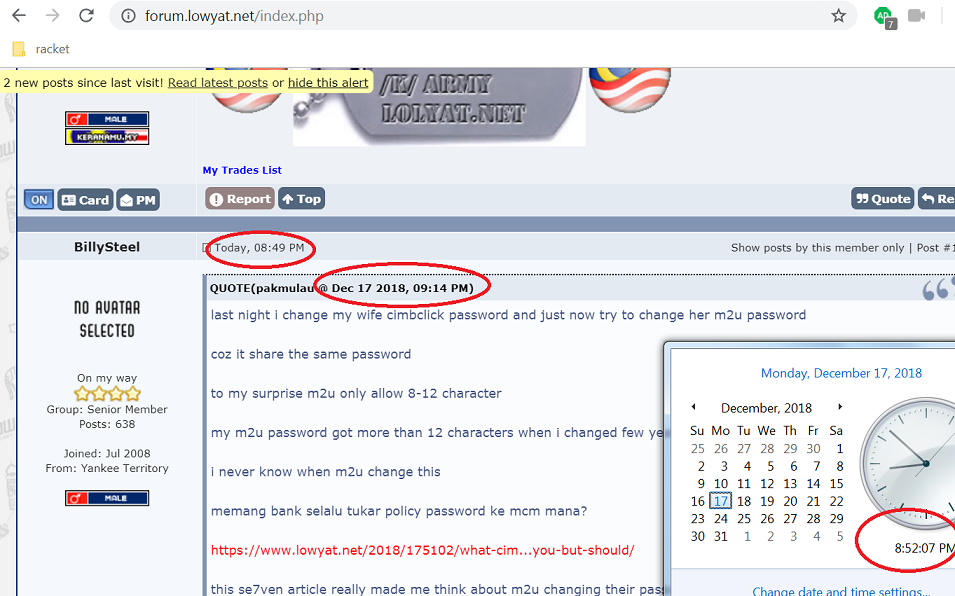
adoi, have I been online for too long? what's with the funky timestamps? billysteel quoted a post from the future ka?

user posted image
okuribito
post Dec 17 2018, 09:15 PM

Regular
******
Senior Member
1,021 posts

Joined: Mar 2010
QUOTE(agewisdom @ Dec 17 2018, 09:04 PM)
Ok, I see now.

The password issue is due to some customers with weak passwords such as an all numerical password getting compromised. What I still don't get then is that CIMB didn't implement the 'three strikes and you're out' system? I mean this is done for ATM cards. Why not for their online banking?  hmm.gif
*
because they dunno who to ban? the offending user's identity not established, right?

or do they ban based on your device id? any more tries from ur device will be disallowed to proceed for next x periods?

QUOTE(agewisdom @ Dec 17 2018, 09:12 PM)
I see. So, if the usual process is done, you would notified via SMS on your handphone.
*
I just read on FB someone complain his hp contact # for his cimb acct was changed without his knowledge. Come to think of it last time my Ambank account also experience the same thing. so lesson learnt is to go do some transaction regularly to test if still get OTA/TAC on own phone

This post has been edited by okuribito: Dec 17 2018, 09:19 PM
okuribito
post Dec 17 2018, 09:22 PM

Regular
******
Senior Member
1,021 posts

Joined: Mar 2010
QUOTE(agewisdom @ Dec 17 2018, 09:17 PM)
You would need to key in your username? If that's compromised by some baddie, too bad. You would have to call customer service to reset. Isn't that the norm? Or at least like you said, disallow for x period.
*
lidat i think cannot ler. If i know your username (eg I have a keylogger planted in your system) & i wanna sabo u, i login & give silly pw few times. u'll get locked out oso dunno why tongue.gif
okuribito
post Dec 18 2018, 12:32 AM

Regular
******
Senior Member
1,021 posts

Joined: Mar 2010
QUOTE(miloaisdino @ Dec 17 2018, 11:01 PM)
the code posted by se7en means:
If your password does NOT contain special characters OR is set before 18nov, only the first 8 alphanumeric characters are needed for login (ie alot of bruteforce attacks are going to happen)
*
The matrix say passwords pre 18Nov must be exactly 8 character long & special character is not a requirement - that means cannot be less or more than 8 character BUT special characters are allowed but not mandatory, right?


user posted image

QUOTE(jesserider223 @ Dec 17 2018, 11:35 PM)
quoted post was year 2020, anyway i realized now
*
so how did JohnLai do it? so what if he's overseas? How it work? damn curious laugh.gif

This post has been edited by okuribito: Dec 18 2018, 12:33 AM
okuribito
post Dec 18 2018, 01:03 PM

Regular
******
Senior Member
1,021 posts

Joined: Mar 2010
QUOTE(Hobbez @ Dec 18 2018, 02:34 AM)
Only a few accounts were hacked, but my guess is CIMB is doing damage control when the news break out about how insecure is their accounts. For me, the main problem that I found out is that their passwords only accept the first 8 characters. Which I find out the hard way when I tried to change my password and failed. It keep lying to me and said my ID is invalid (but I could login with that ID).

Let's say your password is 12345678H%&*GGhklp

Anyone can login with your password if they just type in 12345678

If you were stupid enough to put this kind of password, then sorry la....

But CIMB hopes nobody that stupid, so their damage control is to implement that Google Recaptcha to stop brute force password attempts.

And it is easy with bots these days. There are hackers and spammers selling brute force software that they claim can crack most kinds of passwords.

Knowing the length of a password is a big step to cracking it.
*
Something doesn't seem right to me. Everywhere I look, I'm told that passwords are stored after (one-way) hashing (& even salting), never in its original form.

When you originally set up your password as 12345678H%&*GGhklp, it would have been stored as a certain hash. Any slight diff would result in a totally diff hash. (That's why they say they do not know what your password is)

So what boggles me is how someone can get in when he submits 12345678 - the hash for that would definitely be diff from the hash for 12345678H%&*GGhklp ...No?

The only possibility this can happen is IF at the point you originally set up your password as 12345678H%&*GGhklp, it was truncated to 12345678... damn FUBAR, right? Telling ppl to set up long complex pw & truncating to short


okuribito
post Dec 18 2018, 01:17 PM

Regular
******
Senior Member
1,021 posts

Joined: Mar 2010
QUOTE(sevenegg @ Dec 18 2018, 11:32 AM)
this is the answer to my question, now i manage to change the pw successfully. Thanks!

haiyo cimb can really go bang wall this time, thier PR manage it so badly.  doh.gif
*
The password that you set was longer than 8character right? Were you ever able to use your password in full before?
okuribito
post Dec 18 2018, 01:25 PM

Regular
******
Senior Member
1,021 posts

Joined: Mar 2010
QUOTE(Rhetoric @ Dec 18 2018, 01:17 PM)
alot of Malaysia gov sites still save password as plain text. theres been more than one occasion where i forgot password and request for password they just email me the exact password i use instead of some random passkey.
*
hahaha not surprised- gomen dept smile.gif CIMB is a bank ler. If true they store password in original form then BNM should withdraw their licence IMHO. For that matter doesn't BNM do IT system audit on licensed FI's ?
okuribito
post Dec 18 2018, 01:44 PM

Regular
******
Senior Member
1,021 posts

Joined: Mar 2010
QUOTE(boonhan @ Dec 18 2018, 01:30 PM)
I have old password with more than 8 character.

It will still login as long as 8 character infont valid. Hahaha. How nice.
*
so let's say your old pw was 12345678H%&*GGhklp ...

1. before 18 nov, were you able to get in with just 12345678? with 12345678H? or only with 12345678H%&*GGhklp?

2. After 18 nov, were you able to get in with just 12345678? with 12345678H? or only with 12345678H%&*GGhklp?

curious to figure out what cimb is doing tongue.gif
okuribito
post Dec 18 2018, 01:49 PM

Regular
******
Senior Member
1,021 posts

Joined: Mar 2010
QUOTE(Hobbez @ Dec 18 2018, 01:43 PM)
I doubt it. Local bank wholly owned by bumiputra, means they get a "special" card. If they are ever in trouble, govt will bail them out and protek them instead.
*
hahaha let's not go down that road ler. anything that happen to one bank can reverberate throughout the entire system. I'm sure bnm folks realise and understand that

okuribito
post Dec 18 2018, 02:13 PM

Regular
******
Senior Member
1,021 posts

Joined: Mar 2010
QUOTE(OldSchoolJoke @ Dec 18 2018, 01:54 PM)
yesterday se7en got post the code script.
the checking is:-

if got no special characters and >= 8 characters (means new format of password), you will require to type exactly your password
else (old password password), you only need to be correct on the first 8 characters.

meaning if old format of password, any characters behind after 8th characters, if user type in wrongly, user will still be logged in
*
Thx bro, saw that & thinking thru the implications. How does CIMB store passwords? As Is? or after hashing?

If after hashing, old passwords longer than 8char should not be able to get in if just key in first 8 chars. Why? becos the hash would be diff. No? Only way can get in is IF the old password was stored As Is. Wonder if that makes sense hmm.gif


okuribito
post Dec 18 2018, 10:34 PM

Regular
******
Senior Member
1,021 posts

Joined: Mar 2010
QUOTE(okuribito @ Dec 18 2018, 02:13 PM)
Thx bro, saw that & thinking thru the implications. How does CIMB store passwords? As Is? or after hashing?

If after hashing, old passwords longer than 8char should not be able to get in if just key in first 8 chars. Why? becos the hash would be diff. No? Only way can get in is IF the old password was stored As Is. Wonder if that makes sense  hmm.gif
*
QUOTE(brkli @ Dec 18 2018, 02:29 PM)
no, the code snippet does not prove anything on how they store the password. it only shows thier 'lazy' development to do not want to change backend API, so they convert/translate those inputs (for this case password) as front end.
*
QUOTE(silverhawk @ Dec 18 2018, 06:18 PM)
This is not necessarily the case. What the Javascript is doing is encrypting the password for transmission. If you read the code, it also does the same thing for username. You might ask.. why? Its to protect against sniffing or mitm attacks. This way even if an attacker sniffs out your traffic, its not obvious what your actual plaintext username/password is. They can still replay the request to get in, but at least they don't know what your actual username/pass is.. which you might be using for other sites as well.

The backend could then just decrypt the value, then run it through a different hash/encryption algorithm to check against the DB.

The stupid thing about CIMB was having a max limit on password length. Even now it doesn't make sense that its limited to 20 chars, if you're encrypting/hashing passwords the max length shouldn't really matter.
*
silverhawk the encryptedPass = MFPInit.encrypteMY(password) is the encryption u mentioned, right? Curious, isn't that encryption done by the user's browser based on the bank's ssl cert for security during transmission? Based on the fact that pre-18Nov passwords can be used when truncated to 1st 8 characters, I strongly believe they store raw passwords somewhere in their system. If they ONLY store hashes, there's nothing to compare when shortened old passwords are submitted! Did I misunderstand anything?
okuribito
post Dec 19 2018, 12:10 PM

Regular
******
Senior Member
1,021 posts

Joined: Mar 2010
QUOTE(okuribito @ Dec 18 2018, 10:34 PM)
silverhawk the encryptedPass = MFPInit.encrypteMY(password) is the encryption u mentioned, right?  Curious, isn't that encryption done by the user's browser based on the bank's ssl cert for security during transmission?   Based on the fact that pre-18Nov passwords can be used when truncated to 1st 8 characters, I strongly believe they store raw passwords somewhere in their system. If they ONLY store hashes, there's nothing to compare when shortened old passwords are submitted! Did I misunderstand anything?
*
With the benefit of the nasilemakTech rebuttal, they say the truncation to 8 chars is not an issue at all because ALL old passwords are 8chars long anyway.

IF that's true, yeah it's a non issue. But why need slice with substring(0, 8) ??

BUT I asked here and some people said that their old passwords were longer than 8 chars. In which case, logic says that CIMB must have the passwords stored As Is somewhere in their system

So which is it? Were old passwords pre 18Nov exactly 8 chars OR minimum 8 chars (ie longer also got) ??

PS: those who kena unauthorised transactions should flood nasilemak tech with proof / police reports etc (where's the batu api smiley tongue.gif )

PPS: just saw the latest version of se7en's article ... rclxms.gif everything I talked about is there icon_idea.gif

This post has been edited by okuribito: Dec 19 2018, 12:20 PM
okuribito
post Dec 20 2018, 08:09 PM

Regular
******
Senior Member
1,021 posts

Joined: Mar 2010
omg look like a shitstorm out there! what a mess ler
okuribito
post Dec 21 2018, 01:38 AM

Regular
******
Senior Member
1,021 posts

Joined: Mar 2010
QUOTE(aminpro @ Dec 19 2018, 04:06 PM)
» Click to show Spoiler - click again to hide... «

NLT has amended the two articles in question and added a note in the first paragraph for clarity.

https://nasilemaktech.com/cimb-did-nothing-...al-explanation/
https://nasilemaktech.com/debunking-mainstr...never-happened/
*
Adoi, we have the author himself here thumbup.gif LOL I read your 2 articles smile.gif

So in both articles, you imply that old passwords cannot be longer than 8 chars? That means less than 8 chars also can? That's pretty extreme ler ... no minimum length ka? And confirm nobody ever could create passwords > than 8 chars in the past?

In the first article you said "old passwords do not support or contain special characters" Then in your 2nd article you said "old password consists of letters, numbers and symbols(just not a requirement)" Got or not?

TIA
okuribito
post Dec 21 2018, 11:32 AM

Regular
******
Senior Member
1,021 posts

Joined: Mar 2010
QUOTE(silverhawk @ Dec 19 2018, 03:41 PM)
From what I understand, there were 3 steps to this

1. Passwords were allowed to be 8 or more characters
2. Rules changed, passwords allowed MAX 8 characters
3. Rules changed again, passwords allowed 8-20 characters

So if you had a password in (1) that was longer than 8 chars, it was truncated. Maybe the passwords were stored encrypted instead of hashed, so was possible to work out the original password and truncate it for (2).
» Click to show Spoiler - click again to hide... «

*
That makes sense! And I did not even think about storing in encrypted form. But then again, encrypted form is only slightly better than AsIs / plaintext, isn't it? The argument for 1way hash is so that even if server/DB is broken into OR backup media is lost/stolen sweat.gif as rumored, you can still sleep at night. Encrypted means reversible ler. No?

At the end of the day, I think it all hangs on whether passwords were allowed to be > 8 characters in the past (your step1) AND if yes, how they dealt with those when they changed to MAX 8char (your step 2)

IF passwords were never allowed to be >8 char, then this substring slicing code is plain stupid because anything without special char & > 8 char MUST be invalid & rejected off the bat!

IF passwords were allowed to be > 8 chars, AND if not mandatory changed to 8 char, then the substring slicing is indicative of some downright scary approach to password management

Anecdotal evidence I found:

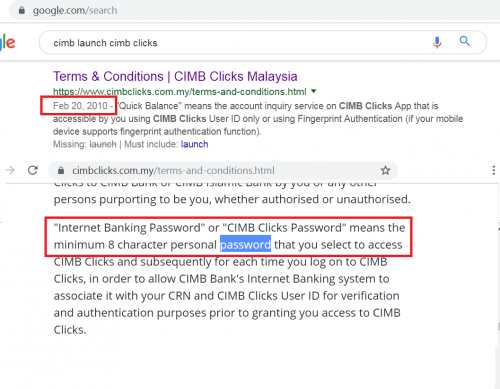
This thread in 2014 discussed CIMB's 8 char limit. But could it be that this represents your step 2? Maybe before 2014, > 8 char passwords were allowed? PS: See 2010 T&C below

sevenegg said he had password > 8 char before

boonhan also said he had longer password before

PS: 2010 CIMB Clicks T&C - says minimum 8 chars
user posted image

This post has been edited by okuribito: Dec 21 2018, 12:54 PM

okuribito
post Dec 21 2018, 05:25 PM

Regular
******
Senior Member
1,021 posts

Joined: Mar 2010
Nov 2017 oredi in the news. Google cimb backup tape lost stolen missing for news article

Really fubar d

This post has been edited by okuribito: Dec 21 2018, 05:25 PM


Change to:
| Lo-Fi Version
0.0632sec    0.46    7 queries    GZIP Disabled
Time is now: 12th December 2025 - 11:55 PM