Just installed Time today and the device given is Huawei HG8145V5. Wanted to use my Huawei AX3 as router so i called to CS and told them i would like to enable bridge mode in my device. The CS told me this is latest device and she is not familiar with the setting and ask me checked with the installer. Is it because i told them wrongly?
Normally they will do the bridge mode setting remotely or enable it from their side?
Should have paid the RM99 more and get the Huawei HG8145X6 instead then pair it with your AX3
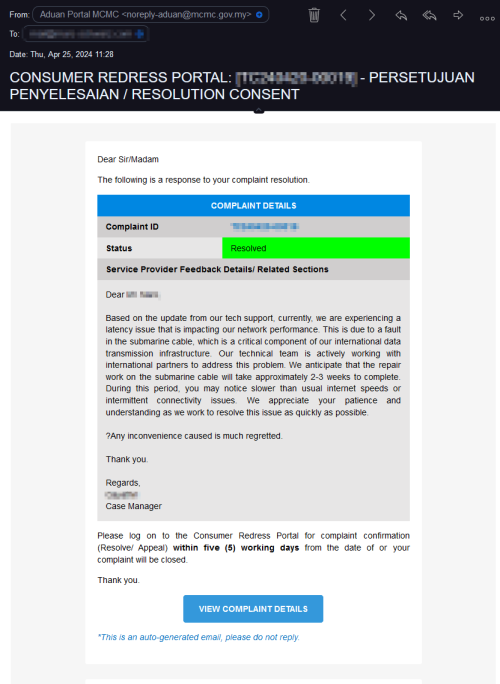
2-3 weeks. Should at least offer some kind of compensation. Anyway... lets see.
There seems to be something fishy and hidden behind this EU connection takedown in this region. A simple VPN connection to India/UAE/Israel will resolve the route issue if it was just a single SEA-WE-ME 5 cable breakdown.
There are so many undersea cables which links SG and Penang directly to India/Middle East. Many of them having TIME/TM as consortium members.
But the weird thing is that many VPN providers have taken down their India physical servers and replaced them with virtualized servers which are secretly based somewhere else.
The public continues to hear no news about any progress and source to this issue.
Is there something the public is not being told? Cyber terrorism involved, clampdown on EU connectivity for security fortification?
Just because of a single submarine cable being down?
There seems to be no issue of EU connectivity with India and the Middle East. I don't really believe it's just because of 1 submariner cable getting severed between Malaysia/SG. We have landings into Penang as well.
The latest EU routing issue is due to SMW5 submarine cable cut.
Just did a quick test with several EU host, TIME is consistently 400ms++ while TM is still around 300ms++.
Lucky for TM, they are one of the partners for SMW4, it's still an older slower cable but they got the priority.
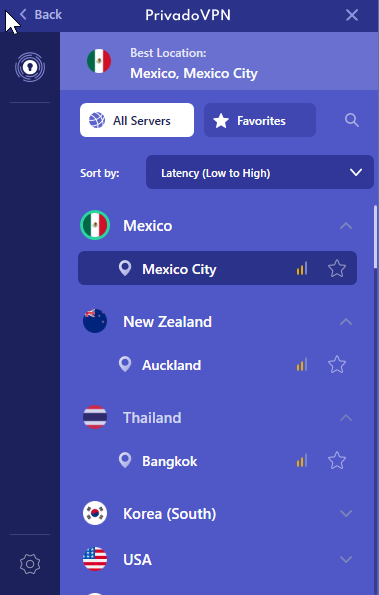
TIME is currently routing through SG for their EU connectity or via NTT backup link through USA. Just shut it off when not using it. Else it'll prevent your phone from deep sleep like all VPN apps.
Not just NTT, Cogent Asia, HE, Sparkle SEABONE, Singtel all major regional Tier-1 ISPs are also affected.
There's something fishy when India/Middle East servers are locking us out with high pings but their connectivity to EU is unaffected.
It can't be just because of 1 undersea cable broken, all EU links latency became so bad that even HK which is further than us from EU is enjoying lower latency than us.
This post has been edited by petpenyubobo: Apr 26 2024, 07:06 PM
Latency for no reason from Malaysia also has increased considerably. Doesn't make sense with 300ms just across the Indian Ocean?
We have many other major undersea cables that links us to India/Middle East besides SE-WE-ME 5, is there something hidden that we public aren't aware? Cyber warfare determent?
So coincident that India recently clamped down on physical VPN servers operating in their country?
That news article is from 2022... That's not "recently"
Many major VPN providers still offered physical servers from India earlier this year before Raya/CNY. I was happily using one last time. It was only recent they took them all down just 1-2 months back and turning India a "virtual" location.
That's because you need to factor in the location of the submarine cable damage. SMW5 is cut somewhere in the straight of Malacca. The link from India/Middle East to EU is not affected.
You also need to factor in the capacity of each cable.
SMW5 is 36.6Tbps. The capacity of SMW3 and SMW4 are 4.6Tbps each. Other submarine link from EU to Asia are irrelevant cause they are really slow.
I believe AAE-1 with 40Tbps capacity is still not fully recovered as well. With that, more than 80% of the capacity between EU and Asia is not available.
The next thing you need to consider would be access priority and SLA. Money talks here, the more you are willing to pay, the better access quality you get.
In situations like this, some providers have a guaranteed SLA with the cable operator so they are not that severely affected.
TM is part of the SMW3, SMW4 and SMW5 consortium, TM can reroute their customers through the other cables which they will have guaranteed access. That would explain why Unifi is not that severely affected unlike TIME. It will still be affected cause those are older, slower cables.
As for EU submarine cable, TIME is only part of the AAE-1 which I believe is currently still not fixed. Hence that explains why all my traceroute from TIME to EU is currently routing through Singapore which is probably Singtel and eventually SMW3 and SMW4 as well.
Since TIME is not part of SMW3 or SMW4, it will depends on the agreement of between TIME and the upstream provider for the quality of service. Again, money talk here and in situations like this, most ISPs will prioritize their own customers.
There's really no conspiracy here.
It's not just TIME as said. Even if you were to connect to a good Tier-1 SG based VPN now your pings to Europe is so badly affected. Why?
SG doesn't just rely on SMW5 to get to Europe only you know. It is among the world's most important transit hub for submarine cable landing in between Europe and US.
I'm now finding for a good VPN server that has good latency to Europe.Until now I can't seem to find one.
How can just a single submarine cable going down affect the entire ASEAN region?
Well I already explained in detail in my previous post. You need to consider the capacity of each cable.
AAE-1 and SMW5 are down and they deliver more than 80% of total available capacity from EU to East Asia. What's remaining are heavily congested now, leading to poor connectivity.
Btw, VPN providers always use the cheapest server they can find. Doesn't matter tier-1 or not.
My private VPN server in SG
Now AAE-1 also down?
I'm using Cogent Singapore, Google, OVH and G-Core Labs Asia, my pings to Europe is still ~400ms now. It' shouldn't right when Singapore has one of the most diverse undersea cable choices to re-route across the world.
I'm suspecting some underhand cartel is going on especially with India. They're refusing even their neighbors like Bangladesh, Myanmar and ASEAN from accessing their land cables into Middle East and Europe for some unknown reasons.
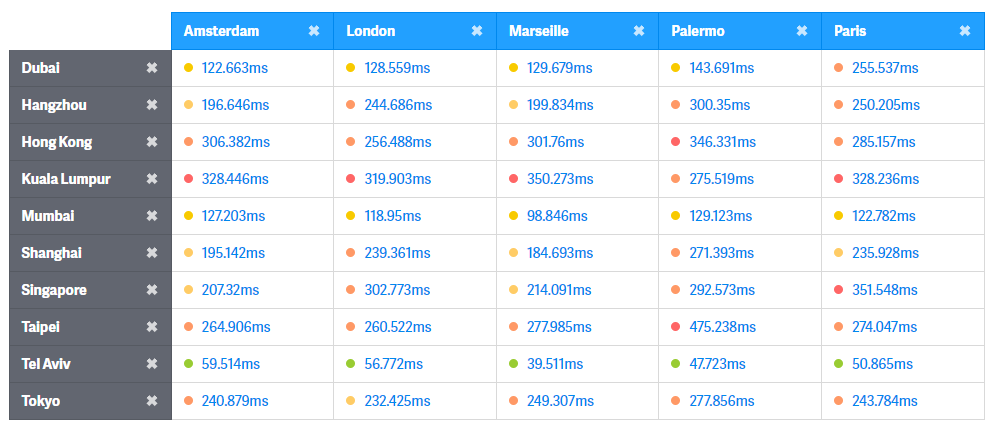
Just look at the latency results from places in the Far East such as Tokyo, Hangzhou and Shanghai to Europe.
Shanghai/Hangzhou to Amsterdam only 190ms+?
Malu leh for ASEAN region to be close to 400ms.
It's time to reconsider bypassing the troubled Bengal and Middle East war regions and venturing into alternative paths such as the Silk Road, Central Asia and Russia to reach Europe.
Too risky to be overly dependent on those Middle East and India regions to reach Europe who loves to play cartel and war games with the world.
Russia/Central Asia is seen to be a more reliable route to Europe now for Far East Asia and ASEAN region.
Well I already explained in detail in my previous post. You need to consider the capacity of each cable.
AAE-1 and SMW5 are down and they deliver more than 80% of total available capacity from EU to East Asia. What's remaining are heavily congested now, leading to poor connectivity.
Yup, too risky to be over reliant on the useless India-Middle East war trouble makers.
80% dependent on them to reach Europe? That's a bit far fetch and pose serious risks in the event of war emergencies to trust them totally.
It's time to reconsider the security and risks for over dependence on them to reach Europe with this case as a serious lesson to learn from.
Shanghai/Hangzhou which is way at the Far East also can reach Amsterdam on the other end of Europe under 200ms malu only weh for ASEAN region being played out by both by Middle East and India.
Russia and Central Asia is now proven to be more reliable and dependable as an alternate route.
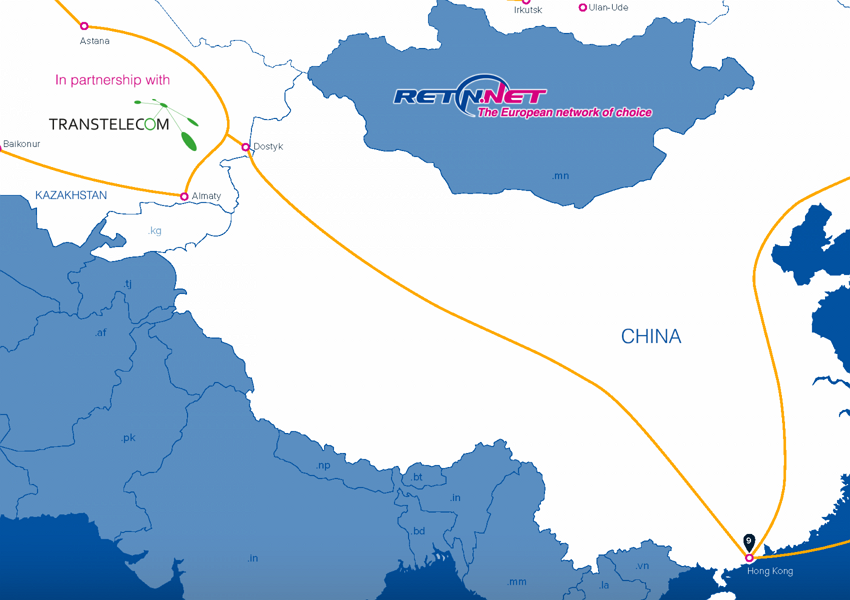
One example is the RETN TransKZ land based cabling network.
As mentioned by blacktubi, AAE-1 and SMW-5 serve as the main undersea cables connecting Asia to Europe these days. There are other cables available but they're much older and suffer from capacity limitations. Additionally, some of old cables are currently experiencing problems and are offline.
RETN may have capacity on those cable (which I won't confirm or deny), but this capacity alone may not meet all demand. And IP transit is considered a basic service, and any available capacity, now considered premium, would likely prioritize managed customers such as business VPN services.
My concerns is not without facts and known pointers. We should not ignore the ongoing rivalry for data cabling markets between ME/Bharat vs Far East Asia(China/Russia).
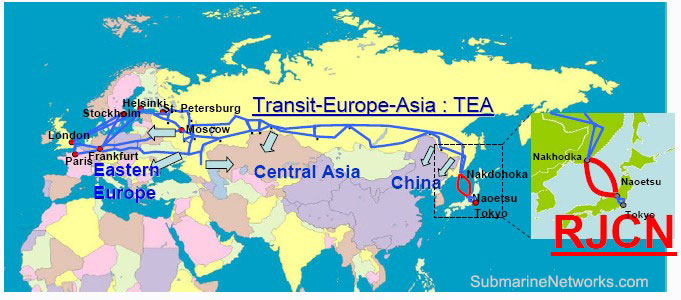
There's plenty of potential for a Trans Siberia network which can deter any terrorists and war games the Middle East/South Asia which can complete a ring loop in the plans.
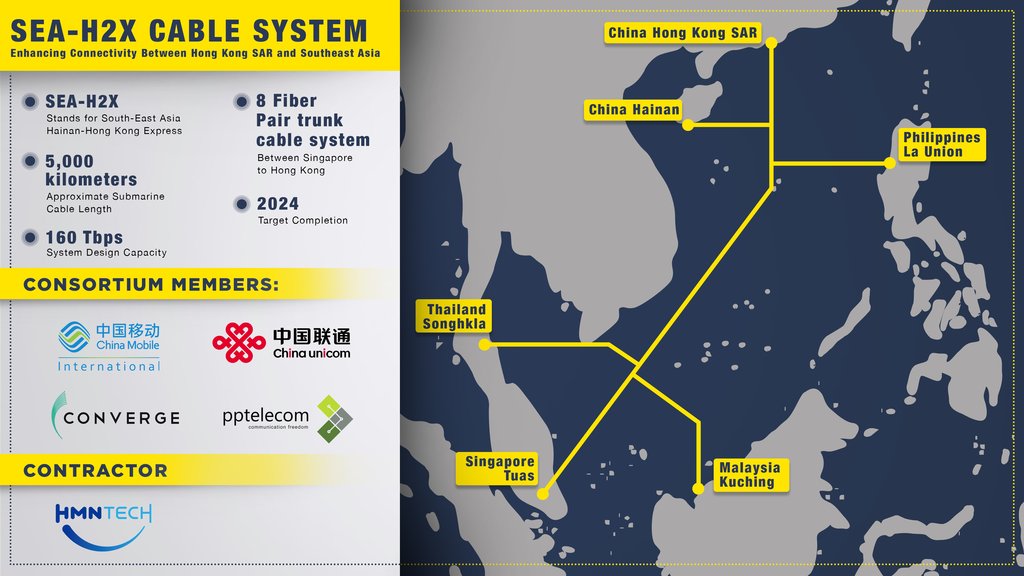
One initiative not made known much to public is the SEA-H2X Cable which is currently slated to be in operation later this year with a design capacity of 160Tbps linking HK, Hainan Island, Songkhla, Kuching and Tuas Singapore.
It's being built by HMN (Huawei Marine Networks) with a consortium consisting of China Mobile, China Unicom, ppTelecom(Sarawakian initiative)
This will link into CMI HK's Tseung Kwan O datacentre and SG's Equinix SG3/Global Switch.
Via HK, this will route into China(Silk Road) Centrla Asia across Trans Siberia/Russia into Europe bypassing the need of over reliance of the risky Middle East/South Asia war torn regions via terrestrial land cables.
In comparison the next SEA-ME-WE addition SMW6 only has 126Tbps initial design capacity so this is even more interesting.
SMW6 was initially was embattled with regional politics when it was to award the submarine cable laying contributor to HMN(Huawei Marine Tech) but later changed their mind to award it to Subcom instead due to unfriendly rival ties between Bharat/Middle East with China.
You forget the fact that whatever cloud you’re connecting to has access to your so called “hidden” NVR behind CGNAT
You’re at their mercy if they have any security issues or leaks with the server that they’re traversing your data from and to
In the event of a burglary, if the theft destroys your NVR(source of recording) on the way out your evidences goes with it.
IP-Cams have 2 modes, paid cloud hosted recording and localized recording with its own memory storage. This makes all your IP-Cam decentralized at home more ideally safe.
You can hide several of them scattered in your house from plain eye sight and the thief who breaks in would have to find every single one of them to destroy the evidence.
If they're on cloud recording live, even if the physical cam is destroyed you're still safe.
NVRs which are centralized is way more susceptible for burglars to attack only a single point and everything that is linked to it is gone.
My point still stands, if the cloud data gets leaked, what are you as an end user is supposed to do?
Other than complaining, your data is already leaked out there, footage of your house is out there.
And cloud, how are they able to offer the user cloud storage? By charging, and what quality can they store? 2MP and no more higher, if someone has a 4 or even 8MP camera, then how? Do this cycle for a few months or even years, and you can even out the cost with just having another onsite backup thats discreet.
If a thief deliberately targets someone's NVR after a break in, do you think that target is like a random residence in a random taman? That sounds more like an organized crime targeting someone high profile. Hide it/put it somewhere hidden from plain sight, dont tell me if you keep your recorder in a random hidden drawer somewhere and the thief is still able to find it after rummaging through all of the stuff.
What brand of cloud? DH/Hik, both Chinese brand. Not saying that they are not good for their price, but considering they're ultimately chinese owned entity, and they have had security issues in the past, Id rathef just buy into their hardware and not touch any of their cloud solutions
Tell me what I already don't know about public IP-cams already being compromised even since the Streamyx days some 20over years already? Back then everyone already had public IPs assigned automatically without needing to beg.
I place my cams strategically facing the main road, hallways and along the corridors hidden to prevent intruders or burglars. Not in private places such as my bedrooms or toilets to do live onlyfan sessions.
Hotels, business premises all do that that's why you get live streams from EarthCam from all over the world to give you live updates of weather and temperature reports.
We already have 8MP 4k IP Cams on the cheap under RM300 now selling on online shopping platforms. Ready for Ai face recognition to deploy company daily attendance system.
I'm just suggesting the worst scenario or possible cases that might happen when a burglary happens.
That is why smart planning for strategic hidden surveillance cams is very important when you do your buildouts. A knowledgeable thief will immediately do a power cut by switching off the main power switch at your home then search for the DVR to destroy before they search out your home to loot.
Well hidden cloud based IP cams which are decentralized and well hidden around your home stand a better chance to deter such cases. They have independent video storage on the device itself and can do remote cloud recording just in case the thief destroys your centralized NVR. Also if you place them well hidden in many spots inside your premise, the thief will have to search them one by one to disable them.
No solution is full proof, tell me what does your traditional cam offer to overcome all these by going all the way with to obtain public IP? Modern day cams no longer need public IPs because vendors have now figured out a way to bundle Dynamic DNS features into their cams/NVRs.
anyone else on 200Mbps can share that if u are on CGNAT or on public IP? if u are on public IP, how did u manage to get it?
It's just a gimmick scheme to force their subscribers to take up higher plans for more revenues.
We all know CGNAT provides an additional layer of protection and if routed through IPv6 via tunnelling it'll take benefits of lower latency and security that IPv6 enjoys like Japan which already fully phased out IPv4 forcing anyone who still wants IPv4 to do MAP-E or IPv4 over IPv6 tunnelling.
They have already phased IPv4 and PPPoE out completely for all their newer plans since 2014 close to 10 years already.All except some very old legacy plans used in rural areas/essential services for senior citizens.
Why our local ISPs are reluctant to promote use of full IPv6 adoption?
They know it's going to destroy their fixed/static IP markets, and also public IPs can generate extra income for them by forcing their customers to adopt pricier plans or pay extra to be eligible for public IPs.
Want to experience first hand how IPoE is implemented? Look no further it's already been in our country for some time. Look at how much more efficient 5G/4G LTE Advanced authenticates when you connect? That's how simple IPoE works, no need extra PPPoE server authentication and manual passwords to enter in your settings. Configure automatic assignment/IP handouts and that's it.
QUOTE(eauyong @ May 1 2024, 11:46 AM)
Yes.
I have a NAS on 24/7 which can record from multiple IP cameras simultaneously, either to the NAS itself or to the cloud.
However I still prefer to let Xiaomi Cloud 'Mi home app for home automation' (comes with Xiaomi IP cameras) do the job as it is very easy. The notification on mobile and its settings can be tweak to your requirement.
At its most sensitive level, it can detect a small insect flying past and notify you within seconds but with six cameras, 3 overseas and 3 in Johor, it quite a tasks to monitor. The free recordings is upto one month for every camera. The recordings can be downloaded if you get notifications. The recorded clips (mentioning persons recorded) with time stamped can then be downloaded. It is convenient and one can make a polis report immediately wherever you are.
Why the talk about going wireless even with access? Besides cutting your main TNB electricity switch during burglary, the thief can also cut off your home's fiber line and you're down another level.
That way what's the point of having wired access and a centralized surveillance system. Cut off its network and power supply, it's just as good as useless.
This post has been edited by petpenyubobo: May 1 2024, 12:49 PM
so based on what u mentioned, it is still fine to go for 200Mbps at cheaper price but on CGNAT?
I was previously a Maxis Home Fibre user for more than 5 years. Towards the end of my subscription(last few months) I gave in paying extra RM10 to continue using the public IP subscription.
Made the brave move to jump to 5G using CGNAT and never looked back. All my IP-cams still function well after the migration.
Most IP cam softwares nowadays provide free dynamic DNS(DyDNS) value added services for their customers already.


 Mar 28 2022, 10:38 PM


 Quote
Quote






 0.2338sec
 1.22
1.22
 7 queries
 GZIP Disabled